
A complete issue · 32 pages · 1906
Life — February 15, 1906
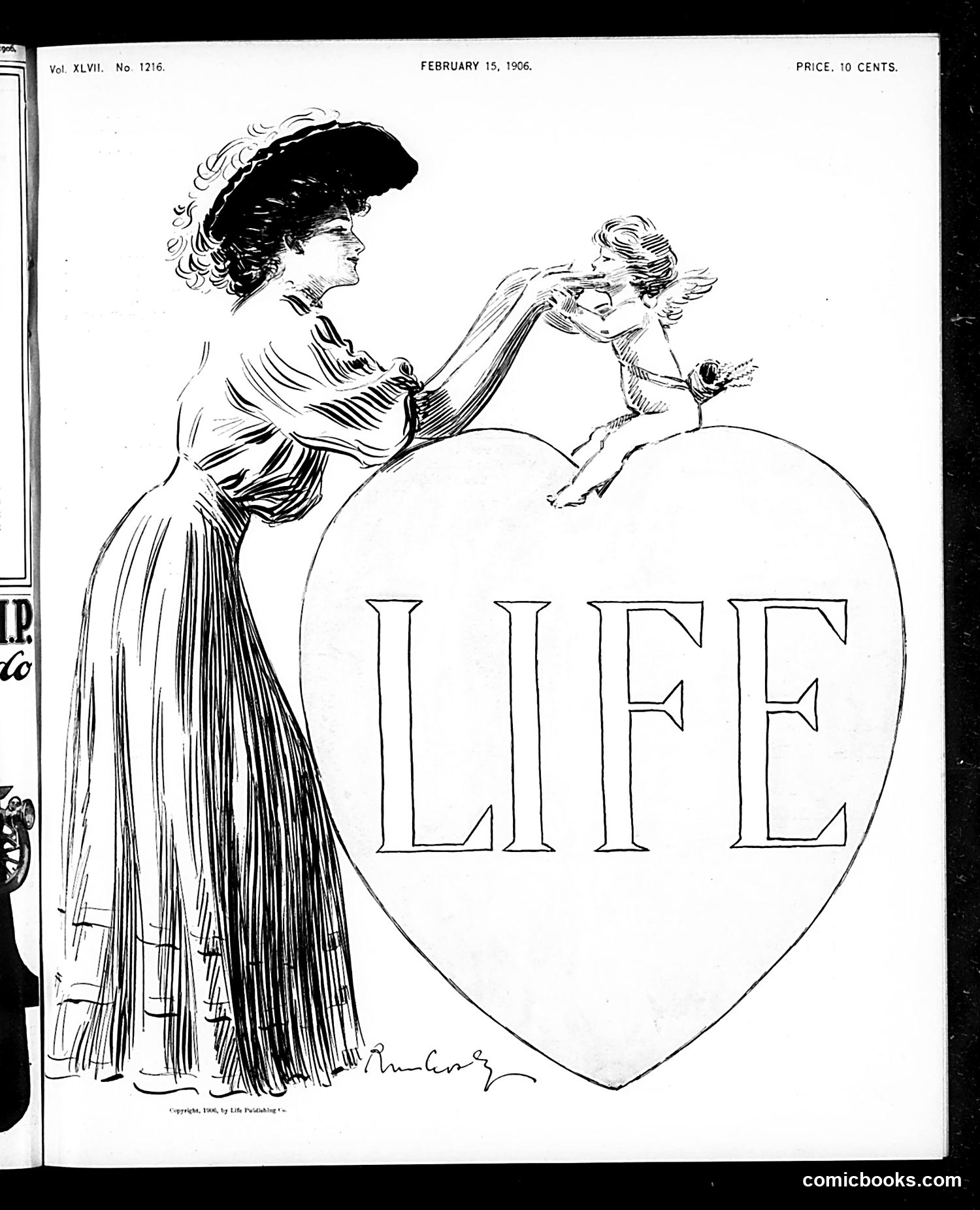
This cover depicts a stylized allegorical figure—likely representing "Life" itself or feminine virtue—holding a heart-shaped object inscribed with the word "LIFE." The woman, dressed in Edwardian-era clothing with an elaborate feathered hat, cradles a cherub or cupid figure above the heart. The image appears to be a Valentine's Day-themed cover (the magazine's date aligns with mid-February). The satire likely comments on romanticized notions of life, love, or womanhood popular in 1906 Edwardian society. The allegorical presentation suggests commentary on how contemporary culture sentimentalized or trivialized serious concepts through decorative imagery and feminine symbolism. Without additional text visible, the specific satirical target remains unclear.
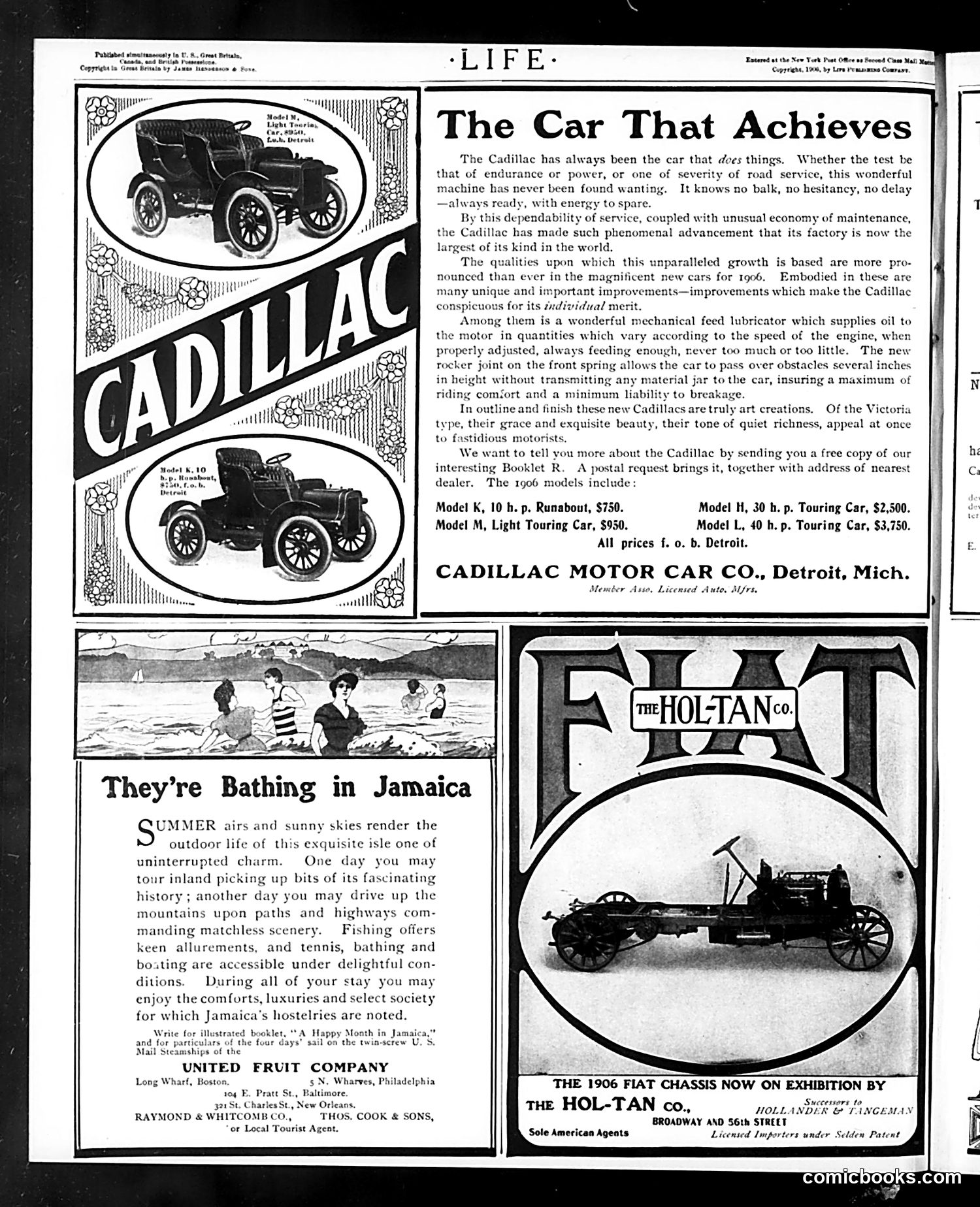
This page consists primarily of **period advertisements** rather than political satire. It contains: 1. **Cadillac Motor Car advertisement** (top): Promotes 1906 models with prices ranging from $750-$3,750, emphasizing reliability, economy, and mechanical innovations like a "mechanical feed lubricator." The text positions Cadillac as industry-leading. 2. **United Fruit Company advertisement** (lower left): Promotes tourism to Jamaica, highlighting leisure activities and luxury accommodations. 3. **Hol-Tan Company advertisement** (lower right): Displays the 1906 Fiat chassis on exhibition at their Broadway showroom. These are straightforward commercial advertisements typical of *Life* magazine's revenue model. No political cartoons or satirical commentary appear on this page. The content reflects early 1900s consumer culture and emerging automobile industry marketing.
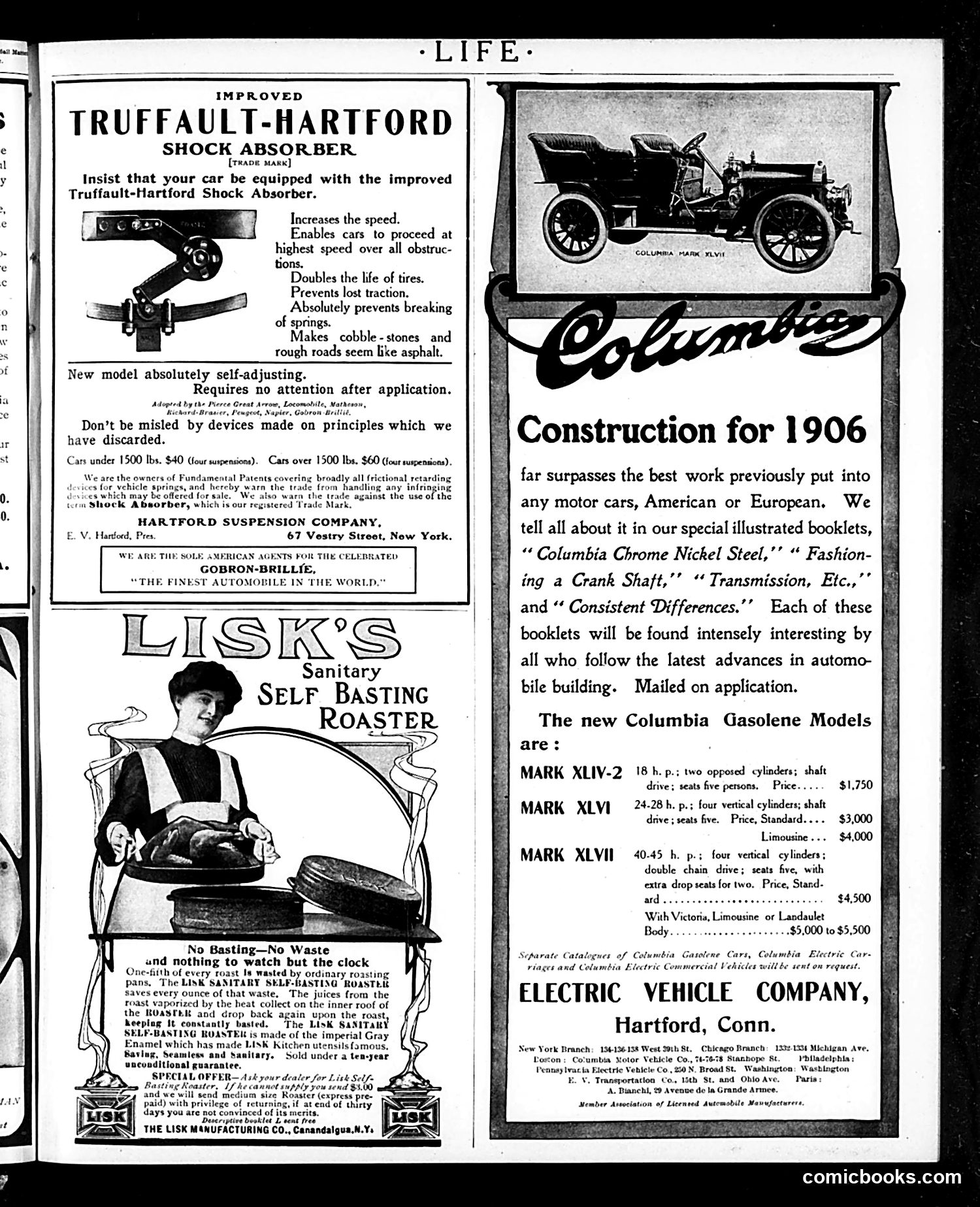
This page contains **primarily automobile advertisements** rather than satirical content. The ads feature: - **Truffault-Hartford Shock Absorber** (top left): emphasizes safety features like increased speed, tire longevity, and spring protection - **Lisk's Sanitary Self-Basting Roaster** (bottom left): shows a woman at a kitchen roaster, advertising "no basting, no waste" with a focus on convenience - **Columbia automobile** (right side): showcases 1906 gasoline models with technical specifications and pricing ($1,750–$5,500) The Lisk roaster ad has mild period humor in its copy ("nothing to watch but the clock"), but overall this appears to be a standard commercial publication page rather than political satire. The content reflects early 1900s consumer goods marketed to middle/upper-class households.
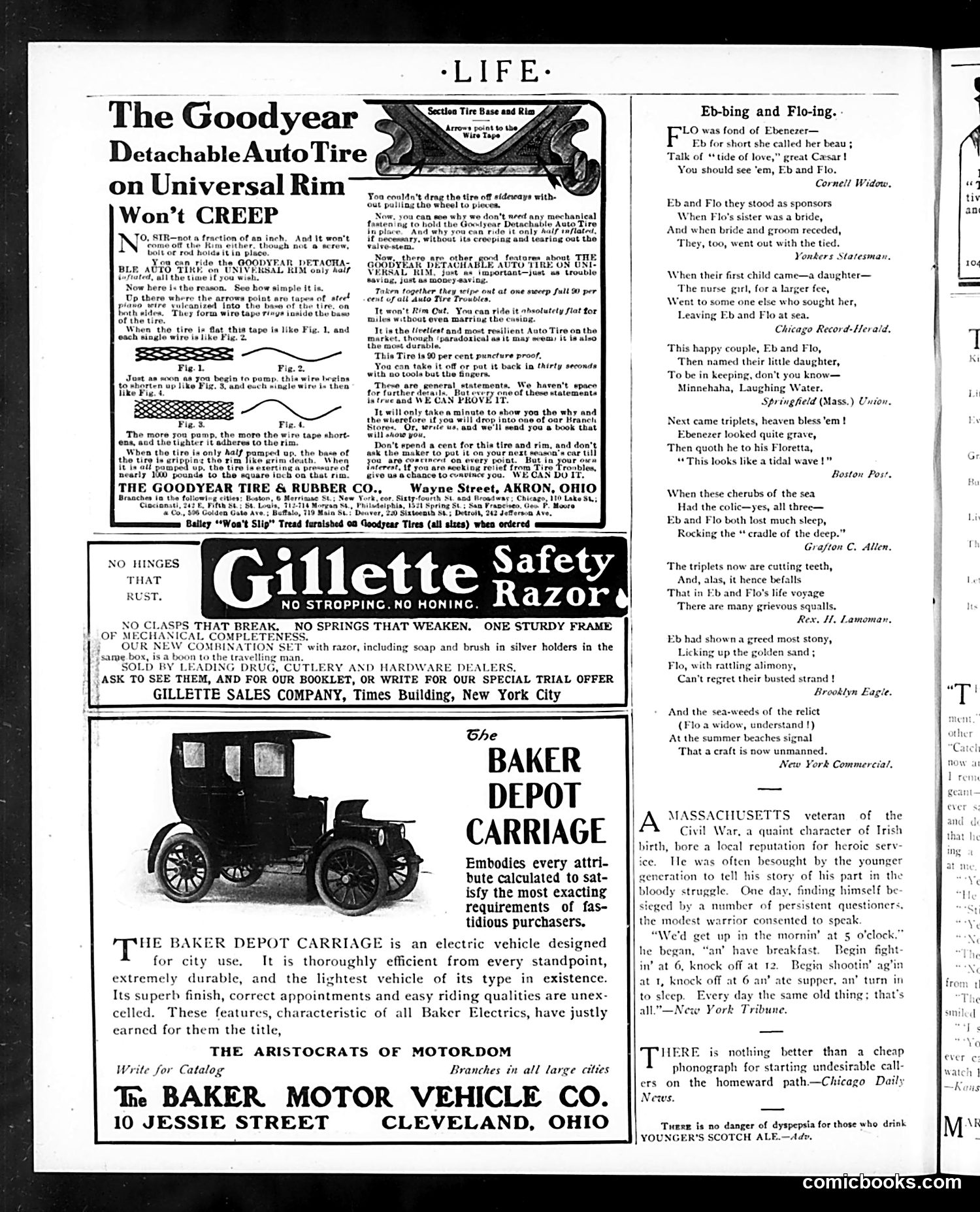
This page is **primarily advertising** from the early 20th century, not political satire. It contains three product advertisements: 1. **Goodyear Detachable Auto Tire** - promoting a tire that won't "creep" on the rim, with technical diagrams 2. **Gillette Safety Razor** - advertising its "no hinges" design and sturdy frame 3. **Baker Depot Carriage** - promoting an electric vehicle for city use The right column contains sentimental poetry titled "Eb-bing and Flo-ing," about a couple named Eb and Flo, apparently newlyweds at sea. This is light, romantic verse—not satirical commentary. There is **no political cartoon** on this page. The content reflects early 1900s consumer advertising and lifestyle content typical of *Life* magazine during that era.
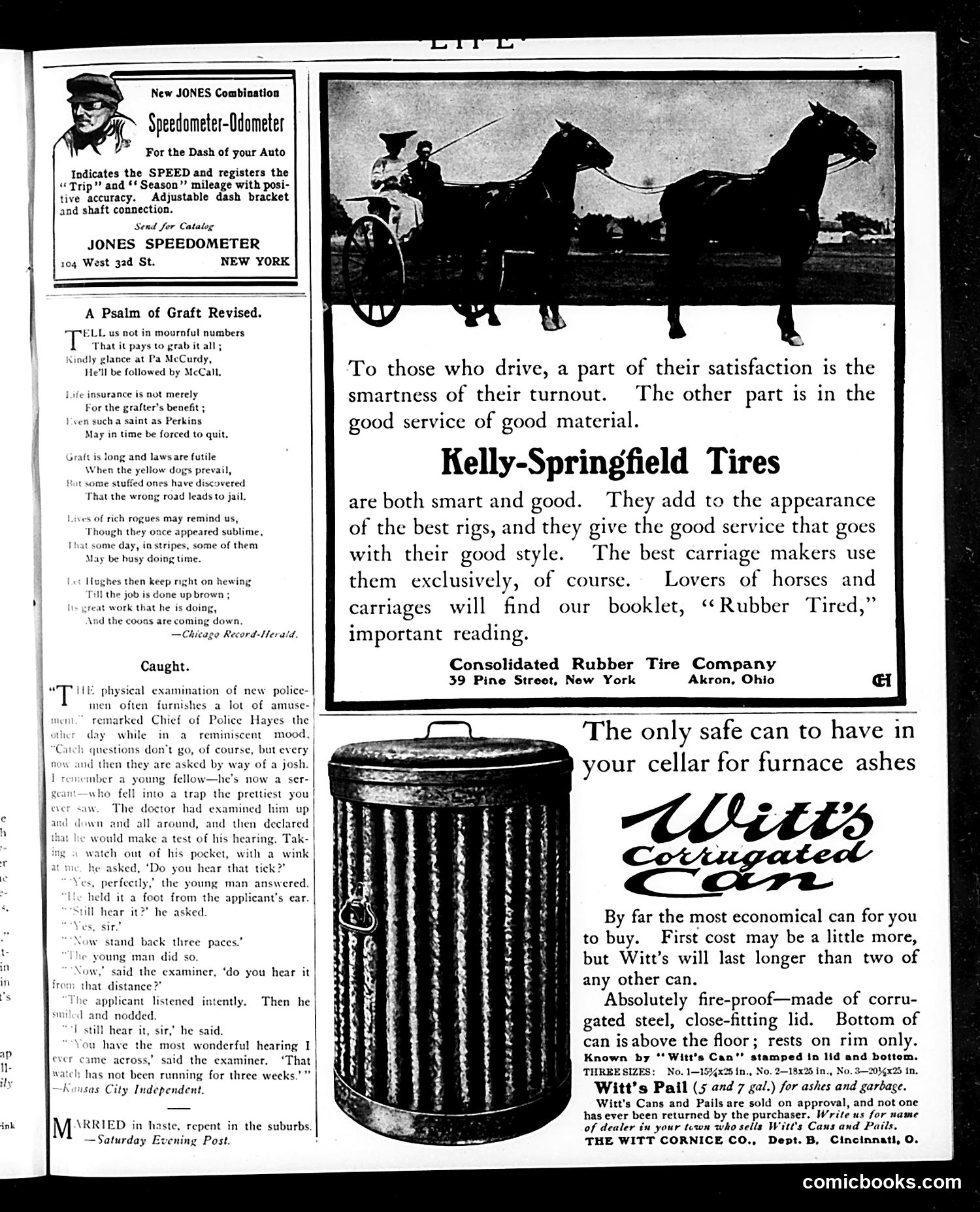
This Life magazine page is primarily **advertising with minimal editorial content**. The main cartoon occupies the upper portion—a silhouette illustration of a horse-drawn carriage advertising Kelly-Springfield Tires. The caption emphasizes that quality tires enhance both the aesthetic appeal and practical performance of carriages. Below is a humorous anecdote titled "Caught," describing a police chief's hearing test conducted through a comedic misunderstanding involving distance perception. The remaining content consists of three advertisements: a Jones Speedometer, Witt's Corrugated Can, and the tire company ad. There are no identifiable political figures or satirical commentary. The page reflects early 20th-century consumer advertising conventions and general-interest humor typical of Life magazine during this period.
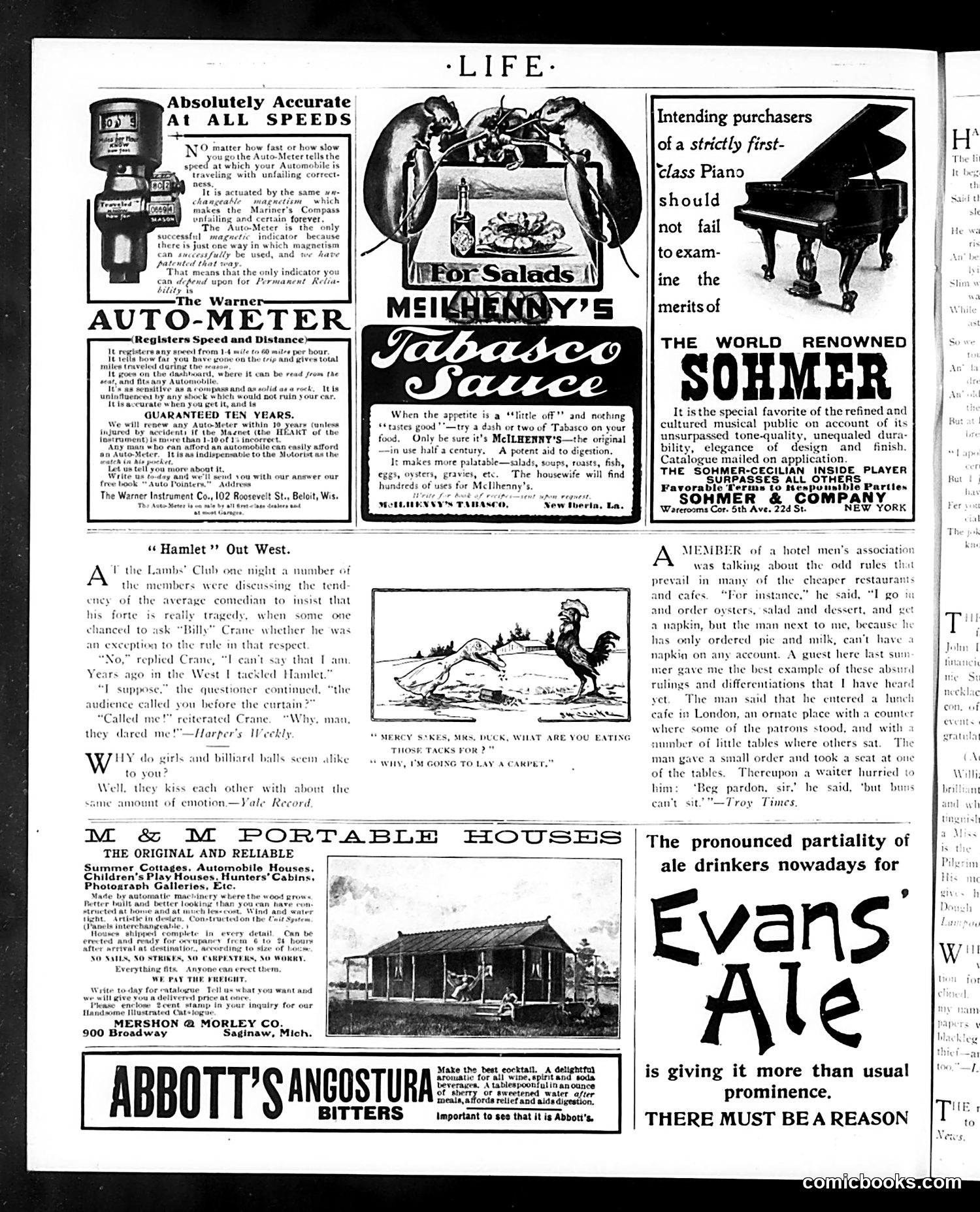
This page is **primarily advertising** with minimal satirical content. The main articles include: 1. **"Hamlet Out West"** - A brief humorous piece about a Lamb's Club discussion regarding comedians performing Shakespeare in the American West. The joke appears to be about cultural incongruity. 2. **"Why do girls and billiard balls seem alike to you?"** - A brief quip contrasting the behavior of women and billiard balls, reflecting period-typical gender humor (now considered offensive). 3. **Hotel etiquette anecdote** - A story about unusual dining rules, emphasizing social propriety. The page is dominated by **product advertisements** for pianos, tabasco sauce, portable houses, and ale—typical early 20th-century magazine content. The limited satirical material relies on gentle social observation rather than sharp political commentary.
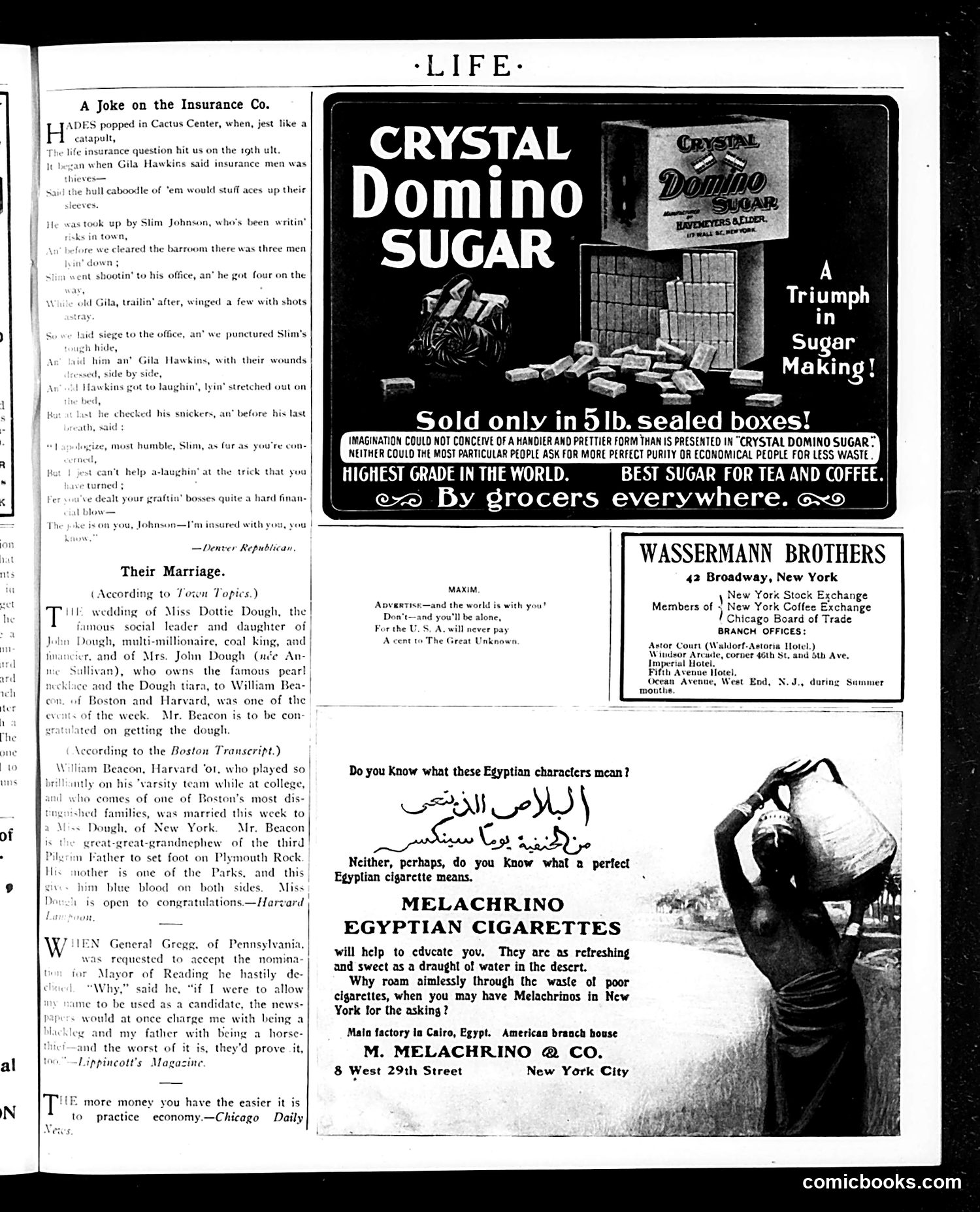
This page is primarily **advertising and social announcements** rather than political satire. The main elements include: **Advertisements:** - Crystal Domino Sugar (large box): emphasizes purity and economy - Wassermann Brothers (stock exchange/coffee traders, NYC) - Melachrino Egyptian Cigarettes: uses orientalist imagery, marketing "exotic" cigarettes as educational and refreshing **Editorial Content:** - "A Joke on the Insurance Co.": a humorous anecdote about Hades and insurance - "Their Marriage": society announcements about William Beacon's wedding (Boston/Harvard family) - General maxims about economy The page reflects early 20th-century *Life* magazine's mix of humor, gossip, and targeted advertising. The Melachrino ad's orientalism and the insurance joke's racial undertones represent period attitudes we'd now recognize as problematic, but the page contains **no clear political cartoons or sustained satire**.
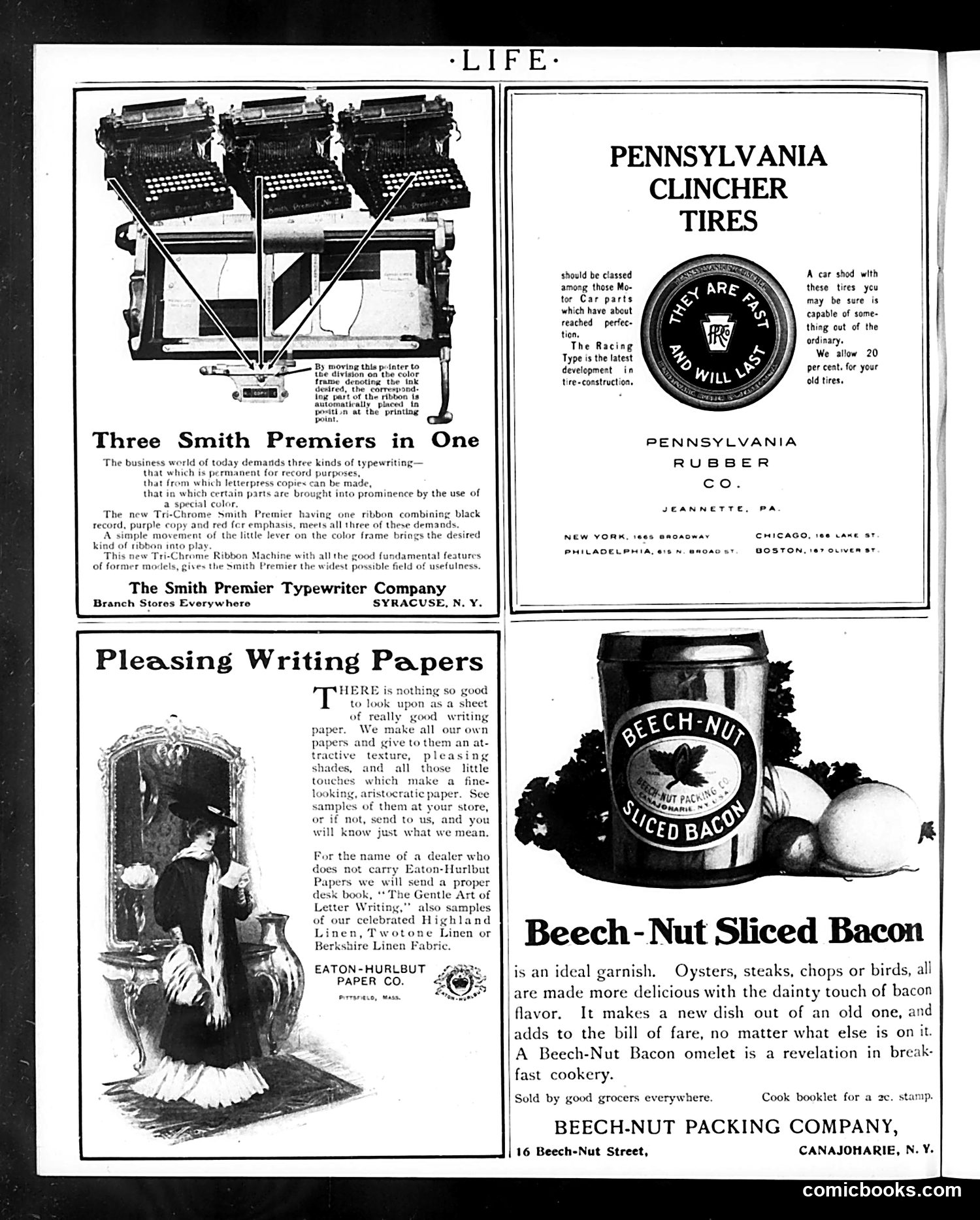
This page contains **four advertisements**, not political cartoons or satire. The content includes: 1. **Smith Premier Typewriter** — promotes a three-in-one model with interchangeable ribbon capability for different colored ribbons, emphasizing its utility for business correspondence. 2. **Pennsylvania Clincher Tires** — advertises automobile tires that will supposedly last 20% longer than standard tires. 3. **Eaton-Hurlbut Writing Papers** — showcases decorative stationery with artistic textures and finishes, marketed to those desiring quality correspondence materials. 4. **Beech-Nut Sliced Bacon** — promotes bacon as a garnish for various dishes, claiming it enhances flavor and offers breakfast novelty. These are straightforward product advertisements typical of early 20th-century *Life* magazine, containing no political or satirical commentary.
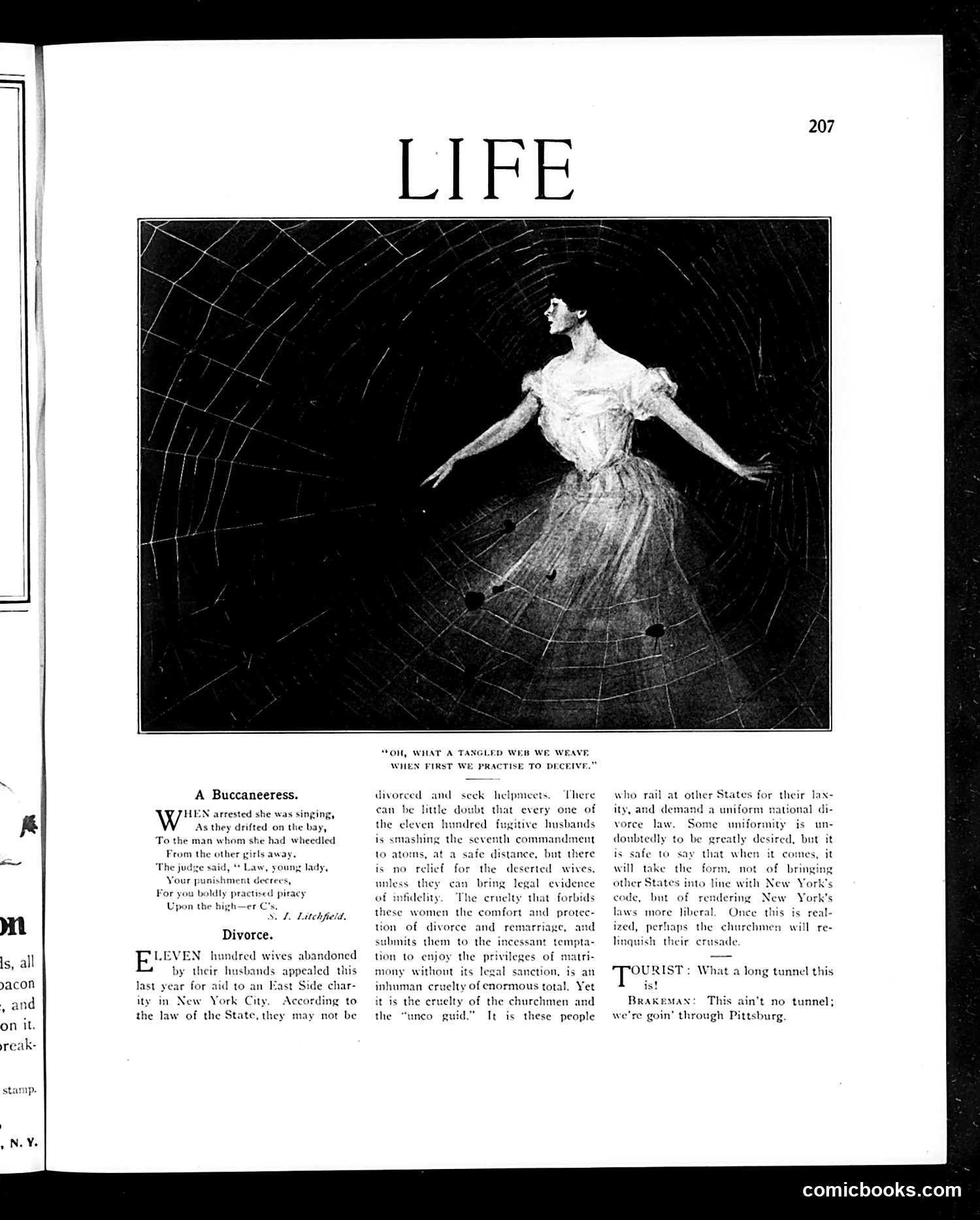
The page features an illustration titled "Oh, What a Tangled Web We Weave When First We Practice to Deceive" — a woman in an elaborate dress caught in a spider's web, likely symbolizing entrapment. The text discusses three brief items: "A Buccaneeress" (about a woman arrested for singing while operating a wheeled vehicle), "Divorce" (addressing 1,100 abandoned wives seeking legal remedies in New York), and a "Tourist" joke about traveling through Pittsburgh. The divorce section is the substantive satire, criticizing the difficulty divorced women face obtaining legal relief and support, and lamenting the "uno guild" — apparently referring to divorce laws' inadequacy in protecting abandoned spouses. The overall commentary critiques women's legal vulnerability in marriage dissolution.
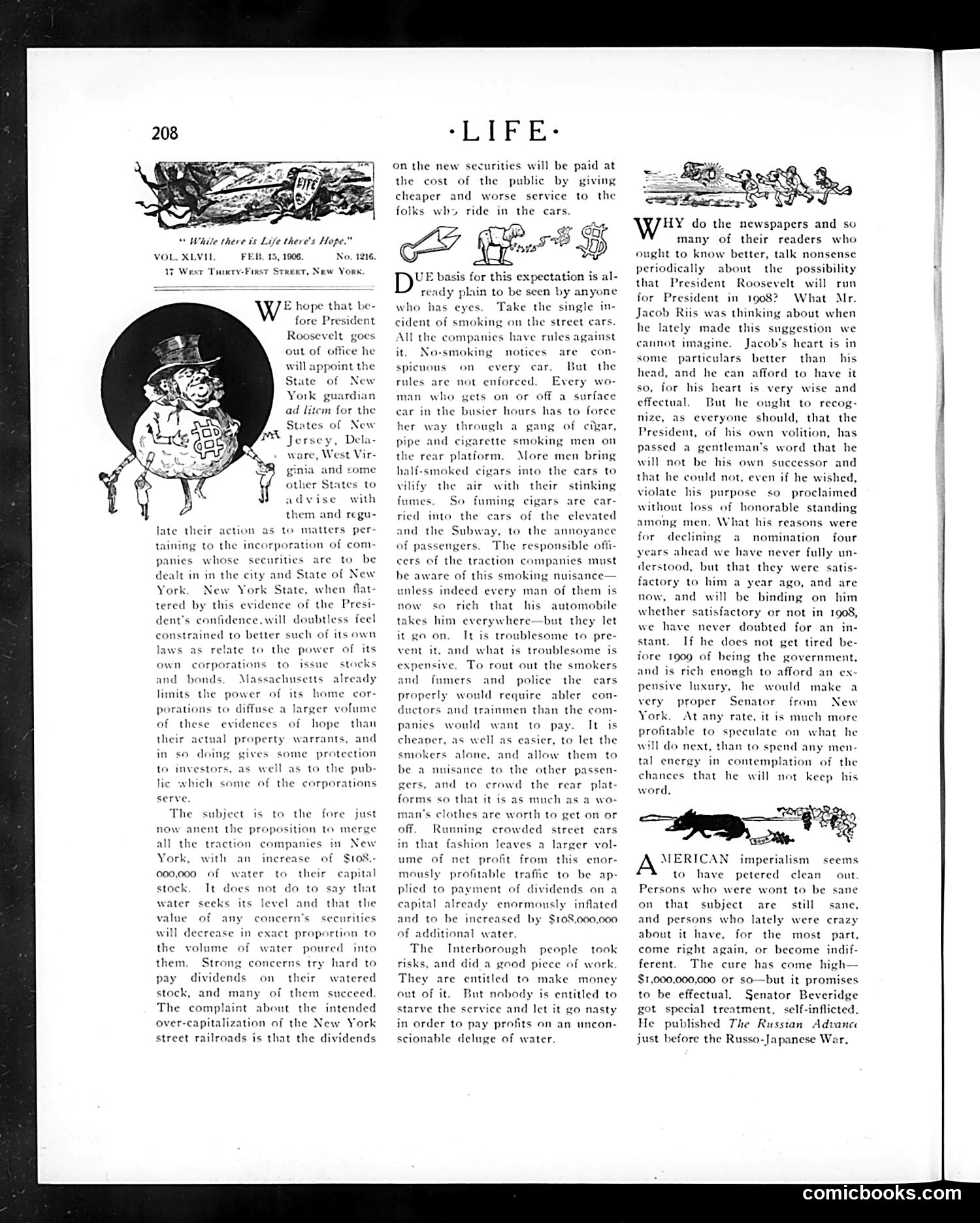
This page contains two satirical pieces about American politics and urban problems. **Left cartoon**: Shows a rotund, disheveled figure labeled as representing someone (likely a politician or corporate figure) caught smoking a cigar indoors on a streetcar. The satire mocks the hypocrisy of wealthy individuals who violate smoking rules meant for ordinary passengers, suggesting the powerful ignore regulations they impose on others. **Right text**: Discusses whether President Roosevelt will run for re-election in 1908, critiquing newspaper speculation about his intentions. It sarcastically suggests Senator Beveridge (mentioned by name) should spend his energy on actual governance rather than political speculation about the presidency. Both pieces exemplify *Life*'s typical Progressive-era critique of corporate power, political hypocrisy, and media sensationalism.
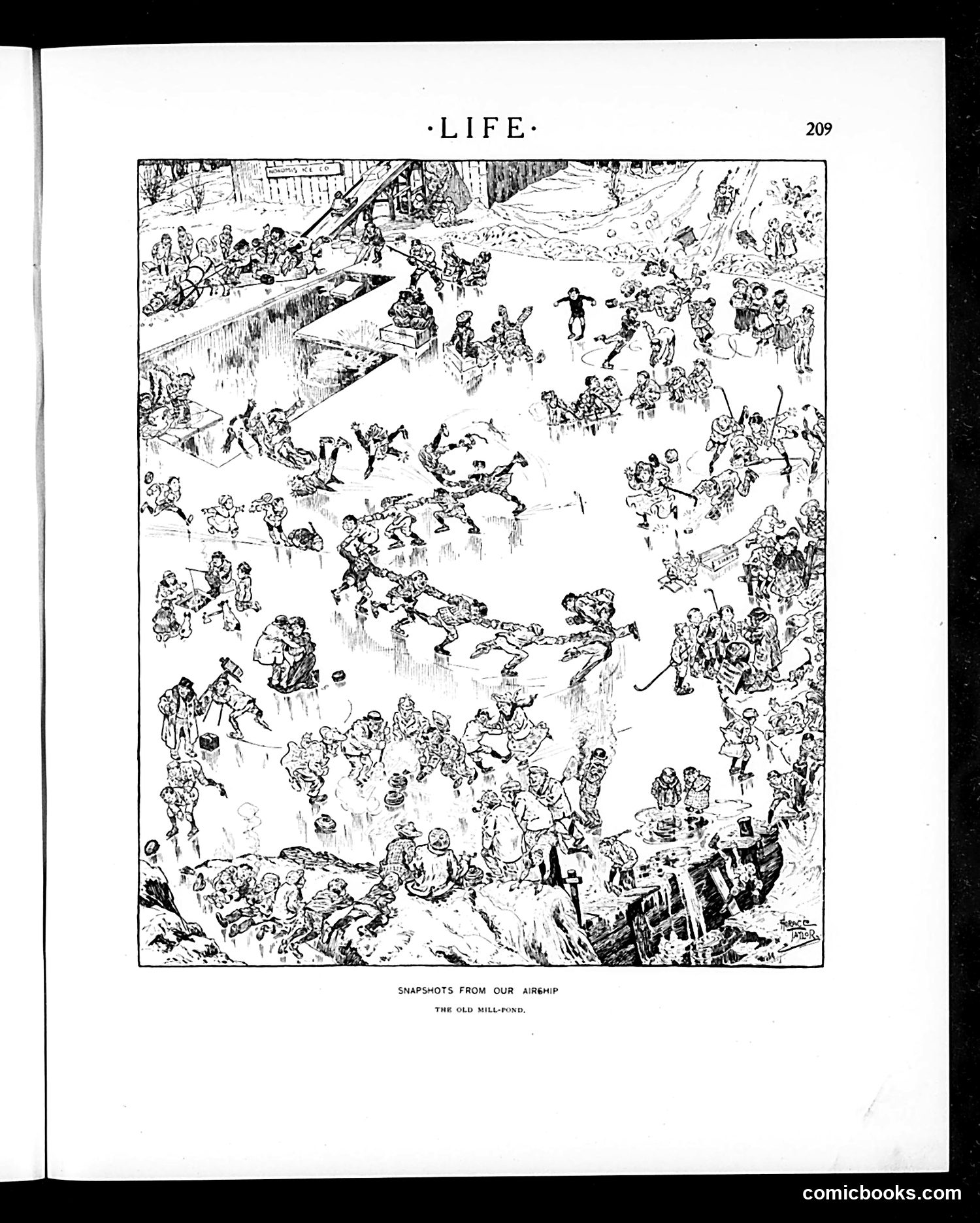
This is an aerial view illustration titled "Snapshots from Our Airship," showing a frozen pond populated with numerous figures engaged in winter activities. The scene depicts people ice skating, playing hockey, sledding, and socializing on and around "the old mill-pond." The satire appears gentle rather than pointed—it's a humorous bird's-eye perspective of everyday leisure activities during winter. The crowded composition, with dozens of small figures scattered across the ice and surrounding areas, emphasizes the scale and chaos of popular recreation. The "airship" reference in the title is characteristic of early 20th-century Life magazine, which frequently used fantastical perspectives and new technologies as framing devices for social observation and gentle humor about American leisure and community life.
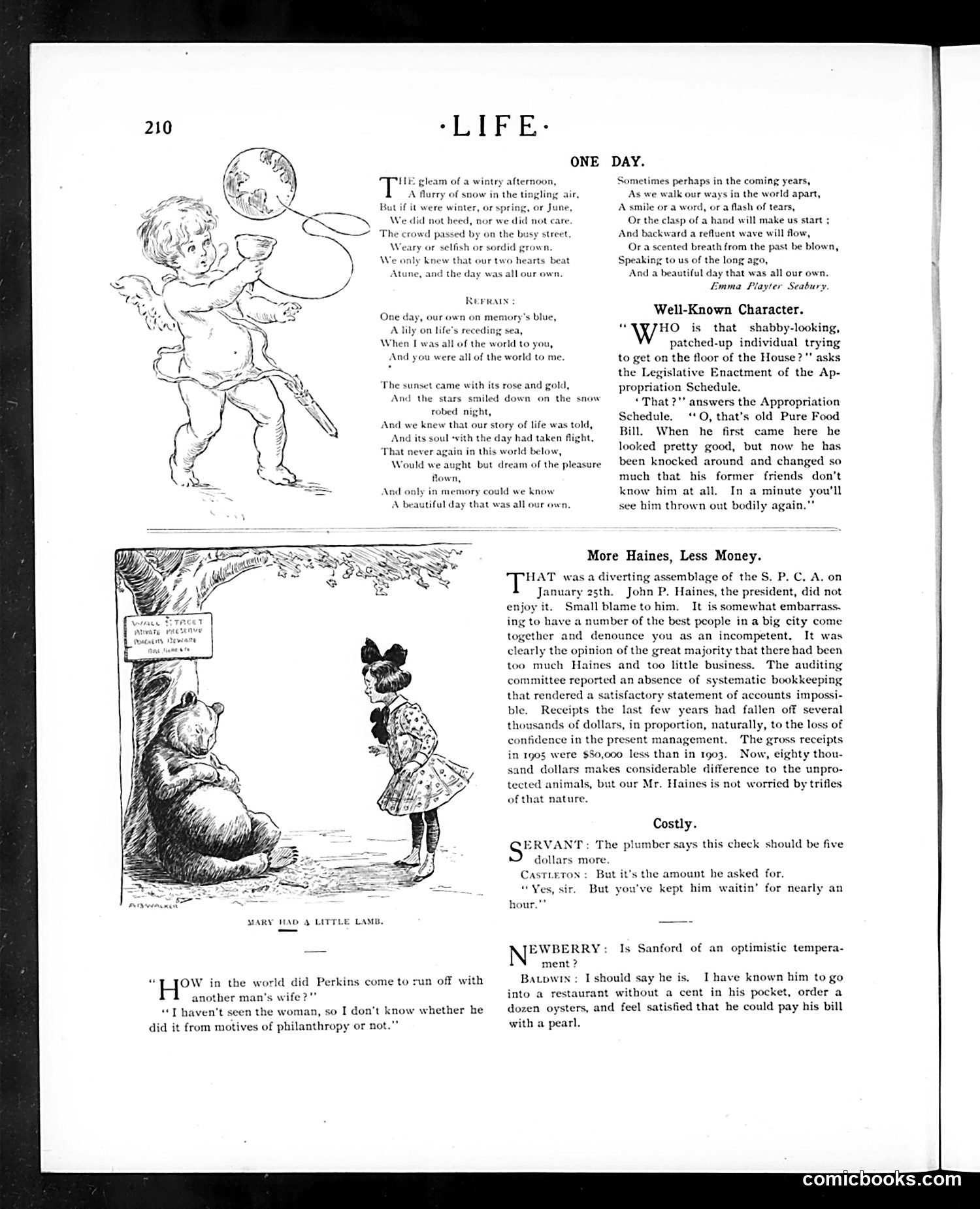
This page contains several satirical pieces about American politics and society: **"One Day"** is a sentimental poem about cherished memories, likely contrasting idealism with harsh reality—a common Life magazine theme. **"Well-Known Character"** satirizes a shabby politician trying to secure funding through the "Legislative Enactment of the Appropriation Schedule" and the "Pure Food Bill." The joke targets corruption and how such figures lose credibility and support. **"More Haines Less Money"** mocks John P. Haines, president of the S.P.C.A. (Society for Prevention of Cruelty to Animals), for poor financial management—receipts dropped $250,000 between 1902-1905. The satire suggests his incompetence, not animal welfare concerns, troubles donors. The remaining brief jokes are unrelated social commentary on domestic and commercial matters.
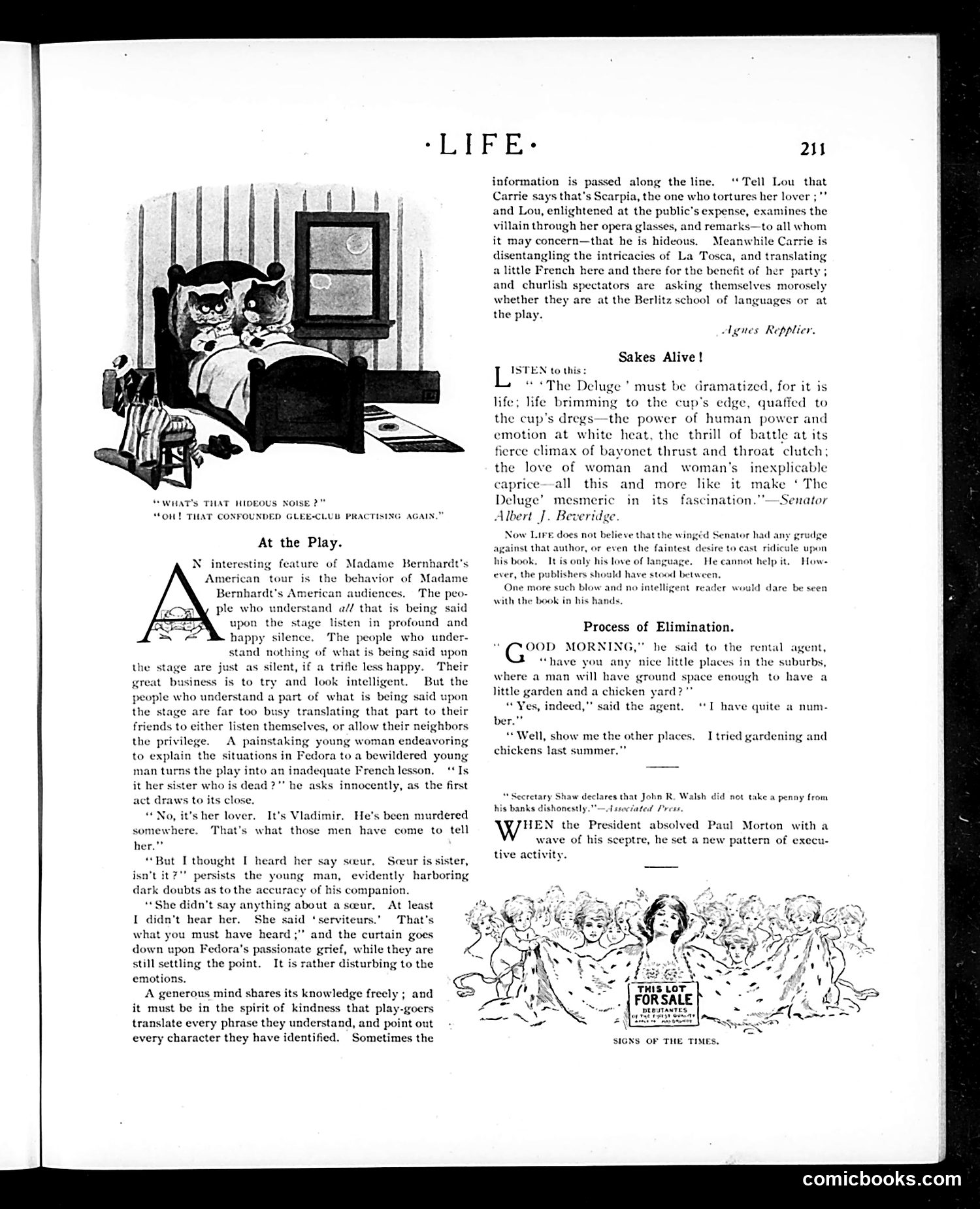
This page contains three satirical pieces from *Life* magazine: 1. **"At the Play"** critiques Madame Bernhardt's American tour, mocking audiences who pretend to understand theatrical performances they cannot actually hear or comprehend. The satire targets the pretentiousness of theatergoers. 2. **"Sakes Alive!"** reviews a play called "The Deluge," praising its dramatic intensity while noting the Senator-author's inflated self-regard about his own writing. 3. **"Process of Elimination"** and **"Signs of the Times"** appear to be brief humorous vignettes about real-estate hunting and economic conditions (the "For Sale" sign in the cartoon suggests property sales during what appears to be a financial downturn). The overall tone mocks social pretense and economic anxiety of the era.
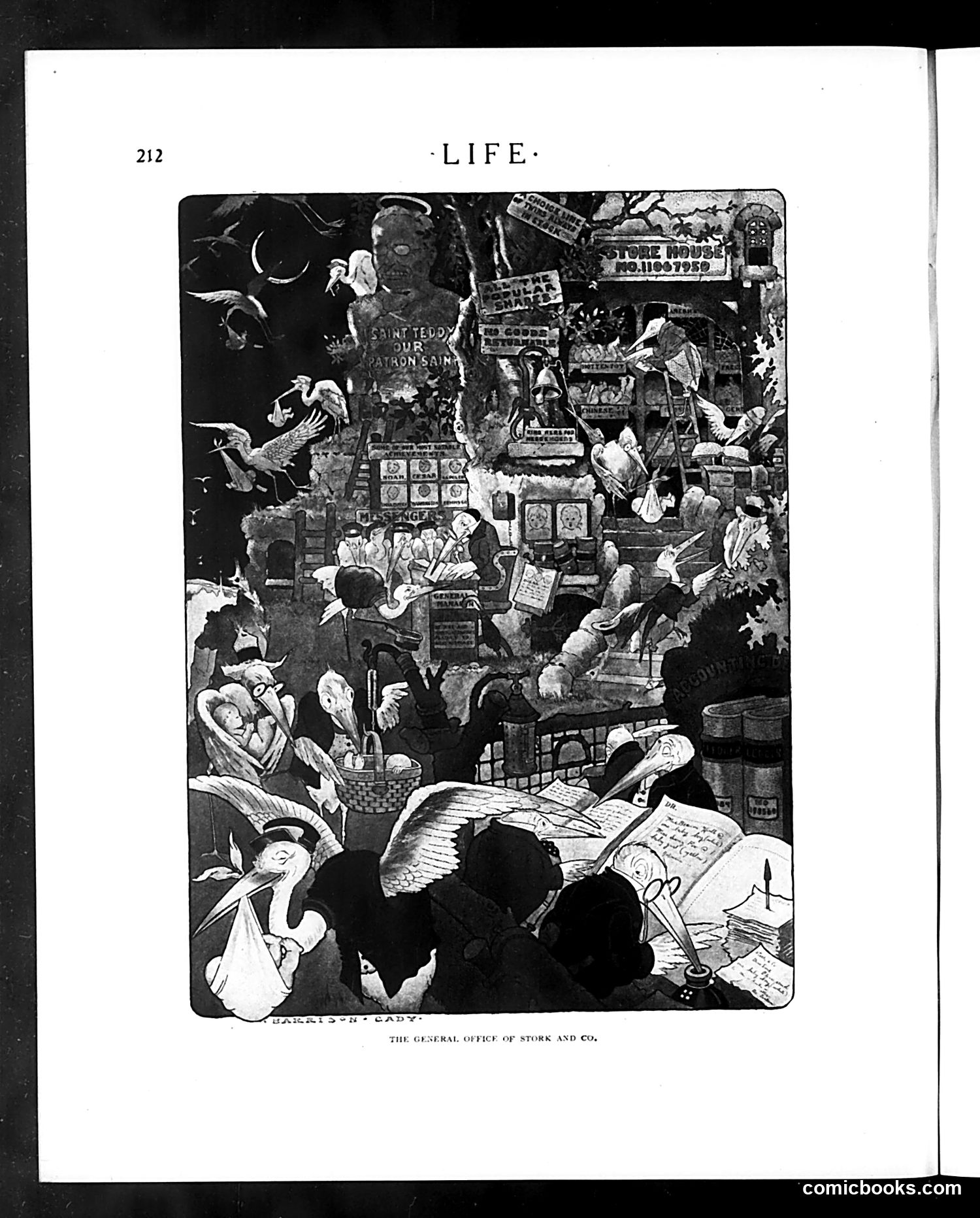
This is a satirical illustration depicting a chaotic supernatural/fantastical office scene. The title "The General Office of Stork and Co." references the stork as the mythological deliverer of babies—a common Victorian euphemism for childbirth. The cartoon appears to satirize fertility, procreation, and perhaps population growth through absurdist imagery: winged creatures (storks and cherubs), filing systems, ledgers, and office bureaucracy are comically merged. The scene suggests the "business" of childbirth as an organized but ridiculous industrial operation. The crowded, complex composition with numerous figures and signage creates visual chaos meant to mock either societal attitudes about reproduction or the growing bureaucratization of modern life. The exact date and specific targets remain unclear from the visible text alone.
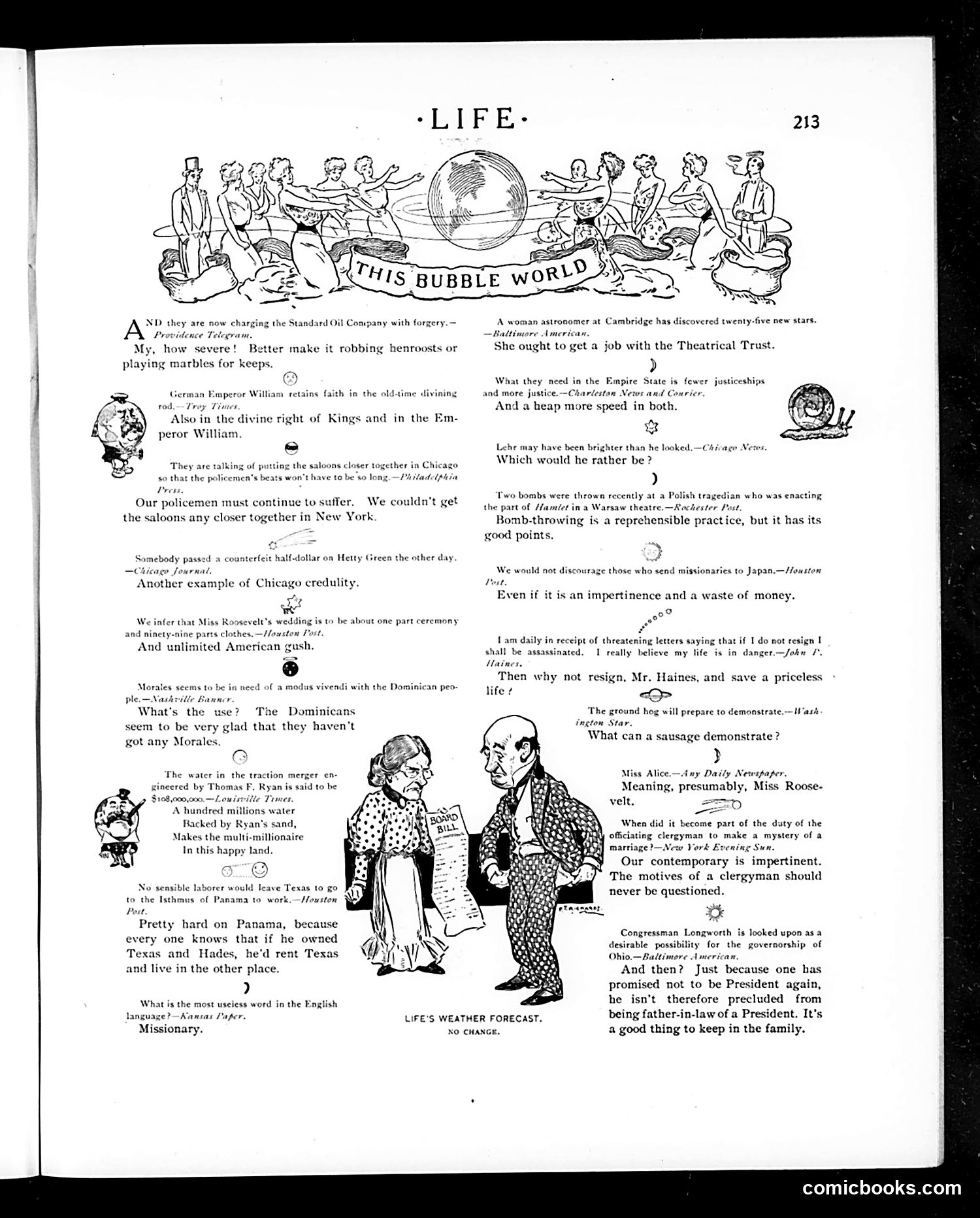
This page collects brief satirical quips and editorial cartoons typical of Life's format. Key targets include: **Political figures**: German Emperor William (mocked for claiming "divine right of Kings"); references to Roosevelt's wedding (likely Theodore Roosevelt's daughter); Congressman Longworth (husband of Alice Roosevelt, satirized for potential Ohio governorship despite pledging not to seek presidency). **Social/business criticism**: Thomas F. Ryan's traction merger—"a hundred millions water / Racked by Ryan's sand"—mocking inflated stock values in monopolistic deals. Dominican political instability under various leaders. The theatrical trust's labor practices. **Absurdist humor**: A bomb thrown at a Polish Hamlet production is called "reprehensible" but "has its good points." A sausage demonstration. Panama being worse than Texas *and* Hades combined. **The cartoon** (lower half) shows two men discussing political appointments, representing contemporary patronage debates. The overall tone reflects Progressive-era skepticism of corporate consolidation, imperial pretension, and political nepotism.
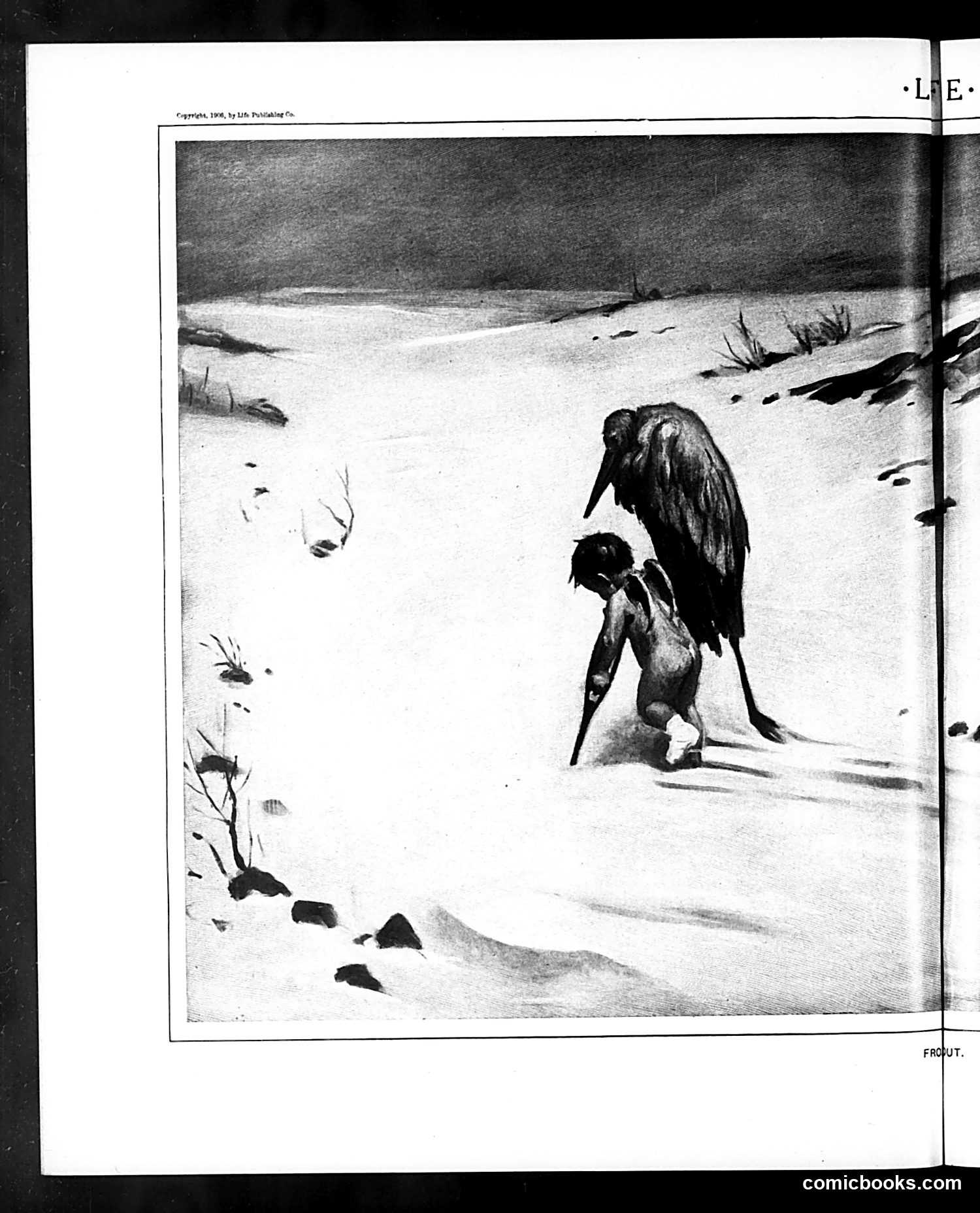
This appears to be an illustration rather than a political cartoon—it depicts a large wading bird (likely a heron or crane) bending down toward a small human figure on a beach or sandy landscape. The scene is rendered in a stark, dramatic style with dark skies and sparse vegetation. Without clearer OCR text or visible captions identifying the figures, the specific political or social satire is unclear. The image could represent a David-and-Goliath scenario or comment on human vulnerability against nature or larger forces, but the exact meaning and historical context remain ambiguous. The copyright line suggests this is from *Life* magazine circa 1908, but additional context is needed to confirm the intended message.
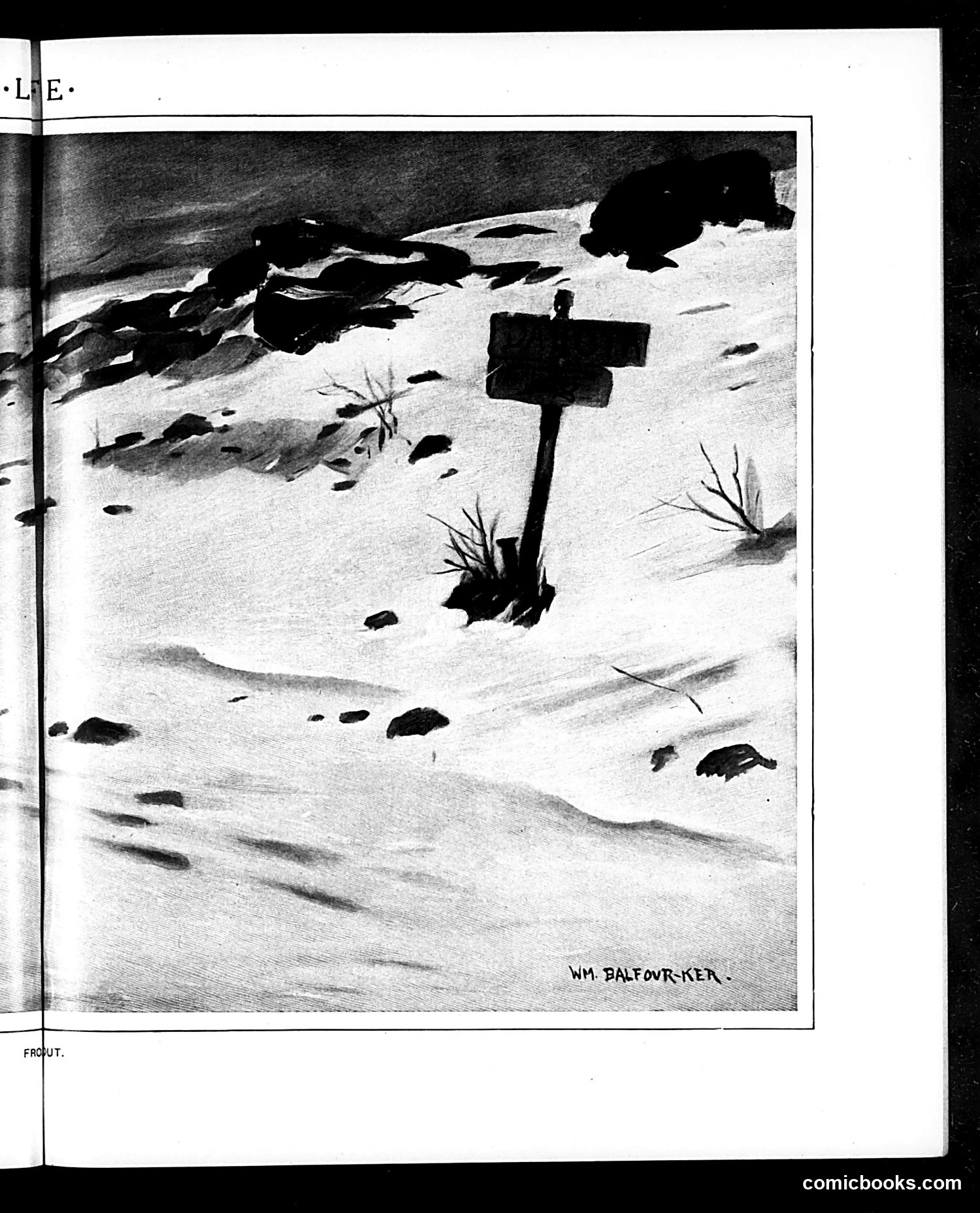
This page from *Life* magazine contains a single illustration by W.M. Balfour-Kier depicting a stark winter beach scene. A wooden cross marker stands in snow-covered sand, surrounded by scattered rocks and sparse beach grass. Dark silhouettes in the background suggest wreckage or debris. The image appears to be a somber commentary on death or loss, likely relating to a maritime disaster or wartime tragedy. The cross functions as a grave marker, while the desolate beach setting emphasizes abandonment and desolation. Without additional context from the magazine's date or accompanying article text, the specific historical event referenced remains unclear, though the composition suggests *Life*'s use of illustration to comment on contemporary tragedy or social commentary during the mid-20th century.
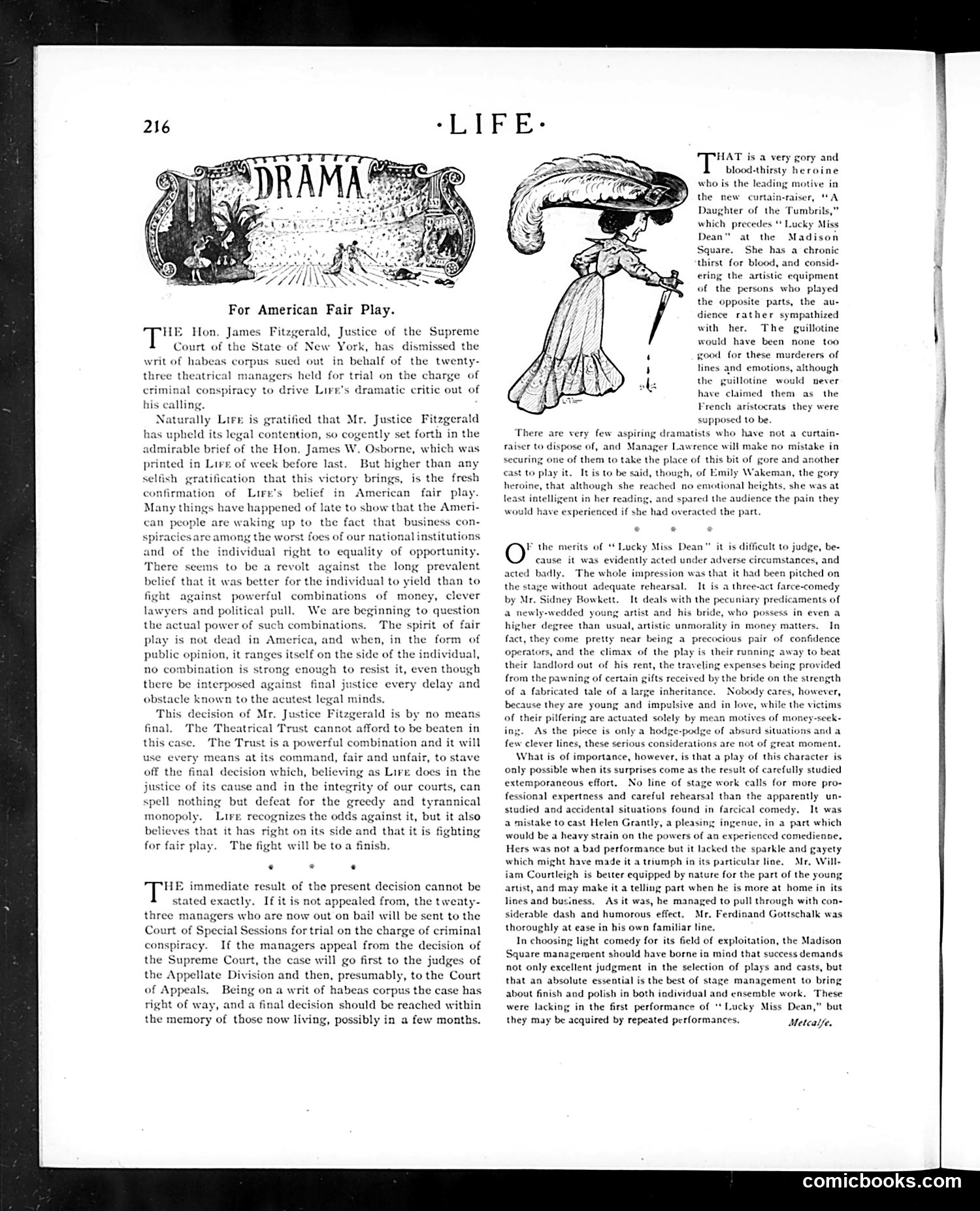
This page reports on a New York Supreme Court decision dismissing charges against 23 theatrical managers accused of conspiracy to drive Life's drama critic from his profession. The case represents a clash between Life magazine and the powerful "Theatrical Trust"—a monopoly controlling much American theater. Life celebrates Justice Fitzgerald's ruling as a victory for "fair play" and individual rights against powerful corporate combinations. The publication frames this as part of a broader American awakening against monopolistic control by wealthy interests using lawyers and political influence. The article argues that while the Trust may appeal, public opinion and the courts should ultimately defeat this "greedy and tyrannical monopoly." The right-side text reviews a play called "Lucky Miss Dean," critiquing its melodramatic curtain-raiser about a bloodthirsty heroine—likely unrelated satire padding the page.
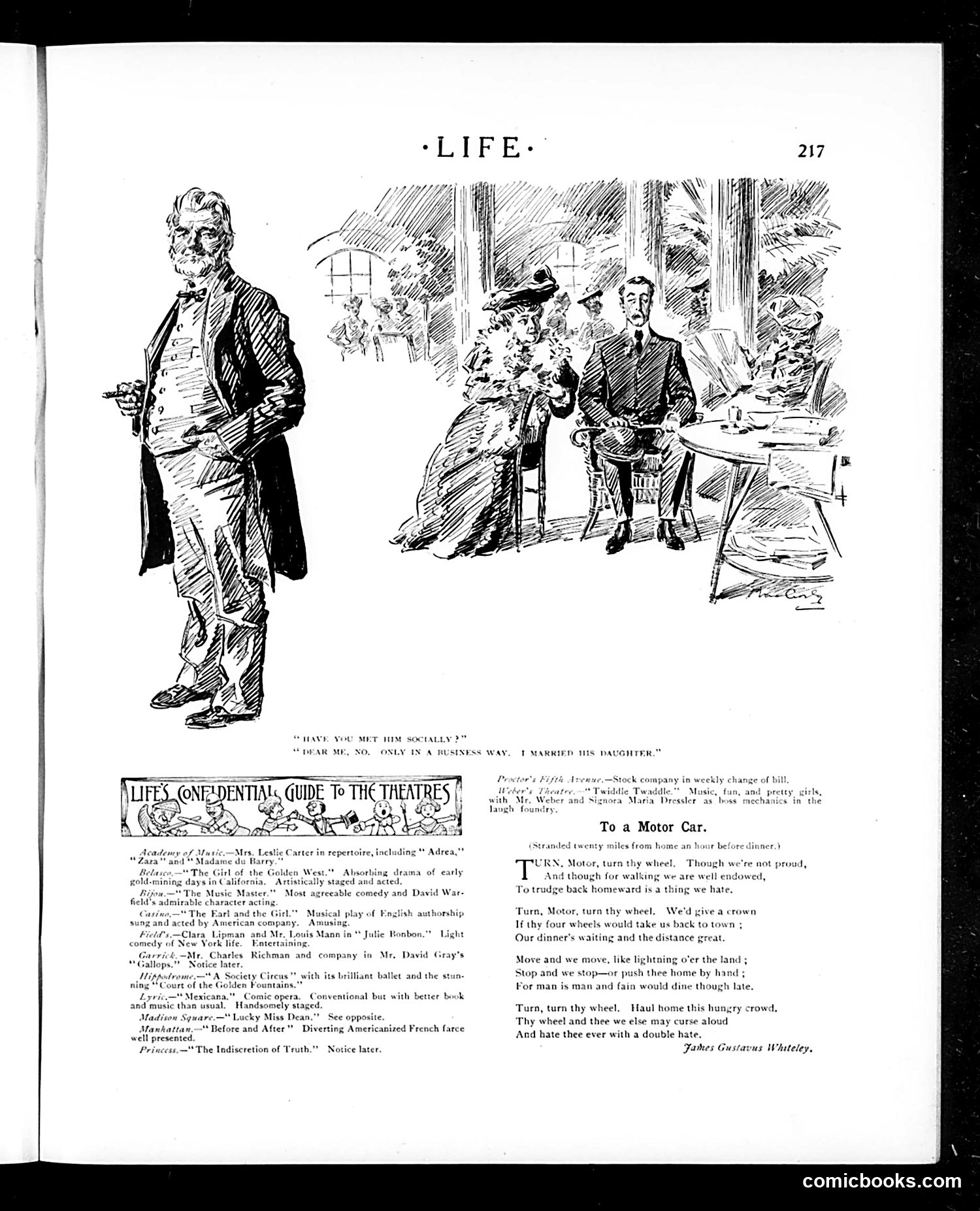
This page contains two distinct pieces of social satire from early 20th-century American life. **The Main Cartoon** (top) depicts a gentleman meeting socially with a woman and her companions. The dialogue joke plays on class divisions: when asked if he's met "Tim" socially, the man responds he knows him only "in a business way"—then reveals he married Tim's daughter, suggesting that marriage across business relationships was socially awkward or that business acquaintance didn't constitute proper social standing. **"To a Motor Car"** (bottom) is a poem by James Gustavus Whiteley satirizing the automobile's role in modern life. It humorously addresses the motor car as if it were a deity, pleading with it to transport tired diners home after evening outings. The poem mocks how dependent wealthy people have become on automobiles for leisure and convenience, treating the car almost religiously ("Turn, turn thy wheel"). The exaggerated language ("hate thee ever with a double hate") mocks both automotive frustration and automobiles' transforming effect on social habits.
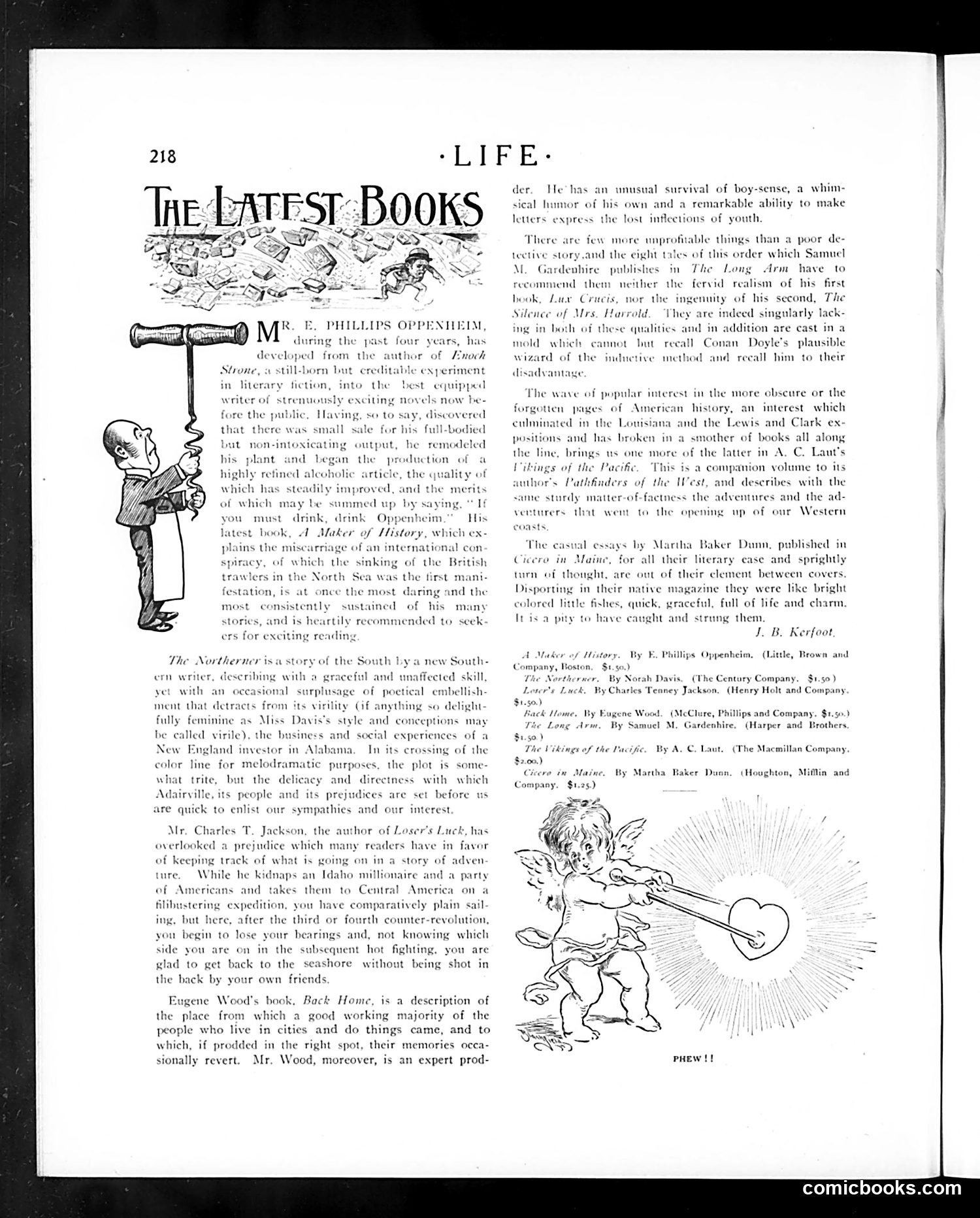
This is a book review section from *Life* magazine featuring humorous critiques of recent publications. The main cartoon depicts Cupid shooting an arrow at a heart, illustrating a playful tone. The reviews use satirical wit typical of *Life*'s approach. For example, E. Phillips Oppenheim is humorously described as having "remodeled his plant and begun the production of a highly refined alcoholic article"—a joke suggesting his novels have become more polished and intoxicating (i.e., more entertaining) over time. The reviewer compares detective stories by Samuel M. Gardenhire unfavorably to Conan Doyle's Sherlock Holmes tales, noting they lack originality. Other reviews discuss books about American history, Southern life, and adventure fiction. The page exemplifies *Life*'s satirical book criticism, using exaggeration and clever wordplay to entertain educated readers while assessing contemporary literature's merits and shortcomings.
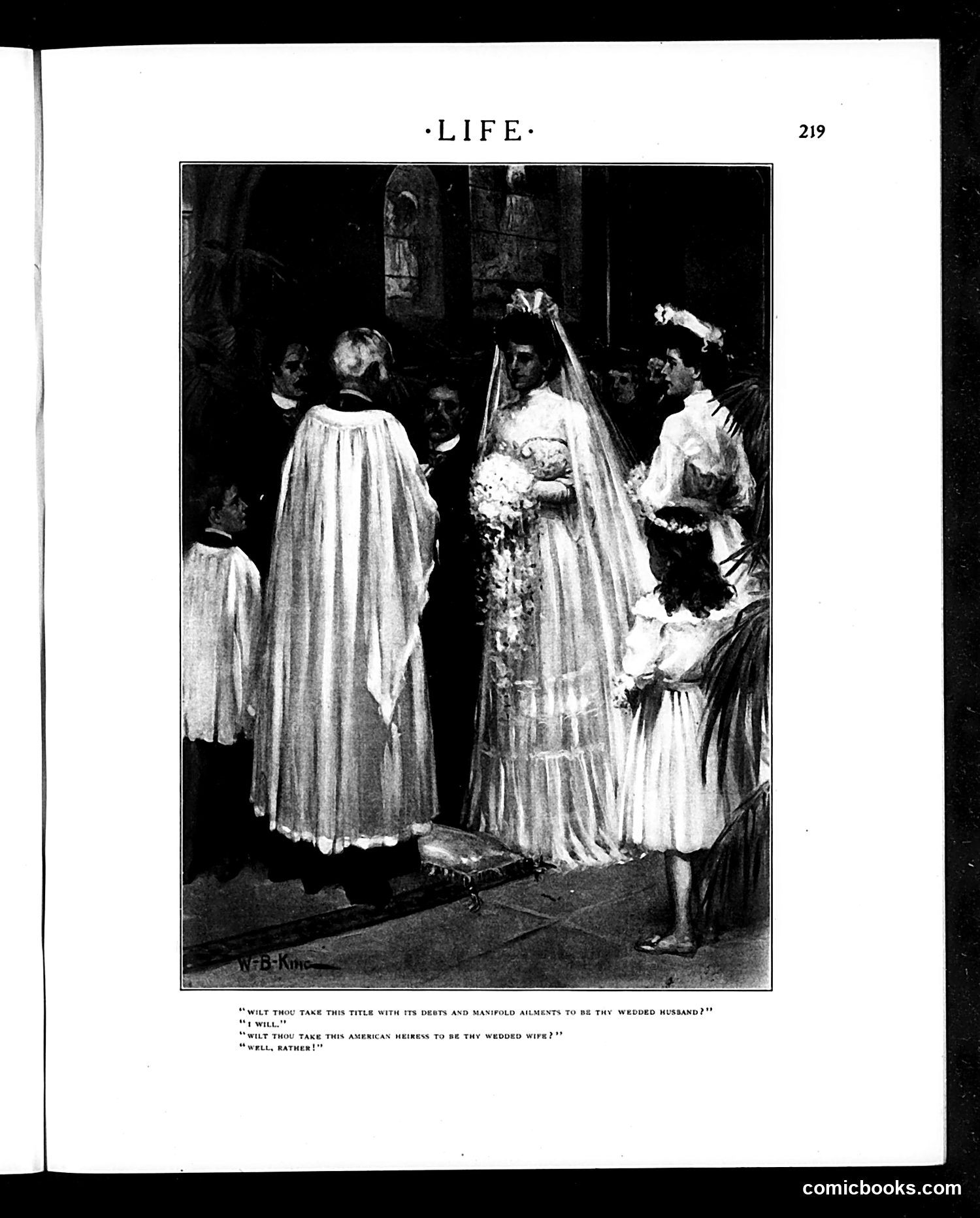
This is a satirical wedding scene commenting on marriages between American heiresses and European nobility—a common phenomenon in the Gilded Age. The dialogue presents a cynical exchange of vows: a European aristocrat agrees to marry an American heiress, but only reluctantly accepts her (saying he'd "rather" not). The satire mocks how titled European men pursued wealthy American women to rescue their financially-troubled estates, while American families sought social prestige through aristocratic marriages. The joke targets both sides: the European's mercenary motivation and the American family's willingness to trade wealth for a title. This reflects genuine social anxiety about these transatlantic marriages that were frequently discussed in contemporary American satirical publications.
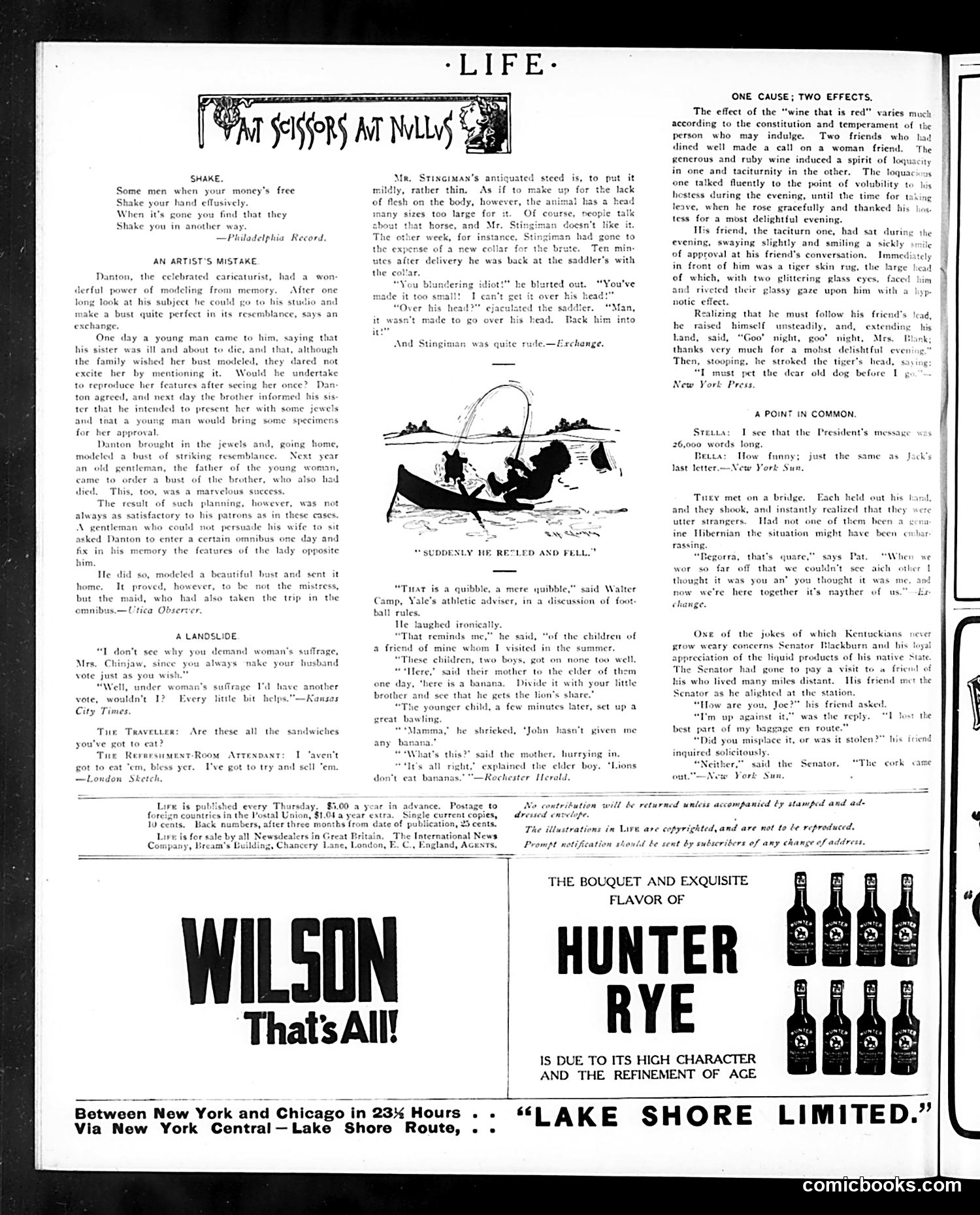
This page contains several short humorous stories and cartoons typical of Life magazine's satirical style. **Main cartoon** ("Suddenly He Retiled and Fell"): Two drunk men meet on a bridge. One is so intoxicated he's falling over. The joke plays on Irish stereotypes—a character named Pat remarks on the strangeness of the encounter, with ethnic dialect humor. **"One Cause; Two Effects"**: A story about wine's different effects on two friends visiting a woman. One becomes talkative; the other becomes nearly catatonic, sitting and staring at a taxidermied animal head until he mimics its vacant expression. The humor derives from physical comedy and the contrast between the friends' reactions. **Other brief anecdotes** include stories about the caricaturist Danton accidentally modeling the wrong woman's bust, and wordplay about a football coach's rulebook being as lengthy as a presidential message. The page exemplifies early 20th-century American humor: relying heavily on ethnic stereotypes, alcohol-related jokes, physical comedy, and observational satire about social situations.
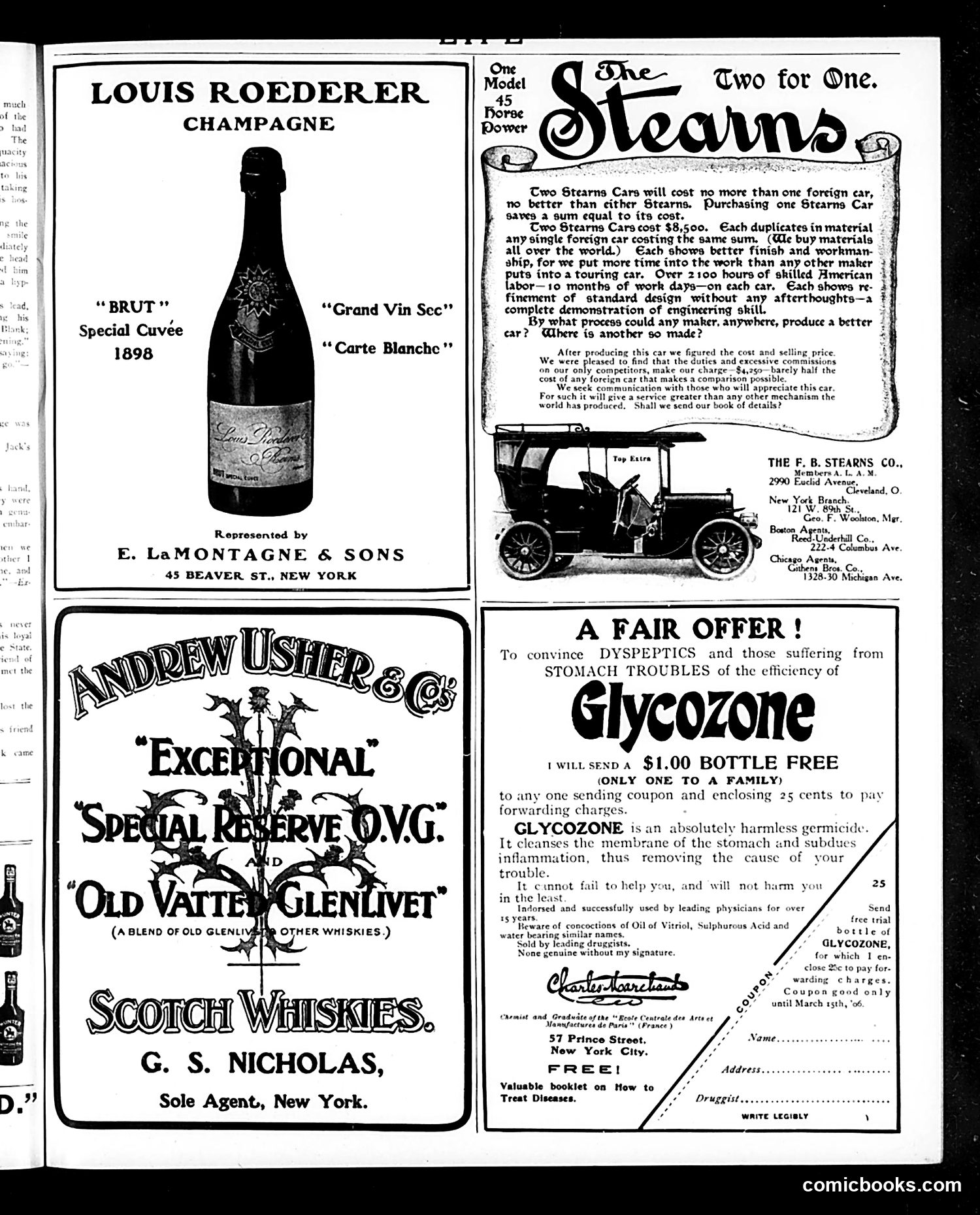
This is primarily a **commercial advertising page**, not a political cartoon. It contains four distinct product advertisements from circa 1898-1906: 1. **Louis Roederer Champagne** — French luxury wine marketed to wealthy consumers 2. **Stearns automobiles** — An American car manufacturer claiming superiority over foreign competitors, emphasizing domestic labor and cost-effectiveness 3. **Andrew Usher whiskeys** — Scottish spirits sold through New York agents 4. **Glycozone** — A patent medicine claiming to cure dyspepsia and stomach troubles, offering a free $1.00 bottle for 25 cents shipping The **Stearns ad** contains the most notable rhetoric: it argues that buying two American Stearns cars costs less than one foreign car while delivering equal quality—a nationalist economic pitch. The **Glycozone ad** exemplifies the era's unregulated patent medicine industry, making broad health claims without scientific evidence. There are no political cartoons, caricatures, or satirical commentary on this page. It reflects early 20th-century consumer culture and marketing strategies.
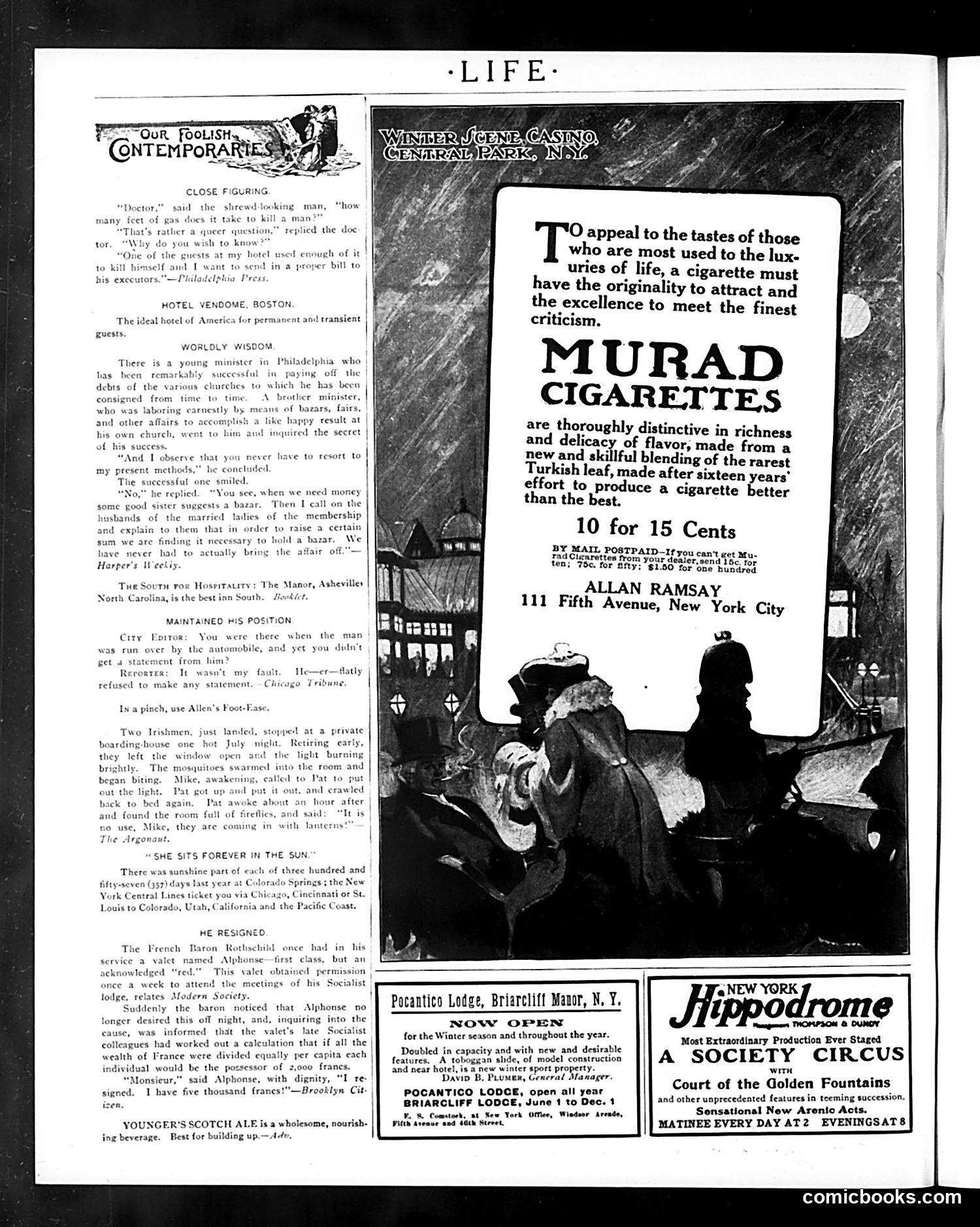
This page combines humor columns with period advertising. The left side features "Our Foolish Contemporaries," satirical anecdotes mocking human behavior: - A story about a Philadelphia minister successfully fundraising through Socialist connections rather than bazaars - A joke about an Irish immigrant refusing a hotel job offer after calculating that equal wealth distribution in France would make him a millionaire - A reporter maintaining composure after being hit by an automobile The humor relies on irony and social commentary typical of early-20th-century Life magazine satire. The right side advertises **Murad Cigarettes** (targeting wealthy consumers), along with luxury goods: the Hotel Vendôme Boston, Pocantico Lodge resort, and the Hippodrome circus production. The page reflects pre-1920s American attitudes: casual ethnic humor about Irish immigrants, socialist critique masked as jest, and marketing luxury goods alongside working-class anecdotes—capturing Life's audience of educated, affluent readers amused by stories of social climbers and working people.
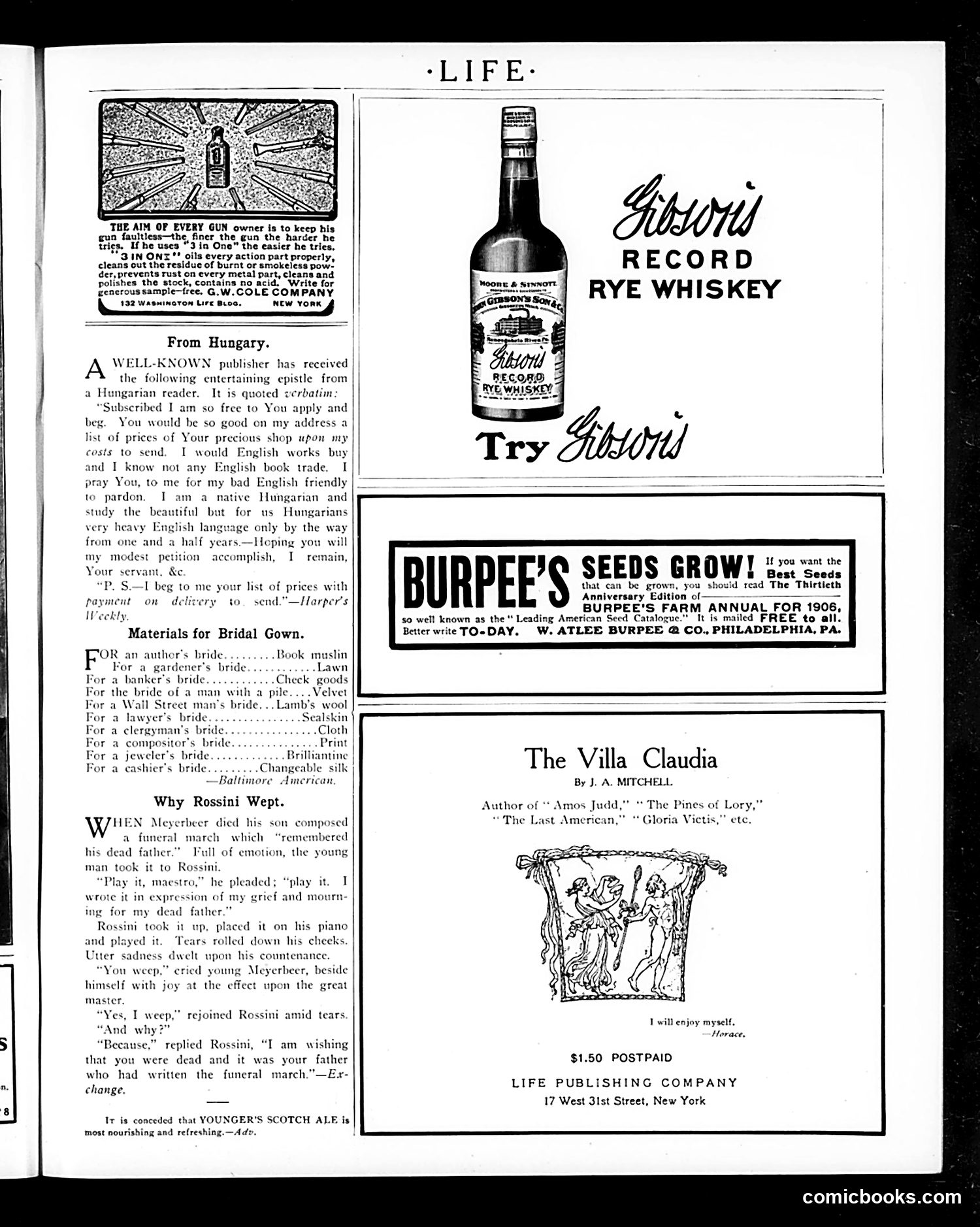
This page is primarily **advertising and miscellaneous content** rather than political satire. The main items include: **"From Hungary"** — A humorous letter supposedly from a Hungarian reader requesting a price list, written in awkwardly broken English. The joke is the mangled syntax and grammar ("I am so free to You apply and beg"), which satirizes non-native English speakers' struggles with the language. This reflects early-1900s attitudes toward foreign immigrants. **"Materials for Bridal Gown"** — A light pun list matching fabric types to brides' professions (lawyer's bride = sealskin, Wall Street man's bride = lamb's wool, etc.). The humor relies on material/profession wordplay. **"Why Rossini Wept"** — An anecdote about composers Rossini and Meyerbeer. The joke: Rossini weeps not from emotion but because he wishes the young composer were dead instead of his father. The page otherwise consists of **advertisements** for gun oil, whiskey, and seed catalogs, plus promotional material for a serialized story "The Villa Claudia."
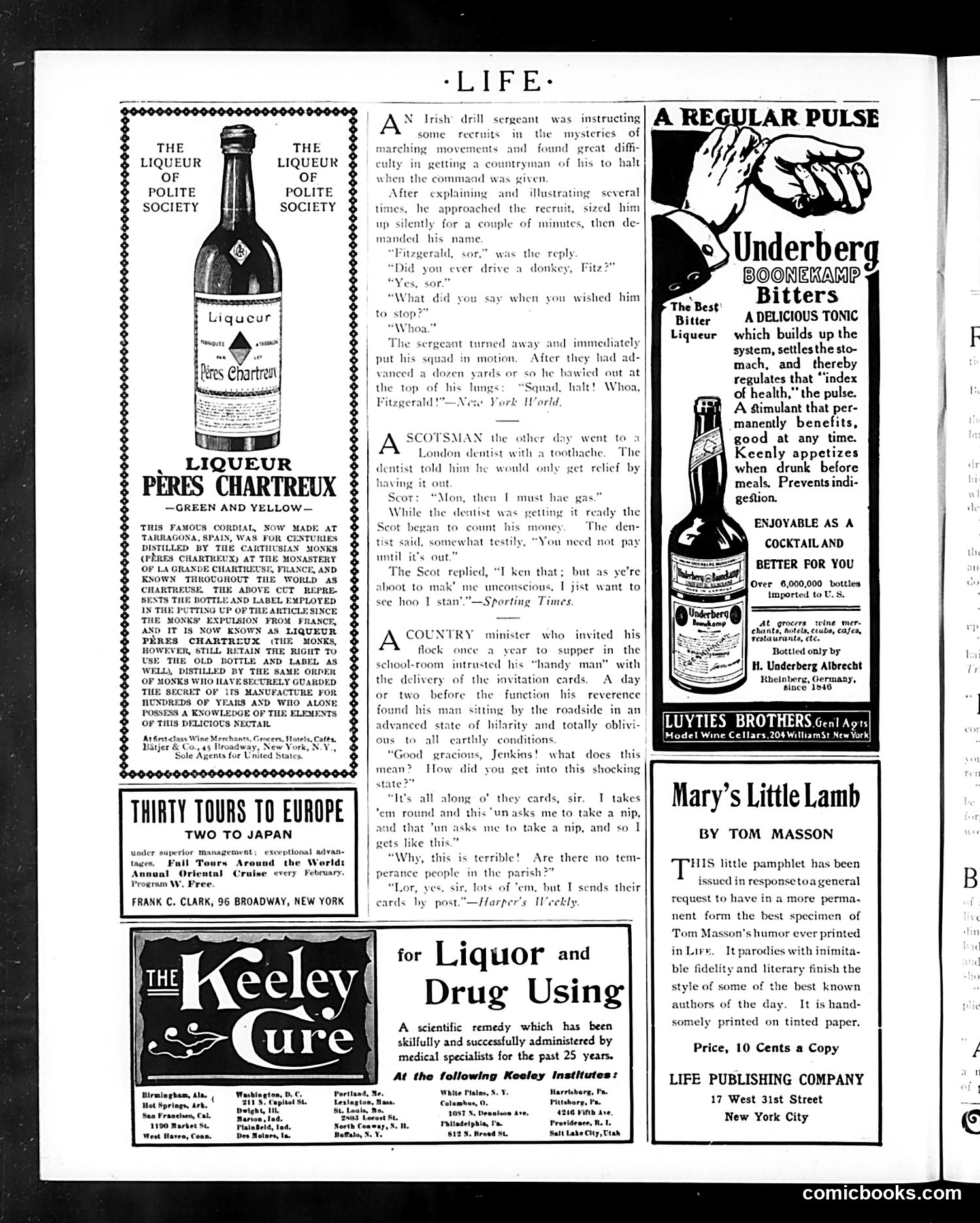
This Life magazine page contains **three ethnic humor anecdotes** typical of early 20th-century American comedy, alongside liquor and patent medicine advertisements. The three jokes play on **stereotypical dialect humor**: 1. An Irish drill sergeant commanding Irish recruit "Fitzgerald" — the joke relies on the recruit responding to "Whoa!" (a donkey command) instead of military orders. 2. A Scottish man at a dentist refusing to pay until unconscious, fearing the dentist will overcharge him — playing on the "stingy Scot" stereotype. 3. A country minister's handyman delivering dinner invitations while getting drunk at every stop, later claiming there are "lots of temperance people" but he mails their cards — satirizing rural hypocrisy about temperance. These represent **period-typical comedy based on national/ethnic caricatures** — Irish, Scottish, and rural English characters portrayed as dim-witted or morally compromised. The humor now reads as dated stereotyping rather than clever satire. The advertisements for alcoholic liqueurs and the "Keeley Cure" for drug addiction reflect contemporary attitudes toward substance use.
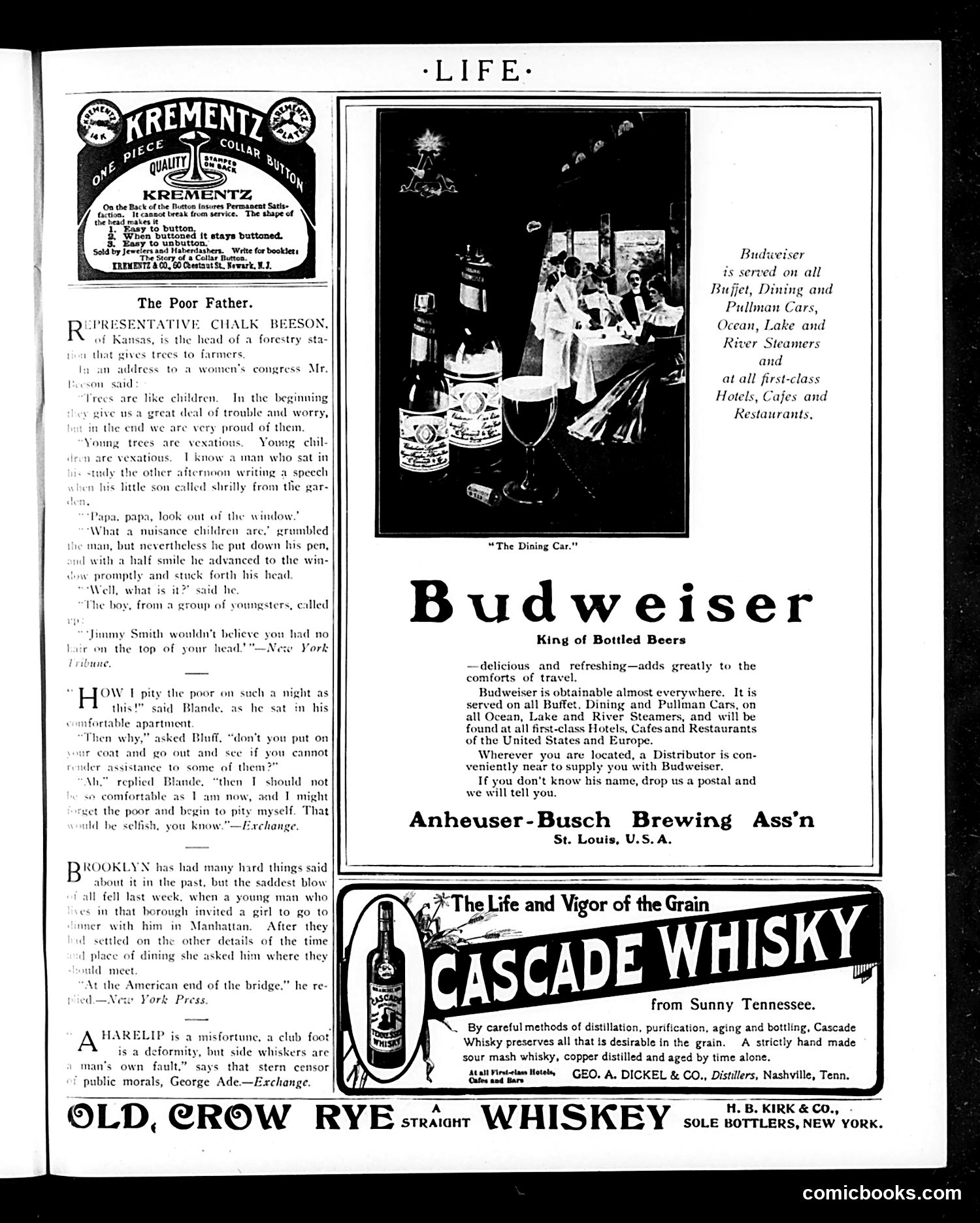
This page contains humorous anecdotes rather than political cartoons. "The Poor Father" presents a speech by Representative Chalk Beeson of Kansas comparing trees to children—both troublesome when young but sources of pride when grown. The joke satirizes the absurdity of this comparison through an interruption: a boy calls from the garden, "Papa, papa, look out of the window. Jimmy Smith wouldn't believe you had no hair on the top of your head!"—undercutting Beeson's sentimental metaphor with crude, physical humor. Additional brief anecdotes mock bourgeois hypocrisy (a comfortable man won't help the poor lest he become uncomfortable himself) and Brooklyn's inferiority (a young man won't even meet his date there). The rest is advertising for Budweiser beer, Cascade Whisky, and Old Crow Rye whiskey—common fare for *Life* magazine of this era.
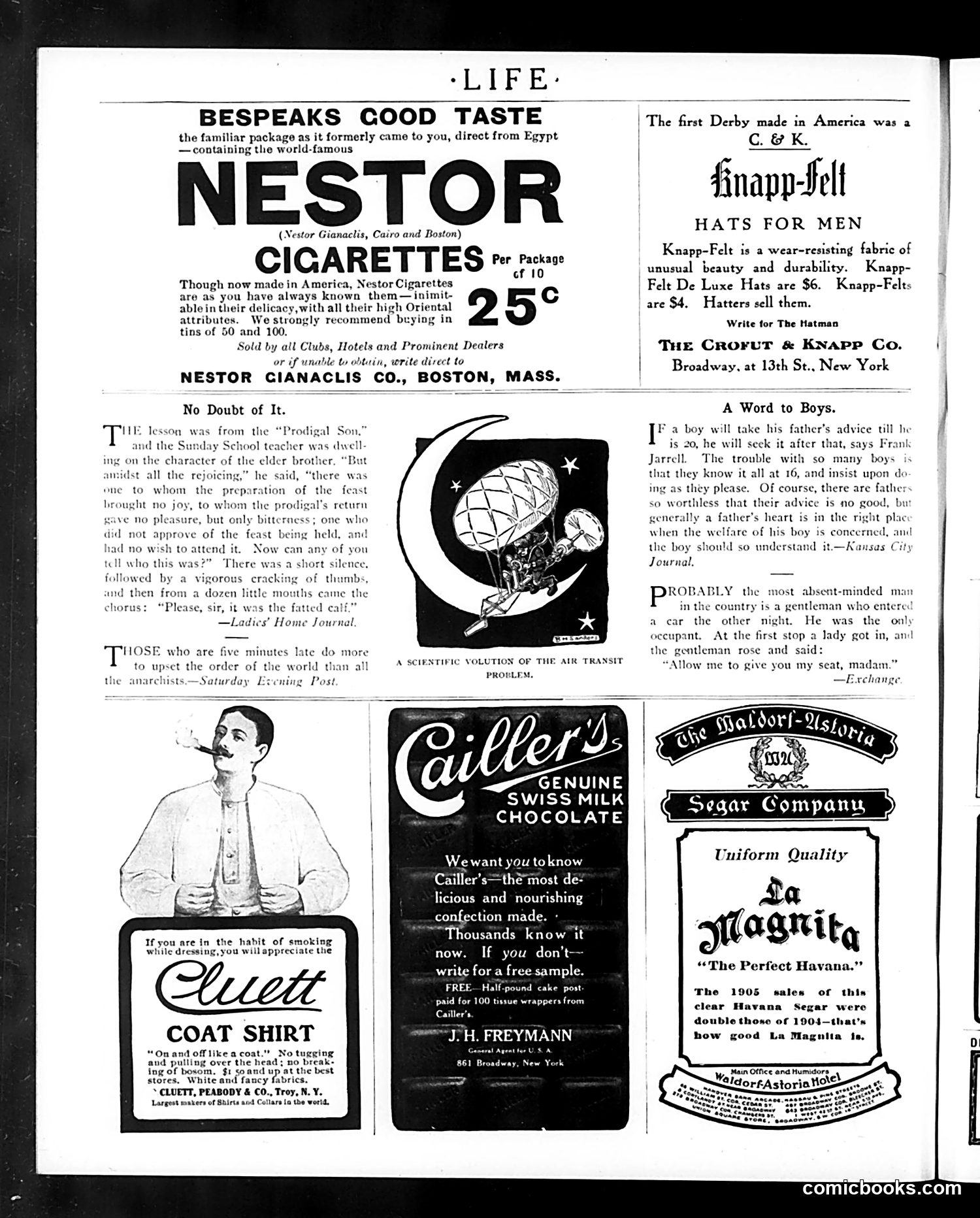
This page is primarily **advertisements and filler content** rather than political satire. The main elements include: **Advertisements:** Nestor Cigarettes (Egyptian imports now made in America), Knapp-Felt hats, Cailler's Swiss chocolate, Cluett coat shirts, and La Magnita cigars dominate the layout. **Humorous anecdotes:** Short jokes and observations fill gaps between ads—a Sunday School story about the "fatted calf," observations about punctuality and anarchists, and a story about an absent-minded gentleman offering his seat to a lady in a car. **One cartoon:** A simple illustration shows a hot air balloon in a crescent moon, labeled "A Scientific Solution of the Air Transit Problem"—light satire on early aviation concepts. The page reflects early 1900s American consumer culture and genteel humor rather than sharp political commentary. The "scientific volution" pun and the absent-minded man anecdote represent the mild, domestic wit typical of Life magazine's satirical approach.
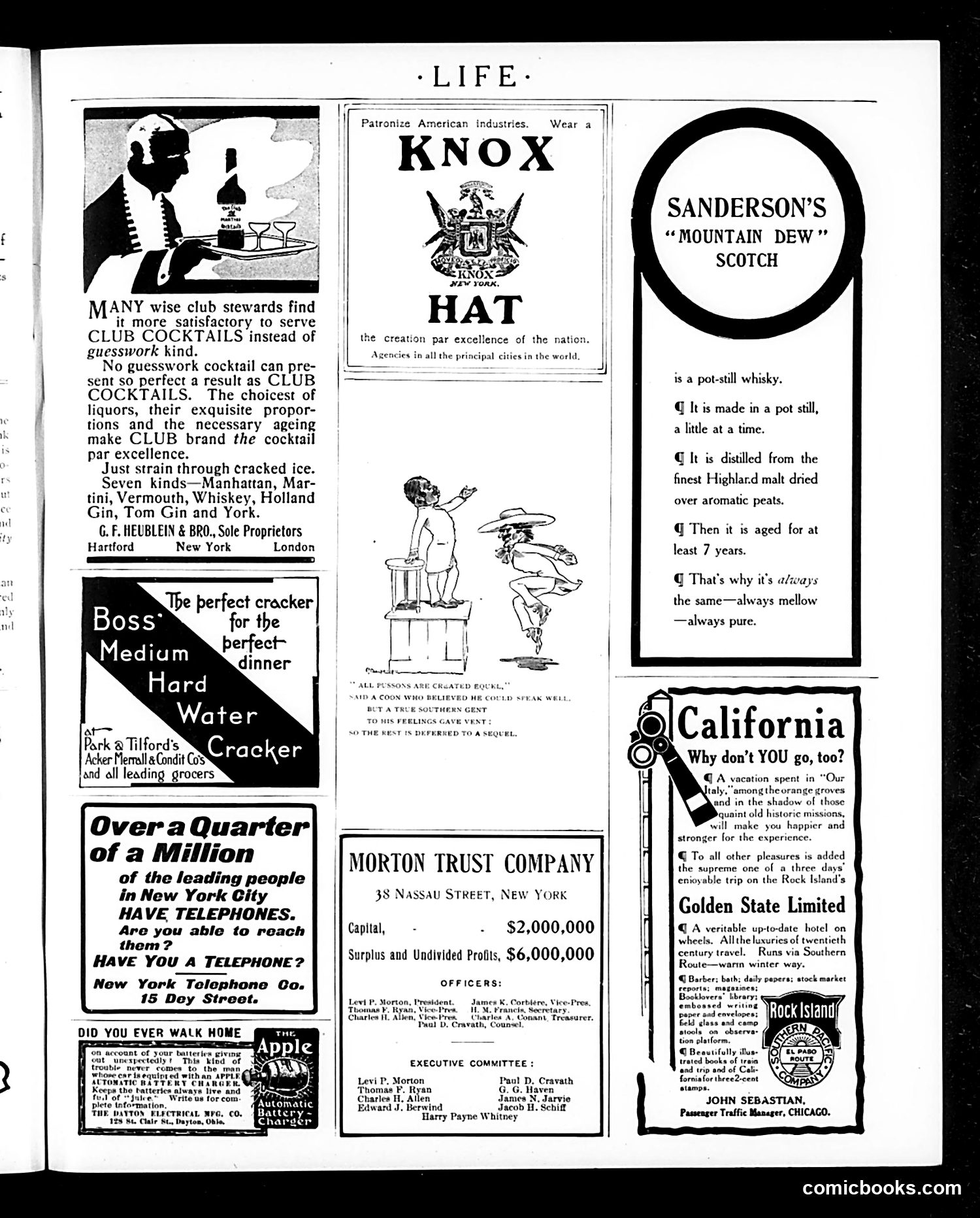
This page is **primarily advertising**, not satire or political commentary. It dates from the early 1900s (likely Prohibition era or pre-Prohibition, given the liquor ads). The advertisements target wealthy, urban audiences: Club Cocktails (pre-mixed drinks), Knox hats, Sanderson's Scotch whisky, Boss crackers, and the Morton Trust Company (a major New York financial institution with officers including Harry Payne Whitney, a prominent industrialist). The center cartoon depicts a man standing on what appears to be a pedestal, tipping his hat—likely an advertisement for Knox hats, using humor to suggest that well-dressed gentlemen wear Knox brand. The "California" ad promotes leisure travel via Rock Island railroad's "Golden State Limited," marketing resort tourism. The New York Telephone Company ad boasts reach to "over a quarter million" subscribers—promoting telephone adoption among the wealthy. These ads collectively reflect turn-of-the-century consumer culture targeting the affluent.
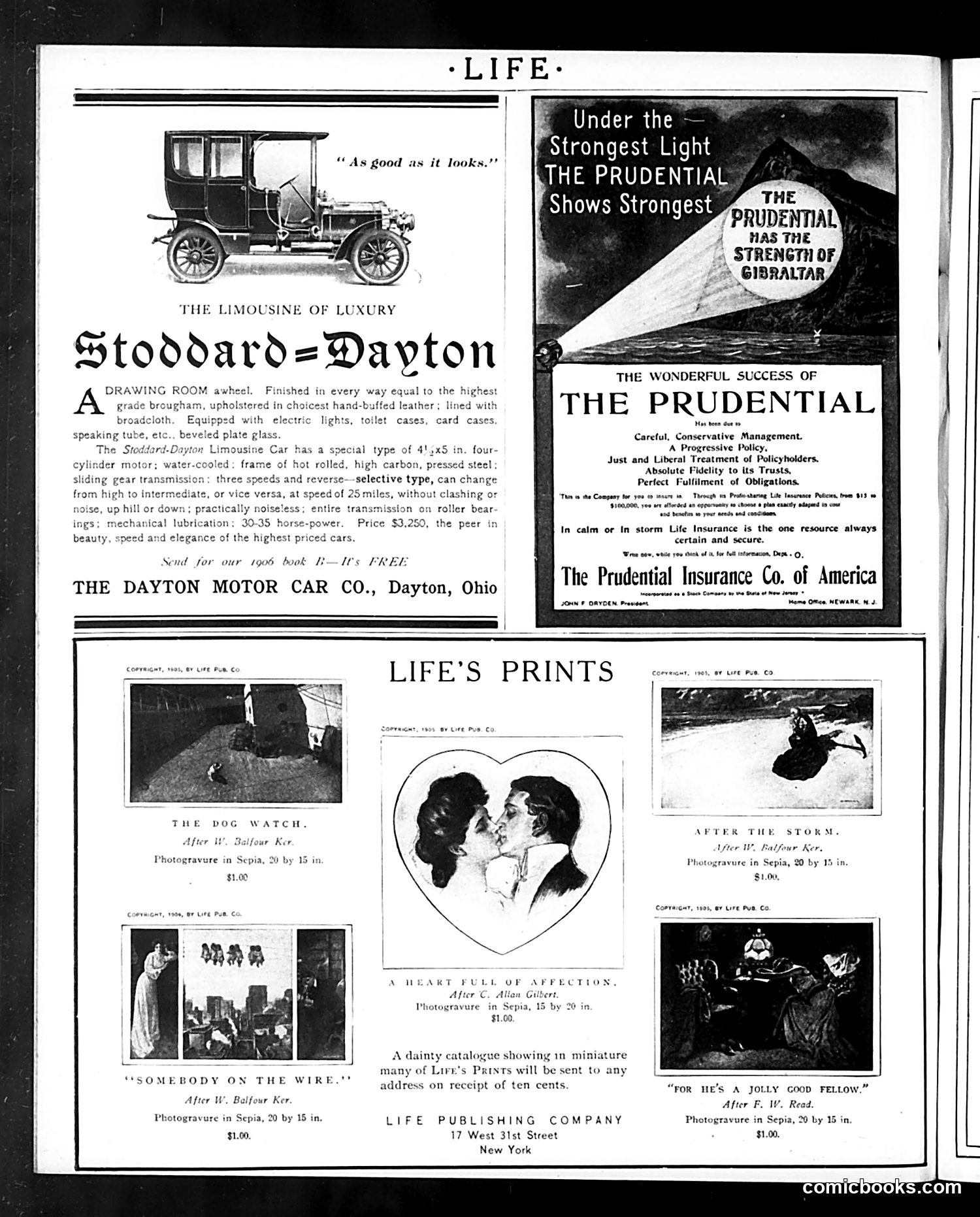
This page is primarily **advertising**, not satire or political commentary. It contains: 1. **Stoddard-Dayton automobile ad** (top left): Promotes a luxury limousine with detailed mechanical specifications and price ($3,250), positioning it as equal to the highest-grade European cars. 2. **Prudential Insurance ad** (top right): Uses a lighthouse beam metaphor ("Under the Strongest Light / THE PRUDENTIAL Shows Strongest") to advertise life insurance, emphasizing the company's financial strength, conservative management, and reliable claims payment. 3. **Life's Prints section** (bottom): Catalog listings for photogravure prints by artists (Balfour Ker, C. Allan Gilbert, F.W. Read) depicting romantic and domestic scenes—"The Dog Watch," "A Heart Full of Affection," "After the Storm," etc.—selling for $1 each. The page reflects early-1900s consumer culture: automobiles as luxury status symbols and life insurance as a modern security product. No political satire or caricature is present.
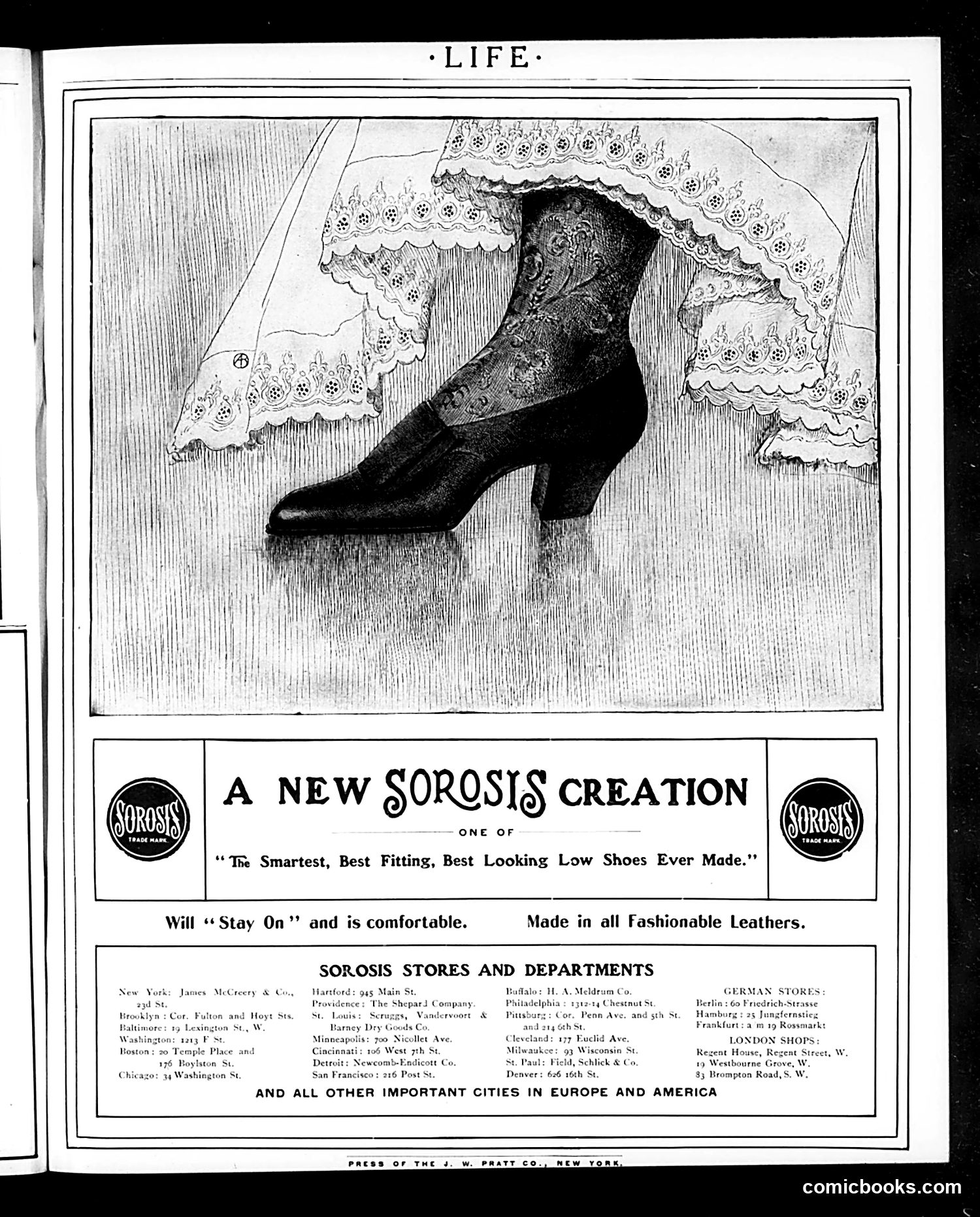
This page is primarily a **shoe advertisement**, not political satire. It advertises Sorosis brand low shoes for women, emphasizing they are "the Smartest, Best Fitting, Best Looking Low Shoes Ever Made" and will "Stay On" while remaining comfortable. The illustration shows a women's foot and lower leg in a black low-heeled shoe, partially covered by decorative lace—likely representing fashionable women's undergarments of the era. The lace detail suggests elegance and femininity. The ad lists Sorosis store locations across major American cities and European capitals, indicating this was a upscale, internationally-distributed shoe brand. There is no political or social satire present—this is straightforward early 20th-century consumer advertising emphasizing comfort, style, and availability.
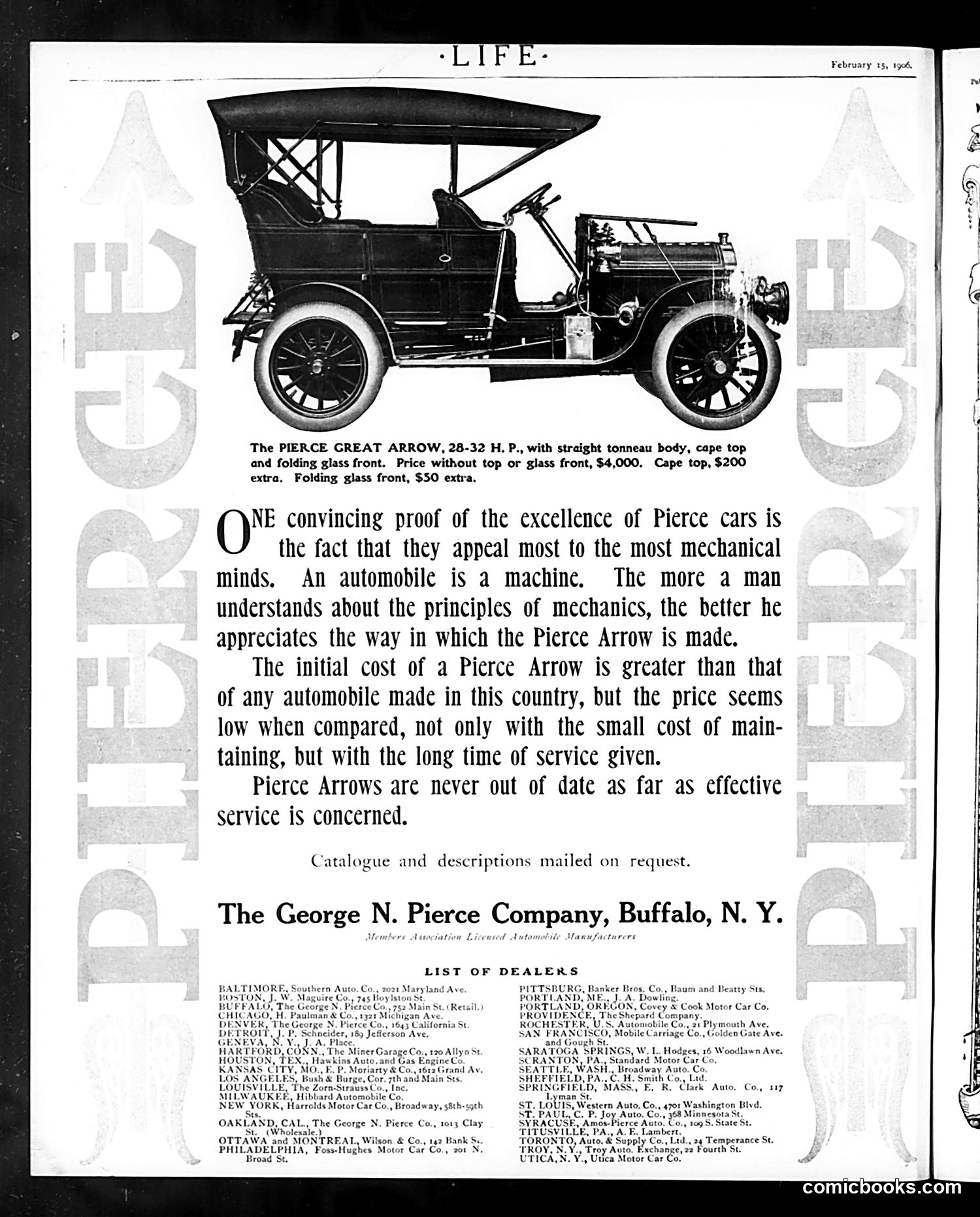
This page is primarily a **automobile advertisement**, not a political cartoon. It features a 1906 Pierce Great Arrow motorcar with detailed pricing and specifications. The ad copy employs a marketing strategy common to early automotive advertising: appealing to **mechanical sophistication and engineering prowess** rather than mere luxury. The text argues that Pierce cars attract "the most mechanical minds" because they demonstrate superior engineering principles. This reflects the era when automobiles were still novelties requiring technical knowledge to operate and maintain. The high price ($4,000 base, with optional upgrades) is justified by claims of durability and low maintenance costs—a pitch suggesting long-term value over initial expense. The large watermarked text visible in the background appears to be decorative masthead elements from *Life* magazine itself, not part of the advertisement's content. **No satire is present**—this is straightforward commercial advertising from the early automotive industry.