
Life, 1906-02-15 · page 20 of 32
Life — February 15, 1906 — page 20: what you’re looking at
What you’re looking at
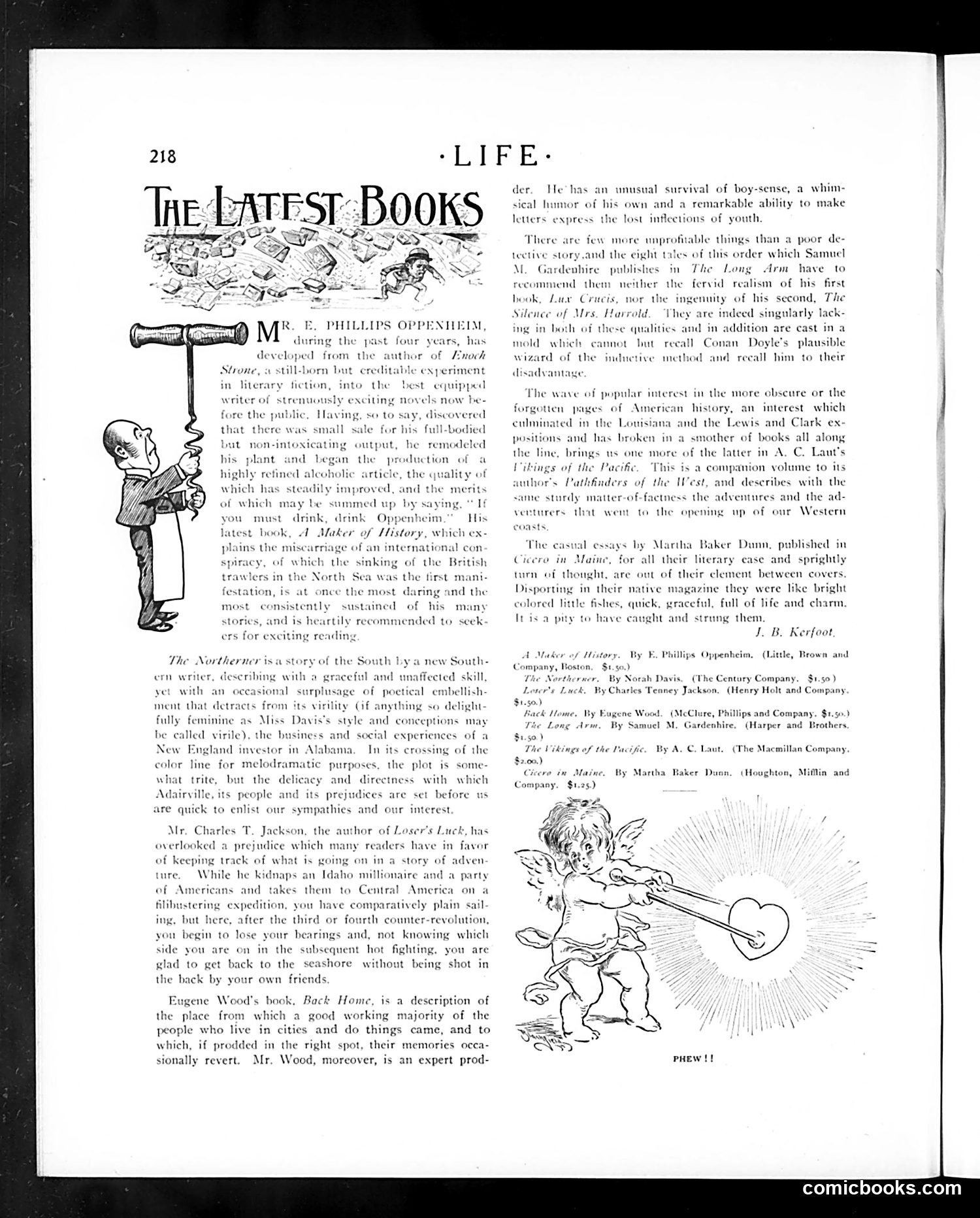
This is a book review section from *Life* magazine featuring humorous critiques of recent publications. The main cartoon depicts Cupid shooting an arrow at a heart, illustrating a playful tone. The reviews use satirical wit typical of *Life*'s approach. For example, E. Phillips Oppenheim is humorously described as having "remodeled his plant and begun the production of a highly refined alcoholic article"—a joke suggesting his novels have become more polished and intoxicating (i.e., more entertaining) over time. The reviewer compares detective stories by Samuel M. Gardenhire unfavorably to Conan Doyle's Sherlock Holmes tales, noting they lack originality. Other reviews discuss books about American history, Southern life, and adventure fiction. The page exemplifies *Life*'s satirical book criticism, using exaggeration and clever wordplay to entertain educated readers while assessing contemporary literature's merits and shortcomings.
📄 Transcribed text from this page (OCR, searchable)
Machine-transcribed from the original scan — historical spelling and the odd misread are preserved.
LIFE iE, LATEST, Books CCL PS wy M® E, PHILLIPS OPPENIEIM, during the px the past four years, developed from the author i till-born but creditable experim in literary fiction, into the best equipped writer of strenuously exciting novels now be- lic, Having, so to say, discovered ere was small sale for his full-bodied but non-intoxicating output, remodeled plant and began the production of a ly refined alcoholic article, the quality of which has steadily improved, and the merits of which may be summed up by saying, “If you must dr 1 Oppenheim.” His latest book, 4 Maker of History, which ex- lains the miscarriage of an international con . of which the sinking of the British trawlers in the North Sea was the first mani- festation, is at once the most daring and the most consistently sustained of his) many , and is heartily recommended to seek reading The Northerner isa story of the South by a new South- ern writer, describing with a graceful ected skill, yet with an occasional surplusage ¢ eal ment that detracts from its virility Gif anything so delight fully feminine as Miss Davis's style and concep! be called virile). the business and social experiences of a New England investor in Alabama. ms may In its crossing of the color line for melodramatic purposes, the plot is some- what trite, but t de y and directness with which Adairville, its people and its prejudices are set before us are quick to enlist our sympathies and our interest Mr. Charles T. Jackson, overlooked a prejudice which author of Loser’s Luck, has ny readers have in favor of keeping track of what is going on in a story of adven ture. While he k f ericans and takes them to Central America on a naps an Idaho millionaire and a party filibustering expedition, you have ¢ ing, but here, rratively plain sail after the third or fowrth counter-revolution, you begin to lose your bearings and, side you are on in not knowing which the subsequent hot fighting, you are slad to get back to the seashore without being shot in the back by your own friends Eugene Wood's book, Back Home, is a description of the place from which a good working majority of the people who live in cities and do things came, and to which, if prodded in the right spot, their memories occa- sionally revert. Mr. Wood, moreover, is an expert prod- der. Heohas an amusual survival of boy-sense, a whim- sical humor of his own and a remarkable ability to make inflections of youth. letters express the lost There are few more unprofitable things than a poor de- tective story.and the eight tales of this order which Samuel M. Gardenhire publishes in) The Lo Arm have to neither the fervid realism of his first book, Lue Crucis, nor t Silence of Mrs. Harrotd. recommend ther ingenuity of his second, hey are indeed singularly ing in both of these qualities and in addition are cast ina cannot but recall Conan Doyle’s plausible wizard of the inductive method and recall him to their mold which disadvantage The wave of popular interest in the more obscure or the American history, an interest’ which and the Lewis and Clark ex- ther of books all brings us one more of the latter in ALC, Vikings of the Pacific forgotten pages of culminated in the Louisia positions and has broken ina si along Laut’s mpanion volume to its and deseribes with the the line, This is a same sturdy matter-of-factness the adventures and the ad- verturers that went to the opening up of our Western The casual essays hy Martha Cicero in Maine, Baker Dunn, for all their literary published in case and sprightly turn of thought, are out of their clement between covers. Disporting in their native magazine they were like bright colored little fishes, quick, graceful, full of life and charm In isa pity to have caught and strung them, J. B. Kerfoot 1 Maker of History. By ¥. Phill $1.50.) Oppenheim, (Little, Brown and The Northerner, Wy Novah Davis. (The Century Lorer's Luck. ByC ompany. (Henry Holt and Company les Tenney Jacks Back Home, Vey Bugene Wood. (McClure, Phillips and Company. $1.50.) irm, By Samuel M. Gardenhire, (Harper and Brothers. (The Macmillan Company By Martha Baker Duon. (Houghton, Mifflin and PHEew!! comicbooks.com