
Life, 1906-02-15 · page 18 of 32
Life — February 15, 1906 — page 18: what you’re looking at
What you’re looking at
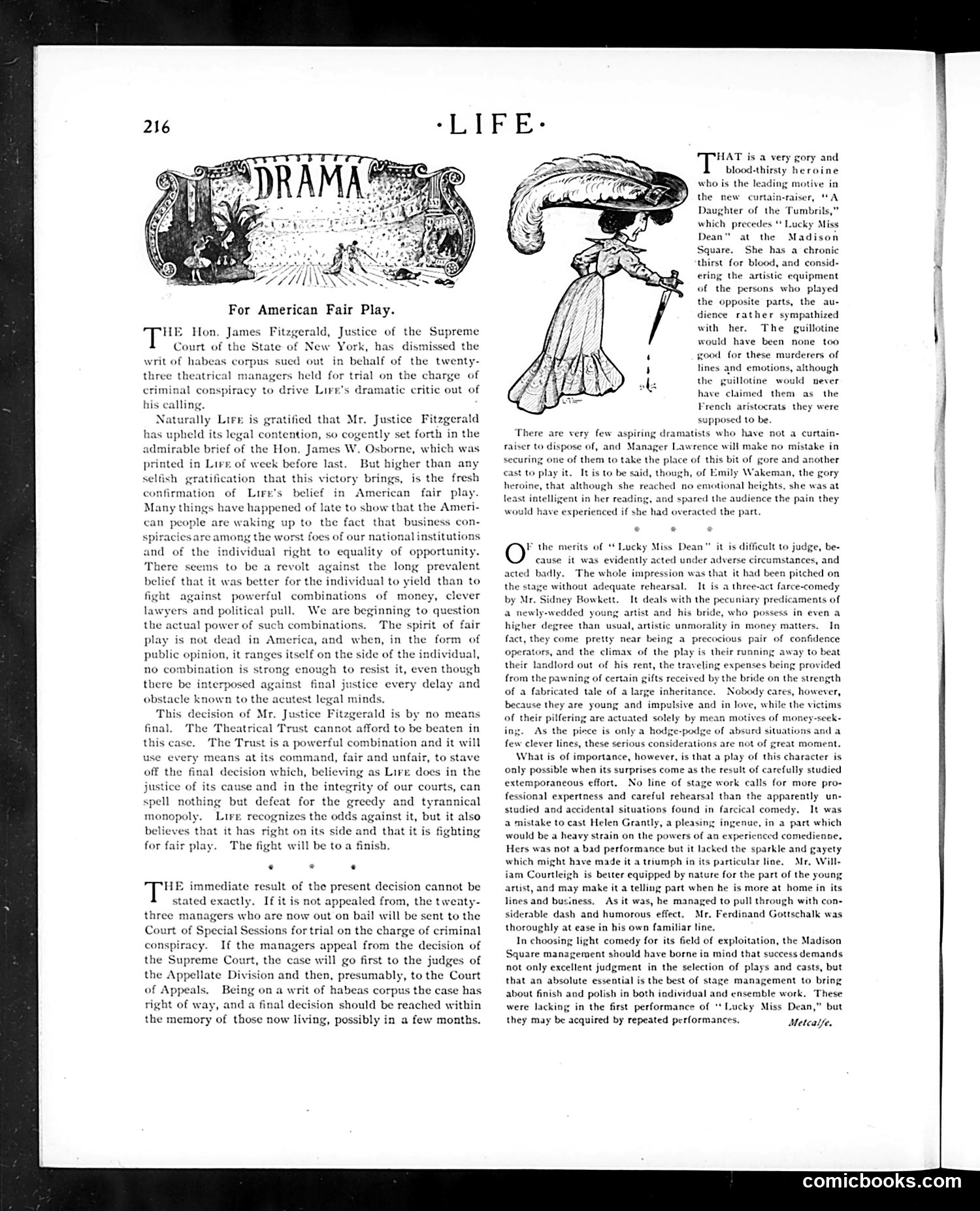
This page reports on a New York Supreme Court decision dismissing charges against 23 theatrical managers accused of conspiracy to drive Life's drama critic from his profession. The case represents a clash between Life magazine and the powerful "Theatrical Trust"—a monopoly controlling much American theater. Life celebrates Justice Fitzgerald's ruling as a victory for "fair play" and individual rights against powerful corporate combinations. The publication frames this as part of a broader American awakening against monopolistic control by wealthy interests using lawyers and political influence. The article argues that while the Trust may appeal, public opinion and the courts should ultimately defeat this "greedy and tyrannical monopoly." The right-side text reviews a play called "Lucky Miss Dean," critiquing its melodramatic curtain-raiser about a bloodthirsty heroine—likely unrelated satire padding the page.
📄 Transcribed text from this page (OCR, searchable)
Machine-transcribed from the original scan — historical spelling and the odd misread are preserved.
For American Fair Play. HE Hon. James Fitzgerald, Justice of the Supreme Court of the State of New York, has dismissed the writ of habeas corpus sued out in behalf of the twenty- three theatrical managers held for trial on the charge of criminal conspiracy to drive Lire’s dramatic critic out of his calling. Naturally Lire is gratified that Mr. Justice Fitzgerald upheld its legal contention, so cogently set forth in the admirable brief of the Hon mes W. Osborne, which was printed in Lire of week before last. But higher than any selfish gratification that this victory brings, is the fresh confirmation of Lire’s belief in American fair play. Many things have happened of late to show that the Ameri- can people are waking up to the fact that business con- Sp and of the individual right t There seems to be a revolt t the long prevalent belief that it was better for the individual to yield than to nt against powerful combinations of moncy, clever ers and political pull. We are beginning to question the actual power of such combinations. The spirit of fair ple nd when, in the form of public opinion, it ranges itself on the side of the individual, no combination is strong enough to resist it, even ugh there be interposed against final justice every delay and ¢ worst foes of our national institutions equality of opportunity. camong law y is not dead in Americ obstacle ninds, nown to the acutest legal This decision of Mr, Justice Fitzgerald is by no means final, The Theatri Trust cannot afford to be beaten in this case. The Trust is a powerful combination and it will use every means at its command, fair and unfair, to stave off the final decision which, believing as Lire does in the justice of its cause and in the integrity of our courts, can spell nothing but defeat for the greedy and tyrannical monopoly. Lire recognizes the odds against it, but it also believes that it has right on its side and that it is fighting for fair play. The fight will be to a finish. . . * HE immediate result of the present decision cannot be stated exactly, If it is not appealed from, the tweaty- three managers who are now out on bail will be sent to the Court of Special Sessions for trial on the charge of criminal conspiracy. If the managers from the decision of the Supreme Court, the case will go first to the judges of the Appellate Division and then, presumably, to the Court of Appeals. Being on a writ of habeas corpus the case has right of way, and a final decision should be reached within the memory of those now living, possibly in a few months. HAT is a very gory and blood-thirsty heroine who is the leading motive in the new curtain-raiser, ¢ Daughter of the Tumbril: which precedes * Lucky Miss Dean” at the Square. She has a chronic thirst for blood, and consid- ering the artistic equipment of the persons who played the opposite parts, the au- dience rather sympathized with her. The guillotine would have been none too Madison good for these murderers of lines and emotions, although the guillotine would never ave claimed them as the French aristocrats they were supposed to be There are very few aspiring dramatists who have not a curtain- raiser to dispose of, and Manager Lawrence will make no mistake in securing one of them to take the place of this bit of gore and another play it. It is to be said, though, of Emily Wakeman, the gory cast heroine, that although she reached no emotional heights, she was at audience the pain the; would have experienced if she had overacted the part. least intellig in her reading, and sp: F the merits of “ Lucky Miss Dean” it is difficult to judge, be- cause it was evidently acted u acted badly, r adverse circumstances, and The whole impression was that it had been pitched on It is a three. It deals with the pecuniary predicaments of the stage without adequate rehearsal. by Mr. Sidney Bowkett. wly-wedded you ct farce-comedy an artist and his bride, who possess in even a higher ¢ fact, they ec operators, and the climax of the play is their running away to b nt, the traveling expenses being provided th es, however, ree than usual, artistic unmorality in 1 ney matters. In pretty near being a precocious pair of confide their landlord out of his r from the pawning of certain gifts received by the bride on the str of a fabricated tale of a large inheritance. N because they are young and impulsive and in love, while the victims obody of their pilfering are actuated solely by mean motives of mone -seek- ing. As the piece is only a hodge-podge of absurd situations and a few clever lines, these serious considerations are not of great moment. What is of importance, however, is that a play of this character is only possible when its surprises come as the result of carefully studied extemporaneous effort, No line of stage work calls for more pro- fessional expertness and careful rehearsal than the apparently un- studied and accidental s Tt was a mistake to cast Helen Grantly, a pleasing ingenue, in a part which would be a heavy strain on the powers of an experienced comedienne. Hers was not a bad performance but it lacked the sparkle and gayety which might have made it a triumph in its particular line, Mr, Will- iam Courtleigh is better equipped by nature for the part of the young artist, and may make it a telling part when he is more at home in its lines and business. As it was, he managed to pull through with con- siderable dash and humorous effect. Mr. Ferdinand Gottschalk was thoroughly at ease in his own familiar tine, In choosing light comedy for its field of exploitation, the Madison Square management should have borne in mind that success demands not only excellent judgment in the selection of plays and casts, but that an absolute essential is the best of stage management to bring about finish and polish in both individual and ensemble work. These were lacking in the first performance of “Lucky Miss Dean,” but they may be acquired by repeated performances. Metcalfe. uations found in farcical comed, comicbooks.com