
A complete issue · 26 pages · 1905
Life — December 9, 1905
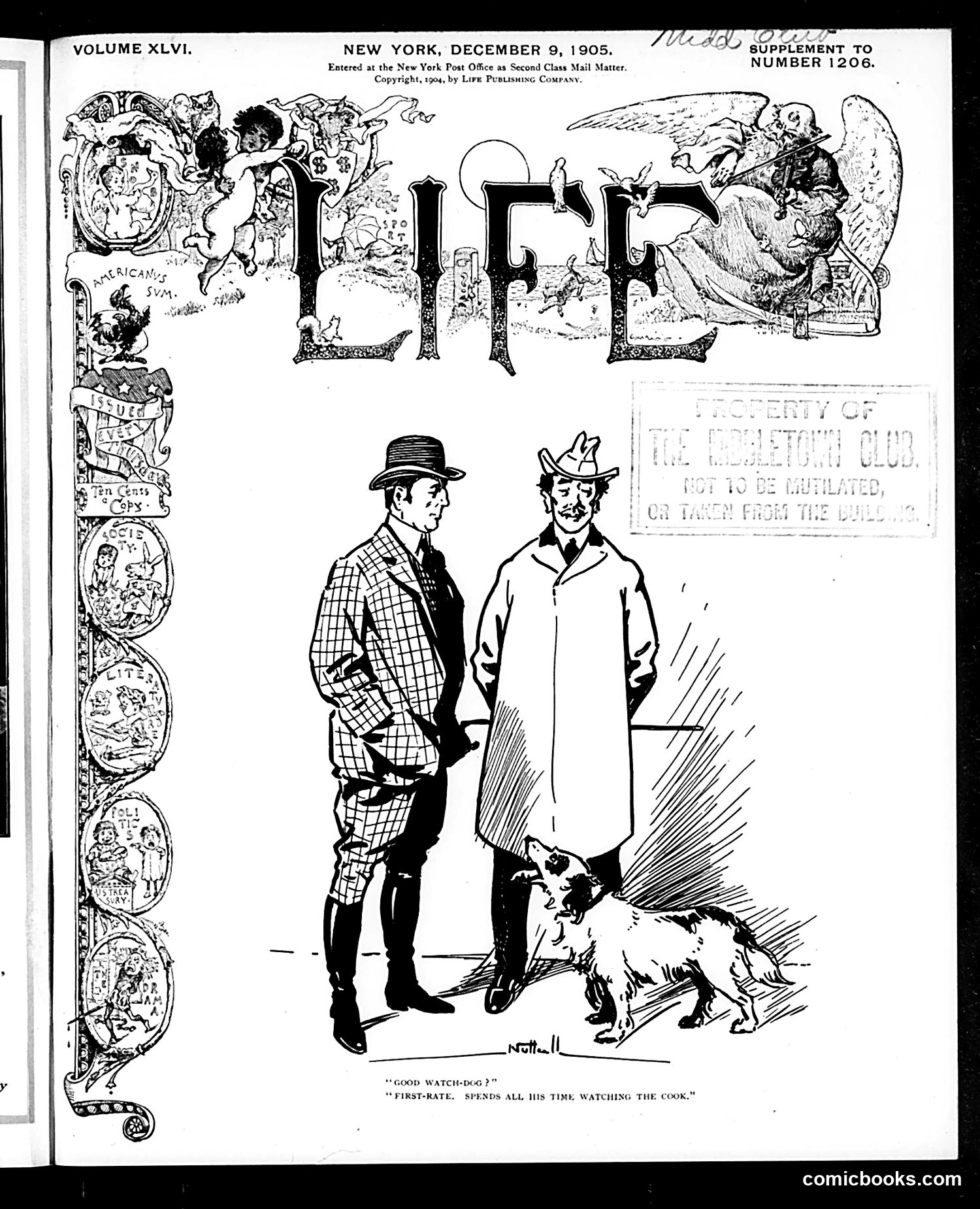
This page features a single cartoon titled "Good Watch-Dog?" with the subtitle "First-Rate. Spends All His Time Watching the Cook." The image shows two well-dressed men—one in a checkered suit and hat, the other in an overcoat—standing with a small dog between them. The satire appears to mock the concept of a "watchdog" in a domestic context. Rather than protecting the household from intruders or danger, this dog devotes all its attention to monitoring the cook, suggesting either incompetent household management or misplaced priorities. The joke likely plays on the period's servant-class anxieties—the wealthy were often suspicious of their employees' trustworthiness, making kitchen oversight a comic preoccupation rather than genuine security.
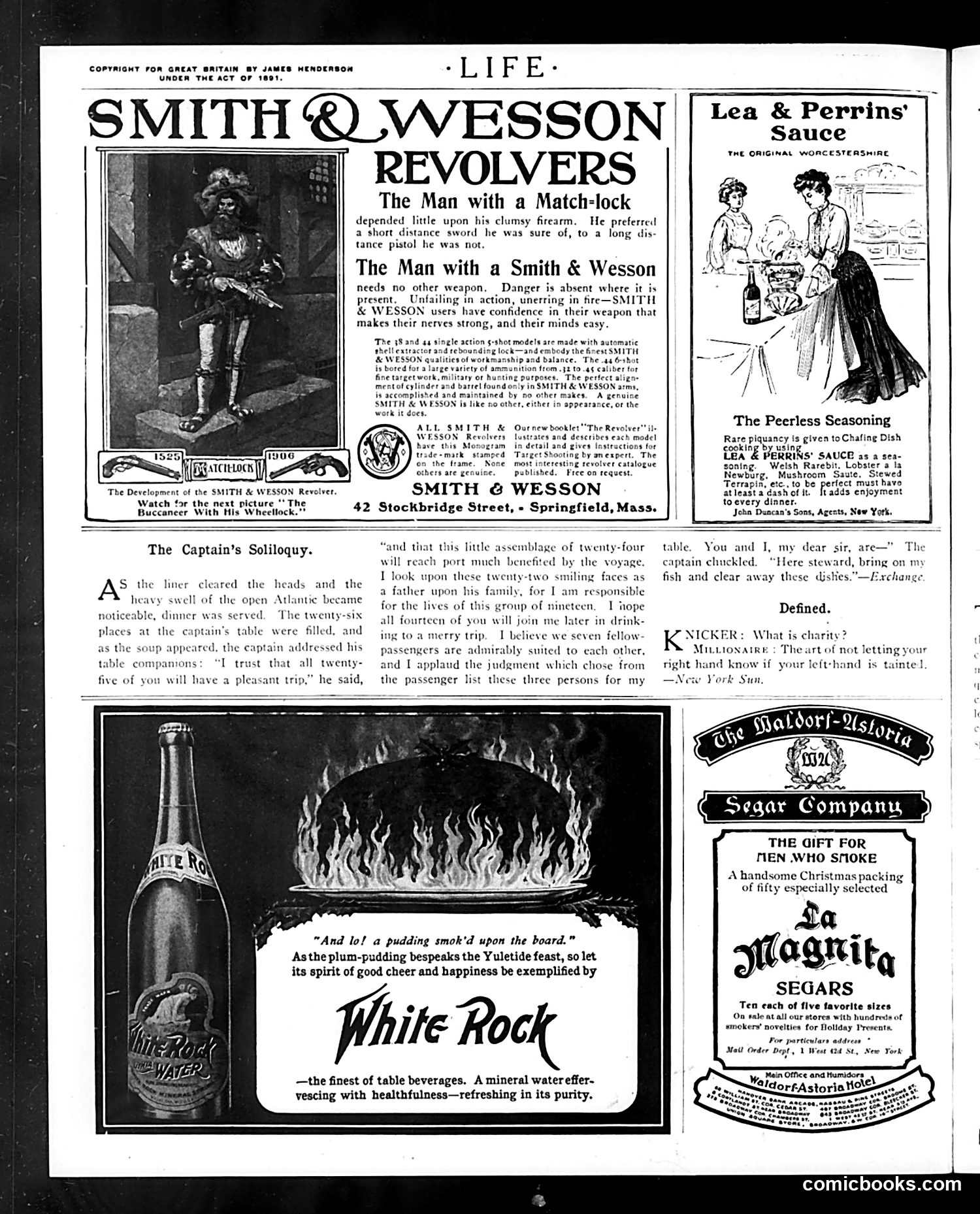
This page is primarily **advertising**, not political satire. The main content promotes consumer products typical of early 1900s Life magazine: 1. **Smith & Wesson Revolvers** - A lengthy ad contrasting the "man with a match-lock" (outdated sword user) against the modern "man with a Smith & Wesson," emphasizing reliability and confidence. This is straightforward product marketing, not satire. 2. **Lea & Perrins' Sauce** - Advertisement for their "Peerless Seasoning" condiment. 3. **White Rock Water** - Mineral water advertised as healthful and pure, with an illustration of plum pudding and flames (Yuletide imagery). 4. **Da Magrita Segars** - A cigar advertisement marketed as a Christmas gift for smokers. The page contains no identifiable political cartoons or satirical commentary—it's a collection of period advertisements.
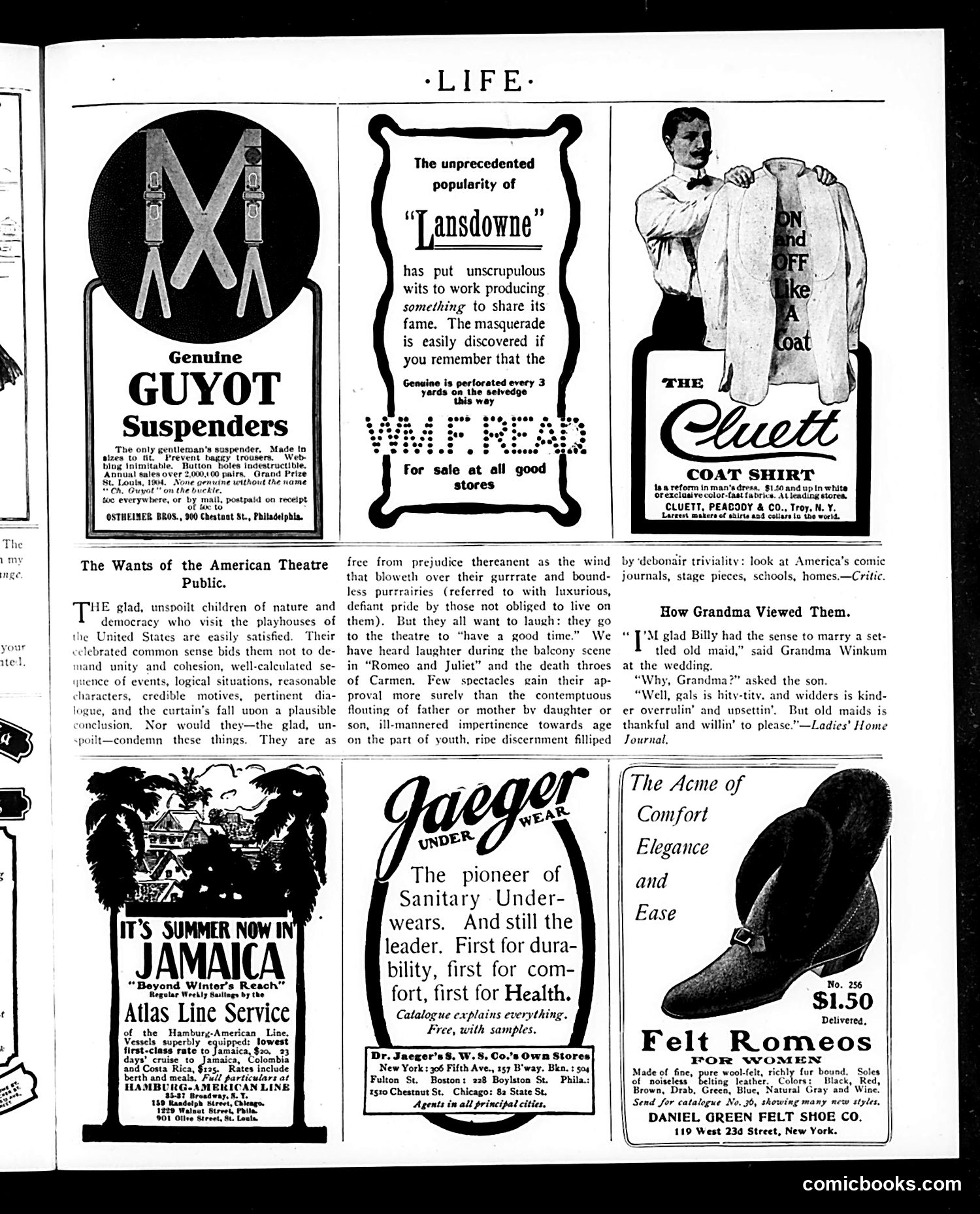
This page is primarily **advertising**, not satirical content. The top third contains an article titled "The Wants of the American Theatre Public," discussing audience preferences for comedy and relatable characters in plays—a straightforward cultural commentary rather than satire. The bulk of the page features five period advertisements: Guyot Suspenders, Lansdowne coats, Cluett dress shirts, Jaeger underwear, Atlas Linc steamship service to Jamaica, and Felt Romeos shoes. One small anecdote, "How Grandma Viewed Them," mildly satirizes elderly people's prudishness about modern theater by contrasting an old woman's disapproval with younger audiences' enjoyment. The page reflects early 20th-century consumer culture and leisure advertising rather than political commentary.
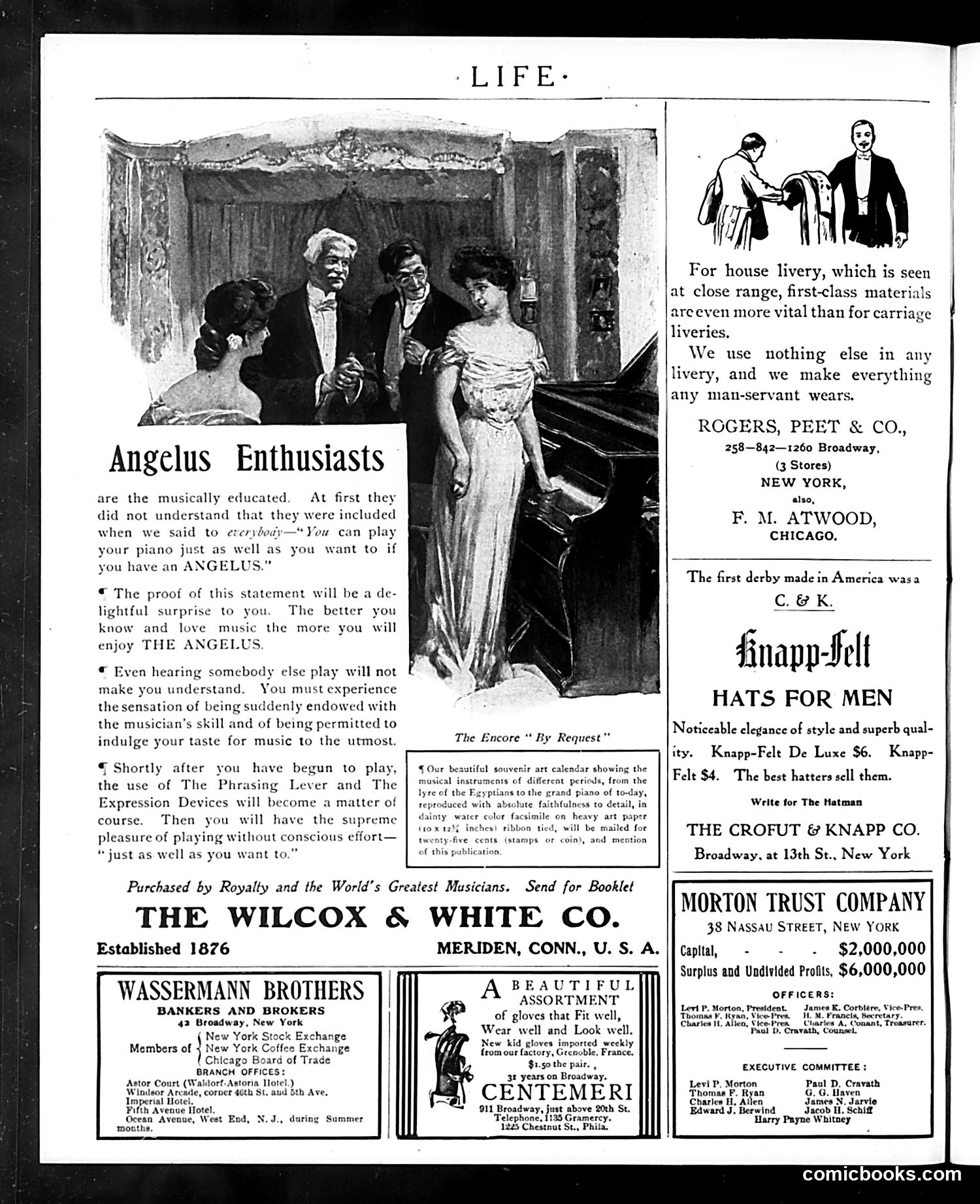
This page is primarily **advertising**, not political satire. The main content features an advertisement for "Angelus Enthusiasts"—a piano brand called "The Angelus." The illustration shows a well-dressed couple and two men gathered around a piano, captioned "The Encore 'By Request.'" The ad argues that Angelus pianos are so superior that anyone can play them well, even without formal training. It appeals to aspiring musicians of the educated classes. The remaining page space contains advertisements for other luxury goods: Rogers Peet & Co. (clothing), Knapp-Felt hats, Centimeri gloves, Wassermann Brothers (stockbrokers), and the Morton Trust Company. There is **no political cartoon** on this page—it's a typical early 20th-century magazine layout mixing editorial space with paid advertisements.
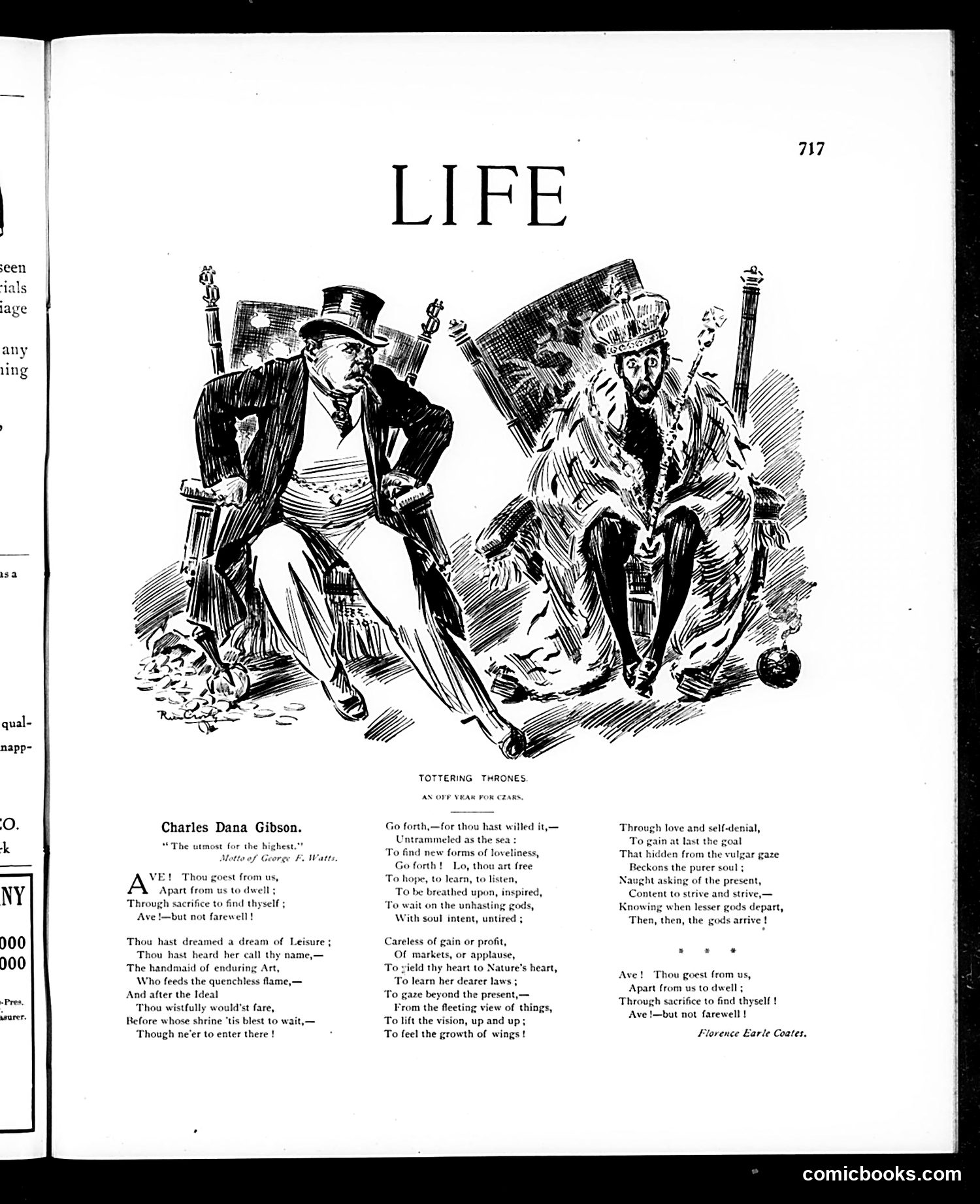
This satirical cartoon depicts two monarchs sitting on unstable thrones, illustrating political instability in early 20th-century Europe. The page includes a poem by Charles Dana Gibson and verses by Florence Earle Coates addressing themes of ambition, spiritual growth, and the transience of power. The cartoon's title "Tottering Thrones" and the shaky throne imagery suggest commentary on European royalty facing challenges—likely referencing pre-World War I political turbulence or revolutionary threats. The figures appear to represent European monarchs, though specific identities aren't clear from the image alone. The satirical point critiques how rulers pursue material gain and worldly acclaim rather than spiritual development, warning that thrones built on shallow foundations inevitably collapse. The poetry reinforces this moral lesson about ambition versus noble purpose.
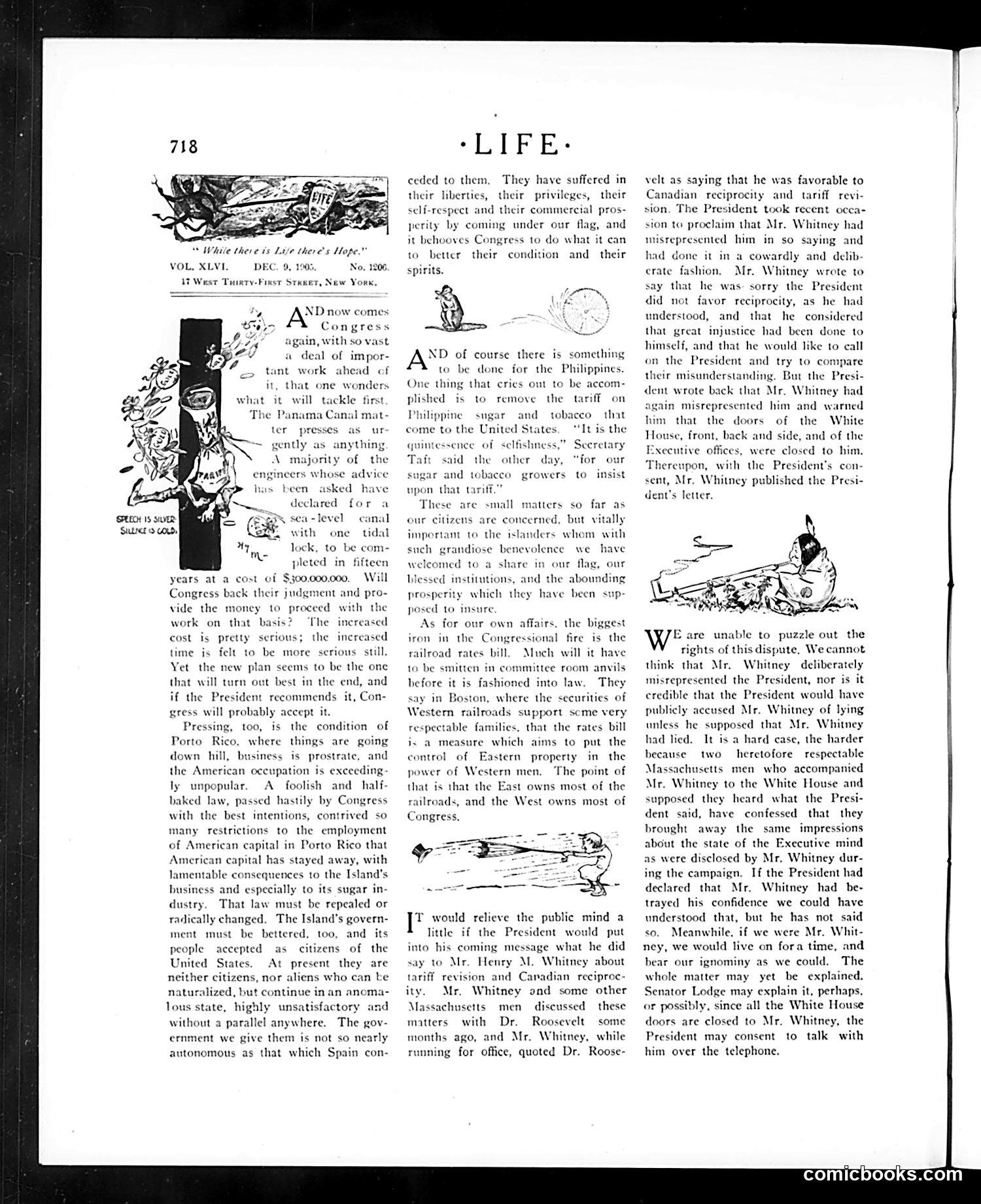
This page discusses Congressional business and Philippine tariffs. The left column contains editorial cartoons criticizing a proposed sea-level canal project that Congress had debated for fifteen years at enormous cost ($200,000,000), which the editor calls foolish. The main text addresses Mr. Henry M. Whitney's dispute with President Roosevelt over tariffs on Philippine sugar and tobacco. Whitney, a Massachusetts businessman, had met with Roosevelt to discuss these trade matters. The editorial expresses frustration that it cannot determine who misrepresented whom—whether Whitney or the President—regarding reciprocal trade policies. The piece suggests the White House doors are now closed to Whitney, treating the incident as a minor but telling example of executive-legislative tension over economic policy.
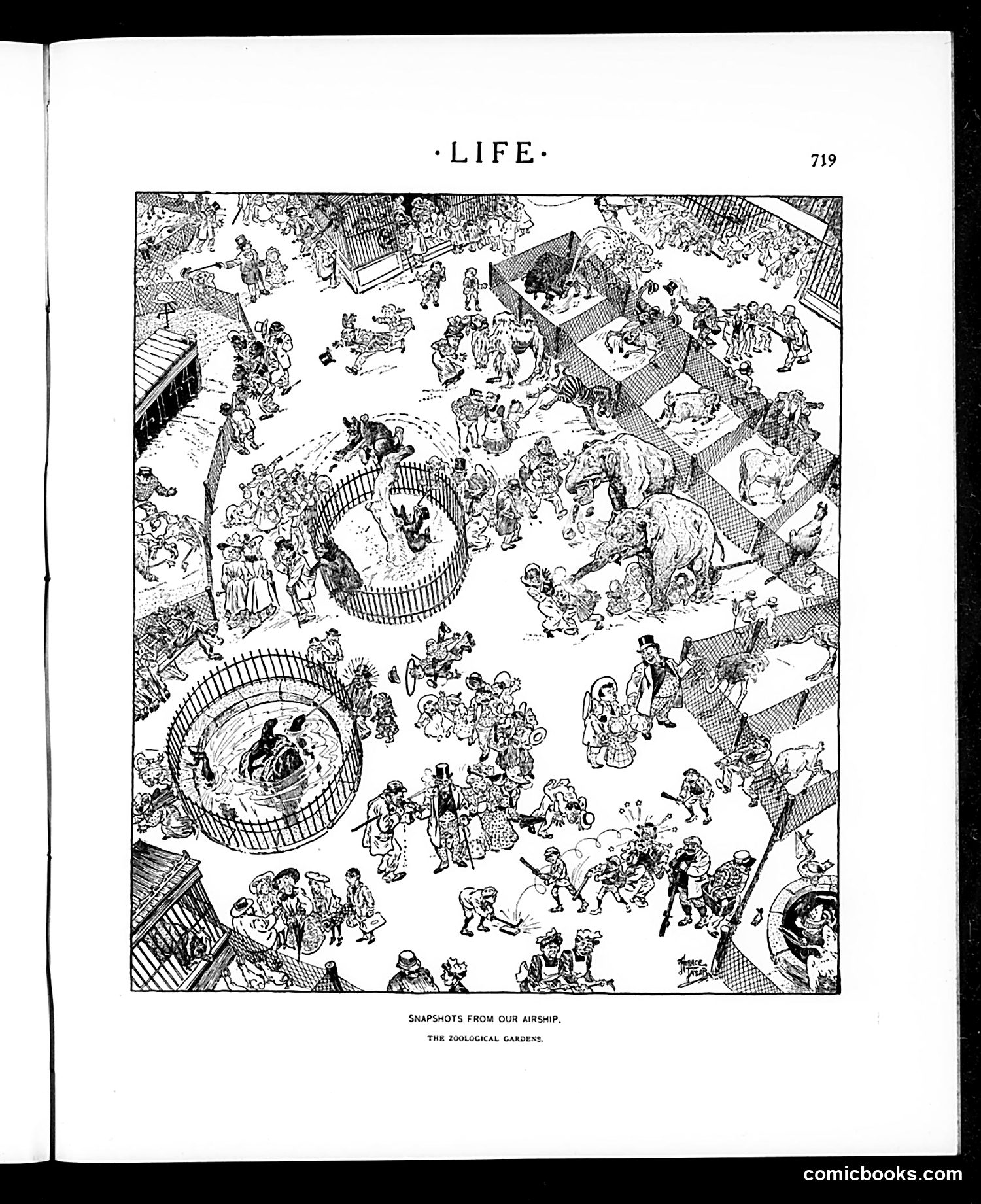
This is an aerial bird's-eye view illustration titled "Snapshots from Our Airship: The Zoological Gardens," depicting a zoo from above. The page shows no political figures or satirical commentary. Instead, it's a humorous observational cartoon showing crowds of visitors at a zoological garden as seen from an aircraft. The satire appears gentle: the packed crowds of tiny figures, various animal enclosures with railings, and the chaotic activity suggest commentary on the novelty and popularity of zoos as public attractions, and perhaps the amusing spectacle of humans observing animals while themselves being "observed" from above by the airship's perspective. This represents early 20th-century leisure culture and the growing fascination with both aviation and public zoo visits.
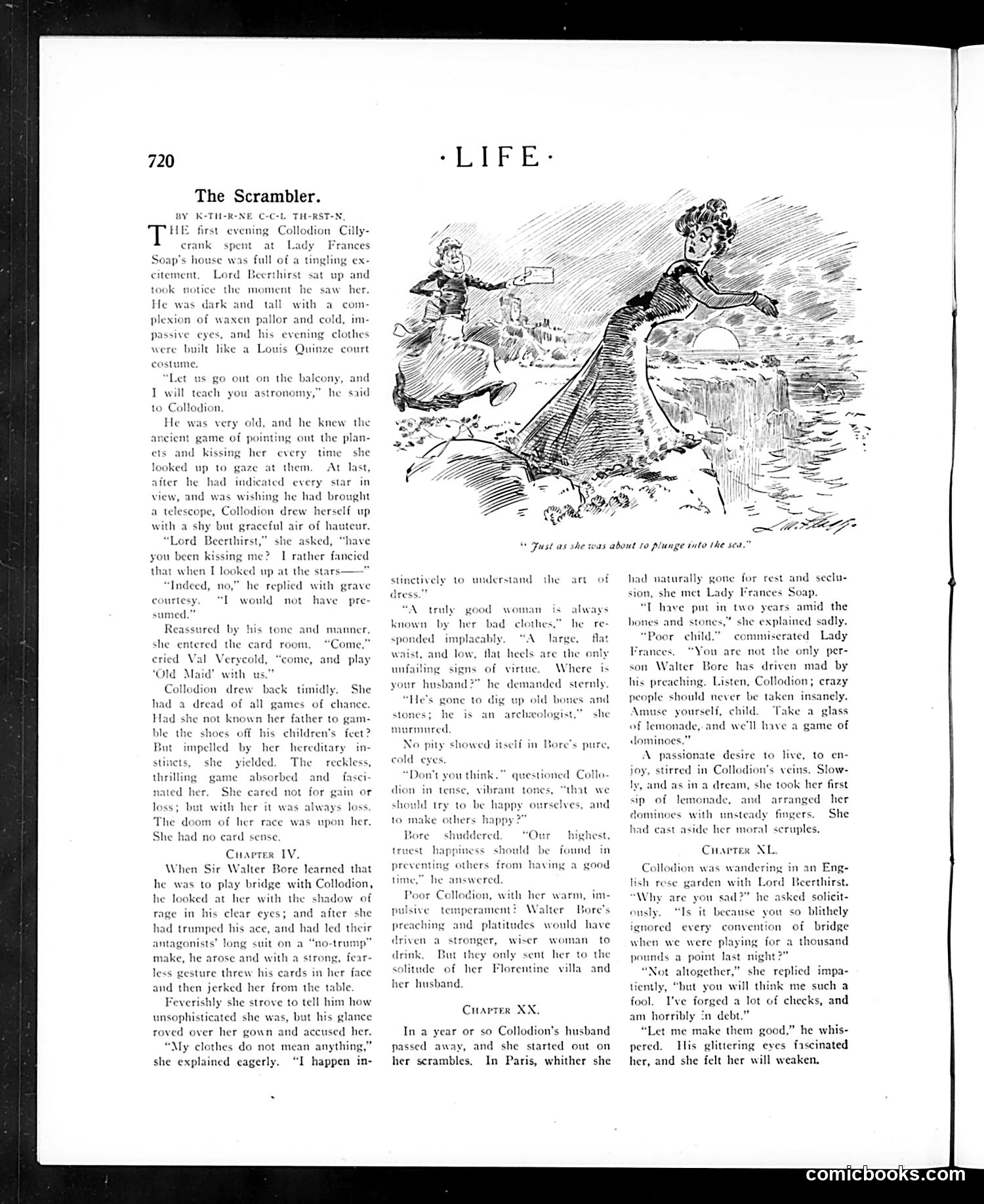
This page presents a serialized story titled "The Scrambler" by Katherine Cleland, illustrated with a sketch showing two women in period dress on what appears to be a seaside setting. The narrative concerns Lord Beerbohm and Lady Frances Soap's evening social gathering. The story involves romantic tension and character development—Lord Beerbohm's attentions toward Lady Frances, her resistance, and complications involving her husband Walter Bore and their financial troubles. The illustration captures a dramatic moment with the caption "Just as she was about to plunge into the sea," suggesting melodramatic plot developments typical of serialized fiction in this era. This appears to be straightforward serialized literature rather than political satire or social commentary—simply entertainment fiction for Life's readers.
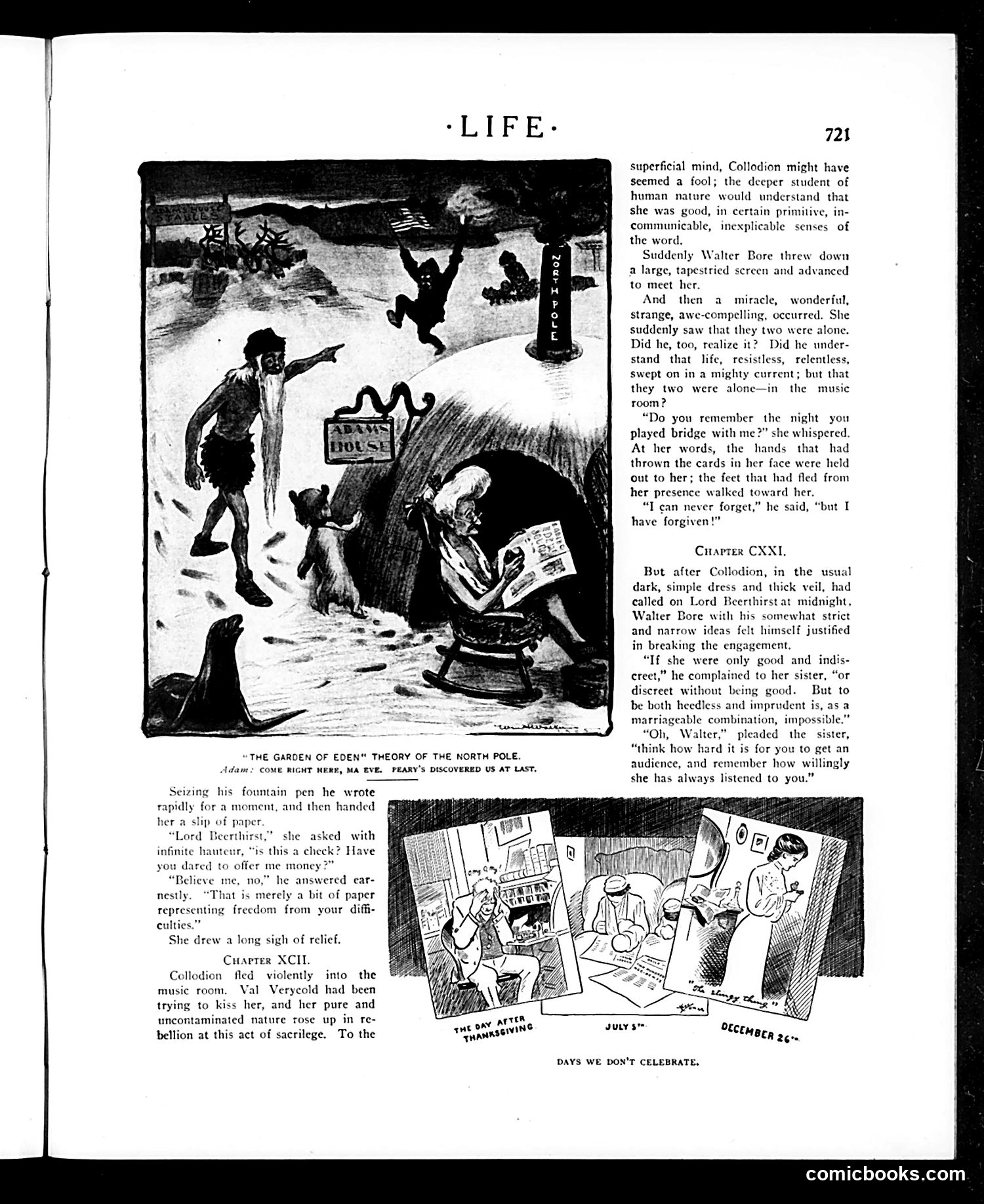
This page contains serialized fiction with illustrations rather than political cartoons. The main image shows a fantastical scene captioned "The Garden of Eden" Theory of the North Pole—Adam Come Right Here, He Peary's Discovered Us At Last," depicting explorers discovering inhabitants at the North Pole. The bottom illustration titled "Days We Don't Celebrate" shows three panels labeled "The Day After Thanksgiving," "July 5th," and "December 26th"—depicting the mundane letdown periods following major holidays. Both pieces are humorous social commentary: the top satirizes Arctic exploration narratives popular in that era, while the bottom jokes about the anticlimax of post-holiday life returning to ordinary routines. The satire targets readers' familiarity with both exploration mythology and holiday culture rather than specific political figures.
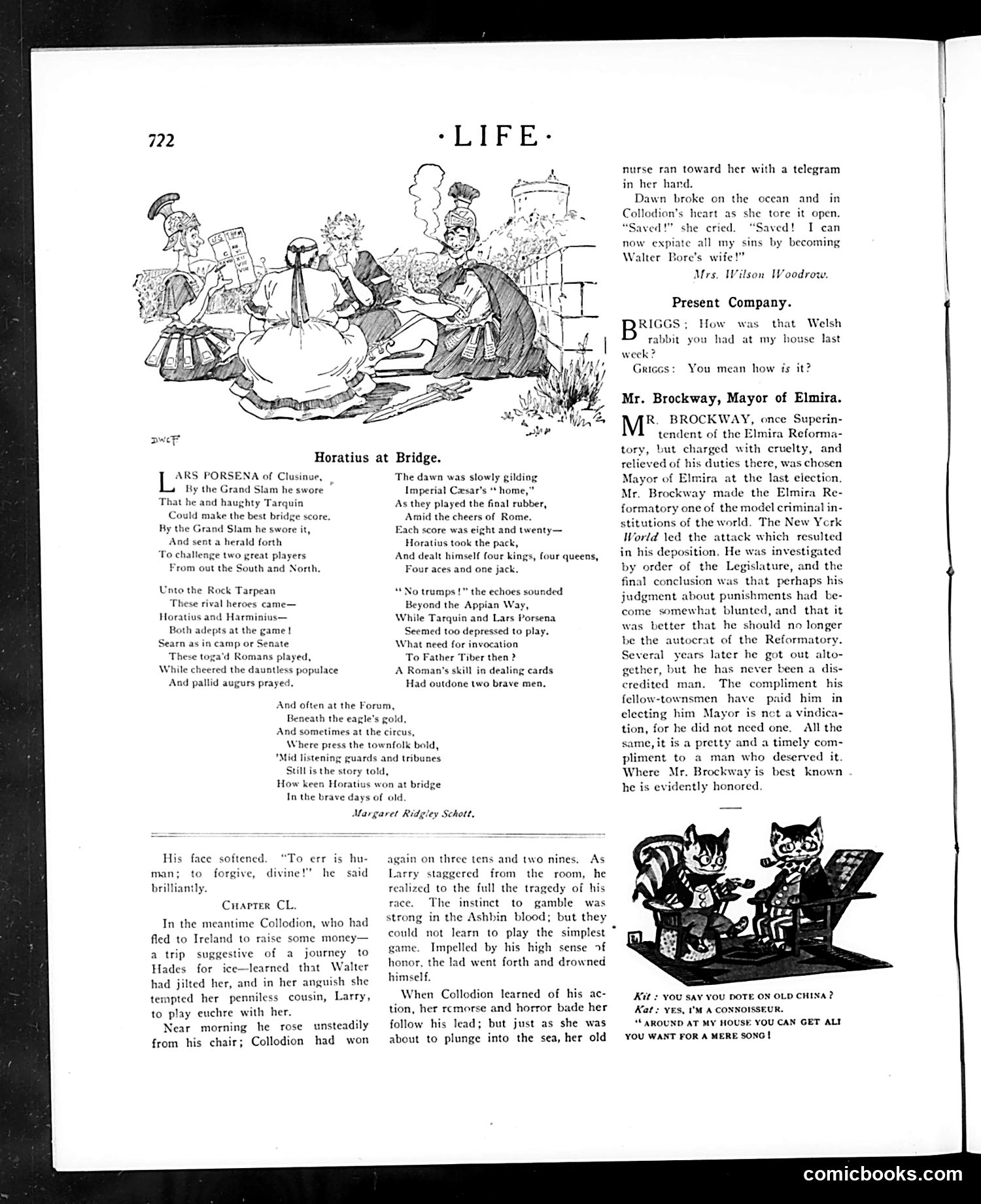
This page contains a satirical section about **Mr. Brockway, Mayor of Elmira**, a former Superintendent of the Elmira Reformatory who was charged with cruelty and removed from his position. He was subsequently elected Mayor. The text mocks this outcome as absurd—that someone investigated and presumably discredited for mistreating inmates at a reformatory would nonetheless be elected to higher office. The satire suggests citizens voted for him despite (or ignorant of) his problematic record, characterizing this as a commentary on public judgment and electoral choices. The section also includes unrelated literary content ("Horatius at Bridge") and a joke about Chinese porcelain at the bottom. The illustrated vignettes appear decorative rather than directly satirical to this narrative.
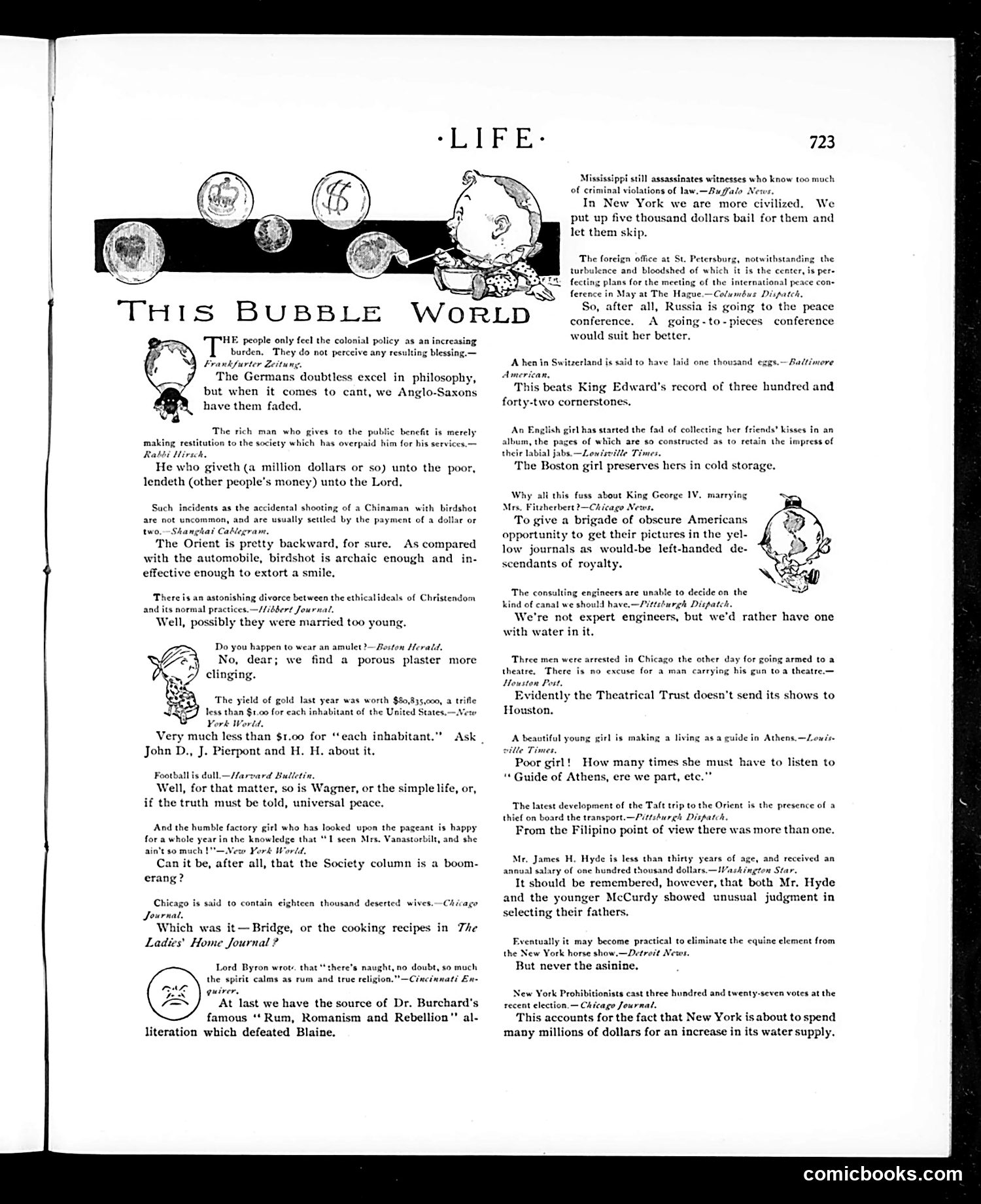
This page satirizes early 20th-century social and political follies through brief anecdotes and small cartoons. The main visual—bubbles floating above the text—symbolizes how insubstantial and temporary these issues are. Key targets include: - **Colonial policy**: Mocked as increasingly burdensome - **Wealth inequality**: A rich man's public "charity" is merely redistributing stolen wages - **Social hypocrisy**: Contrasts Christian ideals with actual practices - **Specific incidents**: Including a Chicago man arrested for carrying a gun to a theater, and criticism of New York's water supply spending The cartoons depict cherubic figures representing these absurdities. The overall message: contemporary society is preoccupied with trivial or hypocritical concerns—mere bubbles—rather than substantive reform.
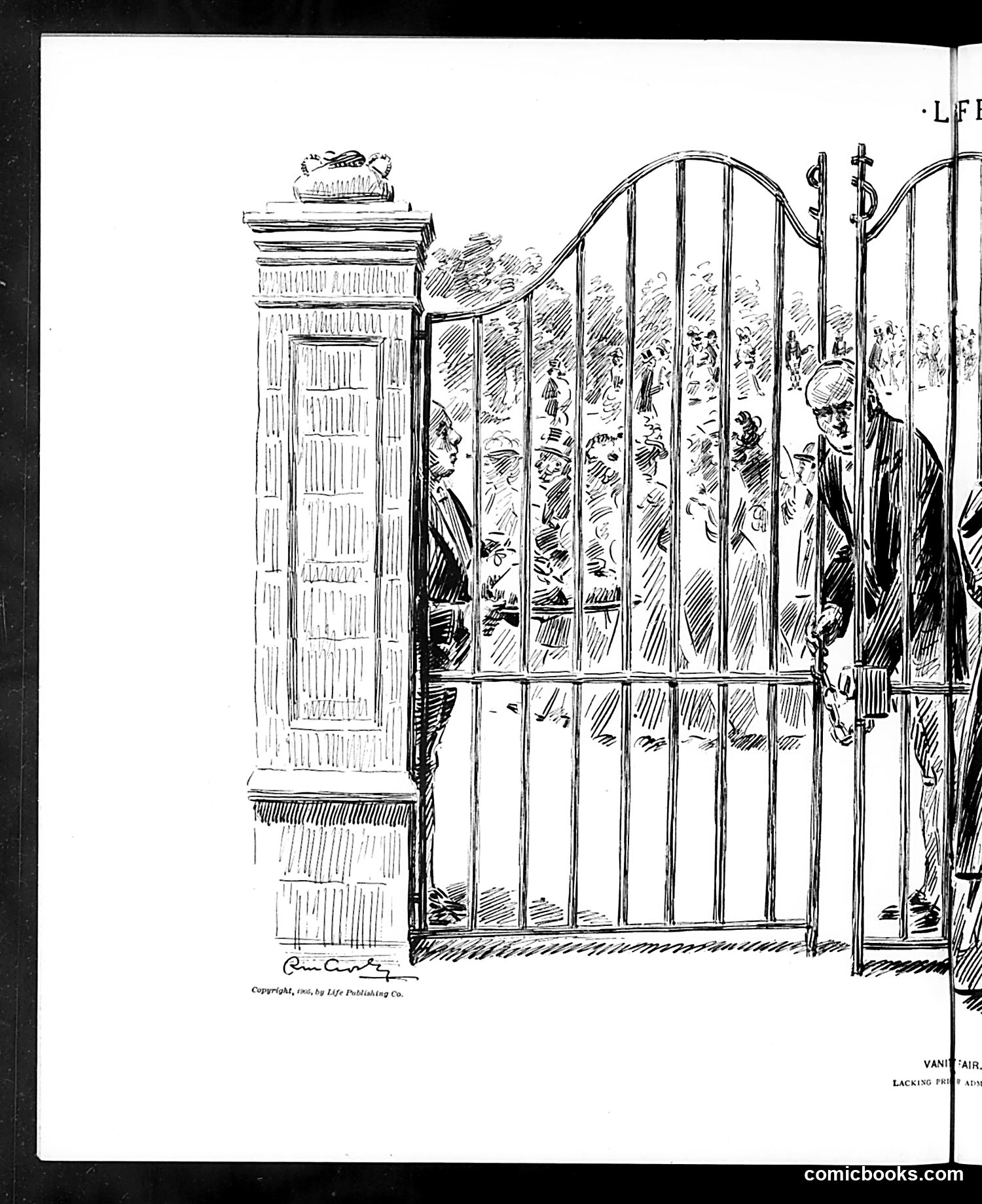
This is a political cartoon by Cesare Carpani (signature visible) from Life magazine, copyright 1905. The image shows a well-dressed man in formal attire standing outside an ornate iron gate, peering through at what appears to be a crowded social gathering or reception inside a grand building (visible through the gate's decorative panels). The cartoon satirizes **social exclusion** or **being denied entry to elite circles**. The contrast between the formally-dressed outsider and the crowd visible beyond the barrier suggests commentary on class barriers, social climbing, or the difficulty of gaining access to exclusive social events or institutions in the Gilded Age. The specific identity of the figure remains unclear without additional context.
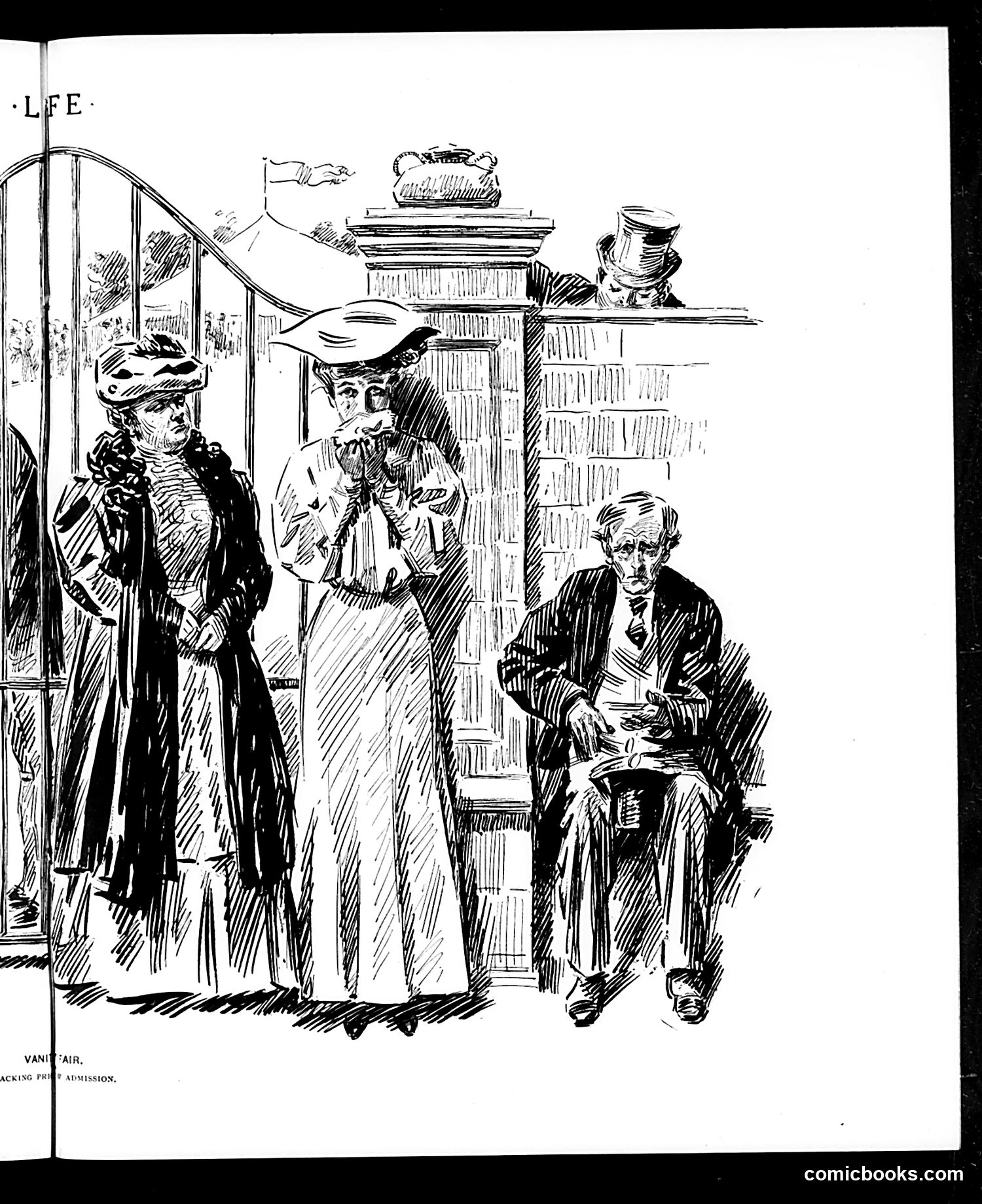
This appears to be a satirical cartoon from Life magazine depicting a scene of social hierarchy and class distinction. The illustration shows well-dressed women and gentlemen in Victorian-era clothing, with figures arranged to suggest different social standings. A seated older man in dark clothing appears to be in a position of lesser status, while fashionably-dressed women and a gentleman in a top hat occupy more prominent positions. The partial caption mentions "VANITY FAIR" and "ACKING FOR ADMISSION," suggesting this satirizes social climbing or attempts to gain entry into exclusive circles. The cartoon likely critiques the arbitrary nature of social acceptance and class pretension of the era. However, without clearer text, I cannot identify specific historical figures being caricatured.
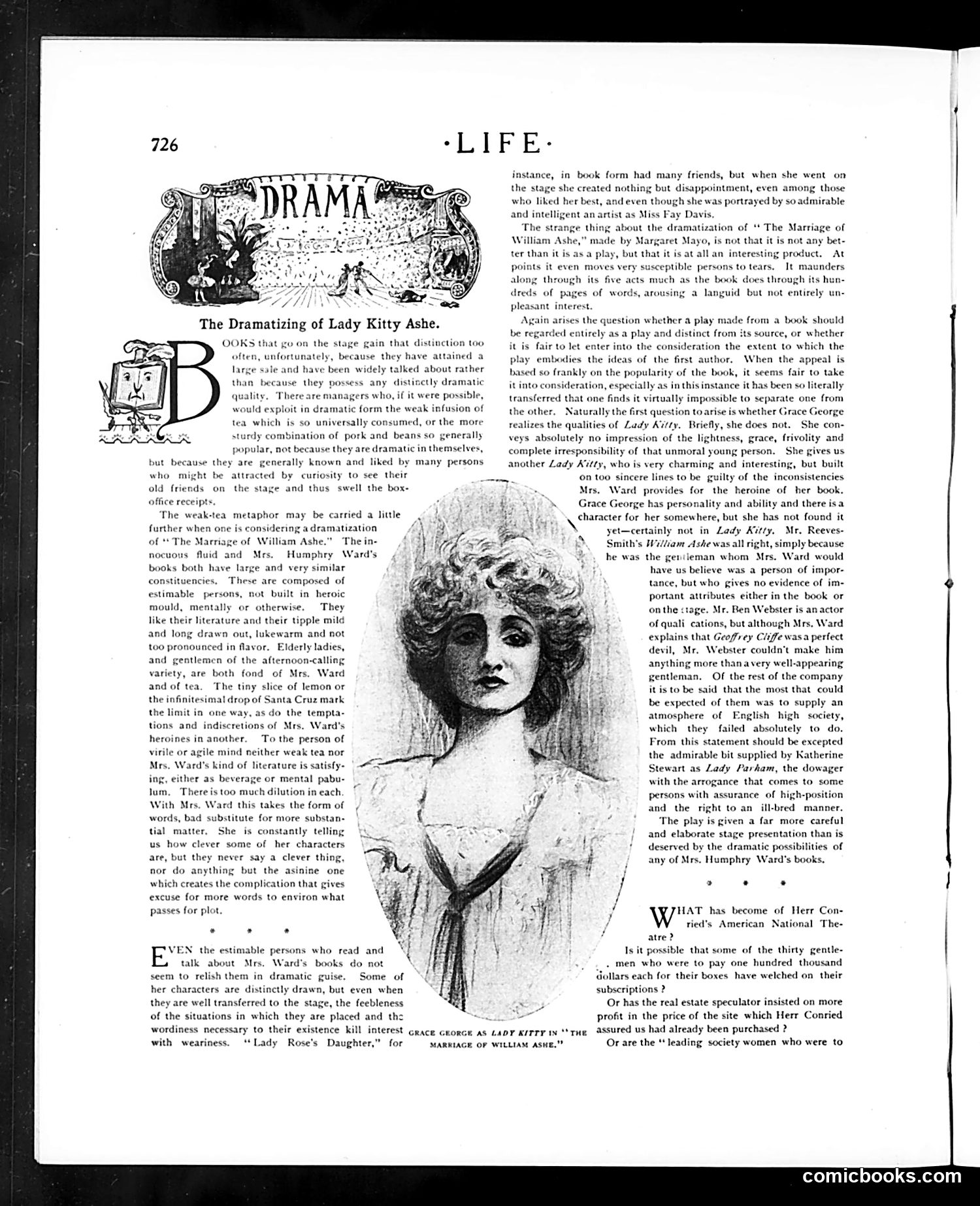
This page critiques the stage adaptation of Mrs. Humphry Ward's novel "The Marriage of William Ashe," dramatized by Margaret Mayo and starring Grace George (shown in the sketch). The satire attacks both Ward's writing style and the adaptation itself. The critic uses "weak tea" as a metaphor for Ward's diluted, verbose novels—full of telling rather than showing, with characters described as clever but never saying anything clever. The books appeal to "estimable persons" of genteel, afternoon-calling society who prefer mild, drawn-out entertainment. The adaptation fails because it merely transplants this wordiness to stage, creating languid five-act plays that preserve the novel's faults without gaining dramatic strength. The critic questions whether a play adapted from a popular book should be judged as drama or as literature—ultimately arguing that when marketing exploits the book's popularity, the adaptation's literary faithfulness becomes fair game for criticism. The point: popular success doesn't equal artistic merit, especially when adapting to different media.
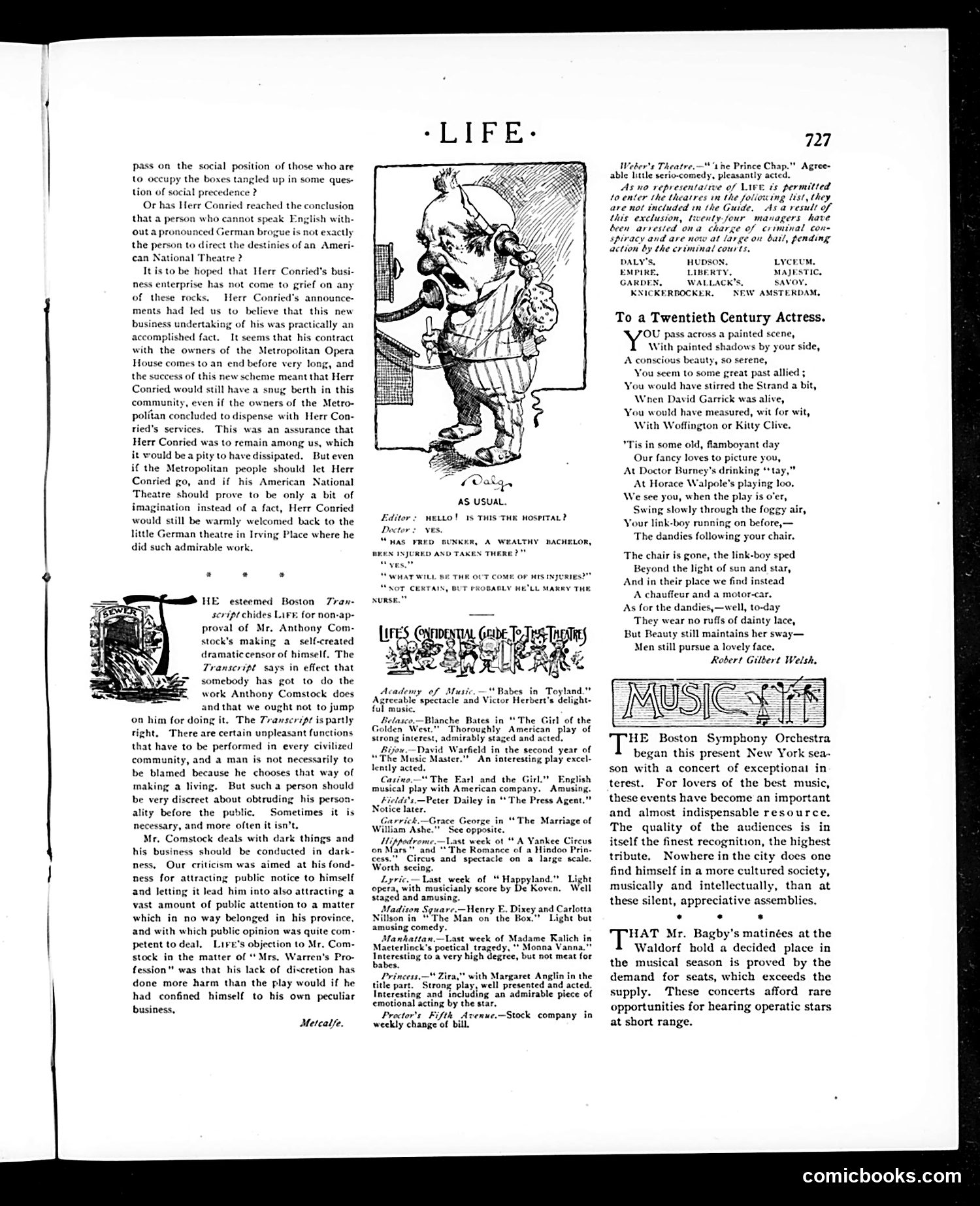
The main cartoon depicts a telephone conversation between a hospital and a caller inquiring about an injured wealthy bachelor named Fred Bunker. The joke's setup asks about medical costs; the punchline reveals the nurse will marry him—suggesting wealthy patients attract matrimonial rather than medical interest. The surrounding editorial discusses Herr Conried, director of the Metropolitan Opera House. The text critiques whether this German-accented impresario can properly direct an American national theatre, questioning both his linguistic abilities and business judgment. It argues his new venture may fail, though the author expresses hope Conried could return to his successful work at the "little German theatre in Irving Place." The satire targets: (1) opportunistic marriages involving wealthy patients and medical staff, and (2) skepticism about foreign-born leadership of American cultural institutions, reflecting period anxieties about immigration and national identity.
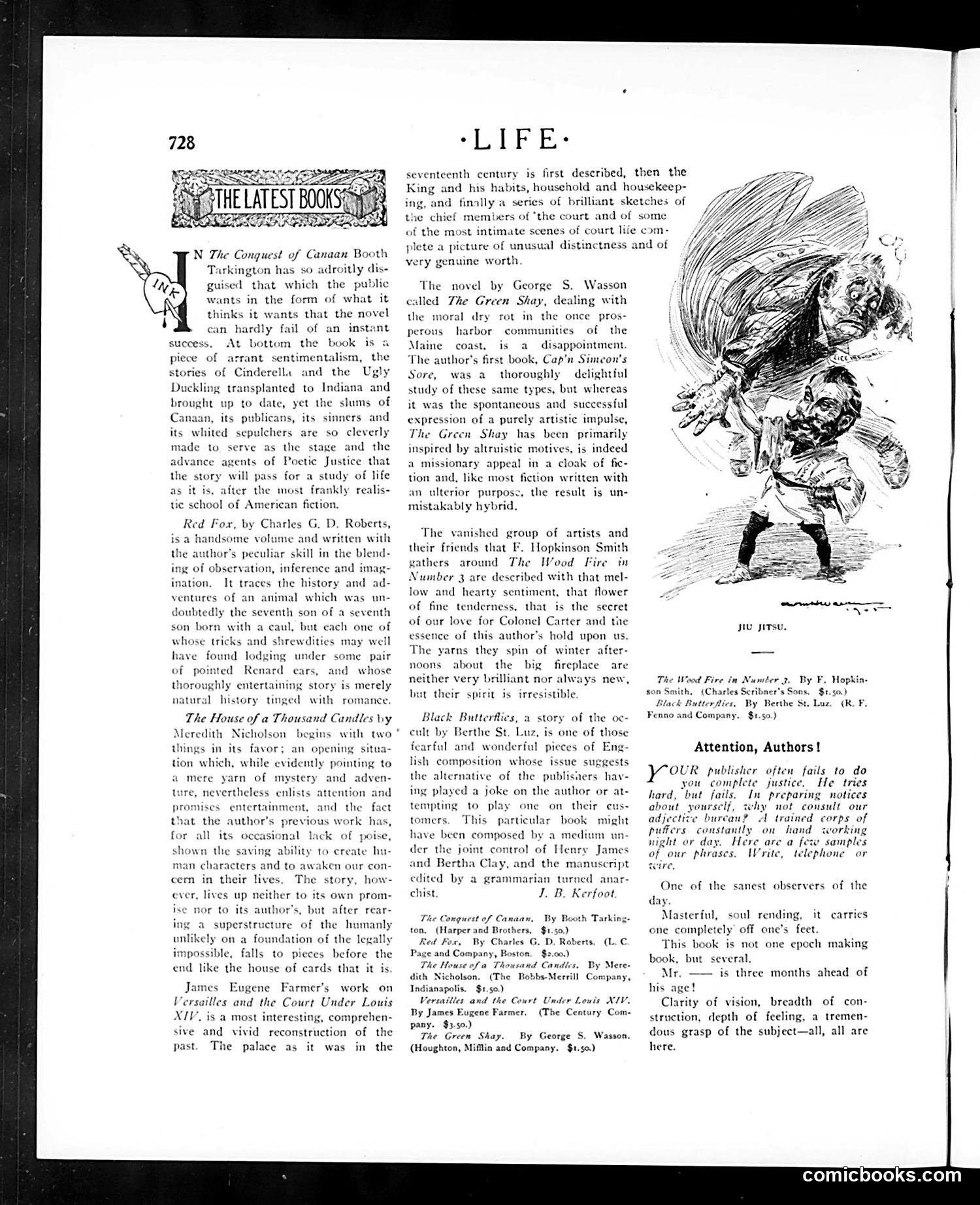
This page from *Life* magazine consists primarily of **book reviews**, not political satire or editorial cartooning. The small illustration on the right depicts a domestic scene—likely related to one of the reviewed novels—showing figures by a fireplace. The reviews discuss contemporary fiction by authors including Booth Tarkington (*The Conquest of Canaan*), George S. Wasson (*The Green Shay*), and F. Hopkinson Smith (*The Wood Fire in Number 3*). The critics assess these works with characteristic early-20th-century literary judgment, praising some for artistic merit while criticizing others as overly sentimental or didactic. A sidebar titled "Attention, Authors!" humorously advises writers to provide clear biographical information to publishers, suggesting some authors had been neglectful about this practical detail. The page serves as *Life's* book column rather than as political commentary—a standard feature in the satirical magazine's mix of humor, criticism, and cultural commentary.
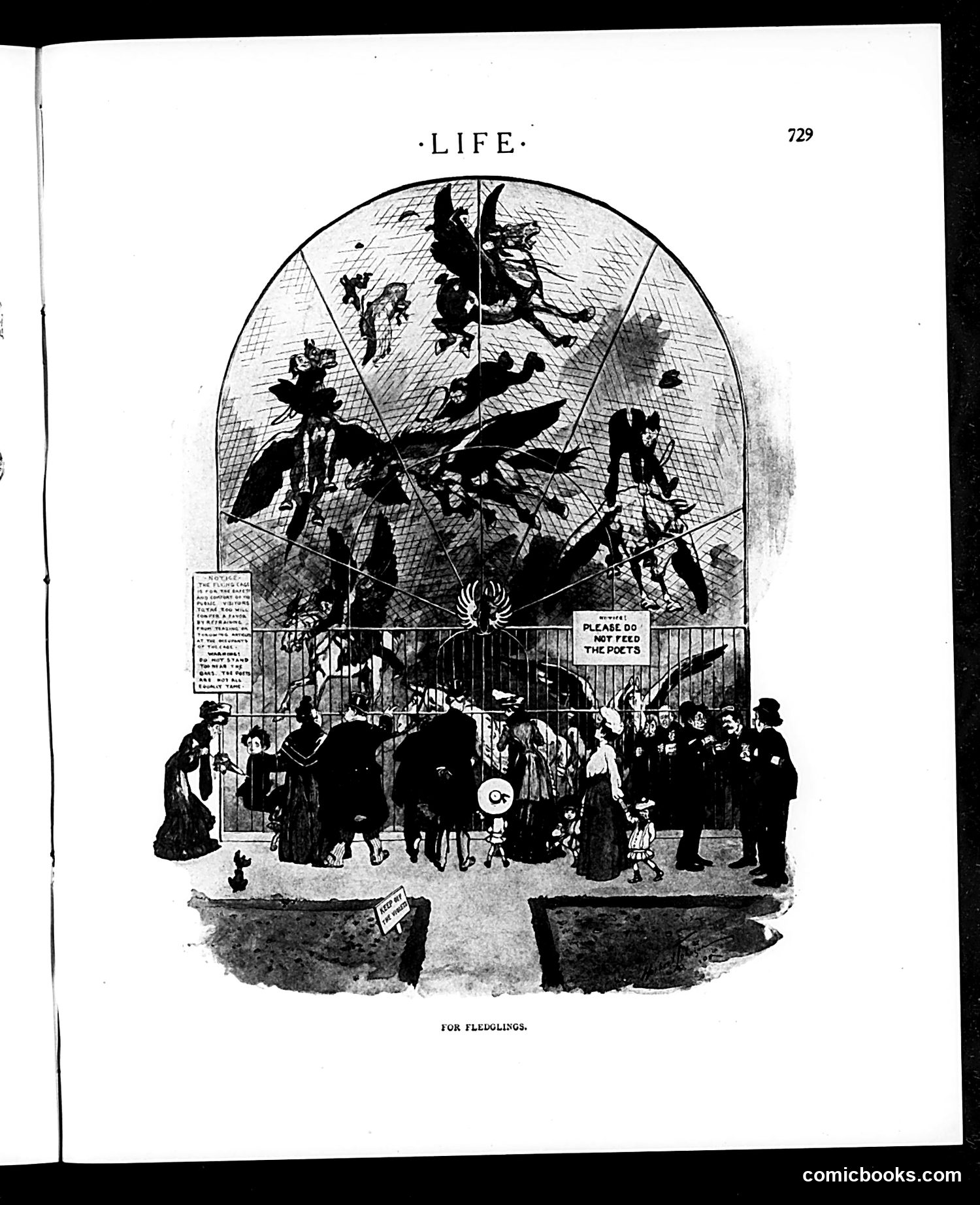
This satirical cartoon depicts a zoo or exhibition labeled "LIFE" where various figures perform chaotically within a large dome enclosure. A crowd of well-dressed visitors observes below, separated by a railing. A sign reads "PLEASE DO NOT FEED THE POETS." The satire targets poets and literary figures as curiosities to be caged and observed like animals. The "do not feed" sign—mimicking zoo warnings—mocks poets as creatures needing restraint from public interaction. The frenzied activity within suggests chaotic, undisciplined behavior. The title "For Fledglings" implies this exhibition serves as instruction for inexperienced observers, possibly satirizing how Life magazine presents culture and society to its readers as spectacle for consumption.
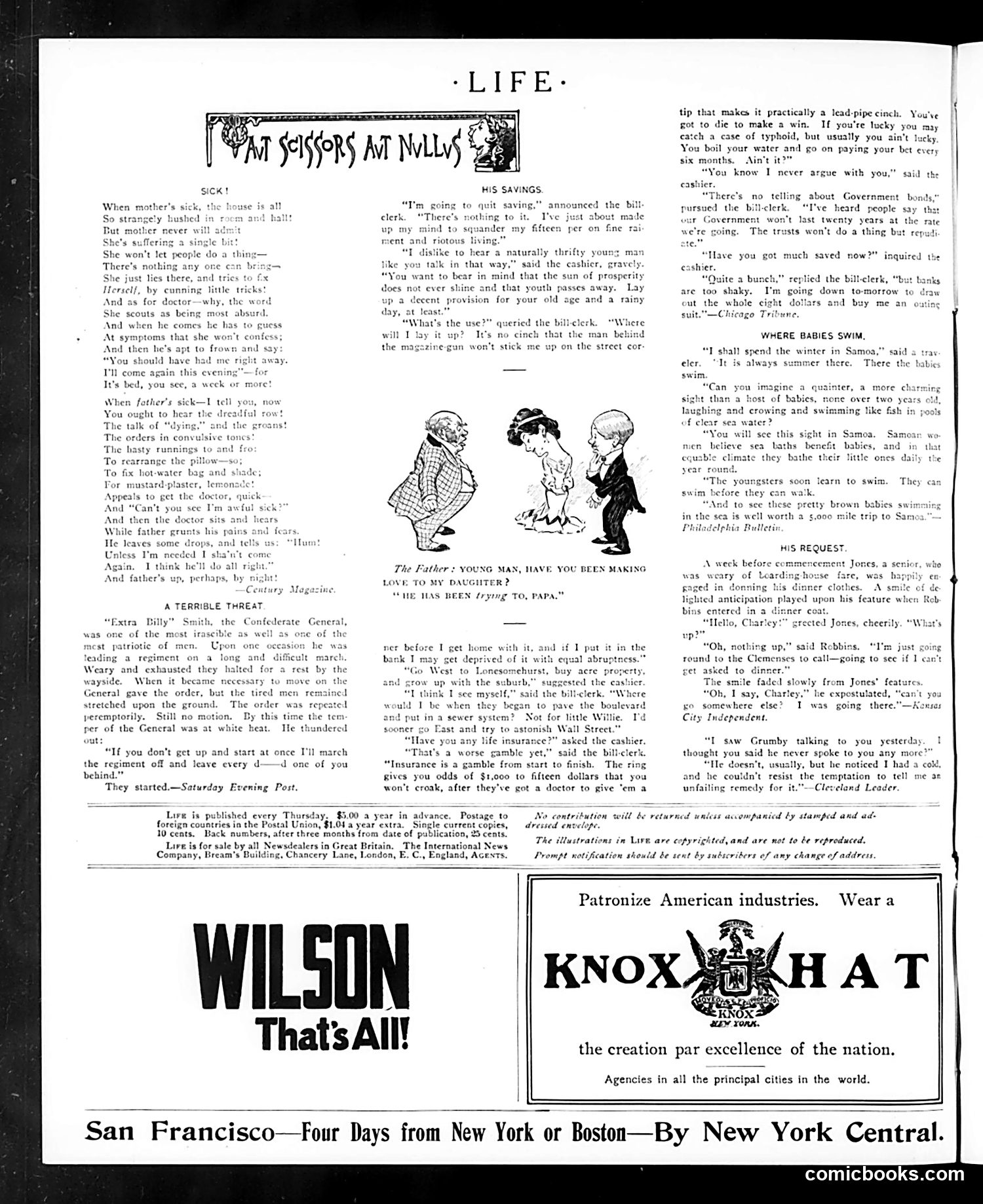
This page contains three satirical pieces typical of Life's social commentary: **"Scissors and Nulls"** contrasts how families treat sick mothers versus fathers. The satire suggests women endure illness stoically without complaint, while men dramatize their ailments and demand attention—mocking masculine self-pity. **"His Savings"** depicts a young clerk dismissing thrift and government bonds as pointless, planning to squander money on "riotous living" instead. The cashier's stern response—warning that prosperity doesn't last and youth passes—represents traditional moral disapproval of wasteful spending, likely reflecting post-Panic anxieties about financial responsibility. **"Where Babies Swim"** and **"His Request"** are brief anecdotes: one romanticizing tropical infant swimming in Samoa; the other a humorous "terrible threat" of a father confronting his daughter's suitor. The ads below (Wilson hats, Knox hats) promote American products. The overall tone reflects early-1900s middle-class concerns: family dynamics, financial prudence, and courtship propriety.
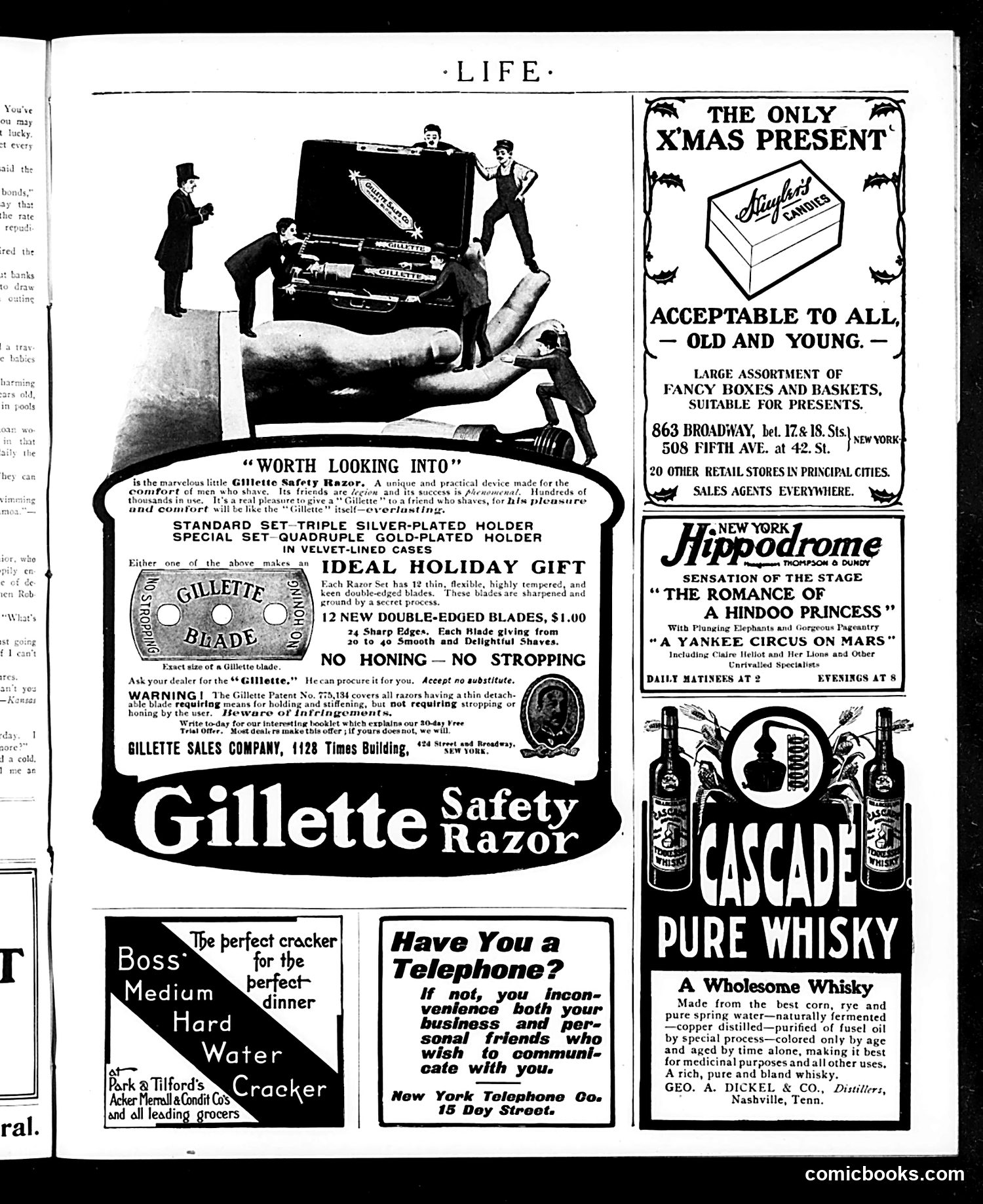
This page consists primarily of **advertisements**, not political cartoons or satire requiring historical context. The main visual element—"Worth Looking Into"—is a Gillette Safety Razor ad showing men examining an oversized razor, using humor to promote the product as an "ideal holiday gift." The illustration is commercial, not satirical. The surrounding ads (Christmas candy boxes, theater productions at the Hippodrome, whisky, a telephone company pitch, and crackers) are standard period marketing with no apparent political or social satire. The only mildly clever element is the telephone company's rhetorical question asking if readers lack a phone—a gentle sales pitch rather than satire. The ads collectively reflect early 20th-century consumer culture and gift-giving conventions, but contain no commentary or jokes requiring historical unpacking for a modern reader.
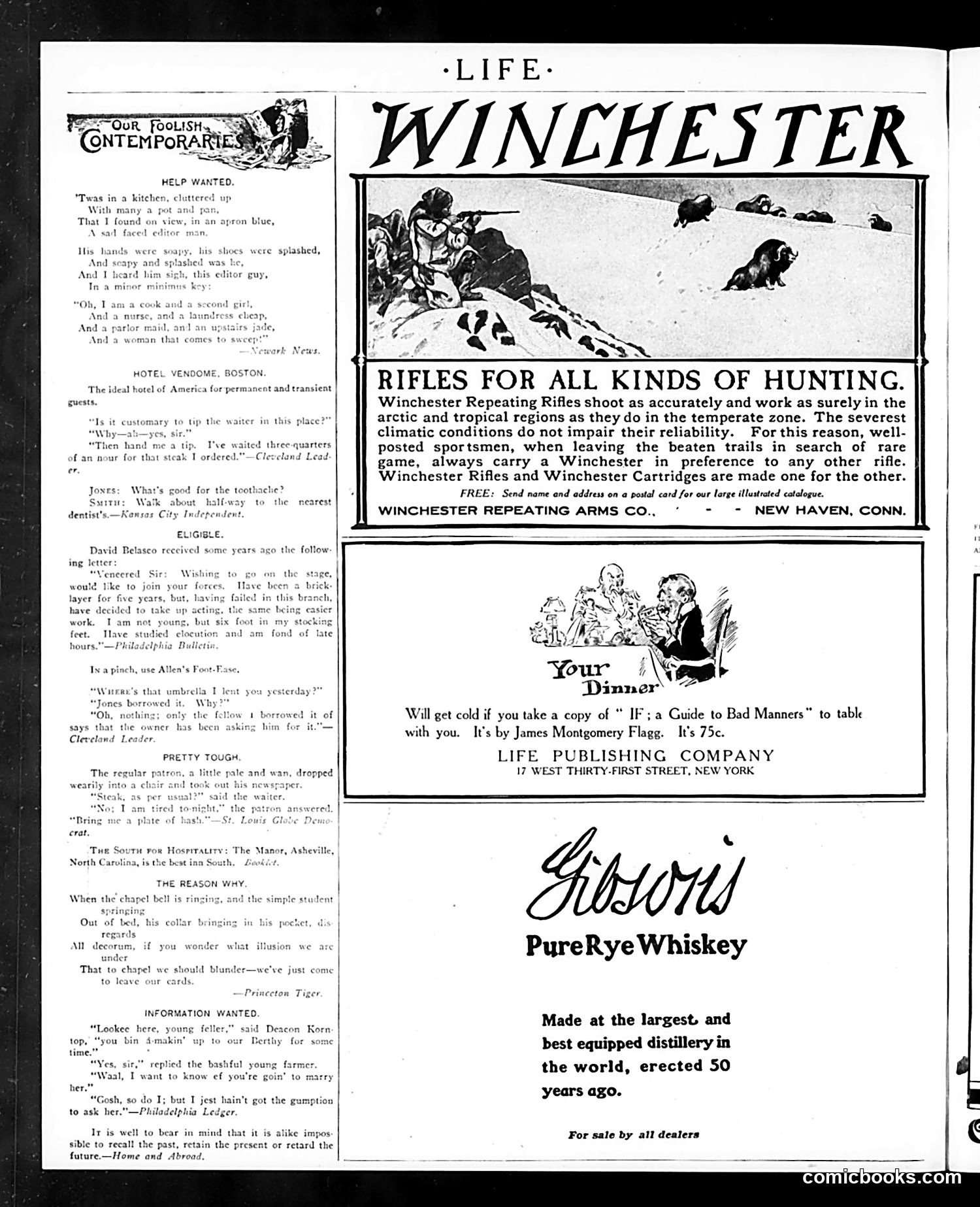
This page from Life magazine is primarily **advertising and humor content** rather than political satire. The left column contains **"Our Foolish Contemporaries,"** a humor section featuring brief anecdotes and jokes clipped from other publications, poking fun at everyday social situations—a waiter's rudeness, romantic confusion, chapel etiquette violations, and courtship awkwardness. These are gentle, domestic comedy sketches with no political dimension. The right side features **full-page advertisements**: Winchester Repeating Rifles (emphasizing reliability in extreme climates for hunters), a Life Publishing Company book promotion by James Montgomery Flagg, and Gibson's Pure Rye Whiskey. The **hunting illustration** at the top of the Winchester ad shows dogs pursuing game in snow—a straightforward product image, not satire. There are **no political cartoons or caricatures** on this page. The humor is social commentary on manners and relationships rather than political critique. This appears to be a standard early-20th-century magazine page blending light entertainment with commercial content.
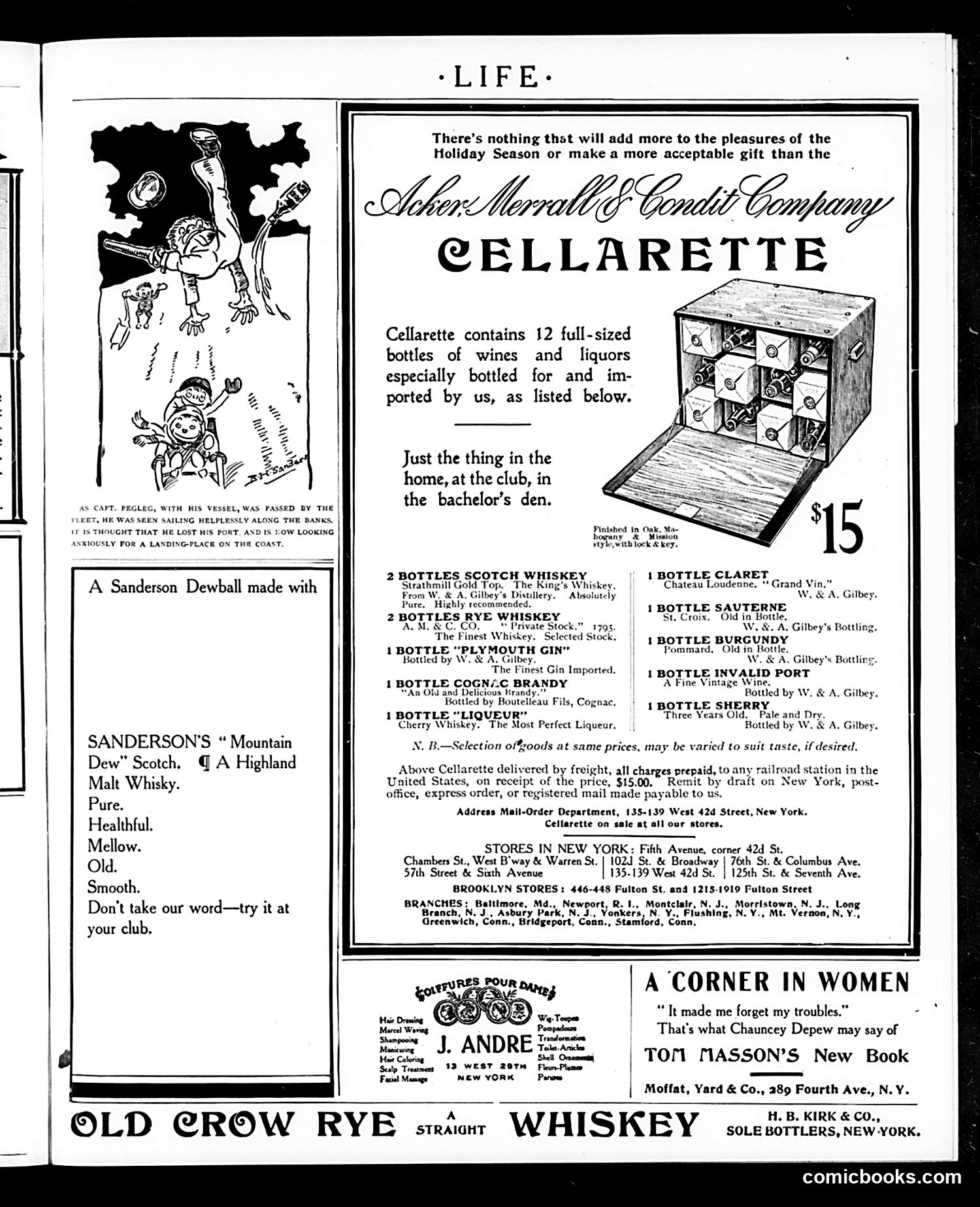
This page is primarily **advertising**, not political satire. The dominant content is a liquor advertisement for a "Cellarette"—a wooden cabinet containing twelve bottles of imported wines and spirits, priced at $15, marketed as an ideal holiday gift for homes, clubs, and bachelor residences. The small cartoon at upper left depicts **Captain Pegleg**, a ship captain who has lost his port and searches anxiously for a landing place on the coast—a whimsical illustration unrelated to the main advertisements. The page includes secondary ads for **Sanderson's Mountain Dew Scotch whisky** and **Old Crow Rye whiskey**, plus notices for J. Andre's beauty treatments and Tom Masson's new book. **Context note**: This appears to be from the Prohibition era or immediately before/after it, when such liquor advertisements were still legal and common in mainstream magazines.
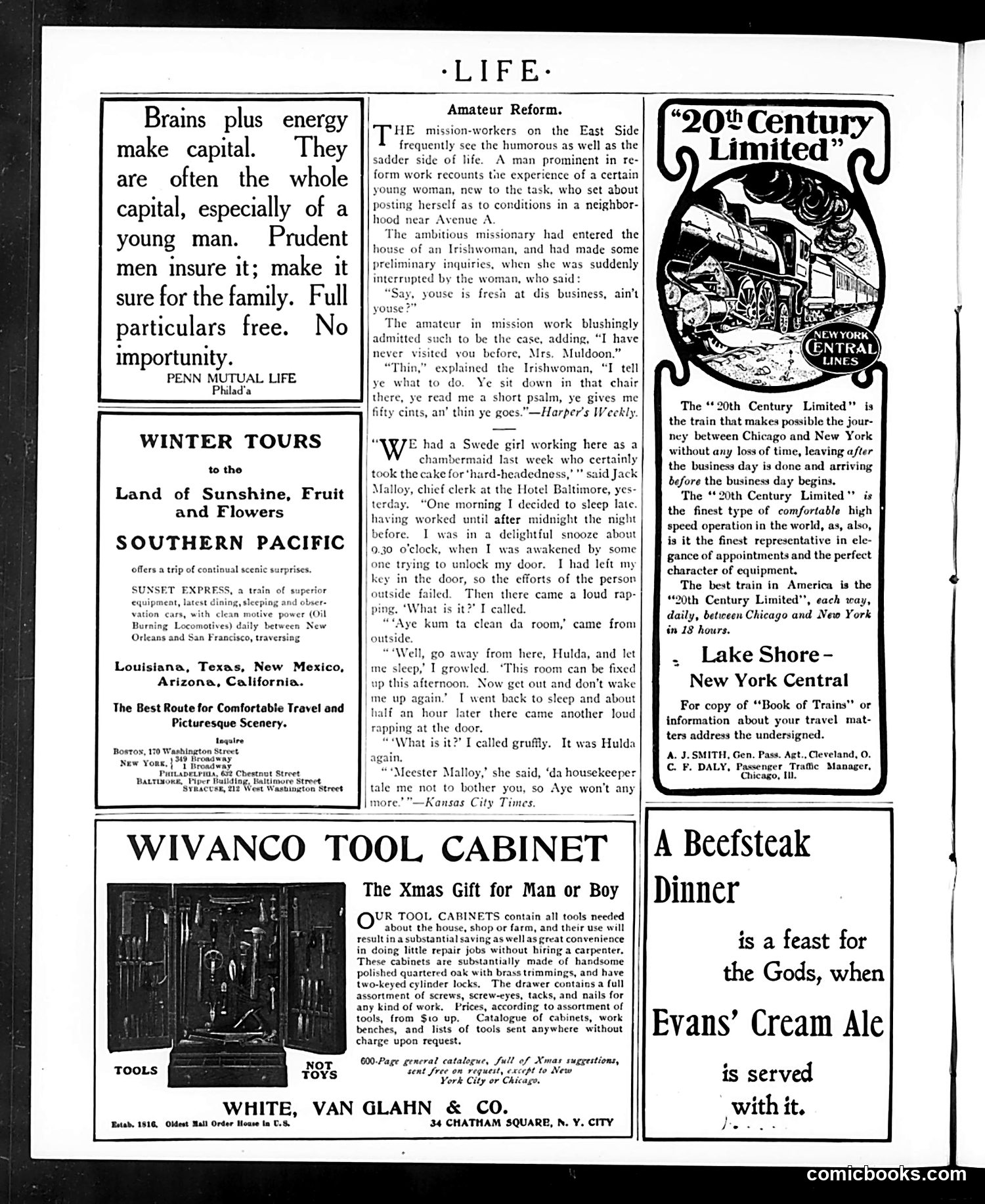
This page is primarily **advertisements and humor pieces**, not political cartoons. The main content includes two comedic anecdotes mocking amateur reformers and immigrant workers: 1. **"Amateur Reform"** satirizes well-meaning but naive middle-class missionaries trying to help poor East Side (immigrant) neighborhoods. An Irish woman tells a condescending reform worker to sit down, read psalms, give her fifty cents, and leave—deflating the reformer's pretensions. 2. **"The Swede Girl" story** ridicules a chambermaid's literal-minded obedience and broken English. She repeatedly tries to enter a guest's room despite being told to leave, following the housekeeper's earlier instructions. Both pieces use **ethnic stereotypes** (Irish and Swedish accents, immigrant "types") common to early-20th-century American humor, mocking both the immigrants and the earnest reformers attempting to "improve" them. The advertisements (Penn Mutual Life, Southern Pacific Railways, Wivanco Tool Cabinet) occupy the remaining space—typical of Life's format.
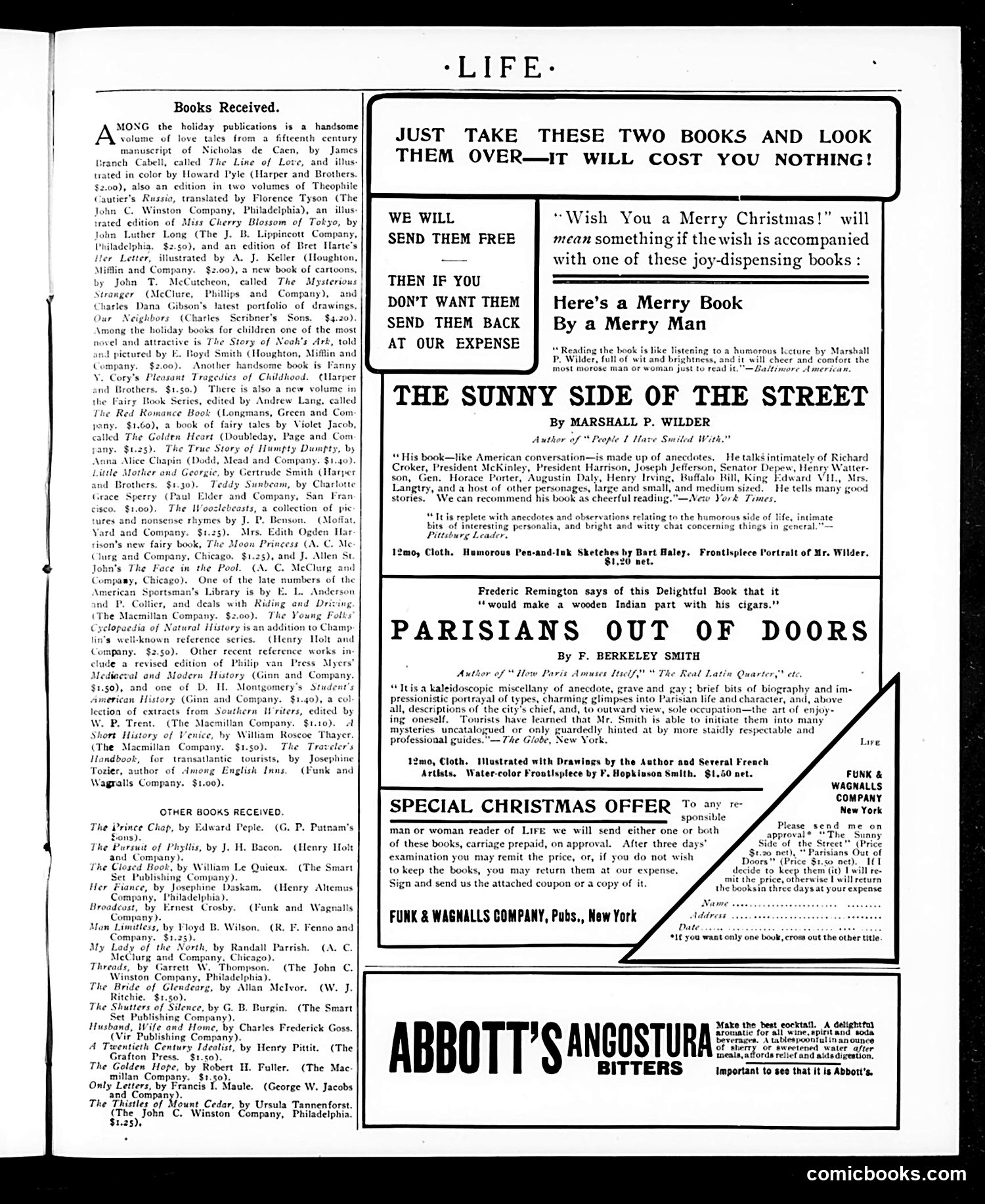
This is primarily a **books review and advertising section**, not a political cartoon page. The content consists of: **Main Content:** - A "Books Received" column listing recently published holiday books with titles, authors, and publishers - Several book advertisements, notably for Marshall P. Wilder's *The Sunny Side of the Street* and F. Berkeley Smith's *Parisians Out of Doors* - A special Christmas offer from Funk & Wagnalls Company allowing readers to examine two books free, returning them at company expense if unwanted **Context for Modern Readers:** This reflects early 1900s publishing and marketing practices. The free-trial book offer was a novel promotional technique. The books listed—fairy tales, travel guides, histories, and sentimental fiction—represent typical Edwardian holiday gift selections. Abbott's Bitters advertisement at bottom is a patent medicine ad common to the era. **No political satire or caricature is present.** This is a straightforward books/publishing industry page typical of *Life* magazine's broader content mix beyond humor.
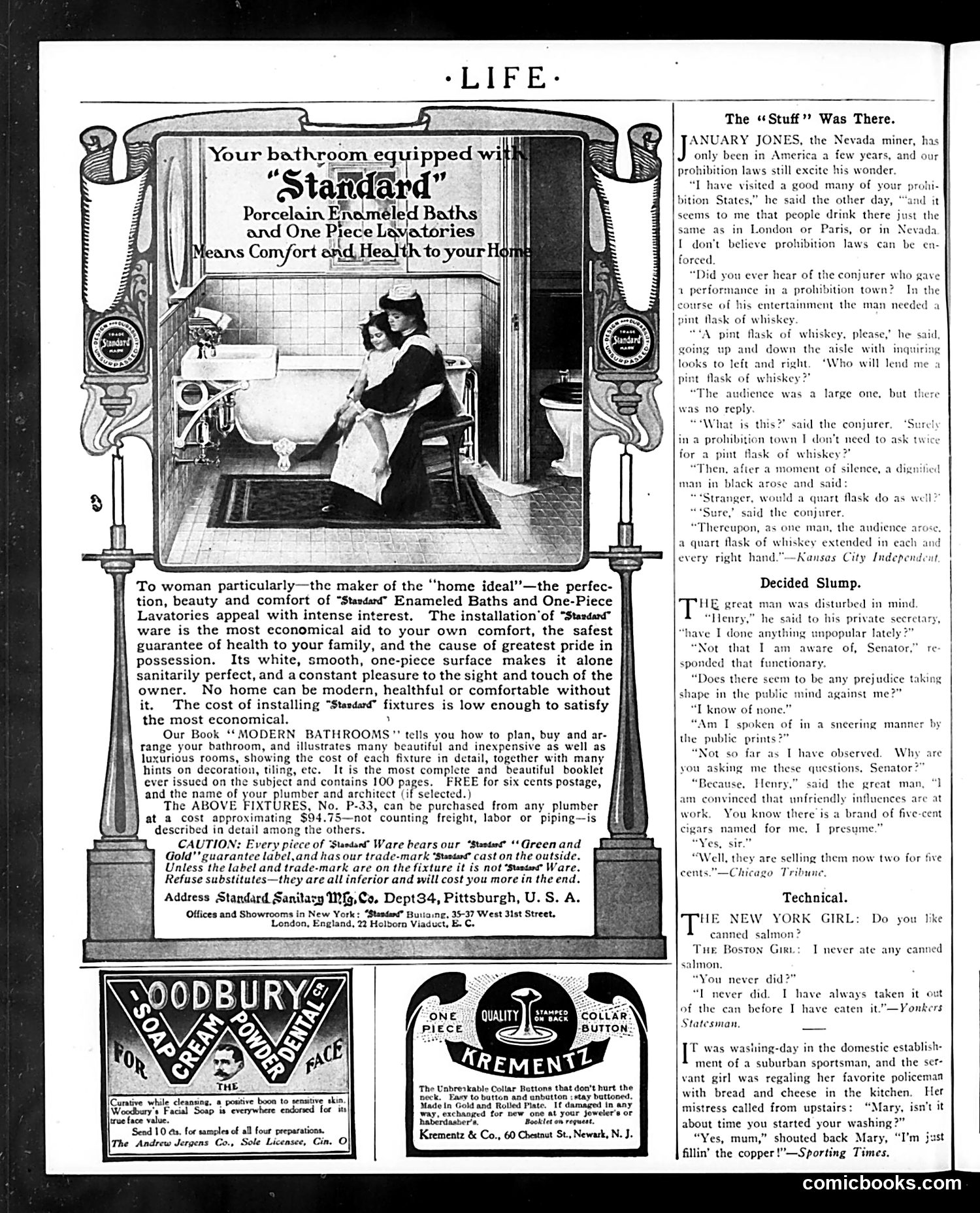
This page primarily contains **advertisements** rather than political cartoons. The dominant feature is a large ad for "Standard" brand porcelain bathroom fixtures, showing a woman and man in a modern bathroom. Below are smaller ads for unrelated products: collar buttons and soap. On the right side are **humorous anecdotes** (not cartoons): 1. **"The Stuff Was There"** mocks American Prohibition laws through a Nevada miner's story about a stage conjurer. The joke: in a prohibition town, when the conjurer asks an audience for a pint flask of whiskey, no one responds. When he asks for a *quart* flask instead, everyone suddenly produces one—satirizing the hypocrisy that prohibition towns still had abundant alcohol despite legal bans. 2. **"Technical"** and **"Decided Slump"** are brief joke columns about regional differences and domestic life. The page reflects early-20th-century concerns: modern sanitation/health, Prohibition-era contradictions, and domestic humor. It's primarily a commercial vehicle with light satirical content mixed in.
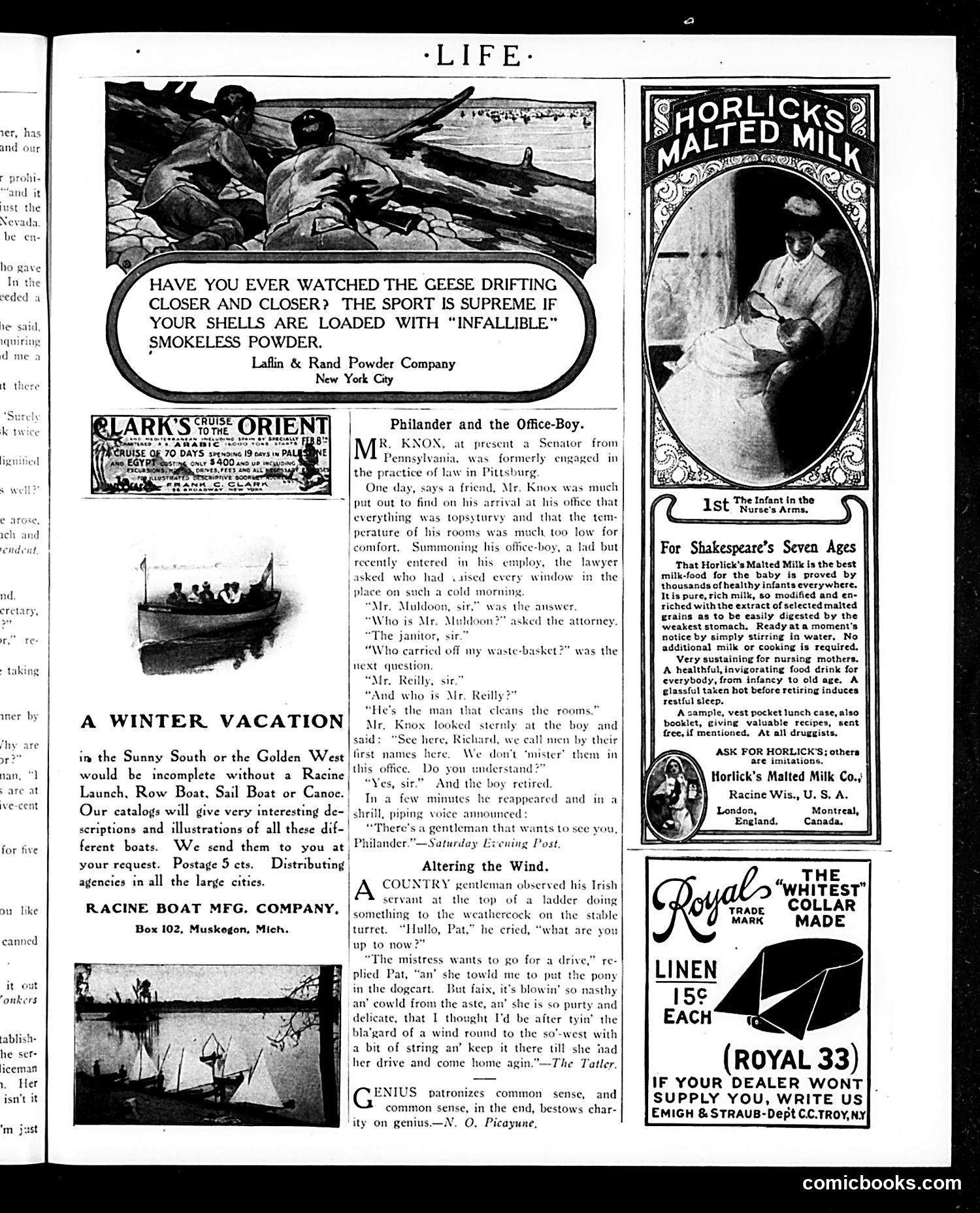
This page contains three distinct humorous anecdotes rather than political cartoons: **"Philander and the Office-Boy"** mocks Senator Philander Knox's pretentious management style. Knox arrives at his Pittsburgh law office to find it cold and disorganized. When he learns the janitor and office cleaners are named Muldoon and Reilly, he pompously insists staff use first names instead—a progressive "modern" approach. When his office boy later announces a visitor as "Mister" someone, Knox's new policy backfires awkwardly, revealing his reform as superficial posturing. **"Altering the Wind"** is an Irish servant joke (a common ethnic humor trope of the era). An Irish worker atop a ladder attempts to physically redirect a weathervane to change the wind direction so his employer's delicate mistress can drive comfortably—depicting Irish workers as charmingly simple-minded. Both anecdotes rely on class and ethnic stereotypes typical of early-20th-century American humor. The page is primarily **advertising**, featuring powder, boat manufacturers, and Horlick's Malted Milk products.
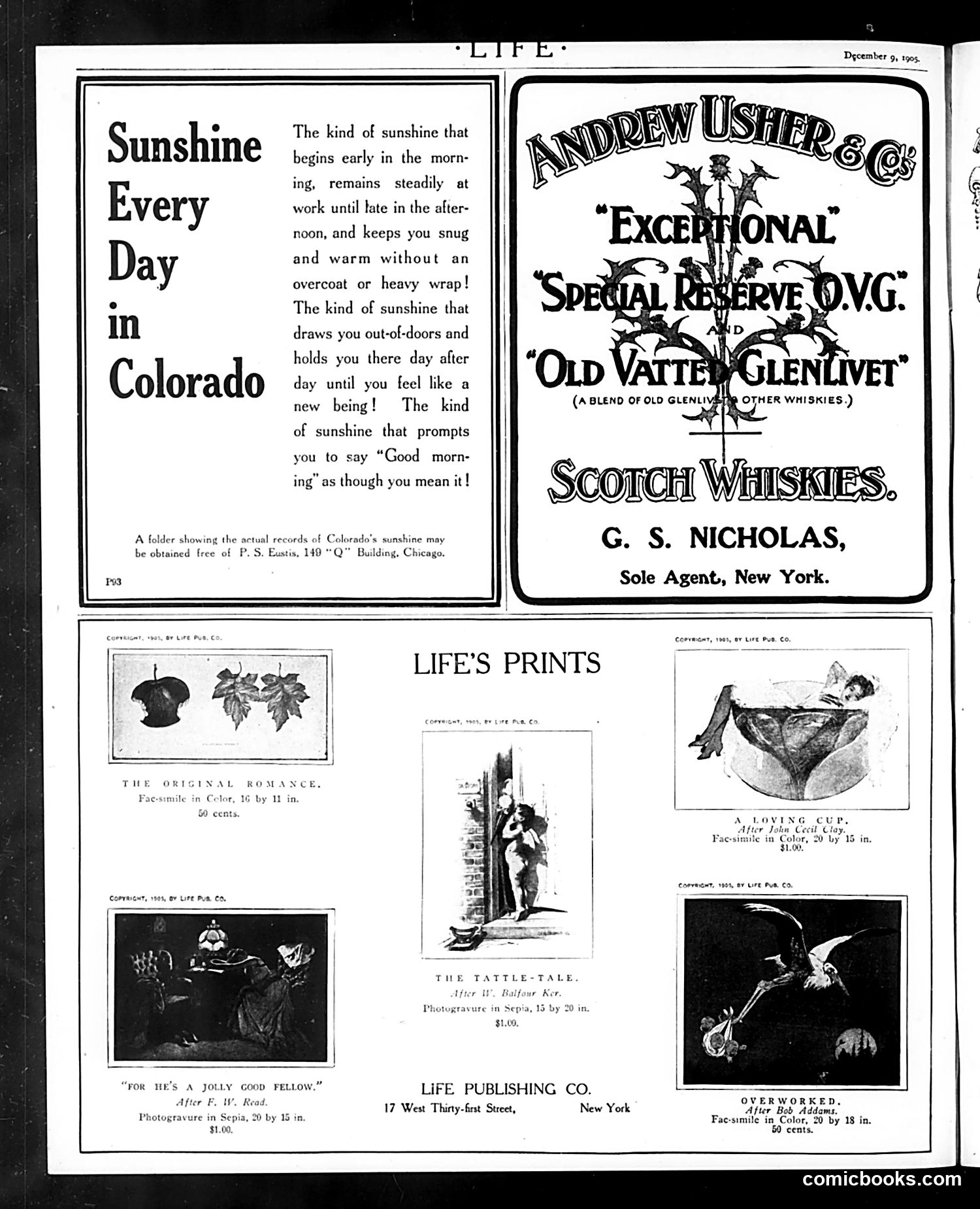
This page is primarily **advertising and product promotion** rather than political satire. The top half features two ads: a Colorado tourism pitch emphasizing year-round sunshine, and a Scottish whisky advertisement from Andrew Usher & Co. promoting brands like "Old Vatten Glenlivet." The bottom section, "Life's Prints," catalogs art reproductions available for purchase from Life Publishing Co. These include: - "The Original Romance" (50 cents) - "The Tattle-Tale" after W. Rainier Key - "For He's a Jolly Good Fellow" after F.W. Read - "A Loving Cup" after John Cecil Clay - "Overworked" after Bob Addams These appear to be sentimental or genre scenes typical of early-1900s popular art—romantic subjects, domestic scenes, and social commentary pieces marketed as affordable home décor. The page reflects Life's business model: mixing editorial content with lucrative advertising and merchandise sales.