
Life, 1905-12-09 · page 16 of 26
Life — December 9, 1905 — page 16: what you’re looking at
What you’re looking at
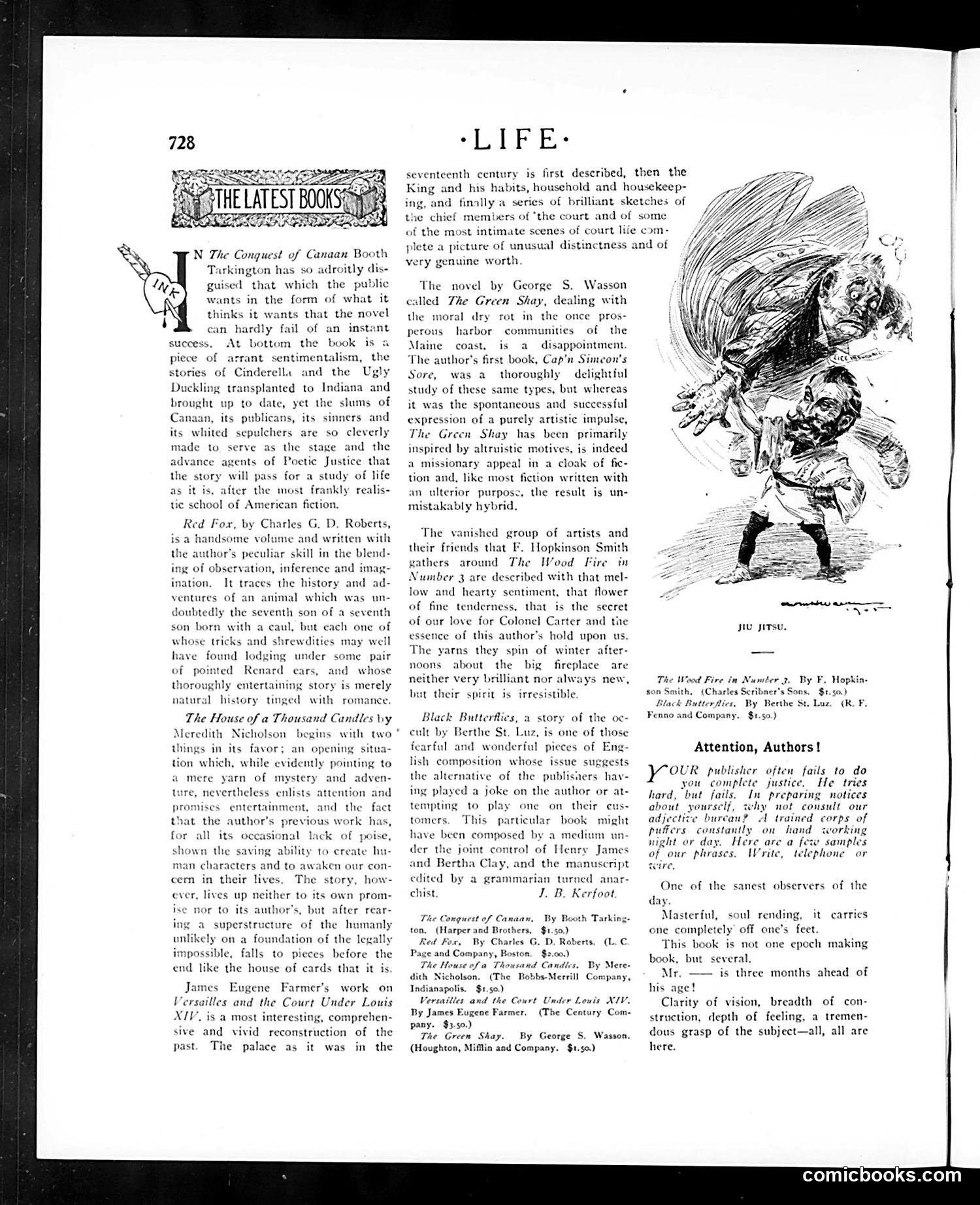
This page from *Life* magazine consists primarily of **book reviews**, not political satire or editorial cartooning. The small illustration on the right depicts a domestic scene—likely related to one of the reviewed novels—showing figures by a fireplace. The reviews discuss contemporary fiction by authors including Booth Tarkington (*The Conquest of Canaan*), George S. Wasson (*The Green Shay*), and F. Hopkinson Smith (*The Wood Fire in Number 3*). The critics assess these works with characteristic early-20th-century literary judgment, praising some for artistic merit while criticizing others as overly sentimental or didactic. A sidebar titled "Attention, Authors!" humorously advises writers to provide clear biographical information to publishers, suggesting some authors had been neglectful about this practical detail. The page serves as *Life's* book column rather than as political commentary—a standard feature in the satirical magazine's mix of humor, criticism, and cultural commentary.
📄 Transcribed text from this page (OCR, searchable)
Machine-transcribed from the original scan — historical spelling and the odd misread are preserved.
N The Conquest of Canaan Booth Tarkington has so adroitly dis guised that which the public wants in the form of what it thinks it wants that the novel can hardly fail of an instant success, At bottom the book is piece of arrant sentimentalism, the stories of Cinderella and the Ugly Duckling transplanted to Indiana and brought up to date, yet the slums of Canaan, its publicans, its sinners and its whited sepulchers are so cleverly made to serve as the stage and the advance agents of Poetic Justice that the story will pass for a study of life as it is, after the most frankly realis- tic school of American fiction. Red Fox, by Charles G, D. Roberts, is a handsome volume and written with th kill in the blend- ng of observation, inference and im. ination. It traces the history and a athor’s peculiar ventures of an animal which was un- doubtedly the seventh son of a seventh son born with a caul, but each one of whose tricks and shrewdities may well have found lodging under some pair f pointed Renard ears, and whose horoughly entertaining story is merely natural history tinged with The House of a Thousand Candles vy Meredith N things in its favor; an opening situa- tion which, while evidently pointing to a mere yarn of mystery and adver ture, nevertheless enlists attention and ertainment, and the fact that the author's previous work has, for all mal lack of shown the saving ability to create man characters and to awaken our con cern in their lives. » story, how ever, lives up neither to its own prom- ise nor to its author's, but after rear- ing a superstructure of the humanly unlikely on a foundation of the legally impossible, falls to pieces before the end like the house of cards that it is. romance. cholson with two begins promises its occasii poise, nes Eugene Farmer’s work on Versailles and the Court Under Louis XIV. is a most interesting, comprehen- sive and vivid reconstruction of the past. The palace as it was in the *LIFE- of the most intimate scenes of court lif plete a picture of unusual distinctness and of very genuine worth Wasson ing with The novel by George S. called The Green Shay, des the moral dry rot in the once pros- perous harbor communities of the Maine coast, is a disappointment he author's first book, Cap'n Simcon’s Sore, was a thoroughly delightful study of these same types, but whereas it was the spontaneous and successful pression of a purely artistic impulse, The Green Shay has been primarily inspired by altruistic motives, is indeed a missionary appeal in a cloak of fic- tion and, like most fiction written with an ulterior purpose, the result is un- mistakably hybrid. The vanished group of artists and their friends that F. Hopkinson Smith gathers around The Wood Fire in Number 3 are described with that mel- nd hearty sentiment, that flower of fine tenderness, that is the secret of our love for Colonel Carter and the essence of this author's hold upon us. The yarns they spin of winter after- noons about the big fireplace are neither very brilliant nor always new, but their spirit is irresistible. low Black Butterflies, a story of the oc- cult by Berthe St. Luz, is one of those fearful and wonderful pieces of Eng- lish composition whose issue suggests the alternative of the publishers hav- ing played a joke on the author or at- tempting to play one on their eus- This particular book might have been composed by a meditm un- control of Henry James and Bertha Clay, and the manuscript edited by a gramm chist tomers. nm turned anar- J. B. Kerfoot. The Conquest of Canaan, By Booth Tarking- ton, (Harperand Brothers. $1.50.) Red Fox. By Charles G. D, Roberts. (L. C ze and Company, Boston. $2.00.) The House of @ Thousand Candis, By Mere- dith Nicholson. (The Robbs-Merrill Company, Indianapolis. $t.50.) Versailles and the Court Under Louis XIV. By James Eugene Farmer. (The Century Com- pany. $3.50.) The Green Shay. By George S. Wasson. (Houghton, Miflin and Company. $1.50.) seventeenth century is first described, then the King and his habits, household and housekeep- d finally a series of brilliant sketches of the chief members of “the court and of some com- JU jITsu. The Wood Fire in Number 3. By ¥. Wopkin- h. (Charles Scribner's Sons. $1.50.) By Berthe St, Luz. (R. F. $t.50.) son Se lack Butterflies, Fenno and Co: any. Attention, Authors! Your publisher often fails to do you complete justice. He tries hard, but fails. In preparing notices about yourself, why not consult our adjective burcau? Al trained corps of puffers constantly on hand working night or day. Here are a few samples of our phrases. Write, telephone or wire, One of the sanest observers of the day. Masterful, soul rending, it one completely’ off one’s feet. This book is not one epoch making book, but several. Mr. —— is three months ahead of his Clarity of vision, breadth of con- struction, depth of feeling, a tremen- dous grasp of the subject—all, all are here. carries comicbooks.com