
Life, 1905-12-09 · page 14 of 26
Life — December 9, 1905 — page 14: what you’re looking at
What you’re looking at
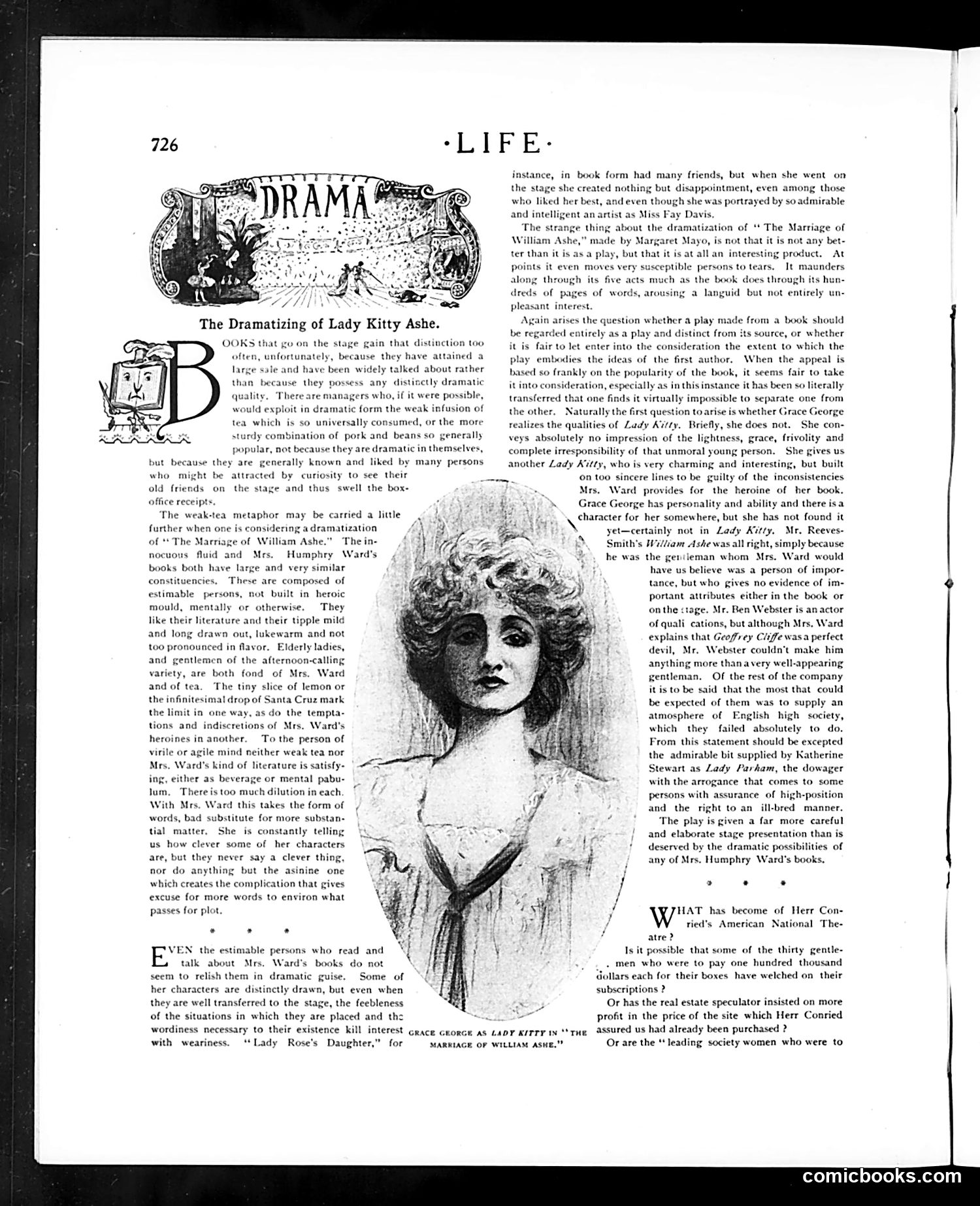
This page critiques the stage adaptation of Mrs. Humphry Ward's novel "The Marriage of William Ashe," dramatized by Margaret Mayo and starring Grace George (shown in the sketch). The satire attacks both Ward's writing style and the adaptation itself. The critic uses "weak tea" as a metaphor for Ward's diluted, verbose novels—full of telling rather than showing, with characters described as clever but never saying anything clever. The books appeal to "estimable persons" of genteel, afternoon-calling society who prefer mild, drawn-out entertainment. The adaptation fails because it merely transplants this wordiness to stage, creating languid five-act plays that preserve the novel's faults without gaining dramatic strength. The critic questions whether a play adapted from a popular book should be judged as drama or as literature—ultimately arguing that when marketing exploits the book's popularity, the adaptation's literary faithfulness becomes fair game for criticism. The point: popular success doesn't equal artistic merit, especially when adapting to different media.
📄 Transcribed text from this page (OCR, searchable)
Machine-transcribed from the original scan — historical spelling and the odd misread are preserved.
OOKS that go on the sts th quality. Th would exp! sturdy com but because th who might be attracted by curiosity to see their old friends on the stage and thus swell the box- office receipts. The weak-tea metaphor may be carried a little further when one is considering a dramatization of * The Marriage of William Ashe.” The in- nocuous fluid and Mes. Humphry Ward's books both have large and very similar constituencies, These are composed of estimable persons, not built in heroic mould, mentally or otherwise. They like their literature and their tipple mild and long drawn out, lukewarm and not too pronounced in flavor. Elderly lad: and gentlemen of the afternoon-calling variety, are both fond of Mrs. Ward and of tea the infinitesimal drop of Santa Cruz mark the limit in one way, as do the tempta- tions and indiscretions of Mrs. Ward's heroines in another. To the person of virile or agile mind neither weak tea nor Mrs, Ward's kind of literature is satisfy- |“ ing, either as beverage or mental pabu- lum, There is too much dilution in each. With Mrs. Ward this takes the form of | words, bad substitute for more substan- tial matter, She is constantly telling us how clever some of her characters are, but they never say a clever thing, nor do anything but the asinine one which creates the complication that gives excuse for more words to environ what passes for plot. The tiny slice of lemon or cf VEN the estimable persons who read and talk about Mrs. Ward's books do not seem to relish them in dramatic guise. Some of her characters are distinctly drawn, but even when they are well transferred to the stage, the feebleness of the situations in which they are placed and the wordiness necessary to their existence kill interest with weariness. “Lady Rose's Daughter,” for The Dramatizing of Lady Kitty Ashe. e gain that distinction too often, unfortunately, because they have attained a large sale and have been widely talked about rather n because they possess any distinctly dramatic e are managers who, if it were possible, it in dramatic form the weak infusion of tea which is so universally consumed, or the more bination of pork and beans so generally popular, not because they are dramatic in themselves, y are generally known and liked by many persons GRACE GEORGE AS LADY KITTY 1N MARRIAGE OF WILLIAM ASHE, *LIFE- instance, in book form had many friends, but when she went on the stage she created nothing but disappointment, even among those who liked her best, and even though she was portrayed by soadmirable and intelligent an artist as Miss Fay Davis, The strange thing about the dramatization of “ The Marriage of William Ashe,” made by Margaret Mayo, is not that it is not any bet- ter than it is asa play, but that it is at all an interesting product. At points it even moves very susceptible persons to tears, It maunders along through its five acts much as the book does through its hun- dreds of pages of words, arousing a languid but not entirely un- pleasant interest. fe from a book should Again arises the question whether a play ma be regarded entirely asa play and distinct from # it is fair to let enter into the consideration the extent to which the play embodies the ideas of the first author, When the appeal is based so frankly on the popularity of the book, it seems fair to take it into consideration, especially as in this instance it has been so literally transferred that one finds it virtually impossible to separate one from the other, Naturally the first question toarise is whether Grace George realizes the qualities of Lady Avtty, Briefly, she does not, She con- veys absolutely no impression of the lightness, grace, frivolity and s source, or whether complete irresponsibility of that unmoral young person. She gives us another Lady Avtty, who is very charming and interesting, but built on too sincere lines to be guilty of the inconsistencies Mrs, Ward provides for the heroine of her book. \ Grace George has personality and ability and there isa character for her somewhere, but she has not found it No yet—certainly not in Lady Kitty. Mr. Reeves: Smith's Witham Ashewasall right, simply because he was the gentleman whom Mrs. Ward would have us believe was a person of impor- tance, but who gives no evidence of im- portant attributes either in the book or onthe <tage. Mr. Ben Webster is an actor of quali cations, but although Mrs, Ward explains that Geoffrey Cliffe wasa perfect devil, Mr. Webster couldn't make him anything more than avery well-appearing gentleman. Of the rest of the company it isto be said that the most that could be expected of them was to supply an atmosphere of English high society, which they failed absolutely to do. From this statement should be excepted the admirable bit supplied by Katherine Stewart as Lady Parham, the dowager with the arrogance that comes to some persons with assurance of high-position and the right to an ill-bred manner. ‘The play is given a far more careful and elaborate stage presentation than is 1 deserved by the dramatic possibilities of any of Mrs. Humphry Ward's books, ° . . HAT has become of Herr Con- merican National The- , ried’s atre? Is it possible that some of the thirty gentle- . men who were to pay one hundred thousand dollars each for their boxes have welched on their subscriptions ? Or has the real estate speculator insisted on more — profit in the price of the site which Herr Conried 2 assured us had already been purchased ? Or are the “leading society women who were to comicbooks.com