
Life, 1905-12-09 · page 6 of 26
Life — December 9, 1905 — page 6: what you’re looking at
What you’re looking at
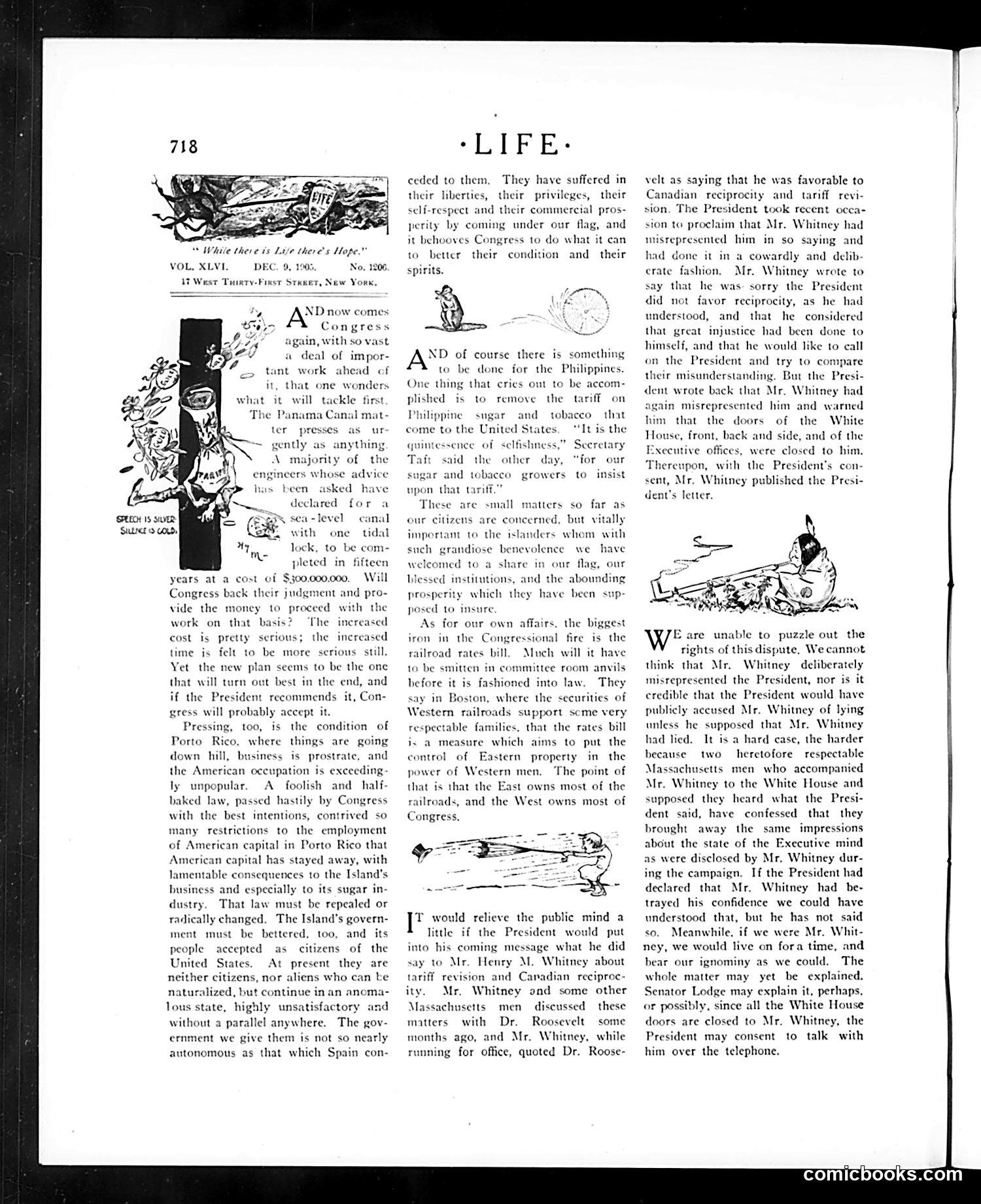
This page discusses Congressional business and Philippine tariffs. The left column contains editorial cartoons criticizing a proposed sea-level canal project that Congress had debated for fifteen years at enormous cost ($200,000,000), which the editor calls foolish. The main text addresses Mr. Henry M. Whitney's dispute with President Roosevelt over tariffs on Philippine sugar and tobacco. Whitney, a Massachusetts businessman, had met with Roosevelt to discuss these trade matters. The editorial expresses frustration that it cannot determine who misrepresented whom—whether Whitney or the President—regarding reciprocal trade policies. The piece suggests the White House doors are now closed to Whitney, treating the incident as a minor but telling example of executive-legislative tension over economic policy.
📄 Transcribed text from this page (OCR, searchable)
Machine-transcribed from the original scan — historical spelling and the odd misread are preserved.
SLED IS SUR Sure 3 ORD “While there ts Life there's Hope.” VOL. XLVI. DEC. 9,1 No, 1206. West Twuxty-Finst Steet, New Yorx. D now comes Congress again, with so vast a deal of impor- tant work ahead of it, that one wonders it will tackle first The Panama Canal mat- ler presses as ur \ gently as anything ) A majority of the engineers whose advice ais been asked have for a canal one tidal lock, to be com- declared \ sea-level with pleted in fifteen years at a cost of $300,000.00. Will Congress back their judgment and pro- vide the money to proceed with the work on that basis? The cost is pretty serious; the time is felt to be more Yet the new plan seems to be the one that will turn out best in the end, and if the President recommends it, Con- gress will probably accept it. Pressing, too, is the condition of Porto Rico, where things are going down hill, business is prostrate, and the American occupation is exceeding: ly unpopular. A. foolish and_ half- baked law, passed hastily by Congress with the best intentions, contrived so many restrictions to the employment of American capital in Porto Rico that American capital has stayed away, with lamentable consequences to the Island's business and especially to its sugar in- dustry. That law must be repealed or radically changed. The Island’s govern- ment must be bettered, too, and its people accepted as citizens of the United States. At present they are neither citizens, nor aliens who can be naturalized, but continue in an anoma- lous state, highly unsatisfactory and without a parallel anywhere. The gov- ernment we give them is not so nearly autonomous as that which Spain con- increased increased serious still, *LIFE: ceded to them, They have suffered in their liberties, their privileges, their self-respect and their commercial pros- perity by coming under our flag, and yngress to do what it can their and their it behooves to better spirits. condition ND of course there somethin; to be done for the Philippines. One thing that cries out to be accom- plished is to remove the tariff on and tobacco that “Tris the Secretary “for our Philippine sugar come to the United States. quintessence of selfishness,” Tait sugar and tobacco upon that tariff.” These are small said the other day, growers to insist matters so far as our citizens are concerned, but vitally mt to the islanders whom with have impo such grandiose benevolence we welcomed to a in our flag, our Dlessed institutions, and the abounding prosperity which they have been sup- posed to insure As for our own affairs, the biggest iron in the Congressional fire is the railroad rates bill. Much will it have to be smitten in committee room anvils hefore it is fashioned into law. They say in Boston, where the securities of Western railroads support scme very respectable families, that the rates bill is a measure which aims to put the control of Eastern property in the power of Western men. The point of that is that the East owns most of the railroads, and the West owns most of Congress. share would relieve the public mind a le if the President would put into his coming message what he did say to Mr. Henry M. Whitney about tariff revision and Canadian reciproc- ity. Mr, Whitney ond some other these some Massachusetts men discussed matters with Dr. Roosevelt months ago, and Mr. Whitney, while running for office, quoted Dr. Roose- velt as saying that he was favorable to Canadian reciprocity and tariff revi- sion. The President took recent occa- sion to proclaim that Mr. Whitney had misrepresented him in so saying and had done it in a cowardly and delib- crate fashion, Mr. Whitney wrote to say that he was: sorry the President did not favor reciprocity, as he had understood, that he considered that great injustice had been done to himself, and that he would like to call on the President and try to compare their misunderstanding. But the Pres dent wrote back that Mr. Whitney had in misrepresented him and warned him that the doors of the White House, front, back and side, and of the Executive offices, were closed to him, Thereupon, with the President's con- sent, Mr. Whitney published the Presi- dent's letter. and WwW are unable to puzzle out the rights of this dispute, We cannot think that Mr. Whitney deliberately misrepresented the President, nor is it credible that the President would have publicly accused Mr. Whitney of lying unless he supposed that Mr. Whitney had lied. It is a hard case, the harder because two heretofore respectable Massachusetts men who accompanied. Mr. Whitney to the White House and supposed they heard what the Presi- dent said, have confessed that they brought away the same impressions about the state of the Executive mind were disclosed by Mr. Whitney dur- ing the campaign. If the President had declared that Mr. Whitney had be- trayed his confidence we could have understood that, but he has not said so. Meanwhile, if we were Mr. Whit- ney, we would live on fora time, and bear our ignominy as we could. The whole matter may yet be explained. Senator Lodge may explain it, perhaps, or possibly, since all the White House doors are closed to Mr. Whitney, the President may consent to talk with him over the telephone.