
Life, 1905-12-09 · page 15 of 26
Life — December 9, 1905 — page 15: what you’re looking at
What you’re looking at
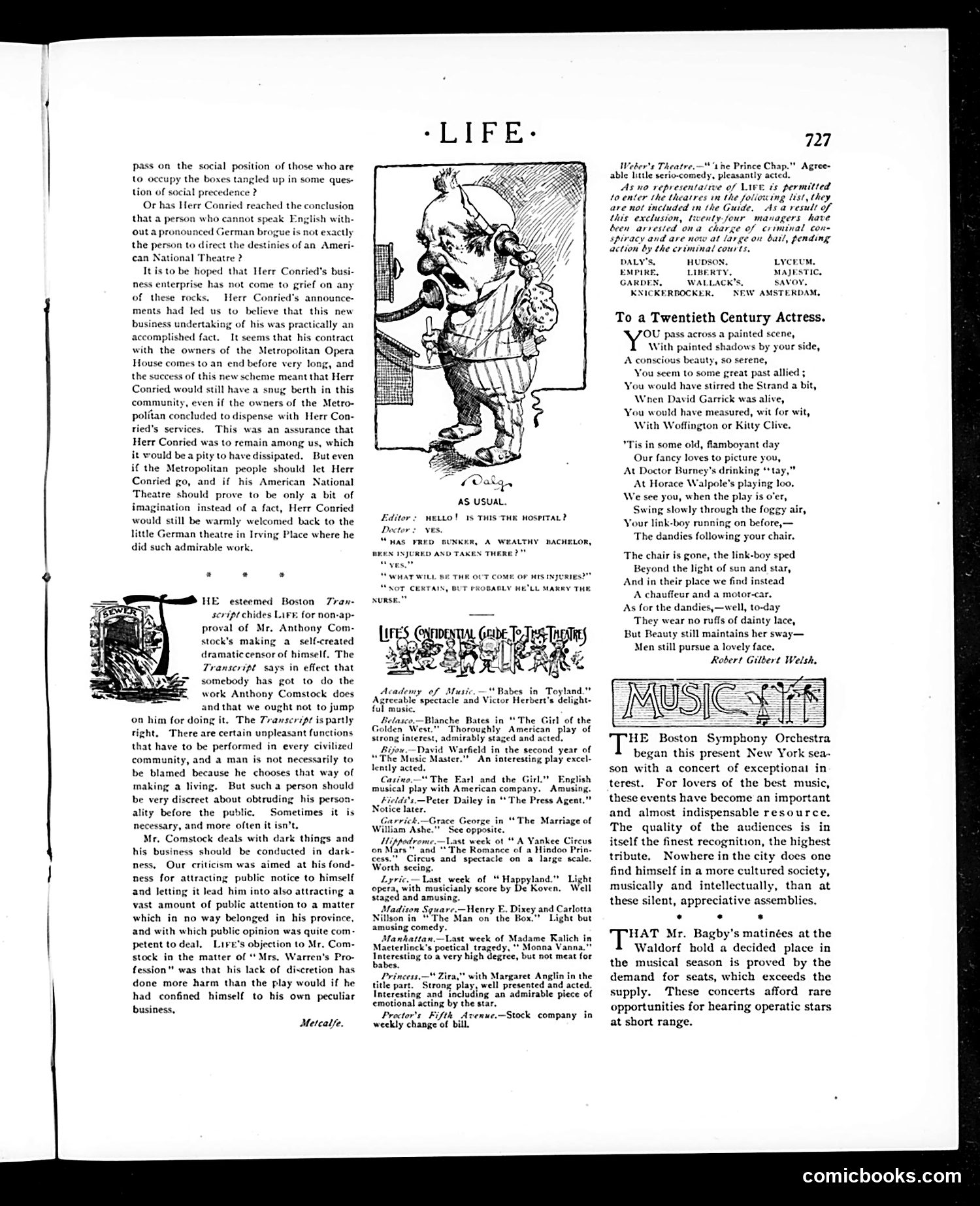
The main cartoon depicts a telephone conversation between a hospital and a caller inquiring about an injured wealthy bachelor named Fred Bunker. The joke's setup asks about medical costs; the punchline reveals the nurse will marry him—suggesting wealthy patients attract matrimonial rather than medical interest. The surrounding editorial discusses Herr Conried, director of the Metropolitan Opera House. The text critiques whether this German-accented impresario can properly direct an American national theatre, questioning both his linguistic abilities and business judgment. It argues his new venture may fail, though the author expresses hope Conried could return to his successful work at the "little German theatre in Irving Place." The satire targets: (1) opportunistic marriages involving wealthy patients and medical staff, and (2) skepticism about foreign-born leadership of American cultural institutions, reflecting period anxieties about immigration and national identity.
📄 Transcribed text from this page (OCR, searchable)
Machine-transcribed from the original scan — historical spelling and the odd misread are preserved.
OO ee eee pass on the social position of those who are to occupy the boxes tangled up in some ques- tion of social preced Or has Herr Conried reached the conclusion that a person who cannot speak English with- out a pronounced € the person to direct the destinies of an Ameri- can National Theatre ? It isto be hoped that Herr Conried’s busi- nce 2 rman brogue is not exactly ness enterprise has not come to grief on any of these rocks. Herr Conried’s announce ments had led us to believe that this new business undertaking of his was practically an hed fact. It seems that his contract with the owners of the Metropolitan Opera House comes to an end before very long, and the success of this new scheme meant that Herr Conried would still have a snug berth in this community, even if the owners of the Metro- politan concluded to dispense with Herr Con- ried’s services, This was an assurance that Herr Conried was to remain among us, which it would bea pity to have dissipated. But even if the Metropolitan people should let Herr Conried go, and if American National ‘Theatre should prove to be only a bit of imagination instead of a fact, Herr Conried would still be warmly welcomed back to the little German theatre in Irving Place where he did such admirable work. accomp HE esteemed Boston 7ran- script chides LiFe: for non-ap- proval of Mr. Anthony Com- stock's making a. self-created dramatic censor of himself, The Transcript says in effect that somebody has got to do the work Anthony Comstock does and that we ought not to jump on him for doing it, The Transcript is partly right. There are certain unpleasant functions that have to be performed in every civilized community, and a man is not necessarily to be blamed because he chooses that way of making a living. But such a person should be very discreet about obtruding his person- ality before the public. Sometimes it is necessary, and more often it isn’t, Mr. Comstock deals with dark things and his business should be conducted in dark- ness. Our criticism was aimed at his fond- ness for attracting public notice to himself and letting it lead him into also attracting a vast amount of public attention to a matter which in no way belonged in his province, and with which public opinion was quite com- petent to deal, Lire’s objection to Mr. Com- stock in the matter of * Mrs, Warren's Pro- fession” was that his lack of dixcretion has done more harm than the play would if he had confined himself to his own peculiar business, Metcalfe. AS USUAL. ditor: meito! 18 THIS THE MosPrTAL? Doctor: Ves. “HAS FRED BUNKER, A WEALTHY MACHELOR, REEN INJURED AND TAKEN THERE?" ves. “WHAT WILL RE-THE OUT Coste OF MES INJURIES?” “Nor CERTAIN, BUT PROBABLY HE'LL MARRY THE NURSE. Academy of Music. —* Babes in Toyland.” Agrecable spectacle and Victor Herbert's delight- ful music. Jasco.—Blanche Bates in The Girl of the West." Thoroughly American py of strong interest, admirably staged and acted, Bijow—David Warfield in the second year of “The Music Master.” An interesting play excel- ently acted. Casino.“ The Earl and the Girl." English musical play with American company. Amusing. Fields's.—Peter Dailey in ‘ The Press Agent.” Notice later. Garrick,—Grace George in “The Marriage of William Ashe." See opposite. Hippodrome.—Last week ot “ A Yankee Circus on Mars" and * The Romance of a Hindoo Prin- cess." Circus and spectacle on a large scale. Worth seeing. Lyric. — Last week of “ Happyland.” Light opera, with musicianly score by De Koven, Well staged and amusing. Maditon Square.—Henry E. Dixey and Carlotta Nillson in “The Man on the Box."’ Light but amusing comedy. Manhattan.—Last week of Madame Kalich in Maeterlinck’s poetical tragedy, " Monna Vanna.” Interesting to a very high degree, but not meat for babes. Princess.—* Zira,” with Margaret Anglin in the title part. "Strong play, well presented and acted. Interesting and including an admirable piece of emotional acting by the star. Proctor's Fifth Avenue.—Stock company in weekly change of bill. 727 Weber's Theatre.—"'the Prince Chap." Agree- able little serio-comedy, pleasantly acted. As no representawe of LAFe ts permitted fo enter the theatres in the following list, they are not included in the Guide, Asa result of this exclusion, tiventy-four managers have been arrested ‘ona charge of criminal con= spiracy and are now at large on bail, pending action by the criminal courts, DALY'S, HUDSON. LYCEUM, EMPIRE, LIBERT MAJESTIC. GARDEN, WALLACK’ SAV KNICKERBOCKER. NEW AMSTERDAM, To a Twentieth Century Actress. ‘OU pass across a painted scene, With painted shadows by your side, A conscious bea You seem to some great past allied ; You would have stirred the Strand a bit, When David Garrick was alive, You would have measured, wit for wit, With Woffington or Kitty Clive. ty, So serene, ‘Tis in some old, flamboyant day Our fancy loves to picture you, At Doctor Burney’s drinking “tay,” At Horace Walpole’s playing loo, We see you, when the play is o'er, Swing slowly through the foggy air, Your link-boy running on before,— ‘The dandies following your chair. The chair is gone, the link-boy sped Beyond the light of sun and star, And in their place we find instead A chauffeur and a motor-car, As for the dandies,—well, to-day They wear no ruffs of dainty lace, But Beauty still maintains her sway— Men still pursue a lovely face. Robert Gilbert Welsh. HE Boston Symphony Orchestra began this present New York sea- son with a concert of exceptional in terest. For lovers of the best music, these events have become an important and almost indispensable resource, The quality of the audiences is in itself the finest recognition, the highest tribute. Nowhere in the city does one find himself in a more cultured society, musically and intellectually, than at these silent, appreciative assemblies. * . . HAT Mr. Bagby's matinées at the Waldorf hold a decided place in the musical season is proved by the demand for seats, which exceeds the supply. These concerts afford rare opportunities for hearing operatic stars at short range. comicbooks.com