
A complete issue · 26 pages · 1905
Life — October 26, 1905
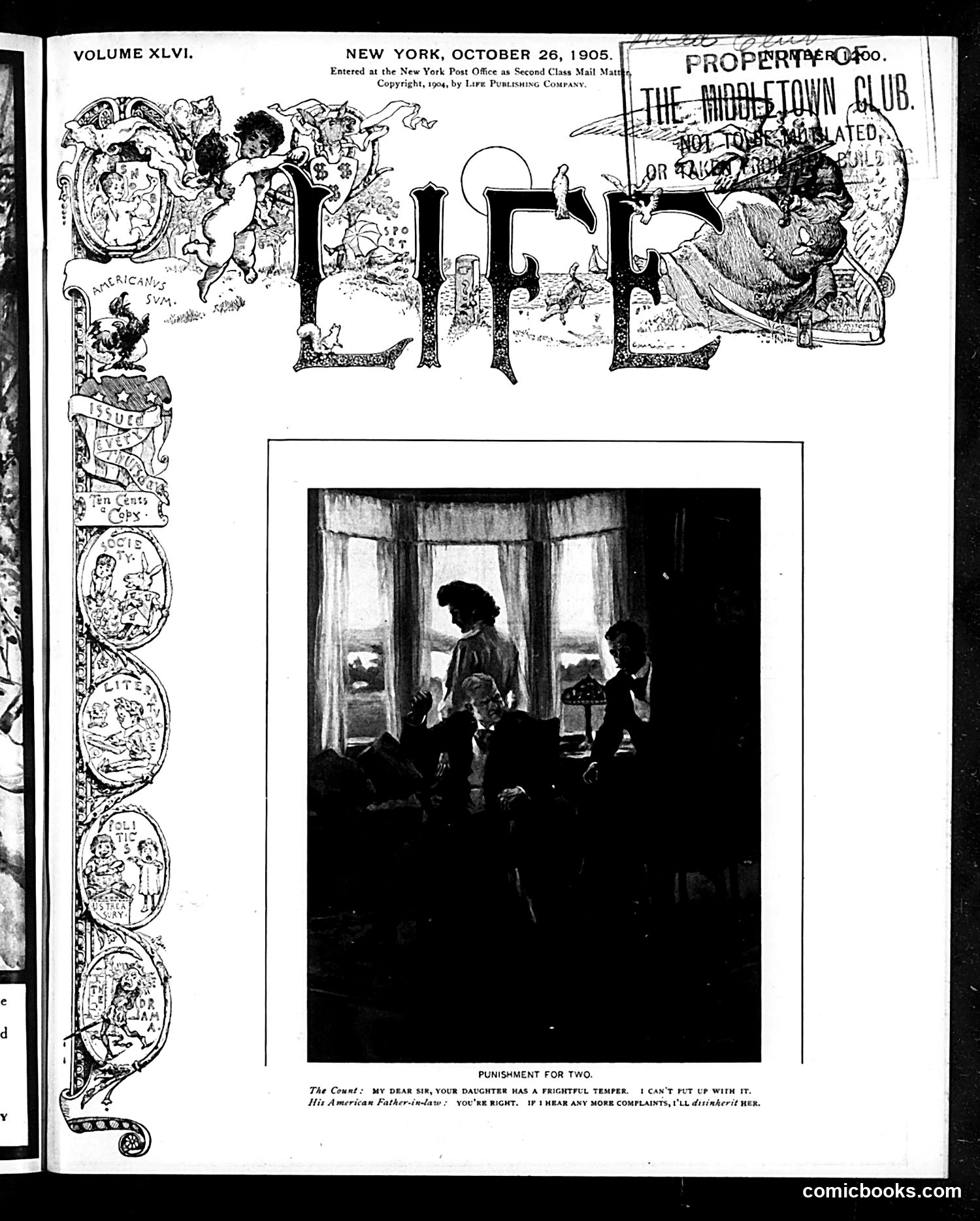
This page from Life magazine presents a satirical cartoon titled "Punishment for Two." The image shows silhouetted figures in what appears to be an indoor domestic scene with a bay window. The caption reads: "The Coast: 'My dear sir, your daughter has a frightful temper. I can't put up with it.' His American father-in-law: 'You're right. If I hear any more complaints, I'll disinherit her.'" The satire targets American wealth and parental authority—specifically mocking a wealthy American father-in-law who threatens to disinherit his temperamental daughter rather than address her behavioral problems. The joke criticizes both the daughter's entitlement and the father's willingness to use financial threats as discipline, reflecting early-20th-century anxieties about American heiresses and Old World versus New World values.
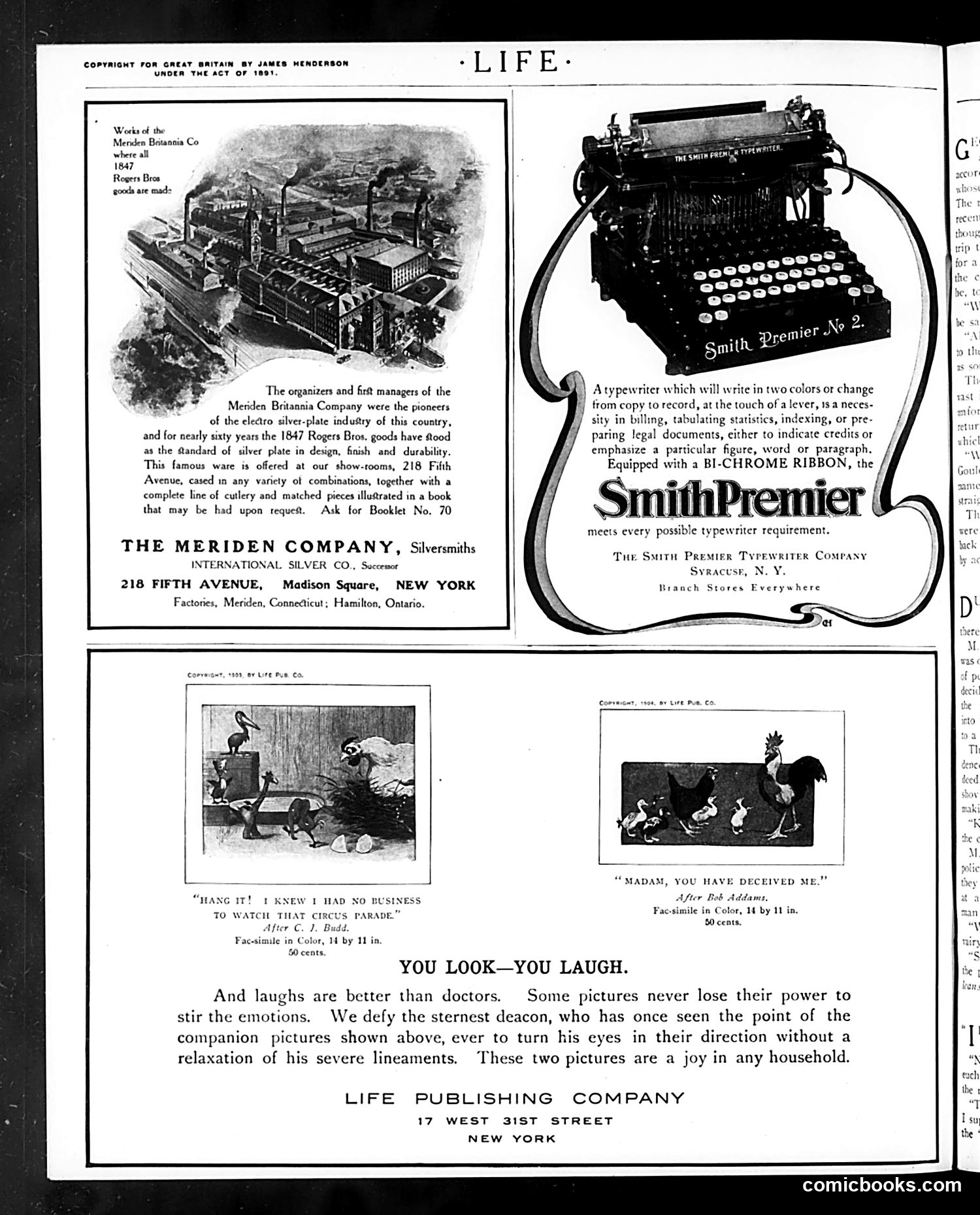
This page is **primarily advertising** with two unrelated components: **Top half:** Advertisements for The Meriden Company (silverware) and Smith-Premier typewriters—straightforward product promotions. **Bottom half:** Two cartoons credited to Life Publishing Company with captions: - "Hang It! I Knew I Had No Business to Watch That Circus Parade" (After C. J. Budd) - "Madam, You Have Deceived Me" (After Bob Adkins) These appear to be **humorous domestic/social comedy** rather than political satire. The first depicts someone regretting watching a circus; the second shows what appears to be a relationship misunderstanding with animals. The framing text emphasizes their emotional impact: "laughs are better than doctors." Without additional context about the artists or specific date, the exact satirical targets remain unclear, though both suggest everyday embarrassment or social mishaps as their humor source.
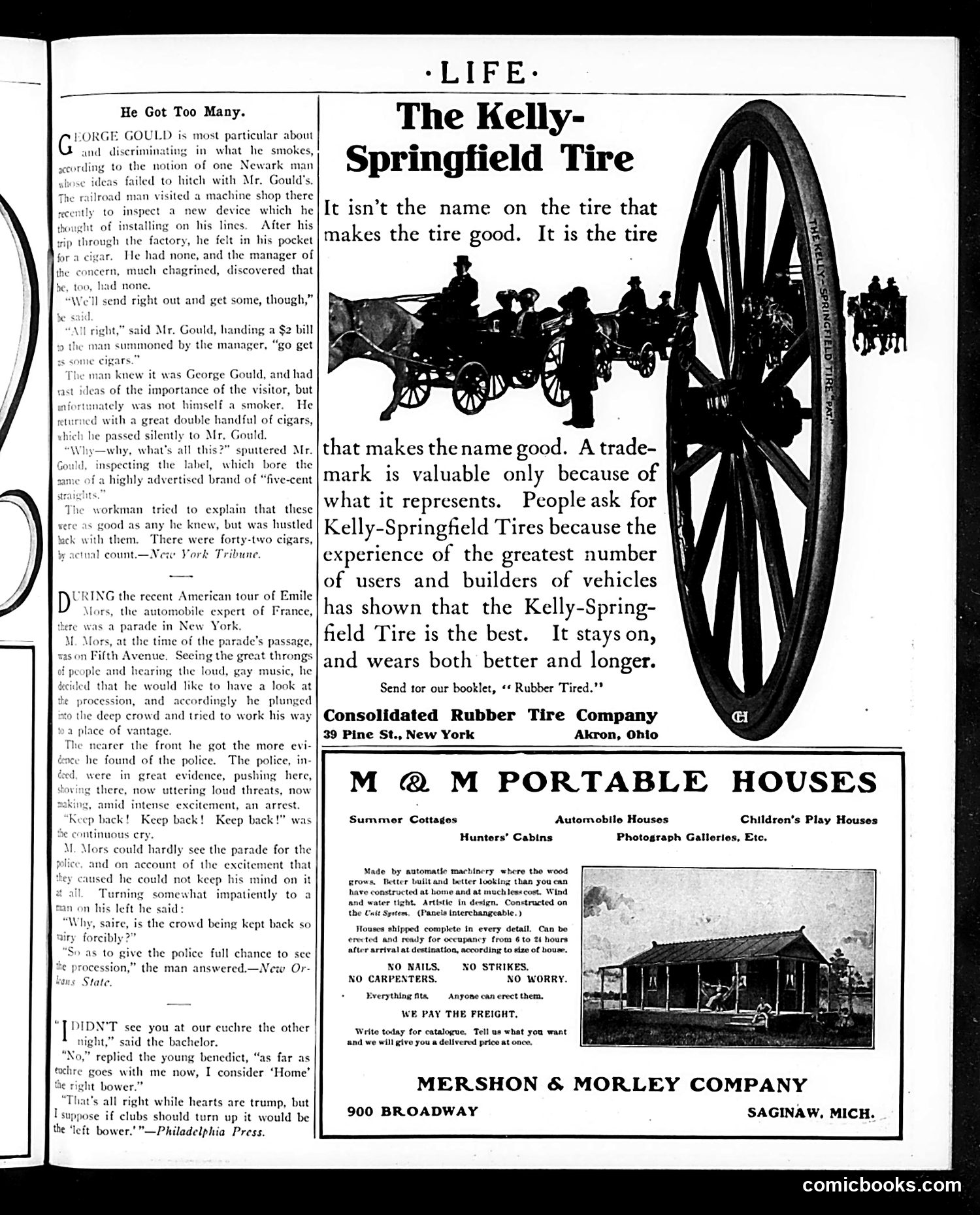
This page contains two distinct sections: **Left side ("He Got Too Many"):** A short satirical story about George Gould, a railroad magnate, visiting a concert. The joke turns on class assumptions: when a manager asks Gould to fetch cigars, Gould complies—then returns with an enormous, expensive handful. The humor mocks both Gould's excessive wealth and the manager's presumption in ordering around someone of his station. **Right side:** Advertising dominates, including Kelly-Springfield Tire and M&M Portable Houses. These are straightforward commercial pitches typical of early 20th-century magazines. The page reflects Life's standard format: satirical social commentary addressing the wealthy elite, paired with period advertising. The Gould anecdote exemplifies Life's interest in mocking conspicuous consumption and social pretension.
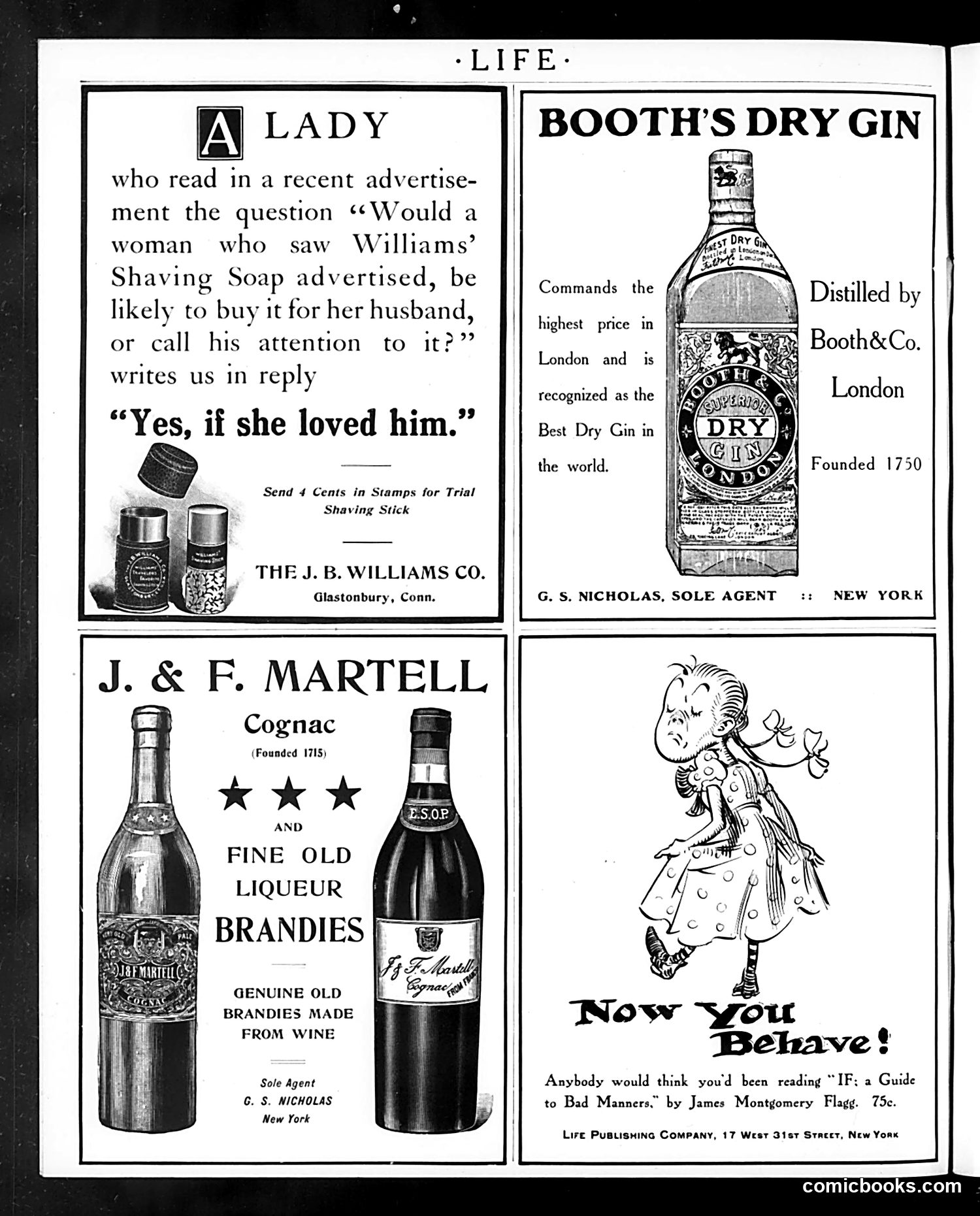
This page consists primarily of **period advertisements** rather than satirical content. The top left features a humorous reader response about Williams' Shaving Soap, where a woman answers "Yes, if she loved him"—suggesting wives purchase grooming products only out of affection, a mild joke about marital dynamics. The remaining three advertisements promote luxury goods: Booth's Dry Gin (London, established 1750), J. & F. Martell Cognac (founded 1715), and a book titled "Now You Behave!" about etiquette by James Montgomery Flagg. The book ad includes a cartoon of a poorly-behaved child, humorously illustrating the need for manners instruction. Overall, this reflects early 20th-century advertising targeting affluent readers.
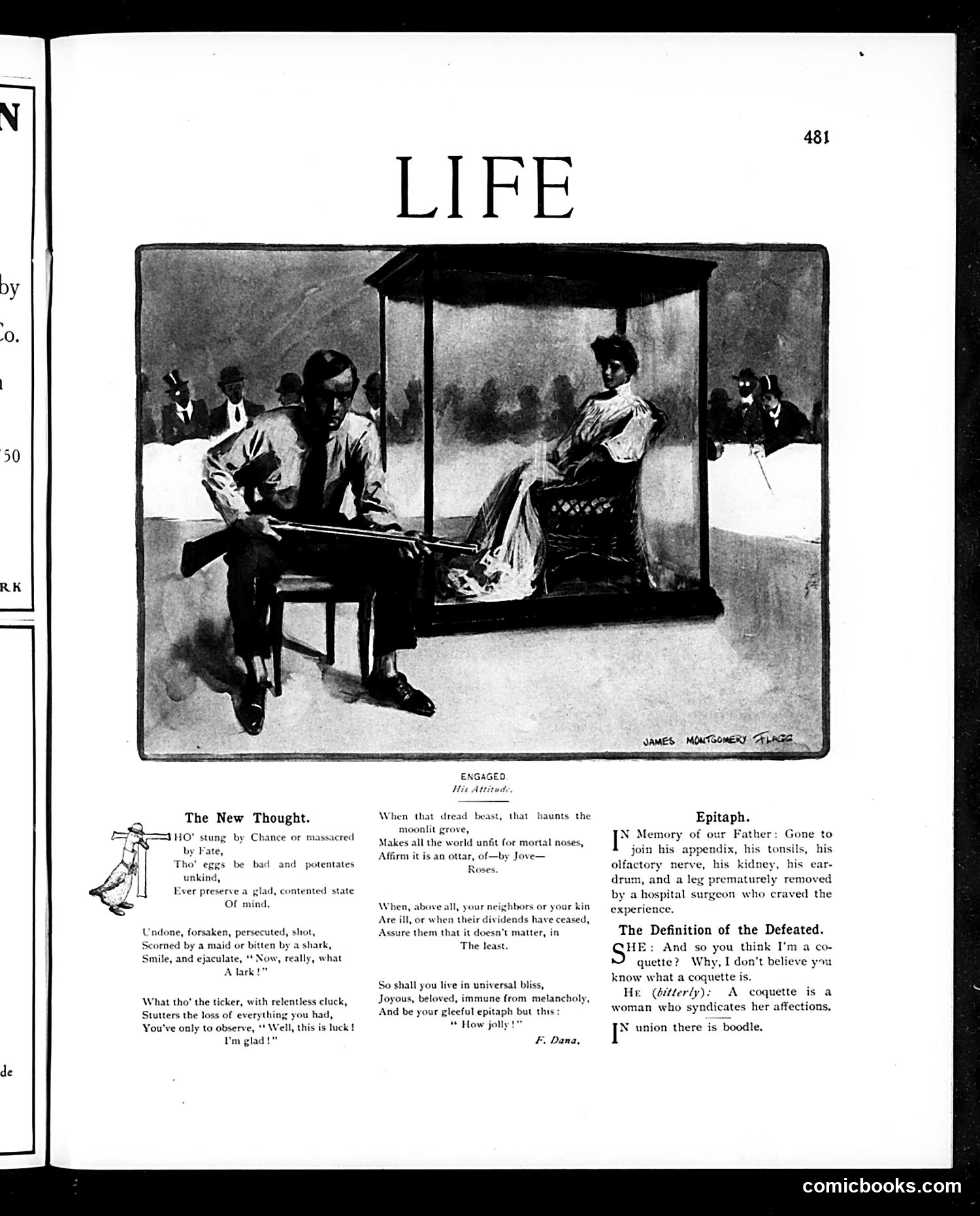
The main cartoon by James Montgomery Flagg depicts a couple at a public display or window, with spectators watching from outside. The title "Engaged" and subtitle "His Attitude" suggest social commentary on courtship behavior and public propriety. The accompanying poems—"The New Thought," "Epitaph," and "The Definition of the Defeated"—appear to satirize modern romantic attitudes and social anxieties of the era. The verses mock both romantic idealism ("dread beast, that haunts the moonlit grove") and practical concerns about marriage and social standing. The humor targets the performative nature of courtship and engagement, particularly how couples present themselves publicly versus privately—a critique of artificial social conventions around romance and marriage that would have resonated with Life magazine's educated, urban audience.
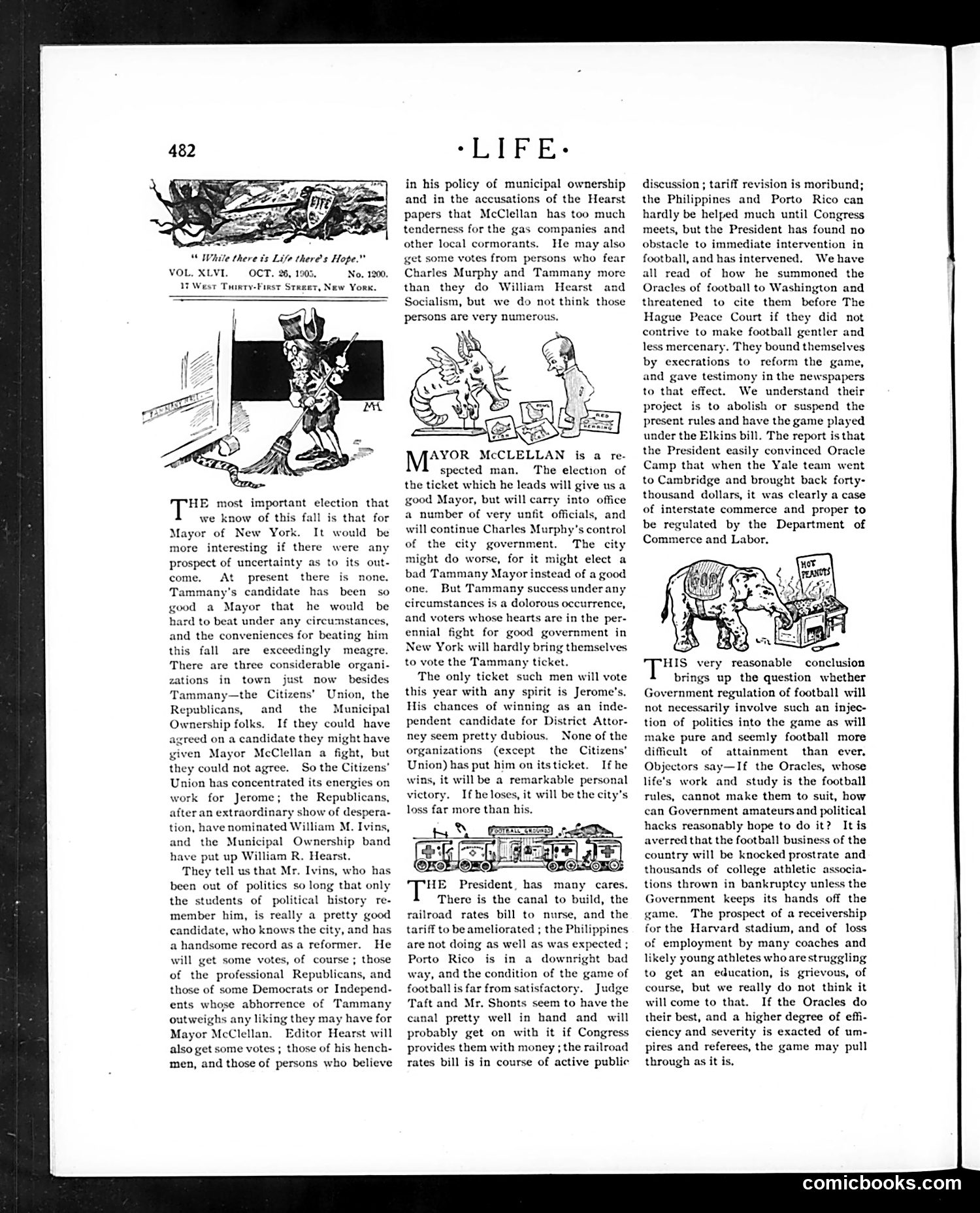
This page discusses New York City's mayoral election, focusing on Mayor McClellan's re-election prospects. The main cartoon (upper left) depicts a political figure confronting what appears to be a ballot box or voting apparatus, satirizing electoral concerns. The text criticizes Tammany Hall's political machine, suggesting McClellan faces opposition from Republican, Citizens' Union, and Municipal Ownership candidates. The article expresses concern about potential "unfit officials" if Tammany wins, though it acknowledges McClellan as "respected." A secondary cartoon (lower right) appears to comment on government regulation of football, referencing recent football reform efforts and the President's intervention in the sport. The satire targets both Tammany Hall's political dominance and broader Progressive-era debates about municipal governance and reform.
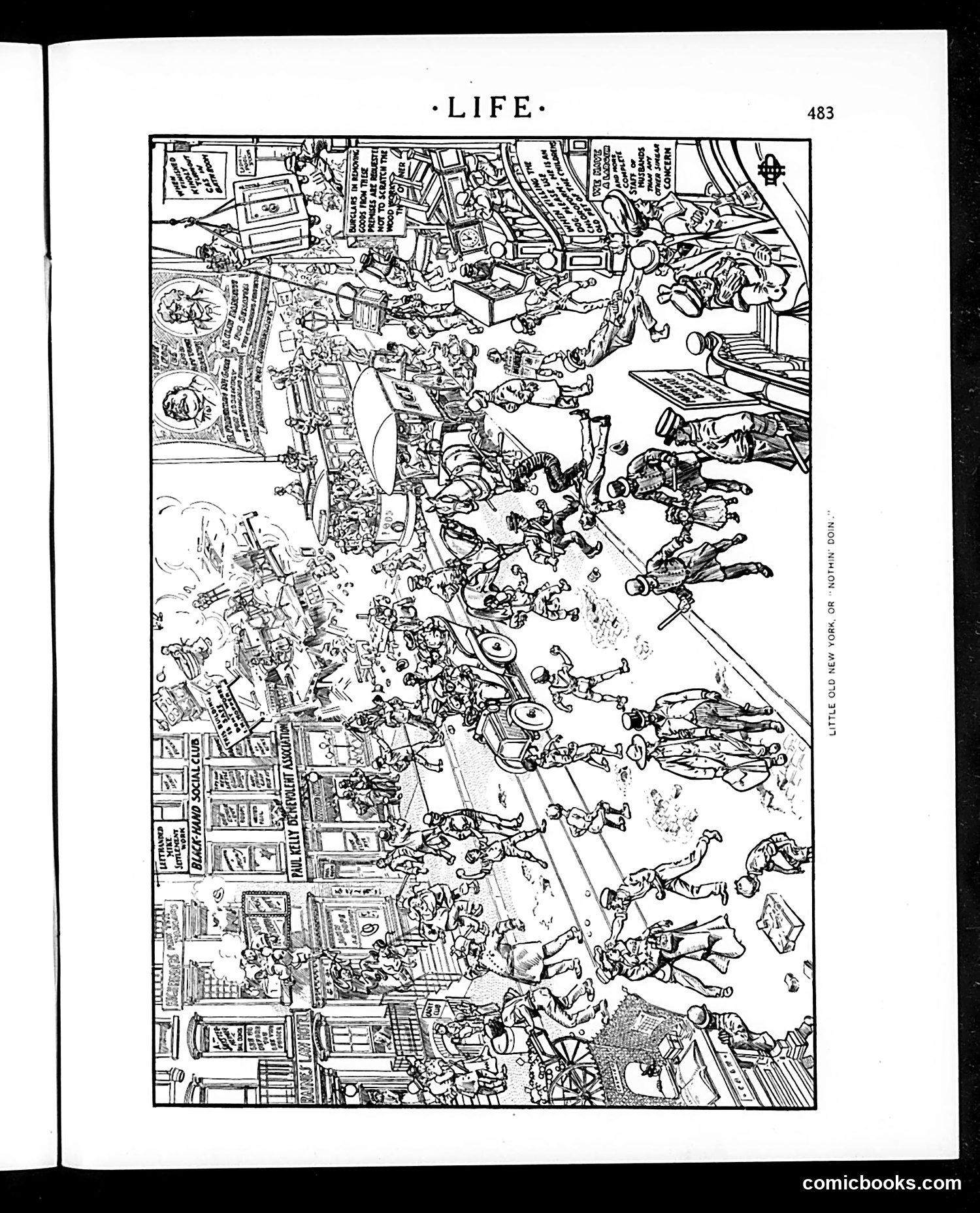
I can see this is a densely-packed satirical illustration from Life magazine (page 483), but the image quality and complexity make it difficult to identify specific figures with certainty. The cartoon appears to depict a chaotic indoor scene with numerous people engaged in various activities—some appearing to interact with furniture, objects, and each other in exaggerated or absurd ways. Without being able to read the caption or accompanying text clearly, I cannot confidently identify which specific political figures or social commentary this targets. The style suggests early-to-mid 20th century satire, likely commenting on contemporary social behavior or political events, but I cannot specify the exact subject matter or point of the satire with confidence from the image alone.
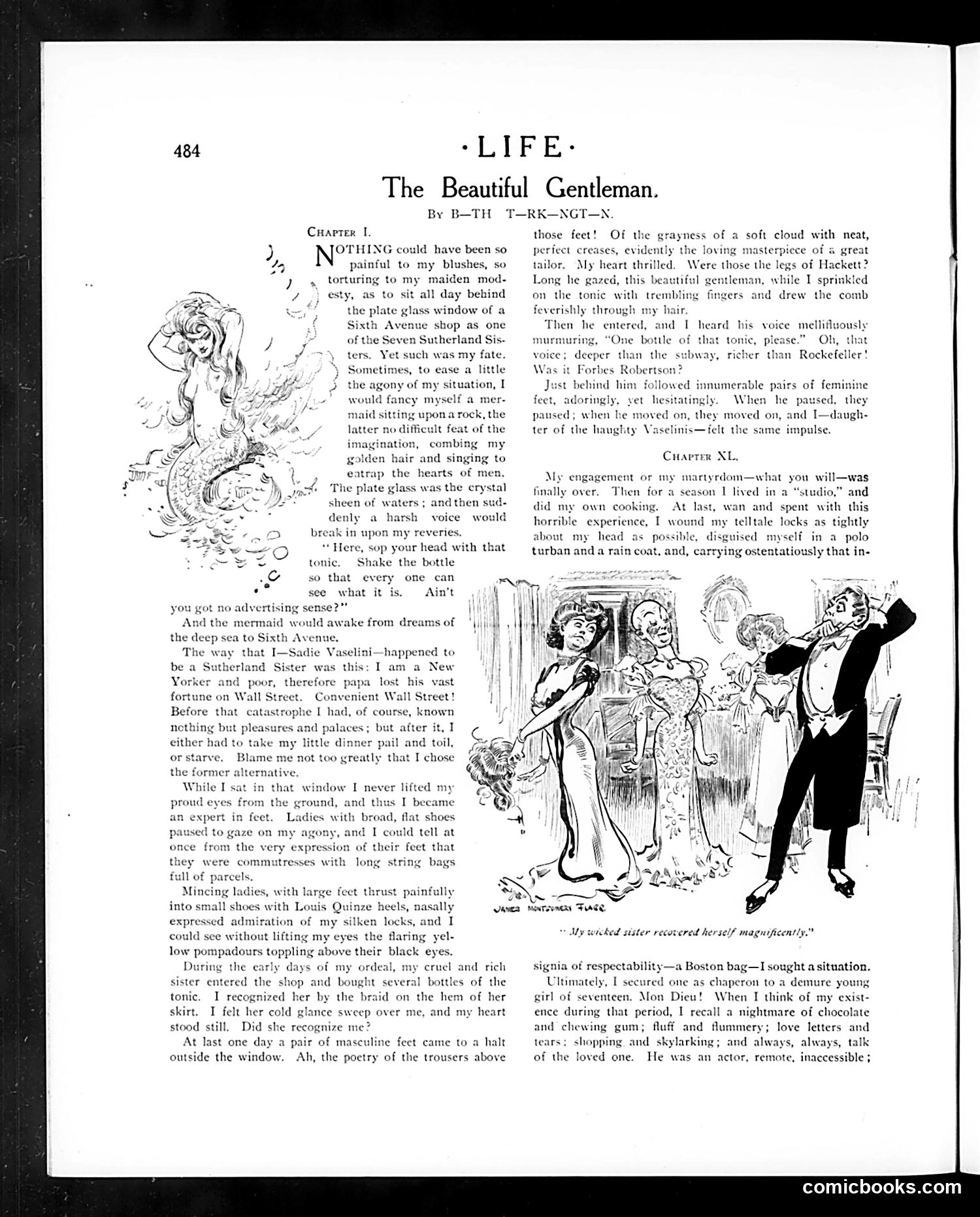
This page presents Chapter I and Chapter XL of a serialized story titled "The Beautiful Gentleman" by B-TH T-RK-NGT-N (likely Booth Tarkington, with vowels removed). The narrative, told by a female character named Sadie Vaselini, describes her fascination with an elegantly dressed man she observed through a shop window on Sixth Avenue. She admires his refined appearance—his perfect creases, soft cloud-like hair, and graceful bearing. The illustration shows a social scene with well-dressed figures in what appears to be an interior setting. The satire likely mocks both the superficiality of being captivated by appearance and the pretensions of fashionable society, themes common to Tarkington's work examining American social aspirations and materialism during this era.
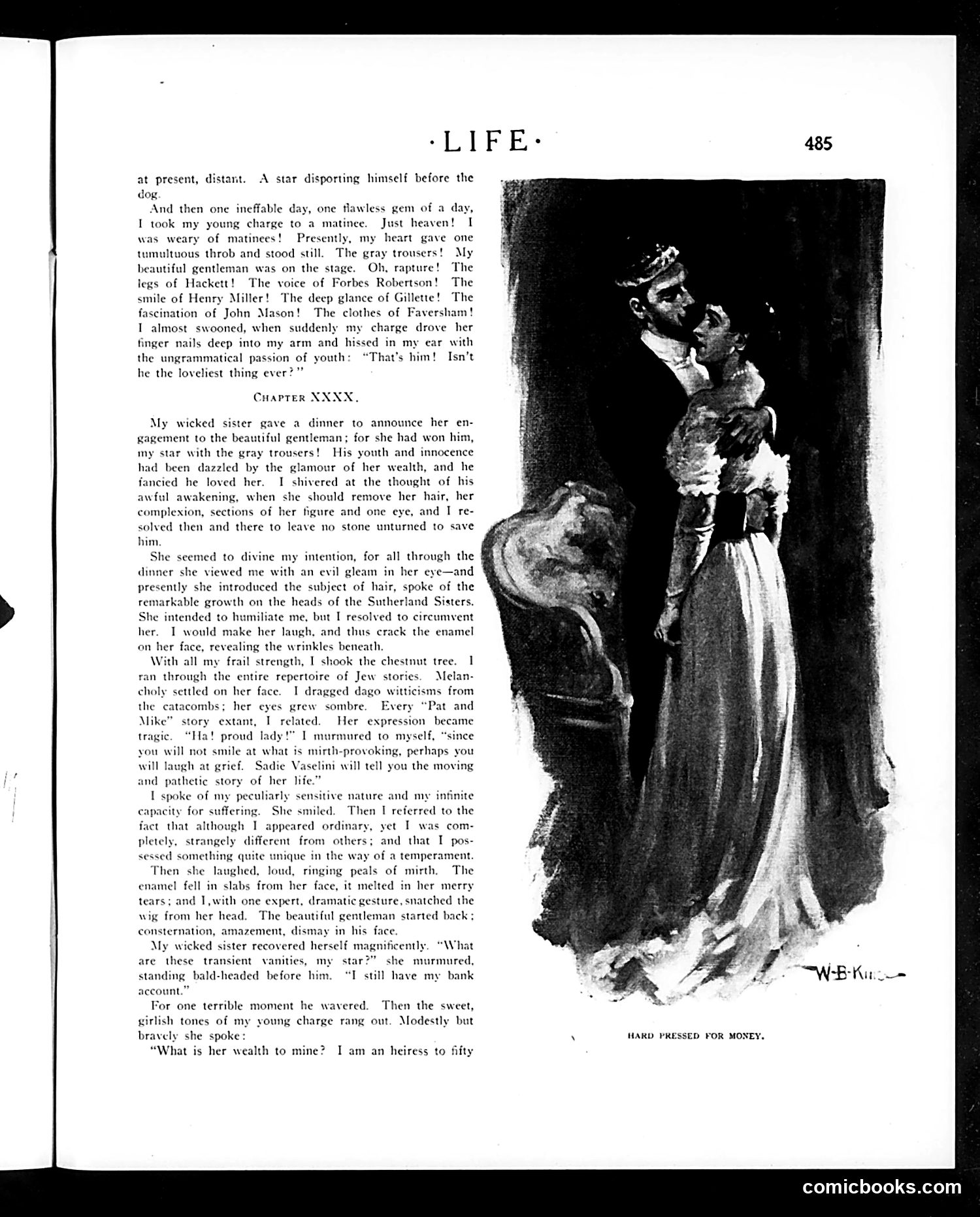
This page contains a fictional narrative (Chapter XXXXX) about a social scandal rather than a political cartoon. The illustration, captioned "Hard Pressed for Money," depicts a dramatic scene where a woman appears to be pressuring or confronting a well-dressed gentleman—likely suggesting financial coercion or blackmail related to romantic entanglement. The text describes a "wicked sister" announcing her engagement to a wealthy gentleman whom the narrator loves. The narrative involves schemes to humiliate the sister and protect the young man from her designs, including elaborate storytelling meant to mock her vanity. The illustration and text together satirize Gilded Age social climbing, female scheming for wealth through marriage, and the vulnerability of naive young men to manipulation by ambitious women—typical themes in Life's satirical fiction of this era.
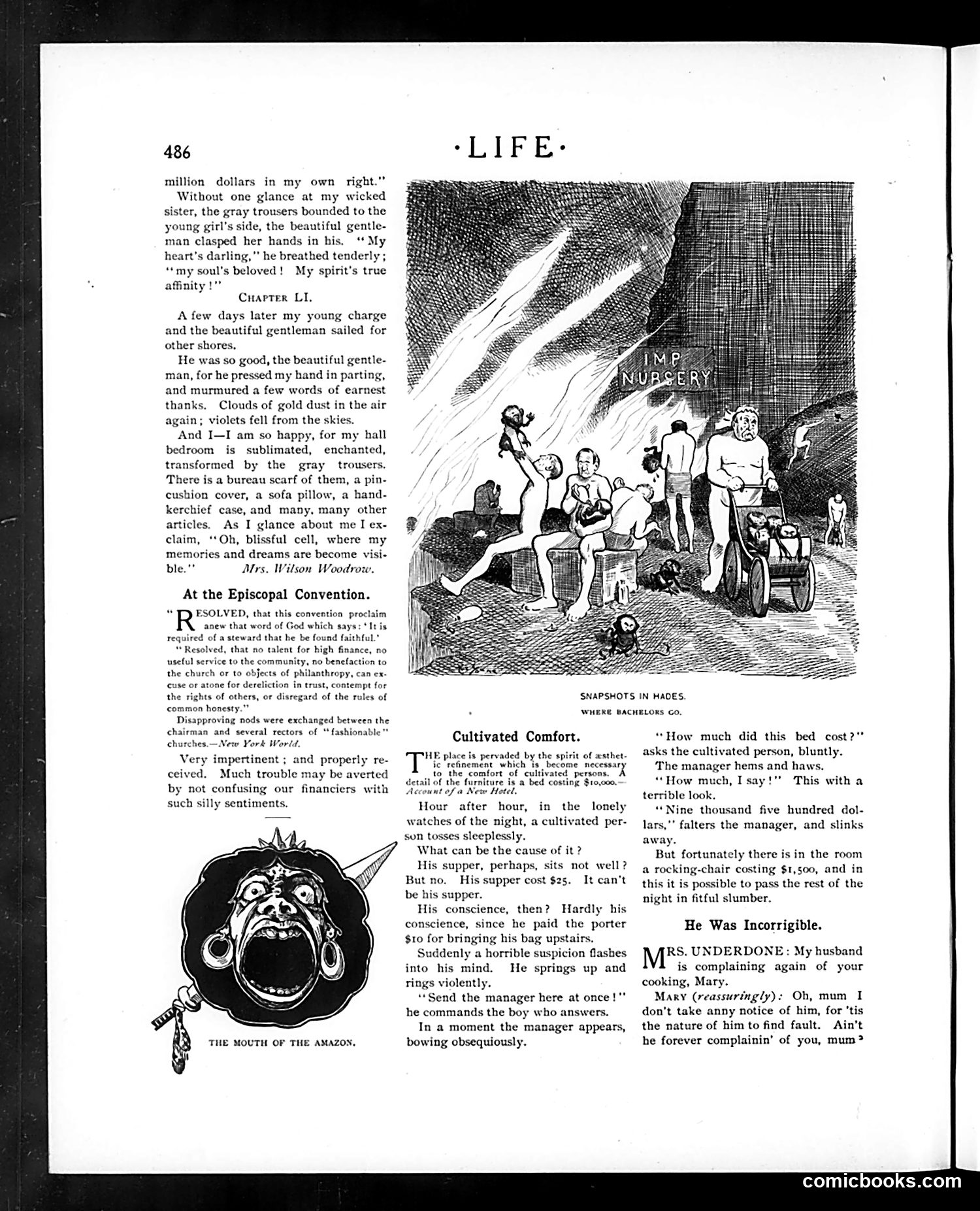
This page contains three distinct satirical pieces: 1. **"Snapshots in Hades"** - An illustration depicting what appears to be a rowdy scene at an "Imp Nursery," likely satirizing bachelor lifestyle or dissolute behavior among unmarried men. 2. **"The Mouth of the Amazons"** - A grotesque caricatured head, likely a racist caricature of an Indigenous person, used for comedic effect—reflecting the deeply problematic racial attitudes common in early Life magazine. 3. **"Cultivated Comfort" and "He Was Incorrigible"** - Short humorous anecdotes about hotel management and domestic complaints, typical of Life's satirical humor about middle-class discomforts and marital discord. The overall tone reflects turn-of-the-century American satire targeting social pretension, comfort-seeking behavior, and domestic life.
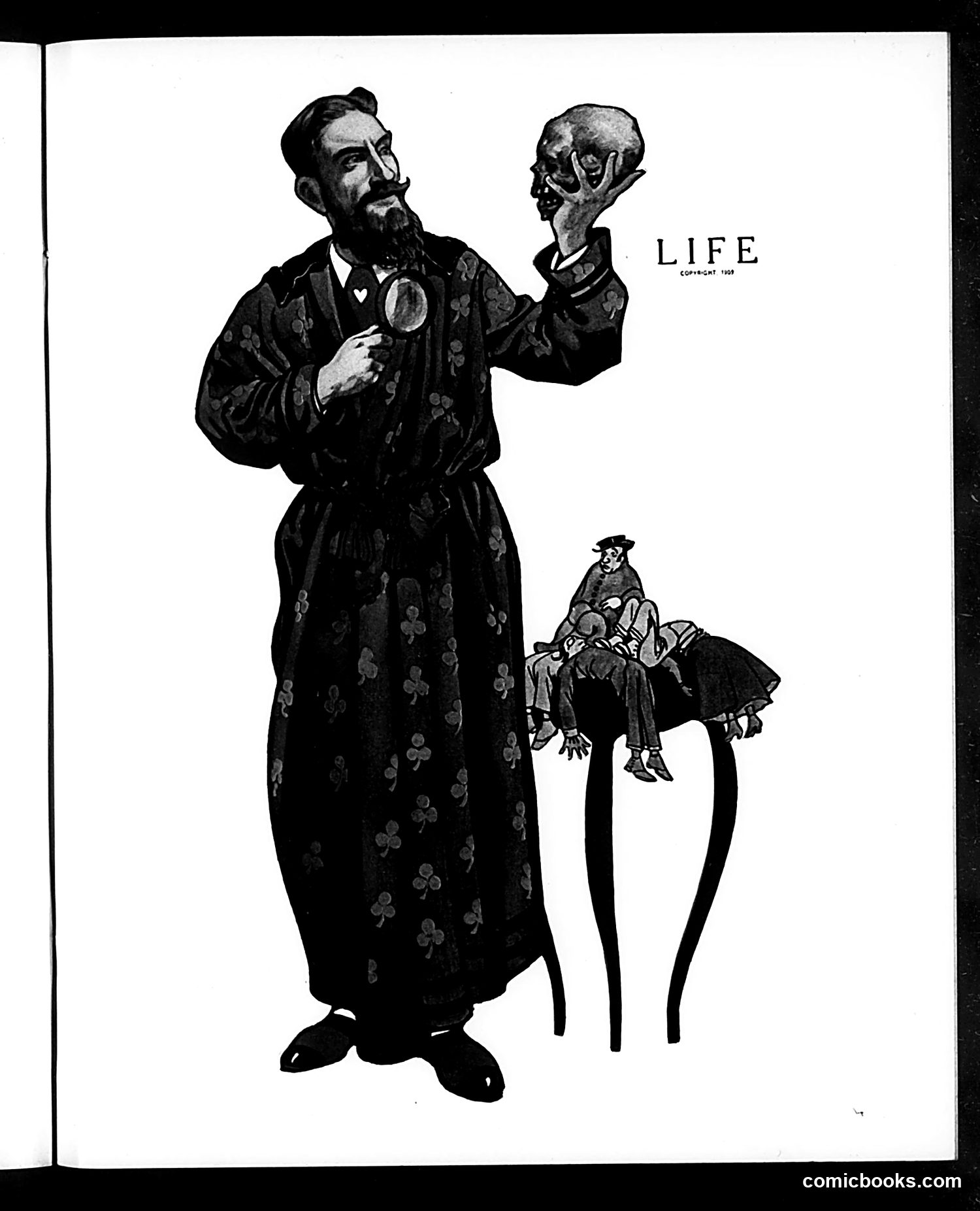
This appears to be a **Life magazine cover** from the early 20th century featuring a bearded man in an ornate robe examining a human skull through a magnifying glass, while a small figure sits astride a thin line below him. The imagery invokes **Hamlet's famous scene** with Yorick's skull—a cultural reference to contemplation of mortality and human nature. The bearded figure appears to be caricatured as an intellectual or scholar, possibly representing a specific public figure of the era, though without additional context it's unclear who exactly is depicted. The juxtaposition of the scholar's serious examination against the tiny figure below suggests satire about the pretensions or limitations of intellectual inquiry. The specific target remains ambiguous from the image alone.

I can see this is a blank or nearly blank page from Life magazine (indicated by "comicbooks.com" watermark at bottom). The page appears to be either: 1. A blank interior page from the original publication 2. A page that didn't scan clearly 3. An advertisement or filler page without visible content Without visible cartoon imagery, text, or other substantive content on this particular page, I cannot identify specific figures, political references, or satirical points. To provide accurate historical analysis as requested, I would need a page with legible cartoon artwork or article text. If you have another page from this Life issue with visible content, I'd be happy to analyze that instead.
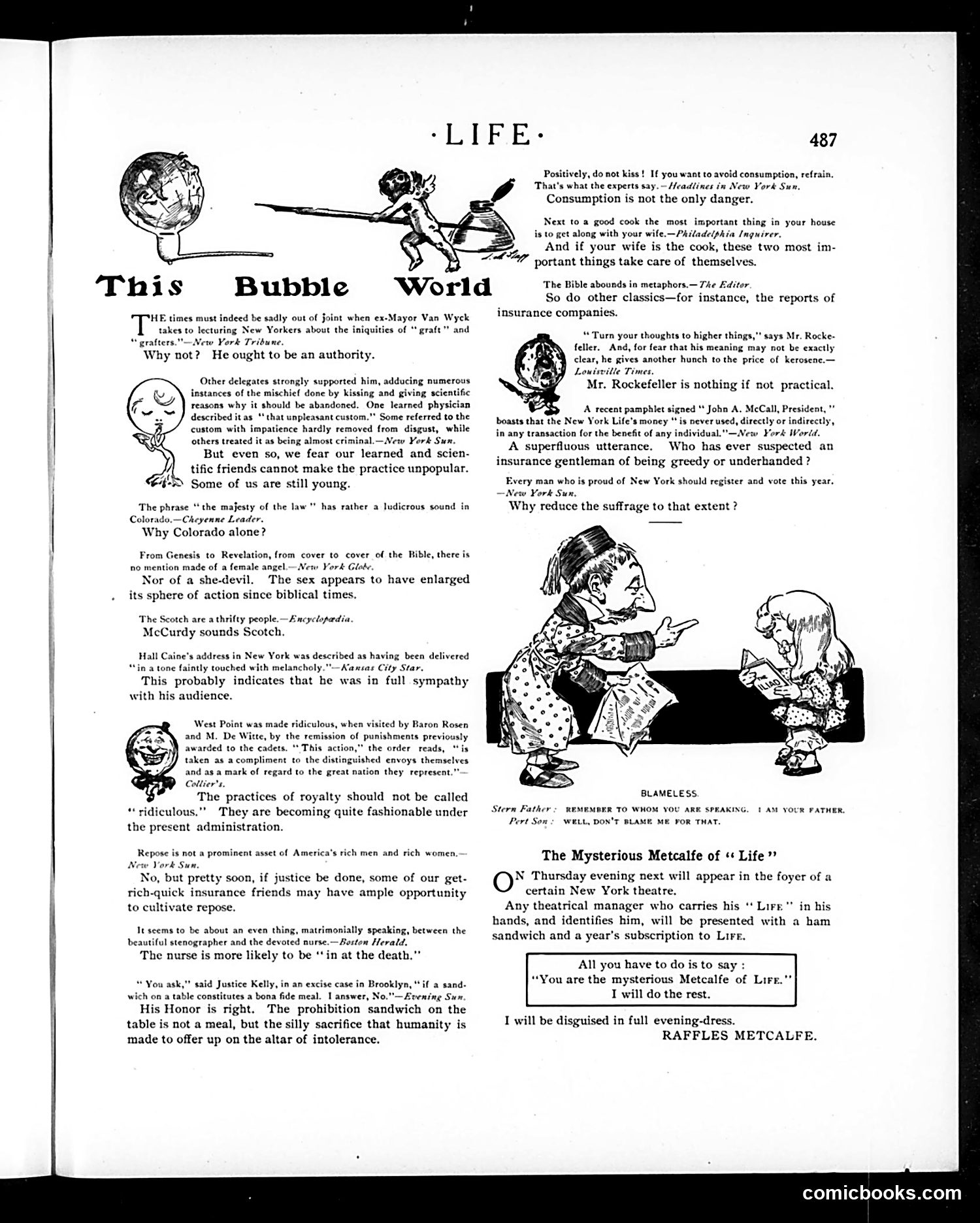
This page is primarily satirical commentary on contemporary issues (era unclear from this excerpt alone). The main cartoon "Blameless" depicts an authority figure scolding a child, illustrating hypocrisy—the adult claims "I am your father" while telling the child not to blame him for something. The page includes various short editorial jabs at social institutions: insurance companies' misleading claims, Rockefeller's business practices, women's expanding social roles since biblical times, and critiques of wealth and privilege among America's elite. "The Mysterious Metcalfe of 'Life'" announces a theatrical stunt where a theater manager will present himself as a "mysterious metcalfe," offering subscriptions as the prize—a self-promotional joke about the magazine itself.
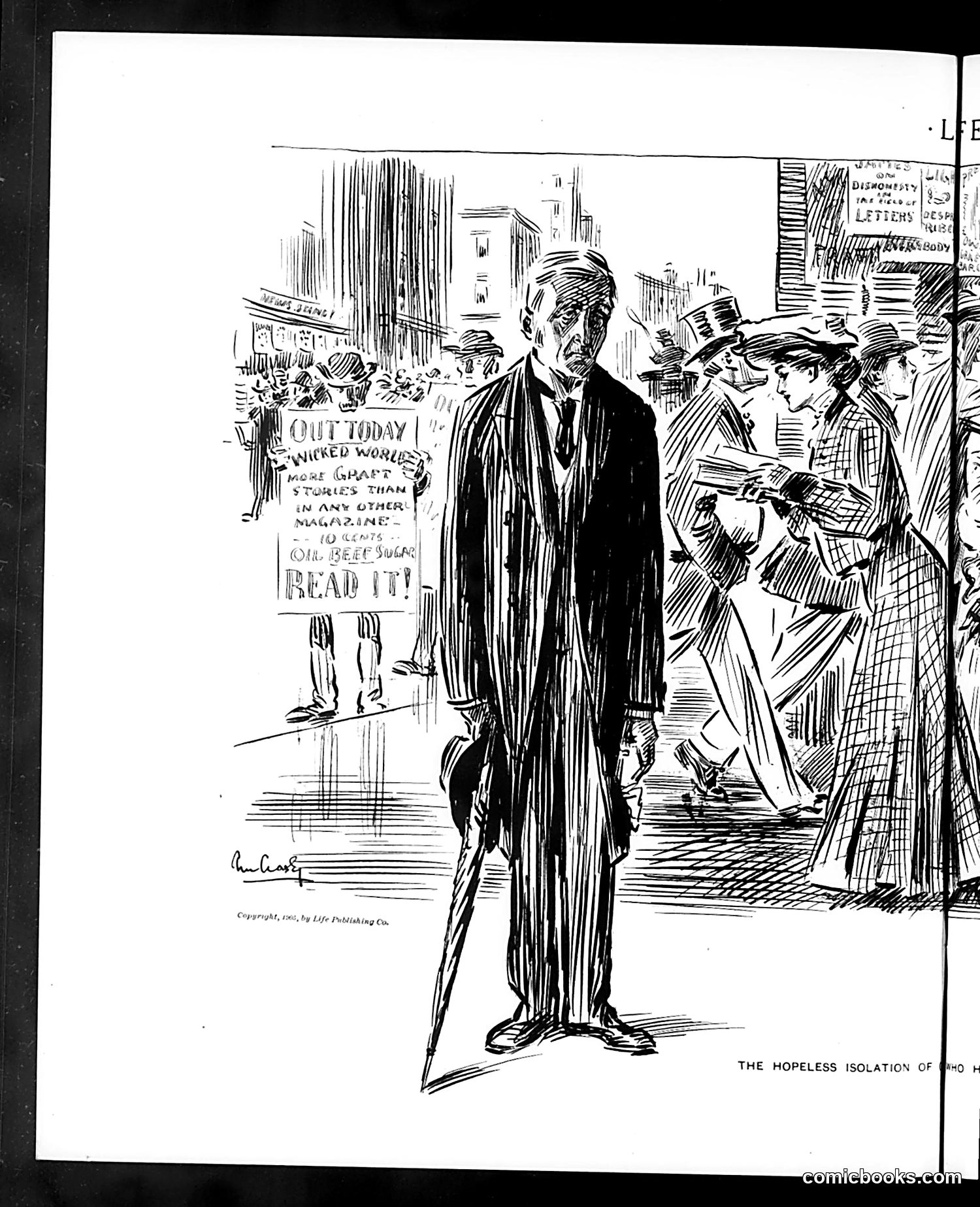
This cartoon depicts a well-dressed man in a long coat standing isolated on a city street, surrounded by crowds and a newspaper stand advertising "OUT TODAY 'WICKED WORLD'" (partially visible text mentioning it's "more graphic" and costs "10 cents"). The title reads "THE HOPELESS ISOLATION OF" (text cut off). The satire appears to comment on **social alienation in modern urban life**—specifically, how a solitary, dignified figure becomes emotionally disconnected despite being physically surrounded by crowds, commerce, and sensational media. The newspaper advertisement emphasizes society's appetite for lurid content, contrasting with the isolated man's apparent detachment or despair. This reflects early 20th-century anxieties about urbanization, mass media, and the psychological toll of modern city living on the individual.
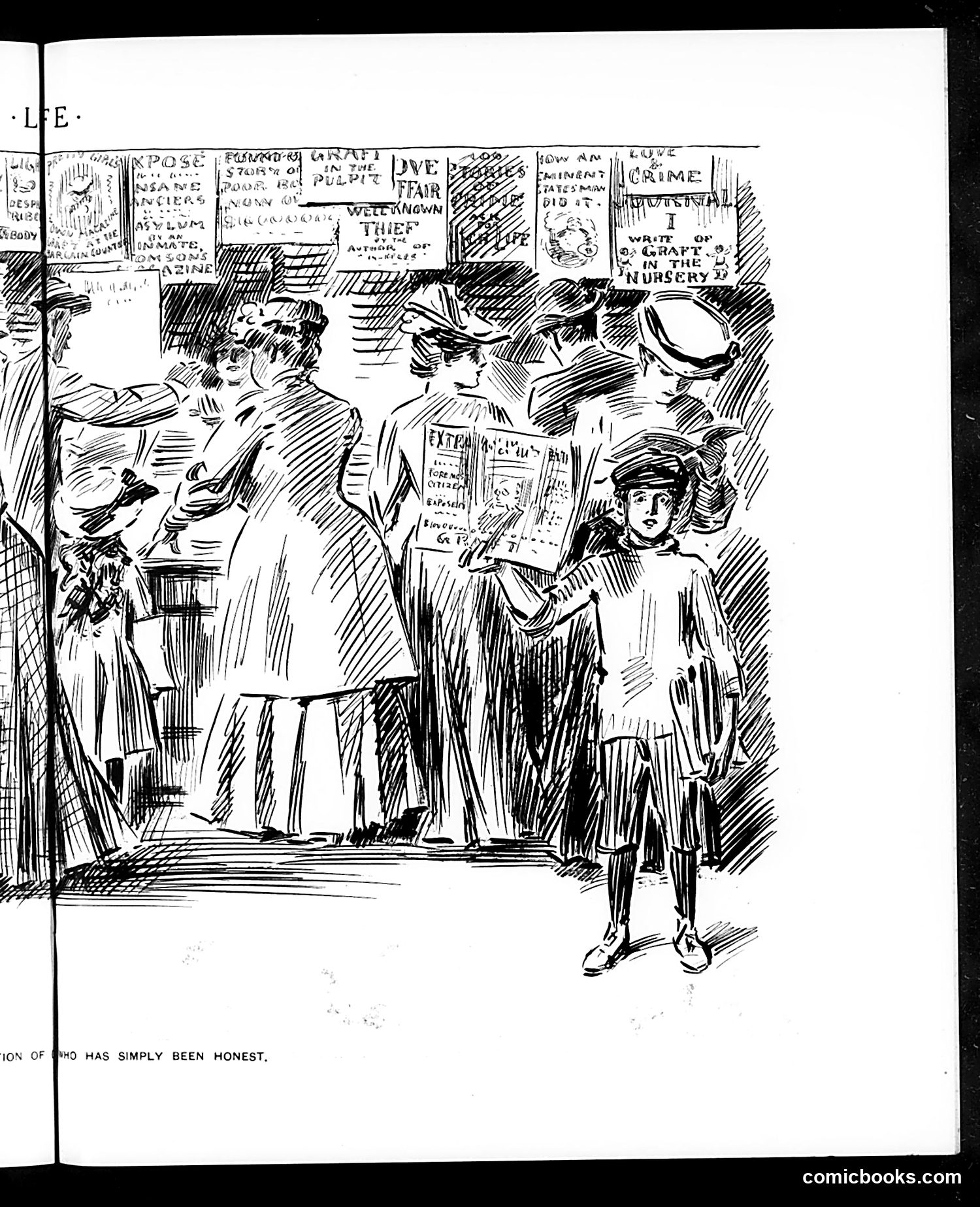
This appears to be a satirical illustration showing a young girl standing alone before a group of adults in what looks like a public space or storefront. Various signs are visible in the background, though most are illegible in this reproduction. The partially visible caption at bottom reads "...ION OF G*HO HAS SIMPLY BEEN HONEST," suggesting this is commentary on honesty or truthfulness. The girl's isolated stance before the gathered crowd suggests she represents an honest person or truth-teller facing skepticism or judgment from society. The crowded, indifferent adults around her may represent public opinion or social pressure. Without clearer text or identifying context, the specific social or political reference remains unclear, though the cartoon appears to critique how honest individuals are received or treated in society.
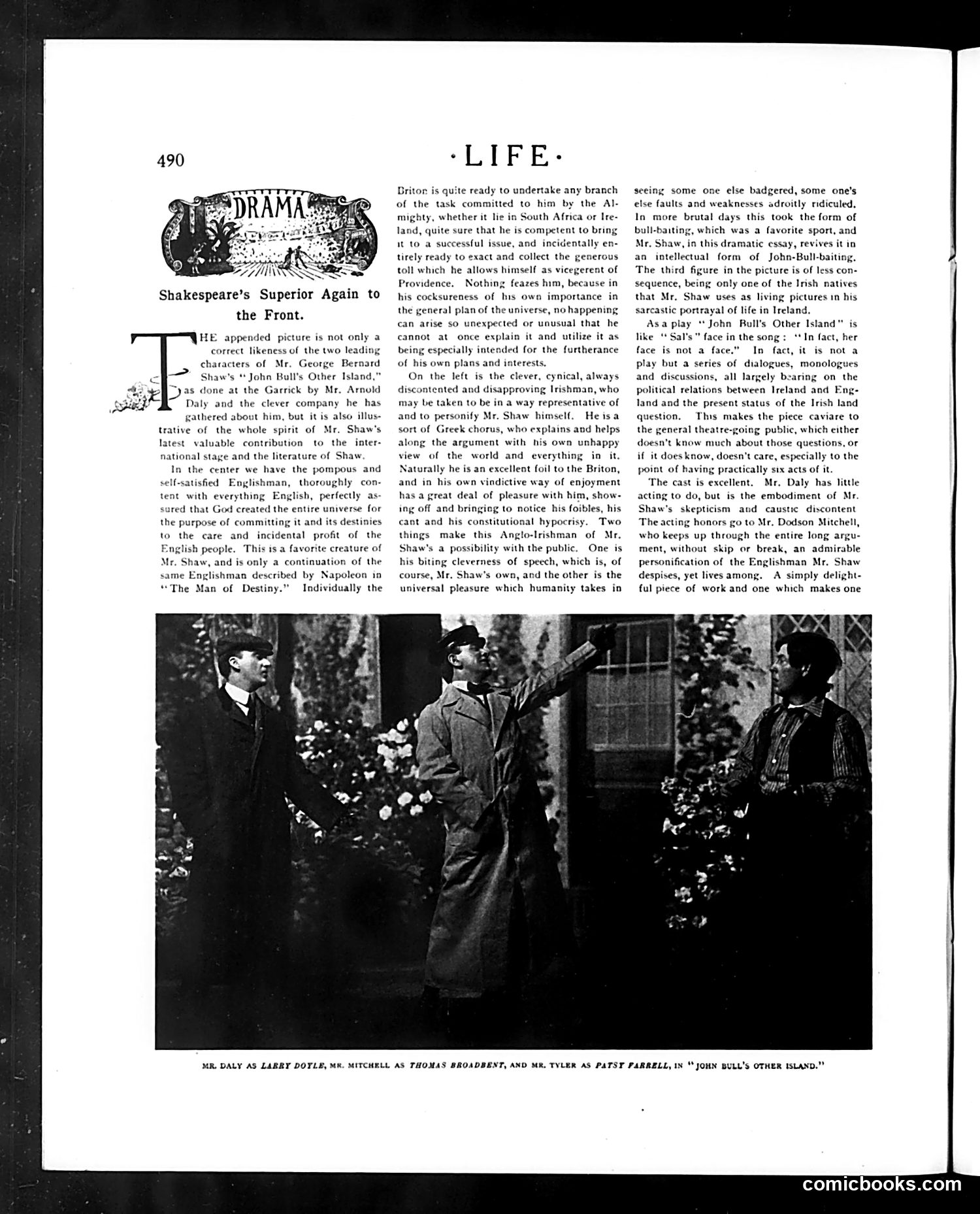
This page reviews George Bernard Shaw's play "John Bull's Other Island," performed at the Garrick Theatre with Arnold Daly. The accompanying photograph shows a scene from the production. The text explains Shaw's satirical characters: a pompous, self-satisfied Englishman (representing British imperial confidence) contrasted with a cynical Irish character who serves as a Greek chorus—essentially Shaw himself. The Irish figure critiques English hypocrisy and colonial attitudes. A third Irish character appears as background. The review notes the play is less a traditional drama than a series of dialogues about Anglo-Irish political relations and Irish land questions. The critic suggests general theater audiences find it too political and intellectual. Dodson Mitchell receives praise for maintaining the Irish character throughout the lengthy argument-driven piece, while Daly competently embodies Shaw's skeptical Englishman.
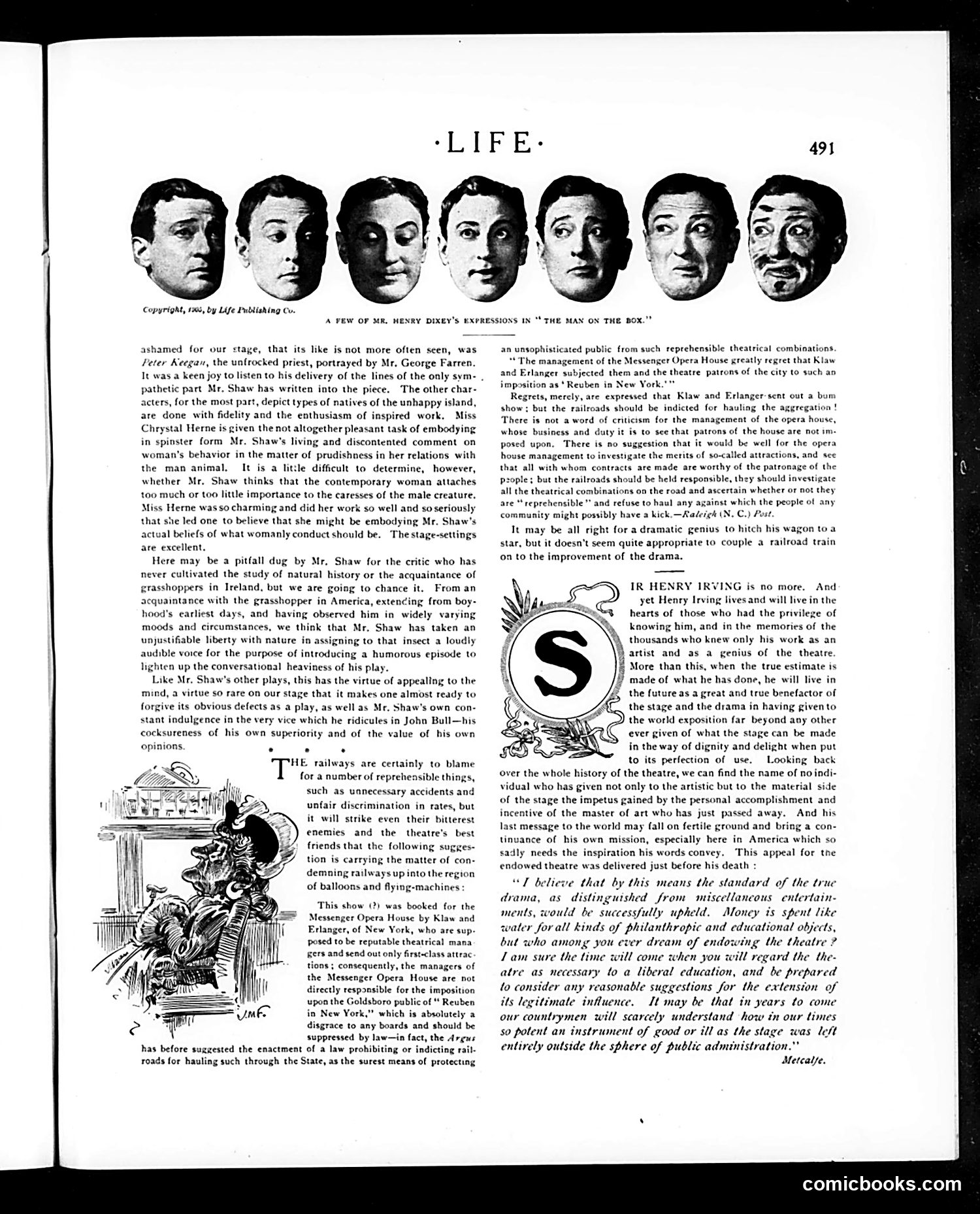
This page features **seven facial expression studies** of actor Henry Dixey in "The Man on the Box," a theatrical production. The photographs showcase different emotional expressions—appears to be standard theatrical documentation showing an actor's range. The article reviews Shaw's play and discusses theater management practices of the era. It critiques **Klaw and Erlanger**, prominent New York theatrical producers, for distributing inferior productions like "Reuben in New York" to regional opera houses. The author sarcastically suggests railroads should be legally liable for transporting such poor-quality shows. The satire targets: theatrical monopolies exploiting local venues, the gap between big-city and provincial entertainment standards, and the powerlessness of regional theater managers forced to book whatever major producers send them. There's also commentary on Shaw's plays themselves—praising their intellectual appeal while criticizing Shaw's authorial smugness and his unflattering portrayal of women's sexuality and Irish identity.
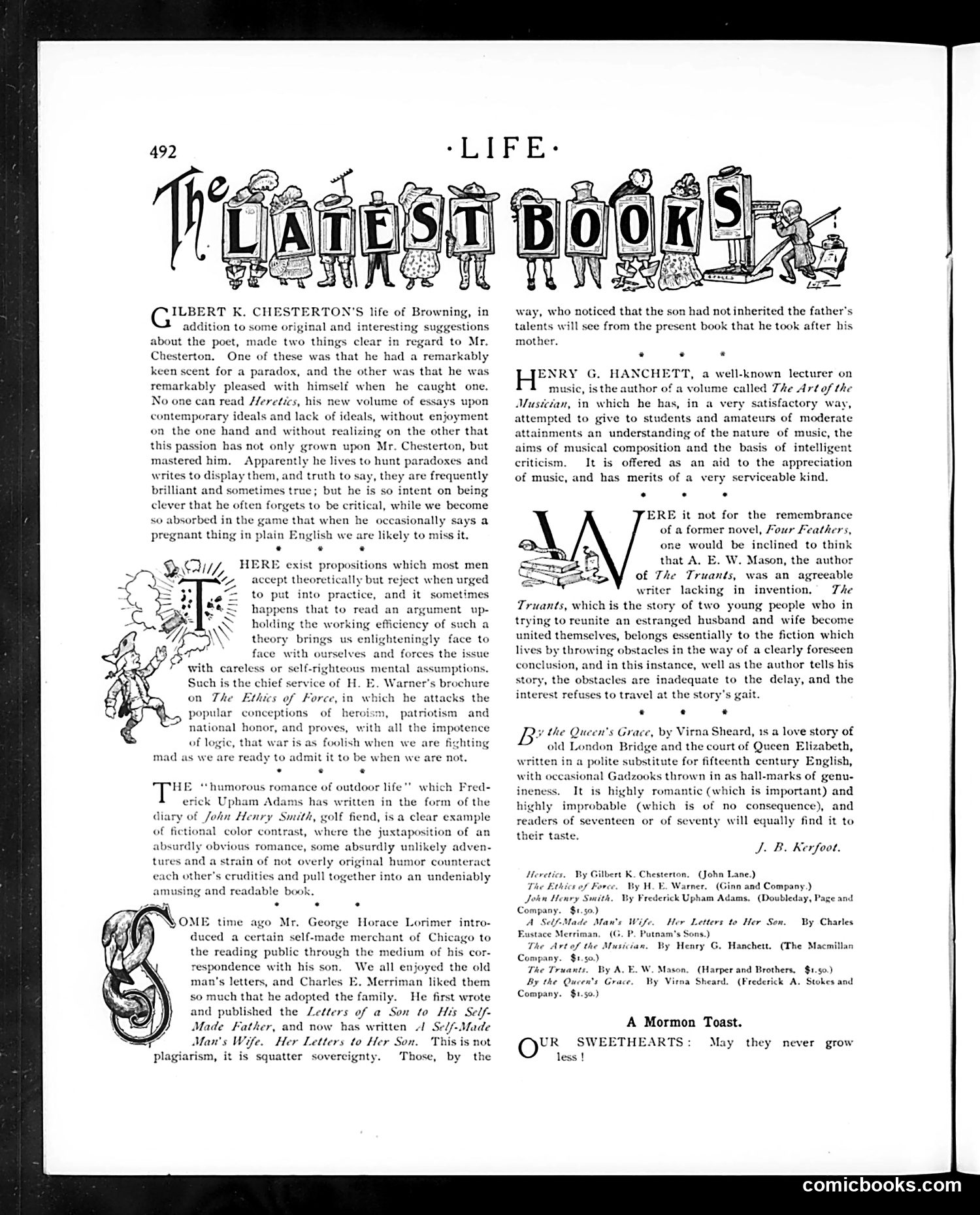
This is a literary review section featuring critiques of contemporary books. The decorative header "The Latest Books" uses anthropomorphized letter characters—a common design style of the era. The reviews discuss works by notable authors: Gilbert K. Chesterton's *Heretics* is criticized for obsessing over clever paradoxes at the expense of genuine insight. H. E. Warner's *The Ethics of Force* is praised for logically attacking romanticized notions of patriotism and war. Frederick Upham Adams's golf novel is deemed amusing but crude. The page also reviews Charles Merriman's imitative "self-made man" letters (following Lorimer's popular format), praises Henry G. Hanchett's music instruction book, and critiques A. E. W. Mason's *The Truants* as formulaic fiction relying too heavily on contrived obstacles. The tone is urbane and occasionally caustic—typical of Life's satirical literary commentary for educated readers of the early 1900s.
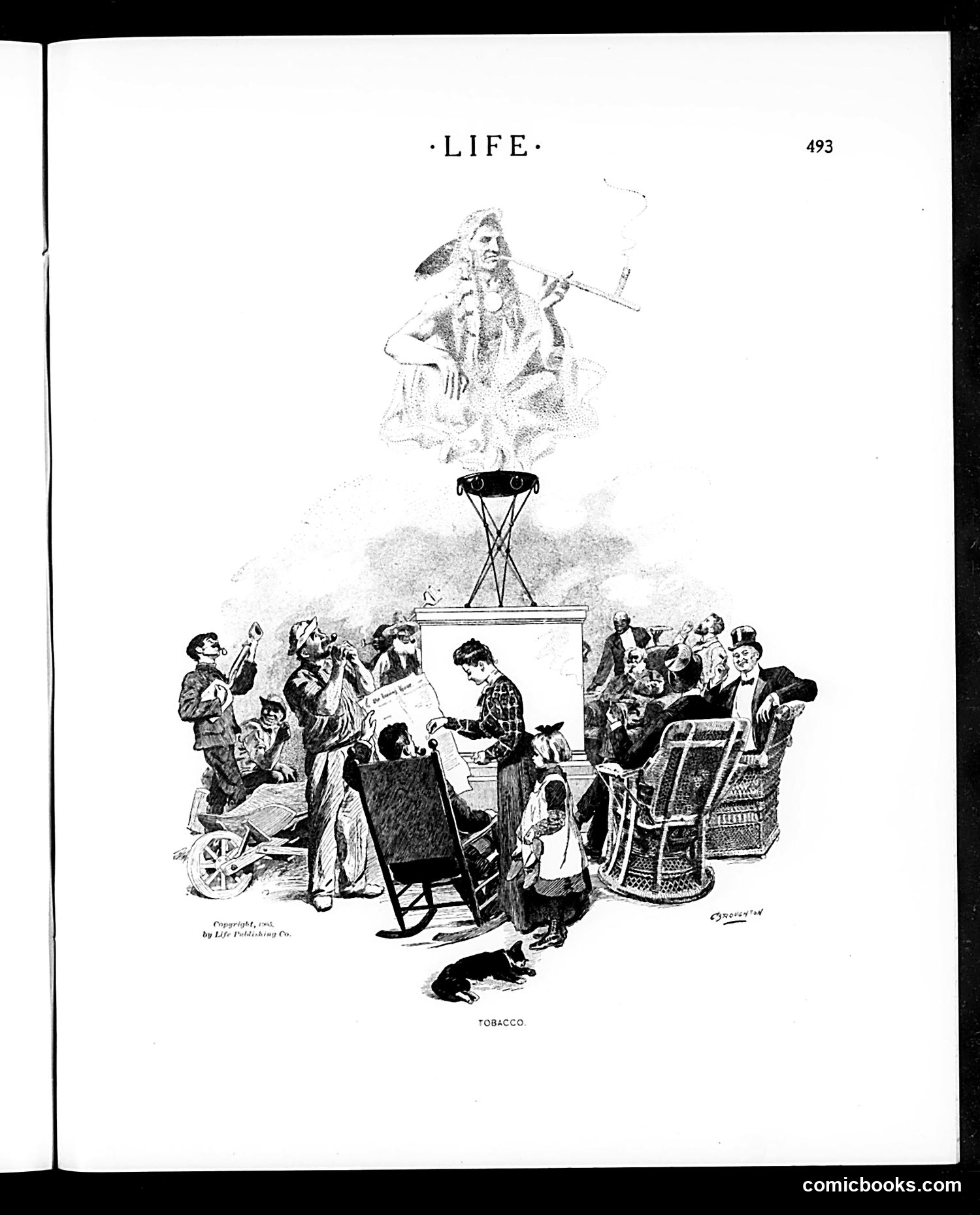
This satirical illustration depicts tobacco as a powerful corrupting influence. A grotesque, wizened figure representing "Tobacco" sits elevated on a pedestal, presiding over a gathered crowd of various people—including well-dressed gentlemen, women, and children—who appear to be worshipping or paying homage to it. The cartoon criticizes tobacco's addictive power and its social penetration across all classes. The elevated position suggests tobacco's dominance in society, while the diverse crowd illustrates its widespread appeal and control over multiple demographic groups. The grotesque appearance of the personified tobacco emphasizes the vice as morally repugnant, yet irresistibly compelling to those depicted below. This reflects early-20th-century anti-tobacco sentiment, viewing smoking as a destructive social evil.
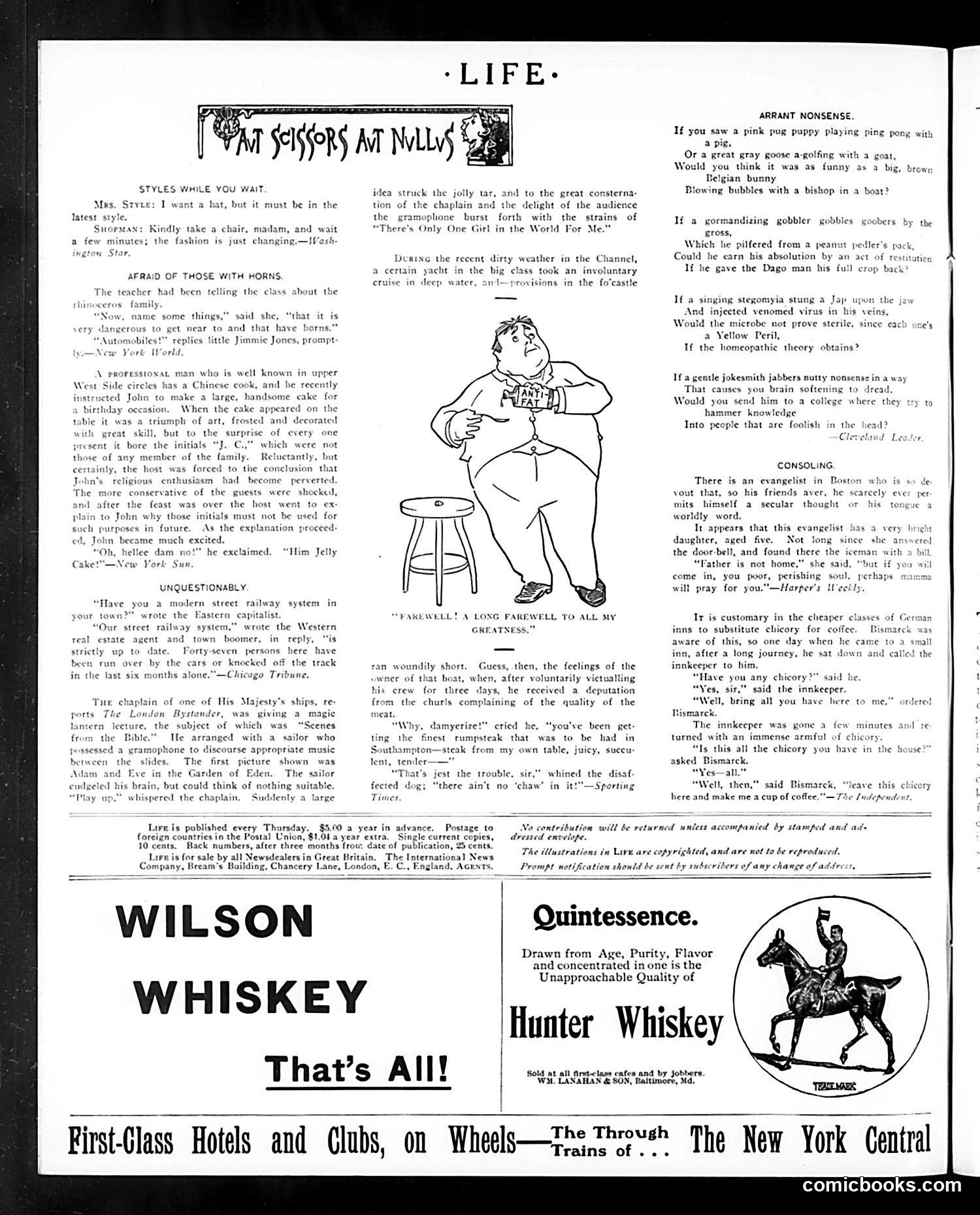
This page from *Life* magazine (a satirical weekly) contains several humor pieces and advertisements typical of early 20th-century American comedy journalism. **Main cartoons/sections:** 1. **"Scissors at Nully's"** - Brief anecdotes about fashion, children, and professional mishaps, establishing comic scenarios. 2. **Central cartoon** - A rotund man sitting on a stool, captioned "Farewell! A Long Farewell to All My Greatness," illustrating a story about a yacht owner who fed his crew expensive steak, only to be told by the sailors it had no "chaw" (chewing texture). The joke mocks pretension and working-class practicality. 3. **"Arrant Nonsense"** - Absurdist rhyming verse mixing absurd imagery (pink pug puppies, golfing geese, Bengali bunnies) with pseudo-intellectual concerns (homeopathic theory, Yellow Peril references). **Bottom ads** promote Wilson Whiskey and Hunter Whiskey, typical period alcohol advertising. The page exemplifies *Life*'s satirical approach: mocking social pretension, class differences, and pseudo-intellectual discourse through whimsical humor.
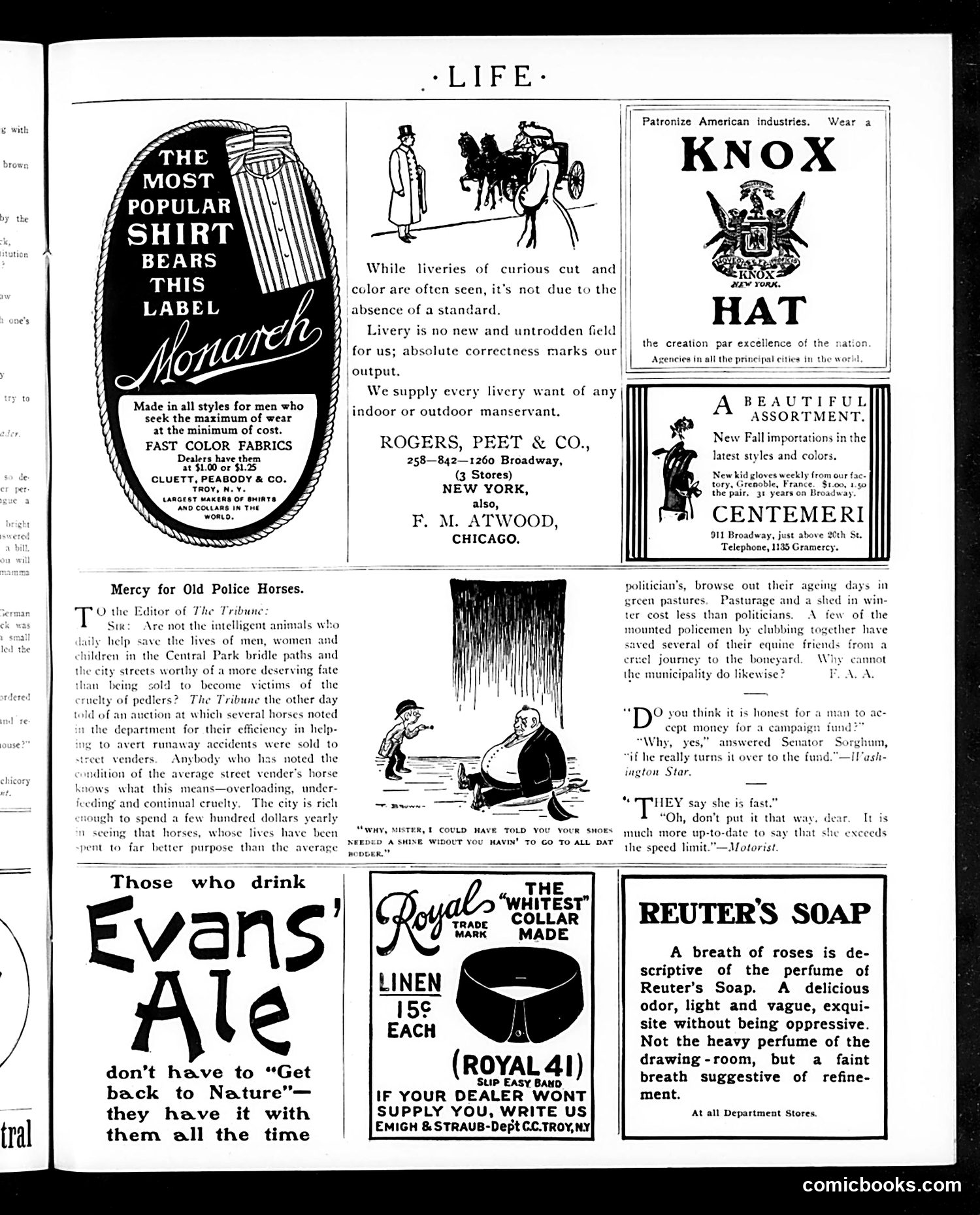
This page is primarily **advertisements and a letter to the editor**, not political cartoons. The notable content includes: **"Mercy for Old Police Horses"** — A letter arguing that retired New York City police horses deserve humane treatment (pasture rest) rather than being sold to street vendors for exploitation. The writer notes these animals have served the public faithfully and deserve better fates than politicians receive, appealing to the city's wealth to fund their retirement. This reflects Progressive Era concern for animal welfare. **The cartoon vignettes** show minor comic exchanges: a shoe-shiner's quip about worn shoes, and a motorist joke about driving speed. **The advertisements** promote Monarch shirts, Knox hats, Evans' Ale, Royal collars, Reuter's soap, and other products—typical early 20th-century marketing, including a note to "Patronize American Industries." The page reflects period concerns about urban animal treatment and contains standard commercial messaging typical of Life's mixed editorial-advertising format.
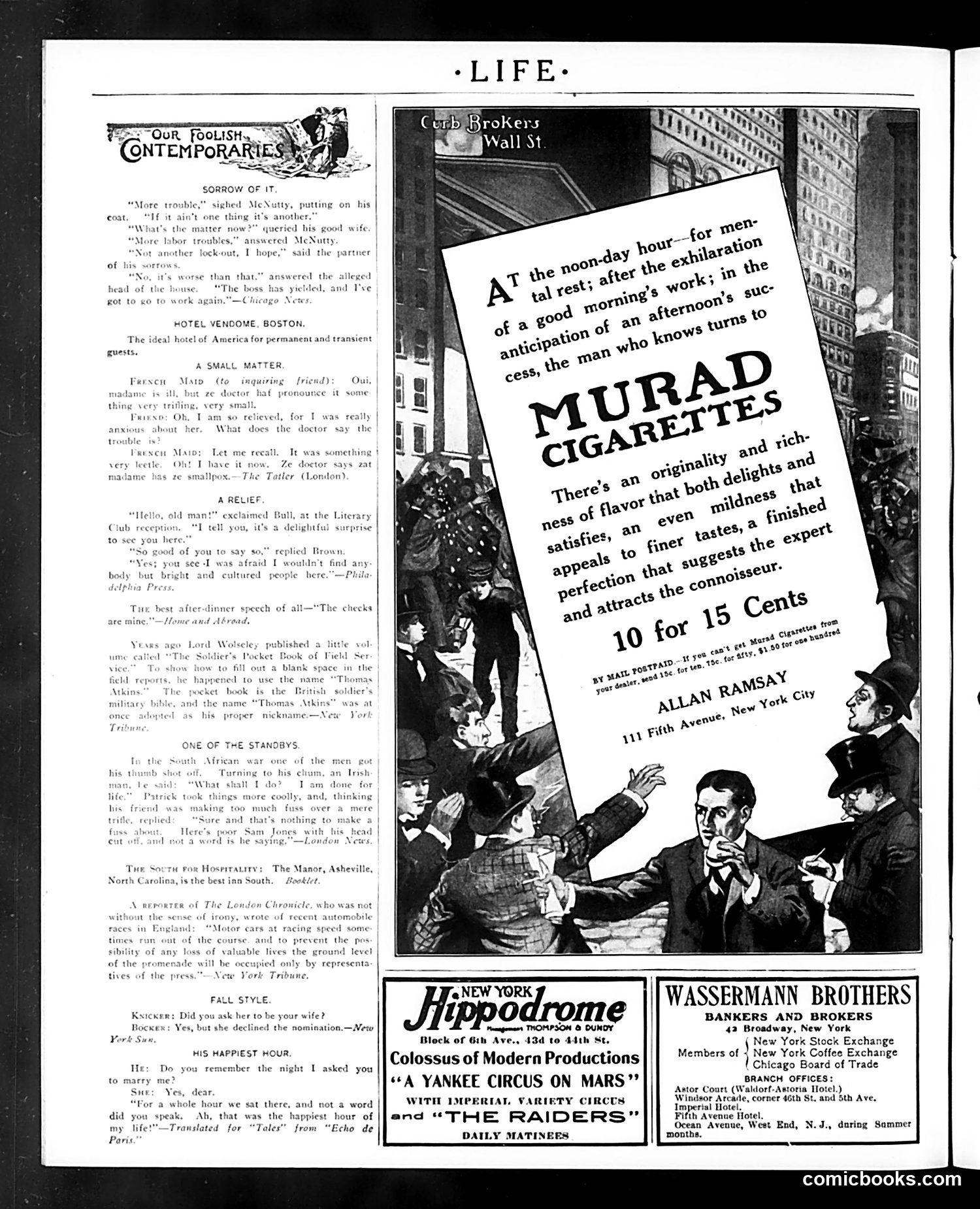
This page mixes humor columns with period advertisements. The left side contains "Our Foolish Contemporaries"—a satirical section reprinting awkward or contradictory quotes from newspapers and public figures, presented as unintentional comedy. Examples include a French Maid's mangled English and contradictory statements about worry. Below that, brief anecdotes mock social pretension and human nature: a man's relief that dinner checks arrive (implying the conversation was tedious), a South African soldier's fatalistic philosophy, and a couple's romantic miscommunication. The right side features a large Murad Cigarettes advertisement—a luxury product marketed to businessmen at noon break—alongside ads for the Hippodrome theater and Wassermann Brothers banking house. The satire is genteel and mild, targeting everyday social absurdities rather than specific political issues. The page reflects early 20th-century Life magazine's focus on urbane, middle-class humor for affluent readers.
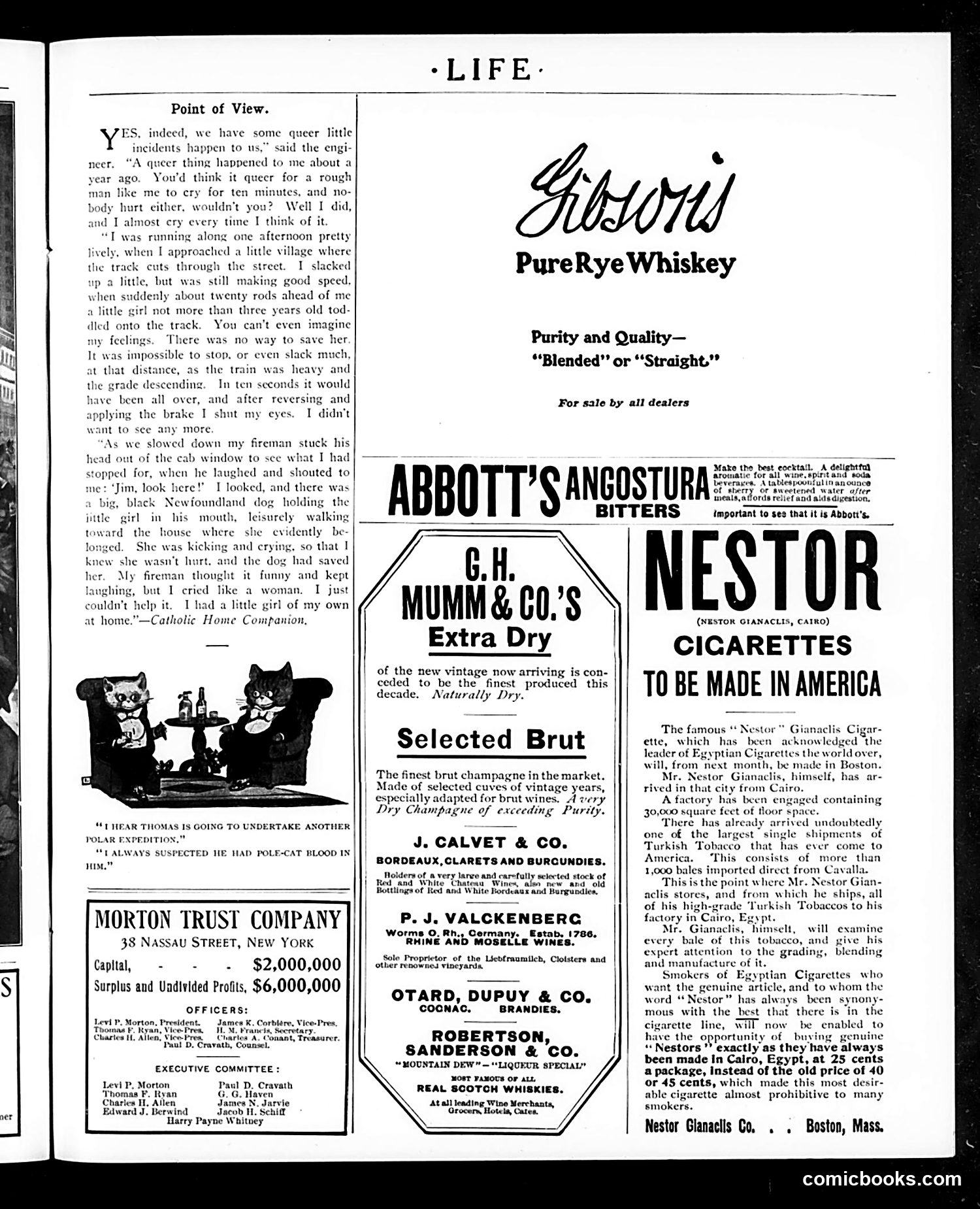
This page features a sentimental anecdote from *Catholic Home Companion* about a train engineer who nearly hits a toddler on the tracks. A Newfoundland dog rescues the child by carrying her away in its mouth. The engineer, initially terrified, breaks down crying—identifying with the child as his own daughter. The accompanying cartoon makes a pun: two cats discuss a third cat's planned polar expedition, with one remarking he "always suspected he had pole-cat blood in him"—a play on "pole-cat" (skunk) versus "polar" explorer. The page is primarily filled with period advertisements for whiskey, champagne, brandy, bitters, and—notably—Egyptian cigarettes about to be manufactured in Boston. The anecdote reflects early 20th-century sentimental values about fatherhood and emotion, while the pun exemplifies the magazine's light satirical humor.
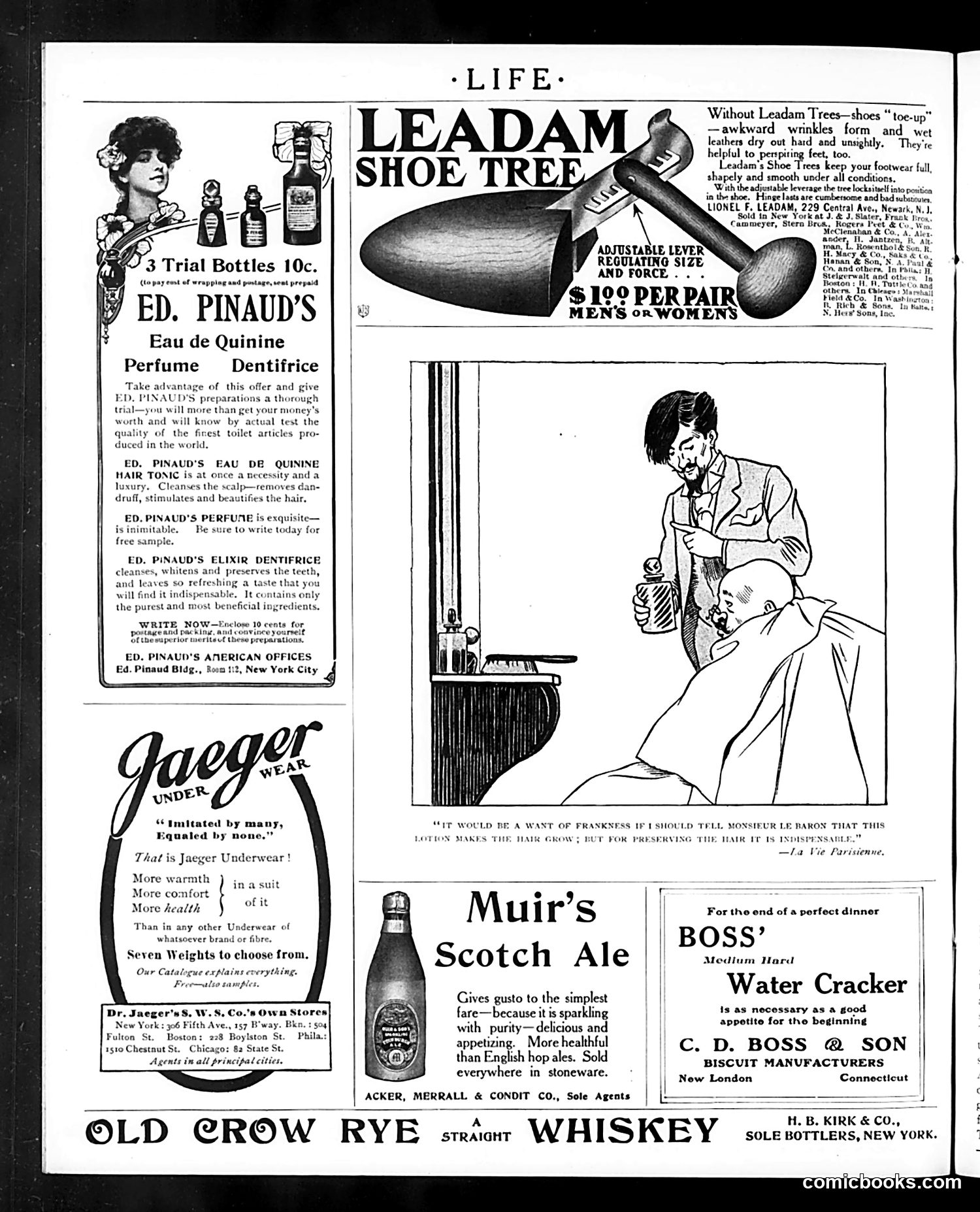
This page is primarily **advertisements** with one small illustration—not political satire. The content reflects early 20th-century consumer goods and social norms. The central cartoon depicts a **barber or hairdresser applying hair lotion** to a male client, with a quote attributed to "La Vie Parisienne" (a French publication) praising the product for preserving hair. This illustrates the era's fixation on male grooming and hair loss remedies—a recurring anxiety in period advertising. The surrounding ads promote luxury toiletries (Ed. Pinaud perfumes and tonics), **shoe trees** (devices that maintained shoe shape), quality underwear, and alcoholic beverages—all markers of genteel living for middle-class readers. The French attribution adds aspirational cachet, suggesting Continental sophistication. There is **no political commentary**—this is straightforward merchandising reflecting Edwardian consumer culture and masculine grooming anxieties.
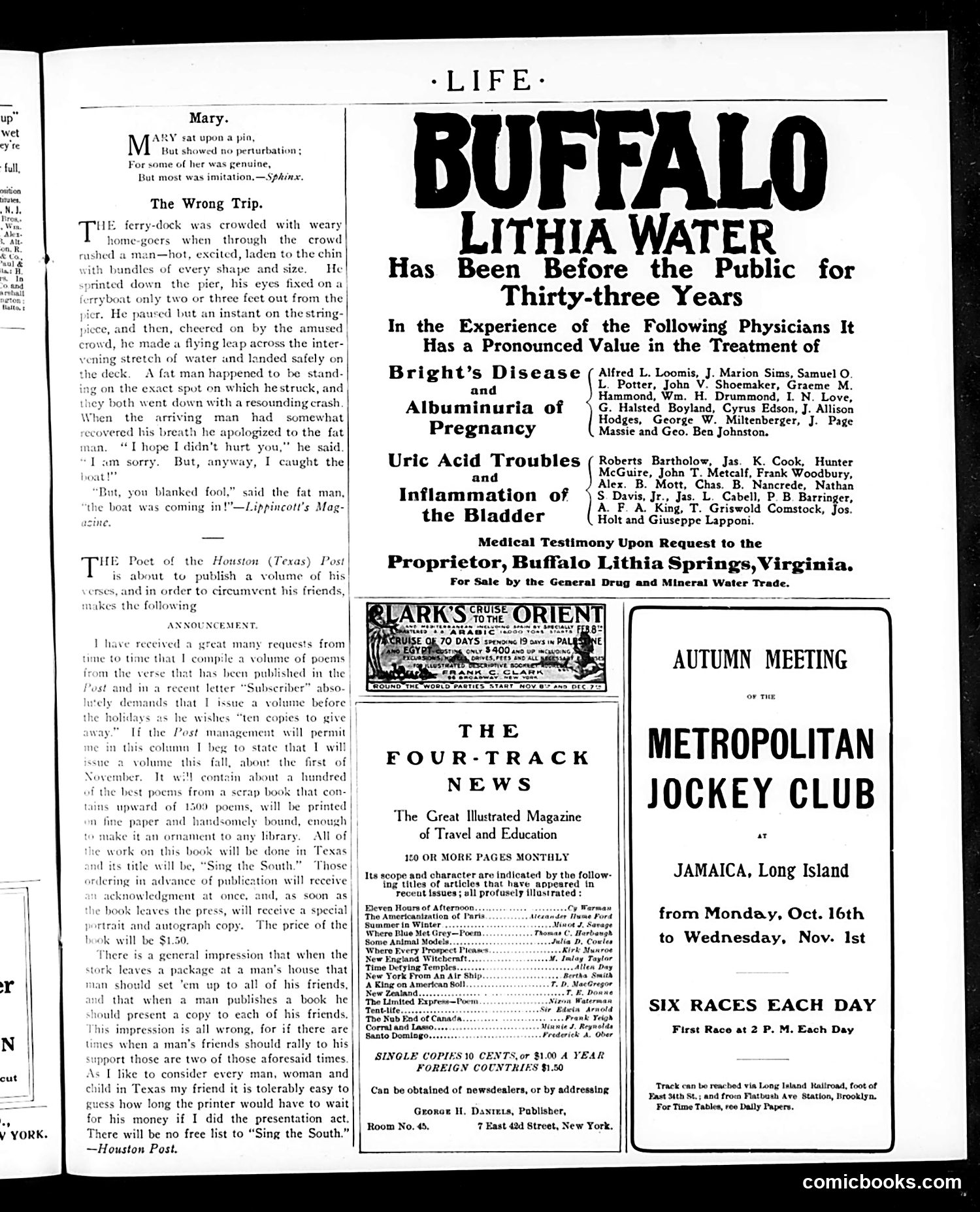
This page is primarily **advertising and announcements** rather than political satire or comics. The main content includes: 1. **Two short humorous stories** ("Mary" and "The Wrong Trip") — lighthearted anecdotes with punchlines, not political commentary. 2. **Large advertisement for Buffalo Lithia Water** — a patent medicine claiming to treat Bright's Disease, albuminuria, pregnancy complications, and bladder inflammation. It lists numerous physicians' names as endorsements, a common (and often dubious) marketing tactic of the era. 3. **Travel and publishing advertisements** — including a cruise to Egypt, a magazine called "The Four-Track News," and an announcement about the Metropolitan Jockey Club's autumn meeting at Jamaica, Long Island. The page reflects early 20th-century magazine culture: mix of light entertainment, aggressive patent medicine marketing with fake medical endorsements, and tourism/leisure advertising targeting affluent readers. No identifiable political figures or satire appear on this page.
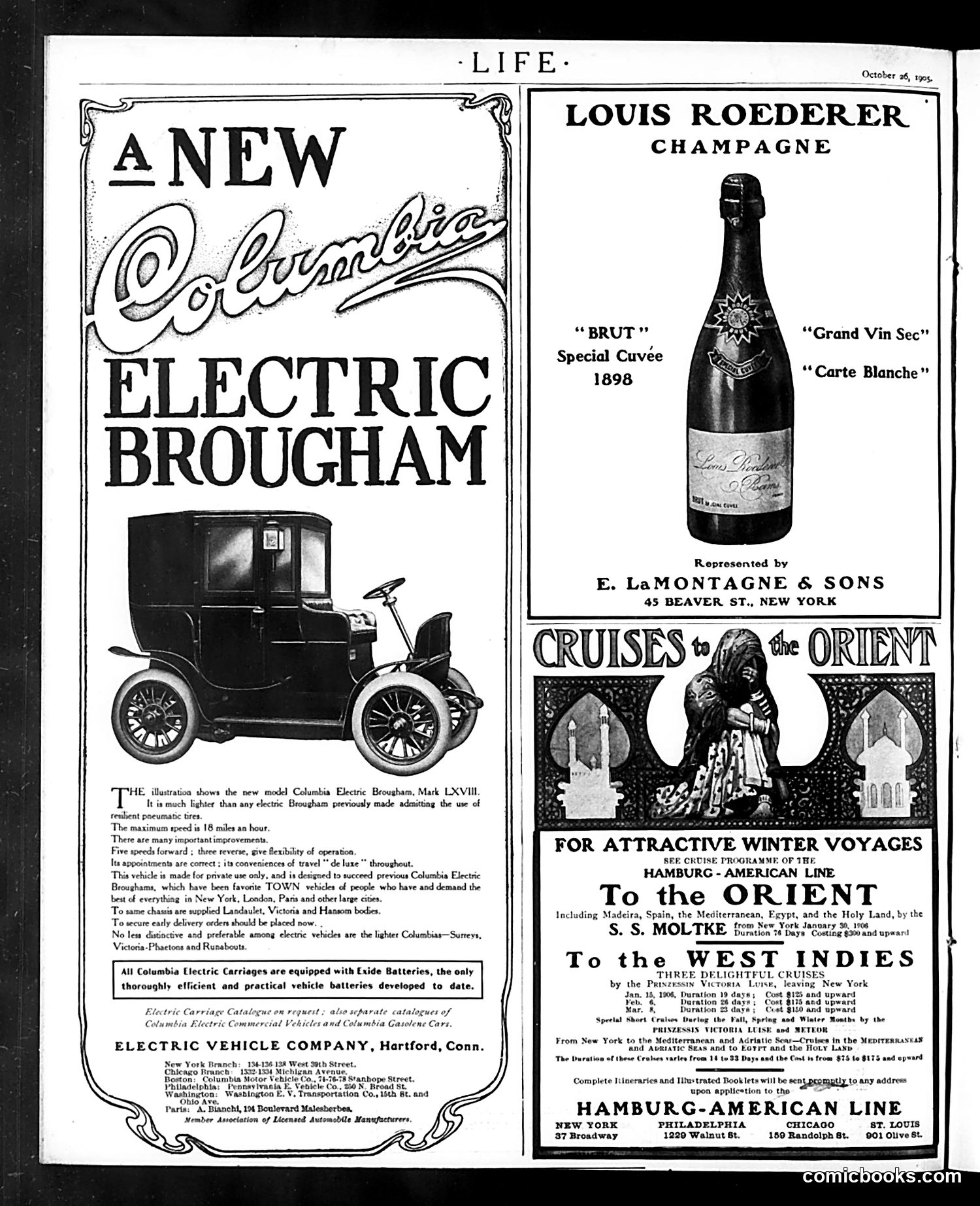
This page is primarily **advertising**, not satire or political commentary. It contains three distinct ads: **Left side**: Advertisement for the new Columbia Electric Brougham automobile (Mark LXVIII). The ad emphasizes luxury features—18 mph maximum speed, pneumatic tires, multiple gears, and appointments "de luxe." It's marketed to wealthy urbanites in New York, London, and Paris as a successor to previous Columbia electric models. This reflects the early 1900s enthusiasm for electric vehicles as viable luxury transportation before gasoline engines dominated. **Top right**: Louis Roederer Champagne advertisement, showcasing three vintage options from 1898. **Bottom right**: Hamburg-American Line cruise advertisements offering winter voyages to the Orient and West Indies, targeting affluent travelers with trips costing $115-$200+. The page collectively targets wealthy readers with luxury goods and leisure travel—typical Life magazine advertising of the Edwardian era.