
Life, 1905-10-26 · page 18 of 26
Life — October 26, 1905 — page 18: what you’re looking at
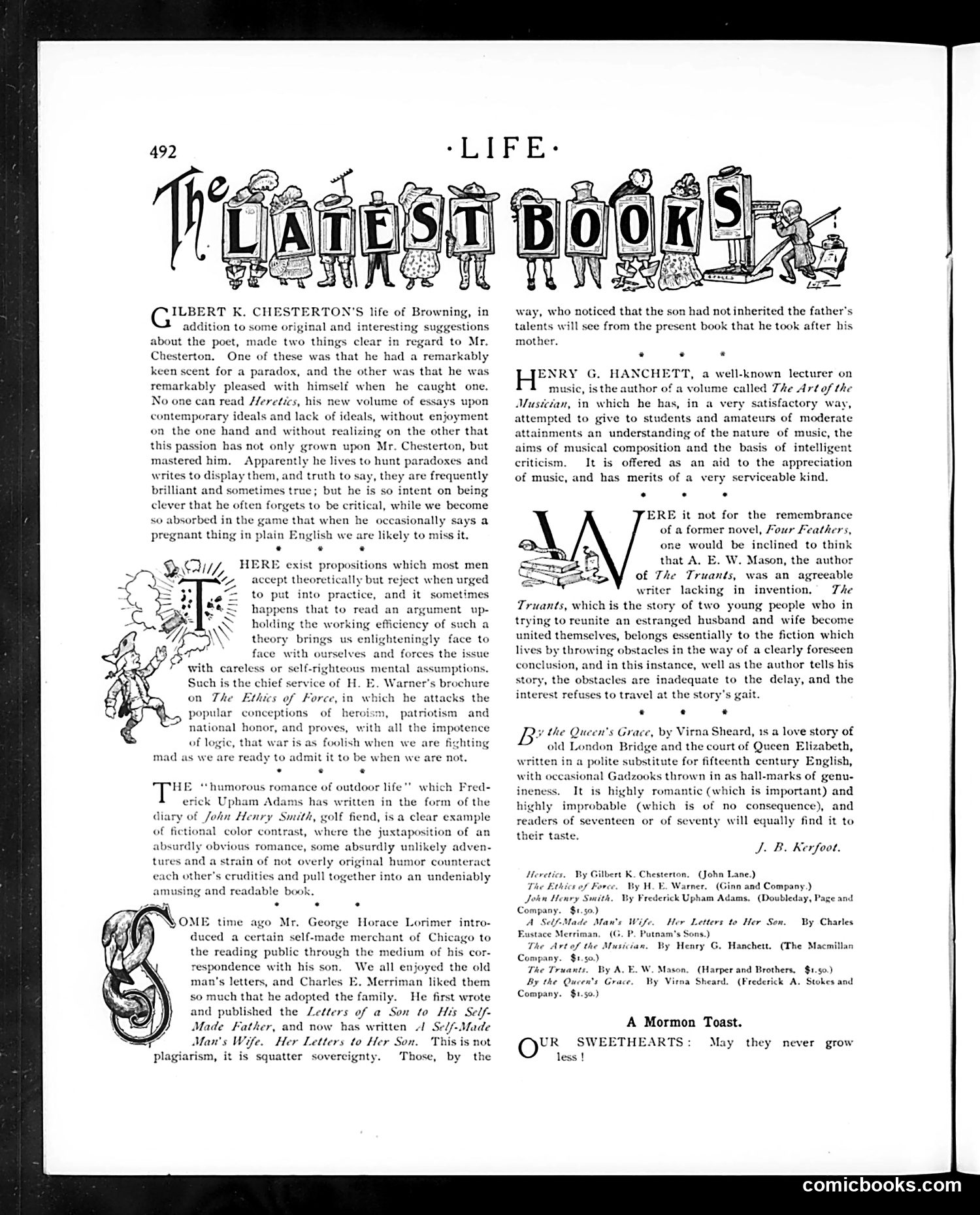
What you’re looking at
This is a literary review section featuring critiques of contemporary books. The decorative header "The Latest Books" uses anthropomorphized letter characters—a common design style of the era. The reviews discuss works by notable authors: Gilbert K. Chesterton's *Heretics* is criticized for obsessing over clever paradoxes at the expense of genuine insight. H. E. Warner's *The Ethics of Force* is praised for logically attacking romanticized notions of patriotism and war. Frederick Upham Adams's golf novel is deemed amusing but crude. The page also reviews Charles Merriman's imitative "self-made man" letters (following Lorimer's popular format), praises Henry G. Hanchett's music instruction book, and critiques A. E. W. Mason's *The Truants* as formulaic fiction relying too heavily on contrived obstacles. The tone is urbane and occasionally caustic—typical of Life's satirical literary commentary for educated readers of the early 1900s.
📄 Transcribed text from this page (OCR, searchable)
Machine-transcribed from the original scan — historical spelling and the odd misread are preserved.
ILBERT K. CHESTERTON'’S life of Browning, in addition to some original and interesting suggestions about the poct, made two things clear in regard to Mr, Chesterton. One of these was that he had a remarkably keen scent for a paradox, and the other was that he was remarkably pleased with himself when he caught one. No one can read Heretics, his new volume of essays upon contemporary ideals and lack of ideals, without enjoyment on the one hand and without realizing on the other that this passion has not only grown upon Mr. Chesterton, but mastered him. Apparently he lives to hunt paradoxe writes to display them, and truth to say, they ntly brilliant and sometimes true; but he is so intent on being clever that he often forgets to be critical, while we become so absorbed in the game that when he occasionally says a pregnant thing in plain English we are likely to miss . * * HERE exist propositions which most men accept theoretically but reject when urged to p ii practice, and it s mes happens that to read an argument up- holding the working efficiency of such a theory brings us enlighteningly face to fi with ourselves and forces the issue Such is the chief service of H. E. Warner's brochure on The Ethics of Force,in which he attacks the popular conceptions of heroi patriotism and national honor, and proves, with all the impoter of logic, that war is as foolish when we are fi mad as we are ready to admit it to be when we are not. . . . TT = ‘*humorous romance of outdoor life'’ which Fred- k Upham Adams has written in the form of the di John Henry Smith, golf fiend, is a clear example of fictior ntrast, where the justap< absurdly obvious romance, s al color tion of an ome absurdly unlikely adven- tures and a strain of not overly original humor counteract cach other's crudities and pull together into an undeniably amusing and readable book. NJOME time ayo Mr. George Horace Lorimer intro- duced a certain self-made merchant of Chicago to the reading public through the medium of his cor- respondence with his son. We all enjoyed the old man’s letters, and Charles Merriman liked them so much that he adopted the family. He first wrote and published the Letters of a Son to His Self- Made Father, and now has written +1 Self-Made Man's Wife. Her Letters to Her Son. This is not jarism, it is squatter sovercignty. Those, by the way, who noticed that the son had not inherited the father's talents will see from the present book that he took after his mother. . e NRY G. HANCHE a well-known lecturer on music, isthe author of a volume called The Artof the Musician, in which he has, in a very satisfactory way, attempted to give to students and amateurs of moderate attainments an understanding of the nature of music, the aims of musical composition and the basis of intelligent It is offered as an aid to the appreciation and has merits of a very serviceable kind. criticism. of musi ERE it not for the remembrance of a former novel, Four Feather. one would be inclined to think that A. E. W. Mason, the author of The Truants, was an agreeable writer lacking in invention, The Truants, which is the story of two young people who in trying to reunite an estranged husband and wife become united themselves, belongs essentially to the fiction which lives by throwing obstacles in the way of a clearly foreseen conclusion, and in this instance, well as the author tells his story, the obstacles are inadequate to the delay, and the interest refuses to travel at the story's gait. the Queen's Grace, by Virna Sheard, 18 a love story of 2” old London Bridge and the court of Queen Elizabeth, written in a polite substitute for fifteenth century Engli with occasional Gadzooks thrown in as hall-marks of genu- ineness. It is highly romantic (which is important) and highly improbable (which is of no consequen readers of seventeen or of seventy will equally find it to their taste. By Gilbert K. Chesterton. (John Lane.) Ry H. E. Warner. (Ginn and Company.) ly Frederick Upham Adams. (Doubleday, Page and Her Letters to Her Son. (G. P, Putnam's Sons.) Art of the Musician. By Henry G. Hanchett. (The Macmillan Company. $1.50.) The Truants. By A, E,W. Mason, (Harper and Brothers, $1.50.) By the Queen's Grace. By Vitna Sheard. (Frederick A. Stokes and Company. $1.50.) By Charles A Mormon Toast. UR SWEETHEARTS: % less ! they never grow comicbooks.com