
Life, 1905-10-26 · page 17 of 26
Life — October 26, 1905 — page 17: what you’re looking at
What you’re looking at
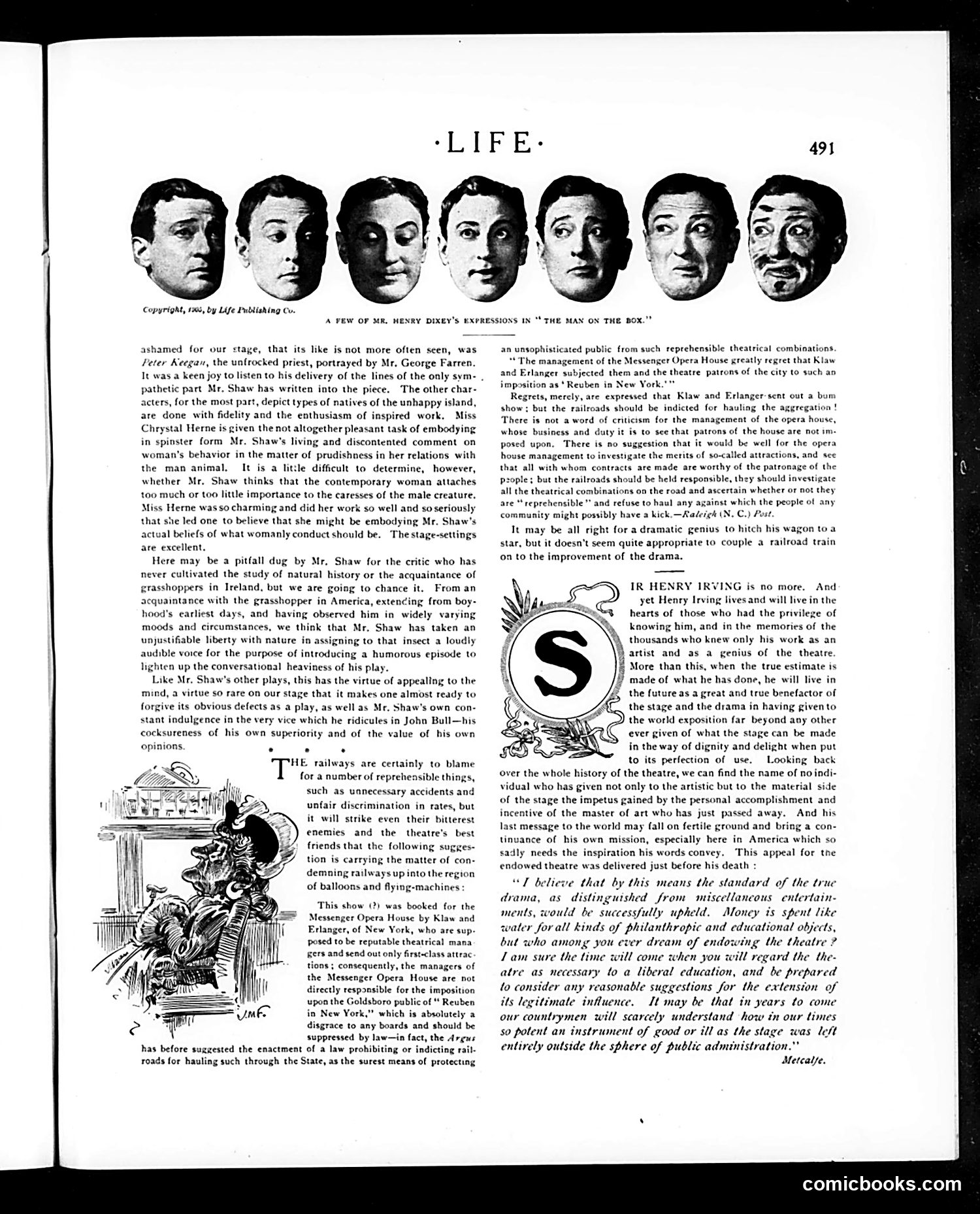
This page features **seven facial expression studies** of actor Henry Dixey in "The Man on the Box," a theatrical production. The photographs showcase different emotional expressions—appears to be standard theatrical documentation showing an actor's range. The article reviews Shaw's play and discusses theater management practices of the era. It critiques **Klaw and Erlanger**, prominent New York theatrical producers, for distributing inferior productions like "Reuben in New York" to regional opera houses. The author sarcastically suggests railroads should be legally liable for transporting such poor-quality shows. The satire targets: theatrical monopolies exploiting local venues, the gap between big-city and provincial entertainment standards, and the powerlessness of regional theater managers forced to book whatever major producers send them. There's also commentary on Shaw's plays themselves—praising their intellectual appeal while criticizing Shaw's authorial smugness and his unflattering portrayal of women's sexuality and Irish identity.
📄 Transcribed text from this page (OCR, searchable)
Machine-transcribed from the original scan — historical spelling and the odd misread are preserved.
Copyright, 198, by Life Publishing Cu. A PEW OF MR, NENRY DIXEY’S EXPRESSIONS IN “THE MAN ON THE BOX."” ashamed for our stage, that its like is not more often seen, was Peter Keegan, the uotrocked priest, portrayed by Mr, George Farren. It was a keen joy to listen to his delivery of the lines of the only sym- . pathetic part Mr, Shaw has written into the piece. ‘The other char- acters, for the most part, depict types of natives of the unhappy island, are done with fidelity and the enthusiasm of inspired work. Miss Chrystal Herne is given the not altogether pleasant task of embodying in spinster form Mr. Shaw's living and discontented comment on woman's behavior in the matter of prudishness in her relations with the man animal, It is a litile difficult to determine, however, whether Mr, Shaw thinks that the contemporary woman attaches too much or too little importance to the caresses of the male creature, Miss Herne was so charming and did her work so well and so seriously that she led one to believe that she might be embodying Mr, Shaw's actual beliefs of what womanly conduct should be. The stage-settings are excellent, Here may be a pitfall dug by Mr, Shaw for the critic who has never cultivated the study of natural history or the acquaintance of grasshoppers in Ireland, but we are going to chance it. From an acquaintance with the grasshopper in America, extending from boy- hood’s earliest days, and having observed him in widely varying moods and circumstances, we think that Mr, Shaw has taken an unjustifiable liberty with nature in assigning to that insect a loudly audible voice for the purpose of introducing a humorous episode to lighten up the conversational heaviness of his play. Like Mr, Shaw's other plays, this has the virtue of appealing to the mind, a virtue so rare on our stage that it makes one almost ready to forgive its obvious defects as a play, as well as Mr. Shaw's own con- stant indulgence in the very vice which he ridicules in John Bull—his cocksureness of his own superiority and of the value of his own opinions. . . . TK railways are certainly to blame for a number of reprehensible things, such as wanecessary accidents and unfair discrimination in rates, but it will strike even their bitterest enemies and the theatre's best friends that the following sugges- tion is carrying the matter of con- demning railways up into the region of balloons and flying-machines : This show (?) was booked for the Messenger Opera House by Klaw and Erlanger, of New York, who are sup- posed to be reputable theatrical mana gers and send out only firsteclass attrac tions ; consequently, the managers of the Messenger Opera House are not directly responsible for the imposition upon the Goldsboro public of " Reuben in New York,” which is absolutely a disgrace to any boards and should be suppressed by law—in fact, the Argus has before suggested the enactment of a law prohibiting or indicting rail- roads for hauling such through the State, as the surest means of protecting an unsophisticated public from such reprehensible theatrical combinations * The management of the Messenger Opera House greatly regret that Klaw and Erlanger subjected them and the theatre patrons of the city to such an imposition as ‘Reuben in New Yor! Regrets, merely, are expressed that Klaw and Erlanger-sent out a bum but the railroads should be indicted for hauling the aggregat There is not a word of criticism for the management of the opera house, whose business and duty it is to see that patrons of the house are not im- posed upon, There is no suggestion that it would be well for the opera house management to investigate the merits of so-called attractions, and see that all with whom contracts are made are worthy of the patronage of the pzople; but the railroads should be held responsible, they should investigate all the theatrical combinations on the road and ascertain whether or not they are “reprehensible and refuse to haul any against which the people of any community might possibly have a kick.—Aadeighk (N. C.) Post. It may be all right fora dramatic genius to hitch his wagon toa star, but it doesn’t seem quite appropriate to couple a railroad train on to the improvement of the drama. IR HENRY IRVING is no more. And yet Henry Irving livesand will live in the hearts of those who had the privilege of knowing him, and in the memories of the thousands who knew only his work as an J artist and as a genius of the theatre. = More than this, when the true estimate is 2 made of what he has done, he will live in the future as a great and true benefactor of the stage and the drama in having given to the world exposition far beyond any other ever given of what the stage can be made in the way of dignity and delight when put to its perfection of use. Looking back over the whole history of the theatre, we can find the name of no indi- vidual who has given not only to the artistic but to the material side of the stage the impetus gained by the personal accomplishment and incentive of the master of art who has just passed away. And his last message to the world may fall on fertile ground and bring a con- tinvance of his own mission, especially here in America which so sadly needs the inspiration his words convey. ‘This appeal for tne endowed theatre was delivered just before his death : that by this means the standard of the true drama, as distinguished from miscellancous entertain- ments, would be successfully upheld. Money is spent like water forall kinds of philanthropic and educational objects, but who among you ever dream of endowing the theatre ? Zam sure the time will come when you will regard the the- atre as necessary to a liberal education, and be prepared to consider any reasonable suggestions for the extension of its legitimate influence. It may be that in years to come our countrymen will scarcely understand how in our times so potent an instrument of good or ill as the stage was left entirely outside the sphere of public administration. Metcale. comicbooks.com