
A complete issue · 30 pages · 1905
Life — October 19, 1905
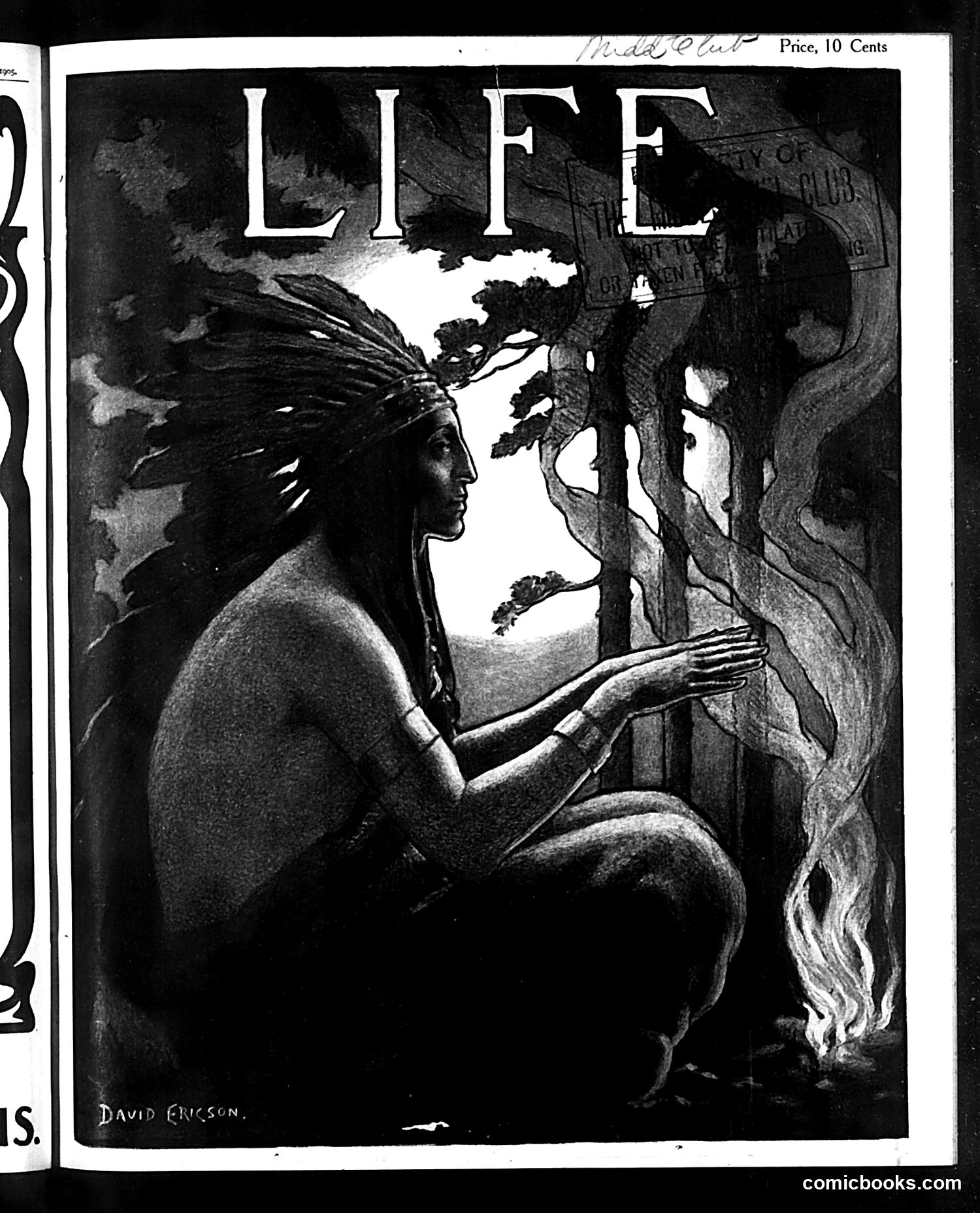
This appears to be a **Life magazine cover** (price 10 cents, dating it to the early 20th century) illustrated by **David Ericson**. The image depicts a Native American man in profile wearing a feathered headdress, gazing toward a landscape with pine trees and what appears to be a distant settlement or structure. He holds what looks like a document or map. The title "LIFE" is prominently displayed, but without additional OCR text from the cover's content, the specific satirical message is unclear. However, given the historical period and imagery, this likely references **westward expansion, Native American displacement, or land appropriation**—common themes in early 20th-century American satire. The juxtaposition of the indigenous figure with the encroaching settlement suggests commentary on the conflict between Native Americans and American expansion.
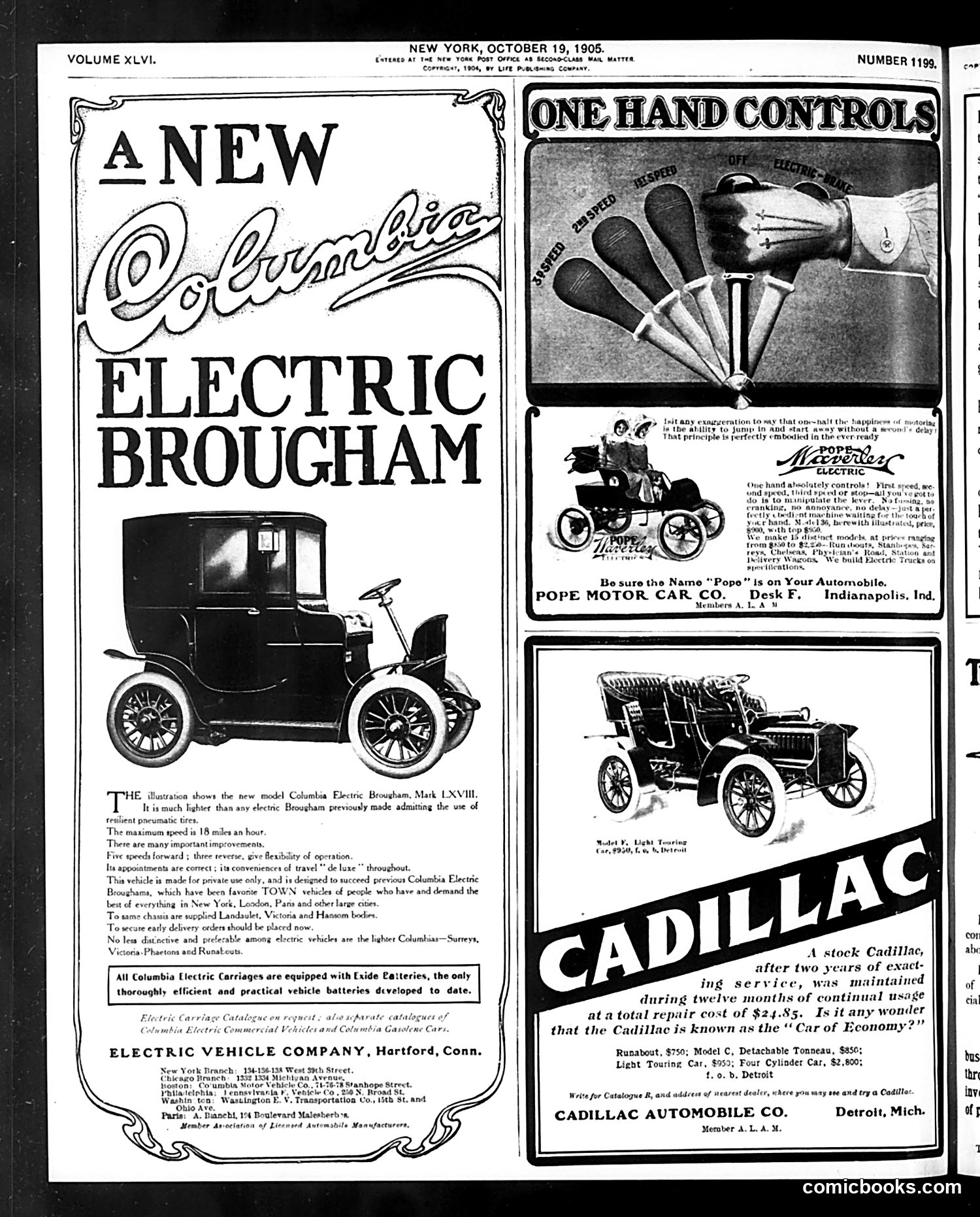
This page is **primarily advertising**, not satire or political commentary. It contains three automobile advertisements from October 19, 1905: 1. **Columbia Electric Brougham** (left): Promotes a new electric carriage model, emphasizing pneumatic tires and reliability. Targets wealthy urban buyers. 2. **Pope Motor Car** (top right): Advertises one-hand controls as a selling point, suggesting this was a notable innovation at the time. 3. **Cadillac** (bottom right): Features a testimonial about a car's durability after two years of service, with minimal repair costs. These ads reflect early automotive competition and marketing strategies emphasizing mechanical innovations and reliability as key selling points to potential buyers in the horseless carriage era.
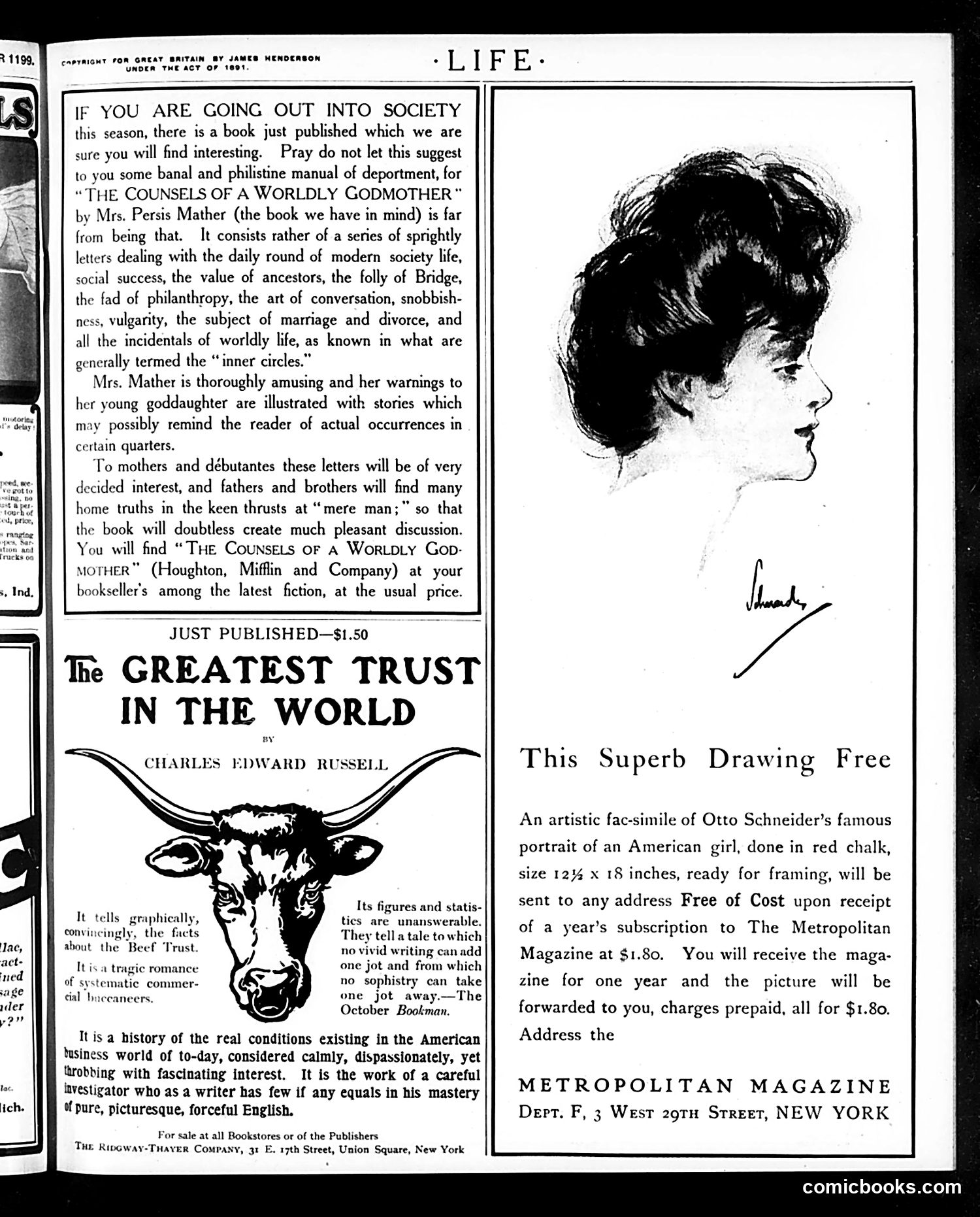
This page is primarily **advertising and editorial content**, not political cartooning. The left side promotes two books: Mrs. Persia Mather's *The Counsels of a Worldly Godmother* (letters about society etiquette) and Charles Edward Russell's *The Greatest Trust in the World* (described as exposing corrupt American business practices). The right side features a portrait drawing by Otto Schneider of "an American girl," offered free with a Metropolitan Magazine subscription. The drawing appears to be a professional artistic piece rather than satire—a typical early 20th-century magazine premium. There is **no political cartoon or satirical commentary** on this page. It represents standard magazine advertising practices of the era, using literary recommendations and artistic giveaways to attract subscribers.
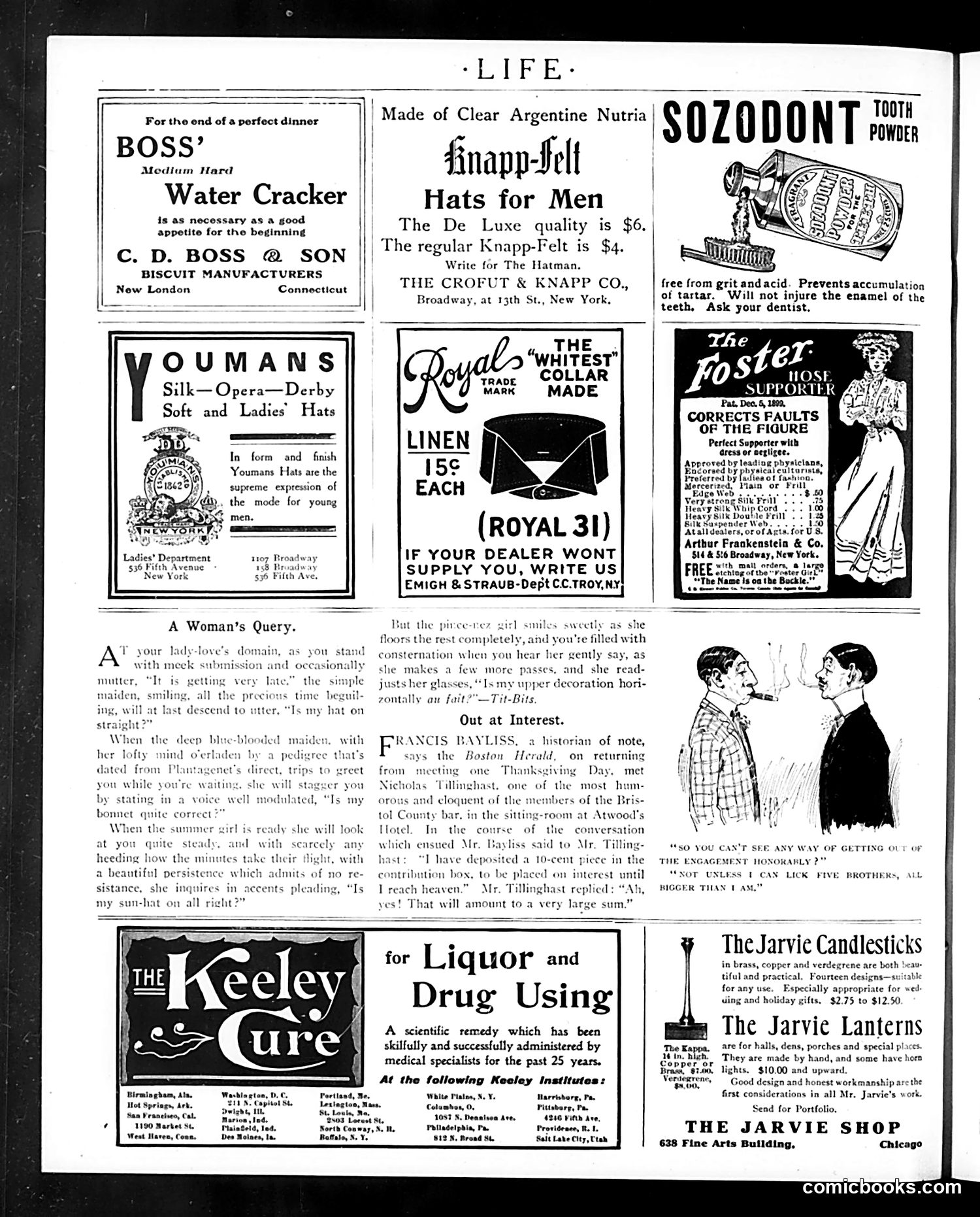
This page is primarily **advertisements** for consumer products (tooth powder, hats, hose supporters, collars, candlesticks), interspersed with brief satirical prose pieces rather than visual cartoons. The main content includes: 1. **"A Woman's Query"** — a humorous piece about a woman waiting for her boyfriend, employing exaggerated romantic language typical of early-20th-century satire. 2. **"Out at Interest"** — a anecdote about Francis Bayliss, a Boston historian, who apparently placed a nickel in a church contribution box expecting large returns, satirizing get-rich-quick schemes or misunderstanding of charitable giving. The satire is **textual and situational** rather than visual, mocking contemporary social pretensions and naive financial expectations. No specific political figures are referenced.
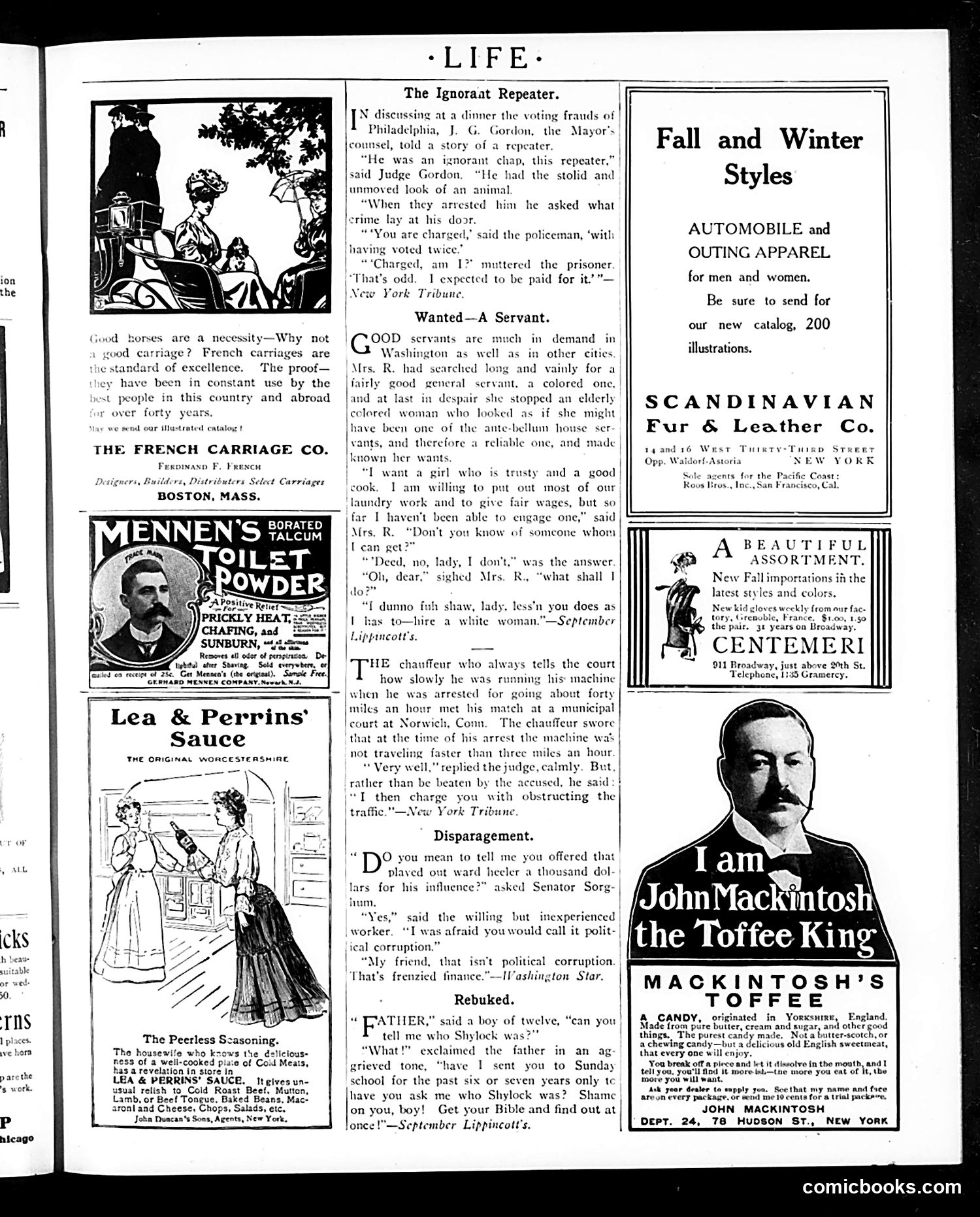
This page is primarily **advertisements and short humorous anecdotes** rather than political cartoons. The featured content includes: **"The Ignorant Repeater"** — A joke about a man arrested for voting twice, claiming he expected "to be paid for it," mocking voter fraud and political corruption. **"Wanted — A Servant"** — Humorous difficulty hiring domestic help, reflecting early 20th-century labor market tensions. **"The Chauffeur"** — A judge's quip about a speeding chauffeur claiming he wasn't going fast, satirizing traffic law enforcement. **Advertisements** dominate: Mennen's Talc Powder, Lea & Perrins Sauce, Scandinavian Fur & Leather Co., and notably **"I am John Mackintosh the Toffee King"** — promoting an English candy brand. The page reflects **everyday social humor** about servants, voting, and automobiles rather than specific political satire.
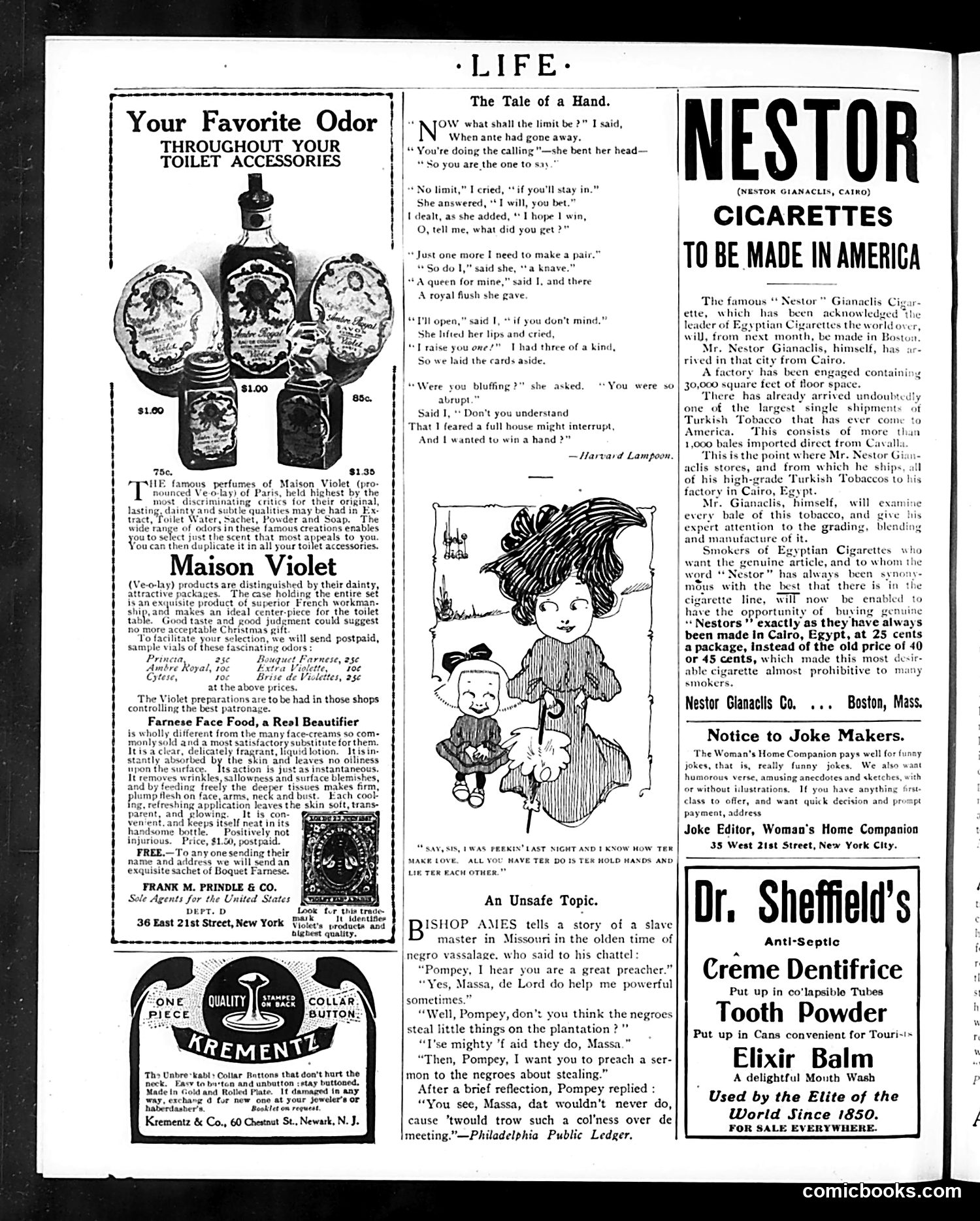
This page is primarily **advertising and light entertainment** rather than political satire. The main content includes: **"The Tale of a Hand"** — A poem by Harvard Lampoon about a romantic wager between two people, illustrated with a sentimental drawing of a woman and child holding hands. **Advertisements** dominate the page, featuring: - Maison Violet perfumes and toiletries - Nestor Cigarettes (promoted as newly American-made, formerly Egyptian) - Dr. Sheffield's tooth powder and elixir balm - Krementz collar buttons **"An Unsafe Topic"** — A brief anecdote about a Mississippi slave master and preacher, presented as humor (reflecting period prejudices). The page reflects early 20th-century magazine format: consumer goods advertising mixed with sentimental poetry and period-typical racial humor that modern readers would find offensive.
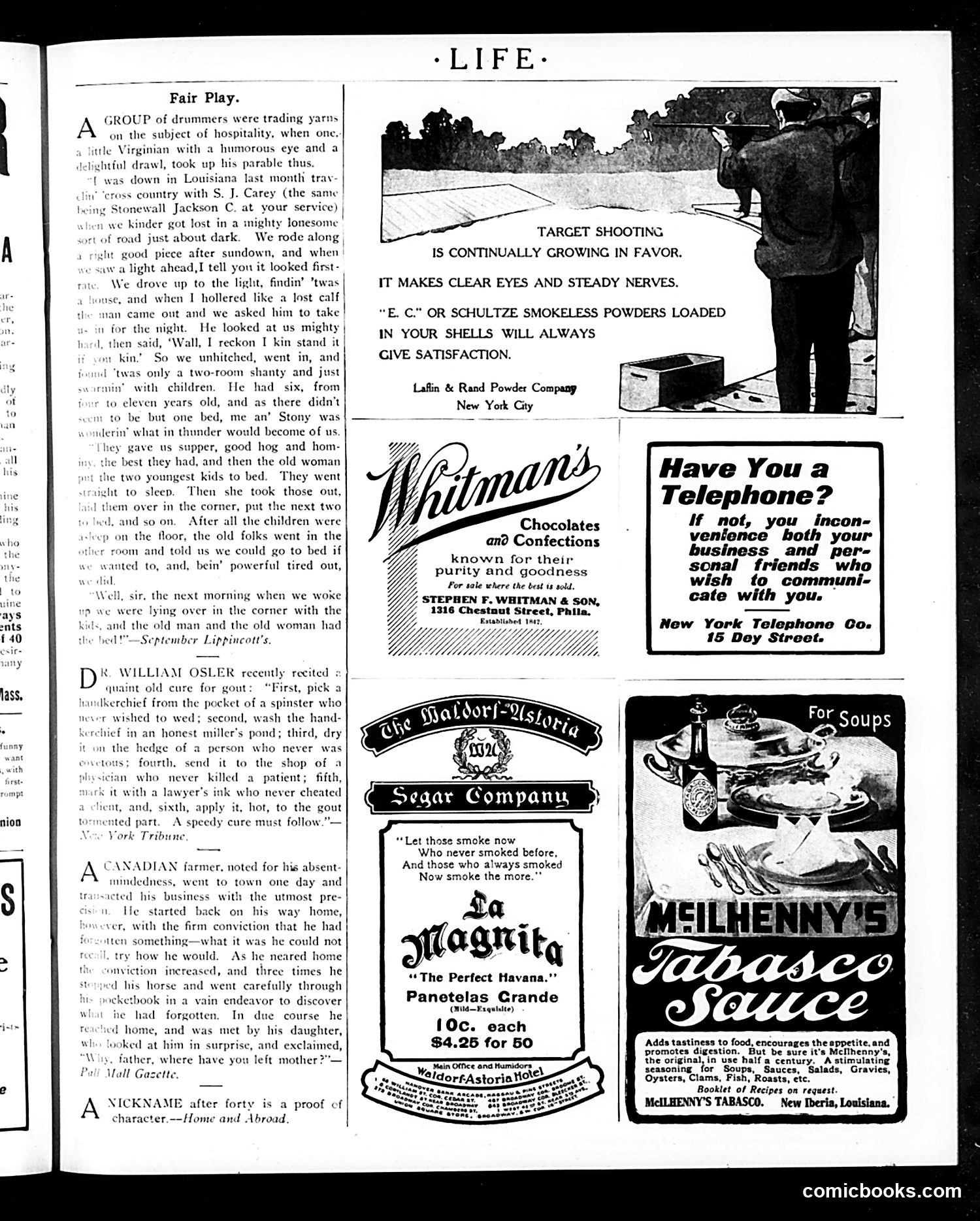
This page is primarily **advertisements interspersed with three short humorous anecdotes**, not political cartoons. The advertisements promote consumer products: smokeless powders for target shooting, Whitman's chocolates, a telephone service, sugar, cigars, and tabasco sauce. The three text pieces ("Fair Play," an anecdote about William Osler's medical wit, and a story about a Canadian farmer) are genteel humor typical of early 20th-century Life magazine—they rely on wordplay, rural/provincial characters, and clever observations rather than satire or caricature. There is **no political commentary or identifiable caricatured figures** on this page. It represents Life's mixed editorial-advertising format and its focus on genteel, domesticated humor aimed at educated middle-class readers.
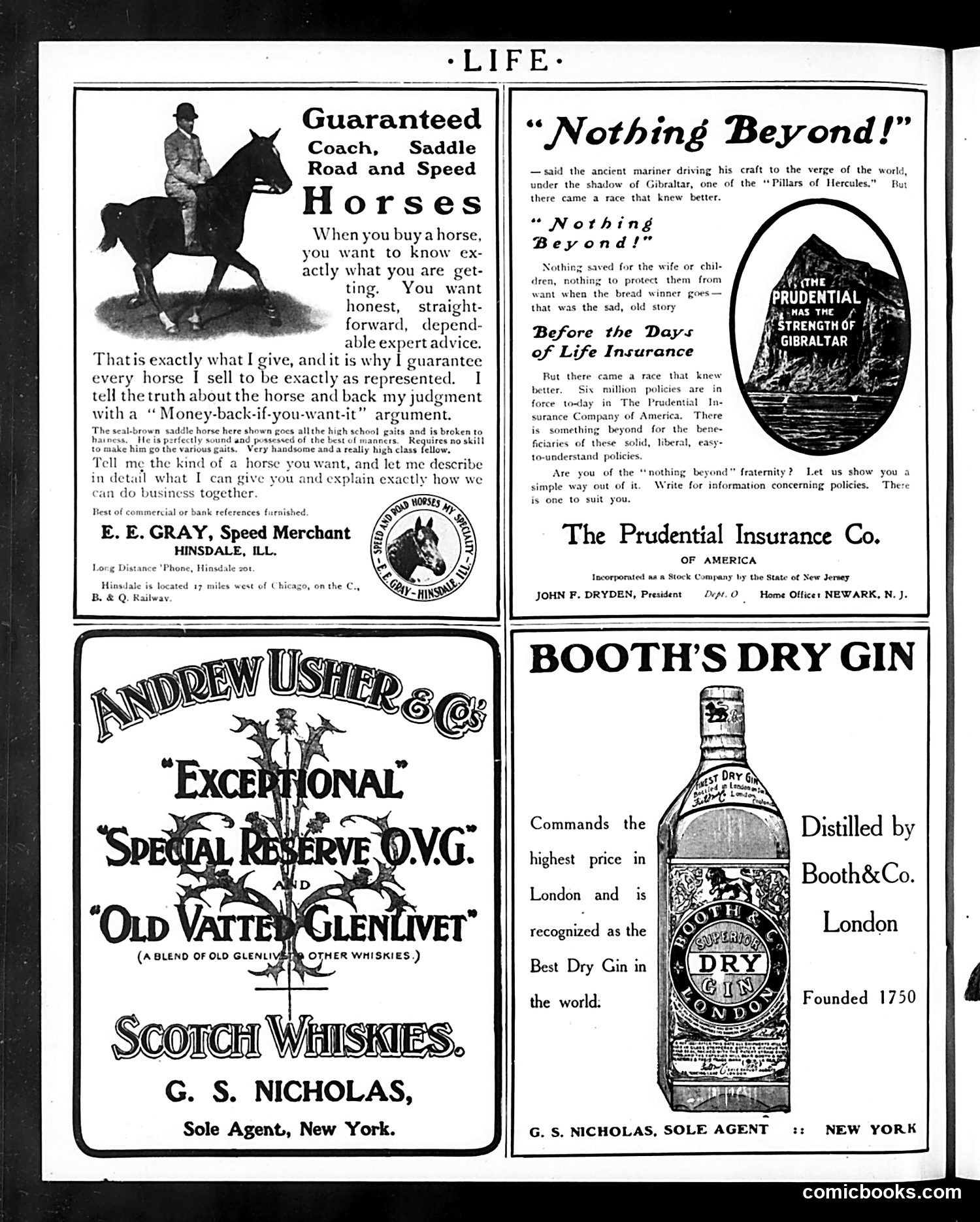
This page is primarily **advertising**, not satirical content. It contains four commercial advertisements from what appears to be an early 20th-century issue of *Life* magazine: 1. **E.E. Gray's horses** - guaranteeing quality coach and saddle horses 2. **Prudential Insurance** - emphasizing life insurance protection with the tagline "Nothing Beyond!" (likely referencing limits of coverage) 3. **Andrew Usher & Co.** - promoting Scotch whiskies 4. **Booth's Dry Gin** - claiming to be the world's best gin, founded 1750 There is no political satire or cartoon visible here. The page reflects early 20th-century American consumer culture, with emphasis on luxury goods (horses, spirits) and emerging insurance industry marketing. The advertisements use the magazine's space to reach *Life*'s affluent readership.
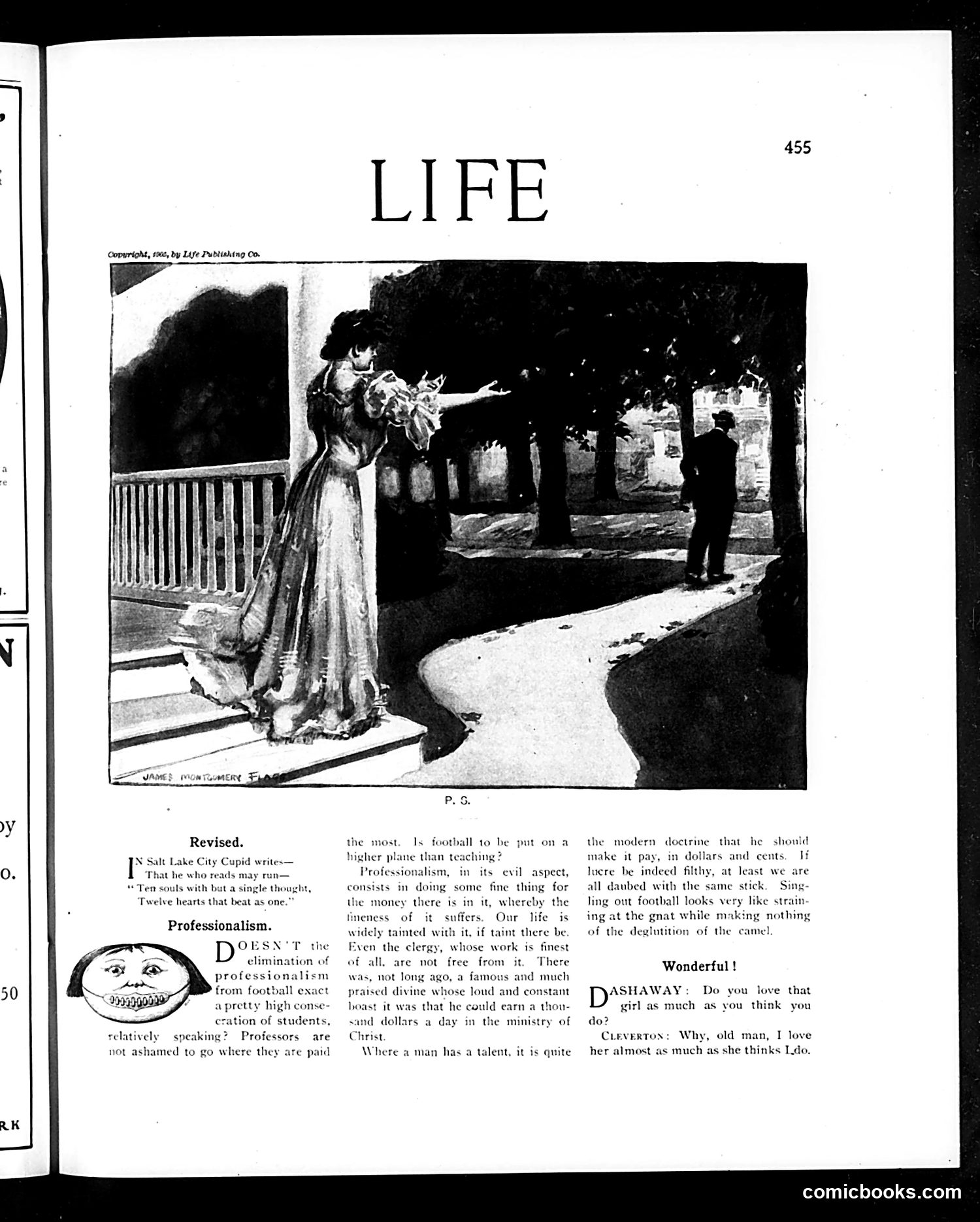
The main illustration depicts a romantic garden scene with a woman in an elegant dress gesturing toward flowers, while a man stands in the distance—a typical sentimental romantic tableau. Below, the text sections titled "Revised," "Professionalism," and "Wonderful!" critique early 20th-century attitudes. "Professionalism" mocks the hypocrisy of condemning professionalism in football while accepting it in other fields like the clergy, who earned substantial salaries. The accompanying caricatured face emphasizes the satirical tone. "Wonderful!" presents a brief dialogue between characters named Dashaway and Cliverton, apparently joking about romantic attachment. The overall page satirizes social inconsistencies and romantic attitudes of the era, though specific contemporary references remain unclear without additional context.
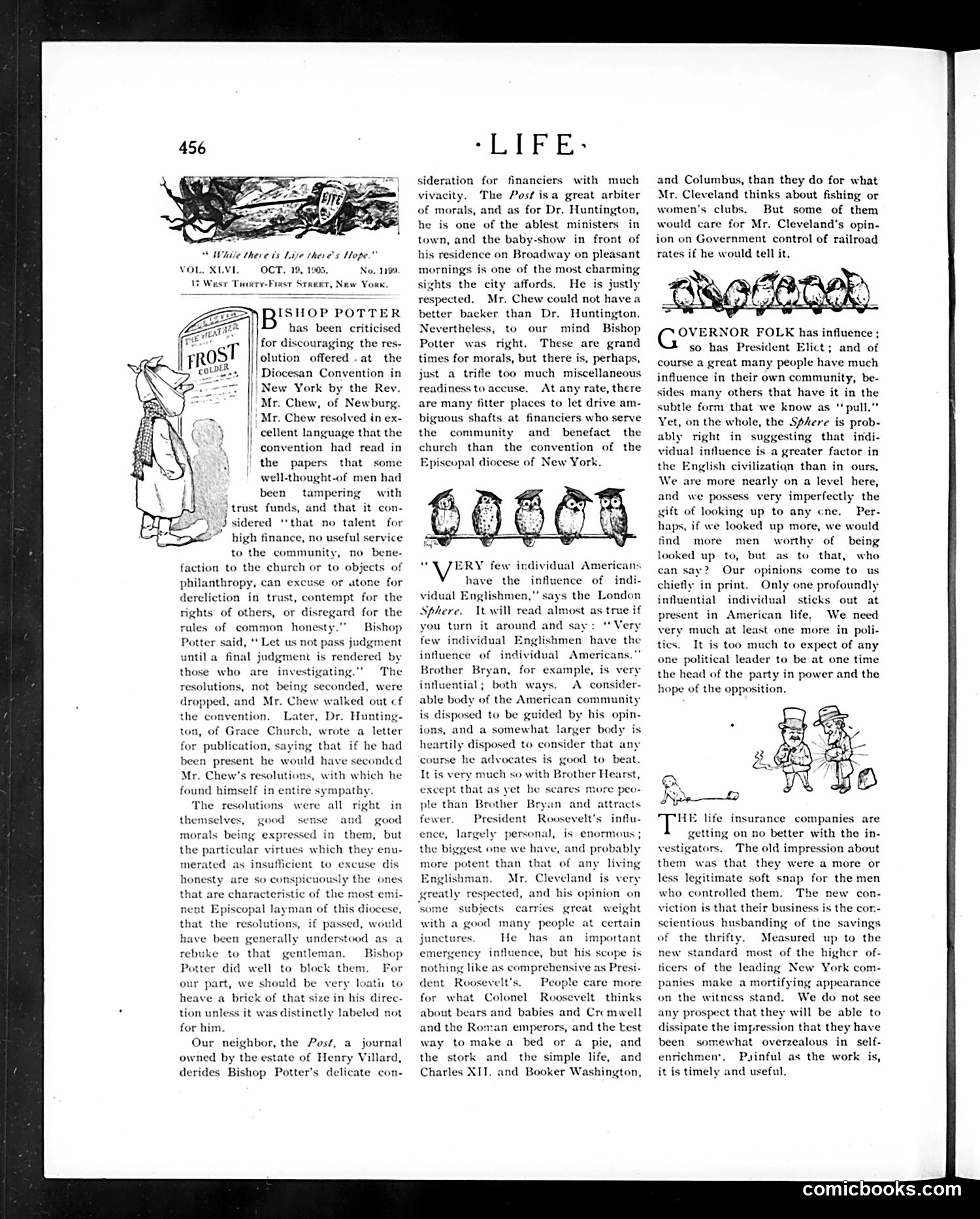
This page features editorial commentary on American political and social influence. The text discusses how individual Americans shape national character—naming President Roosevelt, Colonel Cleveland, and Brother Bryan as examples of influential figures whose personal traits affect public opinion. The visible cartoons include illustrations of owls (appearing to represent wisdom or observation) and figures engaged in everyday activities, likely supporting the editorial's points about ordinary American life and values. A "Frost" advertisement occupies the left margin, unrelated to the main content. The overall theme contrasts American individualism with English deference to authority, arguing that Americans should respect leaders based on merit rather than position. The text suggests life insurance companies are gaining legitimacy as they become more transparent about their operations.
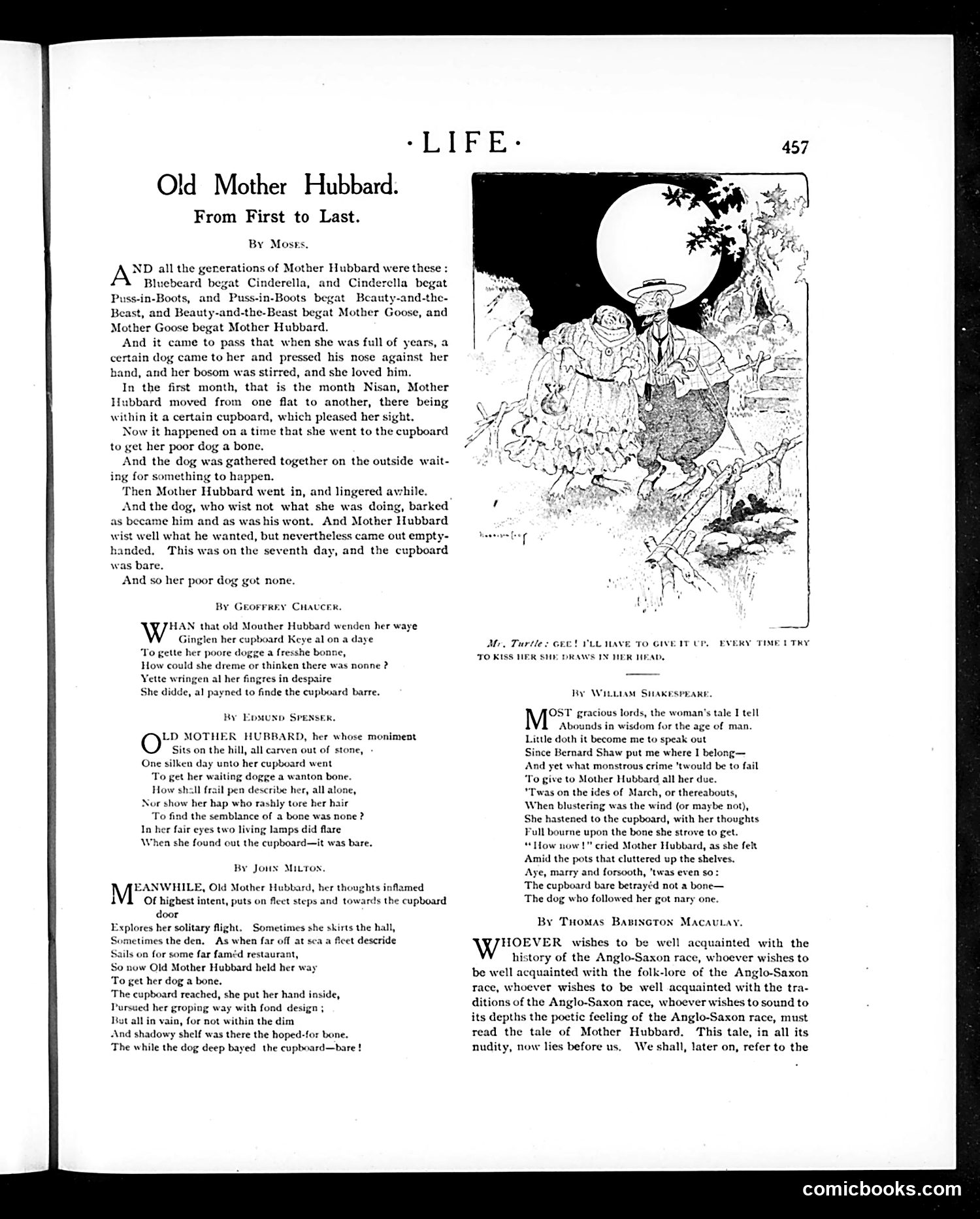
This page presents multiple literary interpretations of the nursery rhyme "Old Mother Hubbard," presented as satirical poetry by various authors including Moses, Geoffrey Chaucer, Edmund Spenser, John Milton, and William Shakespeare (clearly tongue-in-cheek attributions). The accompanying illustration shows Mother Hubbard at her cupboard with a dog, directly referencing the nursery rhyme's familiar plot: she went to the cupboard to get the poor dog a bone, but the cupboard was bare. Rather than mocking specific political figures, this page satirizes literary pretension by having famous historical poets grandly rewrite a simple children's verse in their distinctive styles—a humorous commentary on how serious literature often overwrites simple truths with elaborate language.
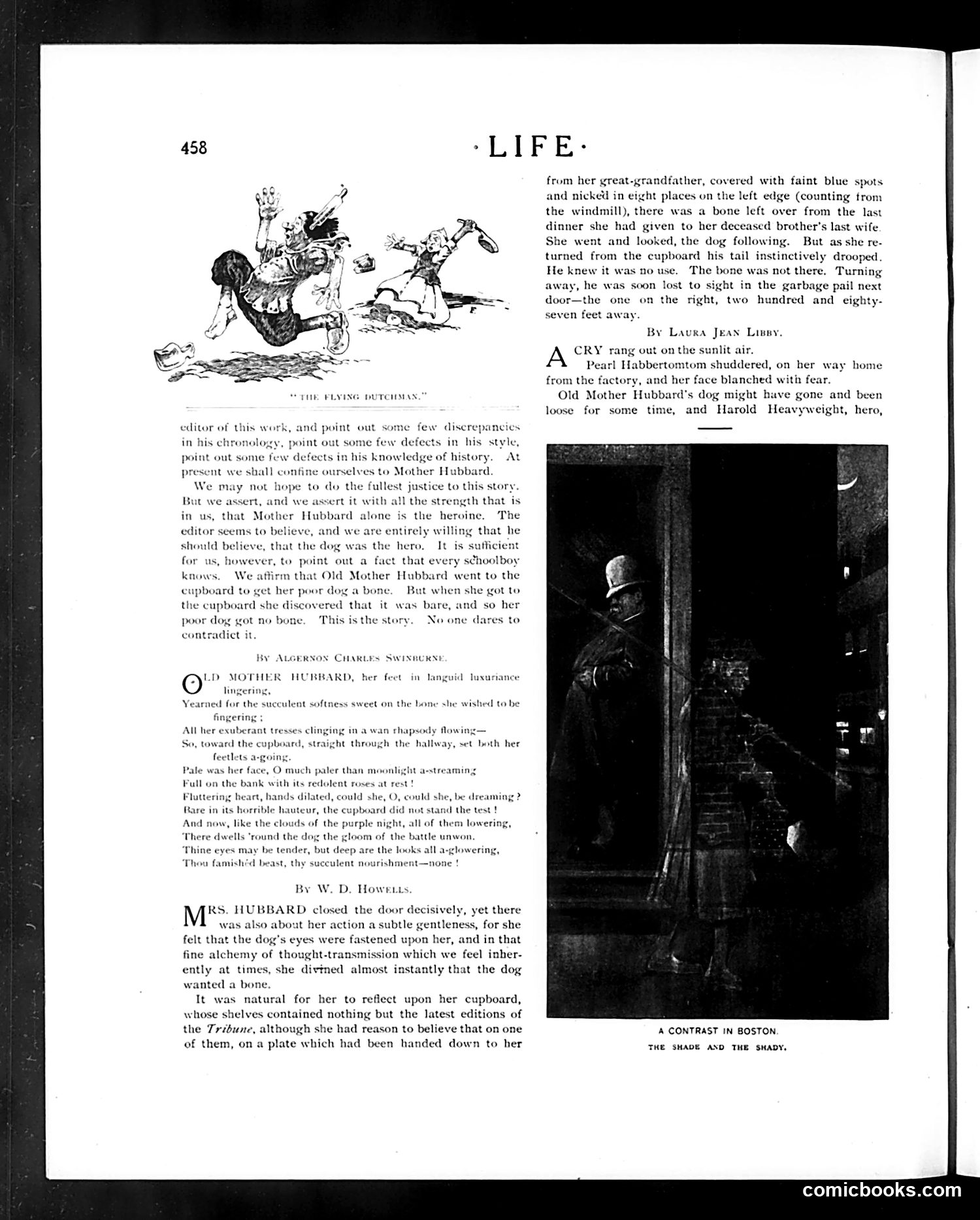
This page from *Life* magazine presents literary fiction rather than political satire. It contains three short stories about "Old Mother Hubbard" and her dog—the nursery rhyme character reimagined as a realistic figure. The illustrated cartoon at top left ("The Flying Dutchman") depicts the dog's acrobatic mishap, while the photograph at right ("A Contrast in Boston: The Shade and the Shady") shows an urban street scene. The text explores a humorous premise: Mother Hubbard went to the cupboard to fetch her dog a bone but found it bare. The multiple literary treatments by authors Swinburne, Howells, and others parody the overwrought Victorian literary style by applying it to this trivial domestic scenario—the satire targets pretentious prose rather than politics or social issues.
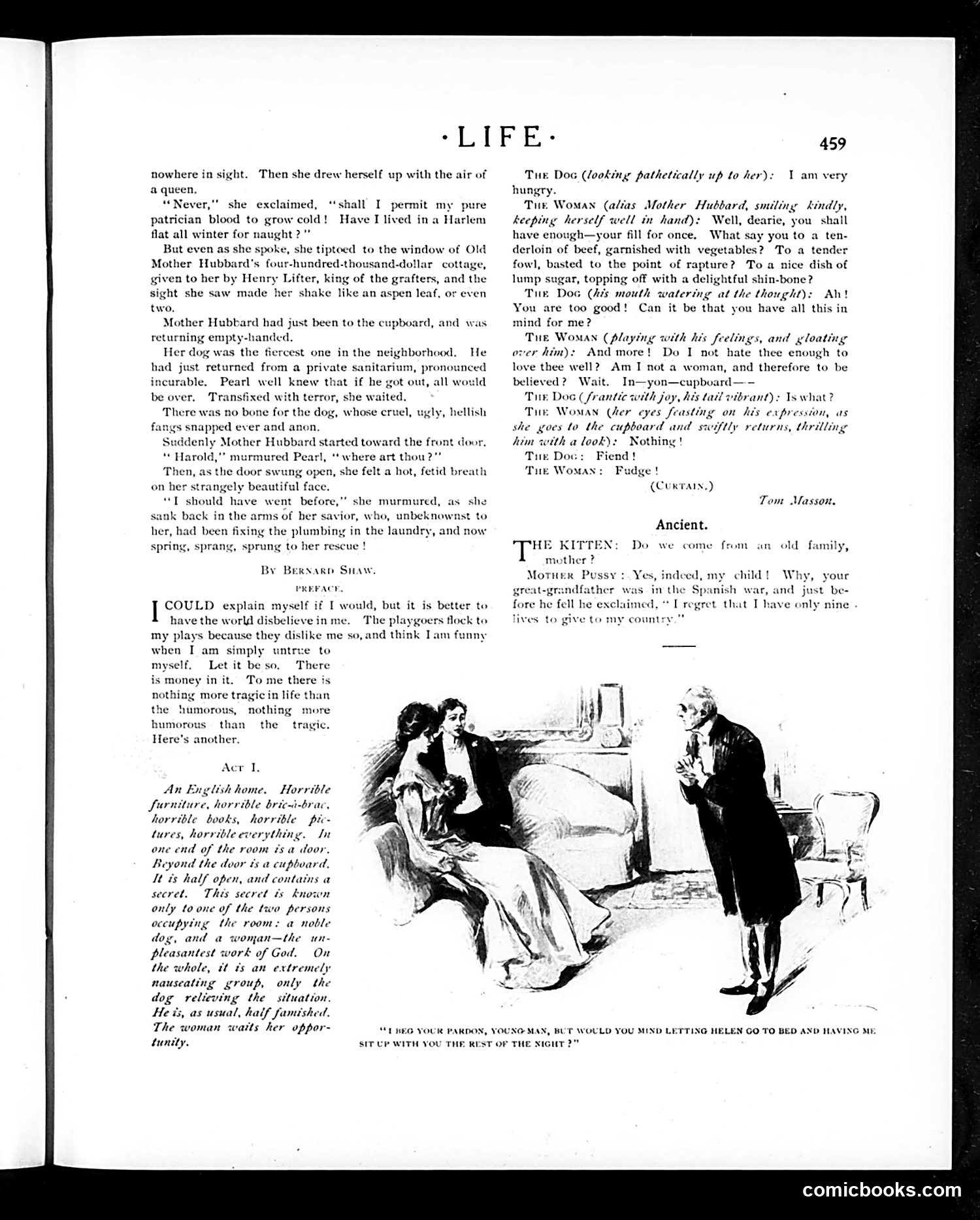
This page contains two separate pieces: 1. **"Life" (by Bernard Shaw preface)**: A short play excerpt about class and poverty. The preface sardonically notes that playgoers attend his plays because they find them funny when he intends social criticism—suggesting audiences miss his satirical point about "the humorous" versus "the tragic" in life. 2. **"Ancient" (by Tom Mason)**: A dialogue between a kitten and mother pussy about family lineage. The mother cat boasts their "great-grandfather was in the Spanish war"—likely referencing Spain's colonial conflicts. The accompanying sketch shows a woman and man in what appears to be a modest interior, though the exact social commentary is unclear from the image alone. Both pieces appear to satirize social pretensions and class assumptions of the era.
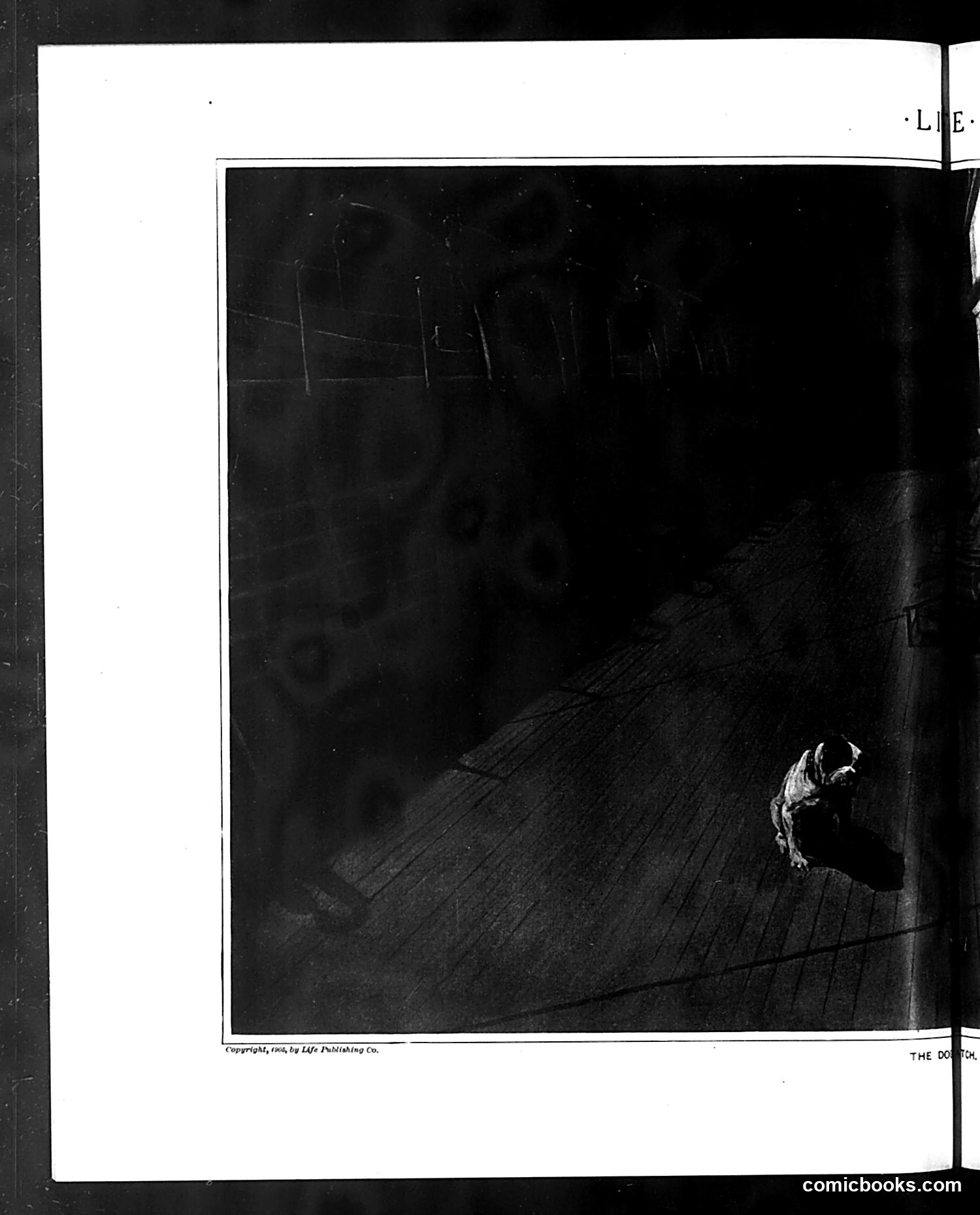
This appears to be a single dark, atmospheric illustration rather than a political cartoon. It depicts a small figure (likely a dog or small animal) on what looks like a wooden deck or floor, with dramatic shadows and architectural elements looming overhead. The composition emphasizes isolation and scale, with the tiny creature dwarfed by its surroundings. Without additional visible text or context on this page, the specific satirical meaning is unclear. The title "THE DOCTOR" (visible at bottom right) suggests possible social commentary, but the exact reference—whether to a political figure, medical profession, or social condition—cannot be determined from the image alone. The mood is decidedly ominous and expressionistic rather than conventionally humorous.
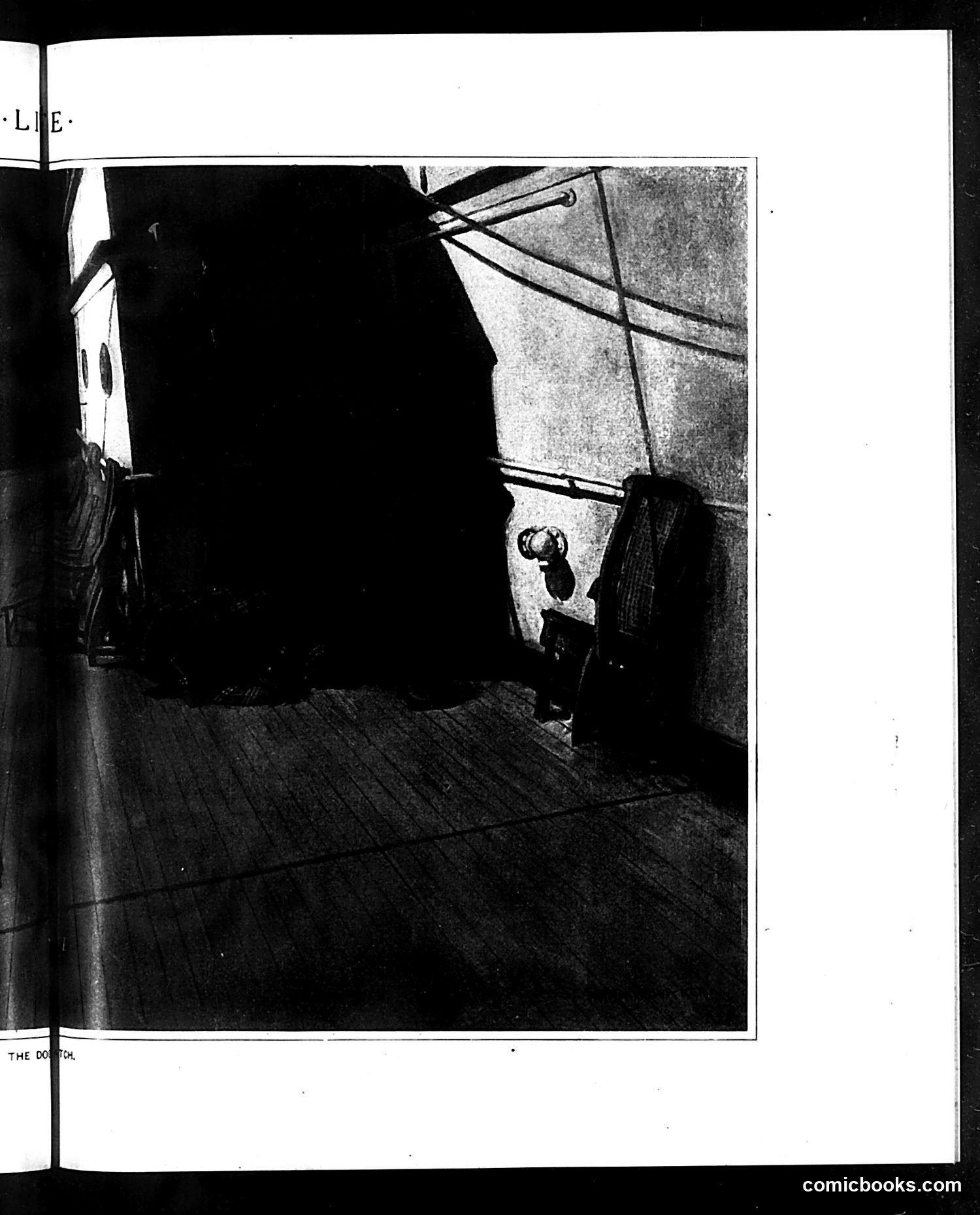
This page appears to be from *Life* magazine and shows a black and white photograph labeled "THE DOCTOR" at the bottom. The image depicts what seems to be an interior space with dramatic lighting and shadows—possibly a medical or clinical setting, given the caption. However, the OCR text is minimal and unclear ("SPR" appears fragmentary), making it difficult to identify specific political or social references with confidence. Without clearer text or visible captions explaining the satirical intent, I cannot reliably identify which figures or events are being referenced, or what the specific point of satire is meant to be. To properly explain this cartoon's meaning to a modern reader, clearer source material or additional context would be needed.
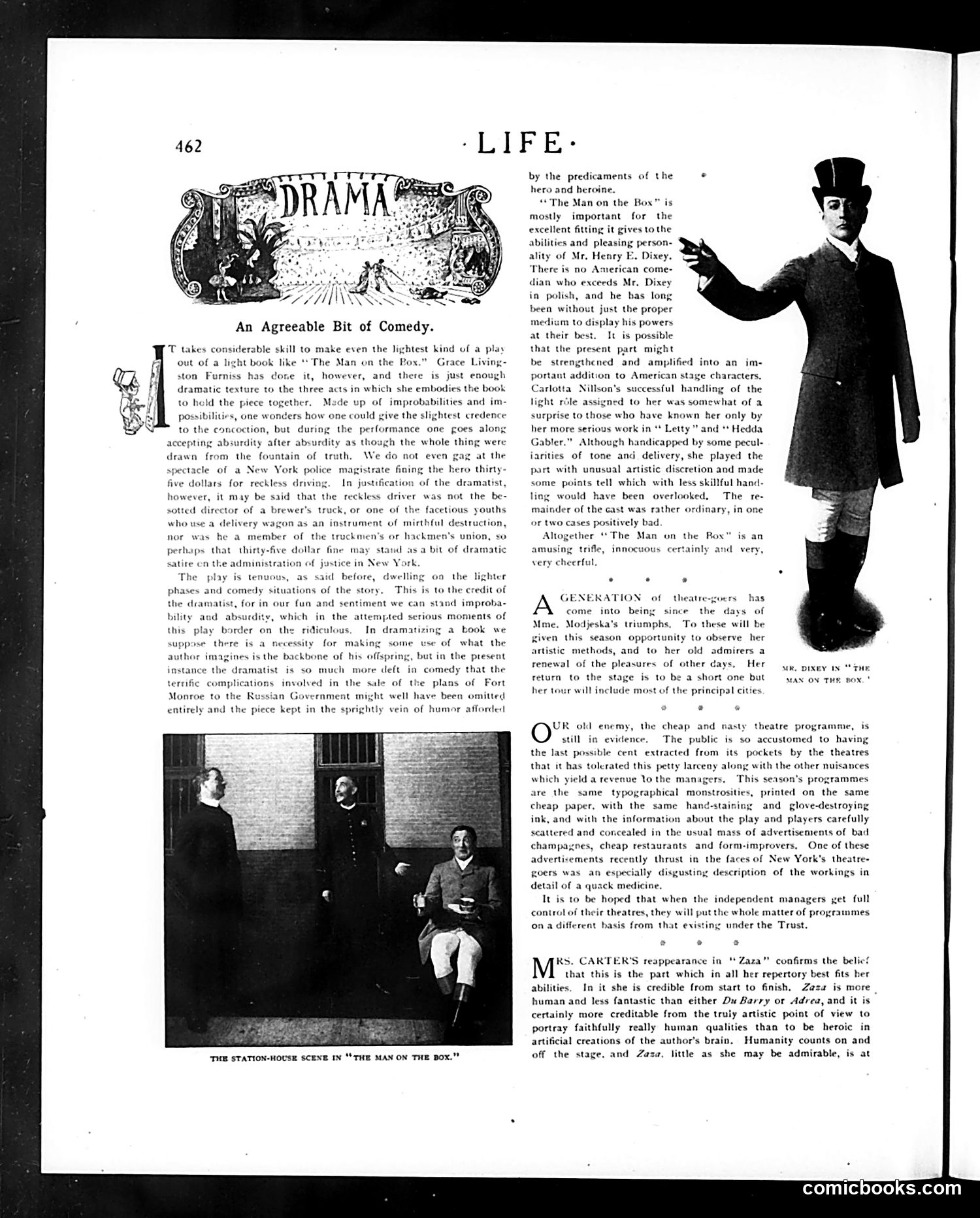
This page reviews "The Man on the Box," a theatrical adaptation of a comedic novel. The text praises the play's lightweight entertainment value while acknowledging its absurd plot—involving improbabilities like the sale of Fort Monroe's military plans to Russia. **The main critique**: The reviewer credits playwright Grace Livingston Furniss with skillfully holding together an implausible story through comedic timing. Henry E. Dixey receives praise as a polished American comedian finally given a suitable role showcasing his talents. An actress (likely Carolina Nilsson) is noted as competent despite handicaps in delivery. **The satire**: The reviewer gently mocks the play's pretensions—suggesting the serious plot elements (the espionage subplot) should be cut entirely to maintain the piece's "sprightly vein of humor." **Secondary complaint**: A separate section attacks cheap theater programs as exploitative, complaining venues extract maximum profit while printing them on cheap paper alongside ads for questionable medicines and restaurants. The page reflects turn-of-century theater criticism and the economics of Broadway entertainment.
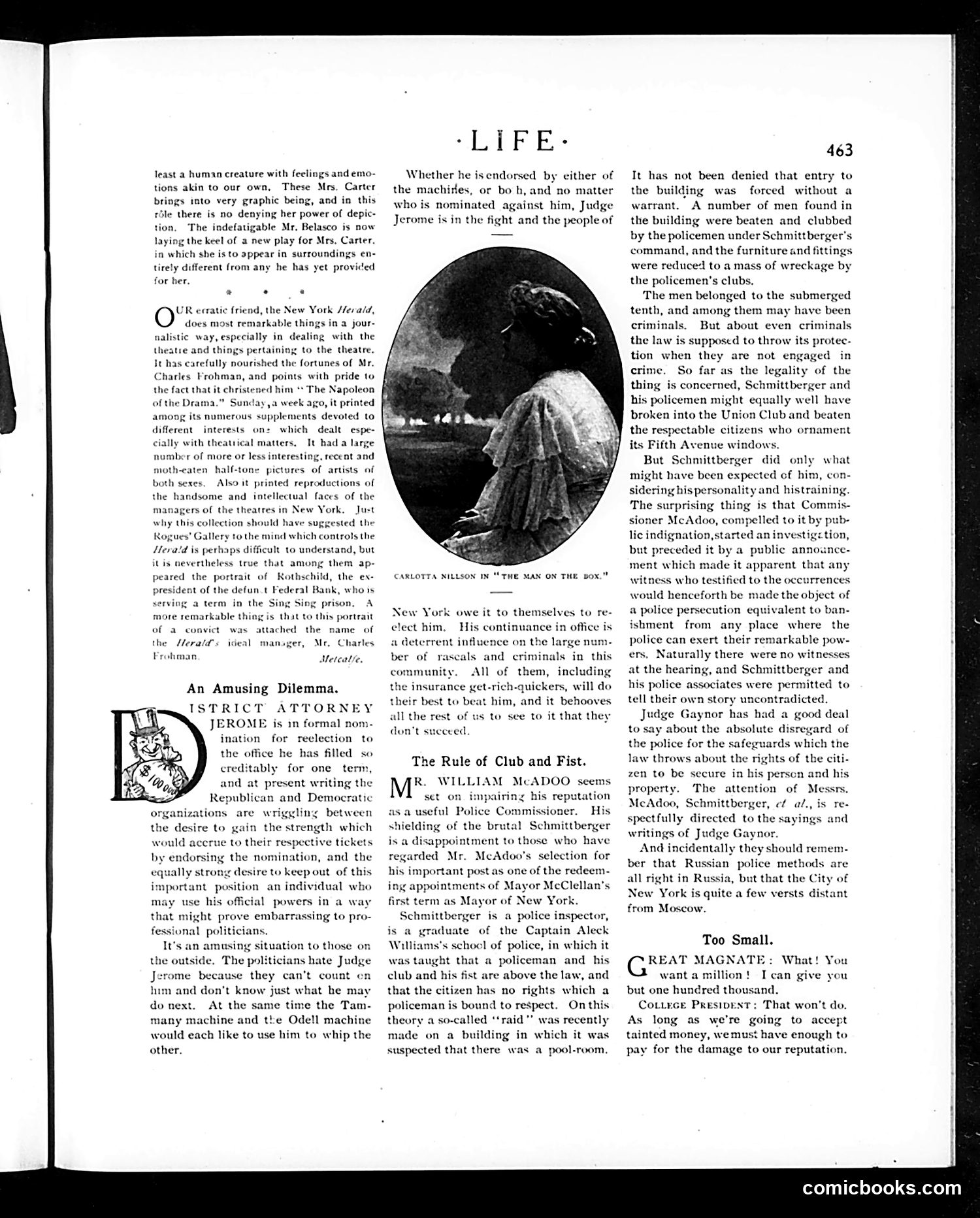
This page satirizes New York City politics and police conduct circa early 1900s. **Key targets:** **Judge Jerome** (District Attorney): The article praises his reelection bid, noting both Tammany Hall and the Odell Republican machine want to use him politically—yet neither fully trusts him because he acts independently and unpredictably. **Police Commissioner William McAdoo**: Criticized for protecting Police Inspector Schmittberger, a brutal officer trained in the "Captain Aleck Williams school" where police brutality was normalized. The satire condemns McAdoo's shielding of Schmittberger despite his reputation for violent raids, including one on a suspected poolroom conducted without legal warrant. **The cartoon image** (captioned "Carlotta Nilsson in 'The Man on the Box'") appears unrelated theatrical content. The satire attacks both police corruption and political cowardice—McAdoo's willingness to overlook police lawlessness to maintain his position, contrasted with Jerome's principled independence.
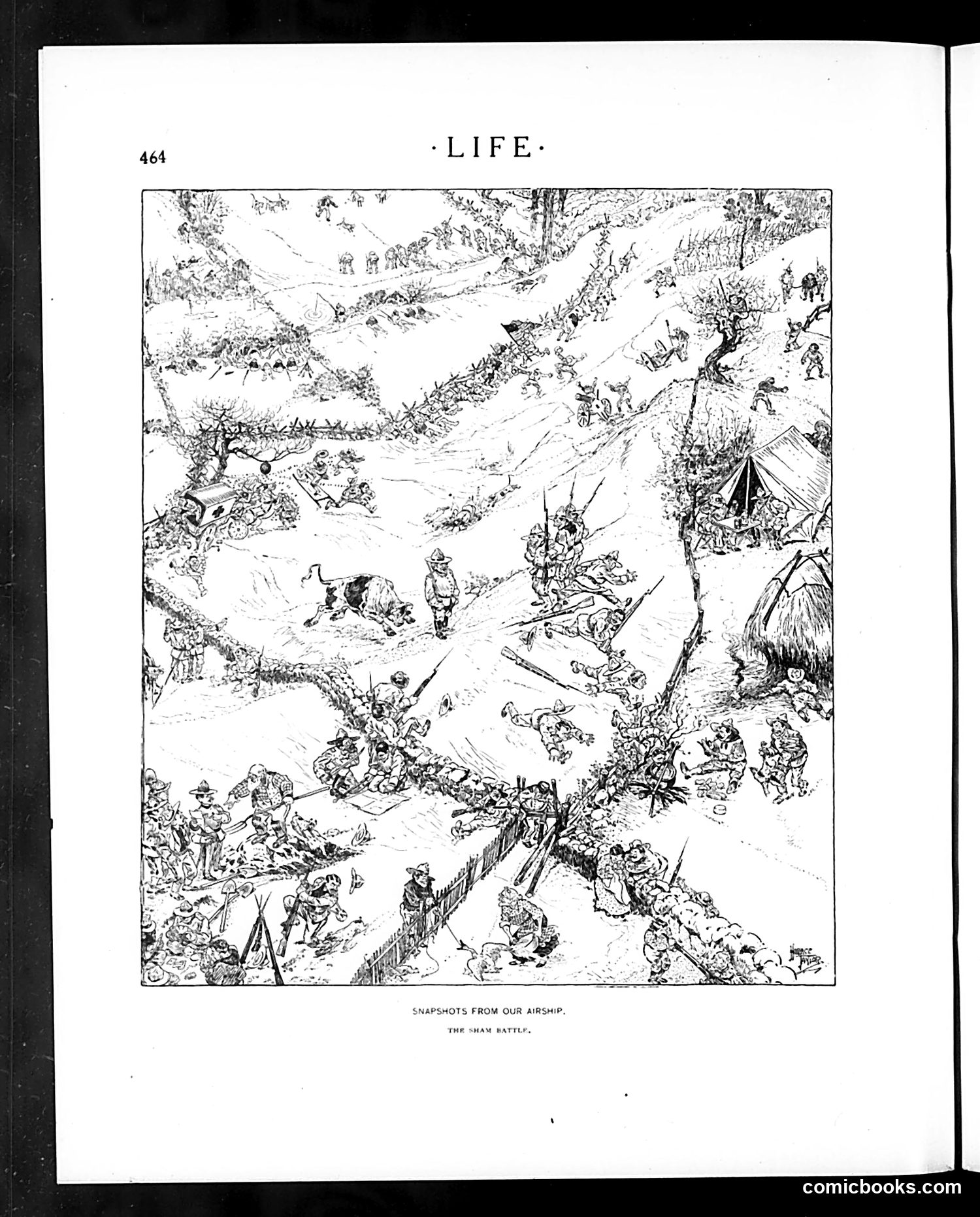
This is a satirical illustration titled "Snapshots from Our Airship: The Sham Battle." The detailed pen-and-ink drawing depicts an aerial view of a military exercise or mock battle, with numerous soldiers, tents, fortifications, and equipment scattered across hilly terrain. The term "sham battle" suggests this critiques military war games or practice exercises—likely depicting them as theatrical, ineffective, or disconnected from real combat. The "airship" perspective humorously frames observers viewing these maneuvers from above, emphasizing the artificial, choreographed nature of the proceedings. Without additional context or visible caricatures of specific political figures, the satire appears to mock military preparedness exercises generally, possibly suggesting they are performative or miss realistic combat conditions. The perspective itself—distant and bird's-eye—reinforces the sense of absurdity.
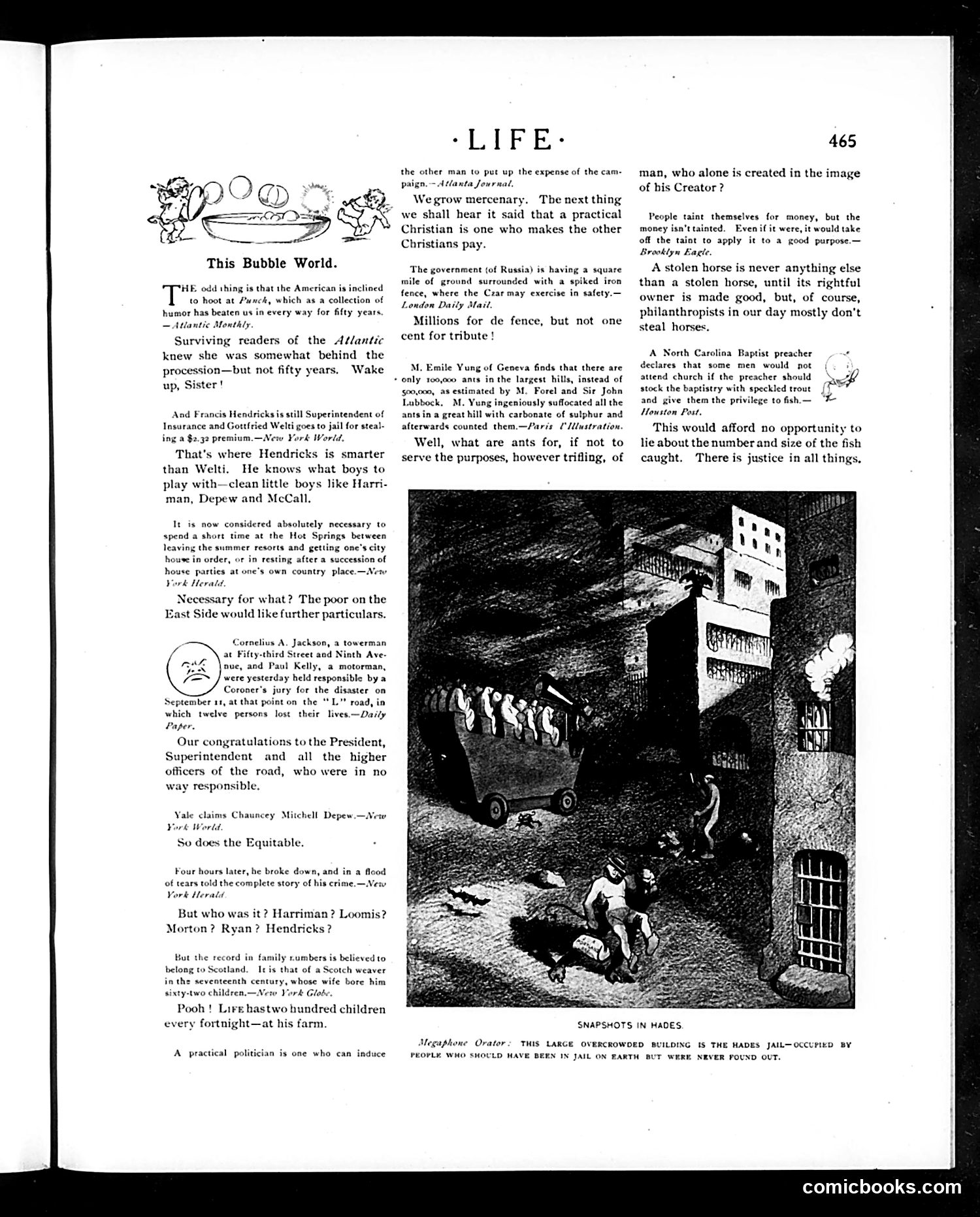
This page from *Life* magazine contains satirical commentary on American corruption and hypocrisy circa early 1900s. The main section, "This Bubble World," attacks wealthy industrialists and politicians who escape accountability. References to "Harriman, Depew and McCall" appear to be prominent businessmen involved in scandals. The piece mocks Francis Hendricks (Superintendent of Insurance) for avoiding jail while lesser figures like Gottfried Welti face punishment for minor theft—suggesting systemic corruption favors the powerful. The cartoon at bottom, "Snapshots in Hades," depicts a crowded jail in the afterlife, captioned that it holds people "who should have been in jail on earth but were never found out." This visualizes the magazine's central complaint: wealthy wrongdoers evade earthly justice through corruption and influence. Throughout, *Life* sarcastically highlights the gap between Christian morality and actual wealthy behavior, and between public accountability and private privilege.
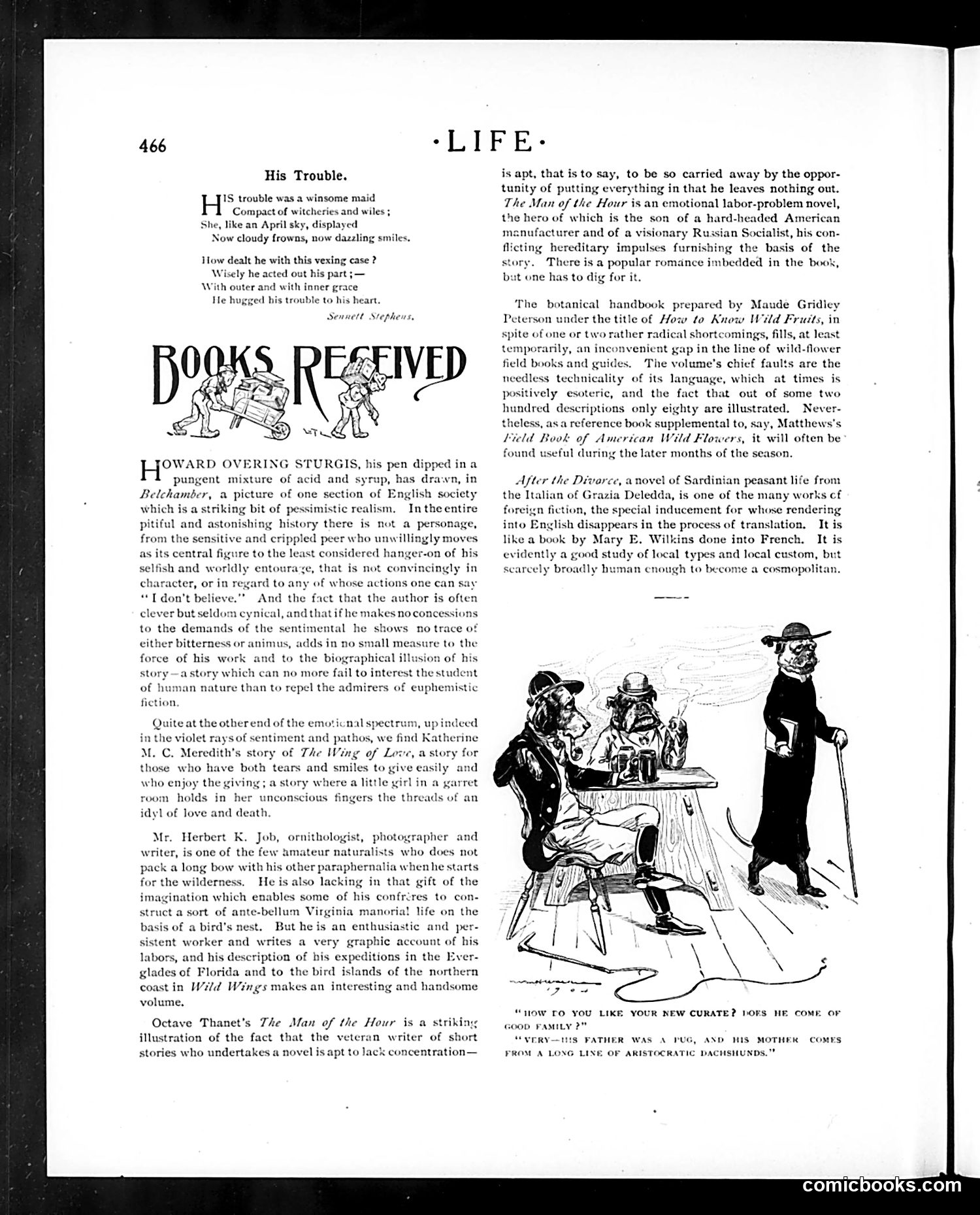
This page is primarily a **book review section** with one accompanying illustration. The main cartoon depicts three well-dressed men in conversation on a street or promenade, with the caption asking about someone's "new curate" and joking that the father "was a fug, and his mother comes from a long line of aristocratic dachshunds." The humor here is **social satire about class pretension**: the joke equates human aristocratic lineage with dog breeding, mocking the absurdity of those who obsess over family pedigree. The implication is that this person's supposedly distinguished ancestry is as ridiculous as tracing a dog's bloodline. The page itself reviews several contemporary novels, including works by Octave Thanet and others, offering literary criticism typical of Life magazine's cultural commentary. The poem "His Trouble" at the top addresses romantic entanglement—likely matching the magazine's mix of humor and sentiment. The overall effect is genteel satire targeting Victorian-era social climbing and class consciousness.
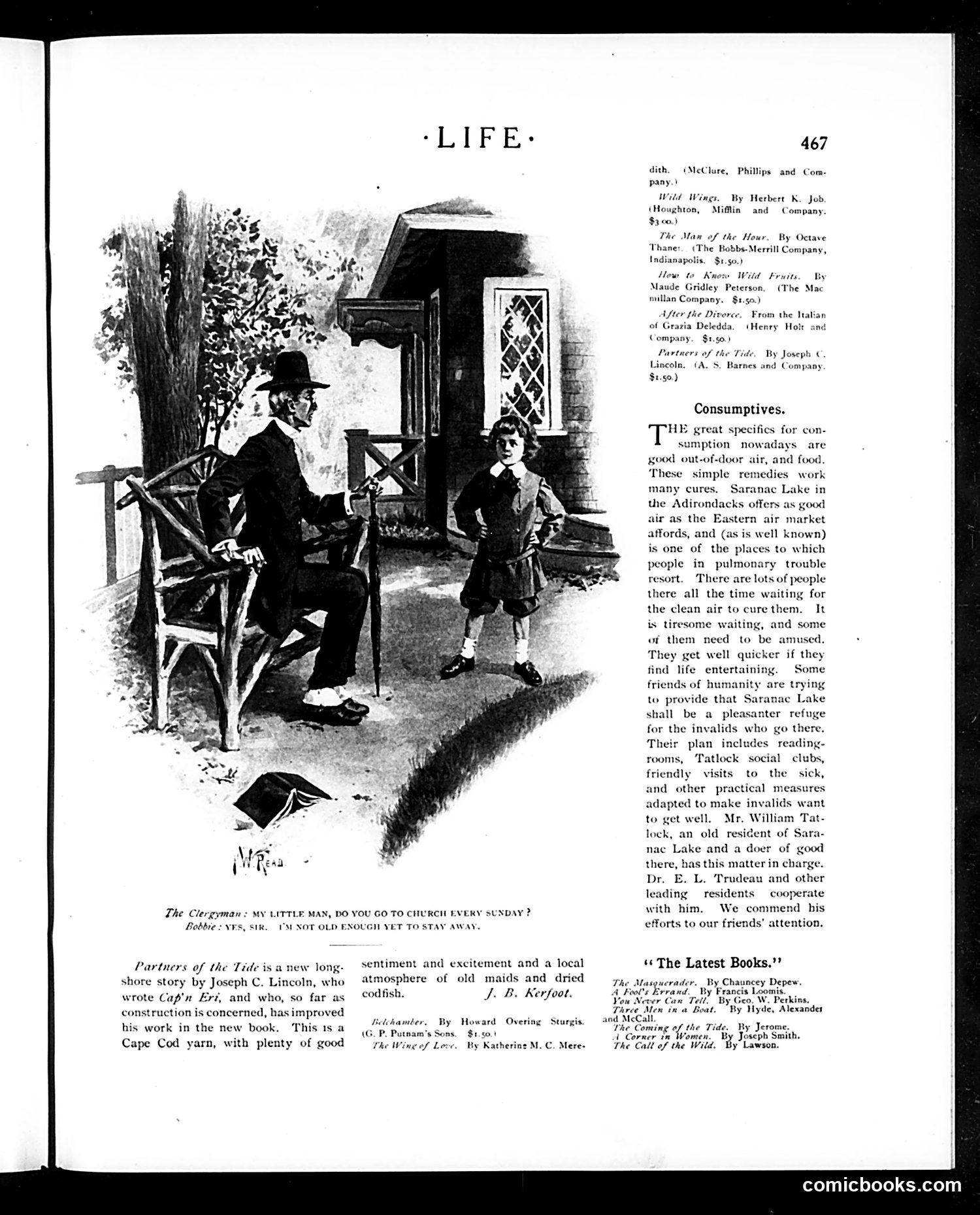
The main cartoon depicts a clergyman asking a young boy ("Bobbie") if he attends church every Sunday. The boy's reply—"Yes, sir. I'm not old enough yet to stay away"—is the joke's punchline, satirizing adult hypocrisy about religious observance. The humor relies on the implication that adults *choose* to skip church once they're old enough to do so without parental enforcement, suggesting widespread indifference to religion despite societal expectations. This reflects early 20th-century skepticism about institutional Christianity, particularly among the educated classes Life's readership represented. The cartoon gently mocks both the clergyman's naive question and the broader cultural pretense that regular church attendance was genuinely valued by adults, when behavior suggested otherwise. It's social satire targeting the gap between professed religious commitment and actual practice.
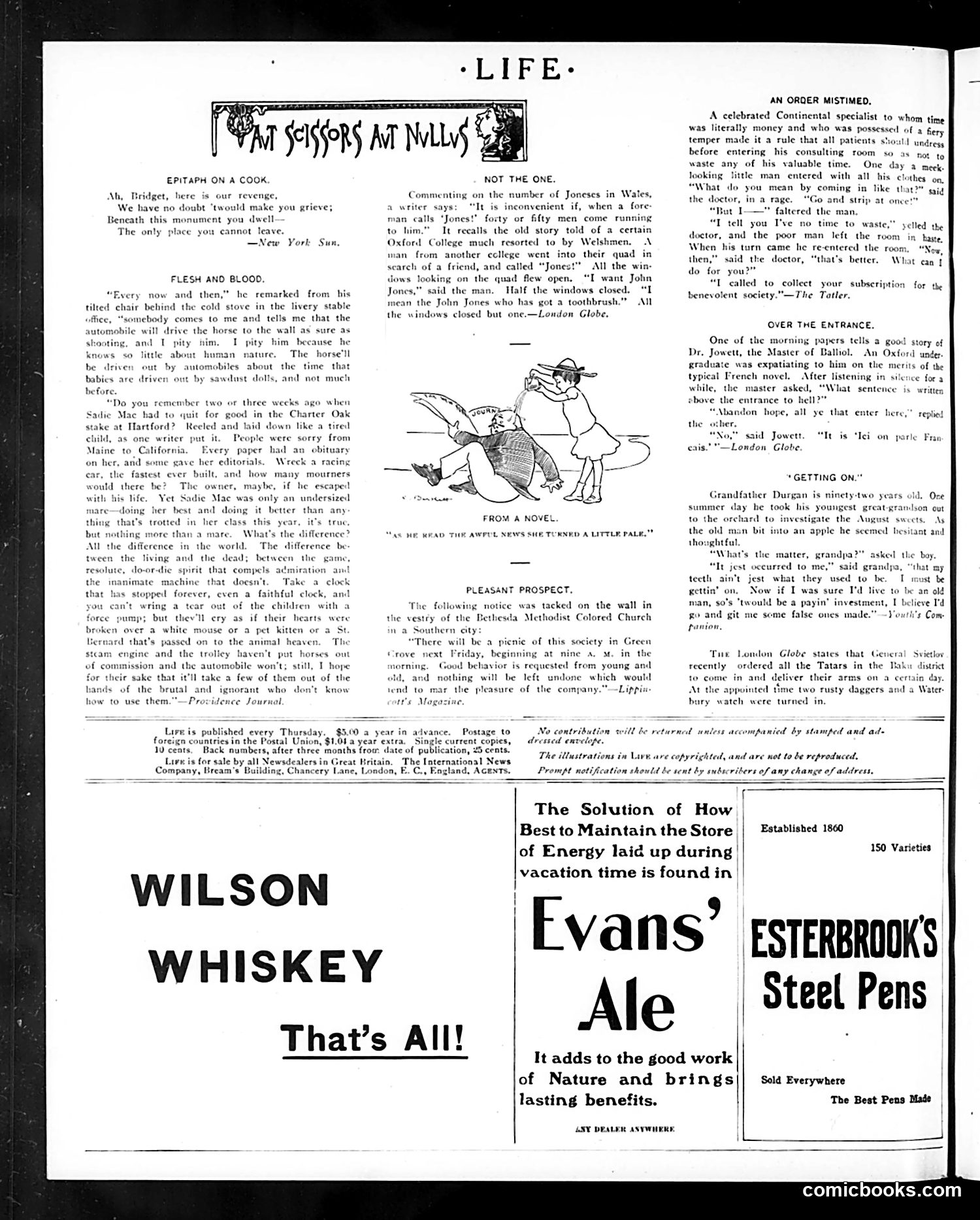
This page contains several satirical items from *Life* magazine: **Main Cartoons/Jokes:** 1. **"Epitaph on a Cook"** and **"Flesh and Blood"**: These are humorous anecdotes about servants and animals. The "cook" joke uses dark humor about domestic service; "Flesh and Blood" is a livery stable worker's meditation on the emotional difference between losing a valued horse versus a mare—satirizing working-class attitudes and the sentimental attachment to animals versus indifference to similar losses among people. 2. **"Not the One"**: A joke about Welsh surnames, mocking the prevalence of "Jones" in Wales. It references Oxford College where so many Welshmen studied that calling "Jones!" brought multiple responses. 3. **"An Order Mistimed"**: A doctor's impatience is mocked when a patient arrives fully clothed for a medical appointment, creating absurdist humor about rigid professional demands. 4. **"Pleasant Prospect"**: Satirical reproduction of a church notice with unintentionally humorous wording about a segregated ("Colored Church") community picnic. The page is mostly advertising for whiskey, ale, and pens.
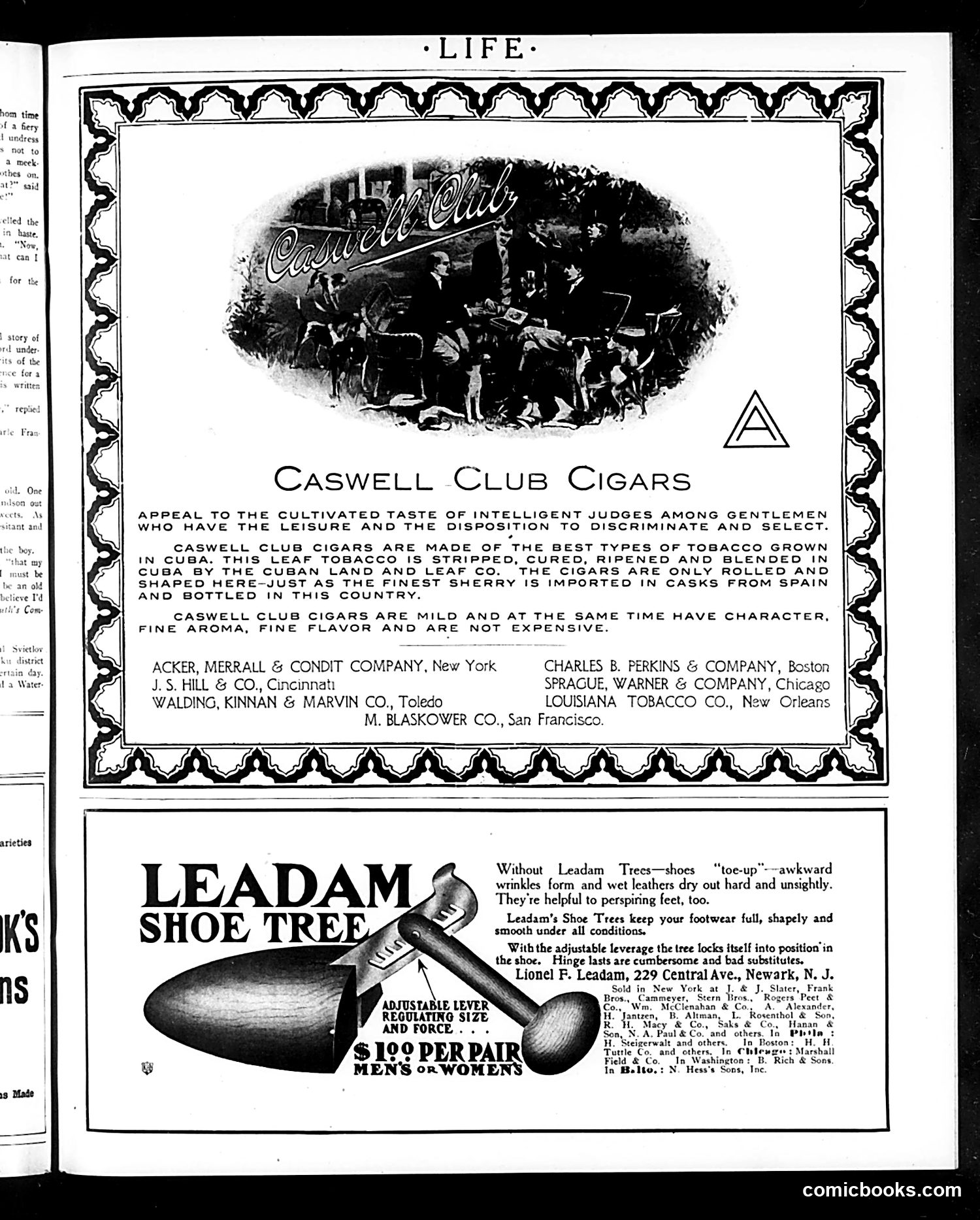
This page contains **two advertisements, not political cartoons**. The top ad promotes **Caswell Club Cigars**, emphasizing their premium status for "intelligent judges among gentlemen" with cultivated taste. It highlights that Cuban tobacco is processed in Cuba but rolled in America—positioning the product as both authentically imported and domestically manufactured, an appeal to early 20th-century consumers valuing both quality and American labor. The bottom ad showcases **Leadam Shoe Trees**, devices inserted into shoes to maintain shape and prevent wrinkles. The illustration shows the mechanical tool with adjustable leverage, pitched as superior to rival "hinge lasts." Both ads target affluent male consumers through appeals to sophistication and product superiority. There is no satire, political commentary, or caricature present—this is a straightforward advertising page from *Life* magazine's commercial section.
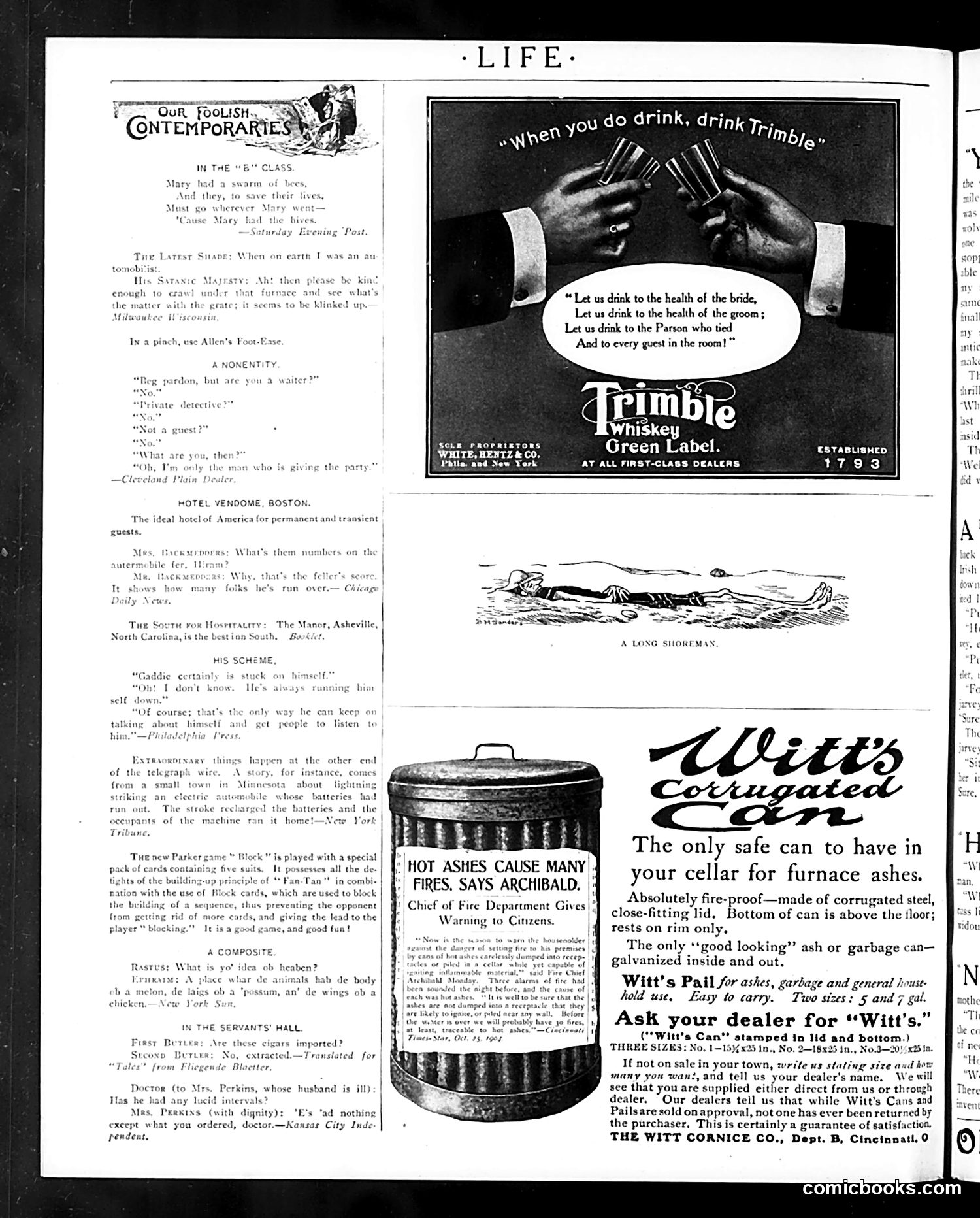
This page contains multiple brief satirical jokes and advertisements typical of early 20th-century Life magazine. **The Cartoons/Jokes:** The text snippets mock various social situations: a waiter's ambiguous identity, an automobile owner who's hit pedestrians, conflicting definitions of heaven, and servants' interactions with employers. These are gentle social satire aimed at class differences, pretension, and everyday absurdities. **The Advertisements:** The prominent ads feature Trimble Whiskey (promoting toasts at weddings) and Witt's Corrugated Can (for safely storing furnace ashes, responding to fire safety concerns). A note about hot ashes causing fires references real urban dangers from coal/furnace heating. **Context for Modern Readers:** This reflects an era when servants and class distinctions were routine topics of humor, when furnaces burning coal or wood created genuine household fire hazards, and when satirical magazines published dozens of brief jokes per page rather than longer narratives. The advertising integrates seamlessly with editorial content.
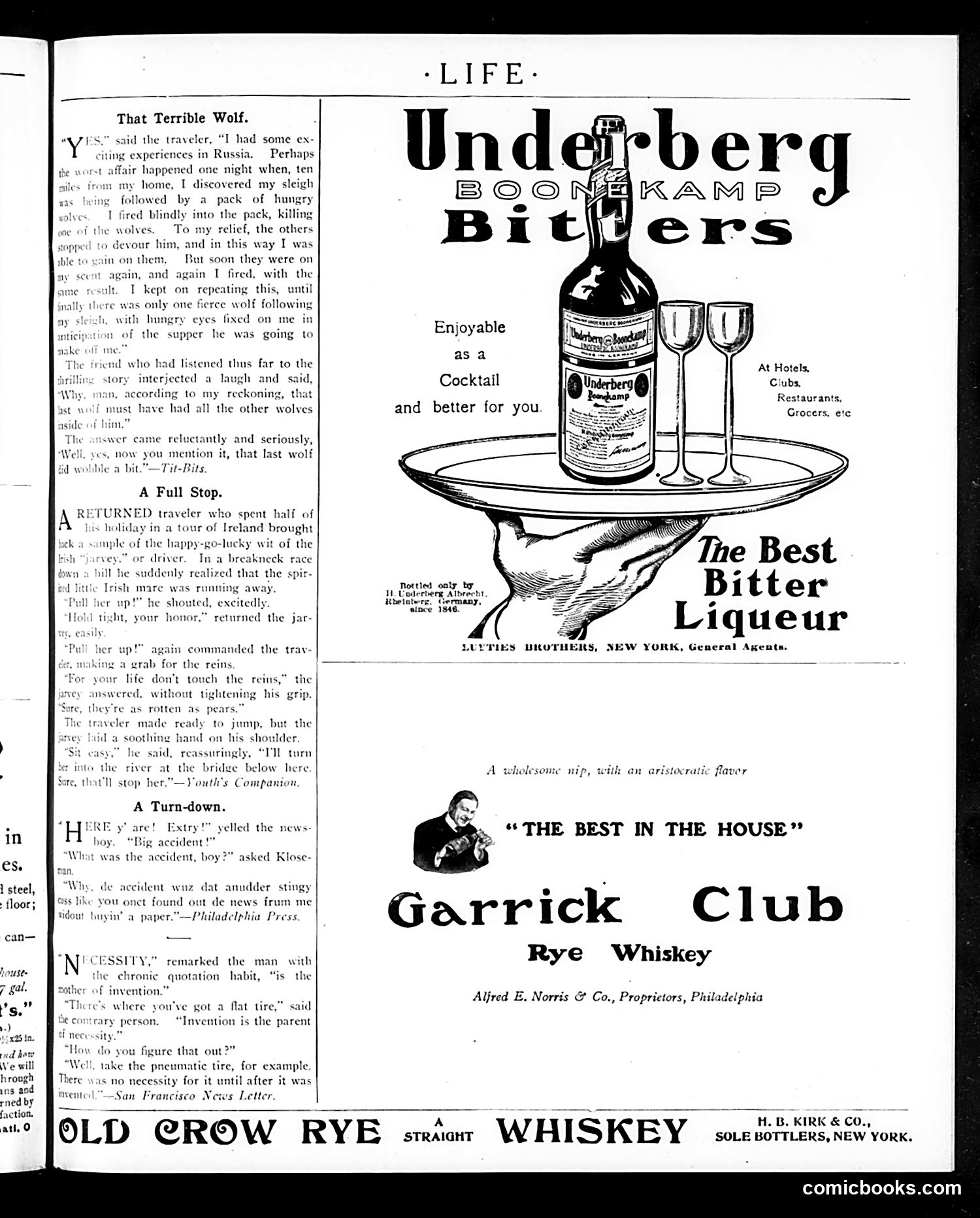
**Content**: This is a mixed page of satirical humor stories and alcohol advertisements, typical of *Life* magazine's format. **The Humor**: - "That Terrible Wolf": A traveler's tall tale about surviving a Russian wolf attack. The joke—pointed out by a friend—is logically absurd: if he killed wolves one by one, feeding the pack the corpses, the last wolf would have eaten all the others and couldn't exist. - "A Full Stop" and "A Turn-down": Brief anecdotes playing on Irish wit and wordplay about necessity vs. invention. **The Advertisements** (clearly marked as such): - **Underberg Bitters** and **Garrick Club Rye Whiskey**: Spirits marketed as suitable for social occasions, hotels, and restaurants. - **Old Crow Rye**: A whiskey advertisement. These ads reflect pre-Prohibition America when alcohol advertising appeared freely in mainstream magazines. The humor pages and ads coexist without irony—this was standard *Life* magazine content from the early 20th century.
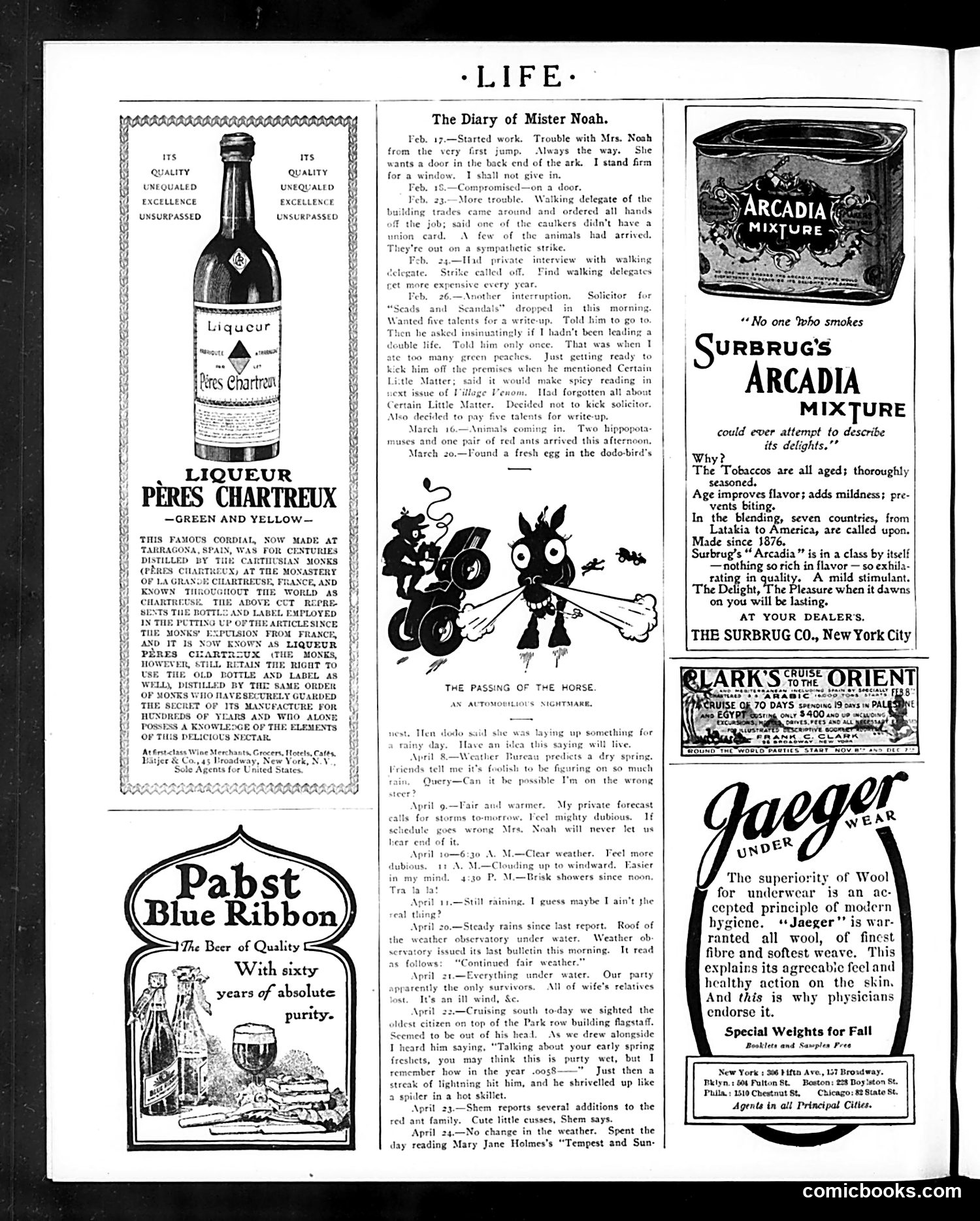
This satirical diary humorously reimagines Noah's Ark experience through the lens of early 20th-century American life. The humor derives from anachronistic complaints: Noah grumbles about labor strikes, solicitors, and expensive delegations—modern irritations transplanted onto biblical narrative. The cartoon titled "The Passing of the Horse: An Automobiles Nightmare" depicts a horse-drawn wagon encountering an early automobile, suggesting anxiety about automotive technology replacing traditional transportation. The diary entry references this collision of old and new. The diary's tone mocks domestic discord (marital arguments about doors), labor unrest (walking delegates demanding pay), and the absurdity of surviving the flood only to face modern bureaucratic annoyances. It's a gentle satire on contemporary American frustrations, using the Noah story as a vehicle for social commentary on strikes, commercialism, and the disruptive pace of technological change in the Progressive Era.
This page is primarily **advertising and travel promotion** with a diary column excerpt titled "During Our Winter Months the Summer Climate of the West Indies." The small cartoon at top-left appears to show **Noah's Ark** with animals, introducing the diary's comedic conceit: the entries are written by someone aboard the ark during the biblical flood. **The satire's premise**: The diary treats Noah's voyage like a modern cruise ship experience, with mundane complaints (wife nagging about pipe smoke, seasickness, red ants) replacing the apocalyptic significance of the flood. The humor lies in **deflating the mythological event** to petty domestic grievances—complaining about the "woman idea" wife's bossiness, amateur minstrel jokes, and animal management problems. The joke for 1906 readers: applying modern, turn-of-the-century married life irritations (smoking bans, women's liberation anxieties, passenger ship culture) to a sacred biblical narrative, treating transcendent history as banal tourism. The page is otherwise filled with **Hamburg-American Line cruise advertisements**, theater promotions (the Hippodrome), and soap advertisements—typical Life magazine content mixing satire with commercial notices.
This page is primarily **advertising** from the early 20th century, with one notable satirical piece: **"Automobile Maxims"** by Richard B. Glaenzer. ## The Satire "Automobile Maxims" parodies Biblical language ("by their tools ye shall know them," "let repentance be thine") to mock the dangers and moral hazards of early automobiles. The piece humorously warns drivers against excessive speed, reckless behavior, and endangering others—presenting car culture as a modern moral failing. Lines like "An auto at speed is a fiend indeed" and warnings about brake failure suggest automobiles were still novel, dangerous innovations that society hadn't fully adapted to. The satirical tone suggests Life magazine was critiquing the recklessness of wealthy car owners and the social disruption caused by this new technology. ## The Advertisements The page features upscale product ads typical of the era: Club Cocktails, Bishop's California Preserves, ABC Wardrobe Trunks, Knox Hats, and formal livery services—targeting affluent readers.
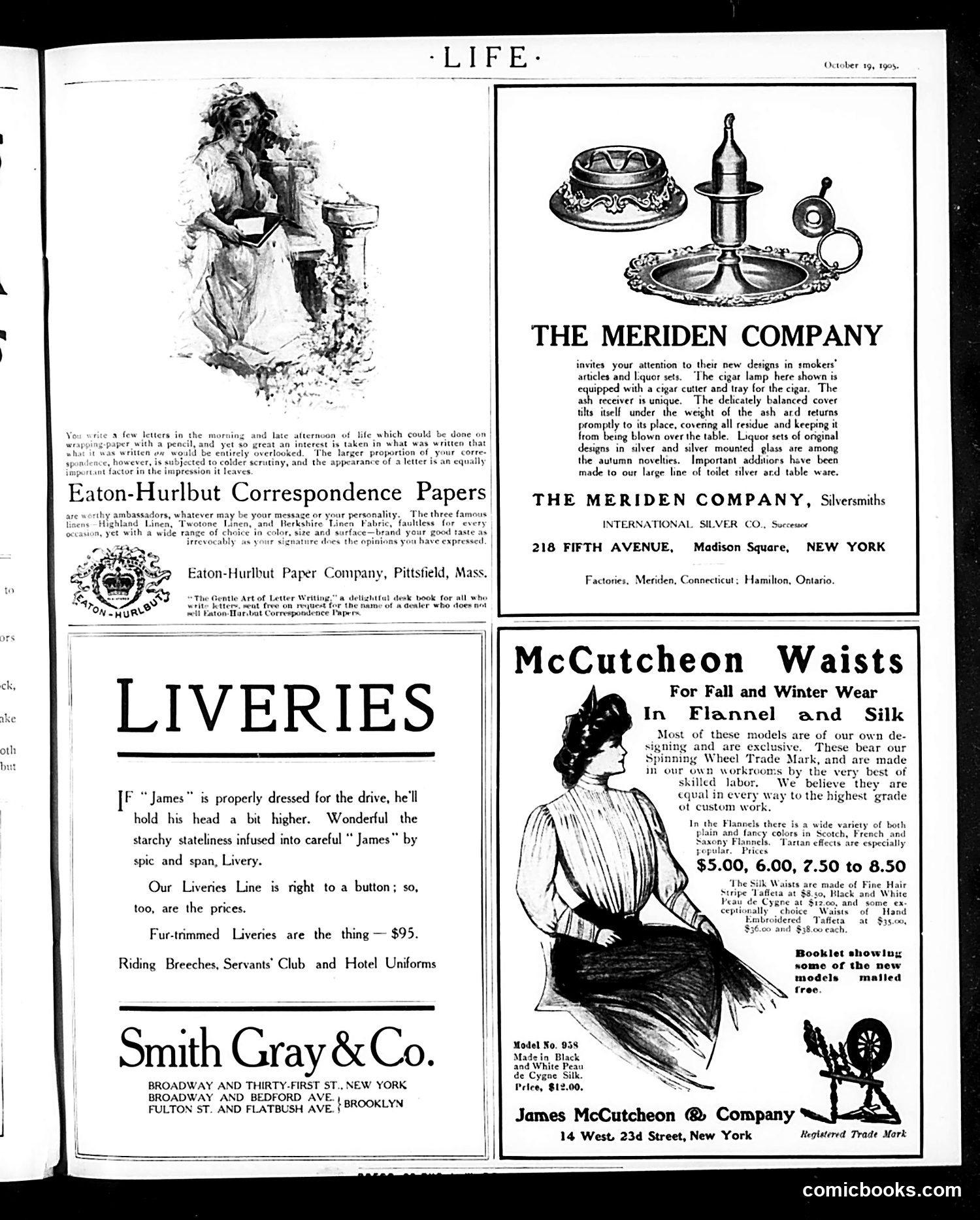
This is primarily an **advertising page** rather than satirical content. It contains four product advertisements typical of early-1900s Life magazine: 1. **Eaton-Hurlbut Paper Company**: Promotes stationery and correspondence papers as suitable for proper letter-writing. 2. **Smith Gray & Co.**: Advertises livery uniforms for servants and drivers, with a brief joke that properly dressed servants ("James") will "hold his head a bit higher"—a gentle class-based humor about how fine clothing affects bearing and dignity. 3. **Meriden Company**: Showcases decorative silver goods (cigar lamps, liquor sets, table ware) for wealthy households. 4. **McCutcheon & Company**: Features fashionable waists (blouses) for women in silk and flannel, priced $5-$8.50. The page reflects **Gilded Age consumer culture**—products targeting upper-class households with disposable income for servants, fine dining accessories, and fashionable clothing. There is no political content or meaningful satire present.
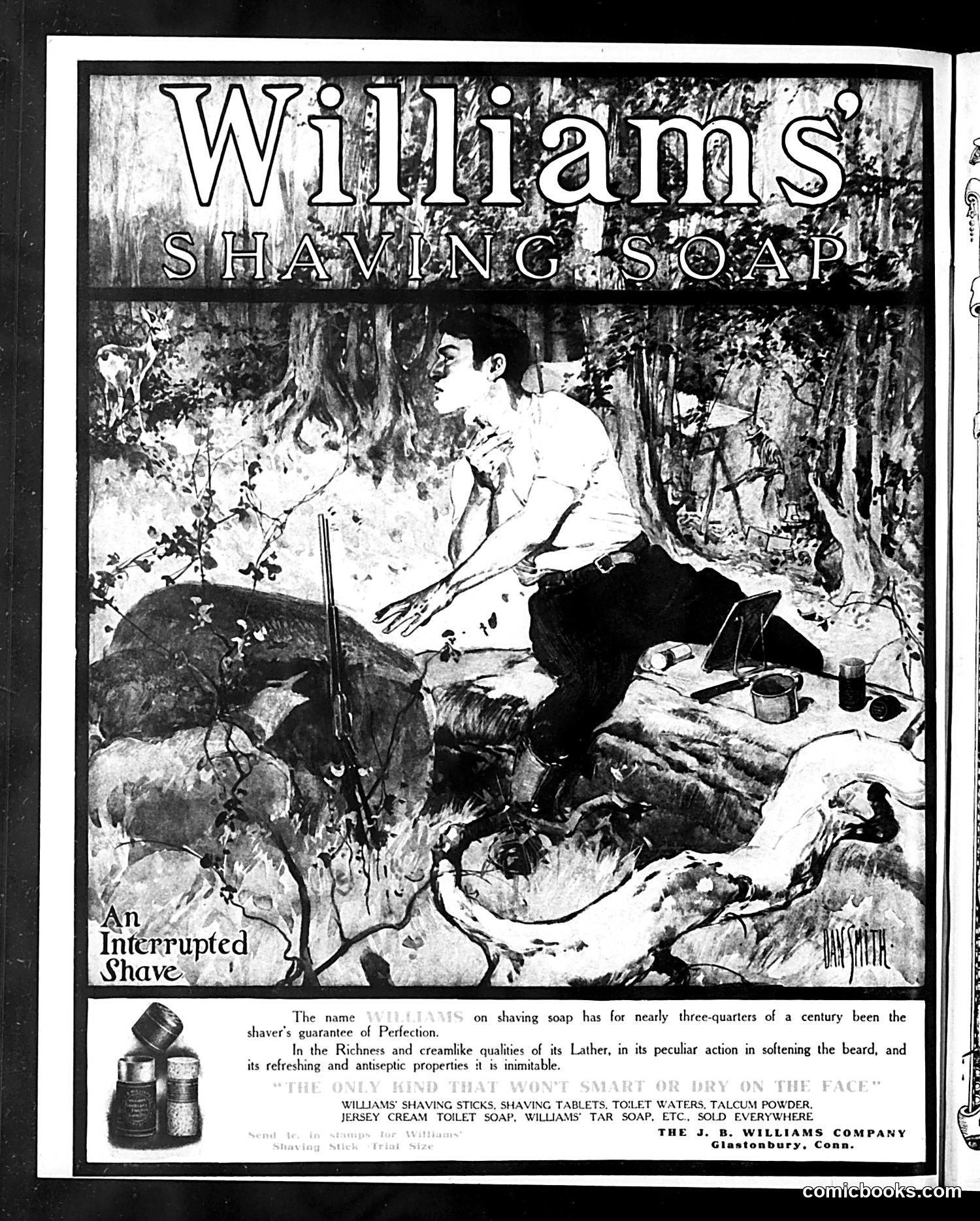
This is primarily a **product advertisement**, not political satire. The image shows a man mid-shave in a wilderness camping scene, interrupted by what appears to be a bear or large animal nearby. The ad's humor plays on the contrast between civilized grooming and rugged outdoor conditions. The caption "An Interrupted Shave" suggests that even in remote, dangerous situations, a man maintains his grooming standards—Williams soap is reliable enough for any circumstance. The accompanying text emphasizes the product's 75-year reputation for quality lather and beard-softening properties. This represents typical early 20th-century advertising strategy: associating a consumer product with masculinity, reliability, and adventure. The wilderness setting reinforces the idea that Williams soap is dependable in all conditions.