
Life, 1905-10-19 · page 20 of 30
Life — October 19, 1905 — page 20: what you’re looking at
What you’re looking at
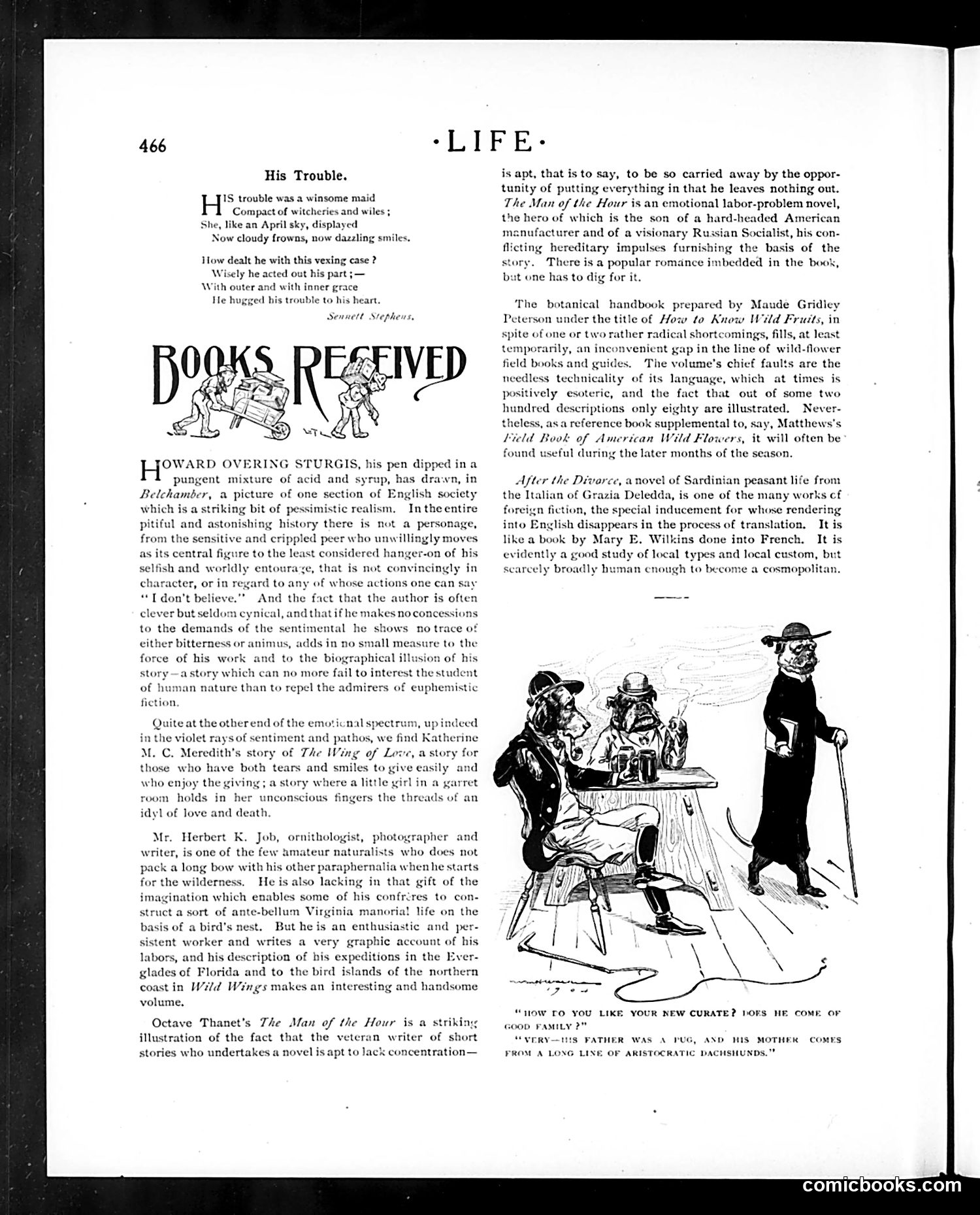
This page is primarily a **book review section** with one accompanying illustration. The main cartoon depicts three well-dressed men in conversation on a street or promenade, with the caption asking about someone's "new curate" and joking that the father "was a fug, and his mother comes from a long line of aristocratic dachshunds." The humor here is **social satire about class pretension**: the joke equates human aristocratic lineage with dog breeding, mocking the absurdity of those who obsess over family pedigree. The implication is that this person's supposedly distinguished ancestry is as ridiculous as tracing a dog's bloodline. The page itself reviews several contemporary novels, including works by Octave Thanet and others, offering literary criticism typical of Life magazine's cultural commentary. The poem "His Trouble" at the top addresses romantic entanglement—likely matching the magazine's mix of humor and sentiment. The overall effect is genteel satire targeting Victorian-era social climbing and class consciousness.
📄 Transcribed text from this page (OCR, searchable)
Machine-transcribed from the original scan — historical spelling and the odd misread are preserved.
*LIFE* His Trouble. 1S trouble was a winsome maid Compact of witcheries and wiles ; , like an April sky, displayed Now cloudy frowns, now dazzling smiles. How dealt he with this vexing case ? Wisely he acted out his part ;— With outer and with inner grace ed his trouble to his heart. Sennett Stephens, OWARD OVERING STURGIS, his pen dipped in a pungent m re of acid and syrup, has drawn, in Belcham a picture of one section of English society which is a striking bit of pessimistic realism. In the entire pitiful and astonishing history there is not a persona; from the sensitive and crippled peer who unwillingly moves as its central figure to the least considered hanger-on of his selfish and worldly entouraye, that is not convincingly in character, or in regard to any of whose actions one can “T don't believ And the fact that the author is often clever but seldom cynical, and that if he makes no concessions to the demands of the sentimental he either bitterness or animus, adds in no small m force of his work and to the biographical ill of his story —a story which can no more fail to interest the student an nature than to repel the admirers of euphemistic hows no trace of ure to the of hu fiction. Quite at th erend of the emoticnal spectru in the violet rays of sentiment and pathos, we find Katherine M. C. Meredith's story of The Wing of Li ve both tears and smiles to giv a little girl in a conscious fingers the threads ¢ those who I who enjoy the giving; a story wher room holds in her idyl of love and death. Mr. Herbert K. Job, ornithologist apher and writer, is one of the few Amateur naturalists who docs not pack a long bow with his other paraphernalia when he starts for the wilderness. He is also lacking in that gift of the imagination which enables some of his confréres to con- phote struct a sort of ante-bellum Virginia manorial! life on the But he is an enthusiastic and per- sistent worker and writes a very graphic account of his labors, and his description of his expeditions in the glades of Florida and to the bird i ds of the northern coast in Wild Wings makes an interesting and handsome volume, basis of a bird's nest. Octave Thanet’s The Man of the Hour is a striking illustration of the fact that the veteran writer of short stories who undertakes a novel is apt to Jack concentration— is apt, that is to say, to be so carried away by the oppor- tunity of putting everything in that he leaves nothing out. The Man of the Hour is an emotional labor-problem novel, the hero of which is the son of a hard-headed American menufacturer and of a visionary Russian Socialist, his con- ting hereditary impulses furnishing the basis of the story. There is a popular romance imbedded in the book, but one has to dig for it. The botanical handbook prepared by Maude Gridicy Peterson under the title of How to Know Wild Fruits, in spite of one or two rather radical shortcomings, fills, at least temporarily, an inconvenient gap in the line of wild-flower The volume’s chief faults are the needless technicality of its field books and guides. anguage, which at times is 1 the fact that out of some two hundred descriptions only eighty are illustrated. Never theless, as a reference book supplemental to, say, Matthews’s Lield Book of American Wild Flowers, it will often be found useful during the later months of the season. positively esoteric, After the Divorce, a novel of Sardinian peasant life from the Italian of Grazia Deledda, is one of the many works cf foreign fiction, the special inducement for whose rendering nglish disappears in the process of translation, It is like a book by Mary E. Wilkins done into French. It is evidently a good study of local types and local custom, but scarcely broadly human cnough to become a cosmopolit “iow TO YOU LIKE YOUR NEW CURATE? 1OFS HE ComME oF GOOD FAMILY ?” VERY—1IS FATHER WAS A PUG, AND MIS MOTHER FROM A LONG LINE OF ARISTOCRATIC DACHSHUNDS.” comes comicbooks.com