
Life, 1905-10-19 · page 16 of 30
Life — October 19, 1905 — page 16: what you’re looking at
What you’re looking at
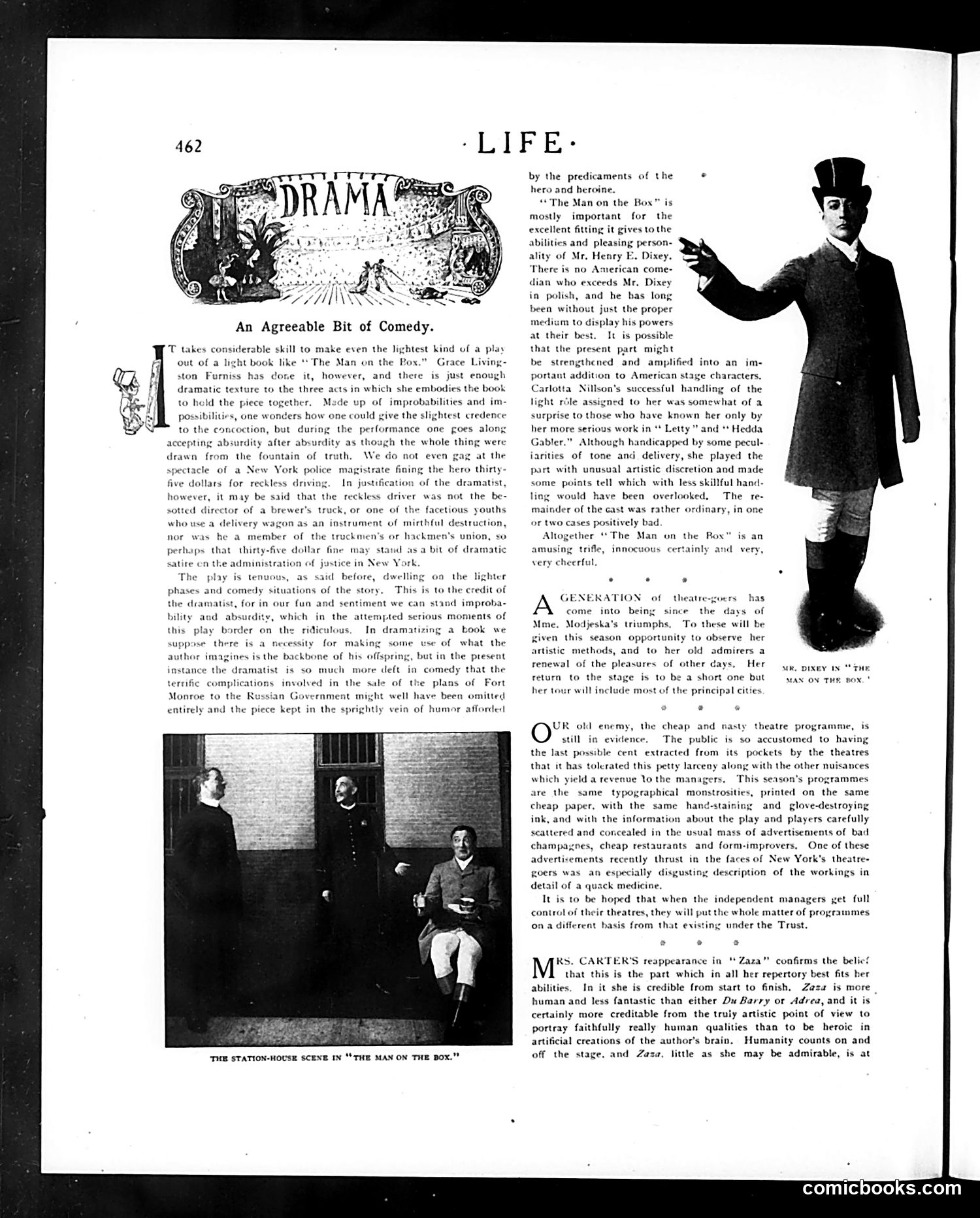
This page reviews "The Man on the Box," a theatrical adaptation of a comedic novel. The text praises the play's lightweight entertainment value while acknowledging its absurd plot—involving improbabilities like the sale of Fort Monroe's military plans to Russia. **The main critique**: The reviewer credits playwright Grace Livingston Furniss with skillfully holding together an implausible story through comedic timing. Henry E. Dixey receives praise as a polished American comedian finally given a suitable role showcasing his talents. An actress (likely Carolina Nilsson) is noted as competent despite handicaps in delivery. **The satire**: The reviewer gently mocks the play's pretensions—suggesting the serious plot elements (the espionage subplot) should be cut entirely to maintain the piece's "sprightly vein of humor." **Secondary complaint**: A separate section attacks cheap theater programs as exploitative, complaining venues extract maximum profit while printing them on cheap paper alongside ads for questionable medicines and restaurants. The page reflects turn-of-century theater criticism and the economics of Broadway entertainment.
📄 Transcribed text from this page (OCR, searchable)
Machine-transcribed from the original scan — historical spelling and the odd misread are preserved.
“LIF E- An Agreeable Bit of Comedy. T takes considerable skill to make even the lightest kind of a play out of a light book like The Man on the Pe Grace Living- ston Furniss has done it, however, and there is just enough dramatic texture to the three acts in which she embodies the book to hold the piece together. Made up of improbabilities and im- possibilities, one wonders how one could give the slightest credence the performance one goes along accepting absurdity after absurdity as though the whole thing were to the concoction, but durin We do not even g. ing the hero thirty- drawa from the fountain of truth. ag at the spectacle of a New York police magistr five dollars for reckless driving, In justification of the dramatist, however, it may be said that the reckless driver was not the be- sotted director of a brewer's truck, or one of the facetious youths who use a delivery wagon as an instrument of mirthful destruction, nor was he a member of the truckmen’s or hackmen’s union, so ¢ dollar fine may stand asa bit of dramatic of justice in New York. dwell perhaps that thirty satire on the adminis nd comedy situations of the story. is tenuous, as said before phases This is to the credit of the dramatist, for in our fun and sentiment we can stand improba- bility and absurdity, which in the attempted serious moments of this play border on the ridiculous, In dramatizing a book we suppose there is a necessity for making some use of what the author imagines is the backbone of his offspring, but in the present deft in comedy that the terrific complications involved in the sale of the plans of Fort Monroe to the Russian instance the dramatist is so much a overnment might well have been omitted entirely and the piece kept in the sprightly vein of humor afforded “THB STATION-HOUSE SCENE IN “'THE MAN ON THE Box."* by the predicaments of the hero and beroine. ¢ Manon the Box” is important for the excellent fitting it gives to the abilities and pleasing person- ality of Mr. Henry E. Dixey. There is no American come- mostly dian who exceeds Mr, Dixey in polish, and he bas long been without just the proper medium to display his powers at their best. It is possible that the present part might be strengthened and amplified into an im- portant additios Carlo’ light rile assigned to hee was somewhat of a surprise to those who have known her only by her more serious work in Letty and ** Hedda to American stage characters, Nillson’s successful handling of the Gabler.” Although handicapped by some pecul- iarities of tone and delivery, she played the part with unusual artistic discretion and made some points tell which with less skillful hand- ling would have been overlooked, The re- mainder of the cast was rather ordinary, in one of two cases positively bad Altogether “The Man on the Box” is an amusing trifle, innocuous certainly and very, very cheerful. GENERATION of come into being since the days of theatre-goers has Mme. Modjeska’s triumphs, To these will b given this season opportunity to observe her artistic methods, and to her old admirers a renewal of the pleasures of other days. Her ve. pixey in En return to the stage is to be a short one but vay ov THE BoX.' her tour will include most of the principal citi * 6 O JR oll enemy, the cheap and nasty theatre programme, is still in evidence, the last possible cent extracted from its pockets by the theatres The public is so accustomed to having that it has tolerated this petty larceny along with the other nuisances which yield a revenue Yo the managers, This season's programmes are the same typographical monstrosities, printed on the same staining and glove-destroying ink, and with the information about the play and players carefully seatte ealed in the usual mass of advertisements of bad champagnes, cheap restaurants and form-improvers, One of these adverticements recently thrust in the faces of New York’s theatre- goers was an especially disgusting description of the workings in detail of a quack medicine. It is to be hoped that when the independent managers yet full control of their theatres, they will put the whole matter of programmes ona different basis from that existing under the Trust. cheap paper, with the same ha and cor ® ° ® RS. CARTER’S reappearance in" Zaza" confirms the belie! that this is the part which in all her repertory best fits her abilities, In it she is credible from start to finish, Zaza is more human and less fantastic than either Du Barry or Adrea, and it is certainly more creditable from the truly artistic point of view to portray faithfully really human qualities than to be heroic in artificial creations of the author's brain. Humanity counts on and off the stage, and Zaza, little as she may be admirable, is at comicbooks.com