
Life, 1905-10-19 · page 10 of 30
Life — October 19, 1905 — page 10: what you’re looking at
What you’re looking at
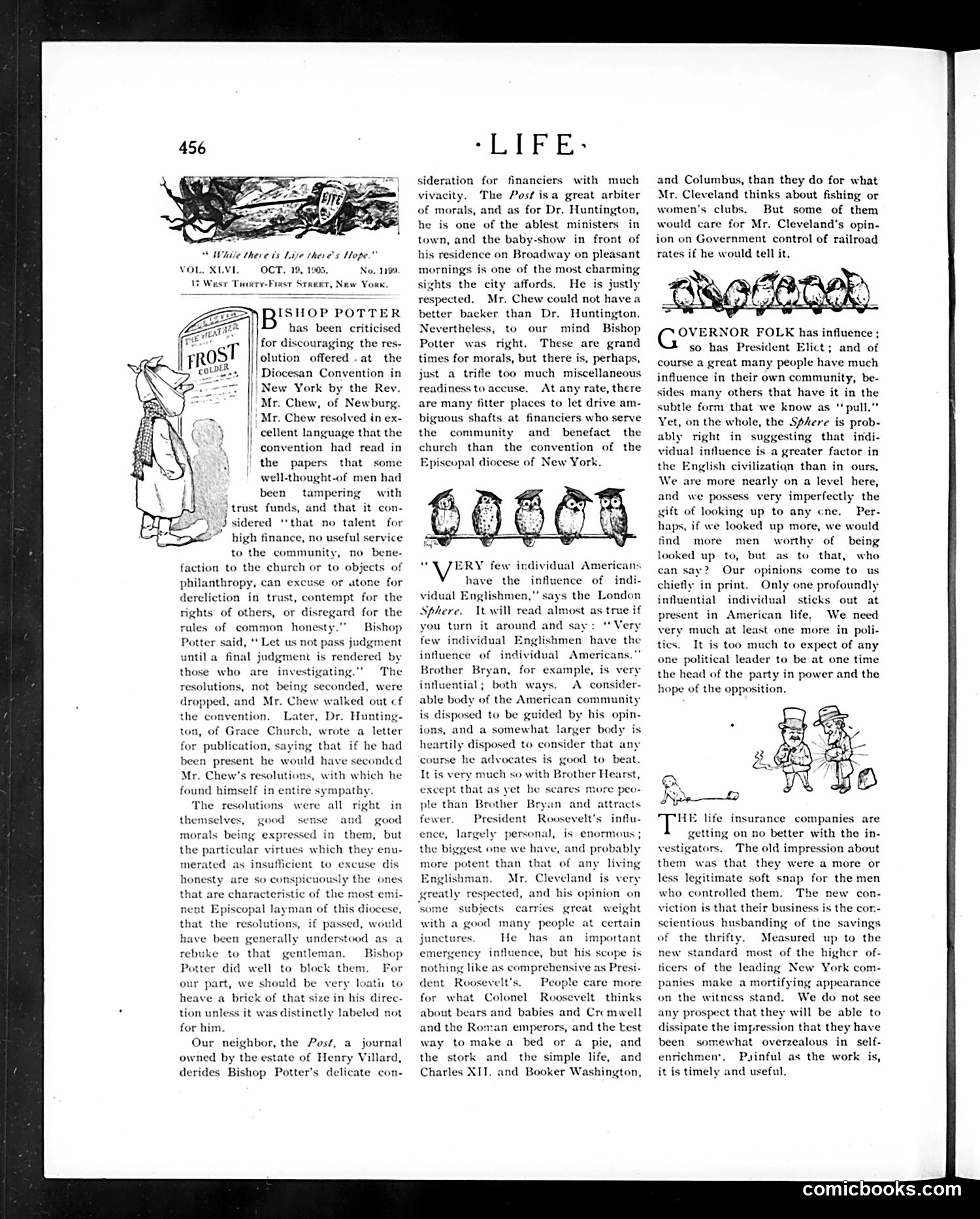
This page features editorial commentary on American political and social influence. The text discusses how individual Americans shape national character—naming President Roosevelt, Colonel Cleveland, and Brother Bryan as examples of influential figures whose personal traits affect public opinion. The visible cartoons include illustrations of owls (appearing to represent wisdom or observation) and figures engaged in everyday activities, likely supporting the editorial's points about ordinary American life and values. A "Frost" advertisement occupies the left margin, unrelated to the main content. The overall theme contrasts American individualism with English deference to authority, arguing that Americans should respect leaders based on merit rather than position. The text suggests life insurance companies are gaining legitimacy as they become more transparent about their operations.
📄 Transcribed text from this page (OCR, searchable)
Machine-transcribed from the original scan — historical spelling and the odd misread are preserved.
ISHOP POTTER has been criticised for discouraging the res- olution offered .at the Diocesan Convention in New York by the Rev. Mr. Chew, of Newburg. Mr. Chew resolved in ex- cellent language that the convention had read in the papers that some well-thought-of men had been tampering with ; trust funds, and t it con- \. J sidered “that no talent fe o> high finance, no useful service to the community, no ben faction to the church or to objects of philanthropy, can excuse or atone for dereliction in trust, contempt for the rights of others, or disregard for the rules of common honest Bishop Potter said, ‘* Let us not pass judgment until a final judgment is rendered by those who are investigating."’" Th resolutions, not being seconded, were dropped, and Mr. Chew walked out cf the convention. Later, Dr. Hunting- ton, of Grace Church, wrote a letter for publication, saying that if he had been present he would have seconded Mr. Chew's resolutions, with which he found himself in entire sympathy all right in and good morals being expressed in them, but cular virtues which they enu- ‘das insufficient to excuse dis The resolutions themselves, ec were honesty are so conspicuously the ones that are characteristic of the most emi- nent Episcopal layman of this dioces that the resolutions, if passed, would have been generally understood as a rebuke to that gentleman. Bishop Potter did well to block them, For our part, we should be very loati: to heave a brick of that size in his direc- tion unless it was distinctly labeled not for him, Our neighbor, the Post, a journal owned by the estate of Henry Villard, derides Bishop Potter's delicate con- ‘LP sideration for financiers with much vivacity. The Post isa great arbiter of morals, and as for Dr. Huntington, he is one of the ablest ministers in town, and the baby-show in front of his residence on Broadway on pleasant mornings is one of the most charming sights the city affords, He is justly respected. Mr. Chew could not havea better backer than Dr. Huntington. Nevertheless, to our mind Bishop Potter was right. These are grand times for morals, but there is, perhaps, just a trifle too much miscellaneov readiness to accuse. At any rate, there are many fitter places to let drive am- biguous shafts at financiers who serve the community and benefact the church than the convention of the Episcopal diocese of New York. i ERY few individual Americans the influence of indi- vidual Englishmen,” says the London Sphere. Wt will read almost as true if you turn it around and “Ve few individual Englishmen have the influence of individual Ameri: Brother Bryan, for example, is very influential; both ways. A consid able body of the American community is disposed to be guided by his opin- ions, and a somewhat larger body heartily disposed to consider the course he advocates is good to beat. It is very much so with Brother Hearst, except that as yet he scares ple than Brother Bryan and President Roosevelt's ore peo: tracts fewer. influ- ence, largely personal, is enormous ; the biggest one we have, and probably more potent than that of any living Englishman. Mr. Cleveland is very ly respected, and his opinion on subjects carries great weight with a good many people at certain junctures, He has an important emergency influence, but his scope is nothing like as comprehensive as Pr dent Roosevelt's. People care more for what Colonel Roosevelt thinks about bears and babies and Cr mwell and the Roman emperors, and the test way to make a bed or a pie, and the stork and the simple life, and Charles XII. and Booker Washington, and Columbus, than they do for what Mr. Cleveland thinks about fishing or women’s clubs. But some of them would care for Mr. Cleveland's opin- ion on Government control of railroad OVERNOR FOLK has influence ; so has President Elict; and of course a great many people have much influence in their own community, be- sides many others that have it in the subtle form that we know as ‘pull.’* Yet, on the whole, the Sphere is prob- ably right in suggesting that ind vidual influence is a greater factor in the English civilizatian than in ow We are more nearly on a level here, and we possess very imperfectly the gift of looking up to any one. Per- haps, if we looked up more, we would find more men worthy of being looked up to, but as to that, who can say? Our opinions come to us chiefly in print. Only one profoundly influential individual sticks out at present in American life. We need very much at least one more in poli- It is too much to expect of any one political leader to be at one time the head of the party in power and the hope of the opposition. tics. HE life insurance companies are getting on no better with the in- igators. The old impression about them was that they were a more or less legitimate soft snap for the men who controlled them. The new con- viction is that their business is the con- scientious husbanding of the savings of the thrifty. Measured up to the new standard most of the highcr of- ticers of the leading New York com- ies make a mortifying appearance on the witness stand. We do not see any prospect that they will be able to dissipate the impression that they have been somewhat overzealous in self- enrichmen’. Pyinful as the work is, it is timely and useful, comicbooks.com