
Life, 1905-10-19 · page 11 of 30
Life — October 19, 1905 — page 11: what you’re looking at
What you’re looking at
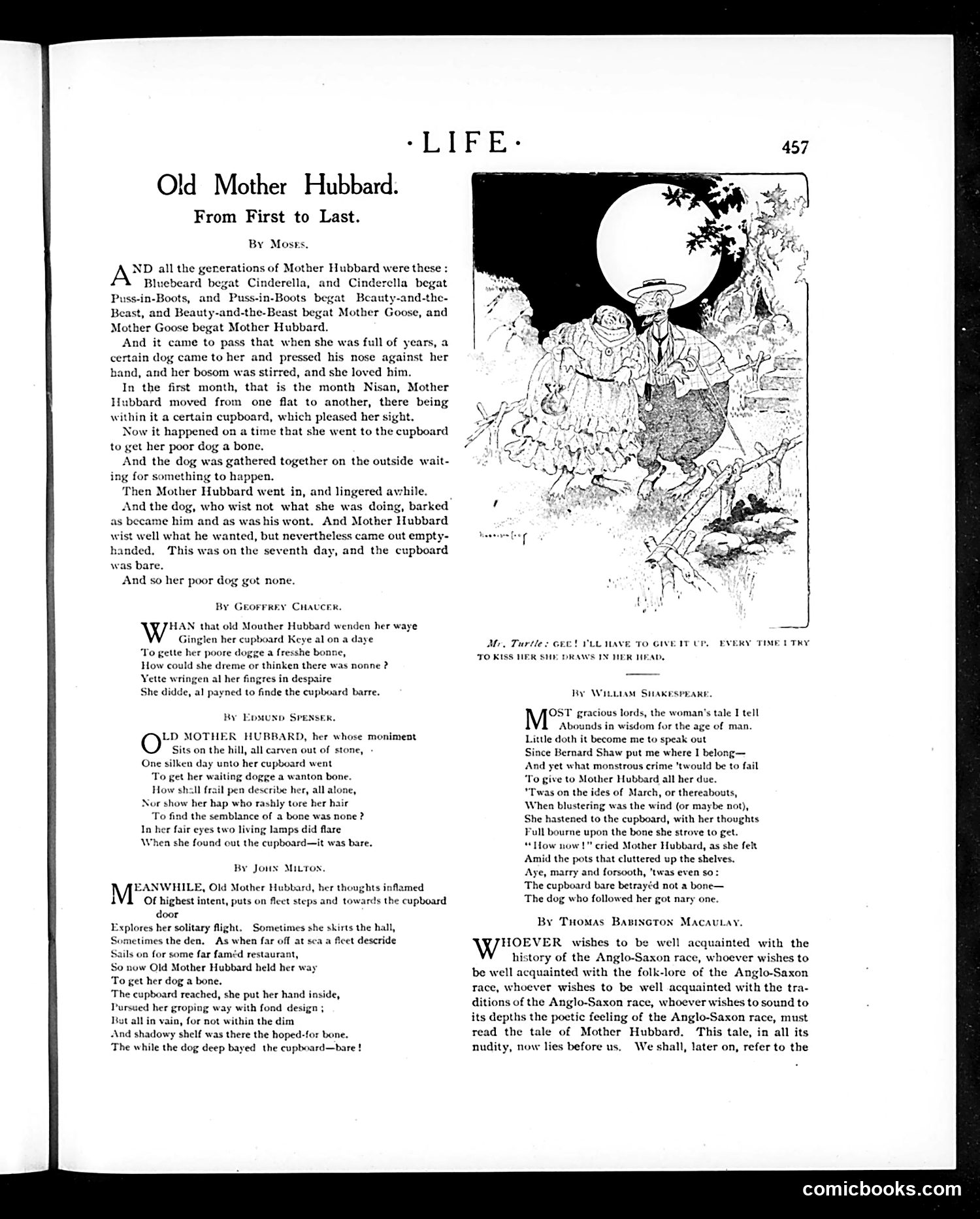
This page presents multiple literary interpretations of the nursery rhyme "Old Mother Hubbard," presented as satirical poetry by various authors including Moses, Geoffrey Chaucer, Edmund Spenser, John Milton, and William Shakespeare (clearly tongue-in-cheek attributions). The accompanying illustration shows Mother Hubbard at her cupboard with a dog, directly referencing the nursery rhyme's familiar plot: she went to the cupboard to get the poor dog a bone, but the cupboard was bare. Rather than mocking specific political figures, this page satirizes literary pretension by having famous historical poets grandly rewrite a simple children's verse in their distinctive styles—a humorous commentary on how serious literature often overwrites simple truths with elaborate language.
📄 Transcribed text from this page (OCR, searchable)
Machine-transcribed from the original scan — historical spelling and the odd misread are preserved.
*LIPE Old Mother Hubbard: From First to Last. By Moses. ND all the generations of Mother Hubbard were these : Bluebeard t it Cinderella, and Cinderella begat Puss-in-Boots, and Puss-in-Boots begat Bcauty-and-the- Beast, and Beauty-and-the-Beast begat Mother Goose, and Mother Goose begat Mother Hubbard. And it came to pass that when she was full of years, a certain dog came to her and pressed his nose against her band, and her bosom was stirred, and she loved him. In the first month, that is the month Nisan, Mother Hubbard moved from one flat to another, there being within it a certain cupboard, which pleased her sight. Now it happened on a time that she went to the cupboard to get her poor dog a bone. And the dog was gathered together on the outside wait- ing for something to happen. Then Mother Hubbard went in, and lingered awhile. And the dog, who wist not what she was doing, barked as became him and as was his wont. And Mother Hubbard wist well what he wanted, but nevertheless came out empty- handed, This was on the seventh y, and the cupboard was bare. And so her poor dog got none. By Georrrry Cnaucer. that old Mouther Hubbard wenden her waye len her cupboard Keye al on a daye To gette her poore dogge a fresshe bonne, How could she dreme or thinken there was nonne ? nal her fingres in despaire She didde, al payned to finde the cupboard barre. By Epauxp SPENSER. LD MOTHER HUBBARD, her whose moniment Sits on the hill, all carven out of stone, One silken day unto her cupboard went To get her waiting dogge a wanton bone. How shall frail pen describe her, all alone, Nor show her hap who rashly tore her hair To find the semblance of a bone was none ? In her fair eyes two living lamps did flare When she found out the cupboard—it was bare. By Joux Micros. EANWHILE, Old Mother Hubbard, her thoughts inflamed IVI of highest intent, puts on ficct steps and towards the cupboard door Explores her solitary flight. Sometimes she skirts the hall, netimes the den, As when far off at sca a ficet descride Sails on for some far faméd restaurant, So now Old Mother Hubbard held her way ‘To get her dog a bone, ‘The cupboard reached, she put her hand inside, Pursued her groping way with fond design ; But all in vain, for not within the dim -\nd shadowy shelf was there the hoped-for bone. ‘The while the dog deep bayed the cupboard—bare ! Mr, Turtle: GECE VLE MAVE To GIVE TT UP, EVERY TIME ETRY TO KISS HER SHE DRAWS IN HER HEAD. By WILLIAM SHAKESPEARE. OST gracious lords, the woman's tale I tell Abounds in wisdom for the age of man. Little doth it become me to speak out Since Bernard Shaw put me where I belong— And yet what monstrous crime "twould be to fail ‘To give to Mother Hubbard all her due. ‘Twas on the ides of March, or thereabouts, When blustering was the wind (or maybe not), She hastened to the cupboard, with her thoughts Full bourne upon the bone she strove to get. “How now!" cried Mother Hubbard, as she felt Amid the pots that cluttered up the shelves. Aye, marry and forsooth, "twas even so: The cupboard bare betrayéd not a bone— The dog who followed her got nary one. By Tuomas Banincton Macautay. HOEVER wishes to be well acquainted with the history of the Anglo-Saxon race, whoever wishes to be well acquainted with the folk-lore of the Anglo-Saxon race, whoever wishes to be well acquainted with the tra- ditions of the Anglo-Saxon race, whoever wishes to sound to its depths the poetic feeling of the Anglo-Saxon race, must read the tale of Mother Hubbard. This tale, in all its nudity, now lies before us. We shall, later on, refer to the comicbooks.com