
A complete issue · 44 pages · 1905
Life — August 3, 1905
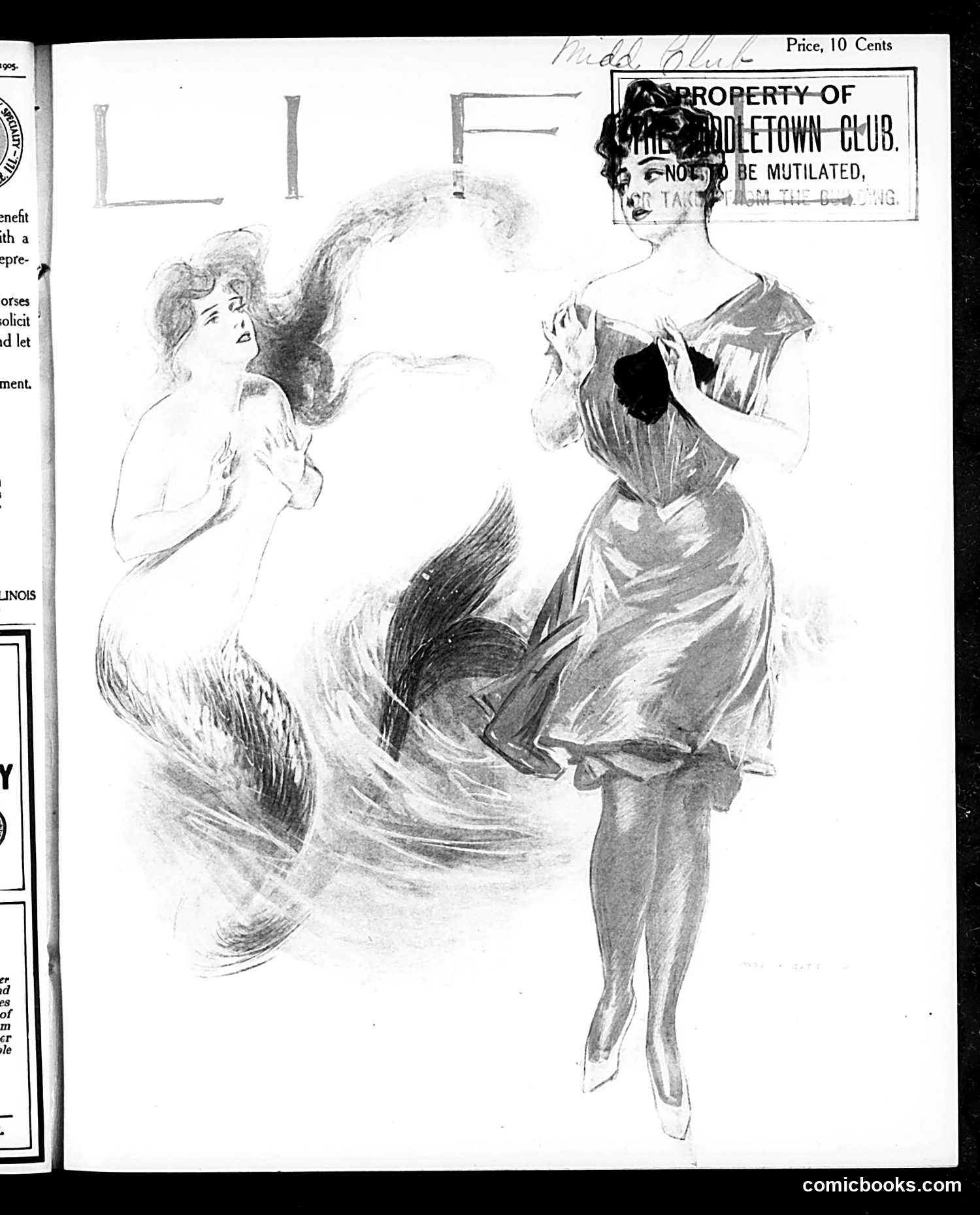
This appears to be a satirical illustration from an early 20th-century *Life* magazine issue (price 10 cents). The cartoon depicts two women in contrasting poses and states of dress—one ethereal and loosely draped, the other more formally/conservatively dressed. The illustration likely satirizes changing attitudes toward women's fashion, propriety, or social roles during this era. The stylistic contrast between the flowing, dreamlike figure on the left and the more structured figure on the right may critique evolving standards of female respectability or the tension between Victorian conservatism and modern sensibilities. The "Middletown Club" property stamp suggests institutional context, though the specific satirical target remains unclear without additional page context or caption text.
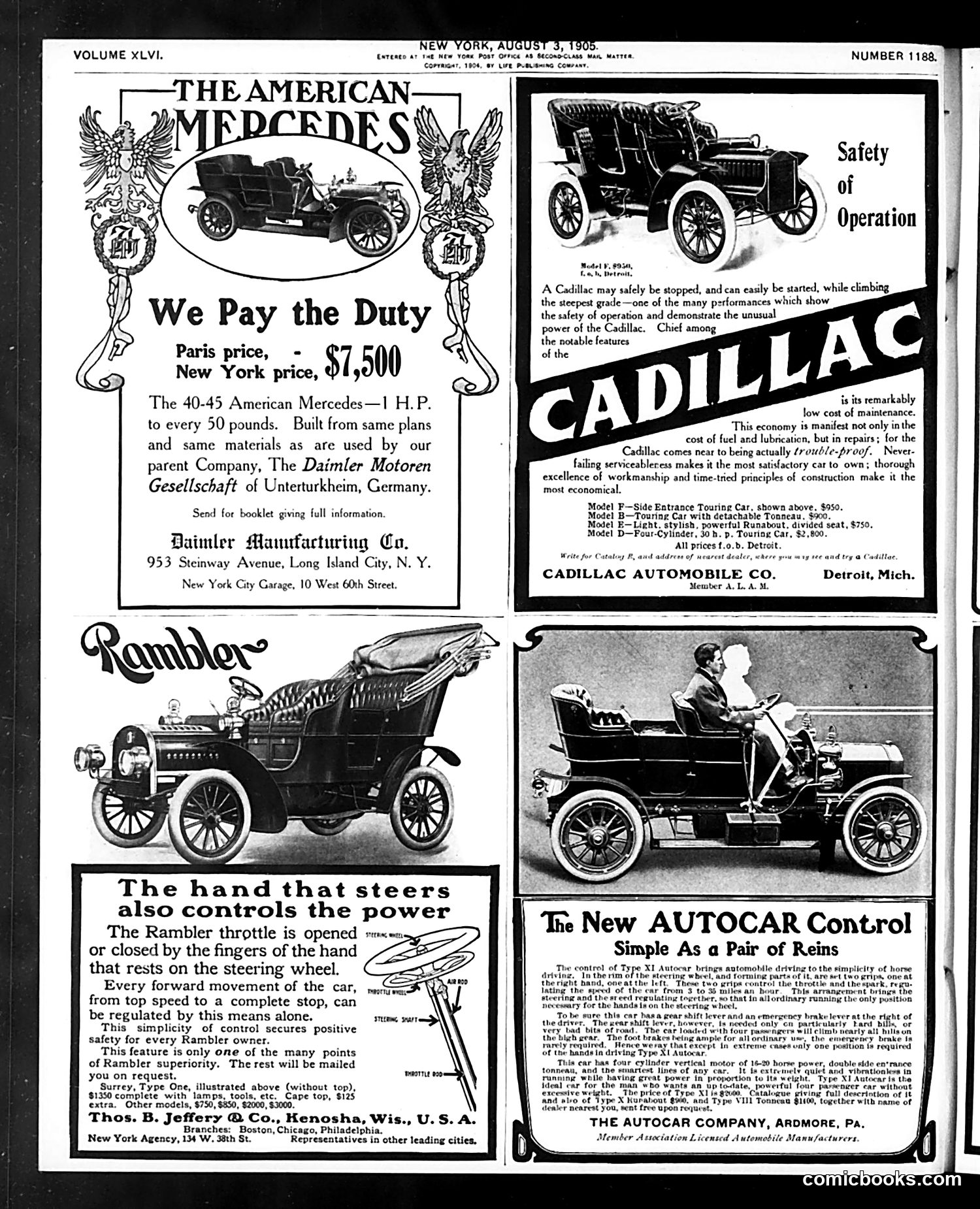
This page contains **four automobile advertisements**, not political cartoons. The ads showcase early 1900s vehicles: 1. **American Mercedes** - emphasizes European engineering (built from Daimler plans in Germany), priced at $7,500 2. **Cadillac** - highlights "safety of operation" and low maintenance costs 3. **Rambler** - features innovative throttle control integrated into the steering wheel 4. **Autocar** - advertises simple "pair of reins" steering control system The ads reflect the nascent automobile industry's competitive positioning. Rather than satire, they demonstrate how manufacturers marketed technical innovations to wealthy early adopters. The emphasis on safety, control simplicity, and reliability suggests consumer concerns about these relatively new, unreliable machines. Prices ($2,800–$7,500) indicate these were luxury items for the wealthy.
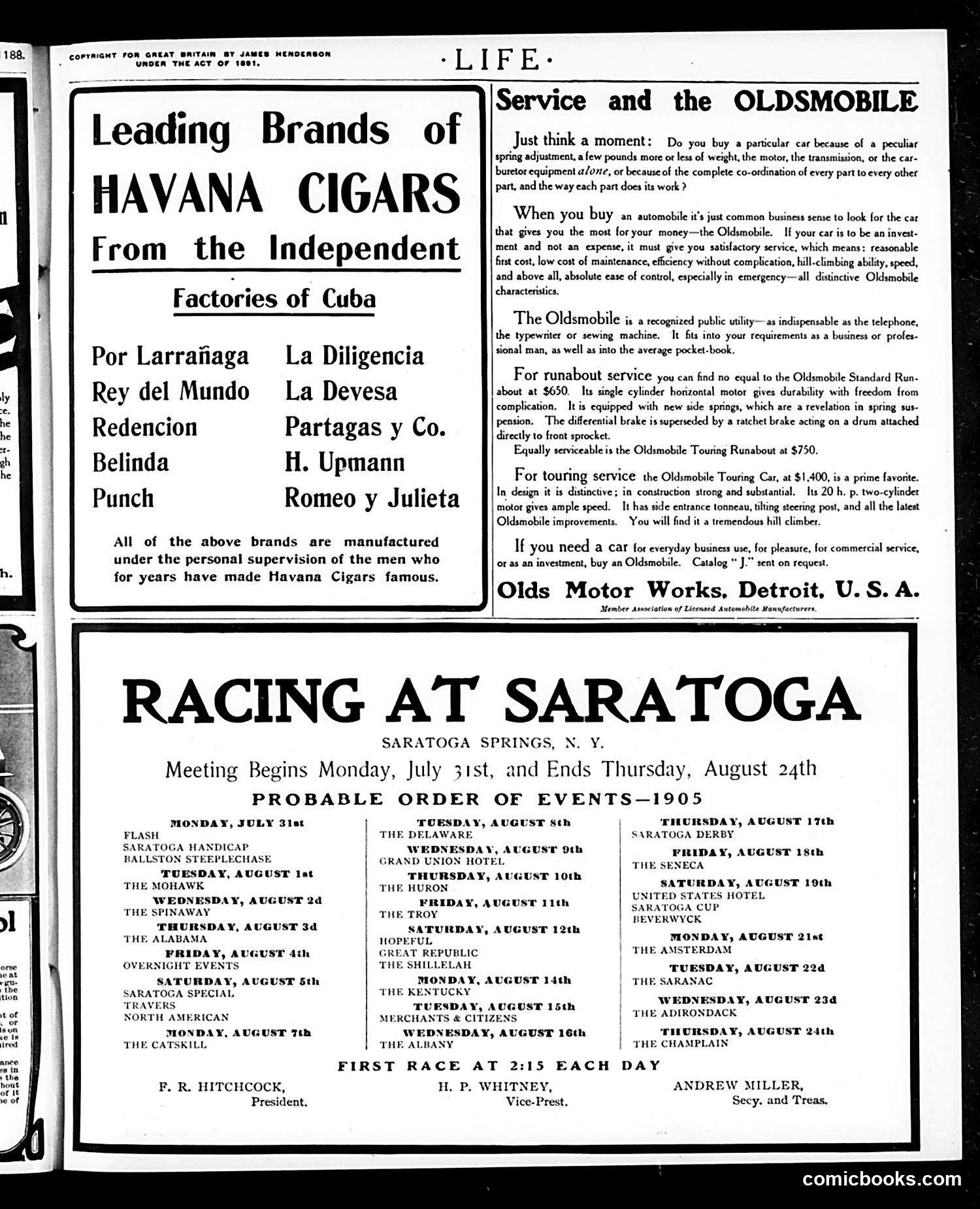
This page contains primarily **advertisements rather than editorial cartoons or satire**. The top half features two ads: one for Havana cigars from Cuban factories, and another for Oldsmobile automobiles, emphasizing reliability and service options. The bottom half advertises **horse racing at Saratoga Springs, New York** for summer 1905, listing race names and dates. Notable races include the "Saratoga Handicap," "Grand Union Hotel," and "Saratoga Derby." The page reflects **early 1900s consumer culture**, showcasing luxury goods (cigars, automobiles) and leisure activities popular among affluent Americans. No political cartoons or satirical commentary is present—this is a straightforward commercial advertisement layout typical of Life's revenue model during this era.
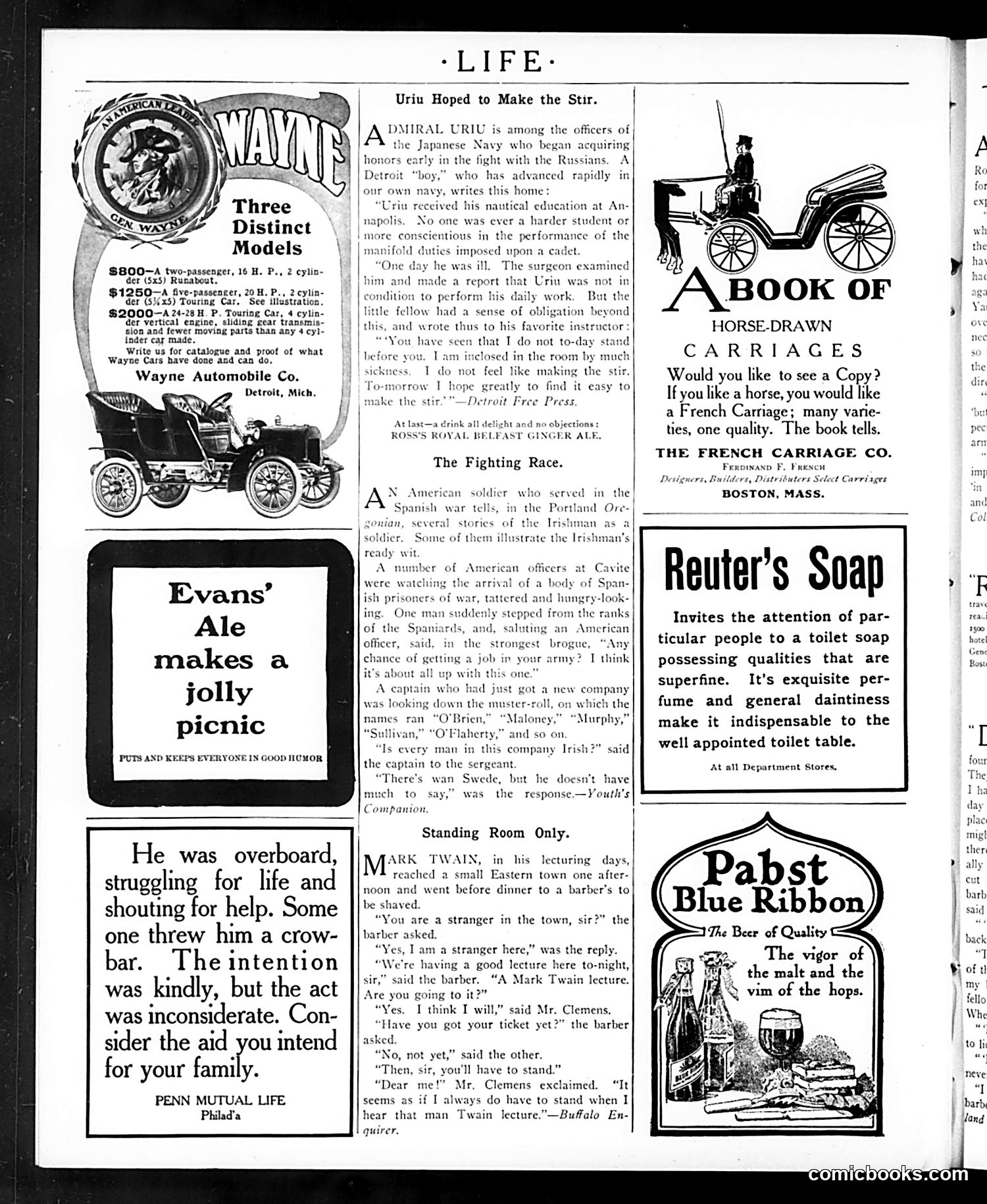
This Life magazine page is primarily **advertising and light humor** rather than political satire. The content includes: - **Wayne Automobile advertisement** promoting three car models with prices ($800-$2000) - **Evans' Ale ad** with a pun about "jolly picnic" - **Penn Mutual Life Insurance** with an anecdote about rescue aid gone wrong—satirizing unintended consequences of well-meaning actions - **Reuter's Soap, Pabst Blue Ribbon beer, and French Carriage Company** advertisements - Two brief humorous pieces: "Uriu Hoped to Make the Stir" (about a Japanese naval officer) and "The Fighting Race" (anecdotes from an American soldier about the Spanish-American War) The page reflects early 1900s consumer culture and American military interests, but contains no significant political commentary or caricature work.
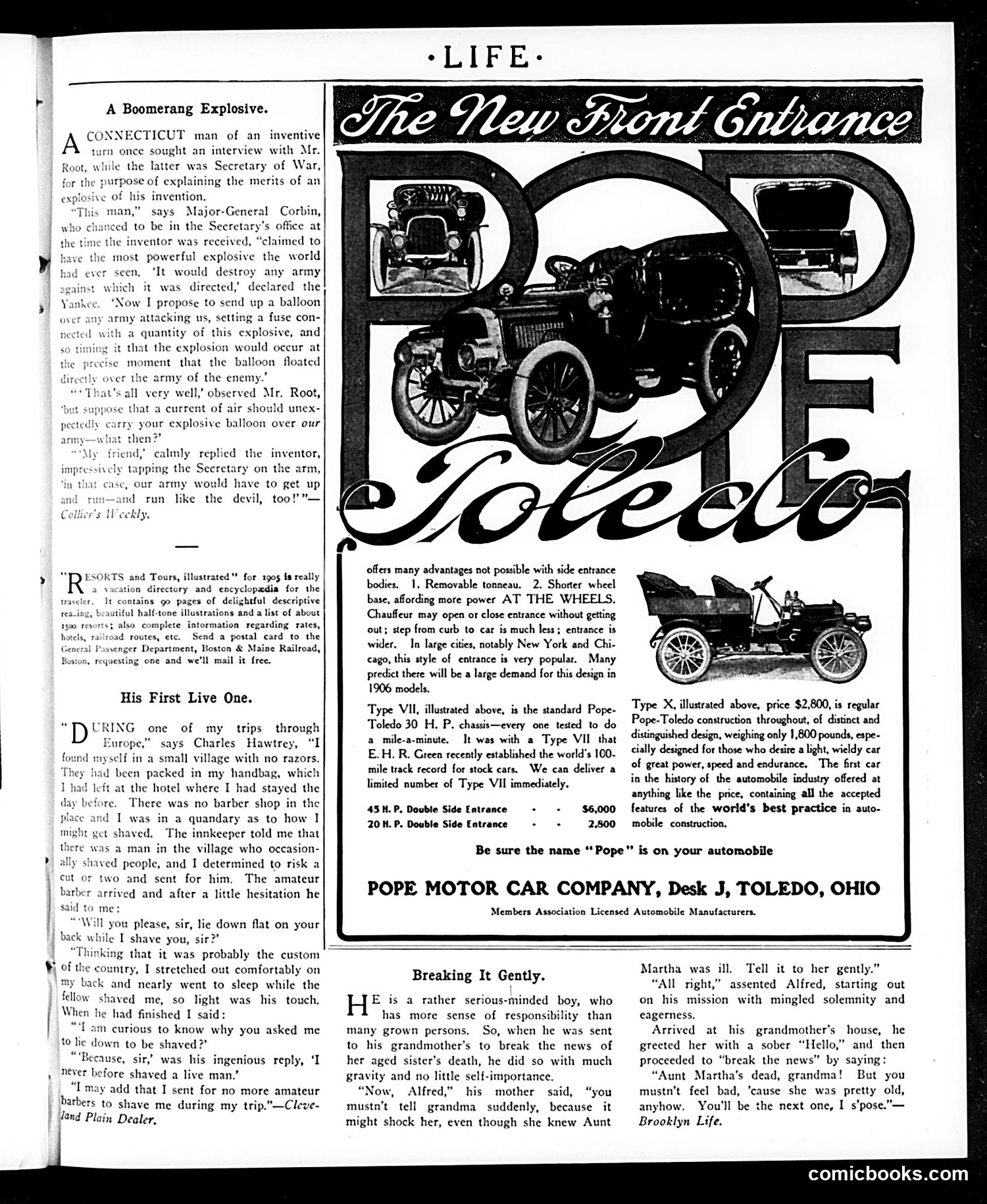
This page is **primarily advertising**, not political satire. The dominant content is a large advertisement for Pope Motor Cars, featuring their new "front entrance" design for automobile bodies. The ad highlights technical innovations: removable tonneau, shorter wheelbase, and entrance design that didn't require stepping over the car's side. Two models are promoted—Type VII and Type X—with prices and specifications. The tagline urges buyers to "Be sure the name 'Pope' is on your automobile." The left column contains unrelated short stories ("A Boomerang Explosive," "His First Live One," "Breaking It Gently") typical of Life's humor content, but these are fiction rather than commentary. There is **no political cartoon or satire** visible on this page. It's a straightforward automotive advertisement from the early 1900s.
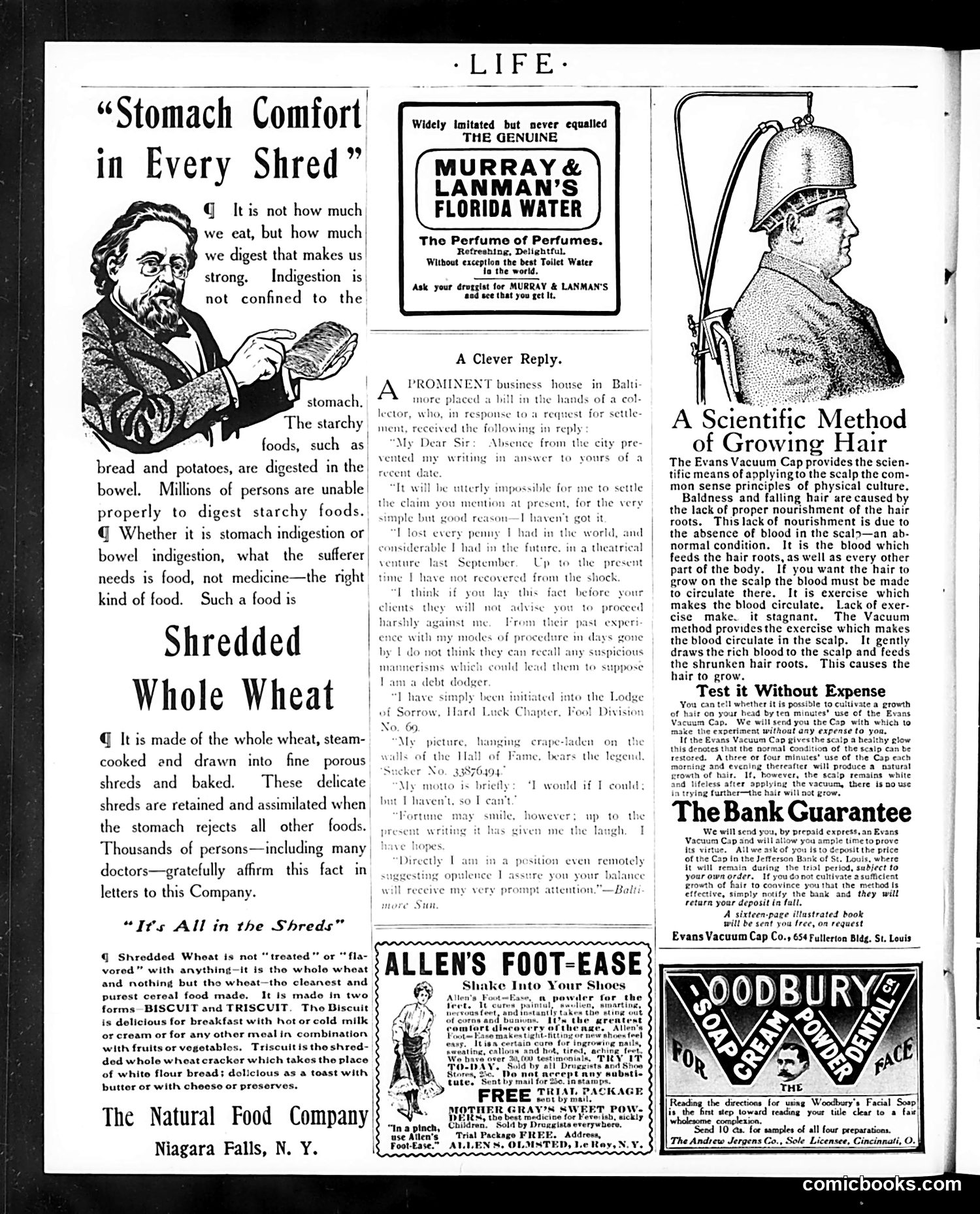
This page is primarily **advertising** rather than political satire. The main content includes: 1. **"Stomach Comfort in Every Shred"** - An advertisement for Shredded Wheat cereal, featuring a bearded man holding a box. The ad claims digestive benefits, positioning the product as a health food for those unable to digest starchy foods properly. 2. **"A Scientific Method of Growing Hair"** - Advertisement for the Evans Vacuum Cap, promising hair growth through increased scalp blood circulation via exercise principles. 3. Additional ads for **Murray & Lanman's Florida Water** (perfume), **Allen's Foot-Ease** (powder), and **Woodbury's Facial Soap**. The page reflects early 20th-century patent medicine and health product marketing, emphasizing pseudoscientific health claims typical of the era. There is no apparent political cartoon or satire present.
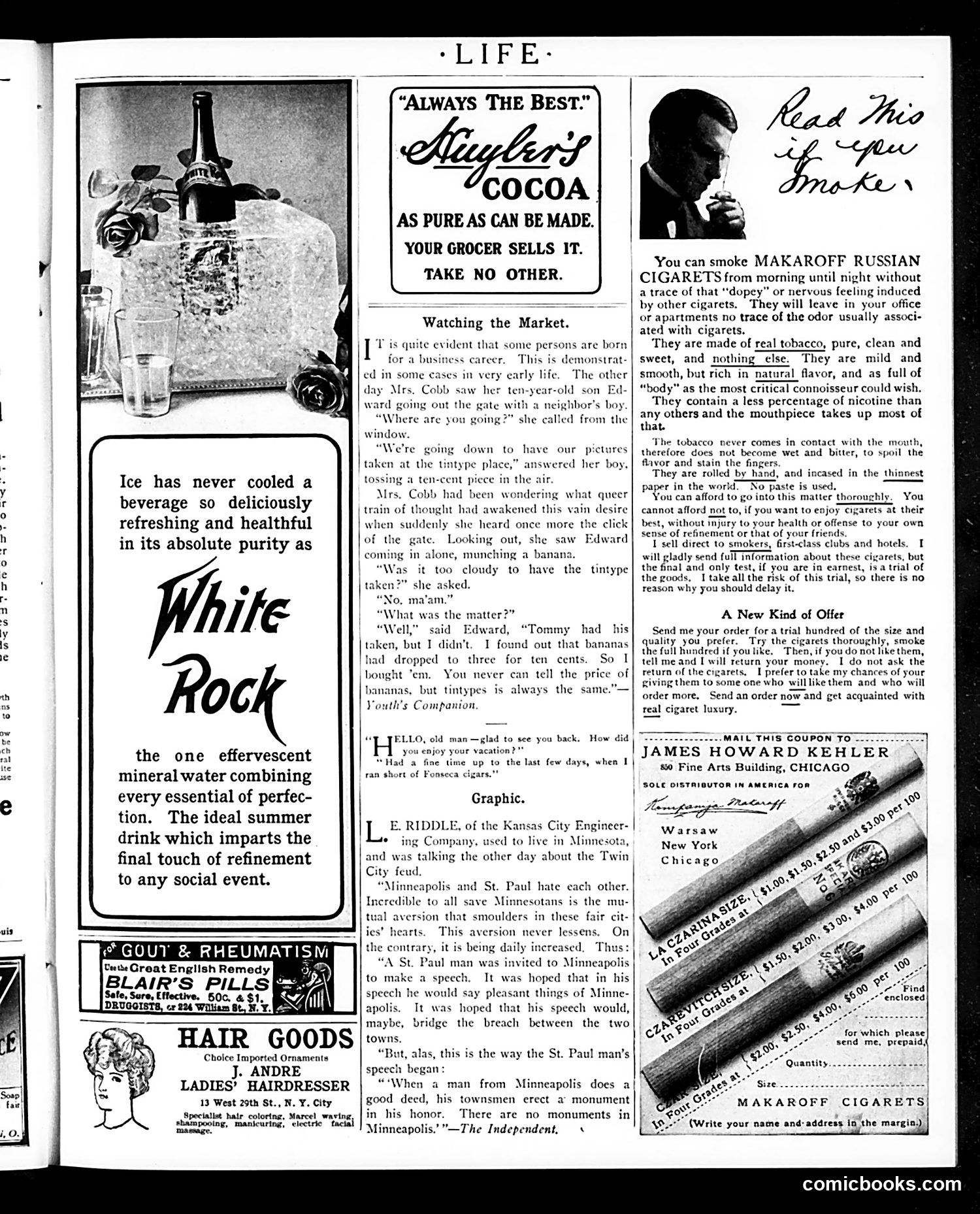
This page is primarily **advertising and commercial content** rather than political satire. The main elements are: 1. **White Rock mineral water ad** - emphasizes "absolute purity," a key selling point for beverages in this era when water safety was a genuine concern. 2. **Stuyler's Cocoa ad** - standard product endorsement. 3. **Makaroff Russian Cigarettes ad** - appeals to smokers by claiming the tobacco doesn't contact the mouth, reducing "dopey" feelings and odor. 4. **"Watching the Market"** - a brief humorous domestic anecdote about a boy trading bananas, unrelated to financial markets despite the title. 5. **Various other ads** for hair goods, gout pills, and mail-order cigars. The page reflects early 20th-century consumer culture and health anxieties rather than political commentary.
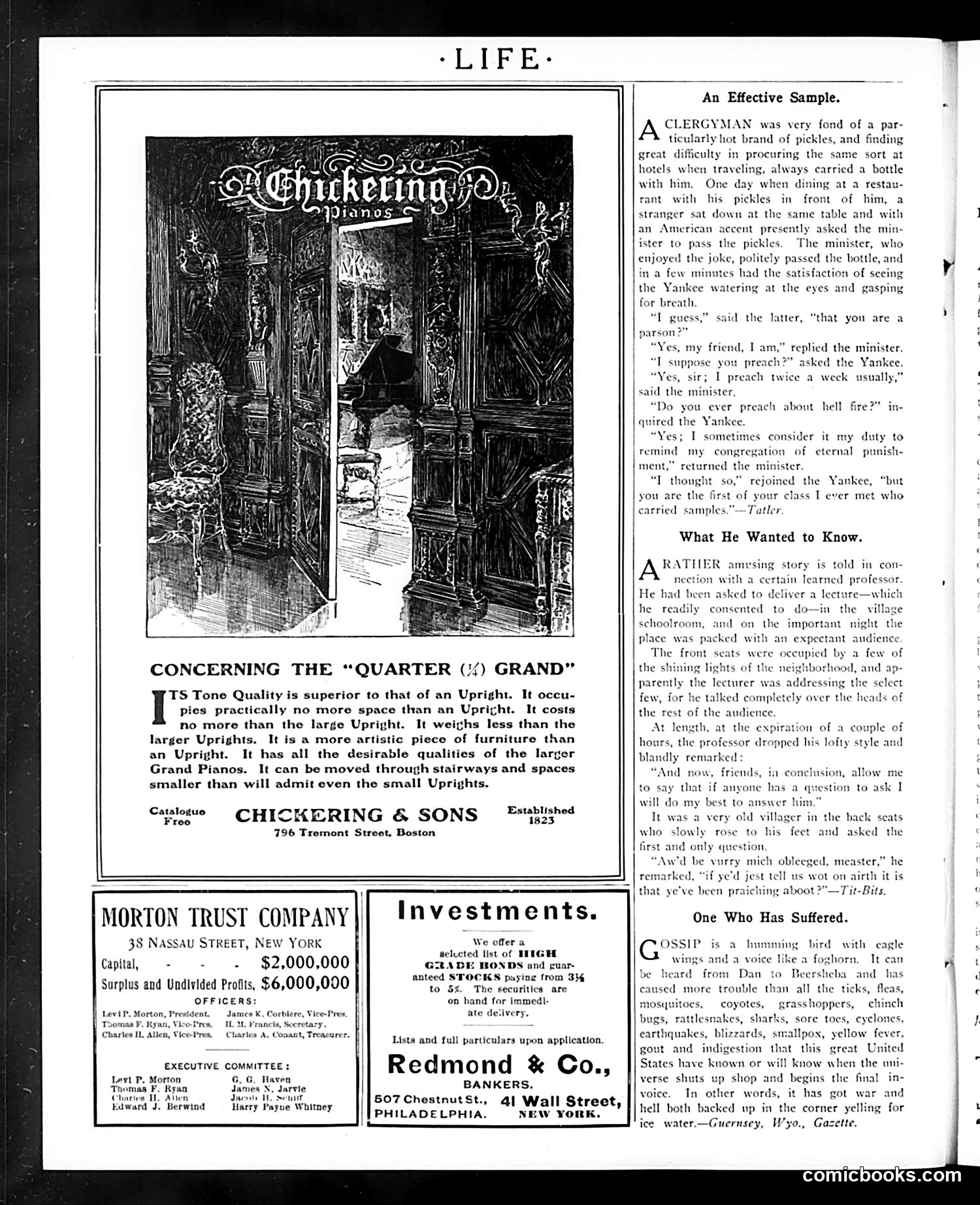
This page is primarily **advertising and humor columns**, not political cartoons. The main illustration titled "Chickering & Sons" shows an ornate Victorian piano showroom interior—this is a furniture advertisement, not satire. The three humor pieces are anecdotal stories: 1. **"An Effective Sample"**: A clergyman's joke about pickles—a minister traveling with a bottle of pickles is mistaken for a parson by a Yankee, leading to a pun about "hell fire" preaching. 2. **"What He Wanted to Know"**: A village schoolmaster's lecture is interrupted by an old man asking one blunt question. 3. **"One Who Has Suffered"**: Defines "gossip" as a destructive bird. These are light social humor pieces typical of Life magazine's content—gentle satire of manners, regional American types (the "Yankee"), and human foibles. No specific political figures or events are referenced.
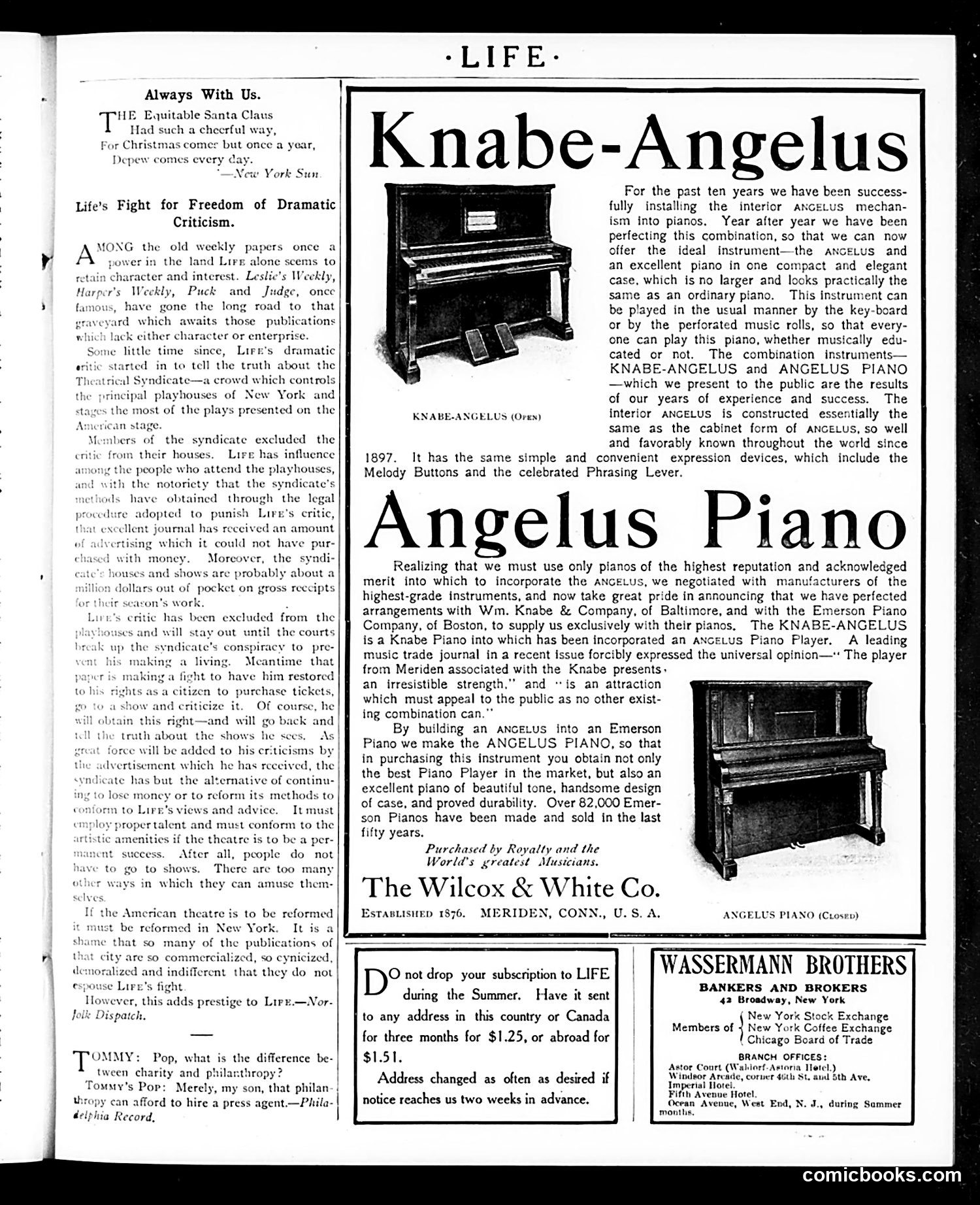
This page is primarily **advertising and editorial content** rather than political satire or cartoons. The main feature is a large advertisement for **Knabe-Angelus pianos**, manufactured by The Wilcox & White Co. of Meriden, Connecticut. The ad emphasizes the piano's quality, durability (over 82,000 sold in fifty years), and its appeal to both professional musicians and amateur players. The left column contains brief editorial pieces, including commentary on dramatic criticism in theater and a charitable debate between "Tommy" and "Tommy's Pop" about the difference between charity and philanthropy. There is also a subscription notice encouraging readers not to drop their Life subscriptions during summer. This is a typical early-20th-century magazine page mixing advertisements with light editorial content.
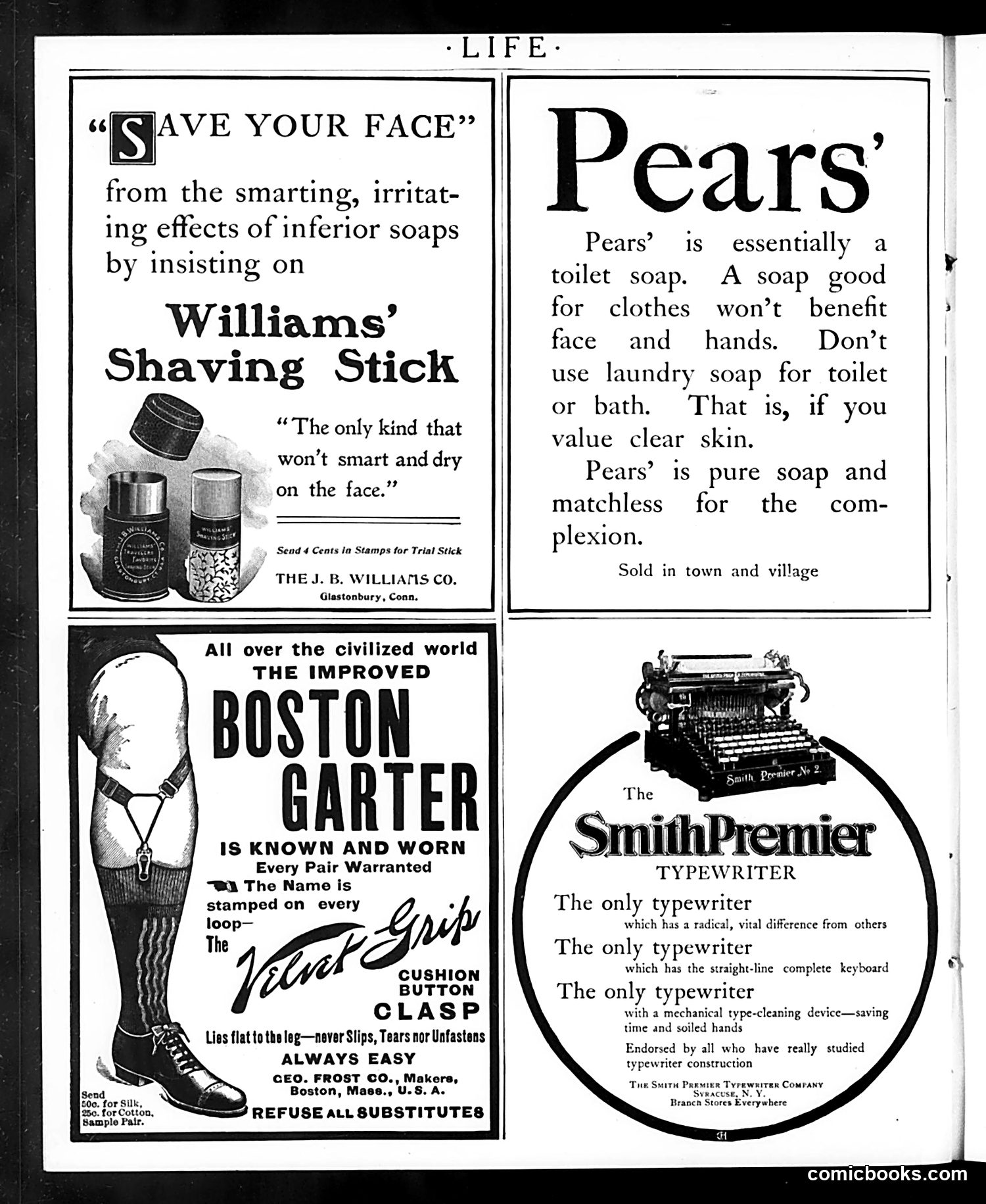
This page is **primarily advertising**, not satire or political commentary. It contains four product advertisements from what appears to be an early 20th-century publication: 1. **Williams' Shaving Stick** — promises to avoid skin irritation ("won't smart and dry on the face") 2. **Pears' Soap** — emphasizes it's a toilet/facial soap, not laundry soap, for clear skin 3. **Boston Garter** — hosiery with a "Velvet Grip" clasp that "lies flat to the leg—never Slips, Tears nor Unfastens" 4. **Smith-Premier Typewriter** — claims superiority through features like a straight-line keyboard and mechanical type-cleaning device The ads use typical period marketing language (superlatives, product differentiation claims, endorsements). There is no political satire or caricature present—this is straightforward commercial advertising.
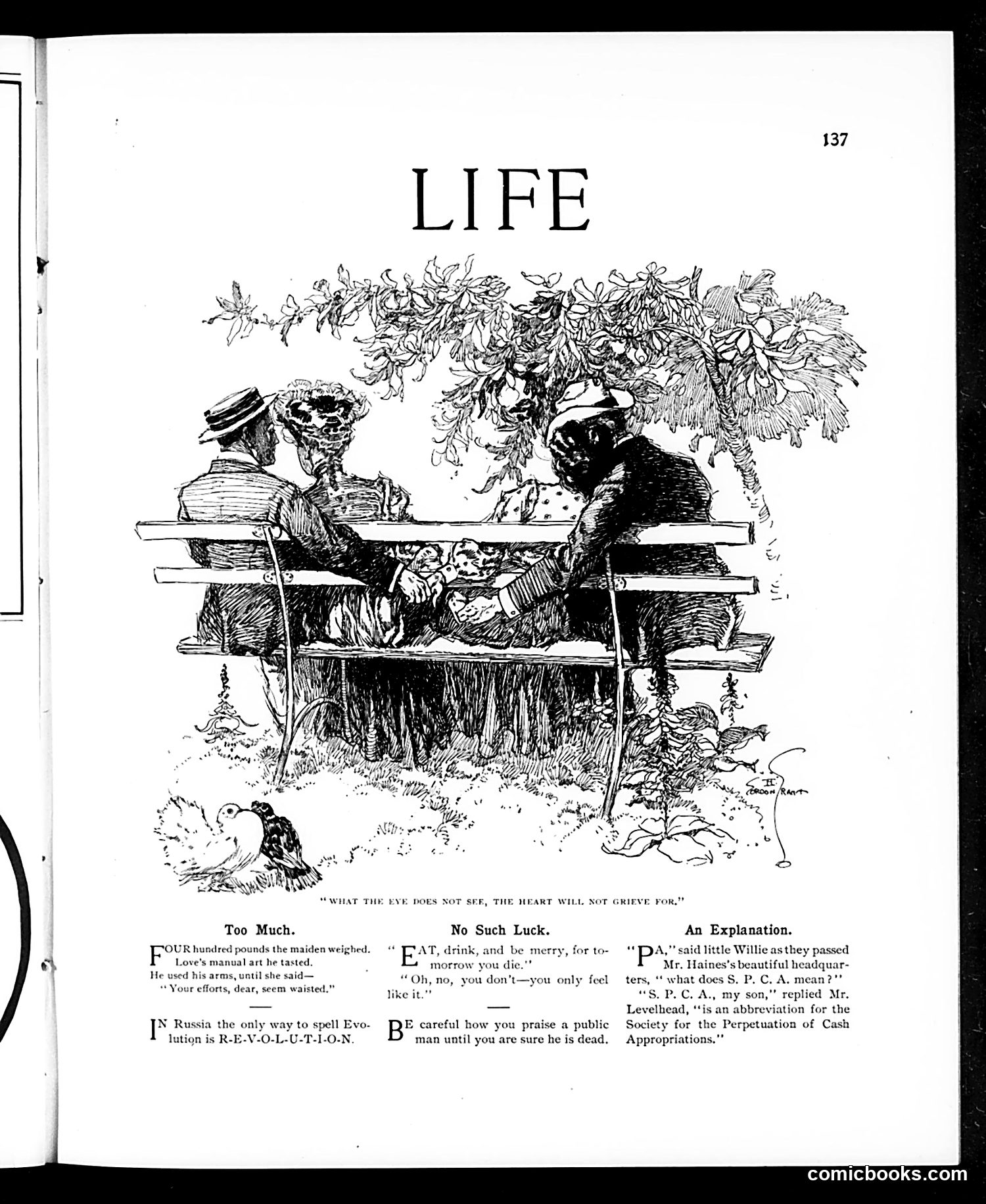
This page from *Life* magazine features a satirical illustration titled "LIFE" showing two well-dressed men and a child sitting on a park bench beneath a tree. The image is accompanied by four brief humorous pieces: **"Too Much"** mocks excessive love's demands. **"No Such Luck"** jokes about feeling miserable despite being told to enjoy oneself. **"An Explanation"** presents a child asking what "P.C.A." means, with an adult explaining it as an abbreviation for "Society for the Perpetuation of Cash Appropriations"—satire on bureaucratic organizations and wasteful government spending. **"In Russia..."** is a quick political jab about Russian spelling. The overall tone is genteel social satire targeting middle-class concerns: emotional excess, social pretense, and institutional waste. The content reflects early 20th-century American satirical humor aimed at educated readers.
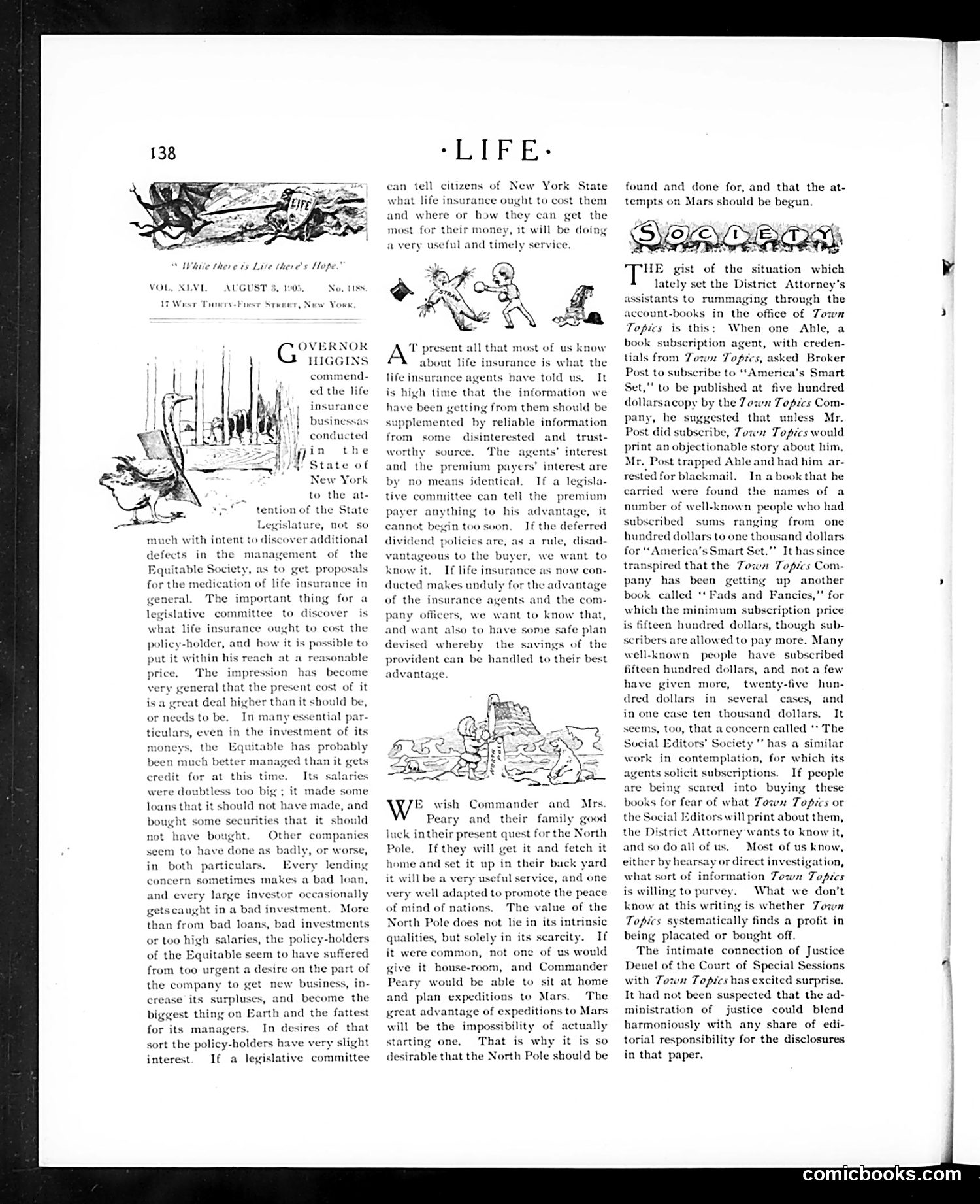
This page contains editorial commentary on life insurance and a satirical piece titled "Society" mocking the *Town Topics* scandal. **Main Cartoon (top left):** "While there is Life there's Hope" shows Governor Higgins commenting on life insurance regulation—urging the state legislature to investigate insurance agents' practices and protect policyholders from fraud. **"Society" Section:** The satire ridicules *Town Topics*, a gossip publication, and a related blackmail scheme. Broker Post supposedly received extortion demands unless he subscribed to *Town Topics* and their book "Fads and Fancies." The piece mocks wealthy subscribers who paid substantial sums, suggesting the publication operated a protection racket, with implications that Justice Deuel's office had discovered the scheme's connection to *Town Topics*.
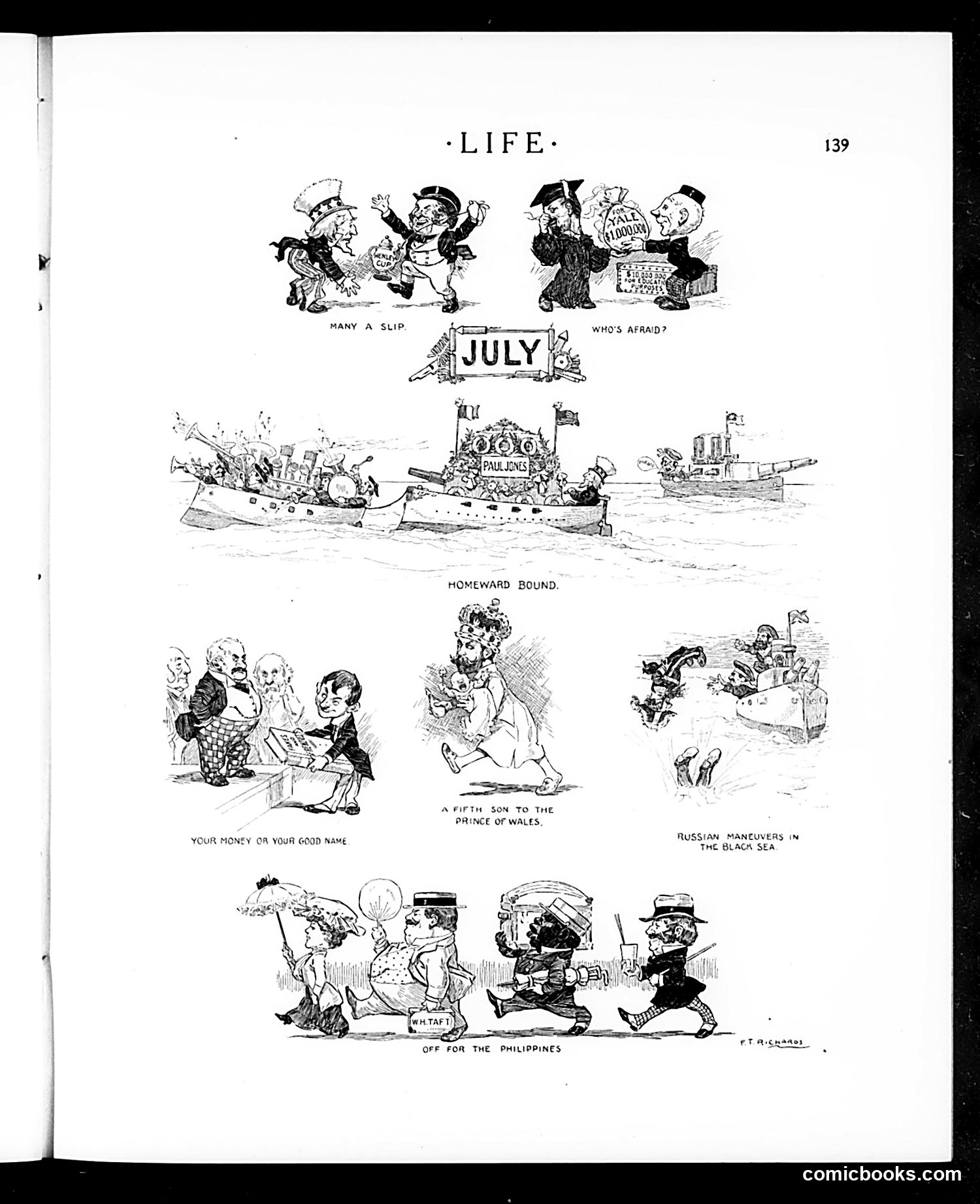
This page collects July-themed satirical cartoons. The top section "Many a Slip" and "Who's Afraid?" appear to mock political or social figures through caricature, though specific identities aren't clearly labeled. The central "Homeward Bound" section depicts contemporary issues: - "Your Money or Your Good Name" satirizes financial corruption or blackmail - "A Fifth Son of the Prince of Wales" references British royalty - "Russian Maneuvers in the Black Sea" reflects Cold War military tensions - "Off for the Philippines" suggests American imperial adventures or military deployment The cartoons use exaggerated physical features typical of early 20th-century satirical illustration. The references to Russia, Britain, and the Philippines indicate this addresses international affairs and American foreign policy concerns of the era.
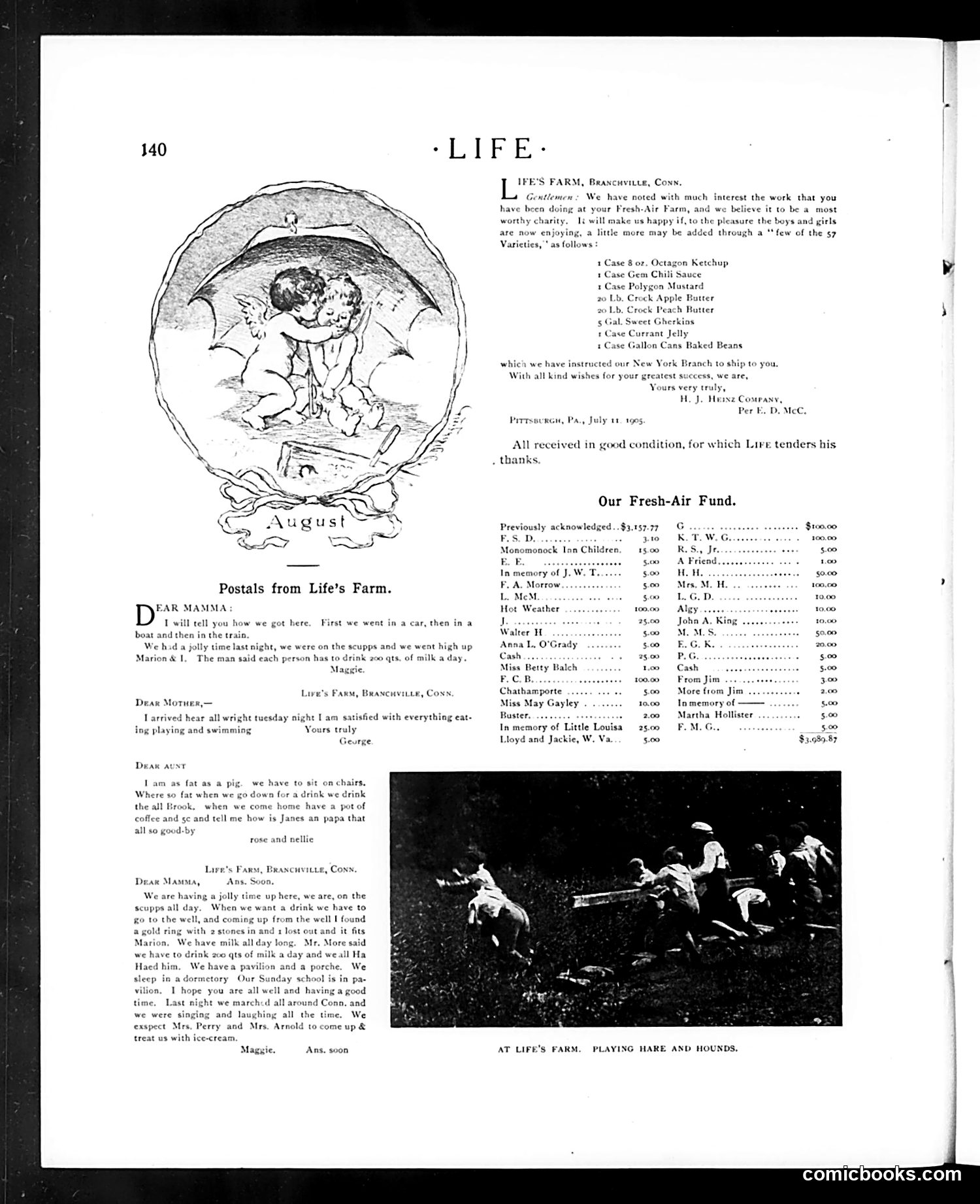
This page documents Life's Fresh-Air Fund, a charitable program providing urban children (likely poor or working-class kids from cities) with summer retreats to rural Connecticut farms. The content is earnest rather than satirical. The decorative header illustration shows cherubs enjoying pastoral pleasures—symbolic of the fund's wholesome mission. The "Postals from Life's Farm" are charming, naive letters from children experiencing farm life for the first time, written in childlike dialect. They describe simple pleasures: drinking milk, playing, swimming, and outdoor activities. The bottom photograph shows children engaged in "hare and hounds" (a chase game), capturing the outdoor recreation the fund enabled. The "Fresh-Air Fund" donations list tracks contributions from readers supporting this Progressive Era charity. The H.J. Heinz Company's substantial donation suggests corporate participation in social welfare initiatives. This represents early 20th-century urban charity work—addressing industrial society's effects by temporarily removing poor city children to healthful rural environments.
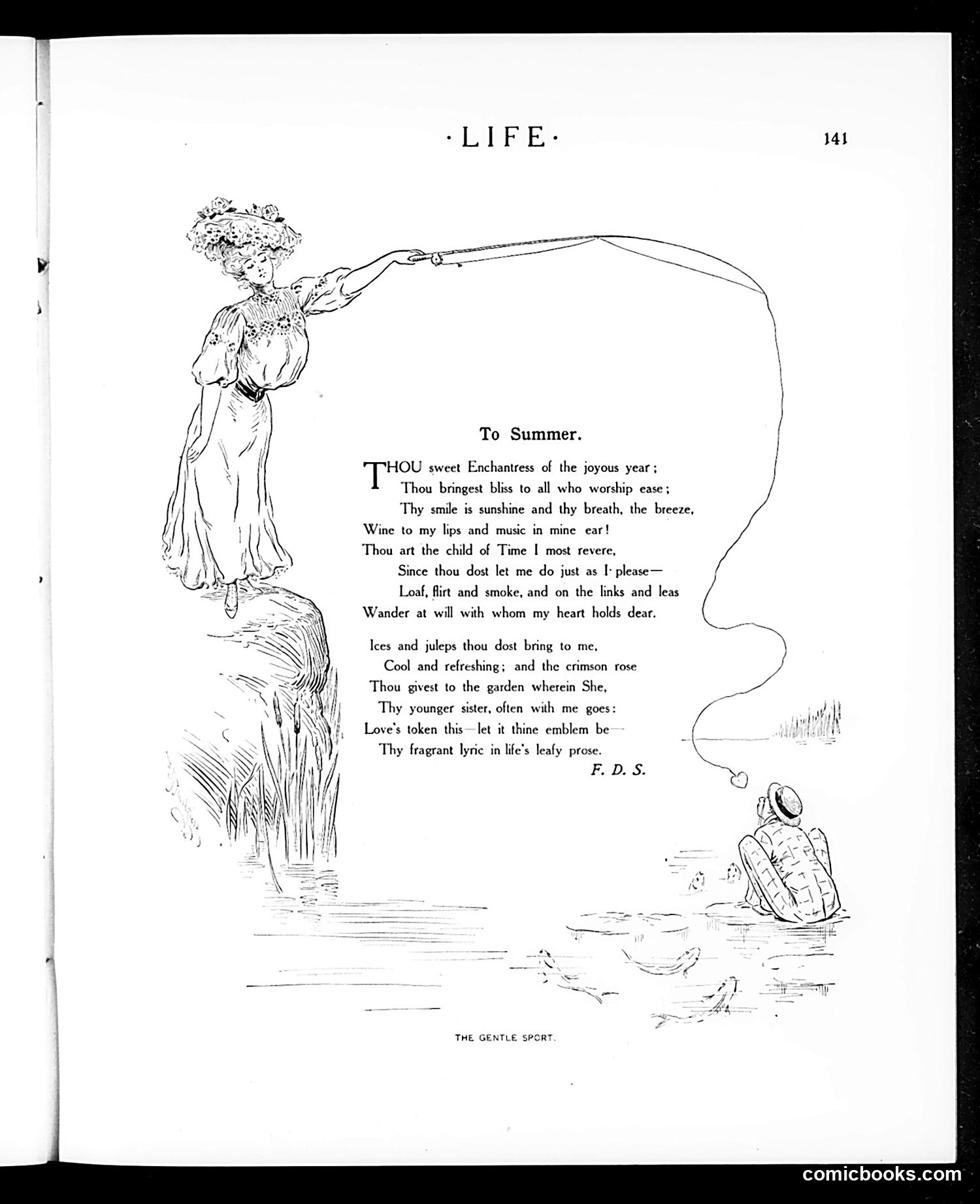
This page presents a romantic poem celebrating summer as a personified woman ("sweet Enchantress"). The accompanying illustrations show an elegantly dressed woman fishing and a man relaxing by water. The poem's humor lies in its tongue-in-cheek tone: the speaker praises summer not for noble reasons, but because it permits idleness—"loaf, flirt and smoke"—and leisurely activities like golfing ("links and leas"). The poem romanticizes summer as freedom from responsibility. The subtitle "The Gentle Sport" refers to fishing, illustrated below. The contrast between the poem's elevated, romantic language and its actual subject (lazy indulgence) is the satire: Life mocks the Victorian tendency to poeticize simple pleasures and idle pastimes as if they were profound spiritual experiences. This reflects early 20th-century American magazine humor—gentle mockery of upper-class leisure culture dressed in flowery language.
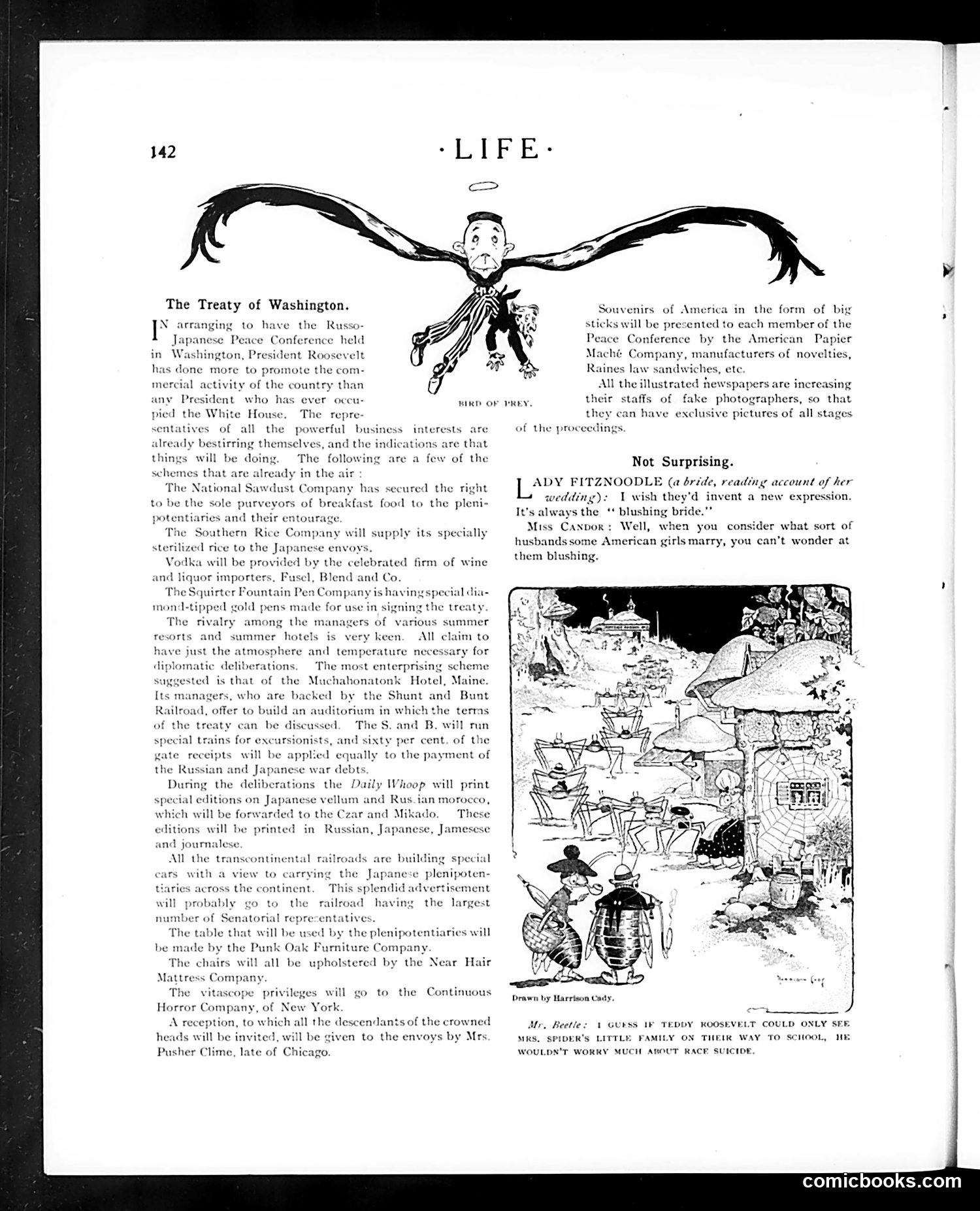
This 1906 Life magazine page satirizes President Theodore Roosevelt's role hosting the Russo-Japanese Peace Conference in Washington. The main cartoon depicts a vulture-like "Bird of Prey" with outstretched wings, representing American commercial interests swooping in to profit from the peace negotiations. The text humorously catalogs schemes by various American companies—sawdust, rice, vodka, pen, and furniture firms—all claiming they'll supply the conference. It mocks how businesses cynically exploit major political events for profit and publicity. The secondary humor about "race suicide" references Roosevelt's famous concerns about declining American birth rates among the educated classes, contrasting anxieties about population with the sight of immigrant children heading to school. The "blushing bride" joke is simply period comic filler mocking marriage conventions—unrelated to the main political content.
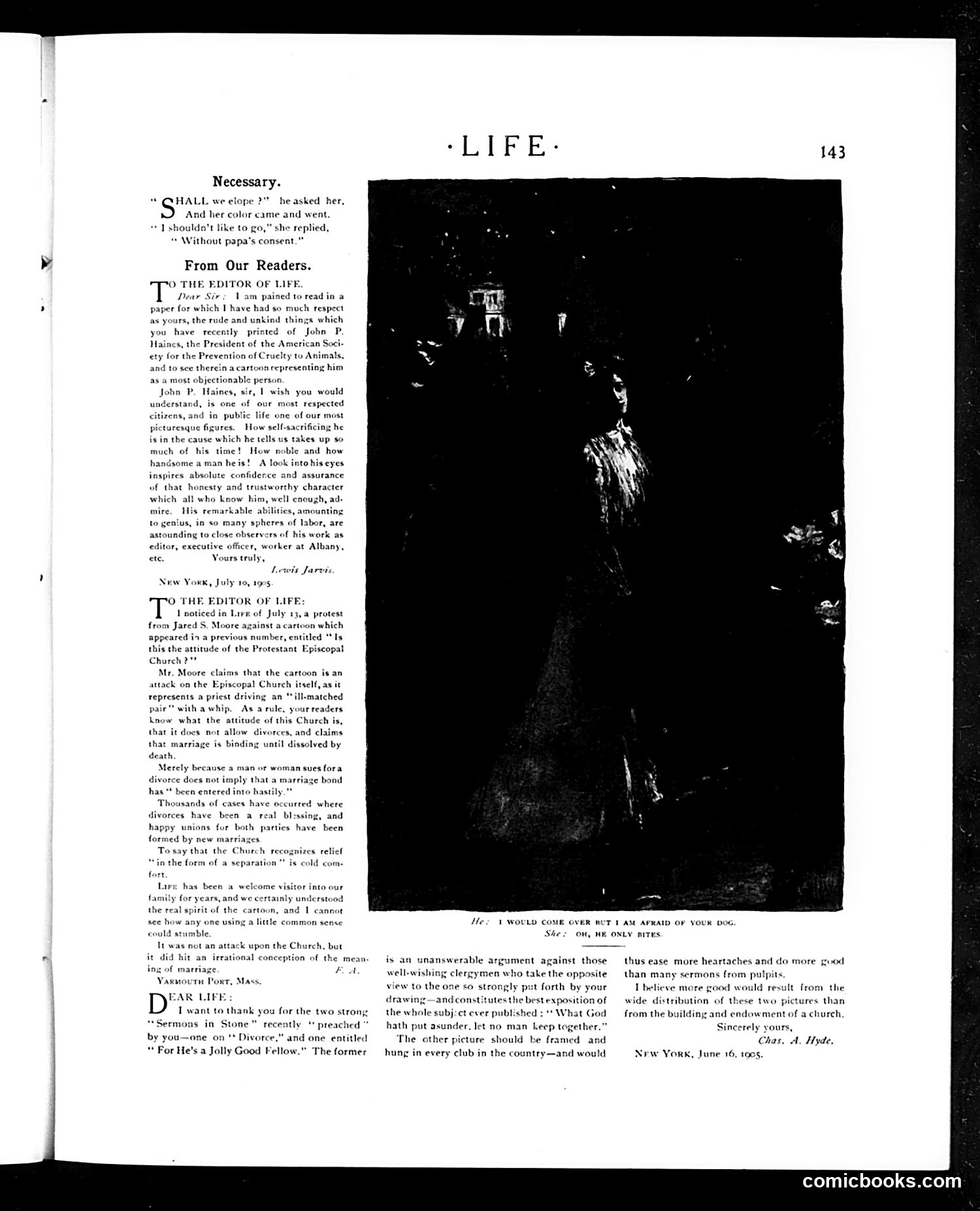
This page features reader letters responding to recent cartoons, primarily addressing two controversial topics: **The Cartoon References:** 1. **A cartoon attacking John P. Haines**, President of the American Society for the Prevention of Cruelty to Animals. A reader defends Haines as a respected, self-sacrificing citizen, objecting to Life's satirical portrayal of him as objectionable. 2. **A cartoon about Episcopal Church divorce policy**. A reader defends Life's criticism, noting the cartoon depicted a priest with a whip driving "illmatched" horses—a metaphor for the Church's strict, inflexible stance against divorce. The reader argues the cartoon effectively critiques the Church's irrational refusal to recognize that divorces can be beneficial. 3. **"Sermons in Stone"** cartoons about divorce receive praise as effective social commentary. **The small cartoon visible** shows a man and woman with the caption about a dog that "only bites"—likely a humorous commentary on social courtship obstacles. The page demonstrates Life's role as a vehicle for satirical social criticism on institutional rigidity.
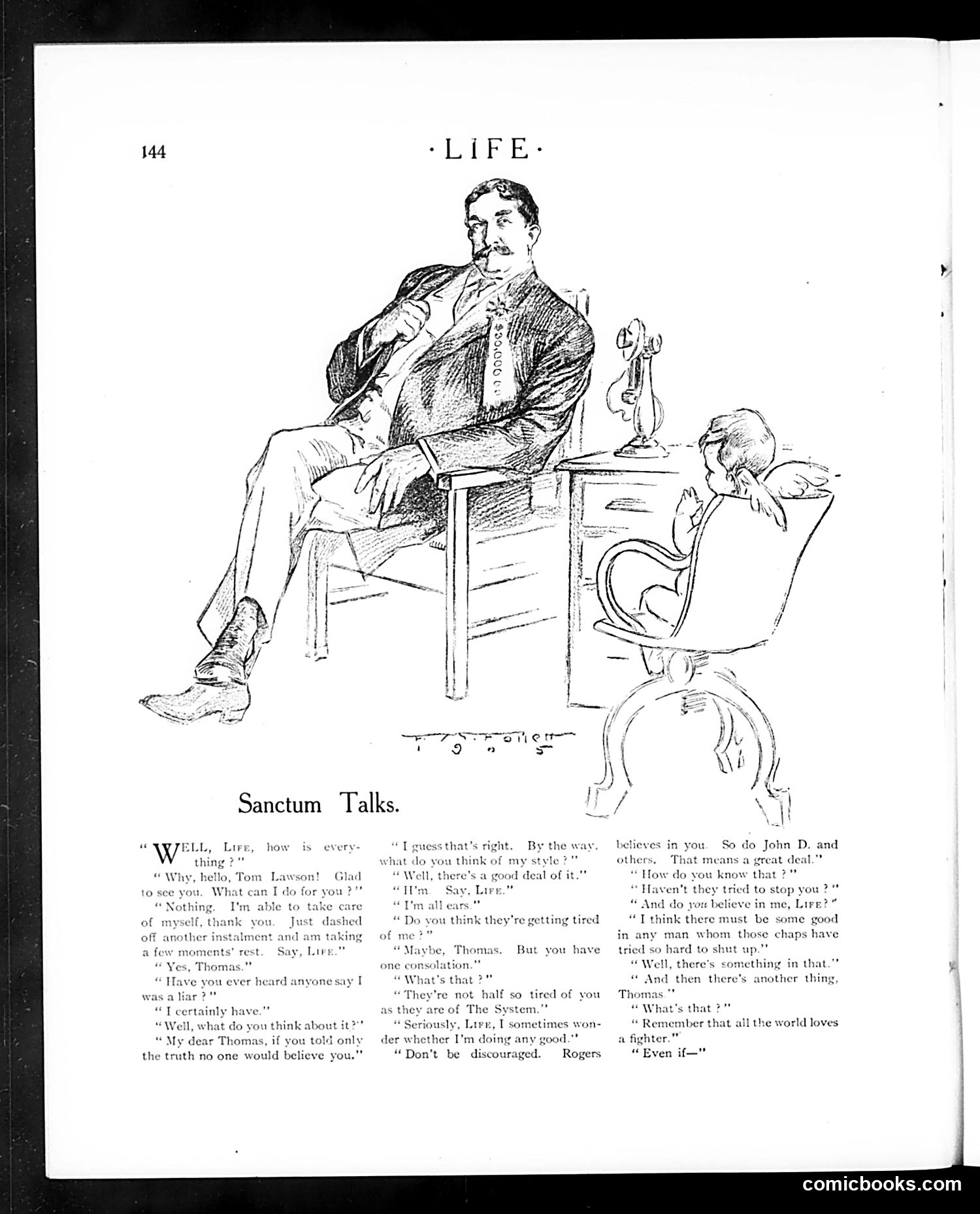
This is a dialogue cartoon between two men—one seated at a desk (appearing to be an editor or authority figure), the other standing or reclining. The seated figure represents the magazine's "sanctum" (inner office), a common Life feature where editors discussed current affairs. The conversation concerns a reformer or public figure (possibly a muckraker journalist or activist) who is discouraged about his effectiveness. His interlocutor reassures him that powerful figures—"John D." (likely Rockefeller) and Rogers (possibly a prominent industrialist)—actively oppose him, which proves his work matters. The joke is that **attempted suppression by the wealthy elite validates the reformer's importance**. This reflects early 1900s Progressive Era attitudes: the cartoon satirizes both reform movements and corporate power by suggesting that public figures gain credibility through elite opposition. The reference to "The System" indicates critique of institutional corruption.
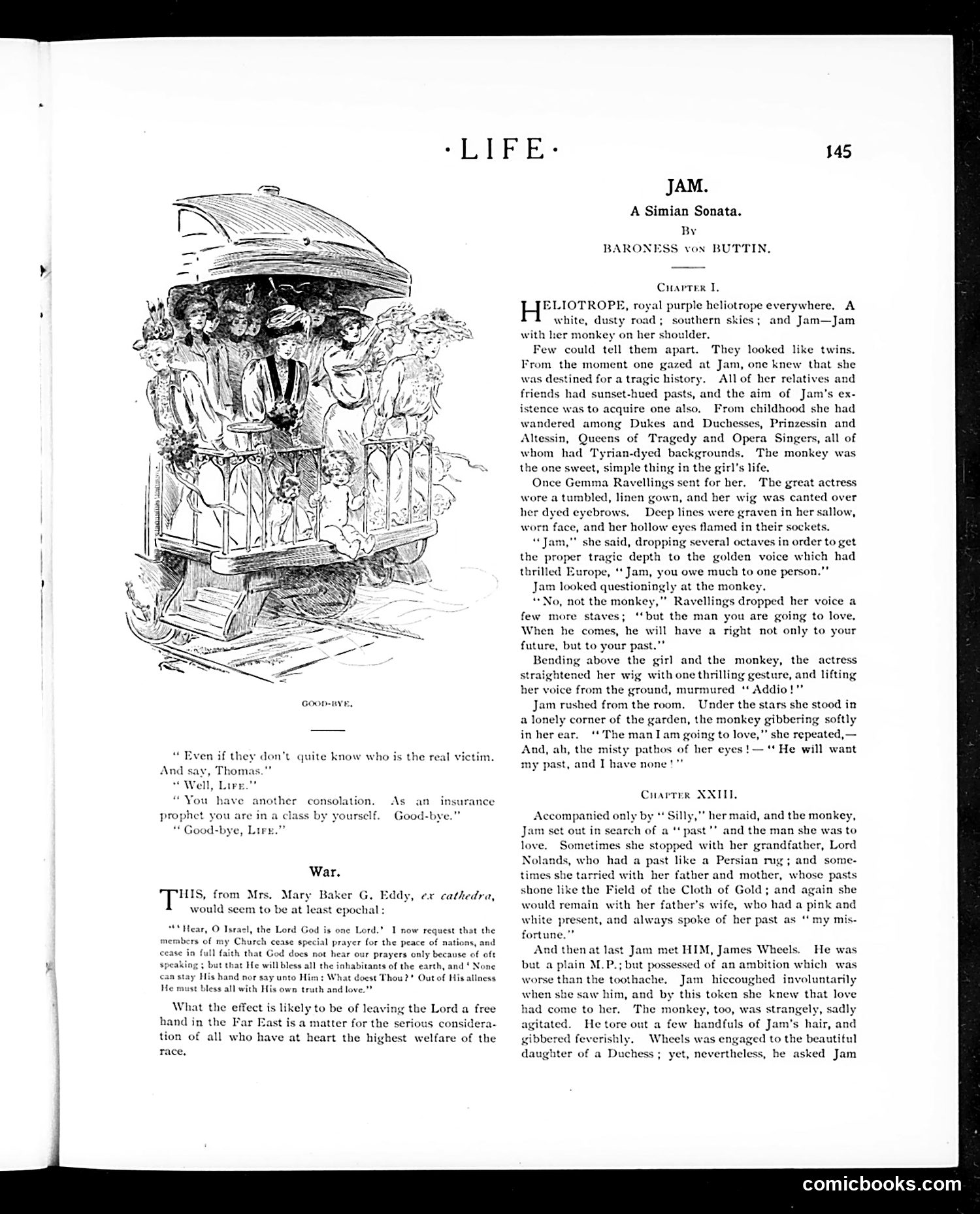
This page contains two distinct pieces from *Life* magazine: **"War" section (top):** A satirical commentary on Mary Baker G. Eddy, founder of Christian Science. She's quoted requesting people stop praying specifically for peace among nations, instead trusting God's general wisdom. The satire mocks this as theologically absurd—essentially telling God to handle world affairs without specific human petition. The joke questions the practical wisdom of leaving major geopolitical concerns entirely to divine will. **"Jam: A Simian Sonata" (bottom):** A serialized fictional story, likely satirizing melodramatic romance novels and theatrical culture. The heroine Jam—described as inseparable from her pet monkey—seeks a "tragic past" to match her aristocratic circles' romantic suffering. The satire mocks how upper-class society romanticizes tragedy and personal suffering as marks of sophistication. The illustration shows a carriage full of theatrical characters, emphasizing the overwrought, performative nature of this social world.
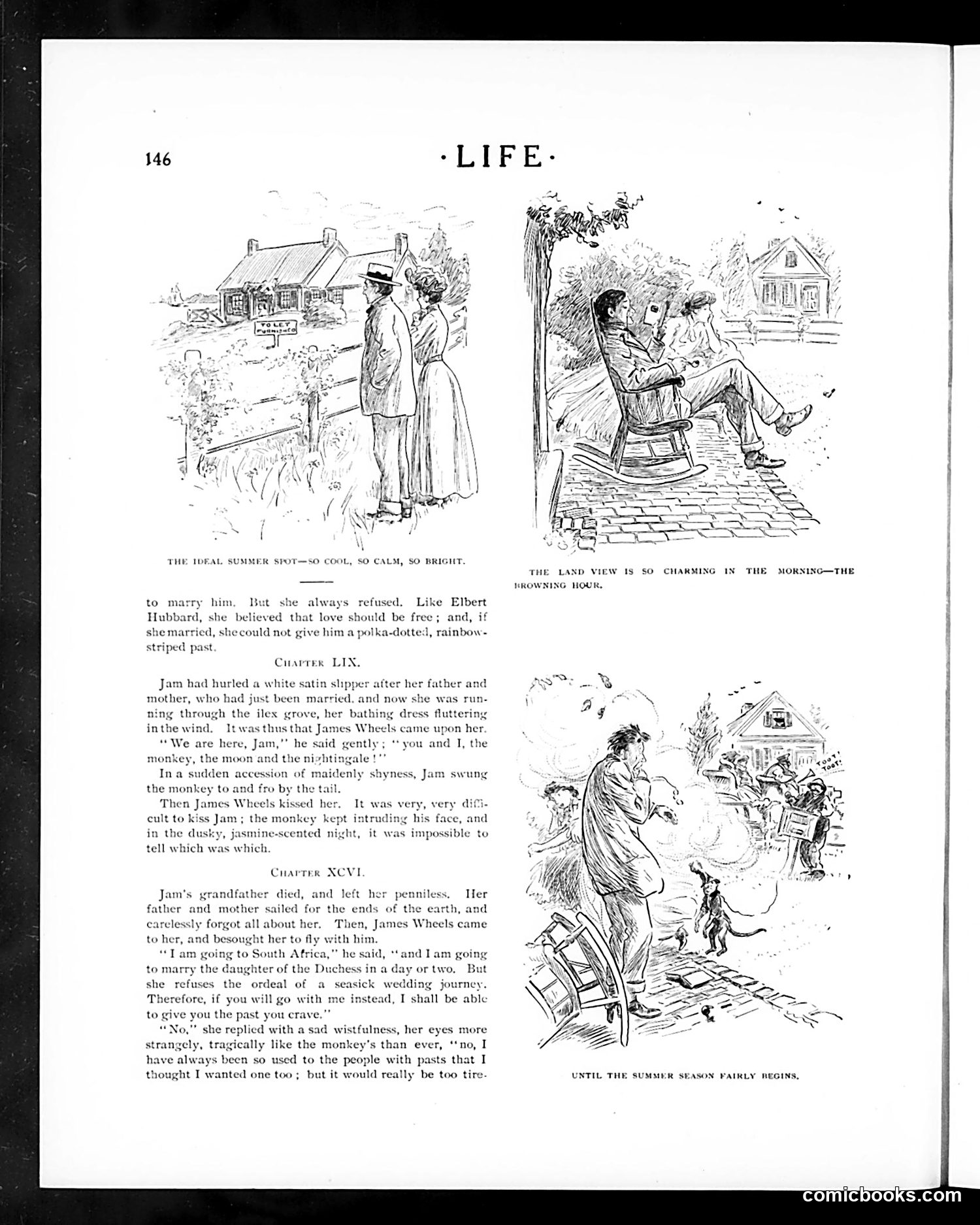
This page presents chapters from what appears to be a serialized romantic story in *Life* magazine, illustrated with pen-and-ink drawings. The narrative follows a character named "Jam" and her romantic entanglements with James Wheels. The story references **Elbert Hubbard**, a real early-20th-century American intellectual and advocate of "free love" philosophy, suggesting the narrative satirizes bohemian or progressive romantic ideals of that era. Jam's refusal of conventional marriage aligns with these values. The plot—involving Jam's eccentric life, a monkey character, and James Wheels's competing romantic obligations (including a Duchess's daughter)—appears comedic and absurdist rather than serious literature. The illustrations show domestic summer scenes and the monkey as a recurring element. Without the full publication date visible, the satirical tone targets contemporary attitudes about marriage, independence, and the fashionable adoption of radical ideas among the leisured classes.
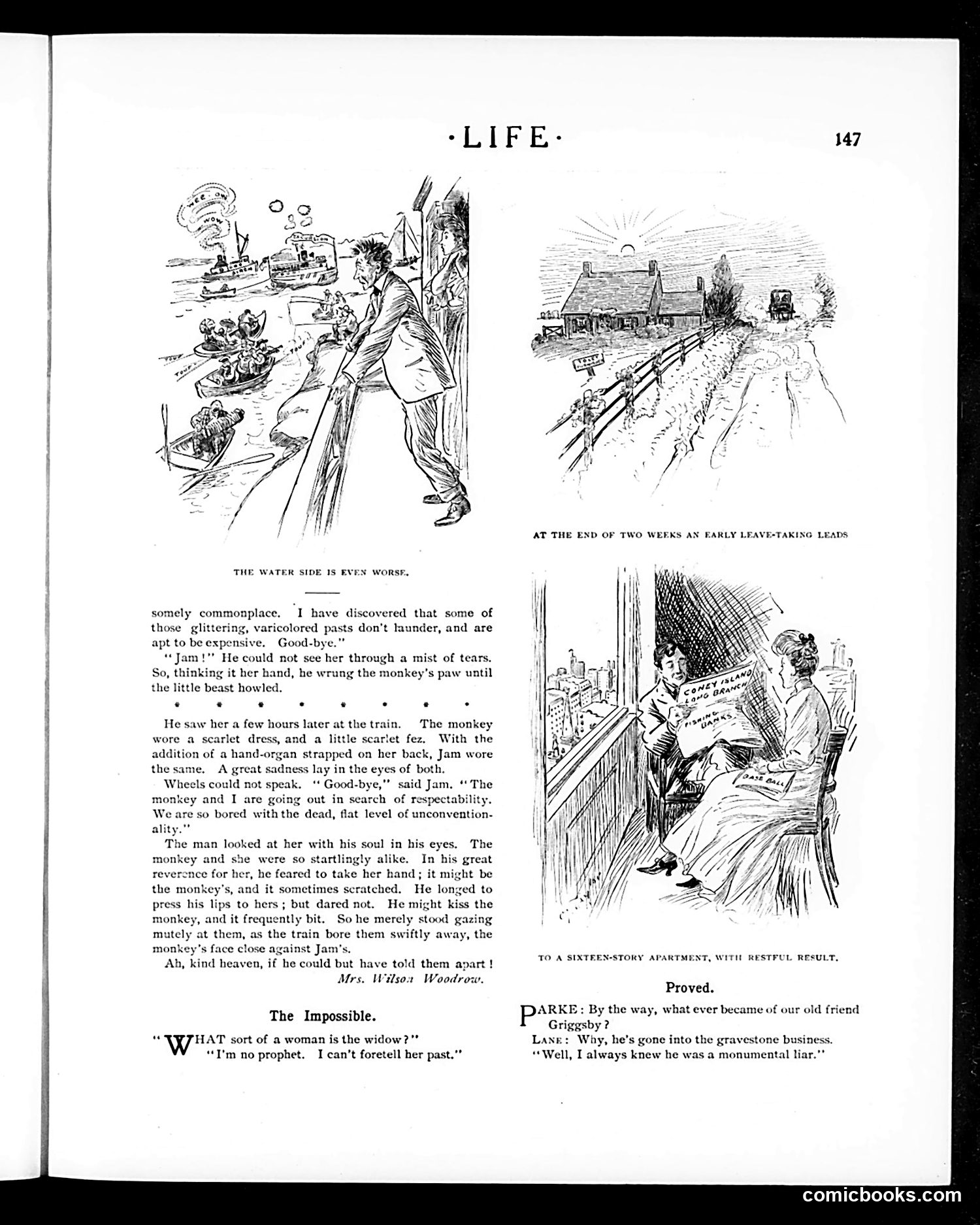
This page contains satirical humor typical of early 20th-century Life magazine. The main story, "The Water Side Is Even Worse" by Mrs. Wilson Woodrow, depicts a sentimental romantic tragedy: a man says farewell to a woman named Jam, who has become indistinguishable from her pet monkey—both wear matching scarlet dresses and fez hats. The satire mocks overly sentimental Victorian romance fiction through absurdist exaggeration; the man cannot tell woman from monkey, making emotional connection impossible. Below, "The Impossible" presents a brief dialogue joke about widow's moral character—a woman's past is unknowable and unpredictable. The final cartoon jokes about "Griggsby," who has entered the gravestone business; the punchline relies on calling him a "monumental liar," a pun on his profession dealing with monuments. These pieces exemplify Life's blend of visual satire, literary parody, and wordplay humor.
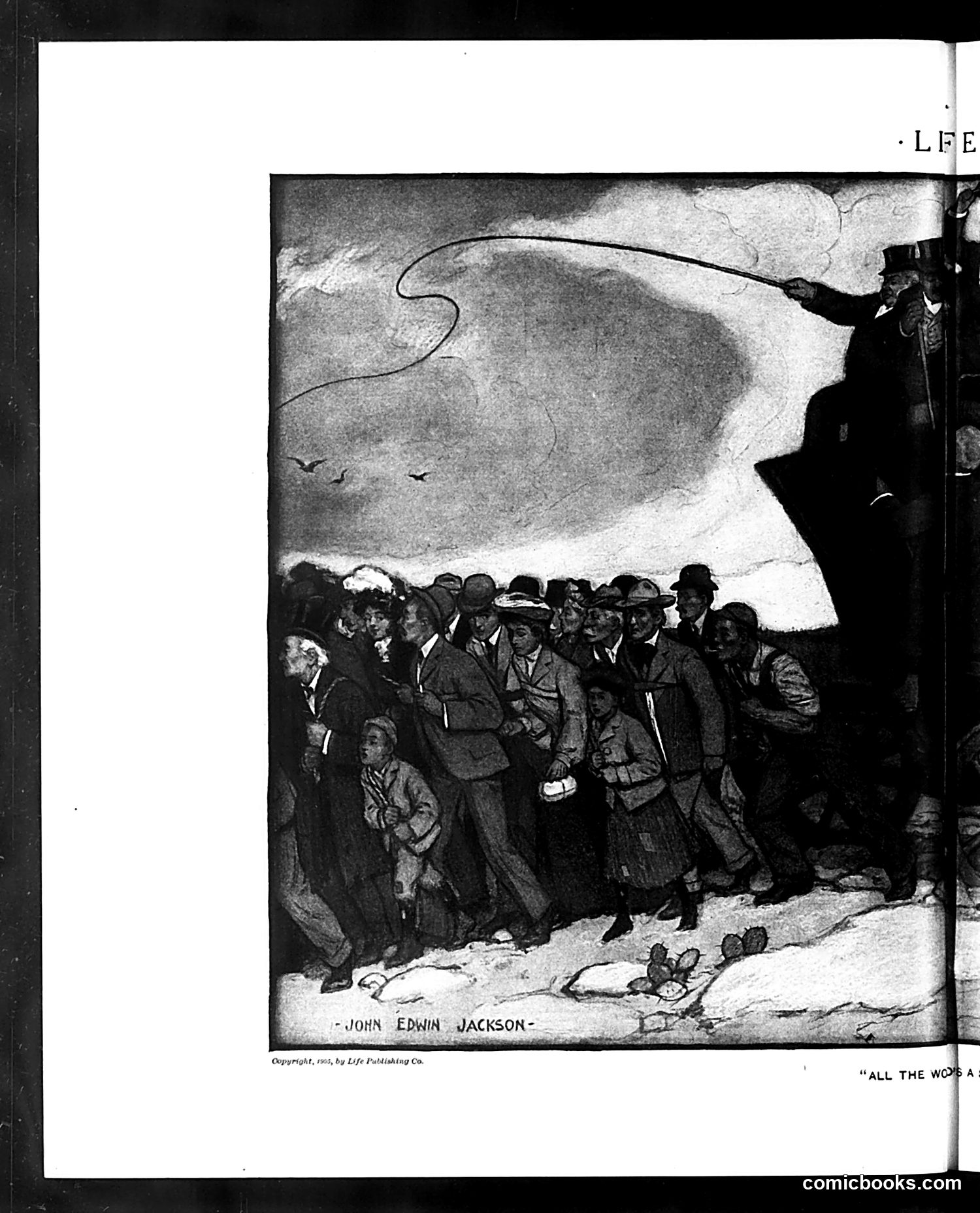
This 1905 Life Magazine cartoon by John Edwin Jackson depicts a crowd of men in formal attire gathered around what appears to be a large sculptural head or bust. The image's satirical point remains partially unclear from the visible portion, though the title "All the W[orld]" (text cut off) suggests commentary on global affairs or public opinion. The gathering of formally-dressed figures suggests a public event or political gathering. Without the complete caption or fuller context, the specific political figure or event being mocked cannot be definitively identified. The exaggerated scale of the head relative to the observers may indicate mockery of ego, vanity, or inflated political importance—common Life Magazine themes. The 1905 date and artistic style are consistent with Progressive Era satire.
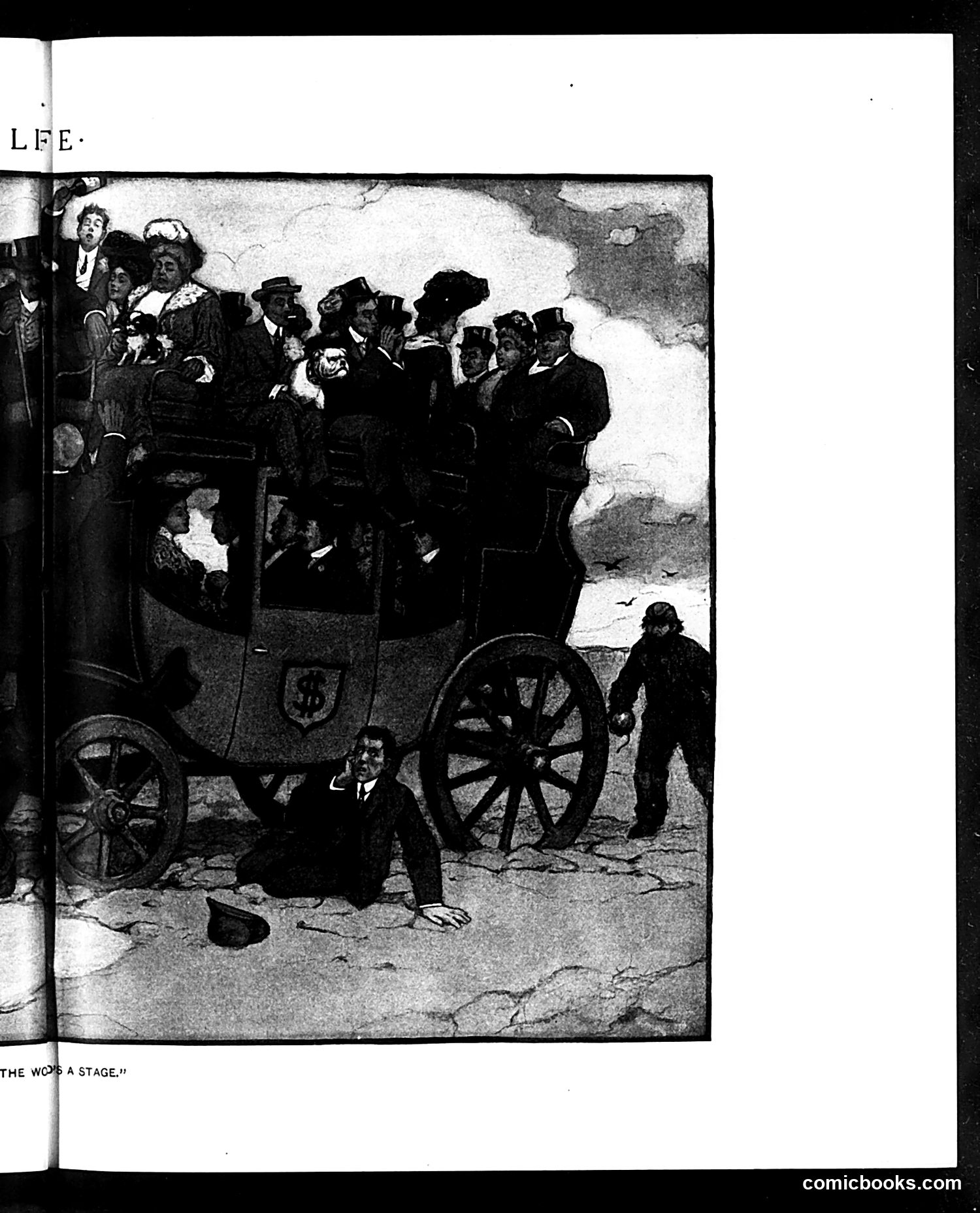
This appears to be a satirical illustration from Life magazine showing a theatrical scene. The caption "THE WO[RLD] A STAGE" references Shakespeare's famous phrase from *As You Like It* ("All the world's a stage"). The image depicts a crowded carriage or platform elevated like a theatrical stage, filled with formally-dressed figures in top hats and period clothing. Below stands a lone figure in a crouched or subservient position, suggesting social hierarchy or class commentary. The satire likely critiques society as performative theater—those "on stage" (the wealthy or powerful, crowded together) versus those below (the common person or working class). The composition emphasizes the literal elevation of the upper class and their theatrical pretense, while marginalizing ordinary people to the ground level. This was typical of Life's social and political commentary during the late 19th/early 20th century.
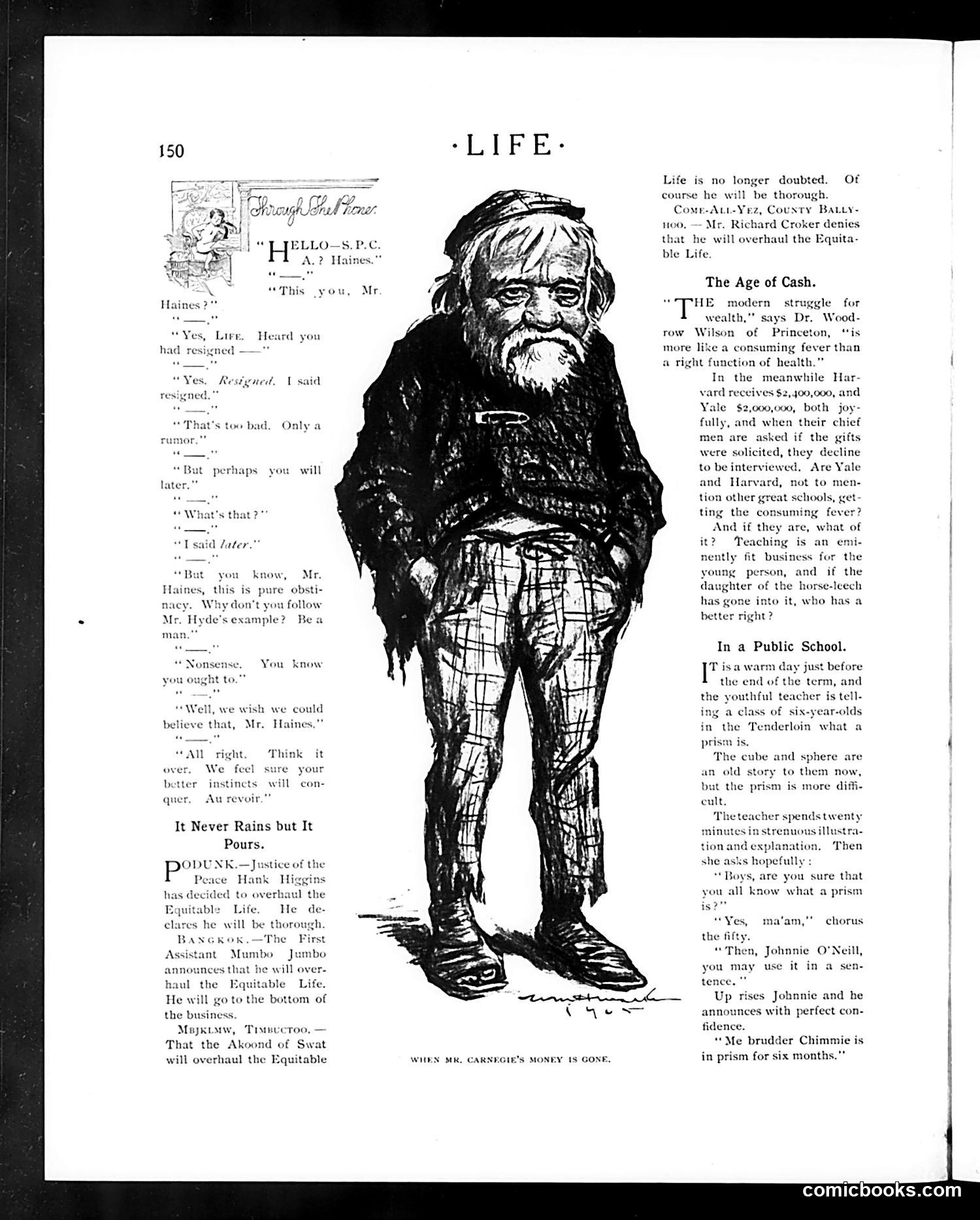
This page satirizes late Gilded Age American concerns through multiple pieces: **Main Cartoon ("When Mr. Carnegie's Money Is Gone"):** A caricatured poor man illustrates the irony of wealthy industrialist Andrew Carnegie's massive philanthropic donations ($2.4 million to Harvard, $2 million to Yale mentioned in text). The satire questions whether such giving actually benefits society or merely assuages the "consuming fever" of wealth-accumulation that Dr. Woodrow Wilson criticizes in the accompanying article. **"It Never Rains but It Pours" section:** References to political figures like Richard Croker (Tammany Hall boss) and the "Akoond of Swat" (a foreign ruler, used mockingly) suggest multiple entities claiming they'll "overhaul" institutions—satirizing empty political promises about reforming major organizations. **"In a Public School" vignette:** Mocks education's limitations, showing a teacher struggling to explain prisms to six-year-olds, concluding with a joke about someone's brother "in prism for six months" (imprisoned)—conflating the word with incarceration. The page collectively critiques wealth inequality, political corruption, and institutional inadequacy.
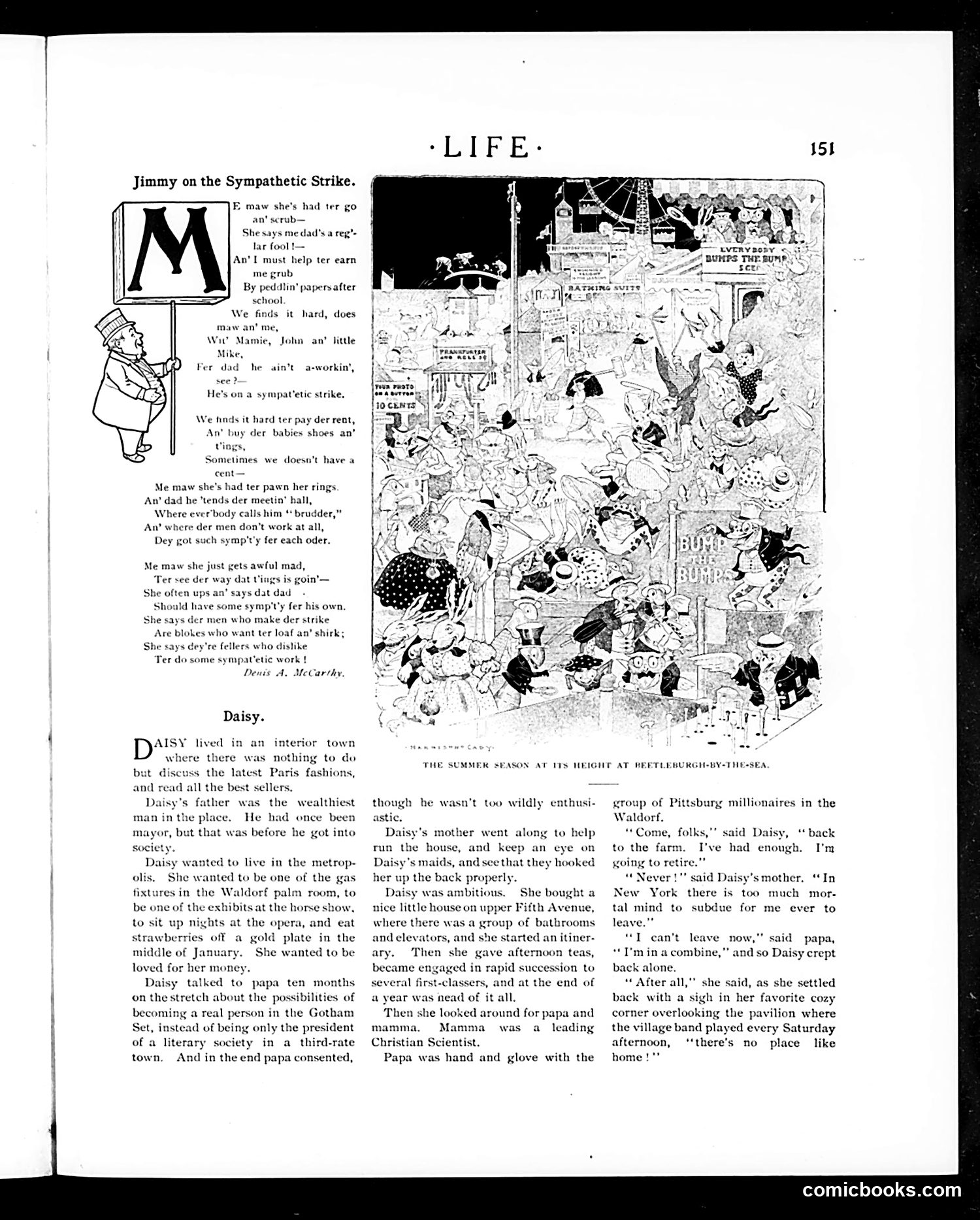
This poem satirizes labor strikes, specifically "sympathetic strikes" where workers refuse work to support other strikers' causes. The narrator is a child whose father participates in such a strike, refusing to work out of solidarity with others—yet his own family suffers genuine hardship: his mother must scrub clothes and pawn her rings, they can't afford rent or children's shoes, and the boy sells newspapers to help feed the family. The satire's point: the father attends union meetings where men call each other "brother" and express mutual sympathy, but he shows *no* sympathy for his own starving wife and children. His mother angrily notes the hypocrisy—these men want to "loaf an' shirk" while their families go hungry. The cartoon mocks both the self-righteousness of strike solidarity and working-class men's indifference to their families' immediate needs. It's anti-labor propaganda dressed as working-class perspective.
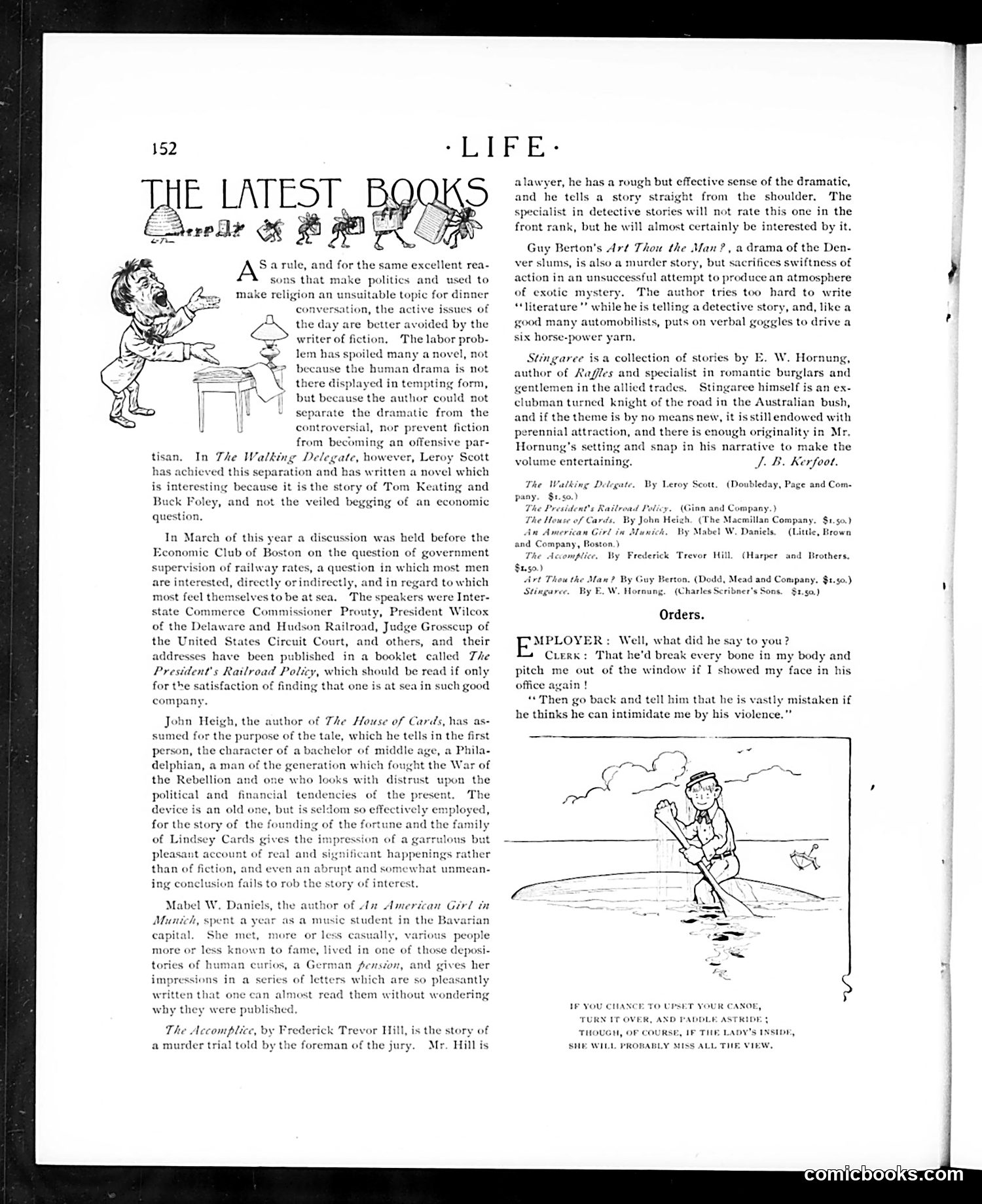
This page reviews recent books for *Life* magazine's literary section. The cartoons are decorative elements illustrating the magazine's style rather than political commentary. The text discusses novels addressing labor disputes and railroad regulation—hot political issues of the era. "The Walking Delegate" by Leroy Scott is praised for telling a story about labor organizing (Tom Keating and Buck Foley) without becoming a heavy-handed political tract. The review notes that authors often fail when mixing dramatic fiction with controversial social issues. The page also references a recent Boston Economic Club debate on government railroad rate supervision, attended by prominent figures including the Interstate Commerce Commissioner—indicating contemporary anxiety about industrial regulation and corporate power. Other reviewed books include detective stories, a novel set in pre-WWI Munich, and "Stingaree," featuring a romantic Australian outlaw. The humor is gentle literary criticism, not political satire.
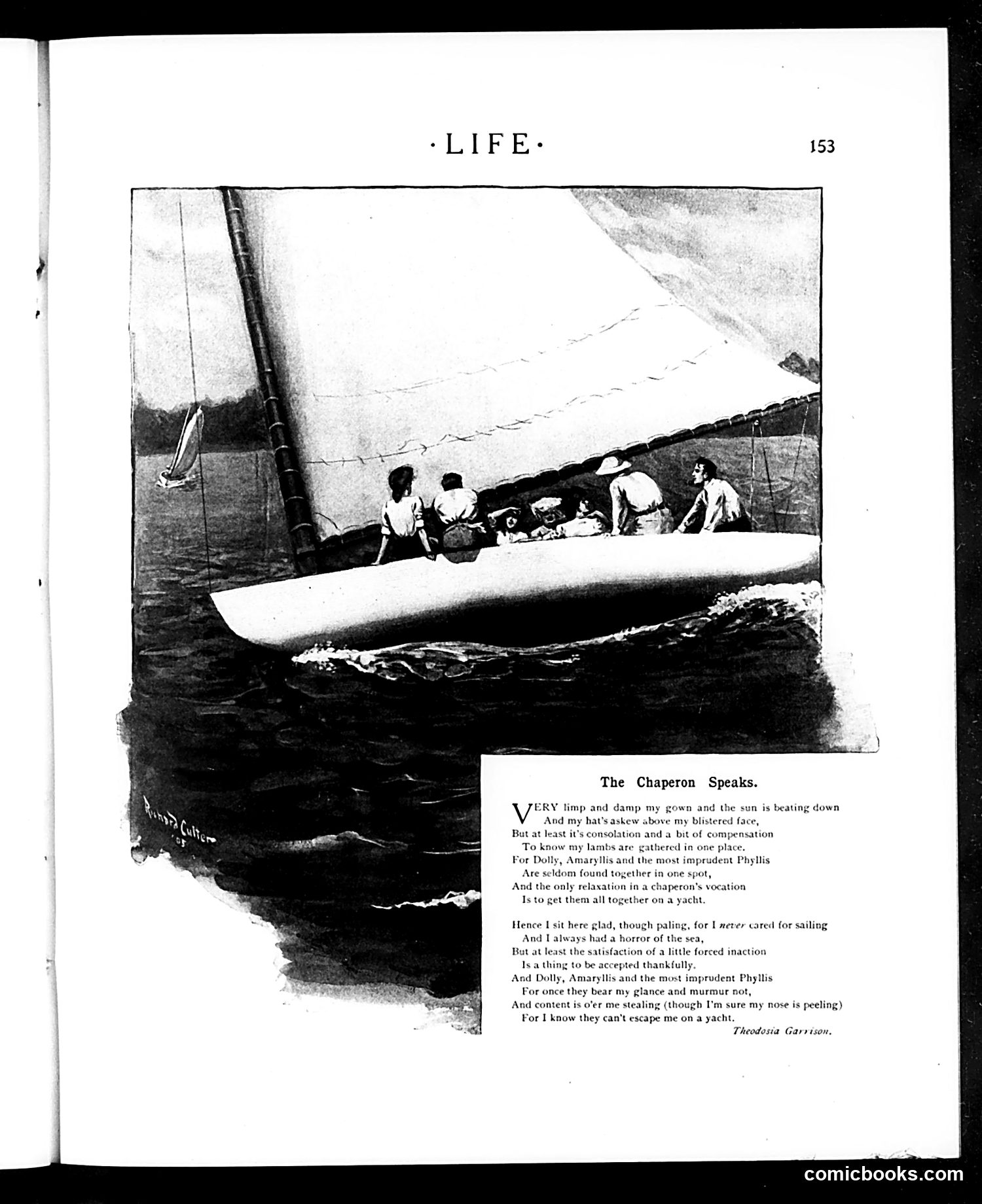
This is a humorous poem accompanying a photograph of women on a yacht. The joke centers on a **chaperon's perspective**—an older woman tasked with supervising young ladies' behavior, a common social obligation in early 20th-century upper-class life. The chaperon describes her misery (damp clothes, sunburn, seasickness) but paradoxically finds it worthwhile because she can finally keep watch over her three charges—Dolly, Amaryllis, and Phyllis—who normally scatter. On a yacht, they cannot escape her supervision. The satire mocks: - The tedious social custom of chaperoning - Young women's typical rebelliousness and tendency to evade supervision - The chaperon's resigned acceptance of discomfort as a trade-off for control The poem is credited to Theodosia Garrison, a real poet of the period. The accompanying photograph shows the scene literally—women clustered on a yacht where escape is impossible.
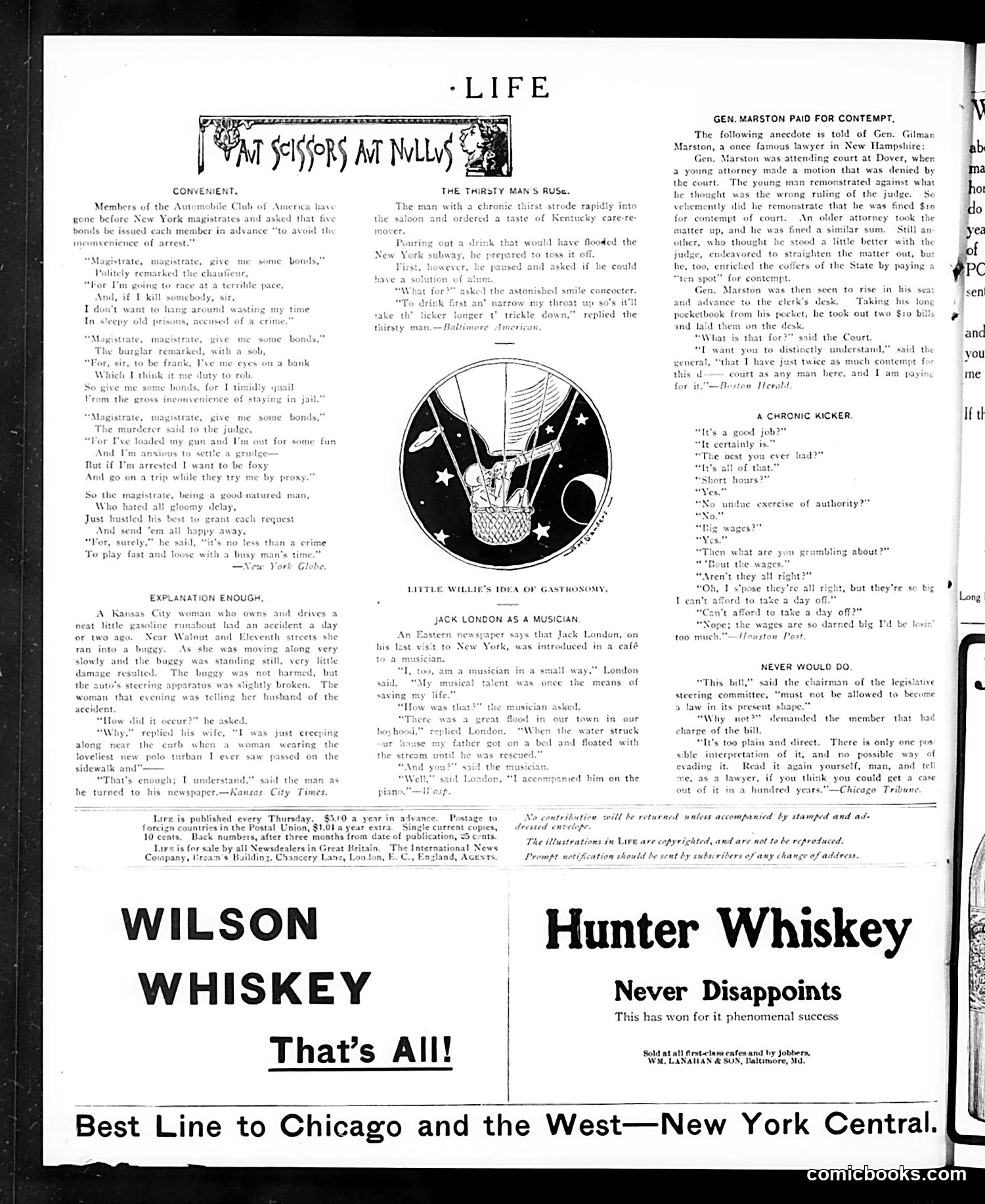
This page contains several humorous anecdotes satirizing American legal and social absurdities circa early 1900s: **"Gen. Marston Paid for Contempt"** mocks judicial pomposity. A young lawyer argues passionately against a judge's ruling; an older attorney takes over but loses the case anyway. Marston then pays $20 in contempt fines while declaring he holds twice the contempt for the court as the lawyer did—turning the punishment into a statement of defiance. **"The Thirsty Man's Ruse"** depicts a man ordering an enormous drink in a bar, apparently to avoid appearing suspicious while actually planning to dispose of it before arrest (Prohibition context implied). **"Jack London as a Musician"** humorously recounts the famous author being told his musical talent was merely "adequate in a small way," prompting him to abandon music. **"A Chronic Kicker"** satirizes a perpetually complaining worker who, despite his good job and decent wages, constantly grumbles. The page mixes legal satire with everyday social commentary, typical of Life's early editorial stance criticizing institutional rigidity and human folly.
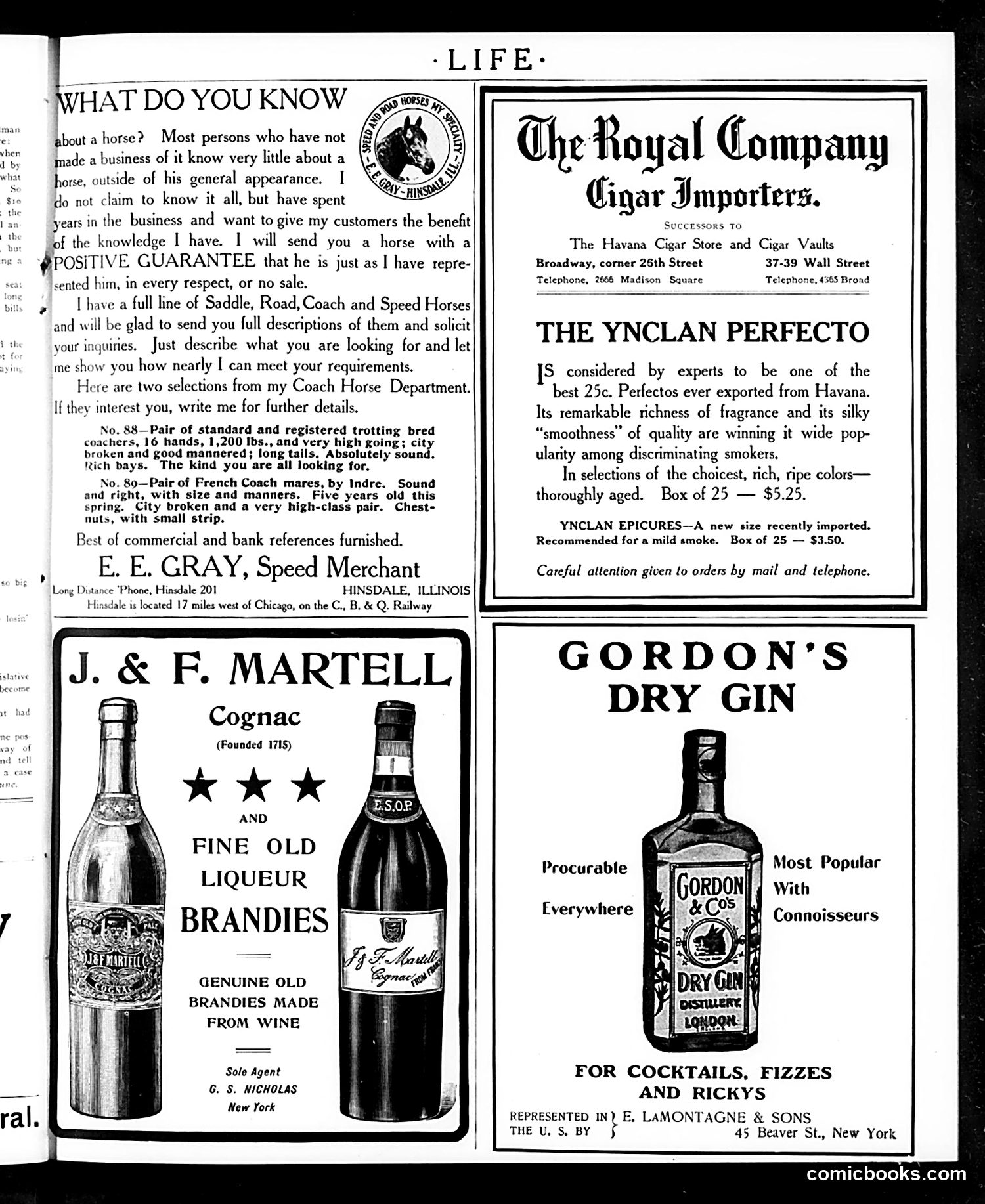
This is primarily an **advertising page**, not a satirical cartoon. It contains four distinct advertisements from the early 20th century: 1. **E.E. Gray (Speed Merchant)** - Horse sales pitch emphasizing quality guarantees and specific breeding details for coach horses 2. **The Royal Company Cigar Importers** - Marketing Ynclan Perfecto cigars as superior 25-cent imports from Havana, targeting "discriminating smokers" 3. **J. & F. Martell Cognac** - Promoting French brandy founded in 1715, distributed by G.S. Nicholas in New York 4. **Gordon's Dry Gin** - Advertising gin for cocktails, positioned as popular among connoisseurs The page reflects **pre-Prohibition era** American commerce (likely 1910s), when alcohol and luxury goods were openly advertised in mainstream magazines. These ads target affluent readers through appeals to exclusivity, quality, and refined taste—typical marketing strategies of the period.
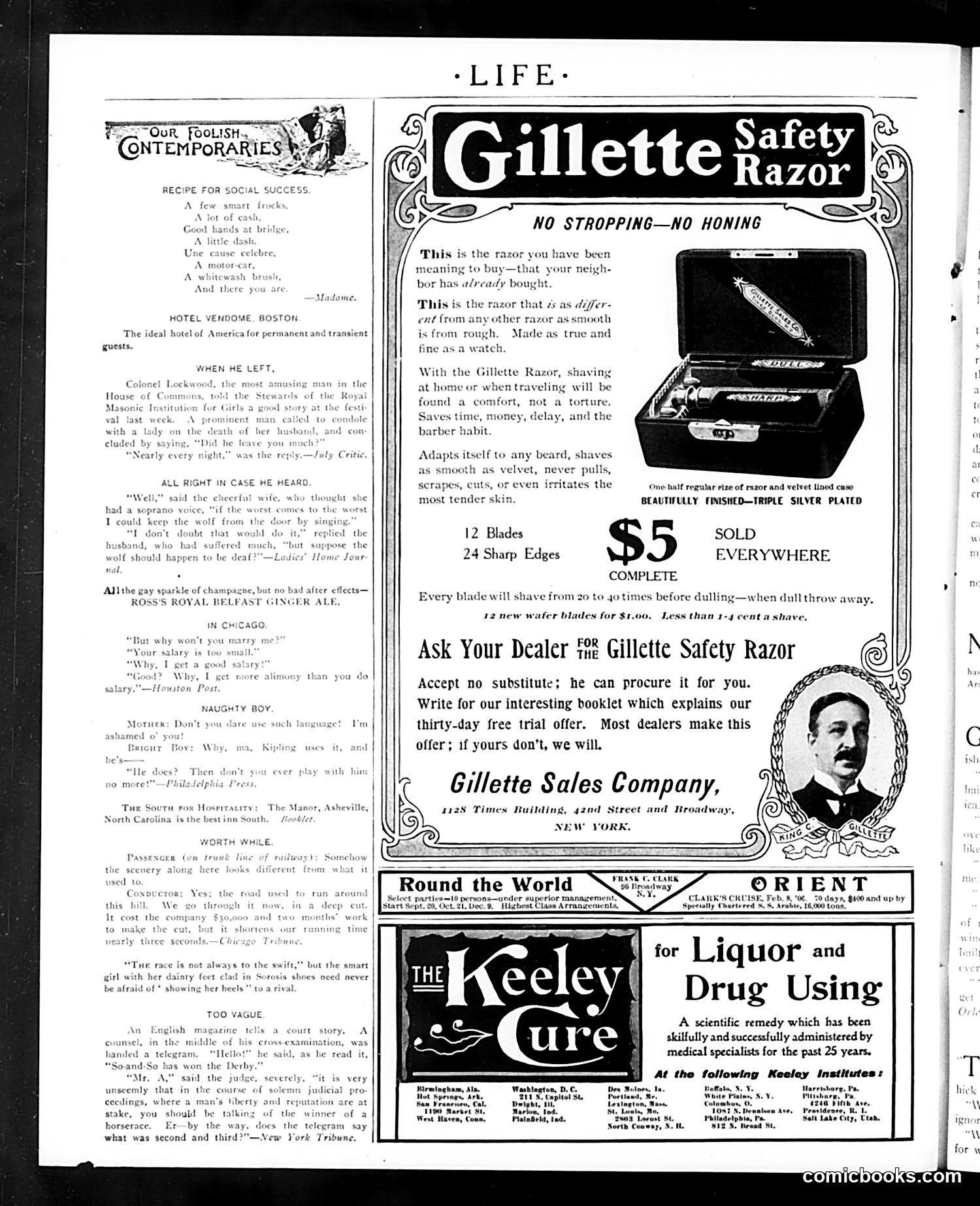
This is primarily an **advertising page** from an early 20th-century issue of Life magazine, with some satirical content mixed in. The left column contains several brief humorous anecdotes labeled "Our Foolish Contemporaries"—short jokes mocking social pretension and confusion, typical of Life's satirical approach. These are not about specific named figures but rather observations of contemporary society. The dominant content is **paid advertising**: a full-page Gillette Safety Razor advertisement (prominently featuring the product and pricing at $5), a "Keeley Cure" advertisement for addiction treatment, a cruise-line ad, and mentions of the Hotel Vendome. The humor relies on **period-specific social references** (bridge games, motorcar ownership, champagne etiquette) that would resonate with Life's educated middle-class readership. Without identifiable caricatures or references to specific politicians/events, the page primarily documents **consumer culture and social mores of the era** rather than political satire. The Keeley Cure advertisement is notable as historical evidence of early addiction-treatment marketing in America.
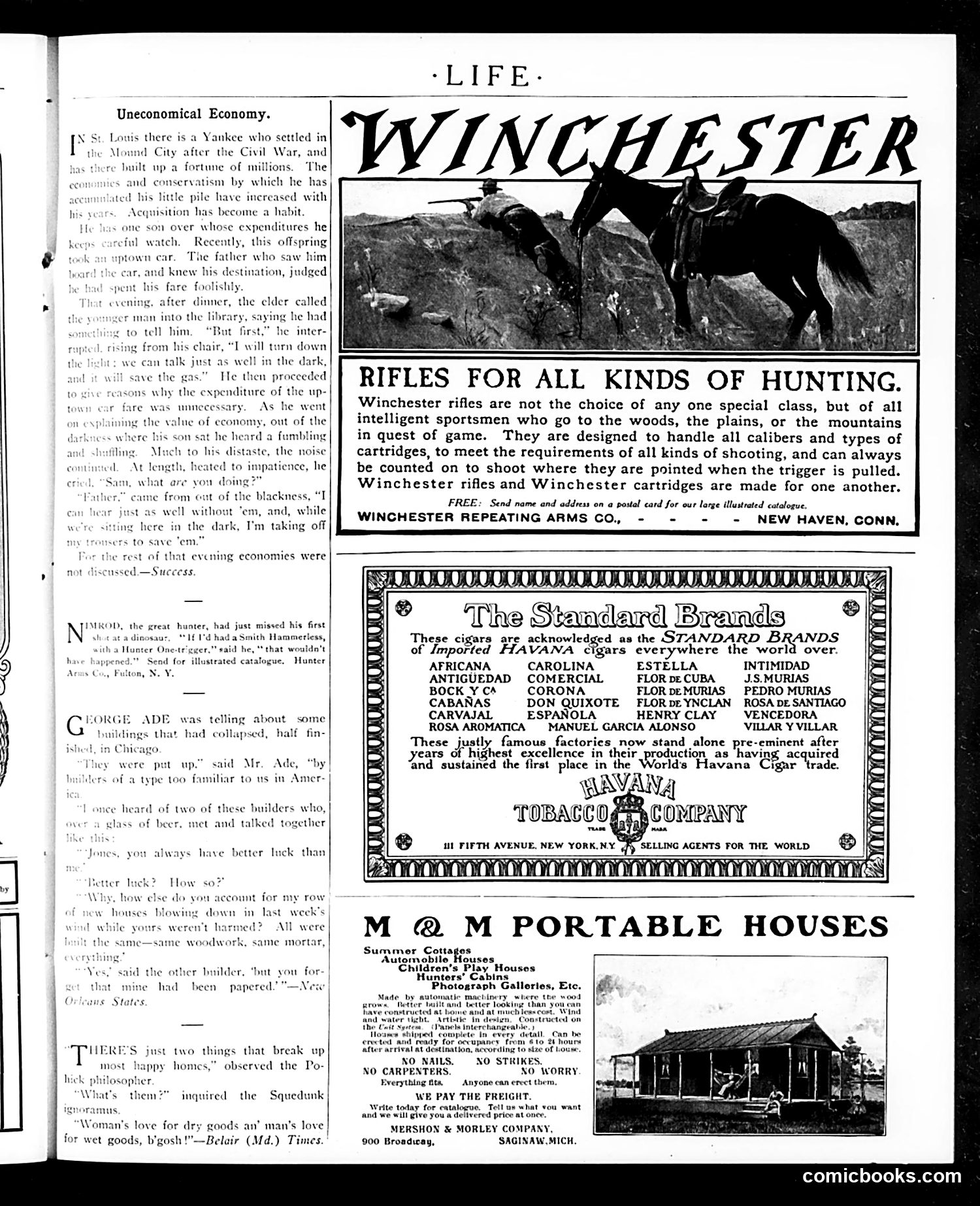
This page's main cartoon illustrates a story about a wealthy St. Louis businessman who built his fortune through careful frugality. Now obsessed with economy, he lectures his spendthrift son about wasteful expenditures—particularly an uptown car ride. **The joke**: After lecturing about the son's extravagance, the father turns off the library light during their conversation to "save the gas." The satire targets hypocritical penny-pinching: the father's miserliness has become so extreme and reflexive that he economizes even during serious moral instruction, undermining his authority. The irony is that such trivial savings are absurd for a millionaire—his obsession with economy has become pathological rather than prudent. The accompanying anecdotes about a hunter and collapsing buildings follow similar patterns of comedic irony involving false economy or lucky circumstances. The page is primarily satirical short humor pieces typical of *Life* magazine's format.
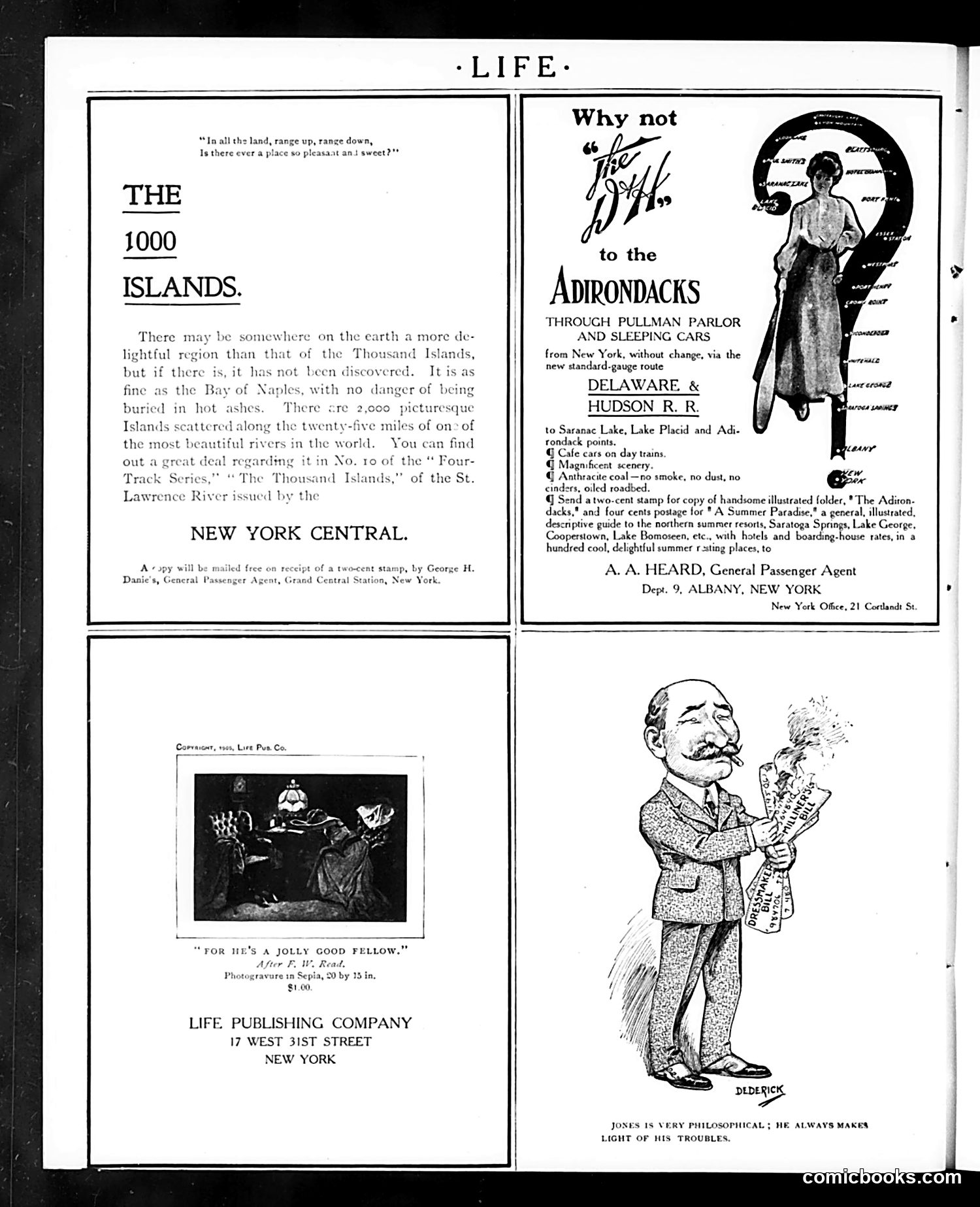
This is primarily an **advertising and promotional page** rather than political satire. The page contains: 1. **Top left**: New York Central Railroad advertisement for "The 1000 Islands" tourist destination along the St. Lawrence River, promoting scenic travel. 2. **Top right**: Delaware & Hudson Railroad advertisement for Adirondack travel, featuring an illustrated woman with a question mark, promoting luxury rail travel with Pullman cars to mountain resorts. 3. **Bottom left**: Life Publishing Company advertisement for a photogravure titled "For He's a Jolly Good Fellow." 4. **Bottom right**: A cartoon by Dederick captioned "Jones is very philosophical; he always makes light of his troubles"—showing a caricatured man making light of his worries. This is a *humor* cartoon, not political satire. The page is essentially a **commercial and entertainment product**, showcasing Gilded Age leisure tourism and magazine advertisements rather than containing social or political commentary.
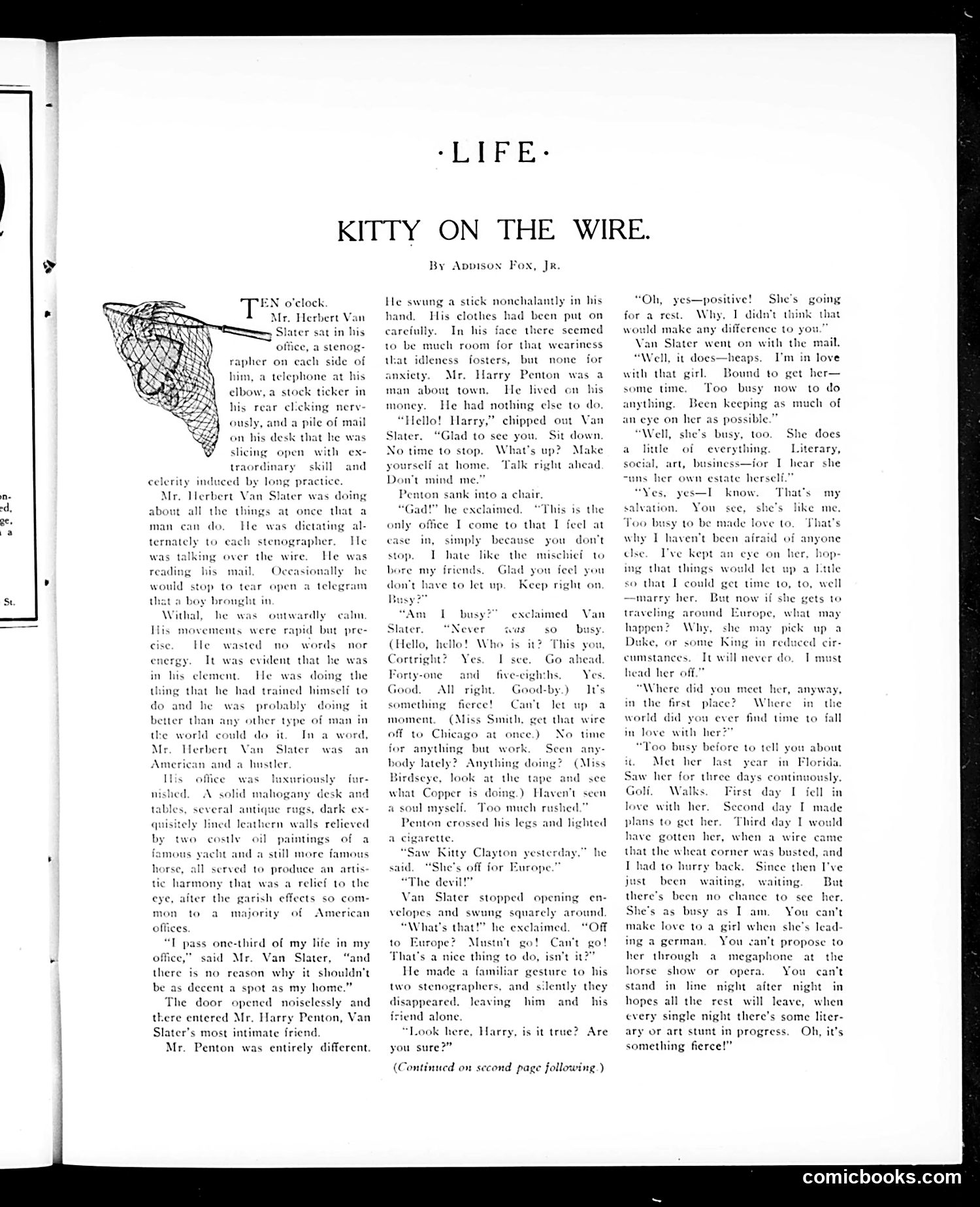
This story satirizes the American "hustler" archetype of the early 20th century. Mr. Herbert Van Slater embodies the obsessively busy businessman—simultaneously dictating to stenographers, reading mail, monitoring a stock ticker, and handling telephone calls. The satire lies in depicting this frantic multitasking as both admirable ("probably doing it better than any other type of man") and hollow. The contrast with his friend Mr. Harry Penton—an idle "man about town" with nothing to do—highlights the story's central irony. When Penton casually mentions that Kitty Clayton (whom Van Slater loves) is leaving for Europe, Van Slater's carefully maintained composure cracks. His obsessive work suddenly seems meaningless; he has been too busy to pursue the woman he loves. The satire critiques American work culture's dehumanizing effects on romance and genuine human connection, suggesting that relentless productivity can cost one life's actual rewards.
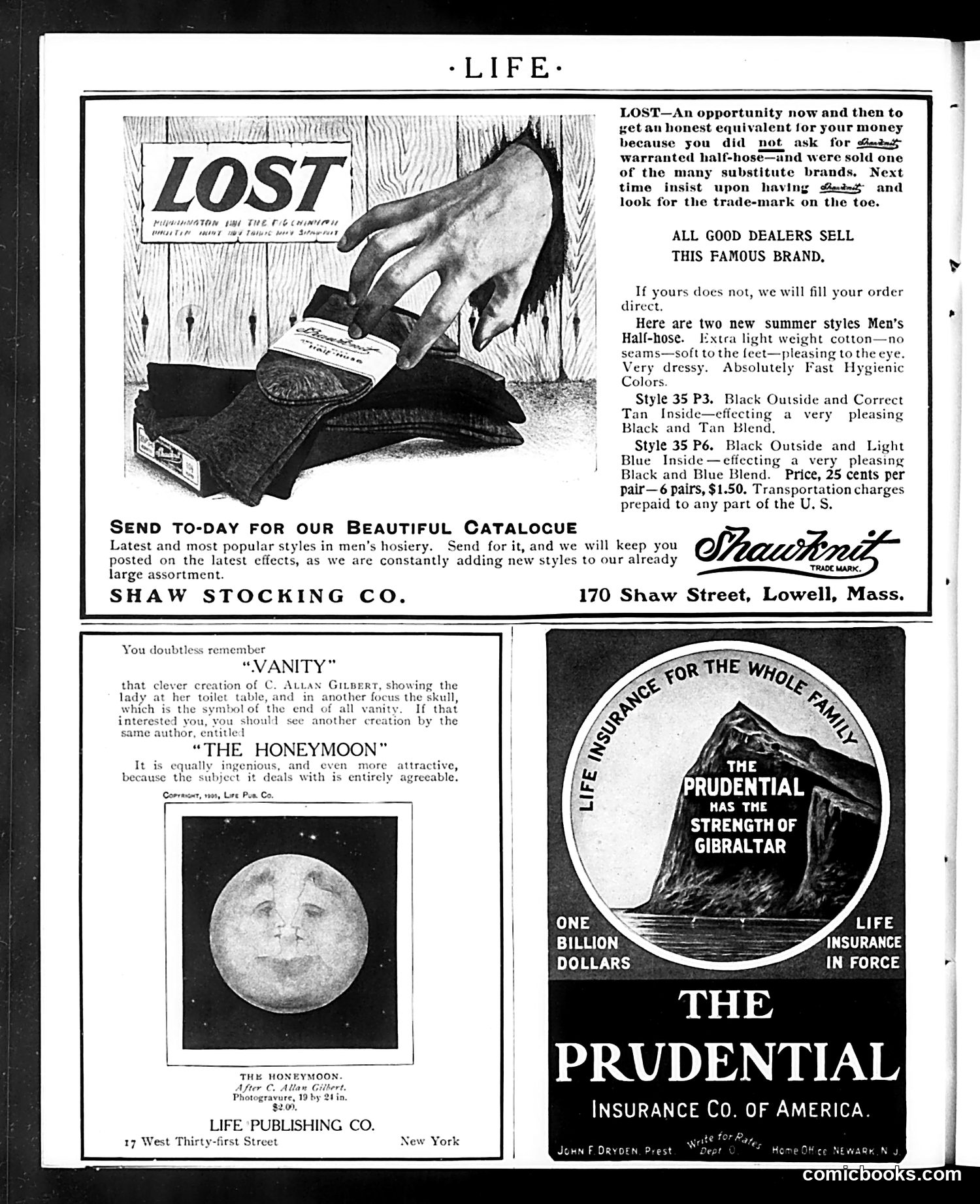
This is primarily an **advertising page** from an early 20th-century issue of *Life* magazine, not a political cartoon. The main content features: 1. **Shaw Stocking Co. advertisement** (top): A humorous "LOST" ad warning consumers about counterfeit half-hose (socks). The illustration shows a hand examining a sock's trade-mark, satirizing consumer fraud—a common concern when knockoff brands proliferated. The joke: you lose money by not insisting on the genuine branded product. 2. **Life Publishing Co. advertisement** (lower left): Promoting two books by C. Allan Gilbert—"Vanity" and "The Honeymoon"—with a photograph of "The Honeymoon" artwork showing a face composed of a couple embracing. 3. **Prudential Insurance advertisement** (right): Featuring the Gibraltar rock as a symbol of strength, promoting "$1 billion in force" of life insurance. The page reflects **turn-of-the-century consumer culture**: brand awareness, product authenticity concerns, and commercial satire in advertising itself.
This page presents a comedic dialogue between two businessmen about romantic courtship in the modern era (early 20th century). The satire targets the collision between **business obsession and personal life**. The protagonist is so consumed by stock market activities (references to tickers, Copper stock at 67) that he cannot spare time for courtship, yet paradoxically claims to love the woman deeply. When he attempts to propose during a car ride, the automobile's mechanical failure interrupts him—he must rush back to his office. The joke's heart: a friend suggests proposing **by telephone**, which horrifies the protagonist, fearing telephone operators would eavesdrop. This satirizes how modern technology (automobiles, telephones, stock tickers) promised to enhance life but instead fragments attention and creates new absurdities. The broader satire mocks men who prioritize financial markets and business "crises" over genuine human connection, while the telephone proposal suggestion ridicules both modern efficiency obsession and the loss of romantic propriety in an increasingly commercialized society.
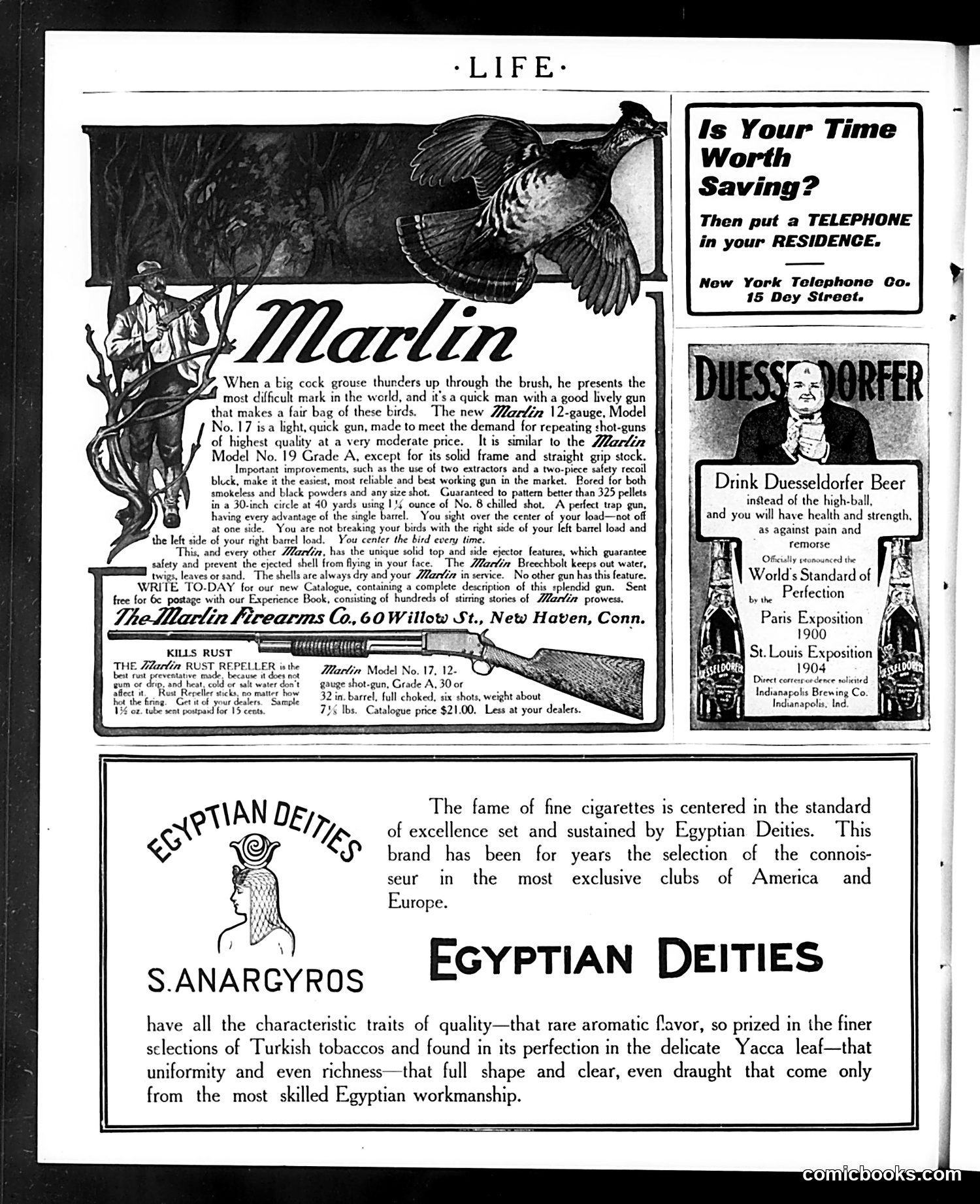
This page is primarily **advertising**, not satire or political cartoon. It contains four distinct product advertisements typical of early 1900s magazines: 1. **Marlin Firearms** (top left): A hunting rifle ad featuring a man with a gun and wild game bird. The text emphasizes the gun's reliability for hunting grouse and other birds—a practical sportsman's pitch. 2. **New York Telephone Co.** (top right): A straightforward utility ad asking whether readers' time is valuable enough to warrant home telephone installation. 3. **Duesseldorfer Beer** (right): Claims the beer provides health and strength as an alternative to "high-ball" drinks. 4. **Egyptian Deities Cigarettes** (bottom): Luxury tobacco advertising, claiming the brand is preferred in exclusive American and European clubs. The page reflects Edwardian-era consumer culture: sporting equipment, technological convenience, alcoholic beverages, and luxury tobacco are all marketed as markers of genteel living. There is no evident satire or political commentary—these are sincere commercial pitches.
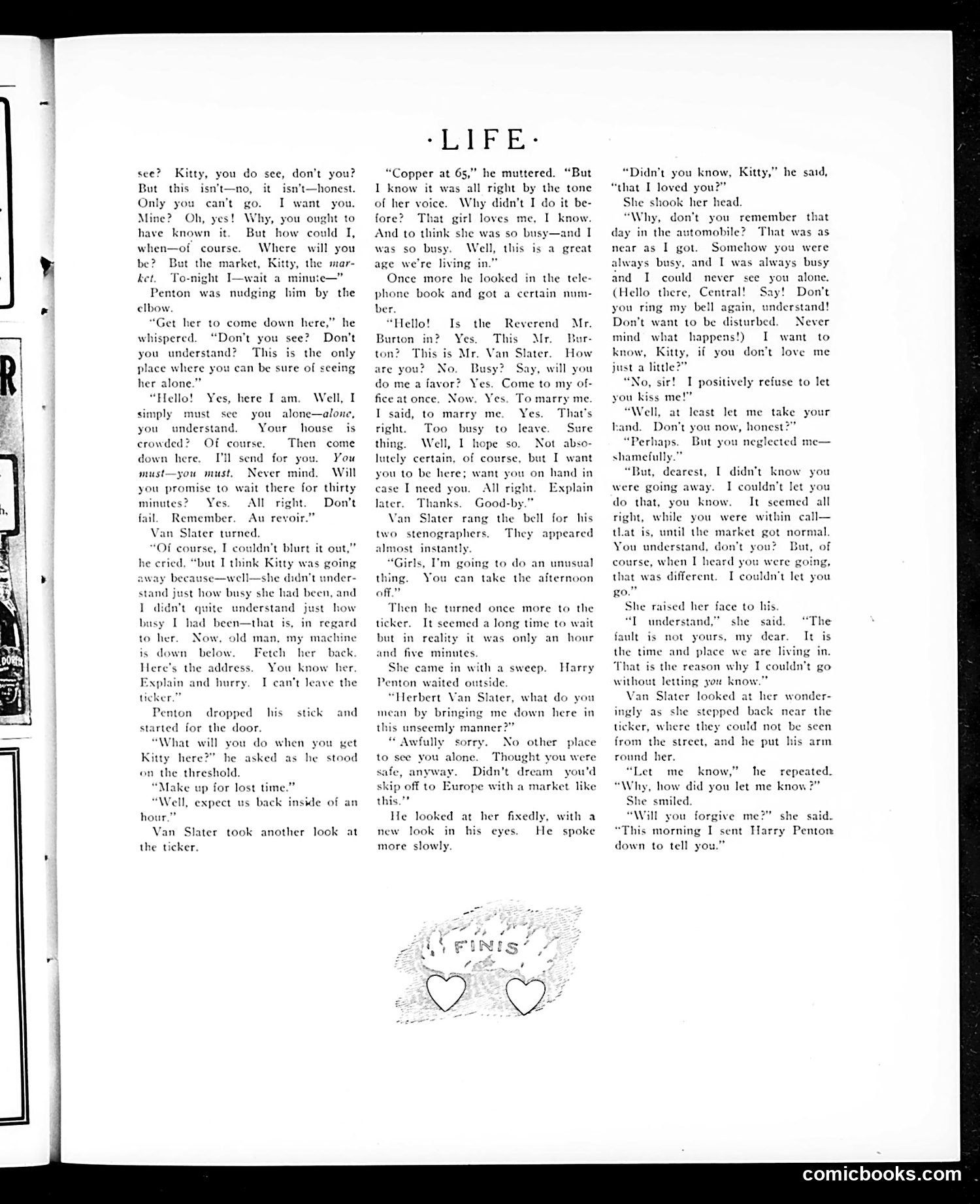
This page presents a serialized romantic story titled "Life," depicting a Wall Street broker named Herbert Van Slater who uses market activity as an excuse for neglecting his romantic interest, Kitty. The satire targets the obsession of early 20th-century businessmen with stock market trading. Van Slater is so preoccupied with ticker prices ("Copper at 65") that he cannot maintain a relationship—he's simultaneously too busy to see Kitty alone and too distracted to understand her feelings. When he finally decides to marry her, he treats it with the same urgency as a business transaction, summoning a reverend while monitoring market data. The joke mocks how American capitalism had invaded even intimate life: Van Slater can only justify his romantic attention during market closures and frames his proposal around market normalization. The decorative hearts at the page's bottom provide ironic contrast to this business-driven courtship, emphasizing how commerce has subordinated sentiment.
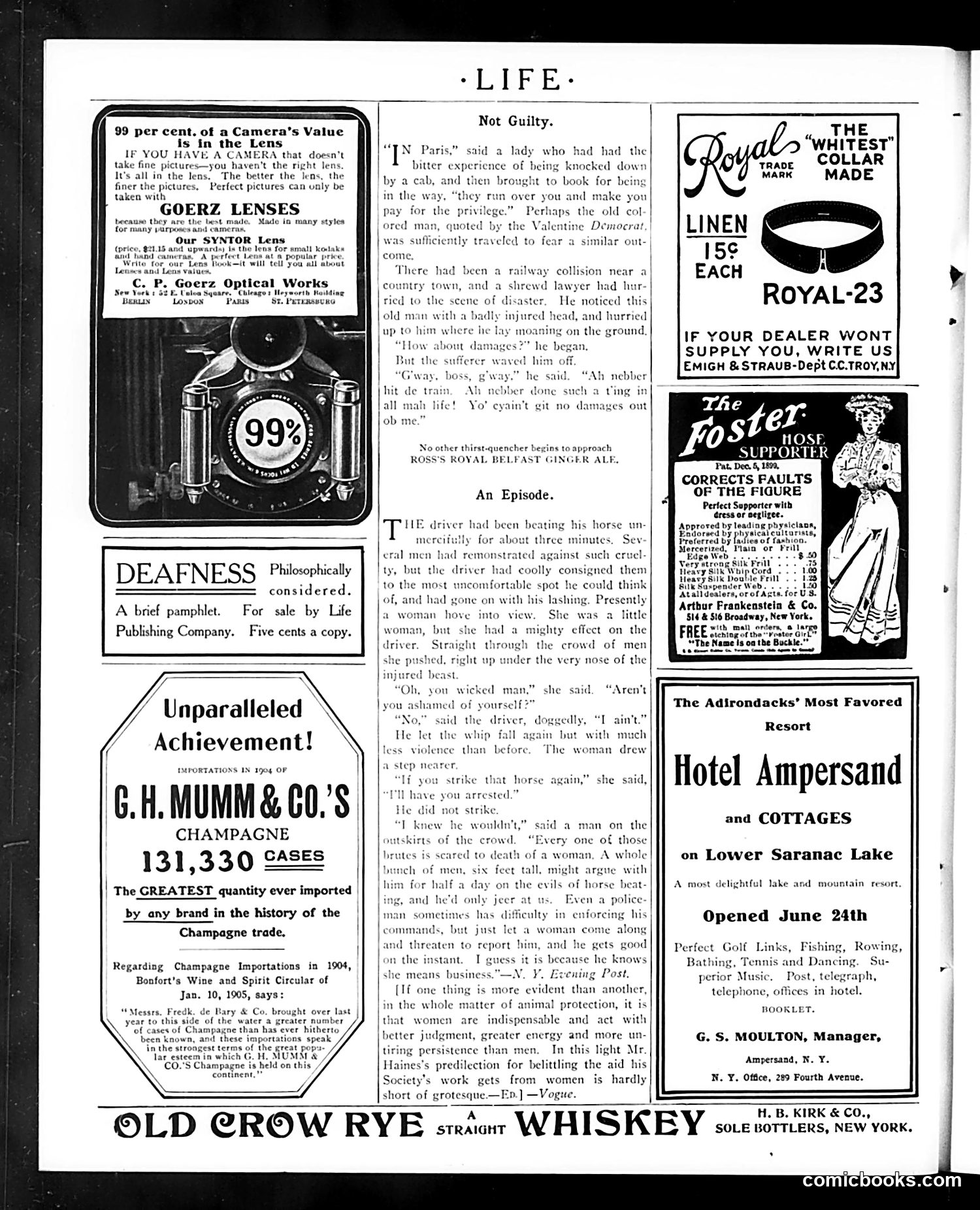
This page is primarily **advertising and miscellaneous content** rather than political cartoons. The main editorial content is a short story titled "An Episode." ## The Story "An Episode" The narrative satirizes gender dynamics and animal welfare. A cab driver brutally whips his horse in Paris. When confronted by an unnamed woman, he dismisses her concerns with casual cruelty. She threatens arrest; he laughs it off, saying "I ain't" guilty of wrongdoing. The editorial note (attributed to Vogue) uses this incident to argue that **women are far more effective advocates for animal protection than men**, displaying superior judgment, energy, and persistence. It mocks a certain "Mr. Haines" for belittling women's contributions to animal welfare societies—a jab at someone diminishing female activism. ## Context This reflects early 1900s debates about women's roles in social reform movements. The piece argues women are indispensable moral actors, not peripheral helpers—a progressive stance for the era, though framed through a patronizing lens common to the period. The remainder of the page contains advertisements for camera lenses, champagne, collars, and resort hotels—typical Life magazine commercial content.
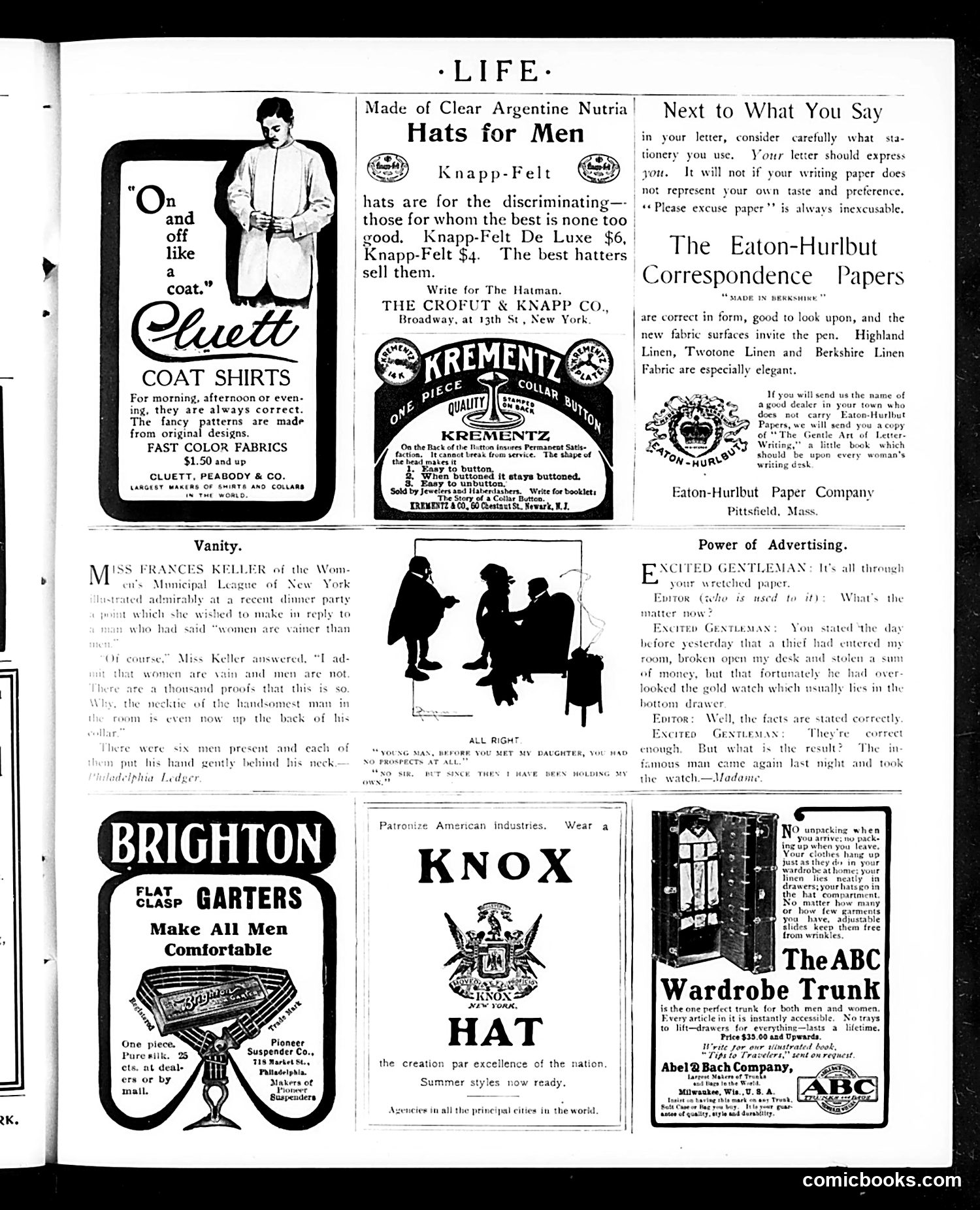
This page is primarily **advertising** with two brief satirical pieces interspersed. The main cartoons are: **"Vanity"**: Frances Keller, a women's suffrage advocate, recounts a dinner party debate where a man claimed "women are vainer than men." Keller countered by noting that six men present each secretly adjusted their neckties behind their backs—a humorous observation about male vanity contradicting their claims of superiority. The satire mocks men's hypocrisy about gender and vanity. **"Power of Advertising"**: An excited gentleman complains to the *Life* editor that after reading about a theft in the previous day's paper, a famous man visited and stole his watch from his desk drawer. The editor replies that the facts are correct but asks "what is the result?"—satirizing how newspaper coverage can inadvertently advertise crimes or create copycat incidents. The remainder consists of advertisements for men's clothing, accessories, and paper products typical of the era.
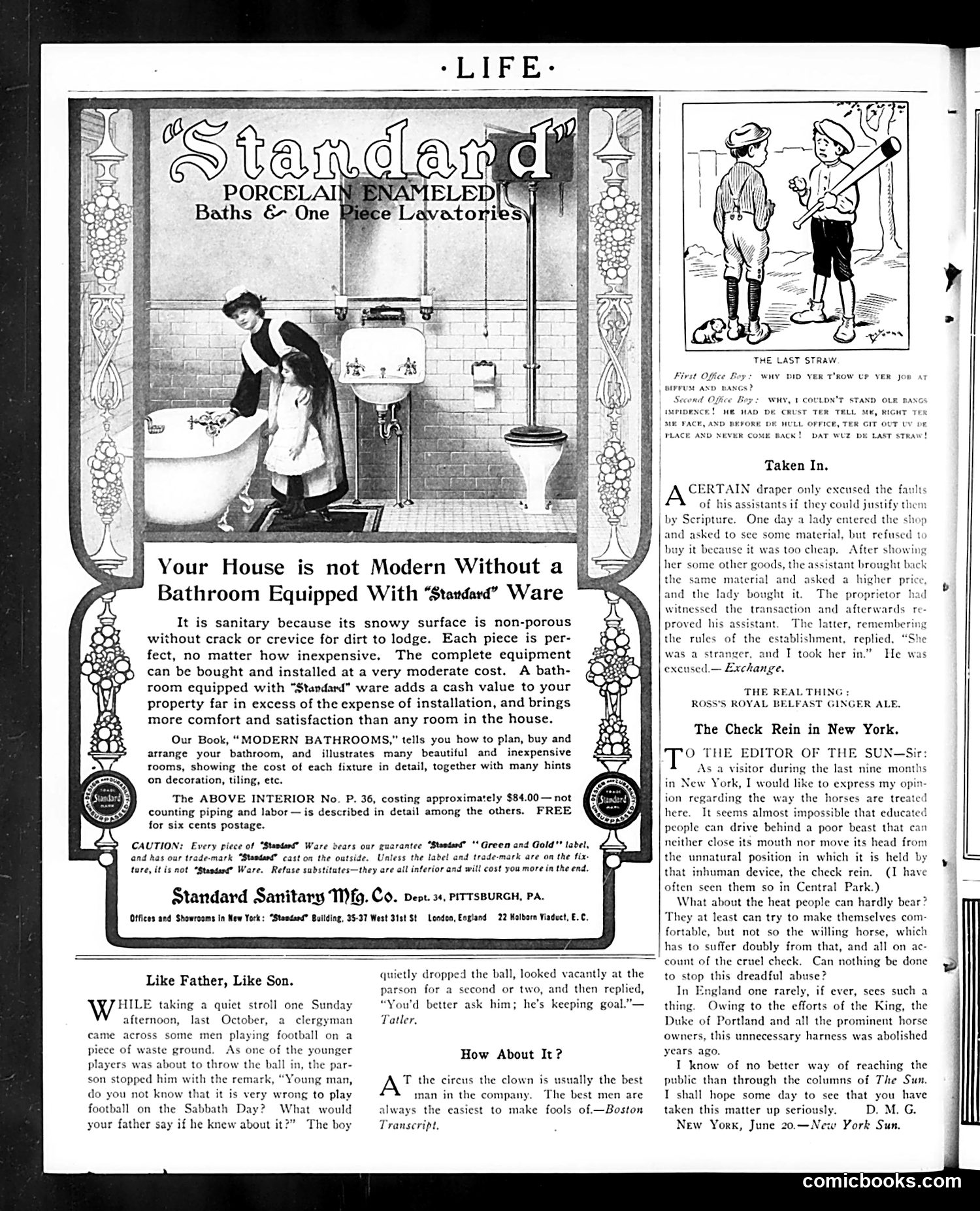
This page is primarily **advertising** for Standard Sanitary Manufacturing Company's bathroom fixtures, occupying most of the layout. The page includes several **humorous anecdotes**: 1. **"Like Father, Like Son"**: A clergyman scolds a boy for playing football on Sunday, only to learn the boy's father is participating in the game as goalkeeper—undermining the moral authority of the rebuke. 2. **"The Last Straw"**: A cartoon depicting office boys discussing why one quit his job, using working-class dialect ("ole Bangs," "de mull office"). The humor derives from the cumulative frustrations of an exasperating boss. 3. **"Taken In"**: A anecdote about a draper's assistant who deceives a customer about fabric quality, then justifies it with Scripture—satirizing religious hypocrisy. 4. **"The Check Rein in New York"**: A letter to the editor criticizing the cruel practice of check reins that restrict horses' natural head movement, advocating animal welfare. The page represents typical early-20th-century *Life* magazine content: light satirical humor mixing social commentary with consumer advertising.
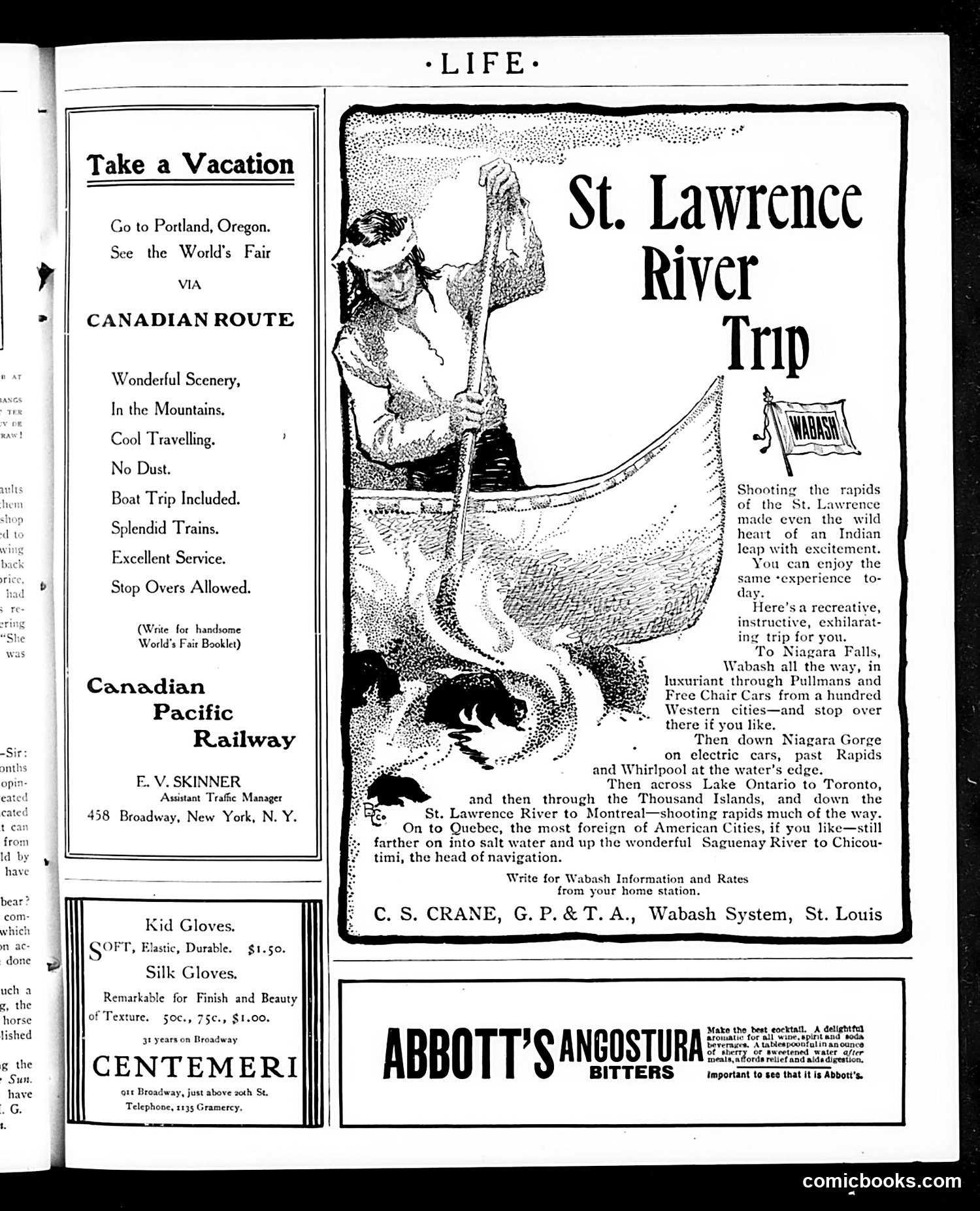
This page contains **primarily advertisements** rather than satirical cartoons. The main content advertises vacation travel and consumer products: **Travel Ads:** The Canadian Pacific Railway and Wabash System promote trips to Portland's World's Fair and St. Lawrence River excursions, featuring illustrations of scenic destinations and leisure travel—reflecting early 1900s tourism marketing. **Product Ads:** Kid gloves by Centemeri and Abbott's Angostura Bitters (a cocktail ingredient) occupy the lower portion, typical of Life's advertising revenue model. **No Political Satire:** Unlike Life's reputation for sharp social commentary, this particular page is commercially focused. The illustration of a man paddling through rapids is promotional artwork, not satirical commentary. **Historical Context:** The page reflects Gilded Age consumer culture and the appeal of exotic travel via rail, when such vacations were luxuries for the wealthy.
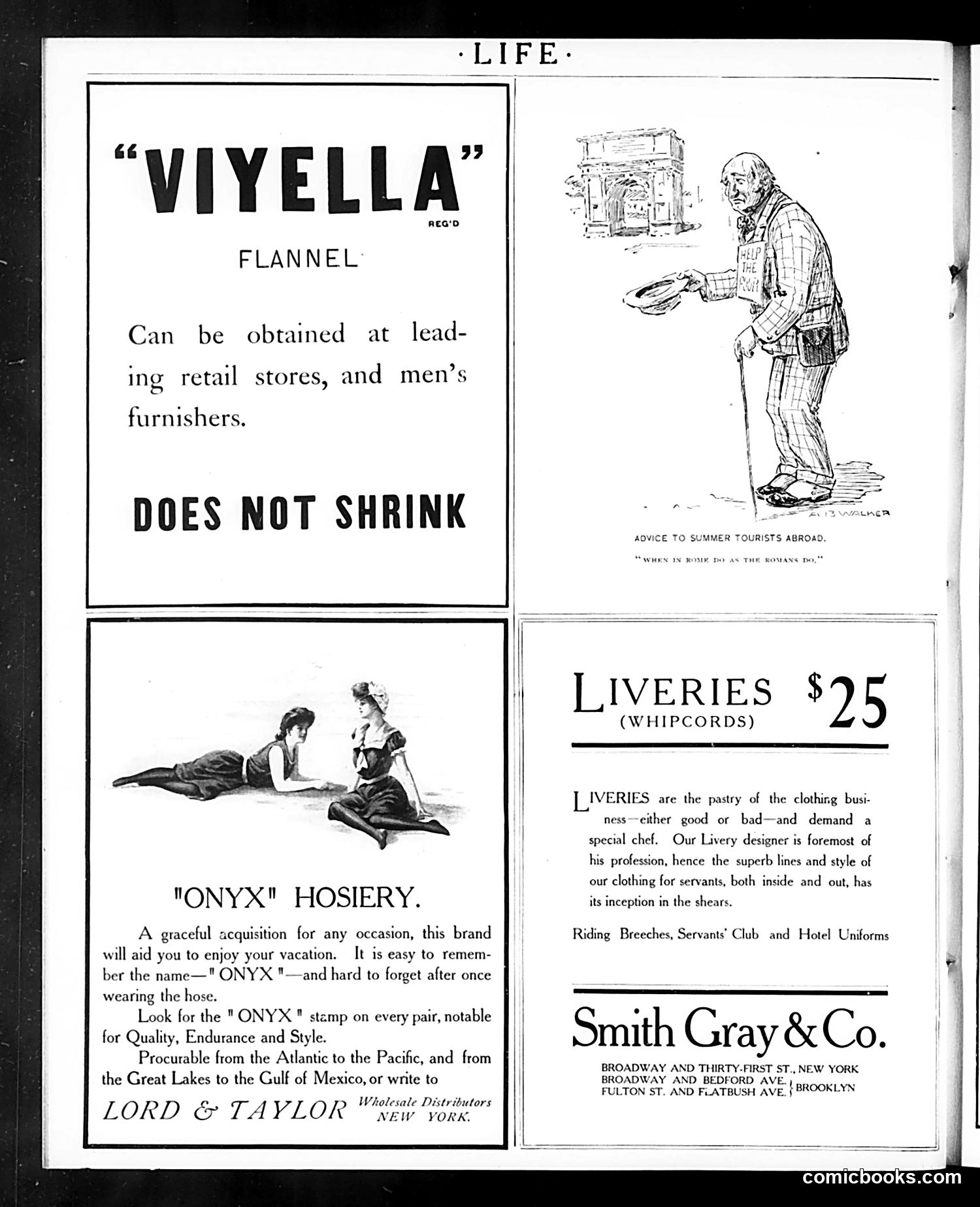
This page is primarily **advertising**, not political satire. It contains four commercial advertisements from early 20th-century America: 1. **Viyella Flannel** – promotes shrink-resistant fabric for men's clothing 2. **Onyx Hosiery** – advertises socks/stockings as vacation wear 3. **Smith Gray & Co. Liveries** – sells uniforms and formal wear for servants and hotel staff, emphasizing quality tailoring 4. An illustration labeled "Advice to Summer Tourists Abroad" shows a man with luggage, likely promoting travel-appropriate clothing The only visual humor appears in the tourist illustration, which seems a mild joke about travelers needing proper attire. The liveries advertisement's language about clothing being "the pastry of the clothing business" is playful but promotional rather than satirical. This is a typical Life magazine page from an era when the publication featured substantial advertising alongside its editorial content.
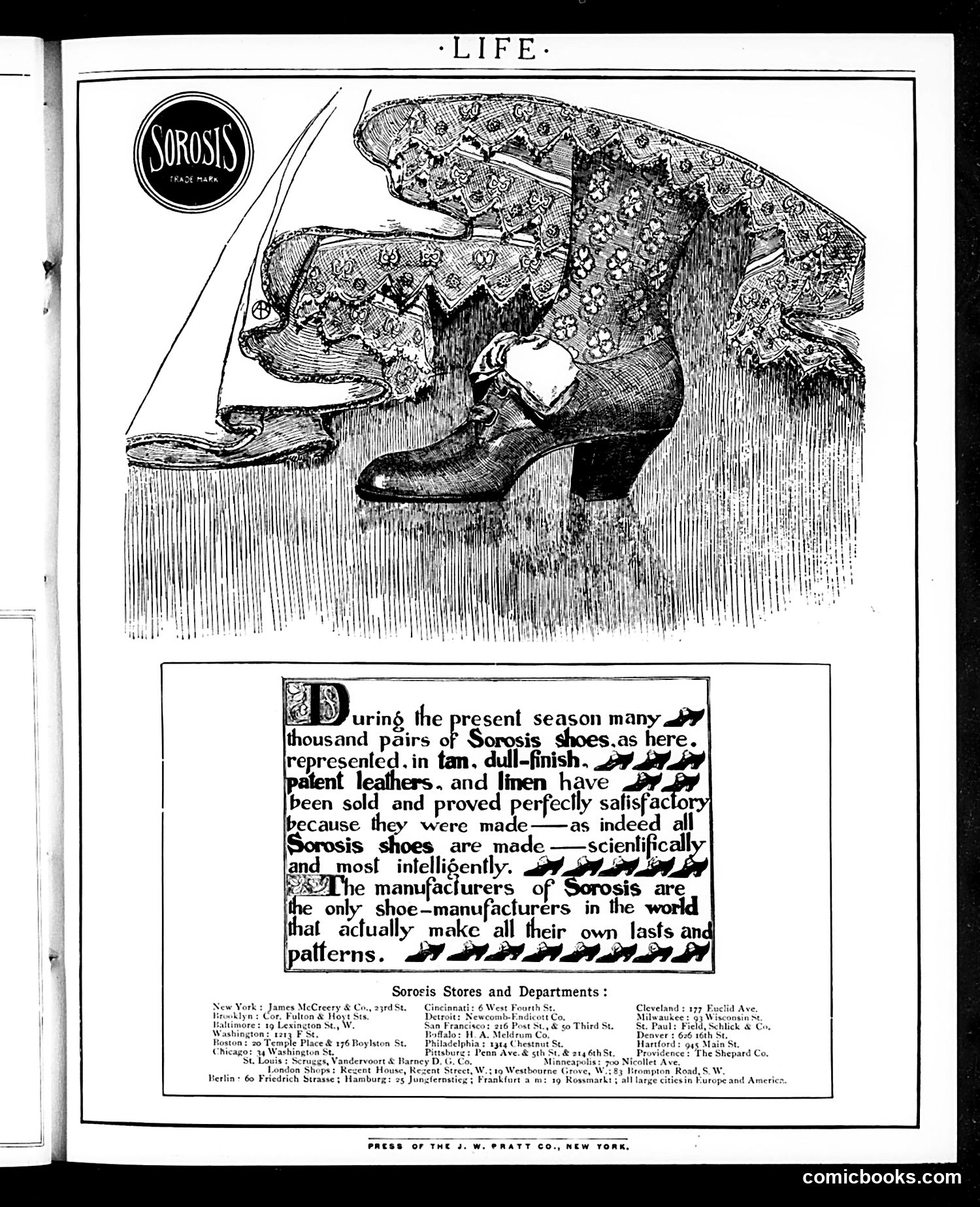
This is an **advertisement**, not political satire. It promotes Sorosis brand shoes in Life magazine. The image shows a woman in early 1900s dress examining or fitting a shoe. The text claims that thousands of pairs of Sorosis shoes have been sold successfully this season in various materials (tan, patent leather, linen). The advertisement's key marketing claim is that Sorosis manufacturers are "the only shoe-manufacturers in the world that actually make all their own lasts and patterns"—meaning they control production entirely rather than outsourcing components, supposedly ensuring quality and scientific design. The decorative shoe illustrations and list of retail locations (major U.S. and European cities) support this as a national/international brand advertisement emphasizing manufacturing superiority and widespread availability. There is no satire here—it's straightforward product promotion typical of Life's advertising content from this era.
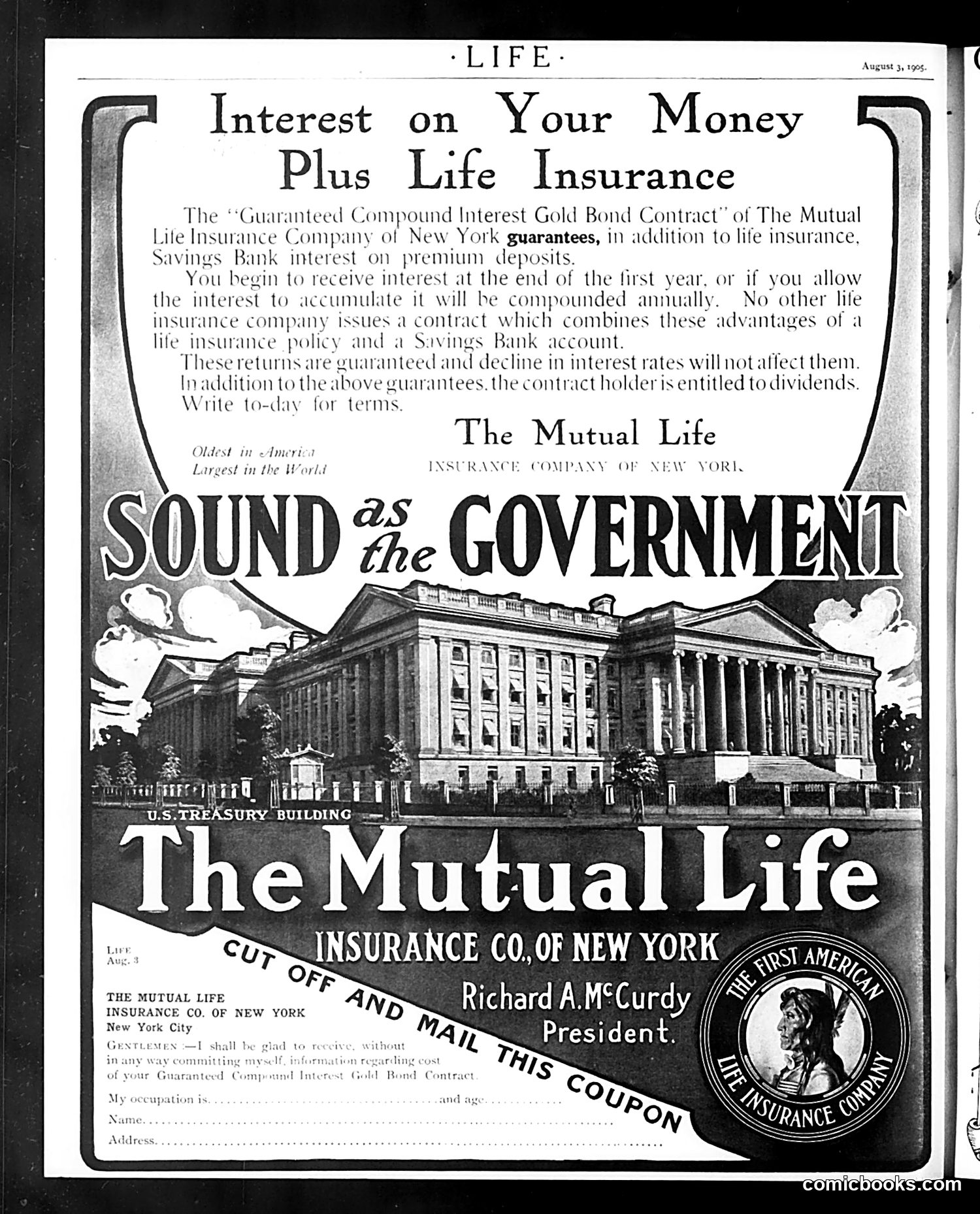
This is a **straightforward insurance advertisement**, not political satire. The Mutual Life Insurance Company of New York is promoting their "Guaranteed Compound Interest Gold Bond Contract"—a hybrid product combining life insurance with savings bank interest. The page features the company's tagline "Sound as the Government" alongside an illustration of the U.S. Treasury Building, equating the company's financial reliability with federal stability. Richard A. McCurdy is identified as President. The ad emphasizes guaranteed returns, compound interest, and dividends to attract depositors during an era when combining insurance with savings products was a novel competitive advantage. A tear-off coupon at bottom invites readers to request terms. There is **no satire or political commentary** visible—this is simply period advertising leveraging patriotic imagery and government association to build consumer confidence in a financial product.