
Life, 1905-08-03 · page 25 of 44
Life — August 3, 1905 — page 25: what you’re looking at
What you’re looking at
This poem satirizes labor strikes, specifically "sympathetic strikes" where workers refuse work to support other strikers' causes. The narrator is a child whose father participates in such a strike, refusing to work out of solidarity with others—yet his own family suffers genuine hardship: his mother must scrub clothes and pawn her rings, they can't afford rent or children's shoes, and the boy sells newspapers to help feed the family. The satire's point: the father attends union meetings where men call each other "brother" and express mutual sympathy, but he shows *no* sympathy for his own starving wife and children. His mother angrily notes the hypocrisy—these men want to "loaf an' shirk" while their families go hungry. The cartoon mocks both the self-righteousness of strike solidarity and working-class men's indifference to their families' immediate needs. It's anti-labor propaganda dressed as working-class perspective.
📄 Transcribed text from this page (OCR, searchable)
Machine-transcribed from the original scan — historical spelling and the odd misread are preserved.
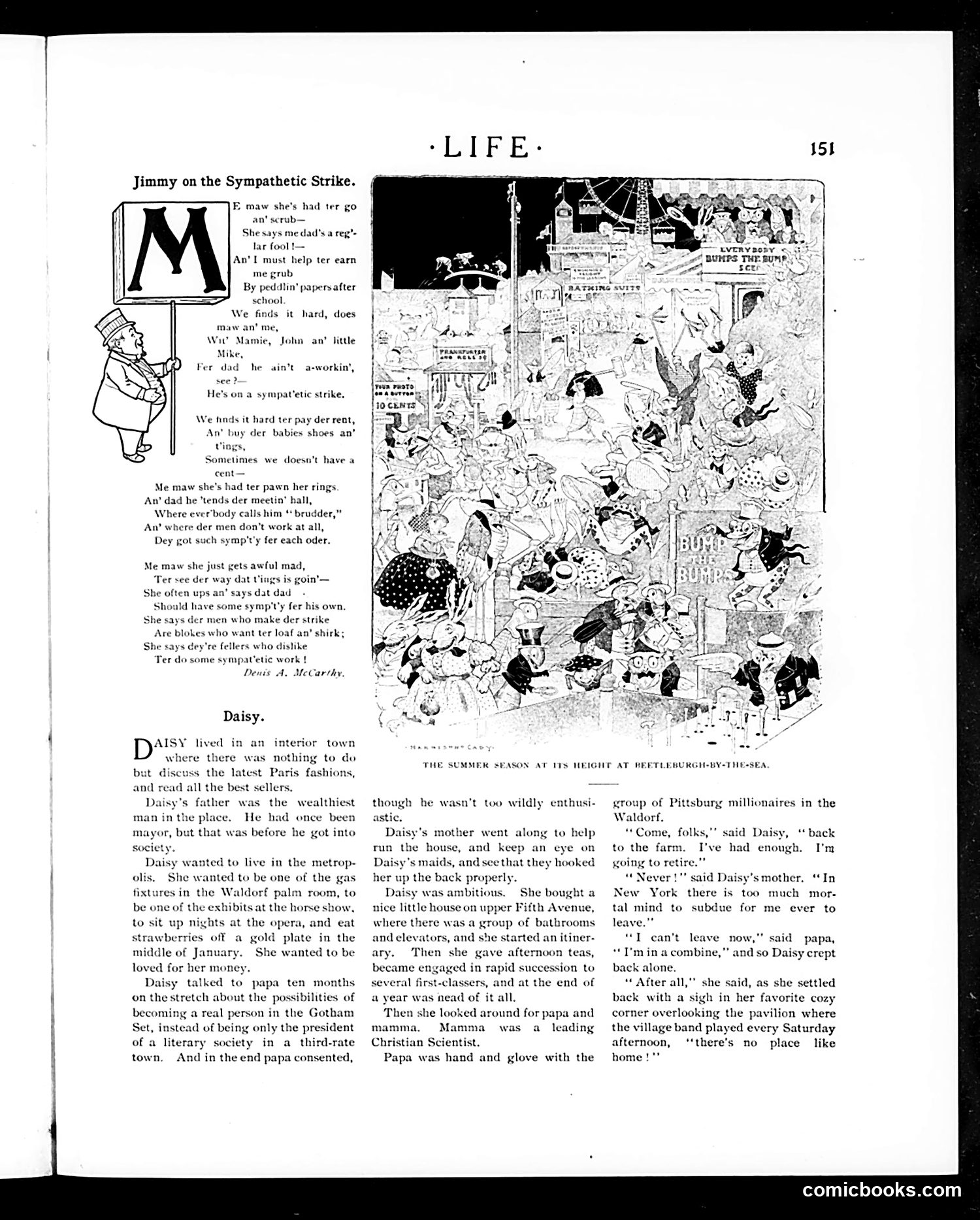
Jimmy on the Sympathetic Strike. E_ maw she’s had ter go an’ serub— She says medad’s a reg"= lar fool An’ L must b me grub By peddlin' papersafter school We finds it hard, does maw an’ me, Wit Mamie, John an’ little Mike, Fer dad h > Ip ter earn ain't a-workin’, He's on a sympat'etic strike, We finds it hard ter pay der rent, An’ buy der babies shoes an’ Vings, Sometimes we doesn’t have a cent— Me maw she’s had ter pawn her rings. An’ dad he ‘tends der meetin’ hall, Where everbody calls him “ brudder,” : der men don’t work at all, got such symp't'y fer each oder. An'w Dey Me maw she just gets awful mad, ‘Ter see der way dat Vings is goin'— She often ups an’ says dat dad Should have some symp't’y fer his own, She says der men who make der strike Are blokes who want ter loaf an’ shirk; She says dey're fel ers who dislike Ter do some sympatetic work | Denis A, McCarthy, Daisy. D** lived in an interior town where there w nothing to do atest Paris fashions, and read all the best sellers, Daisy's father was the wealthiest man in the place. He had once b mayor, but that was before he got into soci Daisy wanted to live in the metrop- olis. She wanted to be one of the gas fixtures in the Waldorf palm room, to be one of the exhibits at the horse show, to sit up nights at the opera, and eat strawberries off a gold plate in the middle of January. She wanted to be loved for her mone talked to papa ten months on the stretch about the possibilities of becoming a real person in the Gotham Set, instead of being only the pre: of a literary society in a third town, And in the end papa consented, THE SUMMEK SEASON AT 11S HEIGHT AT REETLEBURGH-BY-THE-SEA though he wasn’t too wildly enthusi- y's mother went along to help run the house, and keep an eye on Daisy's maids, and see that they hooked her up the back properly. Daisy was ambitious. She bought a nice little house on upper a group of bathrooms tors, and she started an itine: ve afternoon tea h Avenue, where there wa andele Then she gs ion to -classers, and at the end of y yas nead of it all. Then she looked around for papa mamma. Mamma was a leading Chri Papa wa and entist. hand and glove with the group of Pittsburg millionaires in the Waldorf, “Come, folks," to the farm. I sgoing to retire.’ Ne id Daisy's mother, “In New York there is too much mor- tal mind to subdue for me ever to leave aT said Daisy, * back had enough. I'm now,” said papa, and so Daisy crept alone. “ After all,” she said, as she settled back with a sigh in her favorite cozy corner overlooking the pavilion where the village band played every Saturday afternoon, ‘“there’s no place like home !"" comicbooks.com