
Life, 1905-08-03 · page 26 of 44
Life — August 3, 1905 — page 26: what you’re looking at
What you’re looking at
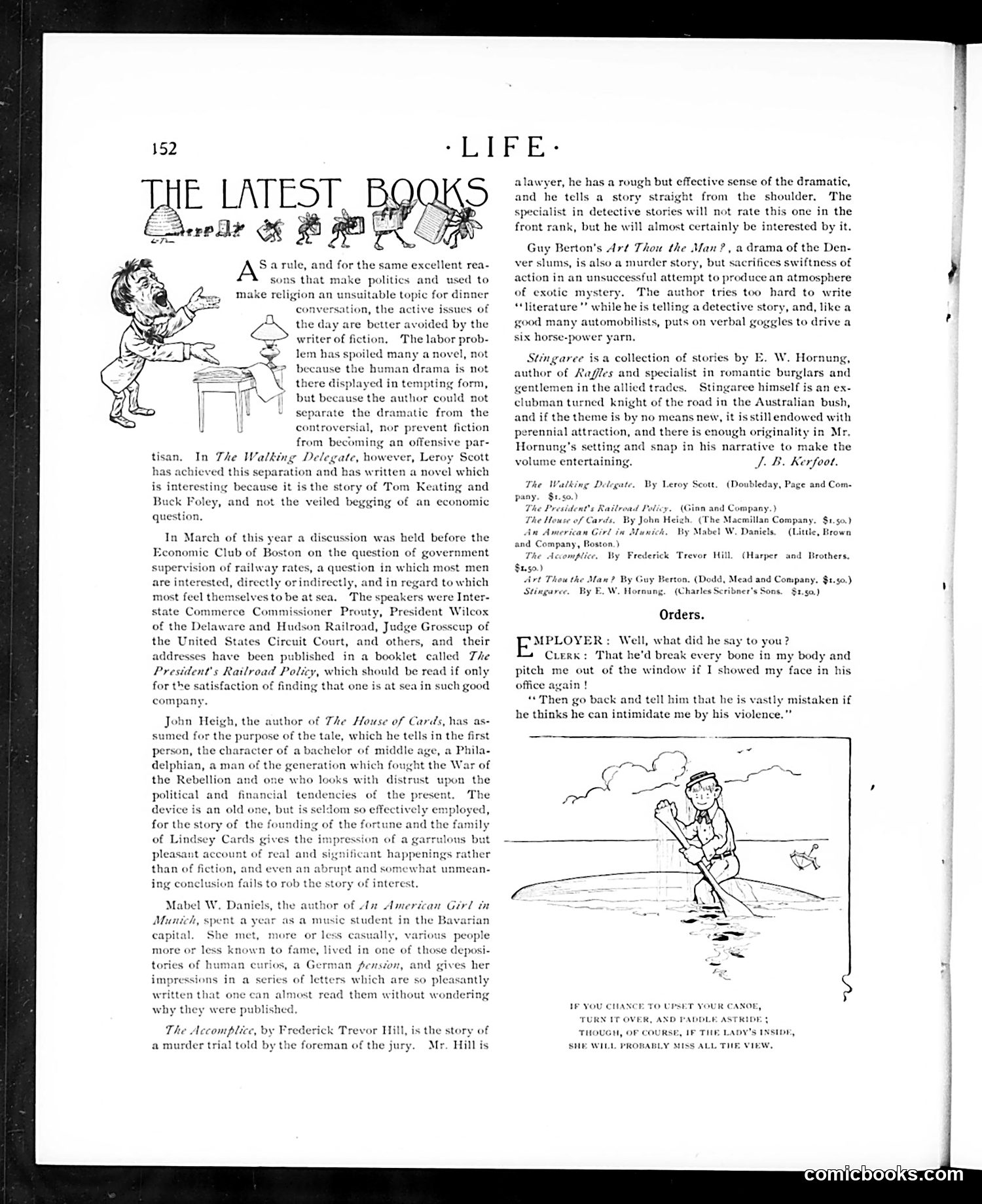
This page reviews recent books for *Life* magazine's literary section. The cartoons are decorative elements illustrating the magazine's style rather than political commentary. The text discusses novels addressing labor disputes and railroad regulation—hot political issues of the era. "The Walking Delegate" by Leroy Scott is praised for telling a story about labor organizing (Tom Keating and Buck Foley) without becoming a heavy-handed political tract. The review notes that authors often fail when mixing dramatic fiction with controversial social issues. The page also references a recent Boston Economic Club debate on government railroad rate supervision, attended by prominent figures including the Interstate Commerce Commissioner—indicating contemporary anxiety about industrial regulation and corporate power. Other reviewed books include detective stories, a novel set in pre-WWI Munich, and "Stingaree," featuring a romantic Australian outlaw. The humor is gentle literary criticism, not political satire.
📄 Transcribed text from this page (OCR, searchable)
Machine-transcribed from the original scan — historical spelling and the odd misread are preserved.
152 I E LATEST, BOQKS veedlt BRO CTs AS arule, and for the same excellent rea- sons that make politics and used to ple topic for dinner re issues of make religion an unsui « the day are better avoided by the writer of fiction. The labor prob- lem has spoiled many a novel, not nan drama there displayed in tempting form, but because the author could not separate the dramatic from the { controversial, nor prevent fiction from becoming an offensive par- In The Walking Delegate, however, Leroy Scott achieved this separation and has written a novel which t isthe story of Tom Keating and y, and not the veiled beggi aversation, the acti because the hur is not tisan, has is interesting because Buck F questic wg of an economic In March of this year a discussion was held before the Economie Club of Boston on the question of government supervision of railway rates, a que: are interested, directly orindirectly, and in regard to which most feel themselves to be ‘The speakers were Inter- state Commerce Commissioner Prouty, President Wilcox of the De ¢and Hudson Railroad, Judge Grosscup of the United States Circuit Court, and others, and their addresses have been published in a booklet called The President's Railroad Policy, which should be read if only for the satisfaction of finding that one is at sea in such good jon in which most men t sea, company. uthor of The House of Cards, has as- sumed for the purpose of the tale, which he tells in the first person, the character of a bachelor of middle age, a Phila- delphian, a man of the generation which fought the War of 0 looks with distrust upon the John Heigh, the the Rebellion and one w political and device is an old one, but for the story of the found of Lindsey Cards ¢ pleasant account of real and si than of fi ing concl Mabel W. financial tendencies of the present. The m so effectively employed, nily ¢ of the fortune and the ives the impressi n of a garrulons but ficant happenings rather upt and somewhat unmean- yn, and even an n fails to rob the story of interest. Daniels, the author of An American Girl in Munich, spent a year as a music student in the Bay: capit she met, more or less casually, various p more or less known to fame, lived in one of those deposi- te impress es of human curios, a German pension, and gives her ns in a series of lett rs which are so pleasantly written that one can almost read them without wondering why they were published. The Accomplice, by ¥ ick Trevor Hill, is the story of trial told by the foreman of the jury. Mr. Hill is a murder LIFE alawyer, he has a rough but effective sense of the dramatic, and he tells a story straight from the shoulder, ‘The specialist in detective stories will not rate this one in the front rank, but he will almost certainly be interested by it. Guy Berton's Art Thou the Man? , a drama of the Den- ver slums, is also a murder story, but sacrifices swiftness of action in an unsuccessful attempt to produce an atmosphere of exotic mystery. The author tries too hard to write “literature "’ while he is telling a detective story, and, like a good many automobilists, puts on verbal goggles to drive a six horse-power yarn, tingaree is a collection of stories by E. W. Hornung, author of Rafles and specialist in romantic burglars and gentlemen in the allied trades. Stingaree himself is an ex- clubman turned knight of the road in the Australian bush, and if the theme is by no means new, it is still endowed with perennial attraction, and there is enough originality in Mr. Hornung’s setting and snap in his narrative to make the volume entertaining. JB. Kerfoot. ¢ Walking Delegate. By Leroy Scott. (Doubleday, Page and C pany. $1.50.) The President's Raitread Policy. (Ginn and Company.) The House of Cards. rican Girl in Munich, By John Heigh. (The Macmillan Company. By Mabel W. Daniels. ( $1.50.) ttle, Brown + Boston.) By Frederick Trevor Hill. (Harper and Brothers. u the Man? By Guy Ber Stingarce. By E. (Dodd, Mead and Company. $1.30.) W. Hornung. (Charles Scribner's Sons. Orders. $2.50.) MPLOYER: Well, what did he say to you? Cierk: That he'd break every bone in my body and pitch me out of the window if I showed my face in his office a; “Then go back and tell him that he is tly mistaken if he thinks he can intimidate me by his violence. IF YOU CHANCE TO UPSET YOUR CANOE, TURN If OVER, AND PADDLE ASTRIDE 5 THOUGH, OF COURSE, IF THE LADY'S INSIDE, SHE WILL PROBABLY MISS ALL THE VIEW,