
A complete issue · 26 pages · 1905
Life — May 11, 1905
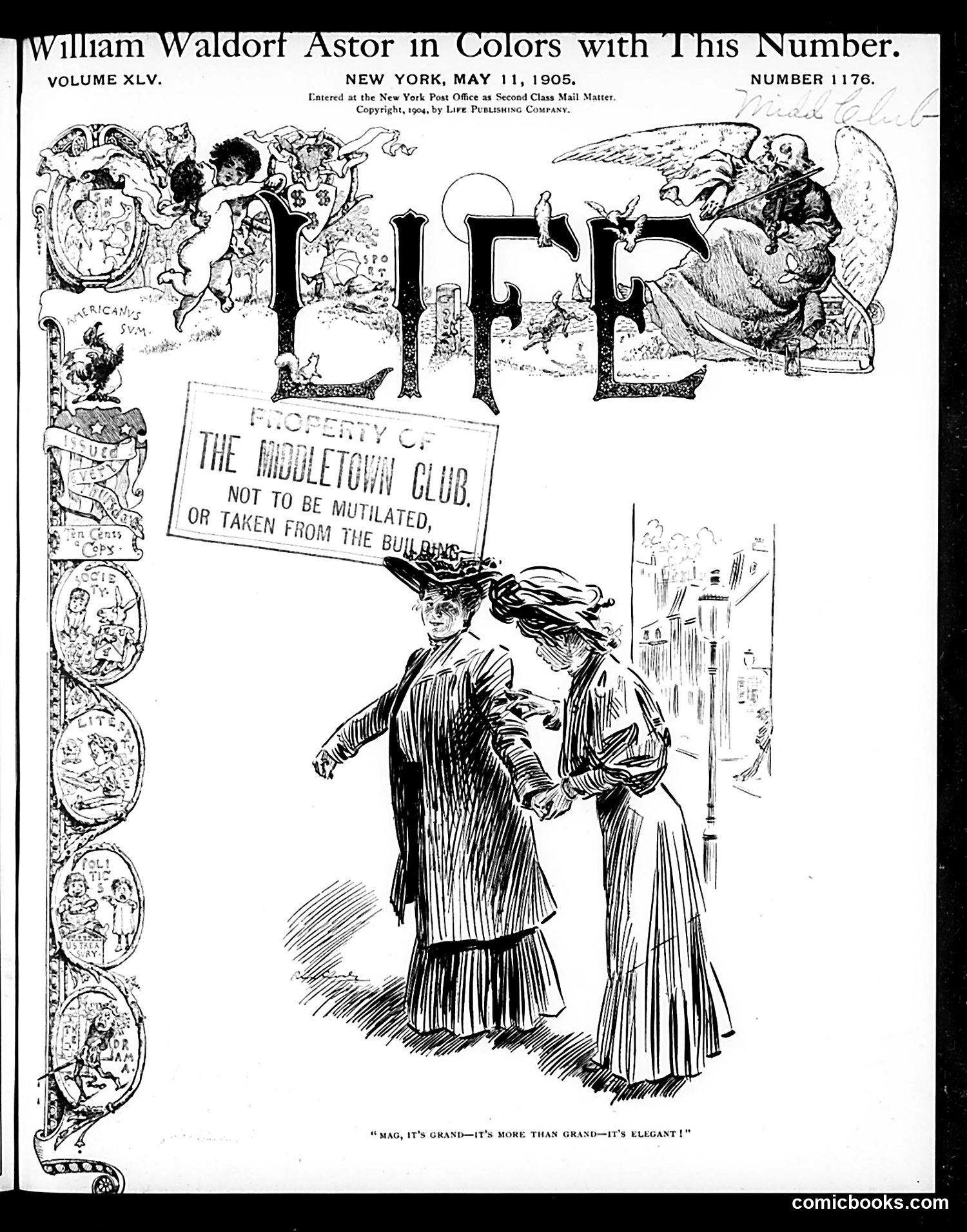
This is the cover of *Life* magazine (May 1905). The main cartoon depicts two fashionable women examining a document labeled "Property of the Middletown Club. Not to be mutilated, or taken from the building." One woman exclaims, "Mag, it's grand—it's more than grand—it's elegant!" The satire mocks the pretensions of elite social clubs and their strict property rules. The women's enthusiasm over a mere club document—treating it as a prized possession worthy of admiration—ridicules both the clubs' self-importance and the snobbish values of wealthy society members who regard club membership as the height of sophistication. The ornate decorative borders and mythological illustrations surrounding the main image reinforce the publication's satirical aesthetic.
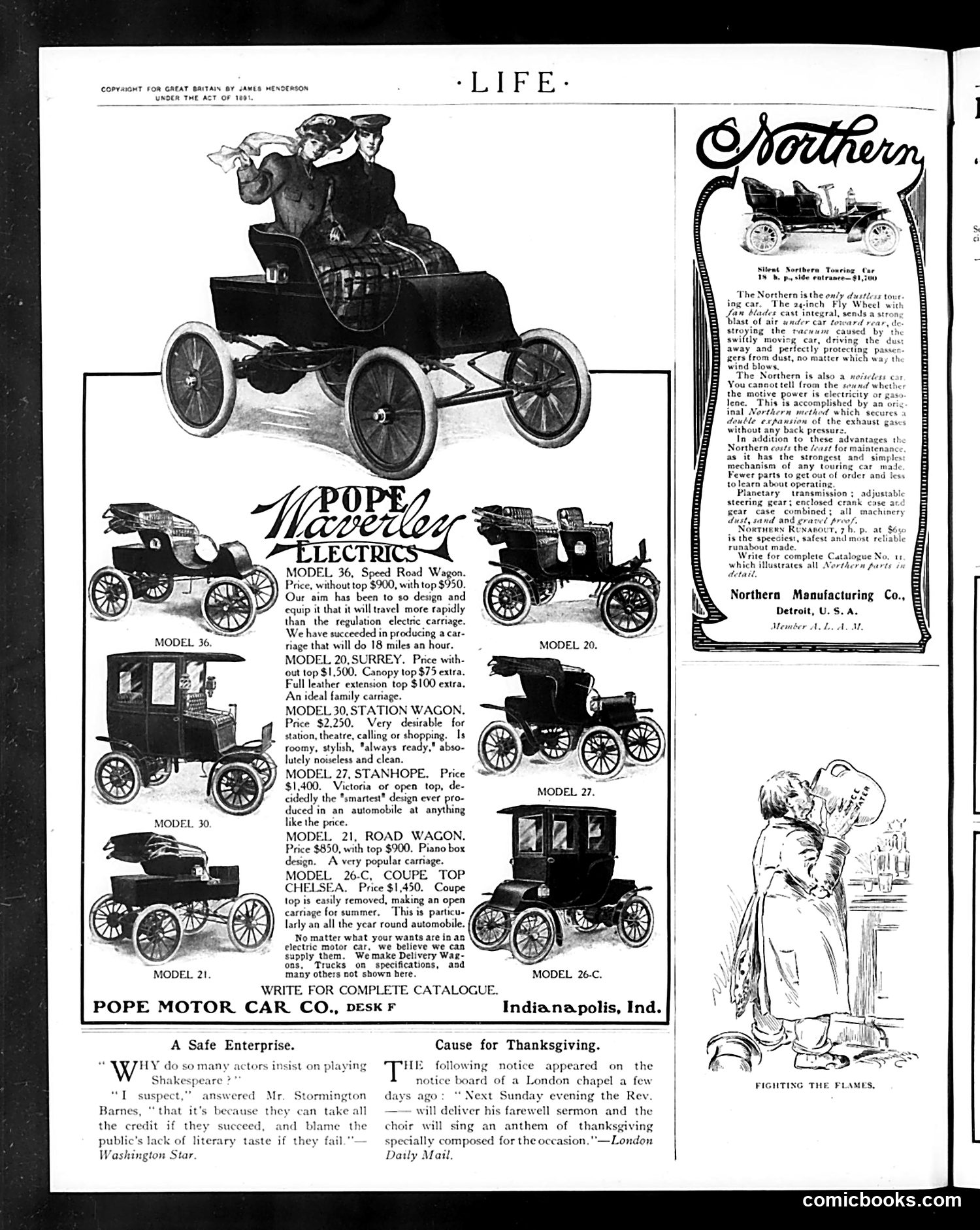
This page is primarily **advertising**, not political satire. The dominant content showcases Pope Motor Cars—multiple models (36, 20, 27, 30, 21, 26-C) displayed with specifications and prices ranging from $850 to $2,250. The top illustration shows well-dressed passengers enjoying a Pope vehicle, emphasizing luxury and comfort. The right side features a Northern Manufacturing Co. advertisement for their touring car. Below are two brief, unrelated text snippets: "A Safe Enterprise" jokes about actors taking credit for success while blaming the public for failures, and "Cause for Thanksgiving" quotes a London chapel's humorous notice about a farewell sermon. These text pieces are minor filler content typical of Life magazine's satirical sections, not the page's focus.
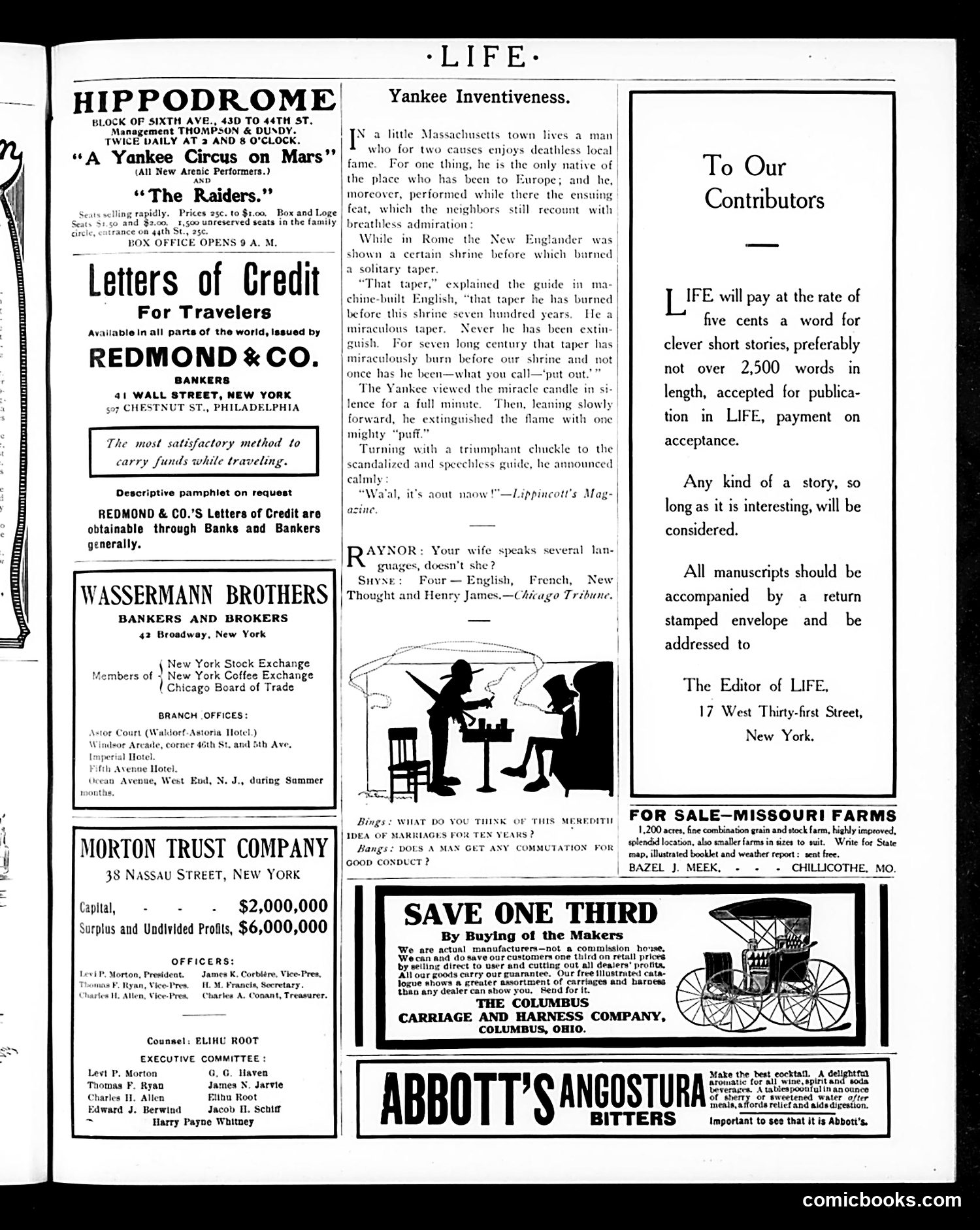
This page is primarily **advertising and editorial content** rather than political satire. The main cartoon depicts two silhouetted figures at a chess table, accompanying a dialogue about a wife who speaks multiple languages (English, French, New Thought, and Henry James). The humor is gentle domestic satire about intellectual pretension—the husband's bewilderment at his wife's affected linguistic abilities. The page otherwise contains financial services advertisements (Redmond & Co., Wassermann Brothers, Morton Trust Company) and product ads (carriages, bitters). The "Yankee Inventiveness" text discusses a tourist's experience in Rome with a centuries-old burning taper. Overall, this reflects early 20th-century middle-class magazine content mixing light humor with commercial interests.
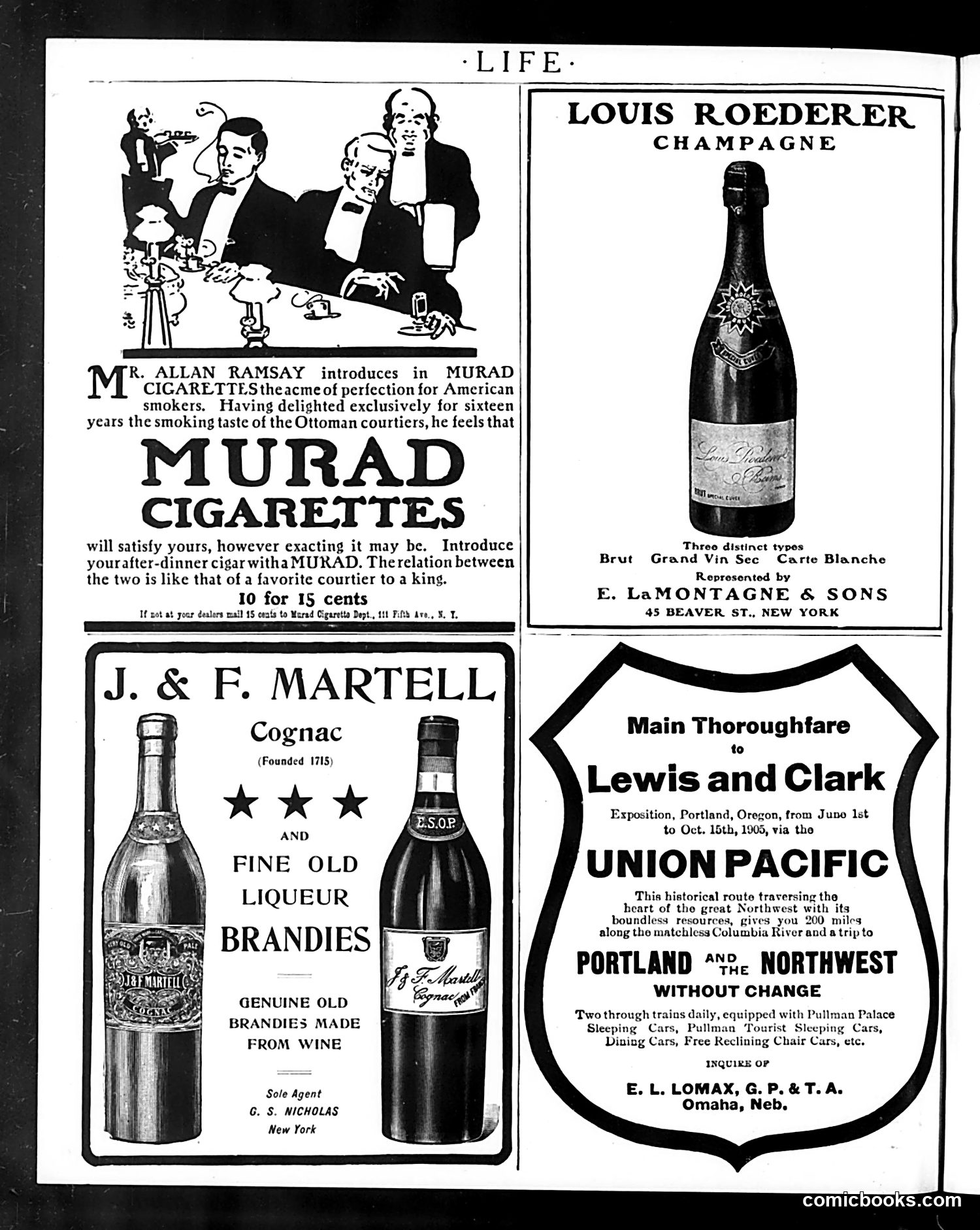
This page is **primarily advertisements** rather than satirical content. The top cartoon advertises Murad Cigarettes, featuring Mr. Allan Ramsay introducing the product at what appears to be a formal dinner party. The ad claims Murad cigarettes represent "the acme of perfection for American smokers," referencing Ramsay's supposed sixteen years enjoying "the smoking taste of the Ottoman courters." The joke is that this exotic pedigree supposedly makes them superior. The remaining three advertisements promote Louis Roederer Champagne, J. & F. Martell Cognac, and Union Pacific Railroad service to the Lewis and Clark Exposition in Portland (1905). The page reflects early 1900s luxury consumer marketing targeting affluent readers.
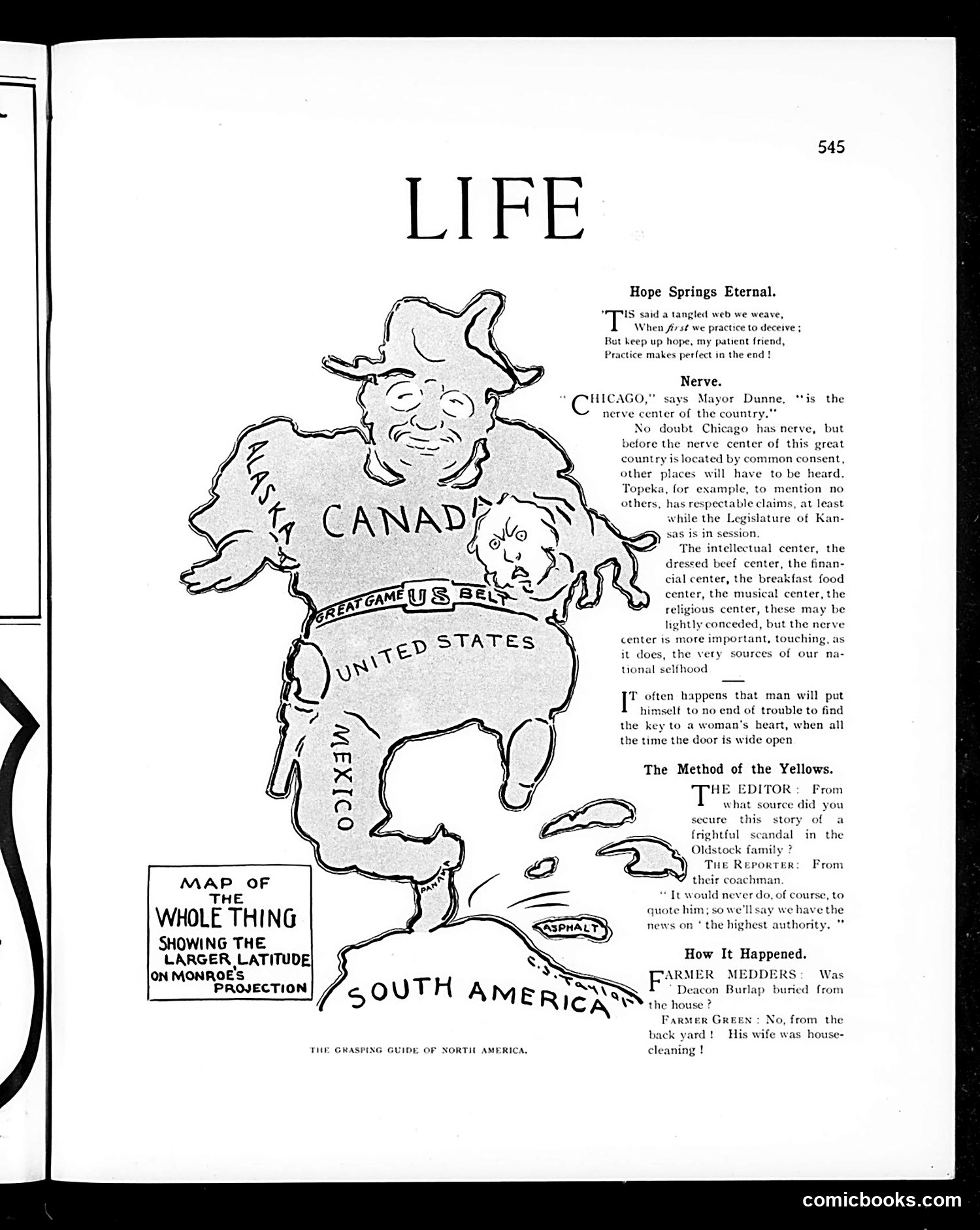
The central cartoon is a satirical map titled "Map of the Whole Thing Showing the Larger Latitude on Monroe's Projection." It depicts North America as a grotesque human figure with Canada as the head, the United States as the torso (labeled "Great Game U.S. Belt"), Mexico as the lower body, and South America as legs. This appears to satirize American expansionist ideology and the Monroe Doctrine—the principle asserting U.S. dominance over the Western Hemisphere. The caricature suggests America's consuming attitude toward neighboring territories. The "Monroe Projection" title sarcastically references President James Monroe's 1823 doctrine opposing European interference in the Americas while enabling American intervention. The accompanying text articles discuss various American cultural claims to centrality ("nerve center").
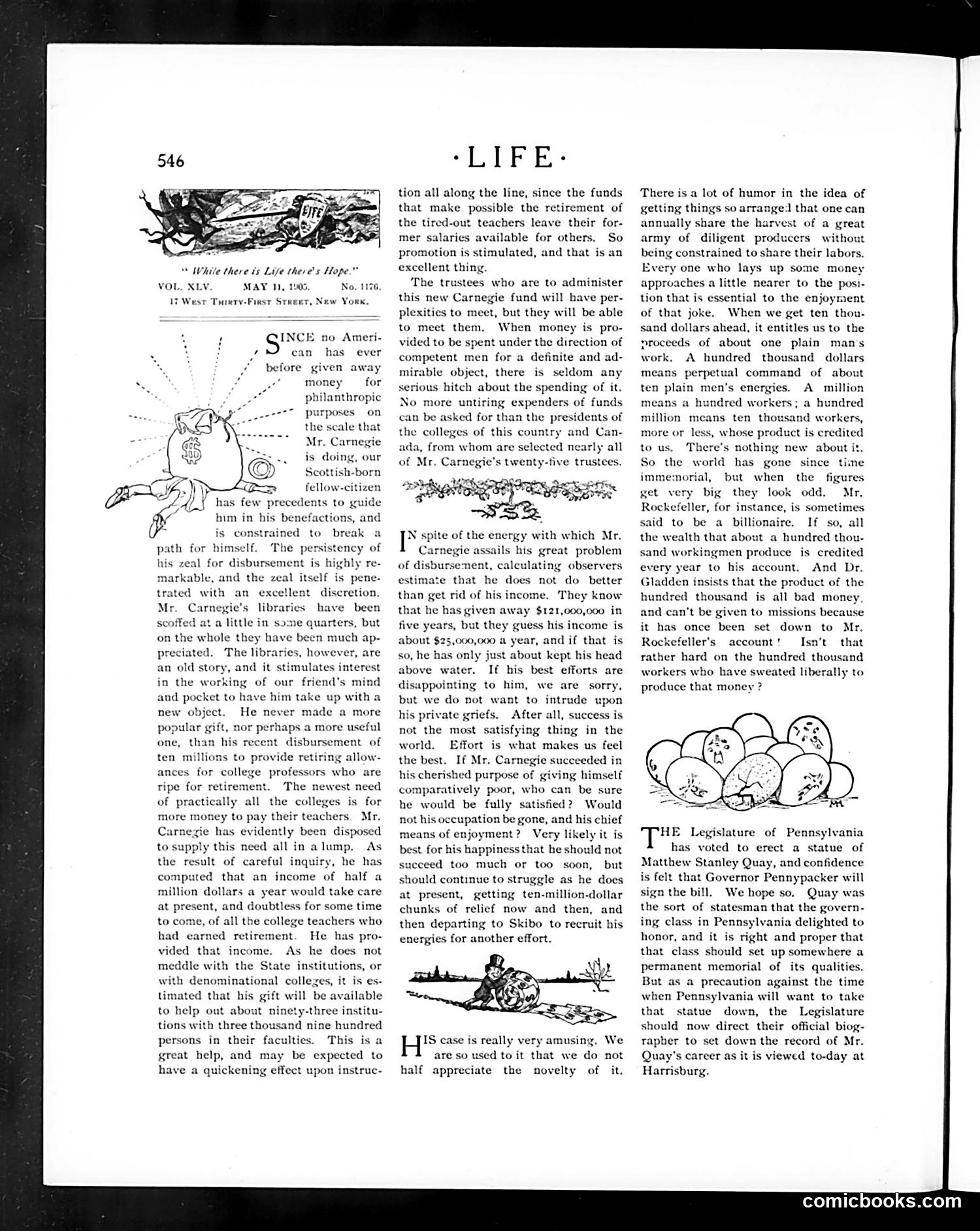
The main cartoon depicts a money bag with a dollar sign, illustrated as a character being "squeezed" or drained. This satirizes **Andrew Carnegie's philanthropic giving**. The accompanying text discusses Carnegie's massive charitable disbursements ($121 million over five years). The satire's point: Carnegie gives away enormous sums while his actual income remains disputed and mysteriously large. The cartoon suggests his wealth is inexhaustible—no matter how much he donates, more money appears. The secondary cartoon shows coins/money, reinforcing themes of abundance and financial mystery. The text also mentions **Matthew Stanley Quay** and Pennsylvania's legislature voting to erect his statue, suggesting political patronage and the glorification of wealthy industrialists. The overall satirical message critiques both Carnegie's charitable self-promotion and the era's wealth concentration among industrial magnates.
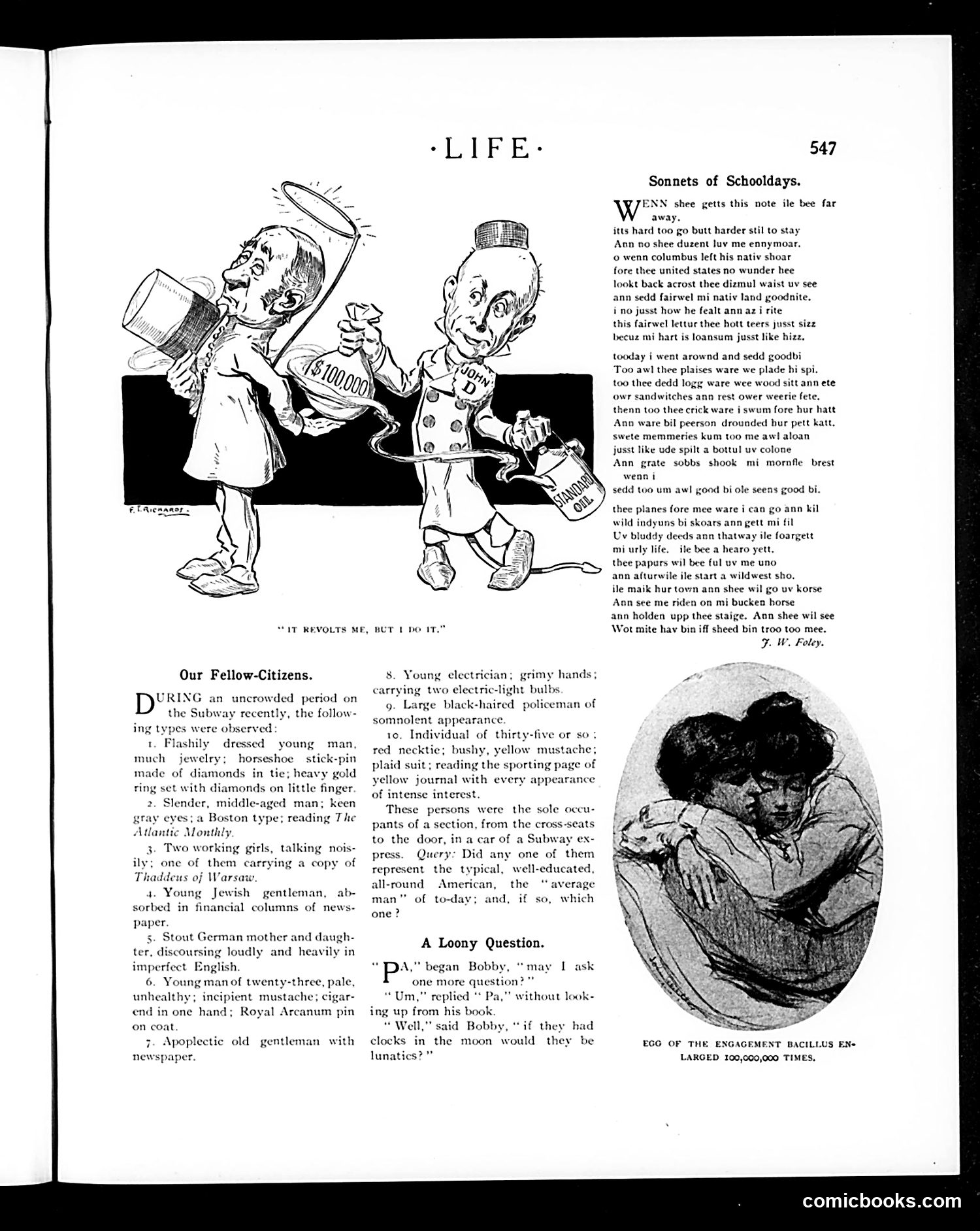
The main cartoon, titled "It Revolts Me, But I Do It," depicts two figures labeled as Columbus-era explorers or colonists. The left figure holds what appears to be a drink vessel while the right figure clutches money or documents. The satire criticizes the hypocrisy of American citizens who claim moral objection to certain practices (possibly exploitation or colonialism) while simultaneously participating in them for profit or convenience. The accompanying section "Our Fellow-Citizens" catalogs various subway passengers as social types, mocking middle-class Americans and their pretensions. Below appears "A Loony Question," a brief humorous dialogue between characters named Bobby and Pa about lunar timekeeping—lighthearted filler content typical of the era's satirical magazines.
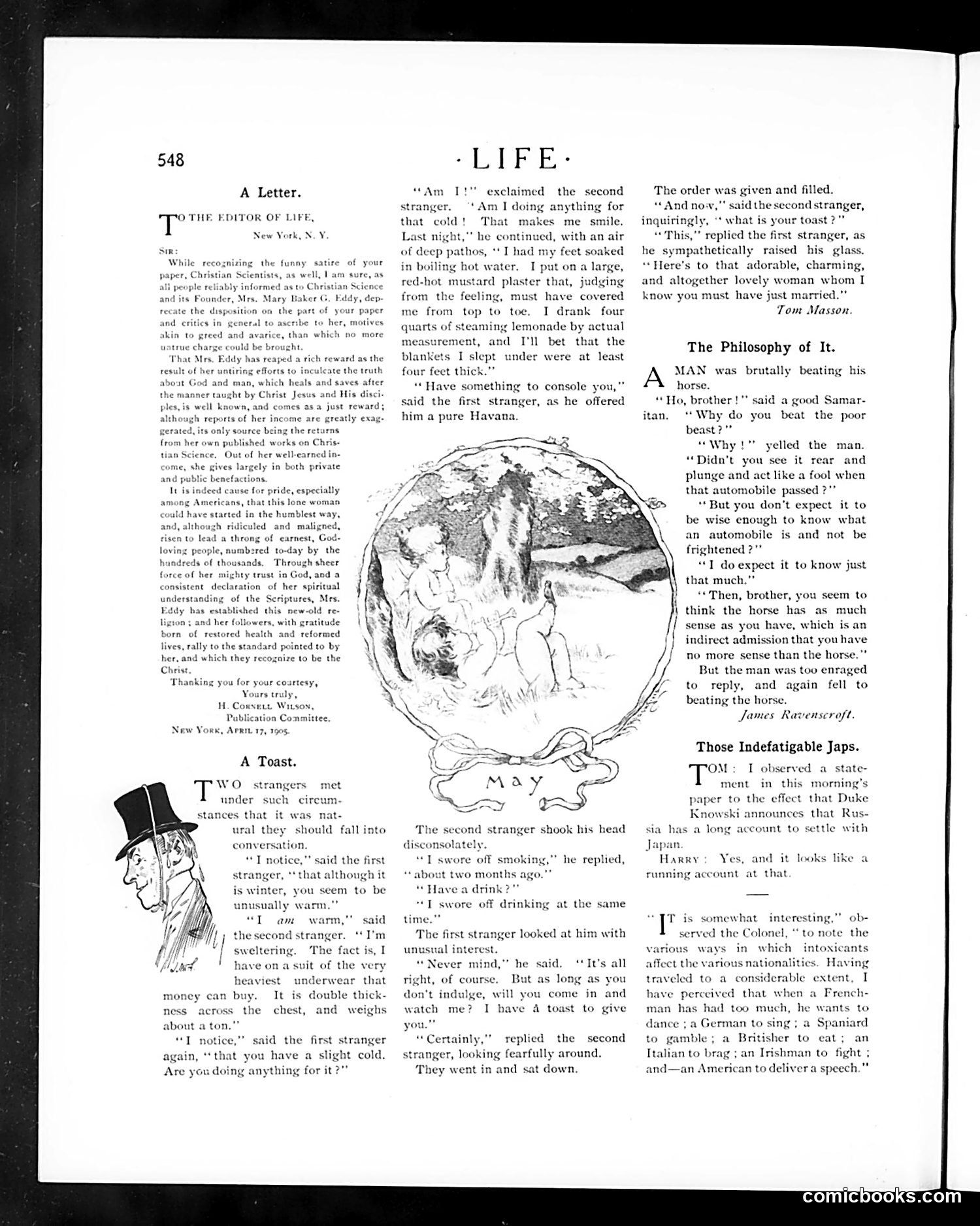
This page contains three separate pieces of satirical humor: 1. **"A Letter"** - A reader's letter praising Life's Christian Science satire, noting its effectiveness at spreading truth through humor. 2. **"A Toast"** - A cartoon dialogue between two strangers meeting in a bar. One complains of cold feet and various ailments; the other suggests increasingly absurd remedies (mustard plasters, lemonade). The cartoon mocks hypochondria and folk remedies—a common target of early 20th-century satire. 3. **"The Philosophy of It"** and **"Those Indefinable Japs"** - Brief humorous dialogues about beating a horse and national stereotypes, respectively. The latter's title reflects period attitudes toward Japanese people, using them as subjects of ethnic humor typical of the era. The page emphasizes conversational humor and social observation rather than political commentary.
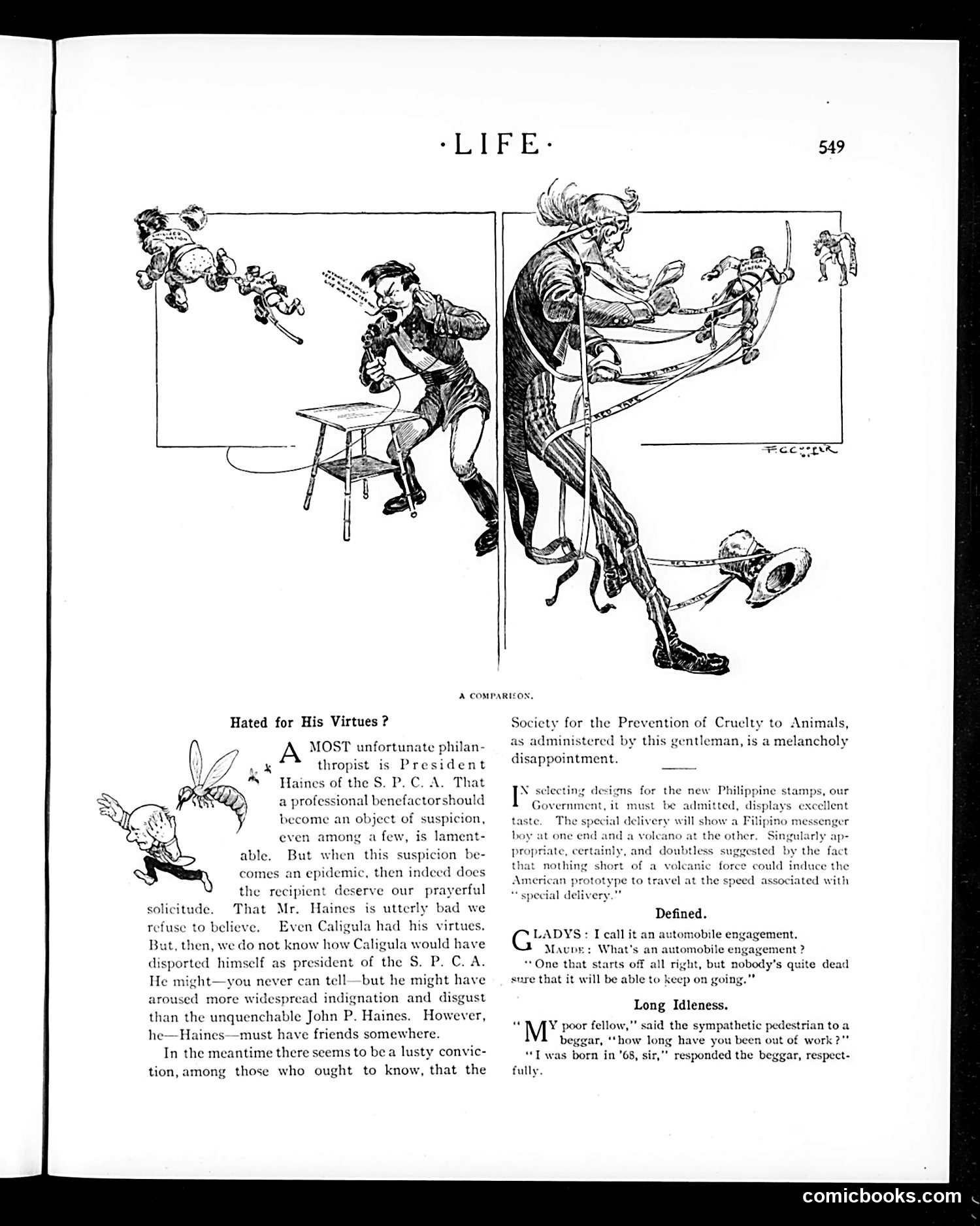
The top cartoon shows a tall, skeletal figure manipulating smaller human figures like puppets on strings—a visual metaphor for controlling or exploiting people. The article "Hated for His Virtues?" discusses President Haines of the S.P.C.A. (Society for the Prevention of Cruelty to Animals). The satire argues it's suspicious that a philanthropist devoted to animal welfare becomes an object of suspicion, even among supporters. The piece sarcastically suggests that even the notoriously cruel Roman Emperor Caligula had virtues, implying Haines deserves credit for his genuine charitable work despite societal skepticism. The page includes brief humorous definitions and anecdotes unrelated to the main cartoon or article.
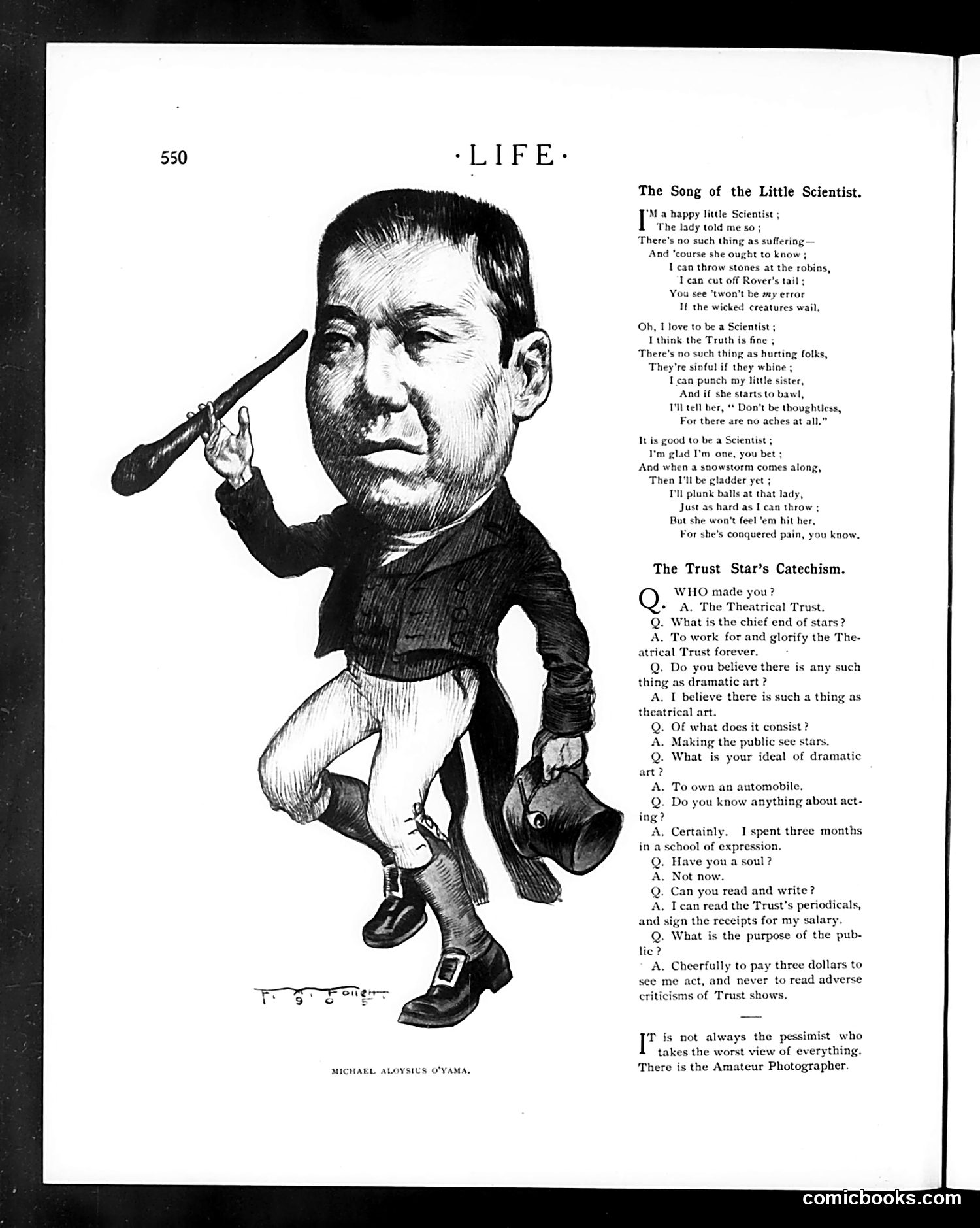
The page features a caricature labeled "MICHAEL ALOYSIUS O'YAMA" — a satirical figure depicted as an exaggerated caricatured man in formal dress holding a telescope or scientific instrument. The distorted facial features and name suggest ethnic ridicule common to early 20th-century American satire. The accompanying text includes "The Song of the Little Scientist" (mocking a character's scientific pretensions through crude humor) and "The Trust Star's Catechism" — a Q&A format satirizing theatrical monopolies (the "Theatrical Trust"). The latter mocks entertainment industry consolidation by presenting absurd answers about corporate goals and artistic integrity. The overall page targets both individual pretension and corporate monopoly practices through exaggeration and mockery typical of Life's satirical approach.
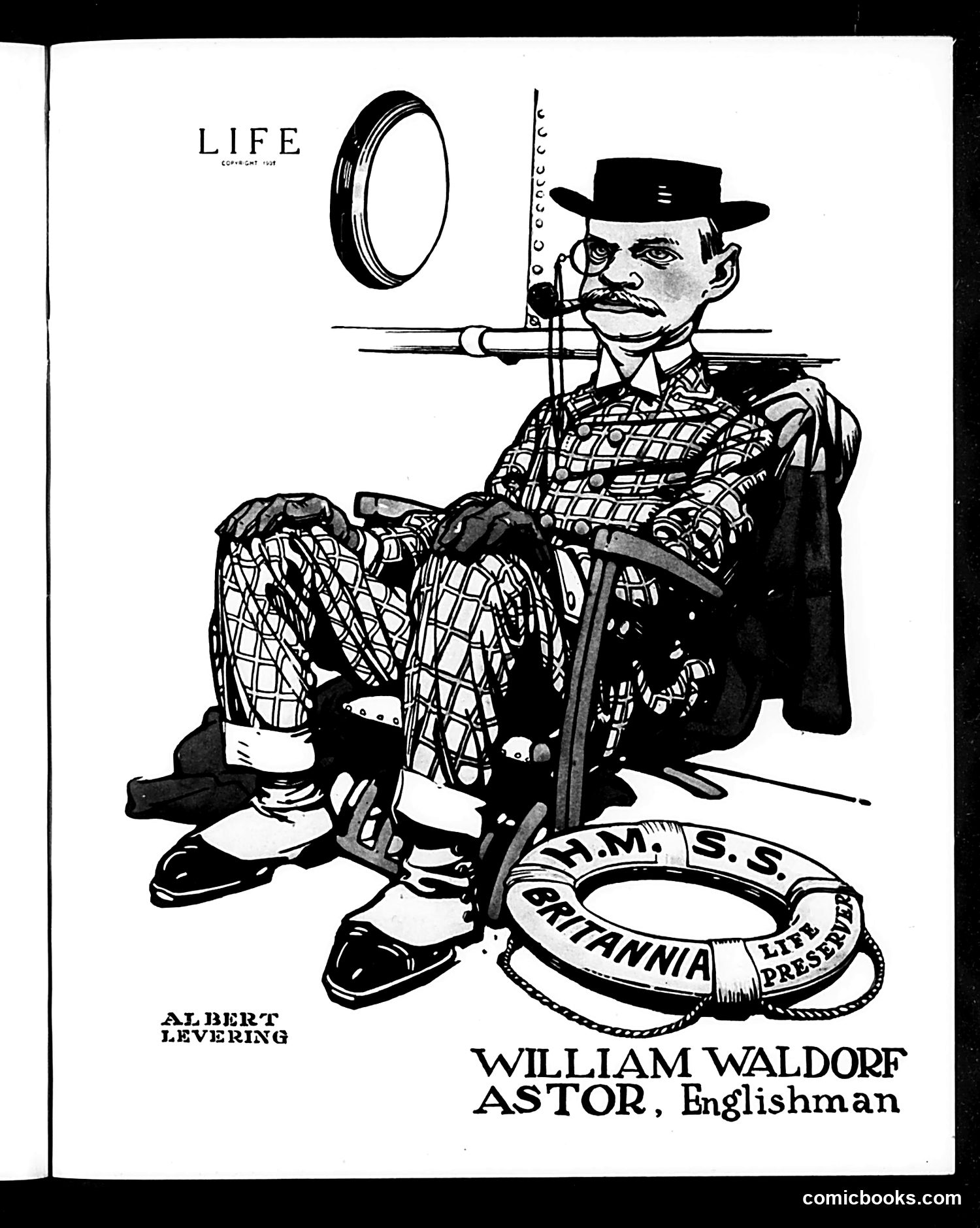
This is a satirical illustration from *Life* magazine titled "William Waldorf Astor, Englishman" by artist Albert Levering. The cartoon depicts Astor as a caricatured figure in checkered clothing, holding a surveying instrument, with a life preserver labeled "S.S. Britannia" at his feet. The satire appears to mock Astor's adoption of English identity and mannerisms. A wealthy American industrialist, Astor apparently renounced his American citizenship to become English, which the cartoon criticizes through exaggerated dress and the life preserver—suggesting he's abandoning his American ship for a British one. The visual joke emphasizes his transformation from American businessman to would-be Englishman, likely commentary on wealthy Americans' aspirations to European aristocracy during the Gilded Age.

I appreciate your question, but I must be honest: the image you've provided appears to be a blank or nearly blank white page with dark borders, likely a scanning artifact or blank page from the magazine. There is no visible cartoon, illustration, text, or content that I can discern to analyze. Without being able to see actual comic panels, caricatures, or satirical illustrations, I cannot identify political figures, explain historical references, or interpret the satire as you've requested. If you have a different image of an actual Life magazine page with visible content, I'd be happy to analyze it according to your guidelines. Please resubmit a clearer image with visible cartoon or editorial content.
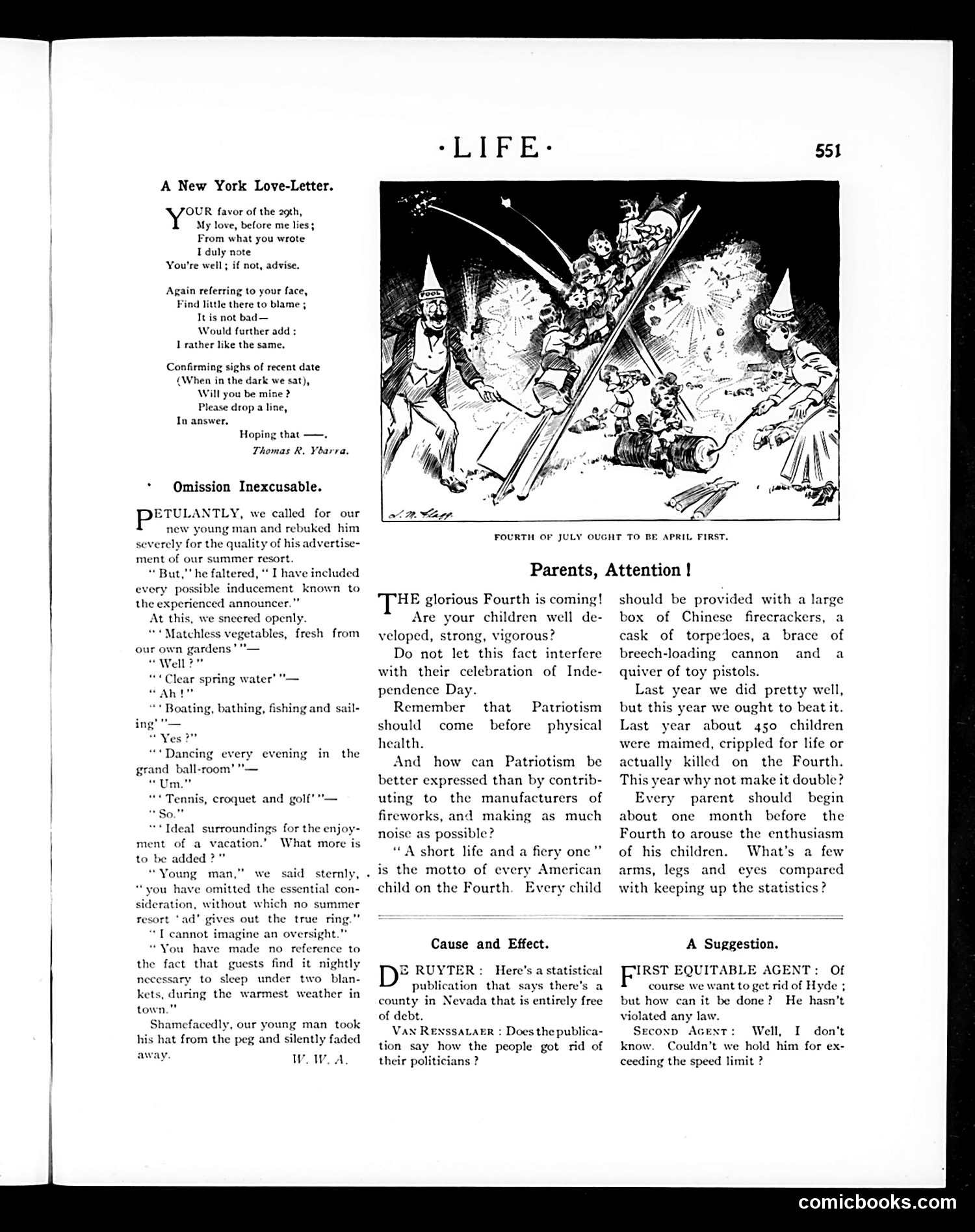
**The Main Cartoon** ("Fourth of July Ought to Be April First"): This is biting satire about Fourth of July celebrations and children's safety. The image depicts chaotic holiday revelry with fireworks and toys. The accompanying text sarcastically celebrates dangerous practices: it "recommends" giving children Chinese firecrackers, cannons, and toy pistols, noting that last year "about 450 children were maimed, crippled for life or actually killed on the Fourth." The satire argues for making it "double" this year—darkly mocking the American tradition of prioritizing patriotic noise-making over child welfare. **Supporting Content**: - A love letter parody by Thomas R. Ybarra offers mild romantic humor - A resort advertisement critique jokes about missing the detail that guests need two blankets even in summer heat - Brief dialogue jokes about political corruption and traffic enforcement **The Point**: Life magazine uses savage irony to condemn the preventable deaths and injuries inflicted on children during Fourth of July celebrations, exposing how patriotic fervor overrides safety concerns.
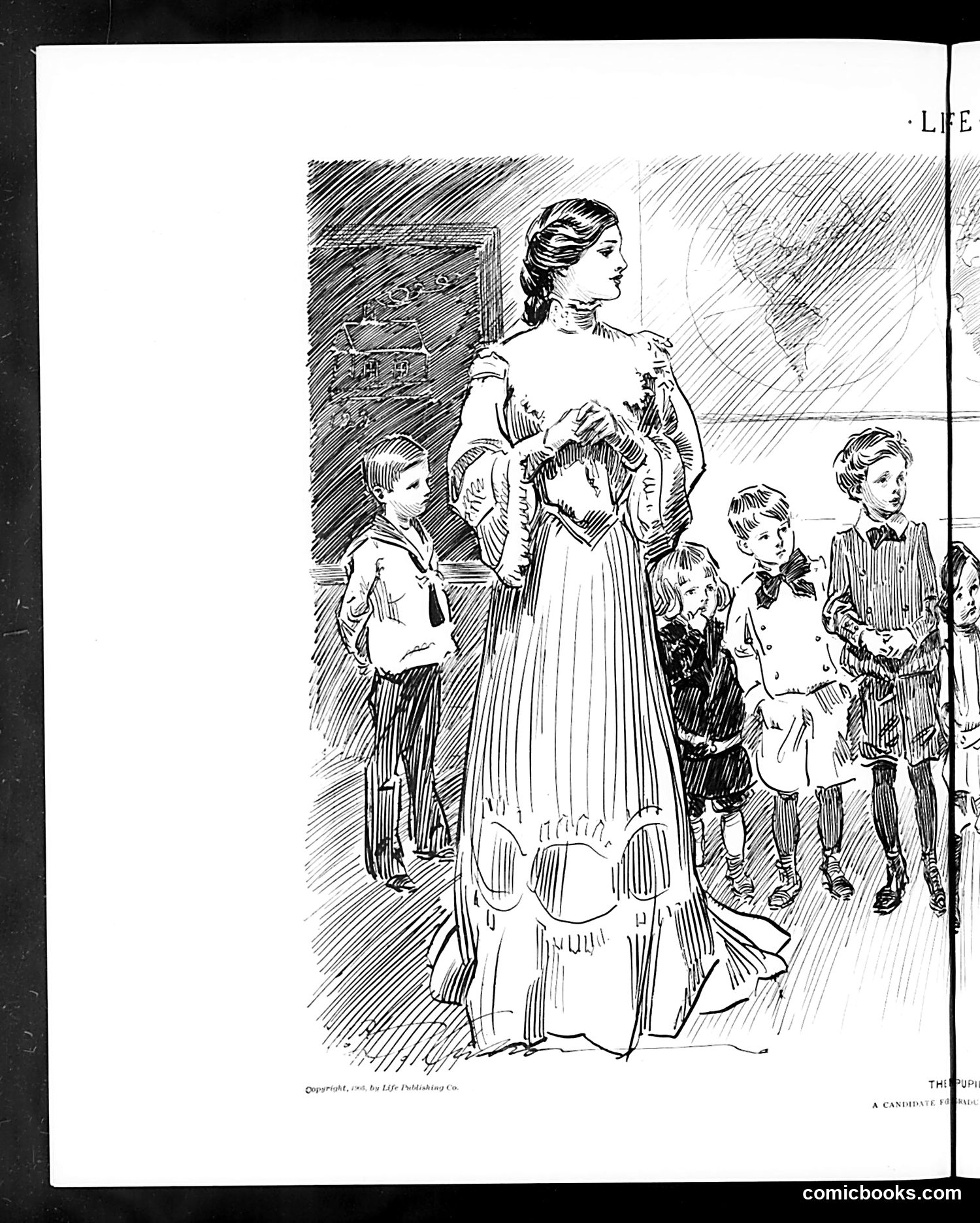
This appears to be a satirical illustration from *Life* magazine depicting a woman (likely a political candidate or public figure) surrounded by children of various ages and appearances. The woman stands prominently in an elegant dress, positioned as a maternal or leadership figure. The caption text is partially illegible in this reproduction, but the composition suggests social or political commentary on motherhood, leadership, or child welfare—common themes in early 20th-century American satire. The diverse presentation of the children may reference immigration, class divisions, or social responsibility. Without clearer text or publication date, the specific political target remains unclear, though the maternal symbolism was frequently used in period satire to critique politicians' or reformers' policies toward children and families.
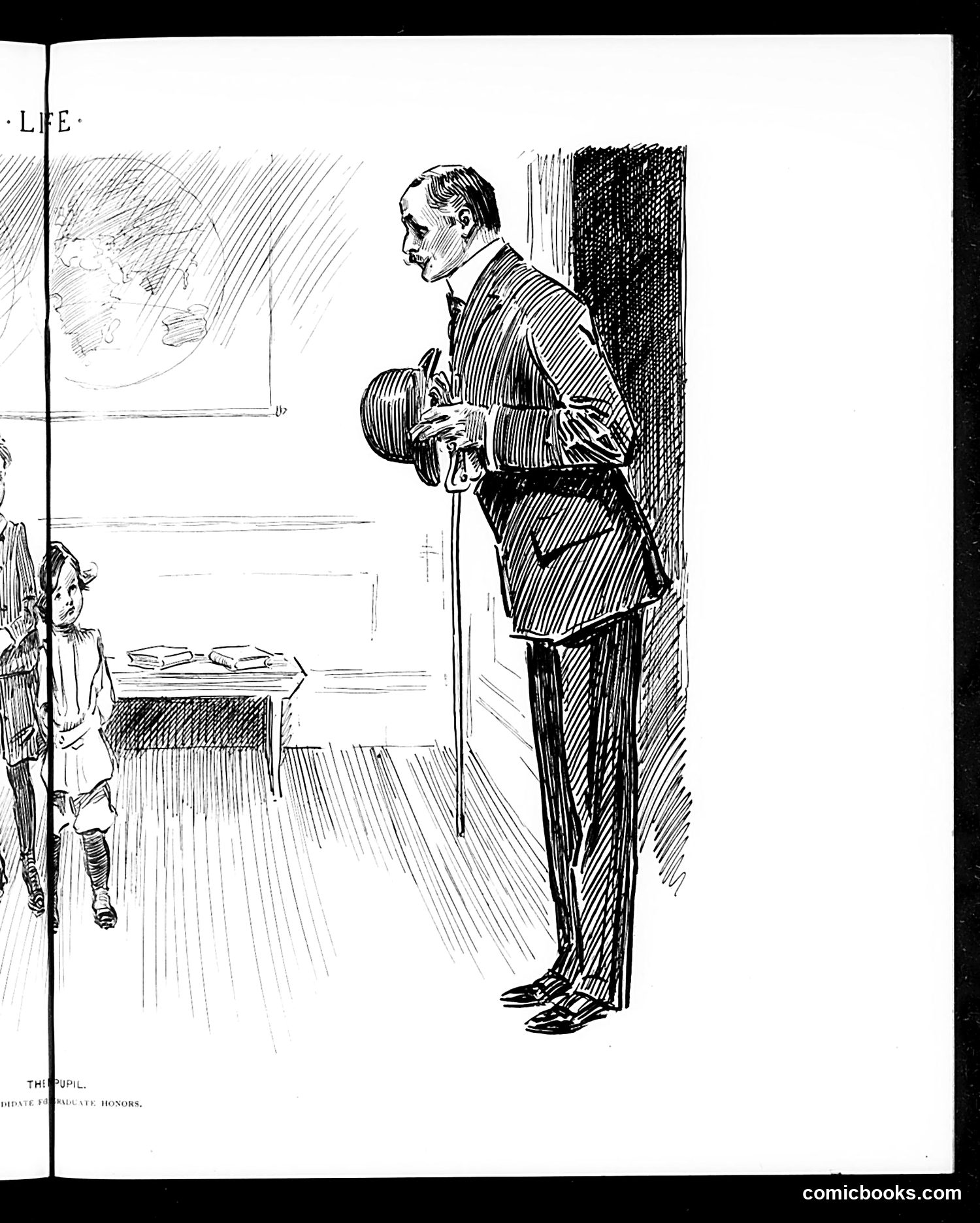
This is a satirical cartoon from Life magazine showing a well-dressed man in profile standing against a wall, holding what appears to be a hat or bowl. A young child on the left observes him with apparent concern or curiosity. The caption reads "THE PUPIL" with partial text below mentioning "EDUCATE FOR MANLY HONORS" (partially obscured). **What it means:** The cartoon appears to satirize education or character development, likely depicting an adult role model in a compromised or undignified position being observed by a youth. The juxtaposition suggests irony about how children learn values—the "manly honors" referenced in the caption contrast sharply with the man's apparent degradation or begging posture. The specific social commentary remains unclear without fuller context or date information.
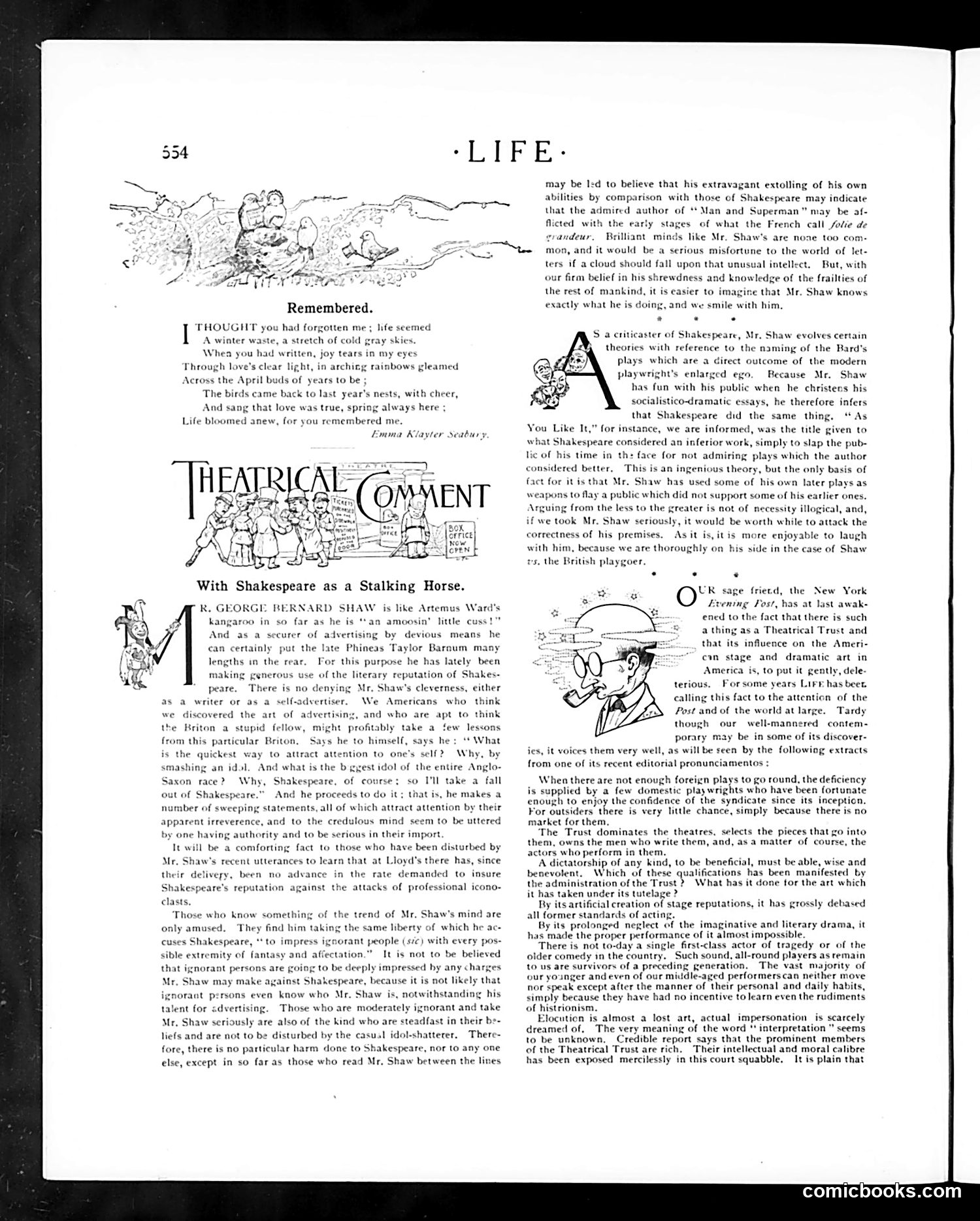
This page satirizes **George Bernard Shaw**, the Irish playwright and critic, for using attacks on **Shakespeare** as a publicity stunt. The article compares Shaw to P.T. Barnum—a famous American promoter—noting that Shaw deliberately makes inflammatory statements about Shakespeare (calling him overrated, etc.) to grab attention, much like smashing an idol draws a crowd. The satire's point: Shaw is employing advertising tactics by being intentionally provocative. The author suggests Shaw himself suffers from "folie de grandeur" (French: delusions of grandeur), arrogantly comparing his own abilities to Shakespeare's while claiming to expose Shakespeare's methods. The piece mocks both Shaw's self-promotion and the gullible public who take his provocations seriously. The accompanying illustrations show Shaw as a mischievous figure, emphasizing how his antics are calculated performance rather than genuine criticism.
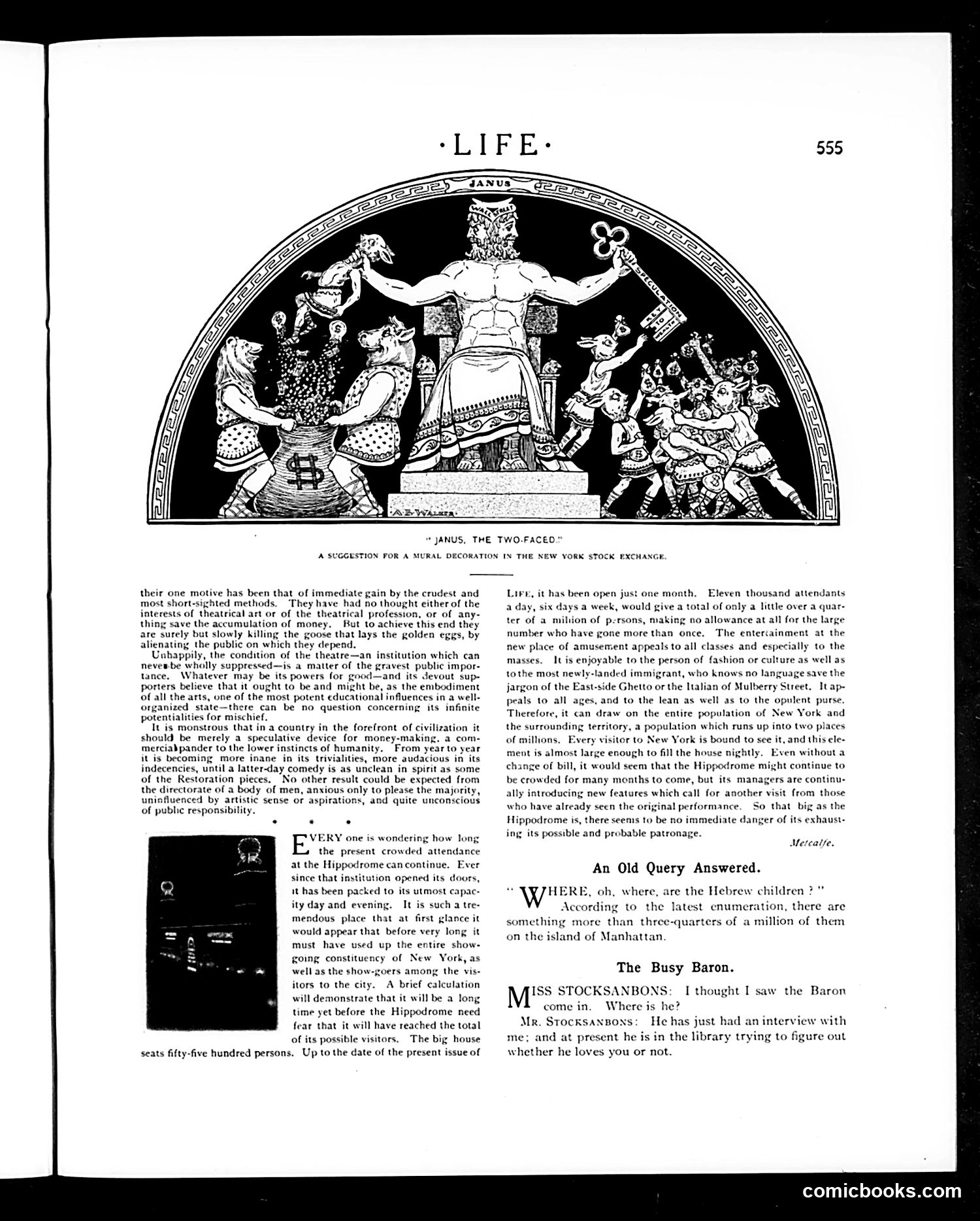
The main illustration depicts **Janus**, the Roman two-faced god, presiding over a theatrical scene. This is a visual metaphor for the article's criticism of New York theater management—specifically appearing to target the **Hippodrome**, a major entertainment venue. The satire argues that theater owners are hypocritical (two-faced): they claim to support theatrical art and culture, but actually pursue only profit through crude, short-sighted methods. The article condemns their focus on money over artistry, their pandering to base instincts, and the resulting moral decline of theatrical productions. The text criticizes how managers neglect "artistic sense or aspirations" while pursuing the lowest common denominator to maximize attendance and revenue. By invoking Janus—the god of beginnings and endings, duality and transitions—the cartoonist suggests these theater operators represent a fundamental moral contradiction: institutions with potential for cultural good corrupted by pure commercialism.
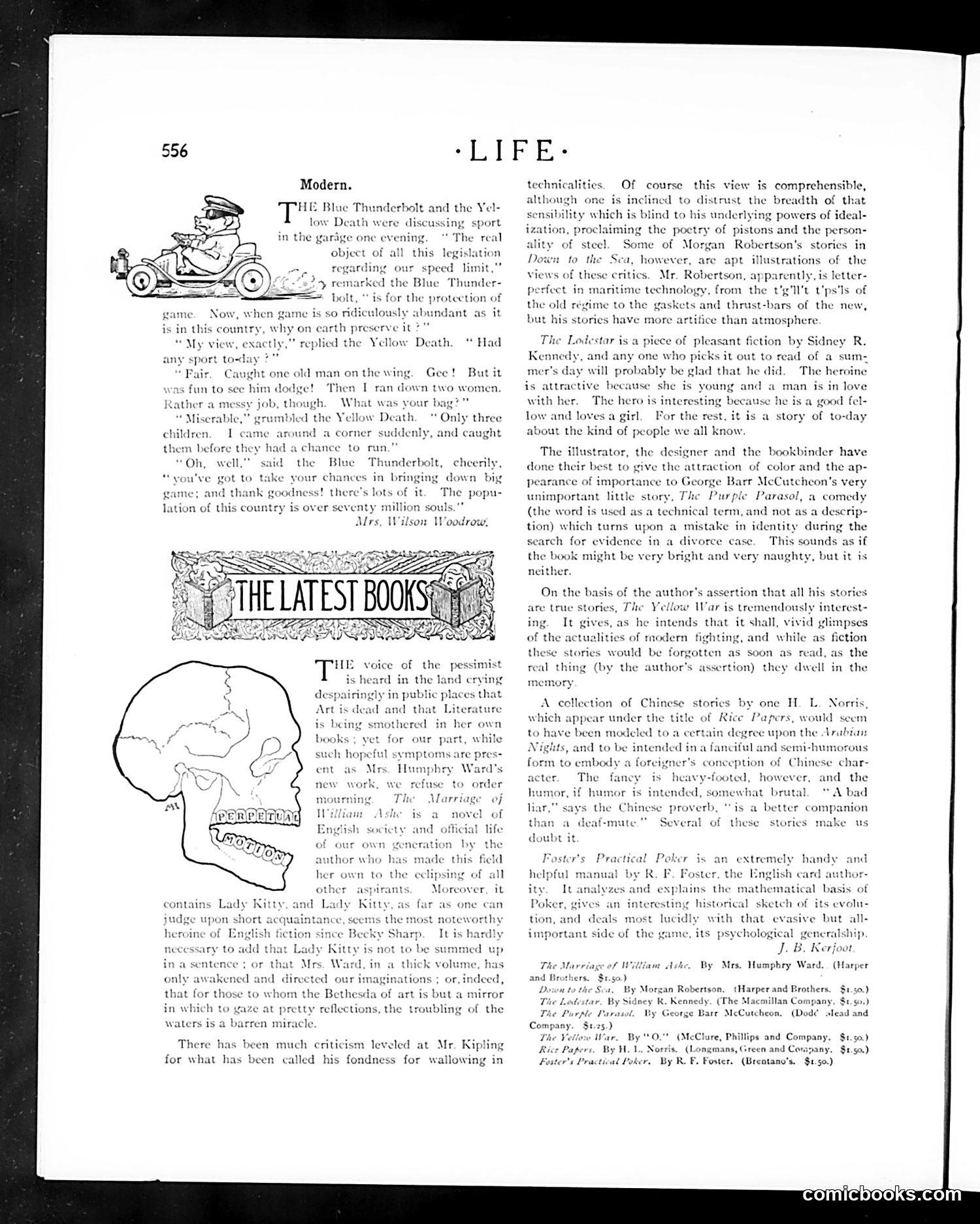
This page contains a satirical cartoon and book reviews. The cartoon depicts two personified automobiles—"The Blue Thunderbolt" and "The Yellow Death"—discussing traffic fatalities as sporting achievements. One boasts of hitting pedestrians ("caught one old man on the wing," "ran down two women"), while congratulating themselves on the country's abundant population (seventy million souls) that allows such "sport" to continue. The satire targets reckless driving and the inadequacy of speed-limit legislation to protect the public. By treating vehicular deaths as casual entertainment, the cartoon mocks both drivers' callousness and society's failure to enforce road safety, presenting an early-20th-century commentary on the automobile's dangers to pedestrians. The joke's dark humor exposes how disposable human life seemed amid rapid motorization. The remainder is a book review section covering contemporary fiction.
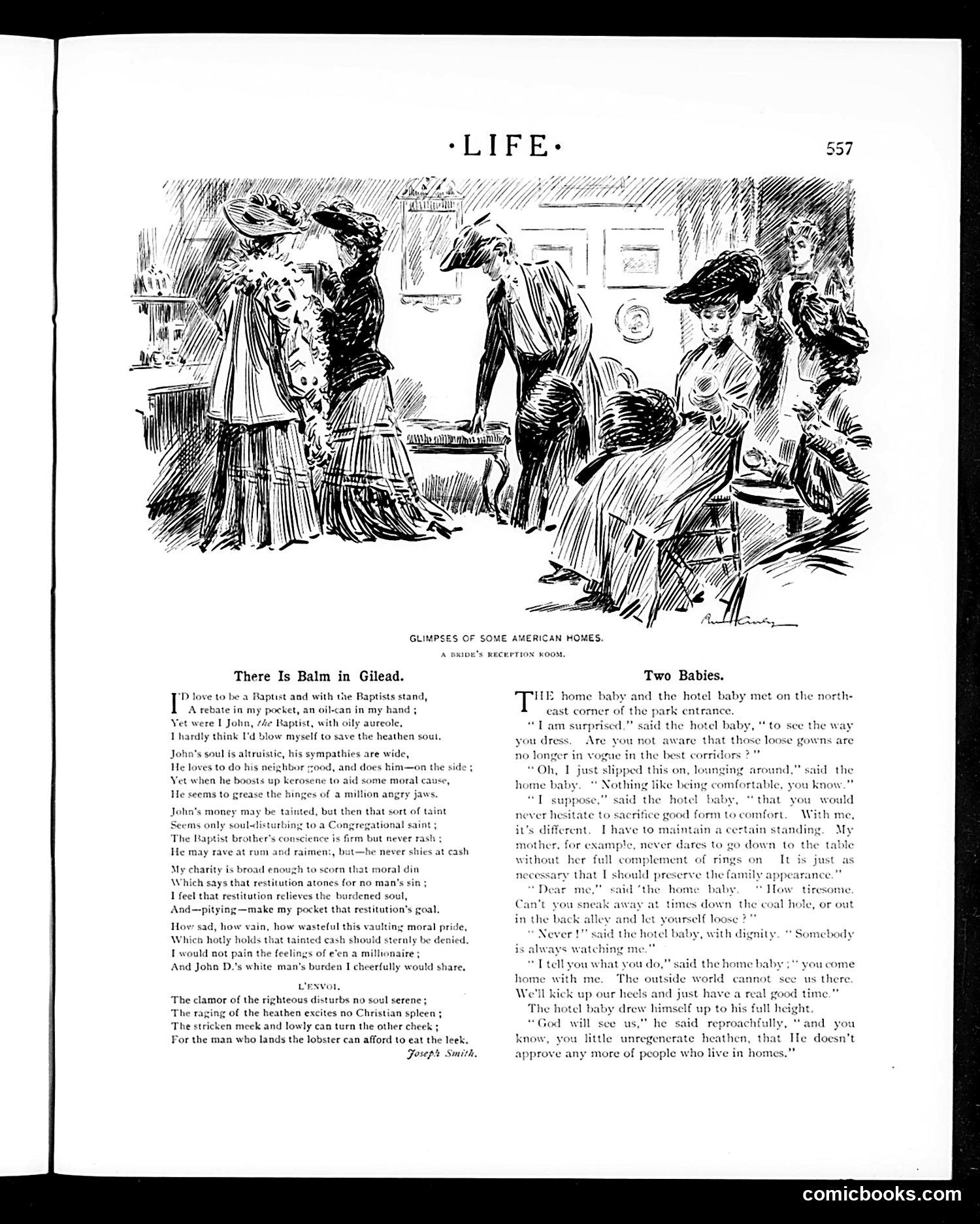
This page from *Life* magazine contains two satirical pieces critiquing American social hypocrisy. **The illustration** shows a bride's reception room, introducing two contrasting characters: the "home baby" (working or middle-class) and the "hotel baby" (wealthy, living in hotels). **The satire**: The dialogue mocks the artificiality of wealthy society. The hotel baby obsesses over maintaining formal appearance and propriety, refusing to relax even in private because "God will see us." The home baby, by contrast, embraces comfort and authentic pleasure. The hotel baby's final line—that God disapproves of people "who live in homes"—inverts expected morality, suggesting that fashionable hotel society has become so removed from genuine living that it's practically ungodly. **The poem** similarly attacks Baptist hypocrisy: wealthy donors like "John D." (Rockefeller) profit from "tainted" oil money while claiming moral superiority and refusing to directly help the poor. The author argues that comfortable, righteous people can afford their principles precisely because they're insulated from real suffering. Both pieces critique Gilded Age wealth and performative respectability.
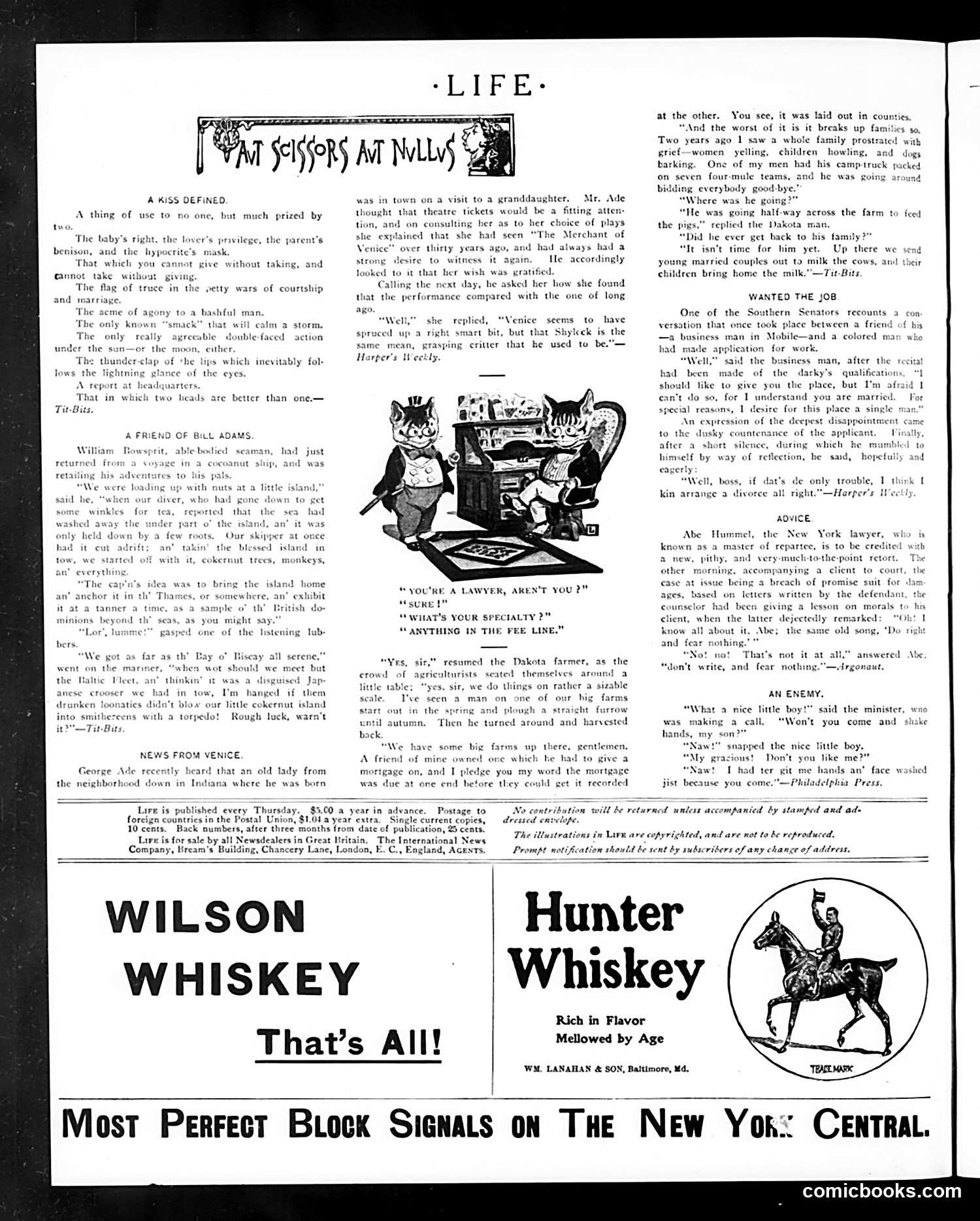
This page contains three humorous anecdotes typical of *Life* magazine's satirical style: 1. **"A Kiss Defined"** presents mock-serious definitions of a kiss—treating an intimate act with deadpan absurdity ("a thing of use to no one, but much prized by two"). 2. **"A Friend of Bill Adams"** recounts a sailor's tall tale about an island held together only by tree roots, which they accidentally cut loose and towed home—absurdist humor playing on nautical exaggeration. 3. **"Wanted the Job"** satirizes racial attitudes of the era: a Black man seeking employment is told he can't have the job because he's married, to which he optimistically offers to arrange a divorce. The joke mocks both racist hiring discrimination and the man's desperate willingness to comply. The page also includes anecdotes about theater, Dakota farm life, and lawyer Abe Hummel's wit. Advertisements for Wilson Whiskey and Hunter Whiskey fill the bottom half—typical period advertising placement in magazines.
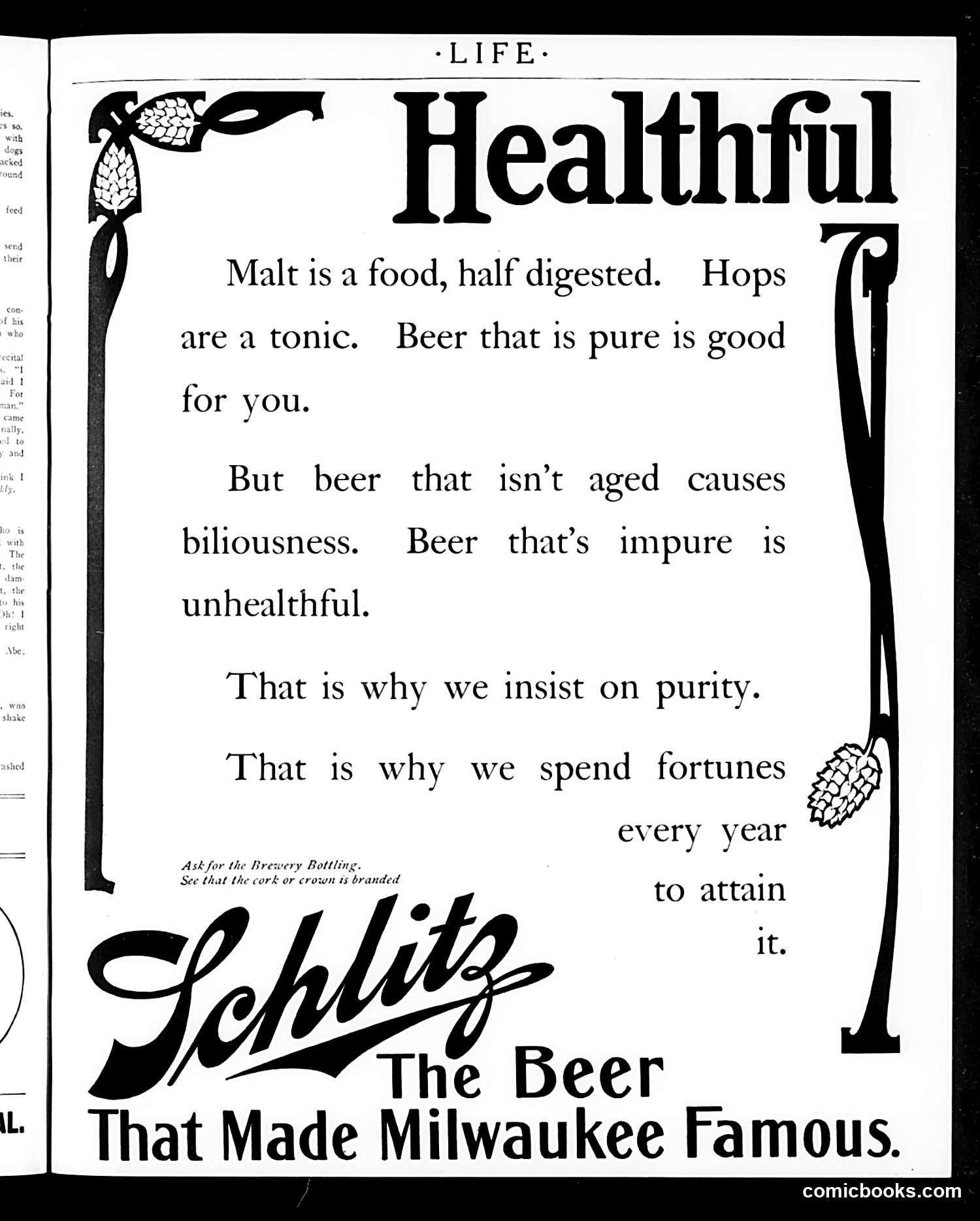
This is a Schlitz beer advertisement disguised as health advice. The ad makes pseudo-scientific claims that malt and hops have medicinal properties, positioning beer as a tonic. It distinguishes between "pure" aged beer (healthful) and impure or unaged beer (causing illness). The satire likely mocks breweries' marketing tactics during the early 20th century, when beer was genuinely marketed with health claims. The exaggerated health rhetoric—claiming beer prevents "biliousness" and requires "fortunes" spent annually to achieve purity—appears designed to parody brewers' inflated claims about their products' medicinal value. The decorative hop vine borders reinforce the "natural" health angle. This reflects pre-Prohibition era advertising when such dubious health claims were common marketing strategy.
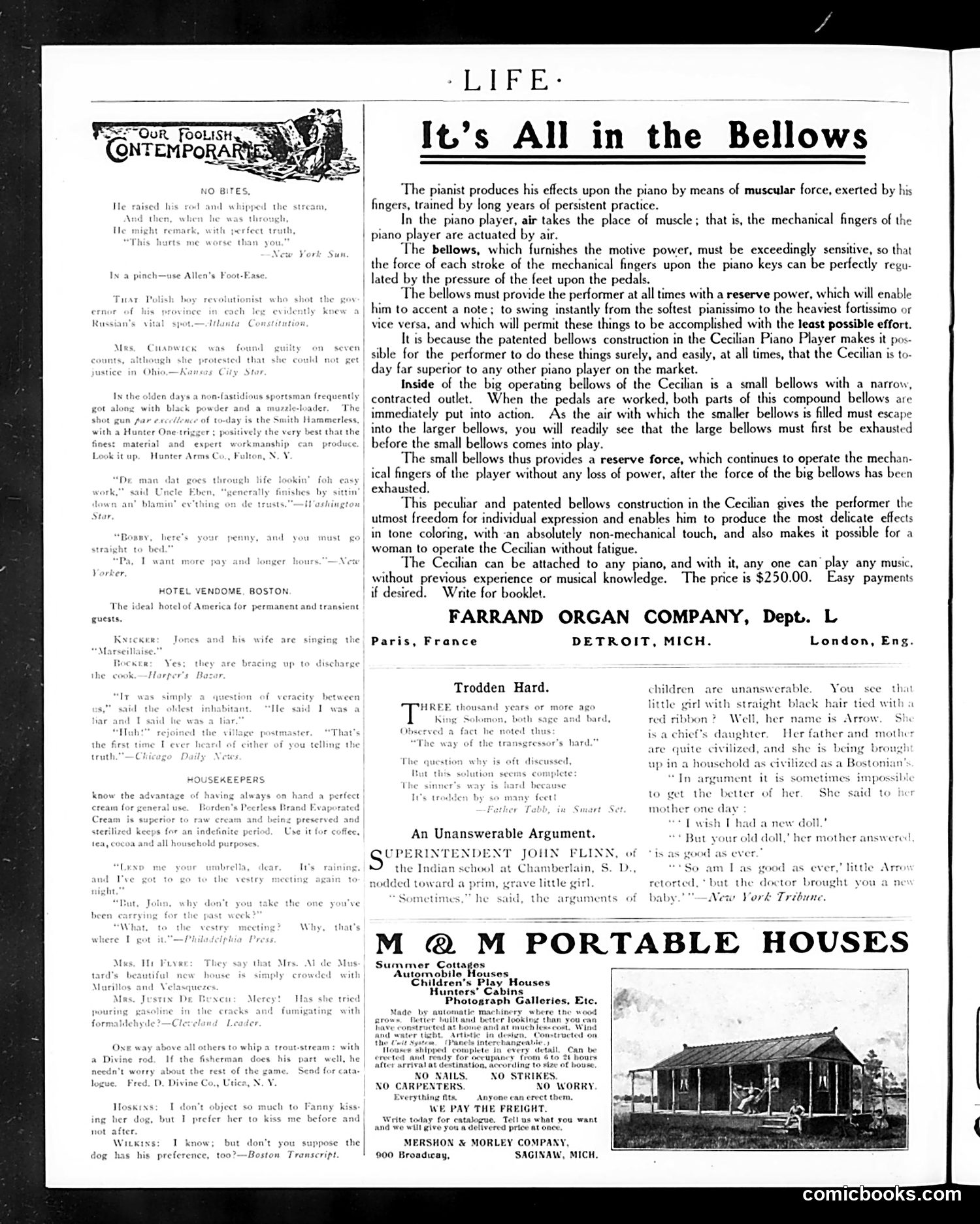
This page is primarily **advertising and light humor** rather than political satire. The "Our Foolish Contemporaries" section at top-left contains brief, disconnected social jokes—snippets mocking everyday absurdities like a fisherman's boasting or arguments about kissing preferences. These are generic humor items, not tied to specific political figures. The main content is a substantial **advertisement for the Cecilian Piano Player** (a mechanical piano), which explains its technical superiority through detailed discussion of its bellows system. This is a genuine product pitch, not satire. A separate humor piece, "Trodden Hard," presents a mild joke about a Native American chief's daughter named "Arrow" being brought to civilization and requesting a doll—the humor resting on the contrast between her heritage and civilized expectations. The page concludes with advertisements for **M&M Portable Houses**. There is **no significant political cartoon or satire** on this page—it's primarily commercial advertising interspersed with light, apolitical humor typical of Life magazine's mixed content.
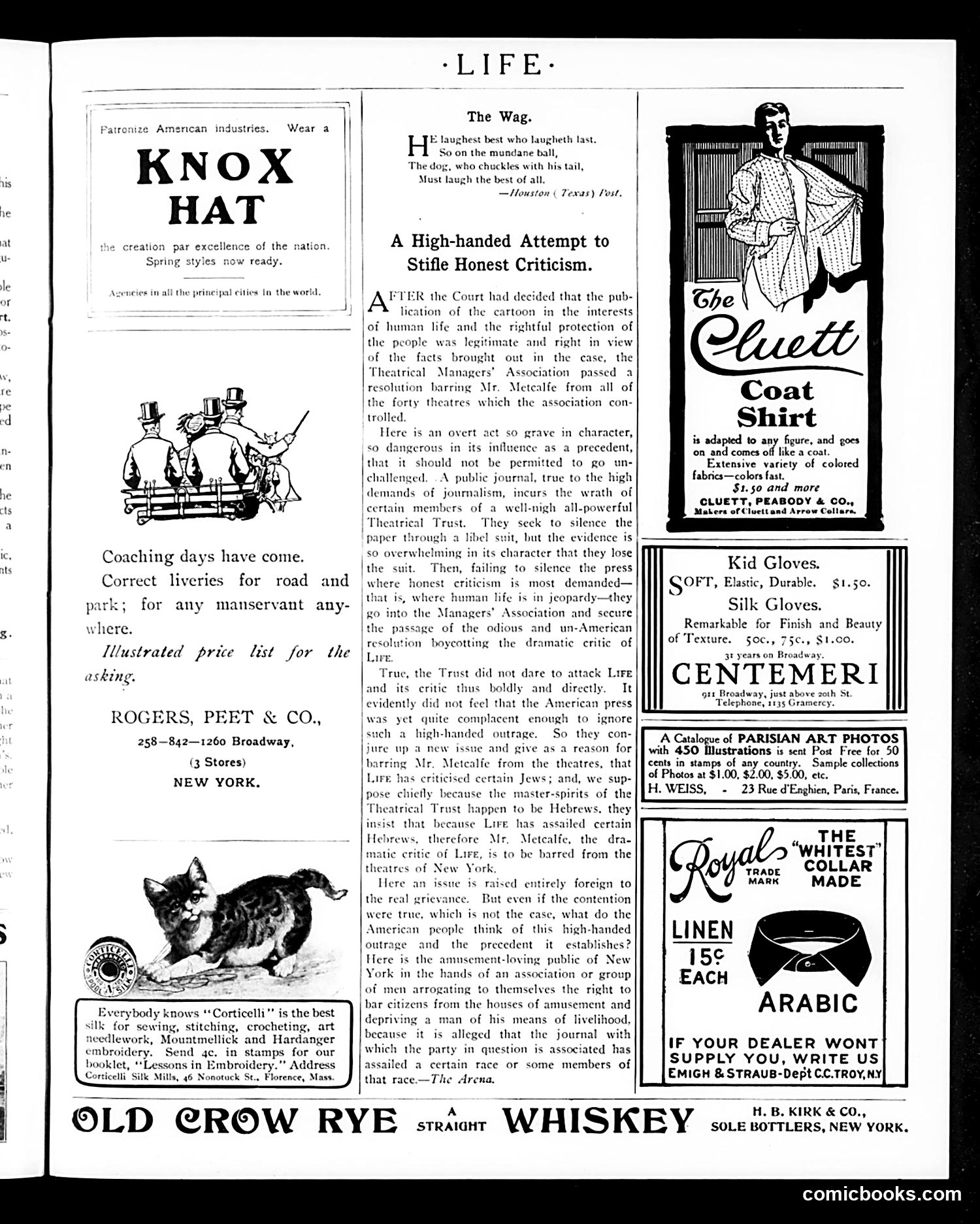
This article criticizes the Theatrical Managers' Association's boycott of Life magazine's drama critic (apparently named Metcalfe) after he published a cartoon the court ruled legitimate. Though Life won the libel case, the theatre trust retaliated by banning him from all forty theatres they controlled. Life condemns this as censorship and corporate abuse of power. The article argues the managers invented a secondary issue—that Metcalfe had criticized Jewish people—to justify the ban, when the real motive was silencing press criticism. Life frames this as un-American: a powerful monopoly depriving a man of livelihood and denying the public access to honest dramatic criticism, all to avoid accountability. The satire targets corporate intimidation of the press and scapegoating of minorities as pretext for suppressing dissent.
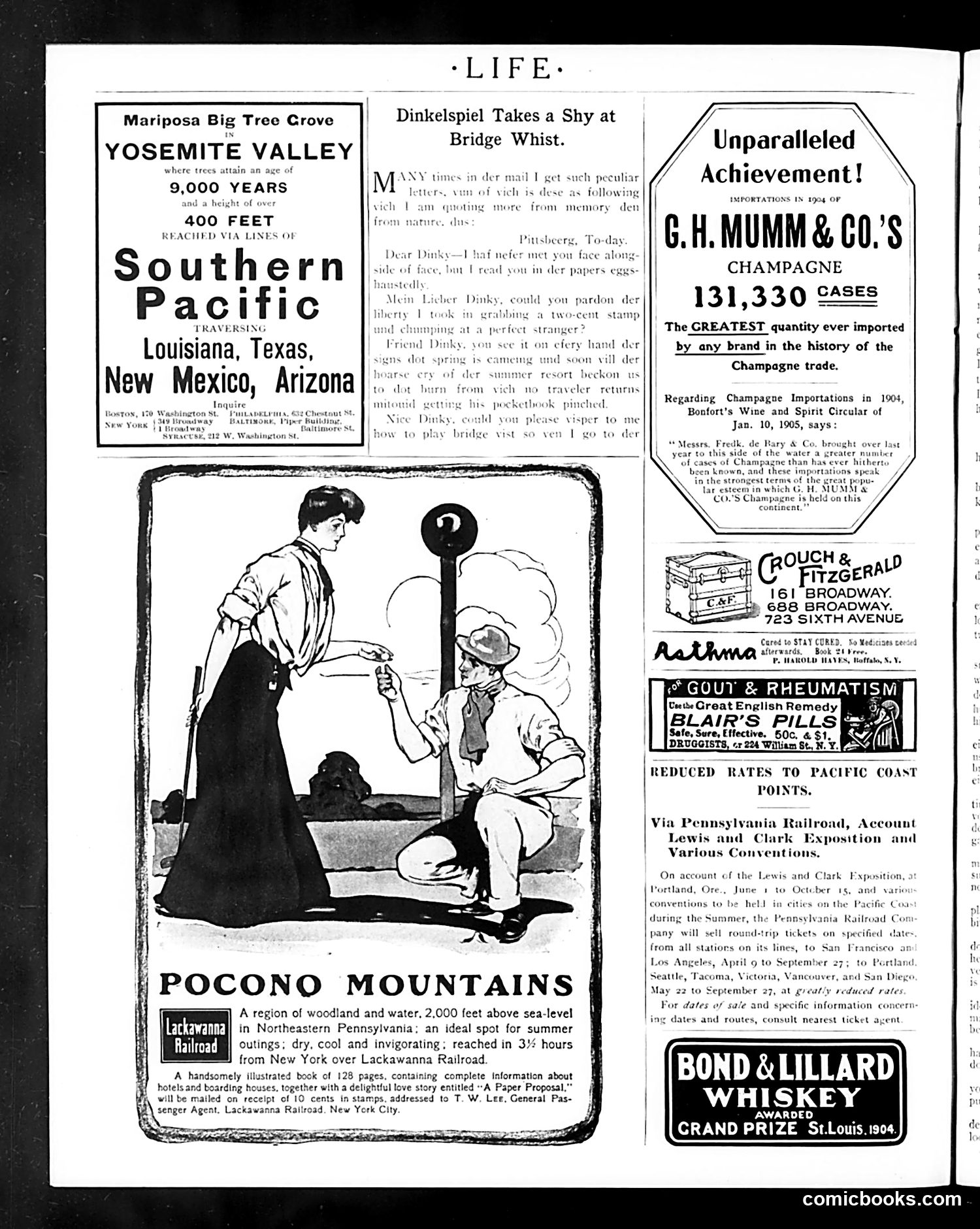
This page is primarily **advertisements** with one small satirical letter-column item at the top. The "Dinkelspiel" piece appears to be a humorous letter exchange (likely fictional) written in exaggerated German-immigrant dialect. A correspondent named "Dinky" writes from Pittsburgh to complain about social embarrassments—apparently involving a postage stamp and bridge whist (a card game). The humor relies on thick dialect humor and awkward social situations, typical of early 1900s American comedy targeting German immigrants. The page is otherwise dominated by travel and consumer ads: Yosemite via Southern Pacific Railroad, Pocono Mountains resorts, C.H. Mumm champagne (boasting record imports), Blair's Pills for gout and rheumatism, Pennsylvania Railroad discounts, and Bond & Lillard whiskey. The satirical content is minimal; the page reflects Life magazine's mixed format of light humor and upscale advertising targeting affluent readers.
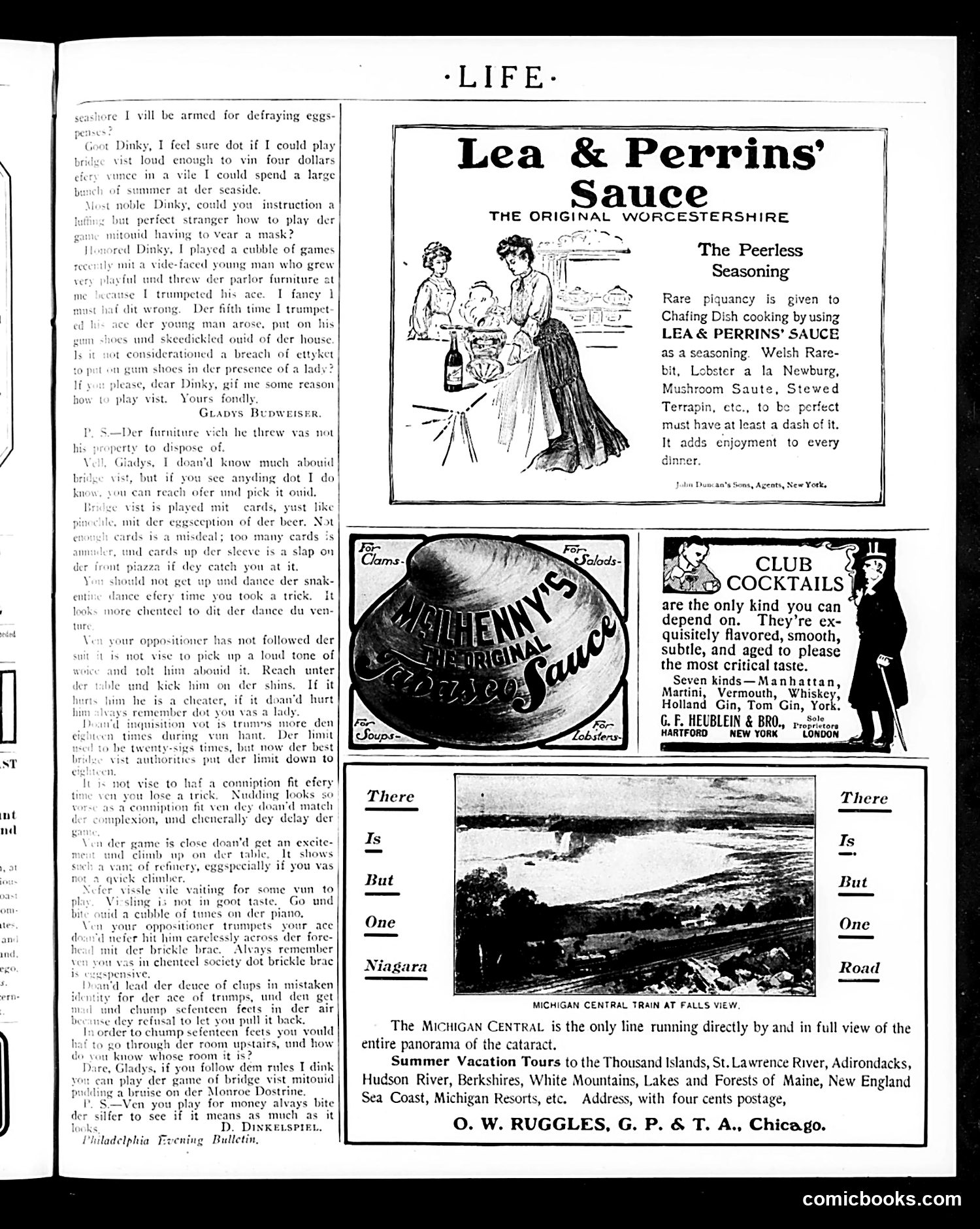
This page contains **primarily advertisements** interspersed with a brief humorous article about bridge etiquette. The main text (left column) appears to be advice on proper bridge game conduct, written in a heavily German-accented English dialect for comedic effect. The unnamed author addresses "Dinky" with rules about gracious play—don't trumpet loudly when winning, don't kick opponents, maintain composure when losing, and don't make a scene by climbing on tables. The **advertisements** include: - **Lea & Perrins' Sauce** (Worcestershire sauce) - **Club Cocktails** by Heublein (featuring seven varieties) - **Michigan Central Railway** promoting Niagara Falls viewing and vacation tours The bridge advice satirizes pretentious social behavior among the leisure class—the joke being that even in games, wealthy people must maintain artificial composure and "refined" conduct. The German-dialect writing suggests this may be gently mocking immigrant or working-class perspectives on upper-class affectations.
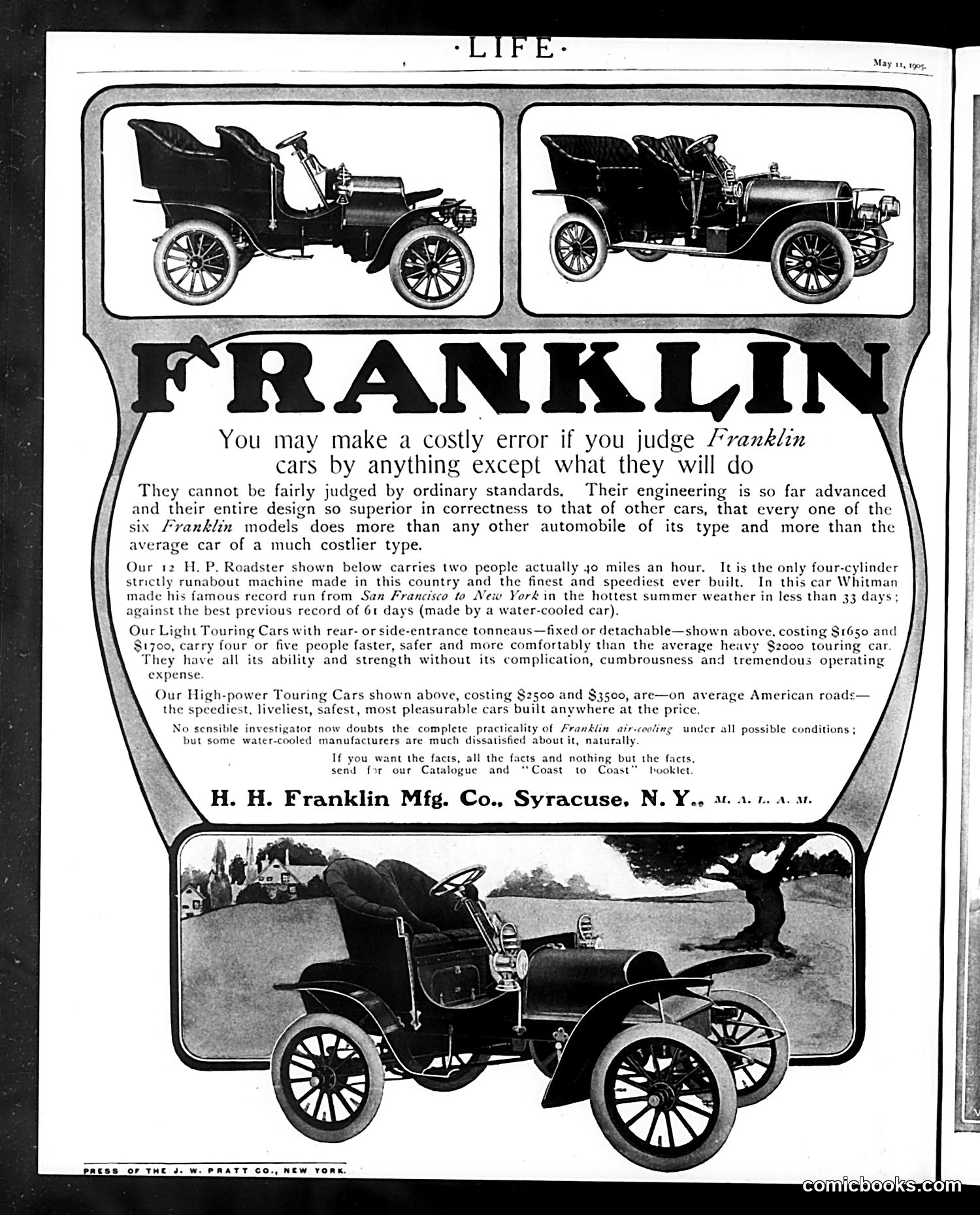
This is a full-page advertisement for Franklin automobiles, not political satire. The "Life" magazine header dates this to May 11, 1925 (the OCR misread "1925" as "1995"). The ad promotes Franklin cars' superior engineering and performance, featuring three vehicle models in photographs. A key selling point is the air-cooled engine—then a competitive innovation—which the ad defends against skepticism from rival water-cooled manufacturers. The text references a notable cross-country endurance record: a Whitman-driven Franklin completed a San Francisco-to-New York run in 33 days, versus 61 days for a water-cooled competitor. The ad's rhetorical strategy is to position Franklin as engineered beyond "ordinary standards," implying buyers shouldn't judge by price alone but by performance capability. This targets affluent consumers interested in automotive innovation during the early automobile era.