
Life, 1905-05-11 · page 18 of 26
Life — May 11, 1905 — page 18: what you’re looking at
What you’re looking at
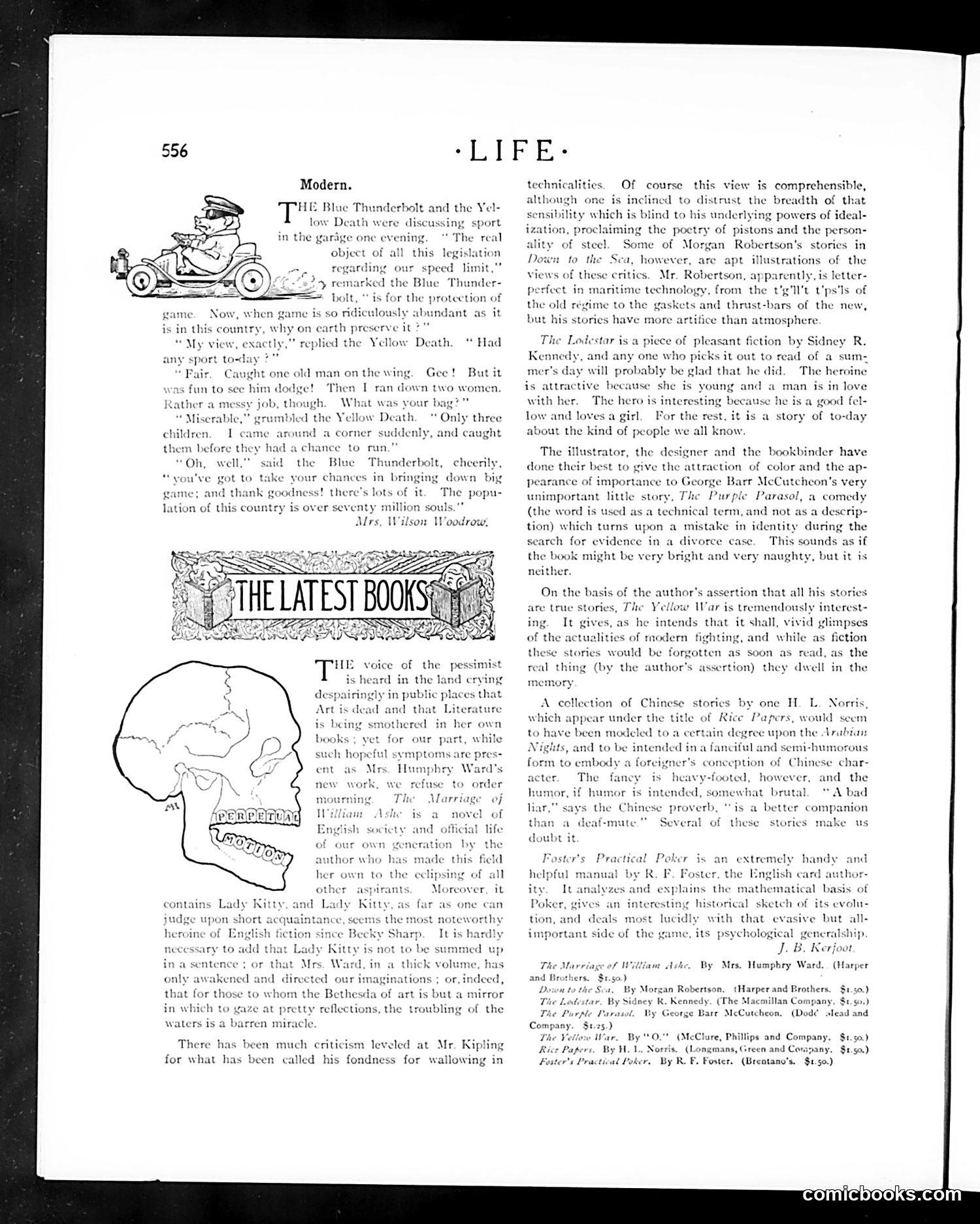
This page contains a satirical cartoon and book reviews. The cartoon depicts two personified automobiles—"The Blue Thunderbolt" and "The Yellow Death"—discussing traffic fatalities as sporting achievements. One boasts of hitting pedestrians ("caught one old man on the wing," "ran down two women"), while congratulating themselves on the country's abundant population (seventy million souls) that allows such "sport" to continue. The satire targets reckless driving and the inadequacy of speed-limit legislation to protect the public. By treating vehicular deaths as casual entertainment, the cartoon mocks both drivers' callousness and society's failure to enforce road safety, presenting an early-20th-century commentary on the automobile's dangers to pedestrians. The joke's dark humor exposes how disposable human life seemed amid rapid motorization. The remainder is a book review section covering contemporary fiction.
📄 Transcribed text from this page (OCR, searchable)
Machine-transcribed from the original scan — historical spelling and the odd misread are preserved.
Modern. HE Blue Thunderbolt and the Yel- low Death were discussing sport we one evening. “' The real object of all this legislation regarding our speed limit,” > remarked the Blue bolt, “is for the protection of Thunder- game is so ridiculously abundant n this country “My view, exactly, why on carth preserve it Yellow Deat “ Had replied the any sport to<day >" “Fair. Caught one old man onthe wing. Gee! But i s fun to see him dodge! Then I ran down two women. Rather a messy job, though. What was your bag?” * Miserable,” bled the Yellow Death, ‘ Only three I came around a corner suddenly, and caught y had achance to rt the Blue hances in bri children Thunderbolt, cheeril: down big rame; and thank goodness! there The popu- lation of this country is over seventy million souls."" Voodrow, HE voice of the pes: is heard in the land crying in public places that and that L: nothered in h b for our part, while Art is dead ature is being rown ach h ymptoms are pres- ent as Mrs. Humphry Ward's new work fuse to order rourning. society and officia our own neration by t author who fh made this field eclipsing of all Moreover, it contains Lady Kitty as or an judge upon short acc heroine of p. Itis hardly i} itty is not to be sun or that Mrs, Ward, in a ly awaken irected our im that for those to. the Bethesda of art is but a mirror in which to gaze at pretty reflections, the necessary to ned up in a sentence ; thick volu: ations ; or, indeed, troubling of the waters is a barren miracle. There has been much criticism leveled at Mr. Kipling for what has been called his fondness for wallowing in Of course this view is comprehensible, i to distrust the breadth of that nsibility which is blind to his underlying powers of ideal- ization, proclaiming the poctry of pistons and the person- y of Morgan Robertson's stories i are apt illustrations of the Mr. Robertson, apparently, is letter- perfect in maritime technology, from the t’g'l't t'ps'ls of the old régime to the gaskets and thrust-bars of the new, but his stories have more artifice than atmosphere t steel. Some Down to the Sea, however, views of these criti The Lodestar is a piece of pleasant fiction by Sidney R. Kennedy, and any one who picks it out to read of a sum- m day will probably be glad that he did. The heroine is attractive because she is young and a man is in lov with her. The hero is interesting because he is a low and loves a girl about the For the rest, it is a story of to-day kind of people we all know The illustrator, the designer and the bookbinder have done their best to give the attraction of color and the ap- pearance of importance to George Barr MeCutcheon’s very unimportant little story, The Purple Parasol, a comedy (the word is used as a technical term, and not as a descrip- tion) which turns upon a mistake in identity during the search for evidence in a divorce case. This sounds as if the book might be very bright and very naughty, but it is neither. On the basis of the author's assertion that all his storie Yellow as he int are true stories, The War is tremendously interest- ing. It gives, 1s that it shall, vivid ylimpses of the actualities of modern fighting, and while as fiction forgotten as soon as read the (by the author's assertion) they dwell in the ese stories would be by one H. L. Norris, which appear under the title of Rice Papers, would seem A collection of Chinese stories to have been modeled to a certain degree upon the Arabian: Nights, form to embody a and to be intended in a fanciful and semi-humorous foreigner's conception of Chinese char- and the Abad is a better companion he faney is heav voted, however, ended, ewhat brutal hinese proverb, * Several of these stories anual by R. F. Foster. glish card a’ yzes and explains the mathema‘ extremely han helpful ity. It Poker, gi al basis of yrical sketch of its evolu- with that evasive but all- its psychological gencralshiy ]. B. Kerjoot Mrs. Humphry Ward. ives an resting tion, 1 deals most lucid’ ortant side of the game, and Brothers. $1.50.) Down to the Sea, By Morgan Robertson, (Harper and Brothers. $1.50.) Tie Lodestar. By Sidney KR. Kennedy, (The Macmillan Company, $1.50.) The Purple Parasol. By George Barr McCutcheon, (Dodé stead and pany. $425.) The Yellow War, By." (McClure, Phillips and Company. $1.50.) Rice Papers. By H. 1. Norris, (Longmans, Green and Corapany. $1.50.) Foster's Practical Poker. By RF, Foster. (Brentano's. $1.50.) (Harper