
Life, 1905-05-11 · page 6 of 26
Life — May 11, 1905 — page 6: what you’re looking at
What you’re looking at
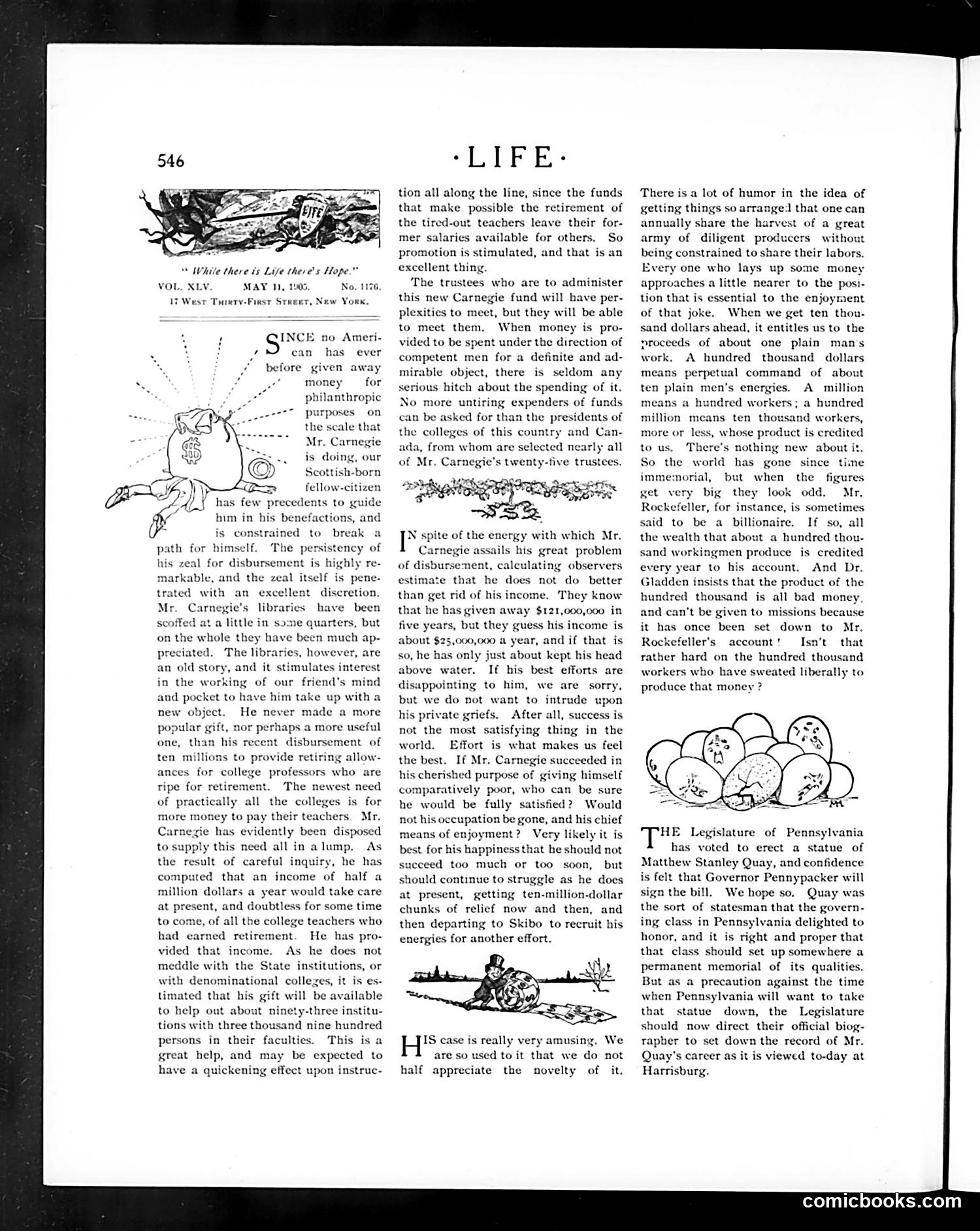
The main cartoon depicts a money bag with a dollar sign, illustrated as a character being "squeezed" or drained. This satirizes **Andrew Carnegie's philanthropic giving**. The accompanying text discusses Carnegie's massive charitable disbursements ($121 million over five years). The satire's point: Carnegie gives away enormous sums while his actual income remains disputed and mysteriously large. The cartoon suggests his wealth is inexhaustible—no matter how much he donates, more money appears. The secondary cartoon shows coins/money, reinforcing themes of abundance and financial mystery. The text also mentions **Matthew Stanley Quay** and Pennsylvania's legislature voting to erect his statue, suggesting political patronage and the glorification of wealthy industrialists. The overall satirical message critiques both Carnegie's charitable self-promotion and the era's wealth concentration among industrial magnates.
📄 Transcribed text from this page (OCR, searchable)
Machine-transcribed from the original scan — historical spelling and the odd misread are preserved.
“ While there is Life there's Hope.” VOL. XL MAY 11, 1905. VT Wes ‘miery-First Street, New Y INCE can before no Ameri- has ever given away money for philanthropic purposes on le that Mr. Carnegie is doing, our Scottish-born the sca fellow-citizen has few precedents to guide ‘actions, and break a The persistency of his zeal for disbursement is highly re- markable, and the zeal itself is pene- trated with nt discretion. Mr. Carnegie’s libraries have been scoffed at a little in ne quarters, but ne whole they have been much ap- him in his ben is constrained to path for himself. r ries, however, are an old story, and it stimulates interest in the working of our friend's mind and pocket to have him take up with a He never made a more pular gift, nor perhaps a more useful than his recent disbursement of ten millions to provide retiring allow ances for college professors who are ripe for retirement. The newest need of practically all the colleges is for more money to pay their teachers. Mr. Carnegie has evidently been disposed to supply this need all in alump. As. the result of careful inquiry, he has computed that an income of half a million dollars a year would take care at present, and doubtless for some time to come, of all the college teachers who had carned retirement. He has pro- vided that As he does not meddle with the State institutions, or with denominational colleges, it is es- timated that his gift will be available to help out about ninety-three institu- tions with three thousand nine hundred persons in their faculties. This is a great help, and may be expected to have a quickening effect upon instruc- new object. income. -LIFE- tion all along the line, since the funds that make possible the retirement of the tired-out teachers leave their for- mer salaries available for othe: So promotion is stimulated, and that is an excellent thing. The trustees who are to administer this new Carnegie fund will have pe plexities to meet, but they will be able to meet them, When money is pro- vided to be spent under the direction of competent men for a definite and ad- mirable object, there is seldom an serious hitch about the spending of it. No more untiring expenders of funds can be asked for than the presidents of the colleges of this country and Can- ada, from whom are selected nearly all of Mr. Carnegie’s twenty I’ spite of the energy with which Mr. Carnegie assails his great problem of disbursement, calculating observers estimate that he does not do better than get rid of his income. They know that he has given away $121,000,000 in five years, but they guess his income is about $25,000,000 a year, and if that is so, he has only just about kept his head above water. If his best efforts are disappointing to him, we are sorry, but we do not want to intrude upon his private grie! After all, success is not the most satisfying thing in the world, Effort is what makes us feel the best. If Mr. Carnegie succeeded in his cherished purpose of giving himself comparatively poor, who can be sure he would be fully satisfied? Would not his occupation be gone, and his chief means of enjoyment? Very likely it is best for his happiness that he should not succeed too much or too soon, but should continue to struggle as he does at present, getting ten-million-dollar chunks of relief now and then, and then departing to Skibo to recruit his energies for another effort. IS case is really very amusing. We are so used to it that we do not half appreciate the novelty of There is a lot of humor in the idea of getting things so arrange:l that one can annually share the harvest of a great army of diligent producers without being constrained to share their labors. Every one who lays up some money approaches a little nearer to the posi- tion that is essential to the enjoyment of that jok When we get ten thou- sand dollars ahead, it entitles us to the proceeds of about one plain man’s work. A hundred thousand dollars means perpetual command of about ten plain men’s energies. A million means a hundred workers; a hundred million means ten thousand workers, more or less, whose product is credited to us. There's nothing new about it. So the world has gone since time immemorial, but when the figures get big they look odd. Mr. Rockefeller, for instance, is sometimes said to be a billionaire. If so, all the wealth that about a hundred thou- sand workingmen produce is credited every year to his account. And Dr. Gladden insists that the product of the hundred thousand is all bad money, and can’t be given to mis: it has once been set down to Mr. Rockefeller's account! Isn't that rather hard on the hundred thousand workers who have sweated liberally to produce that money ? ver ions because HE Legislature of Pennsylvania has voted to erect a statue of Matthew Stanley Quay, and confidence is felt that Governor Pennypacker will sign the bill. We hope so. Quay was the sort of statesman that the govern- ing class in Pennsylvania delighted to honor, and it is right and proper that that class should set up somewhere a permanent memorial of its qualities. But as a precaution against the time when Pennsylvania will want to take that statue down, the Legislature should now direct their official biog- rapher to set down the record of Mr. Quay’s career as it is viewed to-day at comicbooks.com