
Life, 1905-05-11 · page 16 of 26
Life — May 11, 1905 — page 16: what you’re looking at
What you’re looking at
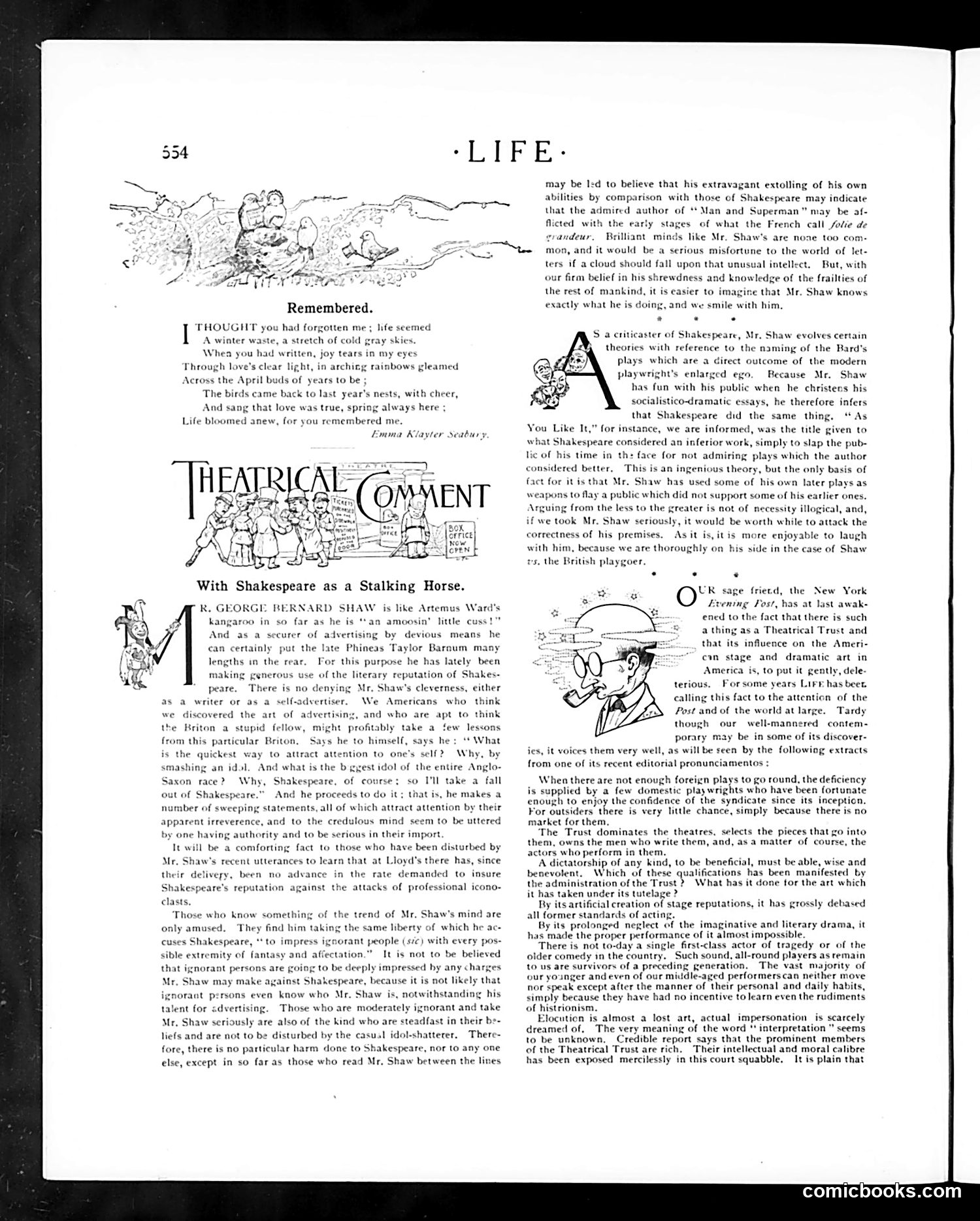
This page satirizes **George Bernard Shaw**, the Irish playwright and critic, for using attacks on **Shakespeare** as a publicity stunt. The article compares Shaw to P.T. Barnum—a famous American promoter—noting that Shaw deliberately makes inflammatory statements about Shakespeare (calling him overrated, etc.) to grab attention, much like smashing an idol draws a crowd. The satire's point: Shaw is employing advertising tactics by being intentionally provocative. The author suggests Shaw himself suffers from "folie de grandeur" (French: delusions of grandeur), arrogantly comparing his own abilities to Shakespeare's while claiming to expose Shakespeare's methods. The piece mocks both Shaw's self-promotion and the gullible public who take his provocations seriously. The accompanying illustrations show Shaw as a mischievous figure, emphasizing how his antics are calculated performance rather than genuine criticism.
📄 Transcribed text from this page (OCR, searchable)
Machine-transcribed from the original scan — historical spelling and the odd misread are preserved.
*LIFE: Remembered. THOUGHT you had forgotten m A winter waste, a stretch of cold gray skies. Whea you had written, joy tears in my eyes Through love's clear light, in archir; Across the April buds of years to be ; The birds came back to last year's nests, with cheer, And sang that love was true, spring always here ; Life bloomed anew, for you remembered m Emma Klayter Seabury With Shakespeare as a Stalking Horse. R. GEORGE BERNARD SHAW is like Artemus Ward's ae little cuss!” devious means he kangaroo in so far as he is amoos! And as a sccurer of advertising by can certainly put the late Phineas Taylor Barnum many lengths in the rear, For this purpose he has lately been making generous use of the literary reputation of Shakes- peare. There is no denying Mr, Shaw's cleverness, either as a writer or as a self-advertiser. We Americans who think we discovered the art of advertising, and who are apt to think the Briton a stupid fellow, might profitably take a few lessons “What y Why, by smashing an idol, And what is the b ggest idol of the entire Anglo- Why, Shakespeare, of course: so I'll take a fall And he proceeds to do it; that is, he makes a from this particular Briton, © quickest way to attract attention to one’s self? Says he to himself, says he Saxon race? out of Shakespeare.” number of sweeping statements, all of which attract attention by their n to be uttered by one having authority and to be serious in their import fact to those who have been disturbed by apparent irreverence, and to the credulous mind s It will be a comfortin; Mr, Shaw's recent utterances to learn that at Lloyd's there has, since their delivery, been no advance in the rate demanded to insure Shakespeare's reputation against clasts, ‘Those who know something of the trend of Mr, Shaw's mind are ¢ attacks of professional icono- only amused. They find him taking the same liberty of which he ac- cuses Shakespeare, “to impress igoorant people (si) with every pos- sible extremity of fantasy and affectation.” It is not to be believed that ignorant persons are going to be deeply impressed by any charges Mr, Shaw may make against Shakespeare, because it is not likely that ignorant persons even know who Mr, Shaw is, notwithstanding his talent for advertising. Those who are moderately ignorant and take Mr, Shaw seriously are also of the kind who are steadfast in their be- liefs and are not to be disturbed fore, there is no particular harm done to Shakespeare, nor to any one the casual idol-shatterer. There- else, except in so faras those who read Mr, Shaw between the lines may be Id to believe that his extravagant extolling of his own abilities by comparison with those of Shakespeare may indicate that the admired author of Man and Superman” may be af- flicted with the early stages of what the French call folie dé grandeur, Brilliant minds like Mr. Shaw's are none too com: mon, and it would be a serious misfortune to the world of let- But, with r firm belief in his shrewdness and knowledge of the frailties of the rest of mankind, it is easier to imagine that Mr. Shaw knows ters if a cloud should fall upon that unusual intellect, exactly what he is doing, and we smile with him, ikespeare, Mr, Shaw evolves certain theories with reference to the naming of the Bard's plays which are a direct outcome of the modern playwright’s enlarged ego. Because Mr. Shaw has fun with his public when he christens his socialistico-dramatic essays, he therefore infers that Shakespeare did the same thing, “As You Like It,” for instance, we are informed, was the title given to what Shakespeare considered an inferior work, simply to slap the pub- c of his time in the face for not admiring plays which the author considered better, This is an ingenious theory, but the only basis of fact for it is that Mr, Shaw has used some of his own later plays as Hier ones. Arguing from the less to the greater is not of necessity illogical, and, we took Mr. Shaw seriously, it would be worth while to attack the correctness of his premises, weapons to flay a public which did not support some of his As it is,it is more enjoyable to laugh with him, because we are thoroughly on his side in the case of Shaw rs, the British playgoer. UR sage friecd, the New York Evening Fost, has at last awak- ened to the fact that there is such a thing asa Theatrical Trust and that its influence on the Ameri- cam stage and dramatic art in America is, to put it gently, dele- terious. Forsome years Lire has beet, calling this fact to the attention of the Post and of the world at large. Tardy though our well-mannered contem- porary may be in some of its discover- ies, it voices them very well, as will be seen by the following extracts from one of its recent editorial pronunciamentos : When there are not enough foreign plays to go round, the deficiency is supplied by a few domestic playwrights who have been fortunate enough to enjoy the confidence of the syndicate since its inception. For outsiders there is very little chance, simply because there is no market for them, ‘The Trust dominates the theatres, selects the pieces that go into them, owns the men who write them, and, as a matter of course, the actors who perform in them. A dictatorship of any kind, to be beneficial, must be able, wise and benevolent. Which of these qualifications has been manifested by the administration of the Trust ?- What has it done tor the art which it has taken under its tutelage ? Ry its artificial creation of stage reputations, it has grossly debased all former standards of acting. By its prolonged neglect of the imaginative and literary drama, it has made the proper performance of it almost impossible. There is not to-day a single first-class actor of tragedy or of the older comedy in the country. Such sound, all-round players as remain to us are survivors of a preceding generation. The vast majority of our younger and even of our middle-aged performers can neither move nor speak except after the manner of their personal and daily habits, simply because they have had no incentive to learn even the rudiments of histrionism. Elocution is almost a lost art, actual impersonation is scarcely dreamed of, The very meaning of the word "interpretation ” seems to be unknown, Credible report says that the prominent members of the Theatrical Trust are rich. Their intellectual and moral calibre has been exposed mercilessly in this court squabble, It is plain that comicbooks.com