
Life, 1905-05-11 · page 19 of 26
Life — May 11, 1905 — page 19: what you’re looking at
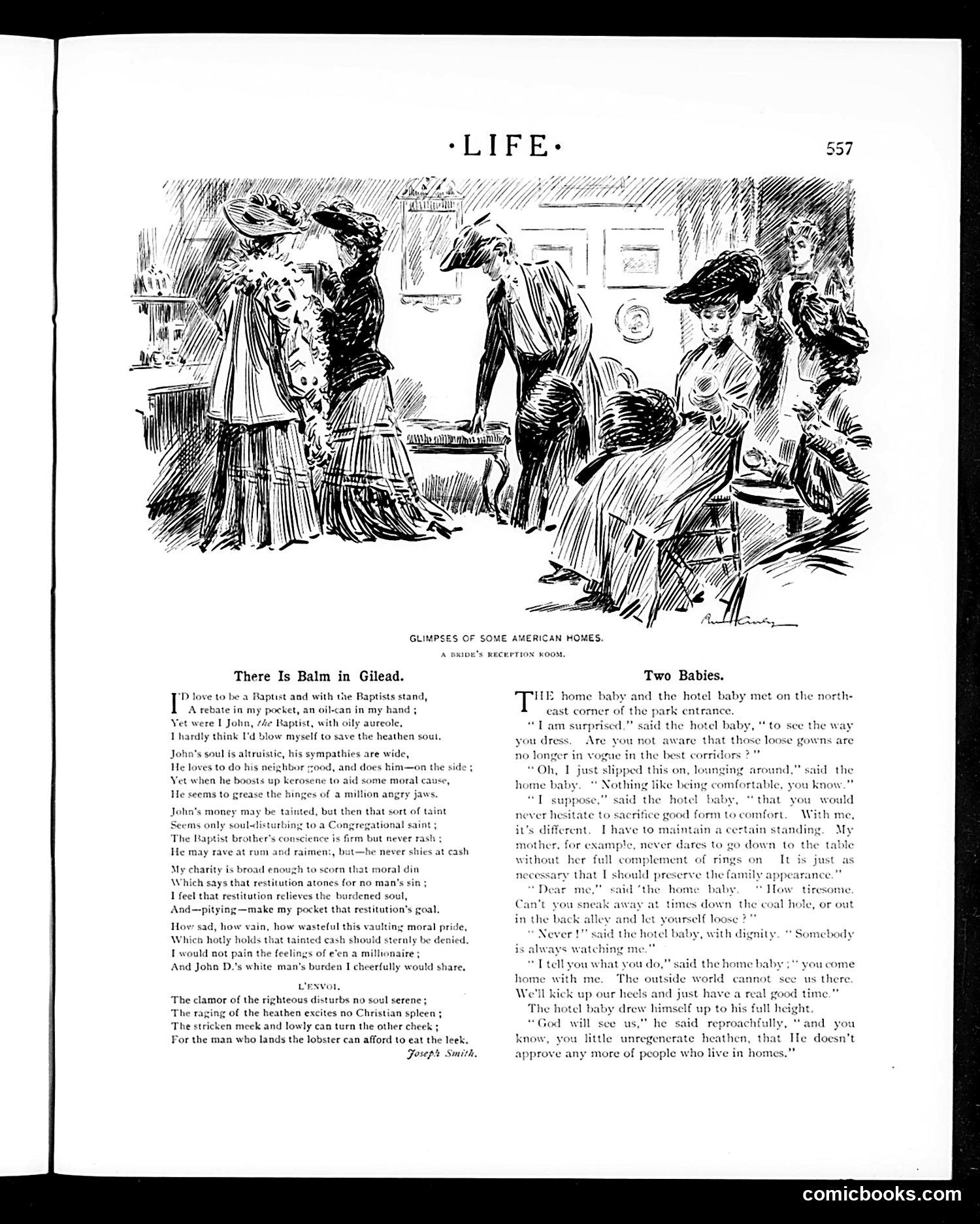
What you’re looking at
This page from *Life* magazine contains two satirical pieces critiquing American social hypocrisy. **The illustration** shows a bride's reception room, introducing two contrasting characters: the "home baby" (working or middle-class) and the "hotel baby" (wealthy, living in hotels). **The satire**: The dialogue mocks the artificiality of wealthy society. The hotel baby obsesses over maintaining formal appearance and propriety, refusing to relax even in private because "God will see us." The home baby, by contrast, embraces comfort and authentic pleasure. The hotel baby's final line—that God disapproves of people "who live in homes"—inverts expected morality, suggesting that fashionable hotel society has become so removed from genuine living that it's practically ungodly. **The poem** similarly attacks Baptist hypocrisy: wealthy donors like "John D." (Rockefeller) profit from "tainted" oil money while claiming moral superiority and refusing to directly help the poor. The author argues that comfortable, righteous people can afford their principles precisely because they're insulated from real suffering. Both pieces critique Gilded Age wealth and performative respectability.
📄 Transcribed text from this page (OCR, searchable)
Machine-transcribed from the original scan — historical spelling and the odd misread are preserved.
oe GLIMPSES OF SOME AMERICAN HOMES. A BRIDE'S RECKFTION KOOM. There Is Balm in Gilead. “D love to be a Baptist and with the Baptists stand, A rebate in my pocket, an oil- L hardly think I'd blow myself to save Joho’s soul is altruistic, his sympathie: He loves to do his neighbor sood, and does hi Yet when he boosts up kerosene to aid some moral cause, He seems to gr of a million angry jaws. john's money may b n that sort of taint y soul-dis ztoa tional saint The Baptist brother's cons -m but never rash ; He may rave at rum ai ent, but—he never shies at cash My charity is broad enough to scorn that moral din Which says that restitution atones for no man’s sin; I feel that restitution relieves the burdened soul, And—pitying—make my pocket that restitution’s goal, How sad, how vain, how wasteful this v Whicn hotly he I would not pain the feelings of een a millionaire; And John D.’s white man’s burden I cheerfully would share, ing moral pride, at tainted cash should sternly be denied. VeNvot. The clamor of the righteous disturbs no soul serene; ‘The raging of the heathen e ‘The stricken meek and lowly can turn the other cheek ; For the man who lands the lobster can afford to eat the leek. es no Christian sple Josep: Smith, Two Babies. T! 5 home baby and the hotel baby met on the north= east corner of the park entrance. “Tam surpri you dress. Are you not aware tha ” said the hotel baby, “to sce the way ose loose gowns are no longer in vogue i “Oh, I just slipped this on, le home t * Nothing like being comfortable, you know.’ “T suppose,” said the hotel baby, “that you we never h ¢ to sacrifice good form to comfort. Wit i nt. Thave to maintain a certain standing. My mother, for example, never dares to go down to the t without her full complement of ri on It is just a necessary that I should preserve the ppearanee.”” “Dear me,” said ‘the home baby. resome. Can't you sneak away at in the back Never ! * Somebody s down the coal hole, or out T tell you what you do,” said the home baby ;** you come > with me, The outside world cannot see us there. “IL kick up our heels and just have a real good time.” The hotel baby drew himself up to hi “God will sce us," he said reproachfully, know, you little unregenerate heathen, that He doesn’t approve any more of people who live in homes.” comicbooks.com