
A complete issue · 28 pages · 1905
Life — March 16, 1905
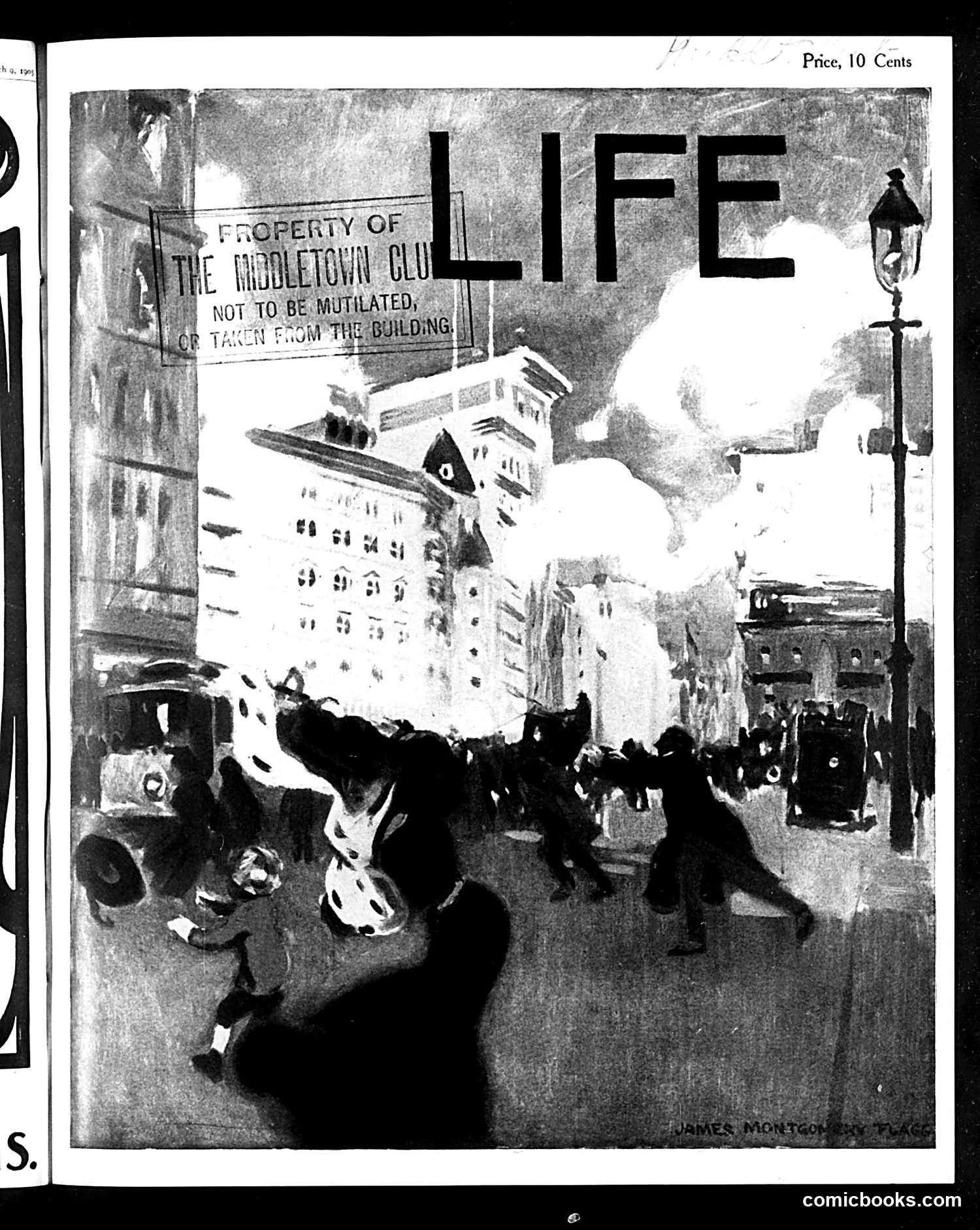
This appears to be a satirical cover titled "LIFE" depicting urban chaos and destruction. A building is collapsing or burning in the center, with crowds of people fleeing in panic through a city street. The scene resembles a disaster or catastrophe. The property stamp reading "PROPERTY OF THE MIDDLETOWN CLUB / NOT TO BE MUTILATED OR TAKEN FROM THE BUILDING" suggests this is satirizing civic institutions or clubs, though the specific reference remains unclear without additional context. The artist's signature reads "JAMES MONTGOMERY FLAGG," a prominent American illustrator. The 10-cent price indicates early 20th-century publication. The satire likely comments on urban social upheaval or institutional failure, but without knowing the specific historical event referenced, I cannot definitively identify the political point being made.
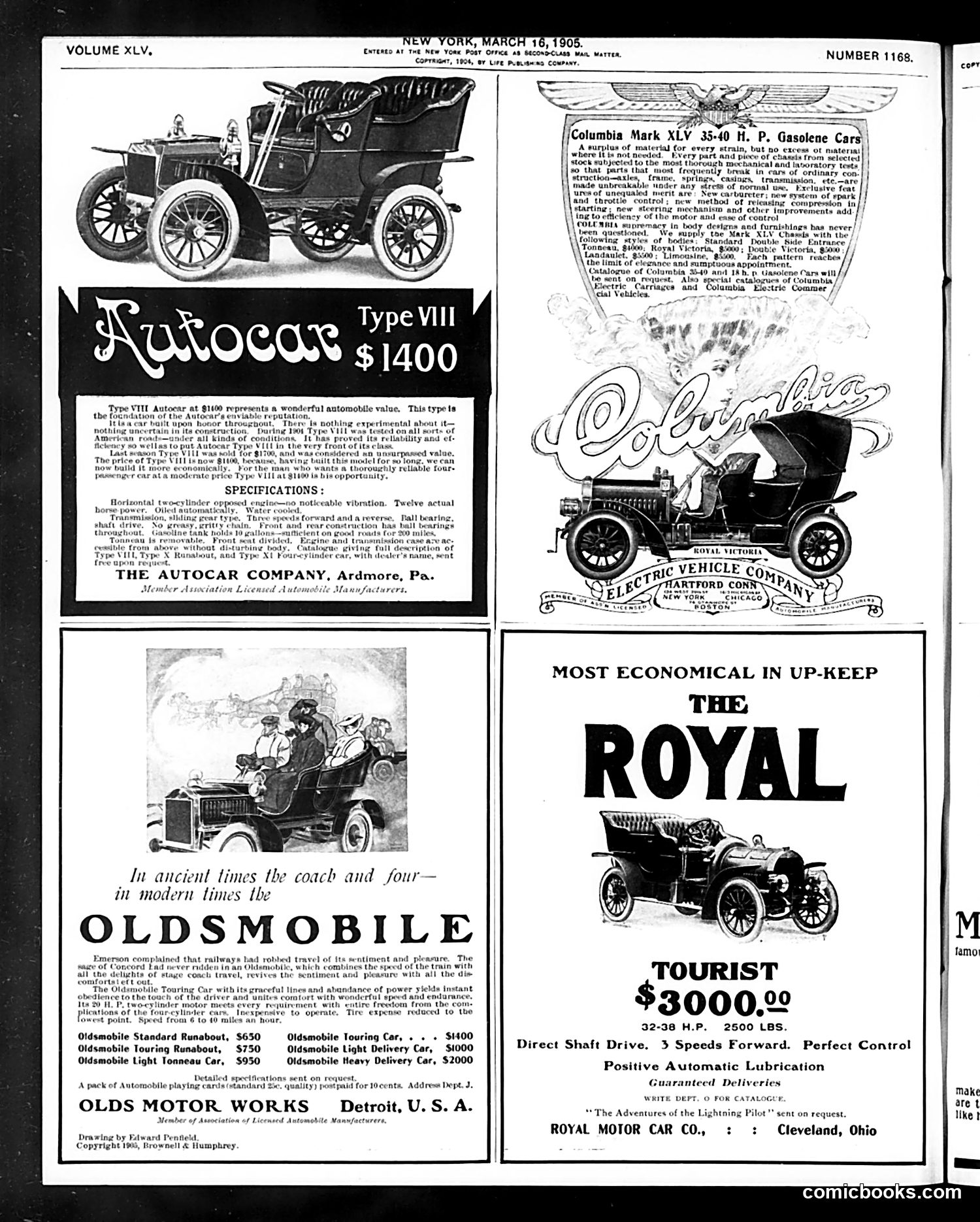
This page contains **automobile advertisements, not political satire or cartoons**. The four ads feature early 1900s motorcar manufacturers competing for customers: 1. **Autocar Type VIII** ($1,400) - emphasizes being a "wonderful automobile value" 2. **Columbia Electric** - promotes an electric vehicle with "Royal Victoria" branding 3. **Oldsmobile** - compares modern automobile comfort to historical coach travel, listing various models ($450-$3,000) 4. **Royal Tourist** ($3,000) - highlights economic efficiency and mechanical features The only visual humor appears incidental—the Oldsmobile ad includes a period illustration of passengers in an old carriage, contrasting "ancient times" with modern motoring. This is a straightforward advertising section typical of *Life* magazine's revenue model, reflecting the nascent American automotive industry around 1905. No political commentary or satirical commentary is present.
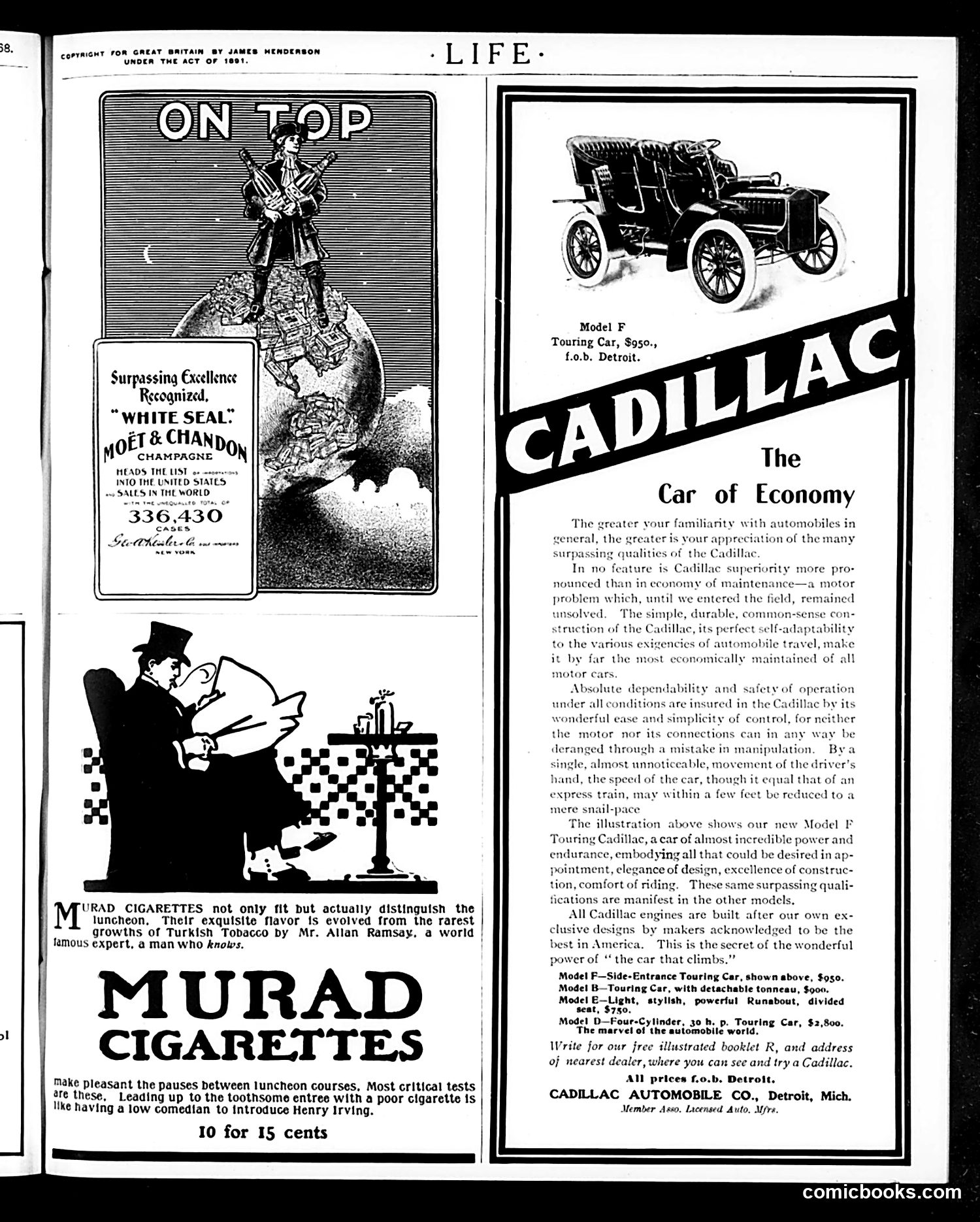
This page is primarily **advertising**, not satirical content. The left side features two ads: one for White Seal Moët & Chandon Champagne (emphasizing its dominance in U.S. sales) and one for Murad Cigarettes (claiming superiority for "pauses between luncheon courses," priced "10 for 15 cents"). The right side advertises the **Cadillac Model F Touring Car** ($950 f.o.b. Detroit), marketed as "The Car of Economy." The copy emphasizes durability, simplicity of control, and reliability—positioning Cadillac as practical despite its luxury positioning. The small cartoon of a man with a top hat at a checkered table appears to be decorative filler rather than political satire. Overall, this represents early 1900s consumer advertising in *Life* magazine.
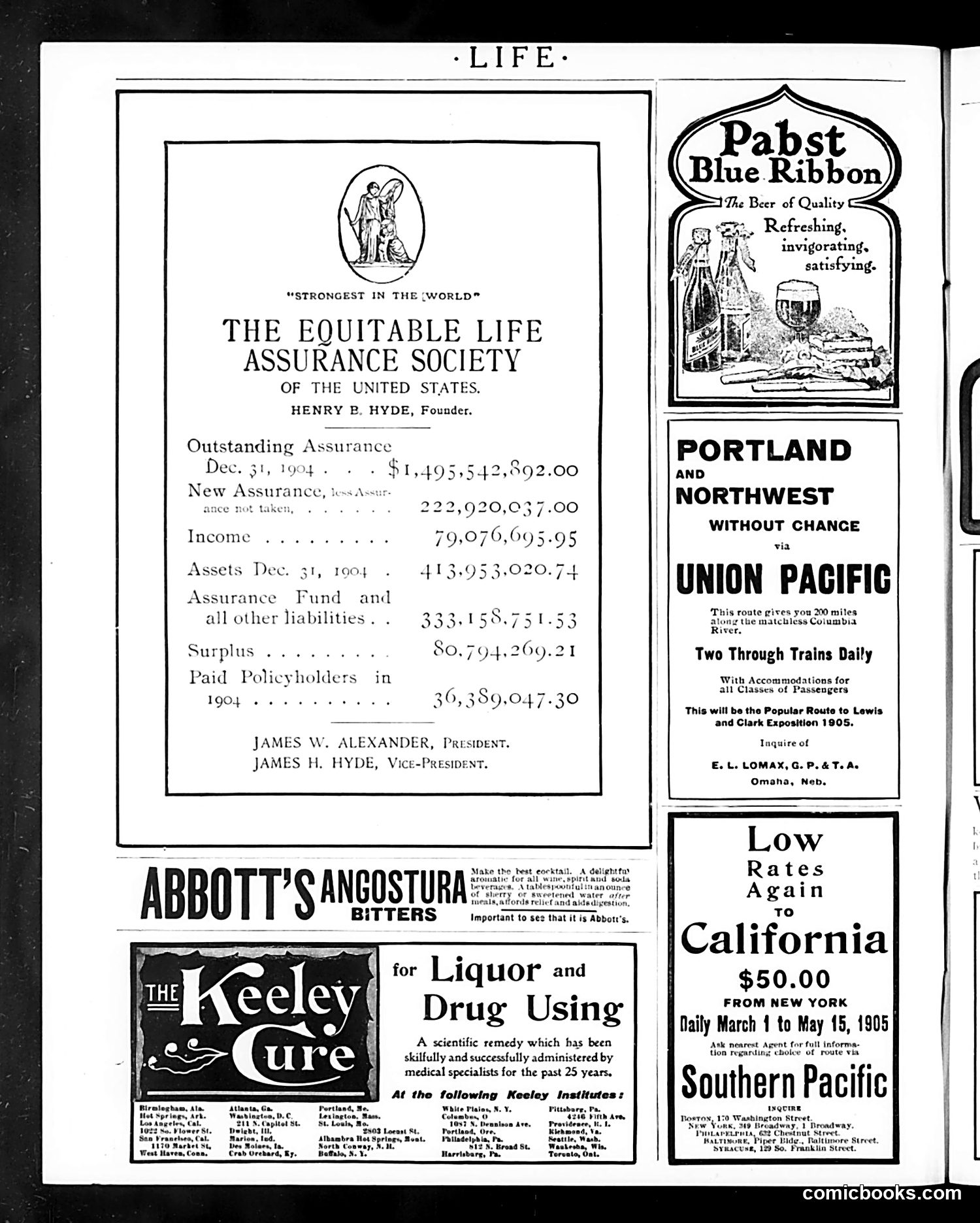
This page is **primarily advertising**, not satire or political commentary. The main content includes: **Left side:** The Equitable Life Assurance Society's financial statement (Dec. 31, 1904), highlighting its status as "strongest in the world" with substantial assets and surplus. **Right side:** Three advertisements—Pabst Blue Ribbon beer, Union Pacific Railroad (promoting Portland/Northwest routes and the Lewis and Clark Exposition of 1905), and Southern Pacific Railroad (California travel rates). **Bottom:** Abbott's Angostura Bitters and "The Keeley Cure" advertisement for treating "liquor and drug using"—a medical treatment facility operating at multiple U.S. locations. The page reflects early 1900s American commerce and reflects the era's attitudes toward alcohol consumption and medicalized "cures" for addiction.
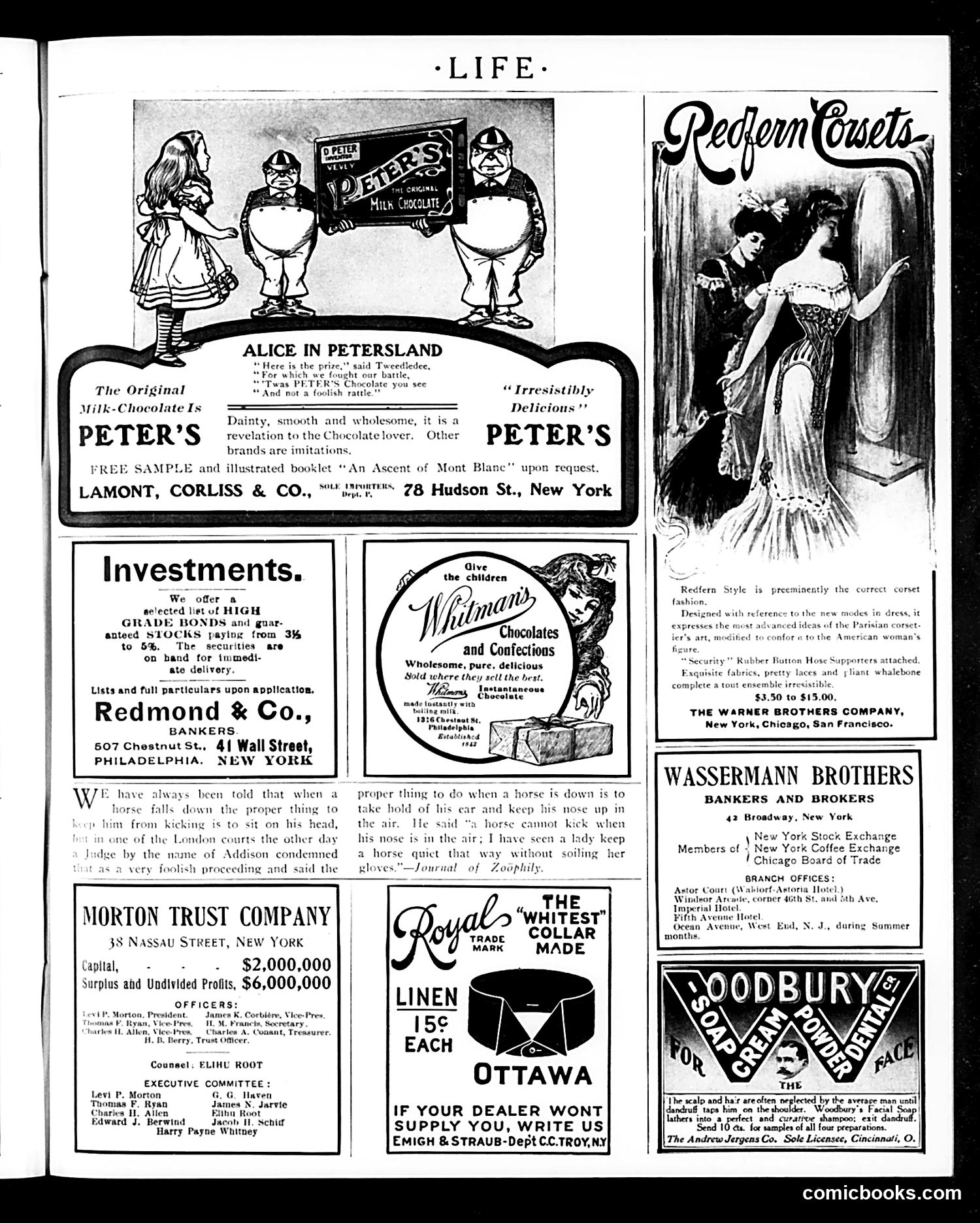
This page is primarily **advertising**, not satirical content. The main advertisements include: - **Peter's Milk Chocolate**: Features "Alice in Petersland" (a parody of *Alice in Wonderland*), promoting their chocolate as superior to imitations - **Whitman's Chocolates and Confections**: Standard product advertisement - **Royal Collar**: Linen collars for 15¢ - **Redtern Corsets**: Fashion advertisement emphasizing Parisian style - **Various financial services**: Morton Trust Company, Redmond & Co. (bankers), Wassermann Brothers (brokers) The page also includes a brief humorous anecdote about a horse falling down and the proper etiquette for helping, attributed to the *Journal of Zoophily*. There is **no significant political satire** on this page—it's a standard early 20th-century *Life* magazine advertising section mixed with light humor.
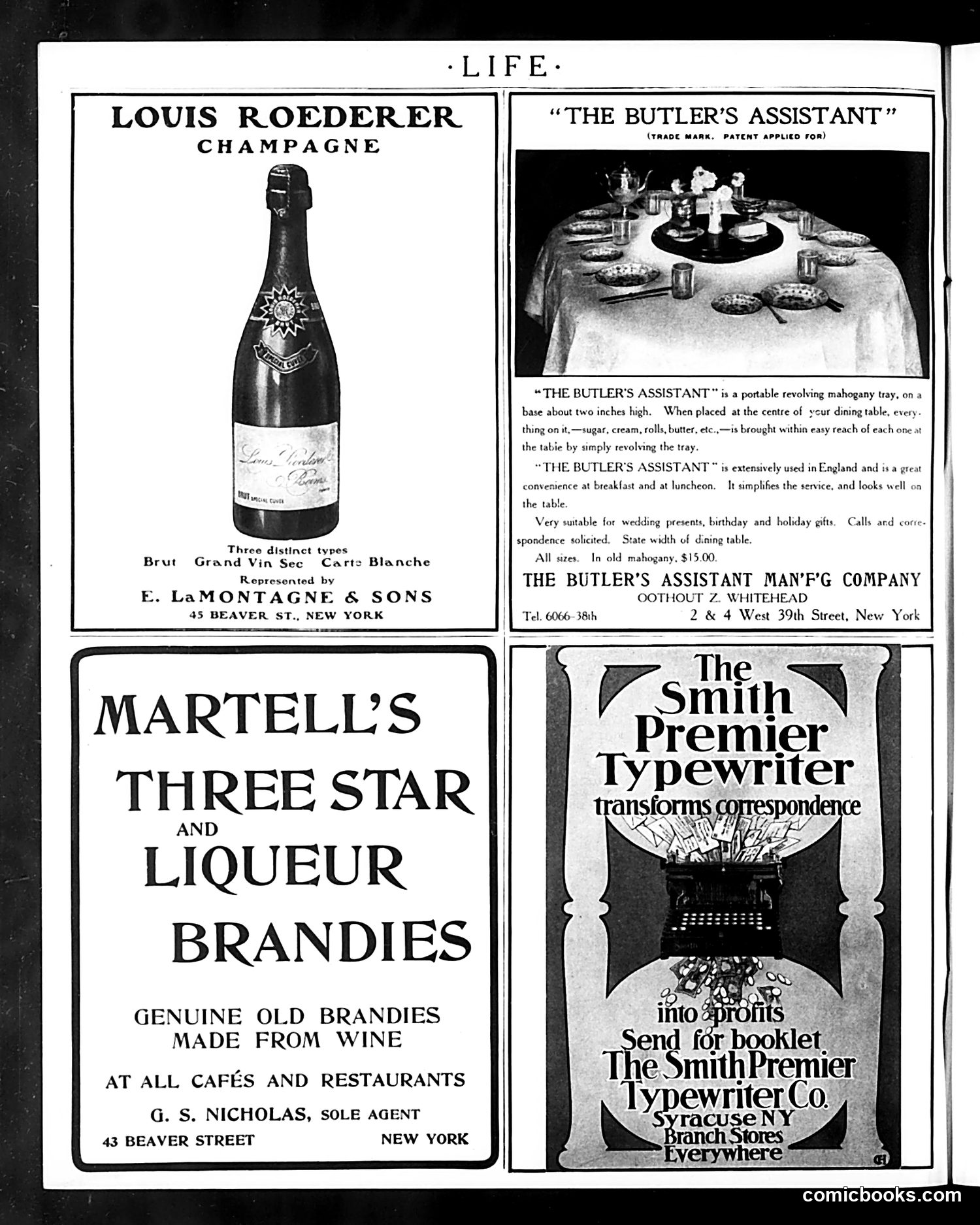
This page consists entirely of **advertisements**, not editorial cartoons or satire. The four ads promote: 1. **Louis Roederer Champagne** - a French wine brand 2. **The Butler's Assistant** - a rotating mahogany serving tray marketed as convenient for breakfast and lunch service 3. **Martell's Three Star and Liqueur Brandies** - genuine old brandies available at cafés and restaurants 4. **Smith Premier Typewriter** - positioned as transforming correspondence into profits These are period advertisements from *Life* magazine, reflecting early 20th-century consumer goods and services. The luxury items (champagne, brandy) and domestic convenience products (serving tray, typewriter) target affluent readers. There is no political satire or social commentary present on this particular page—it's commercial advertising.
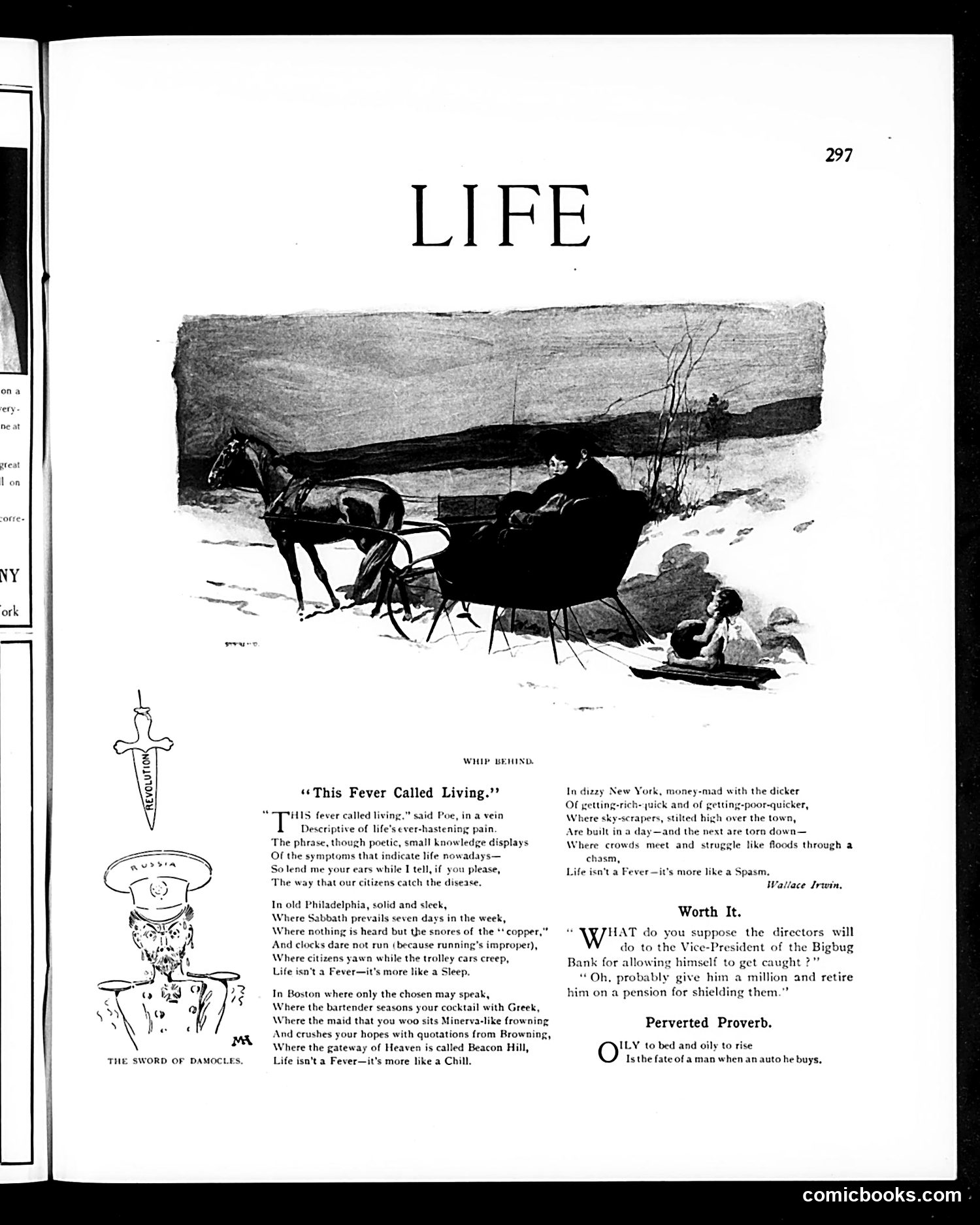
This page is titled "LIFE" and contains satirical commentary on American urban existence. The main illustration shows a horse-drawn sleigh in a winter landscape, accompanying a poem titled "This Fever Called Living" attributed to Poe. The text critiques rapid industrialization and crowded city life in early 20th-century America—specifically New York, Philadelphia, and Boston. It contrasts peaceful rural or natural existence with chaotic urban conditions: sky-scrapers, trolley cars, crowded streets, and commercial hustle. Two decorative emblems appear left of center: "The Sword of Damocles" and an ornate vessel, likely reinforcing themes of danger and excess in modern life. Additional short pieces ("Worth It," "Perverted Proverb") continue the satirical tone, mocking contemporary American social values and urban materialism.
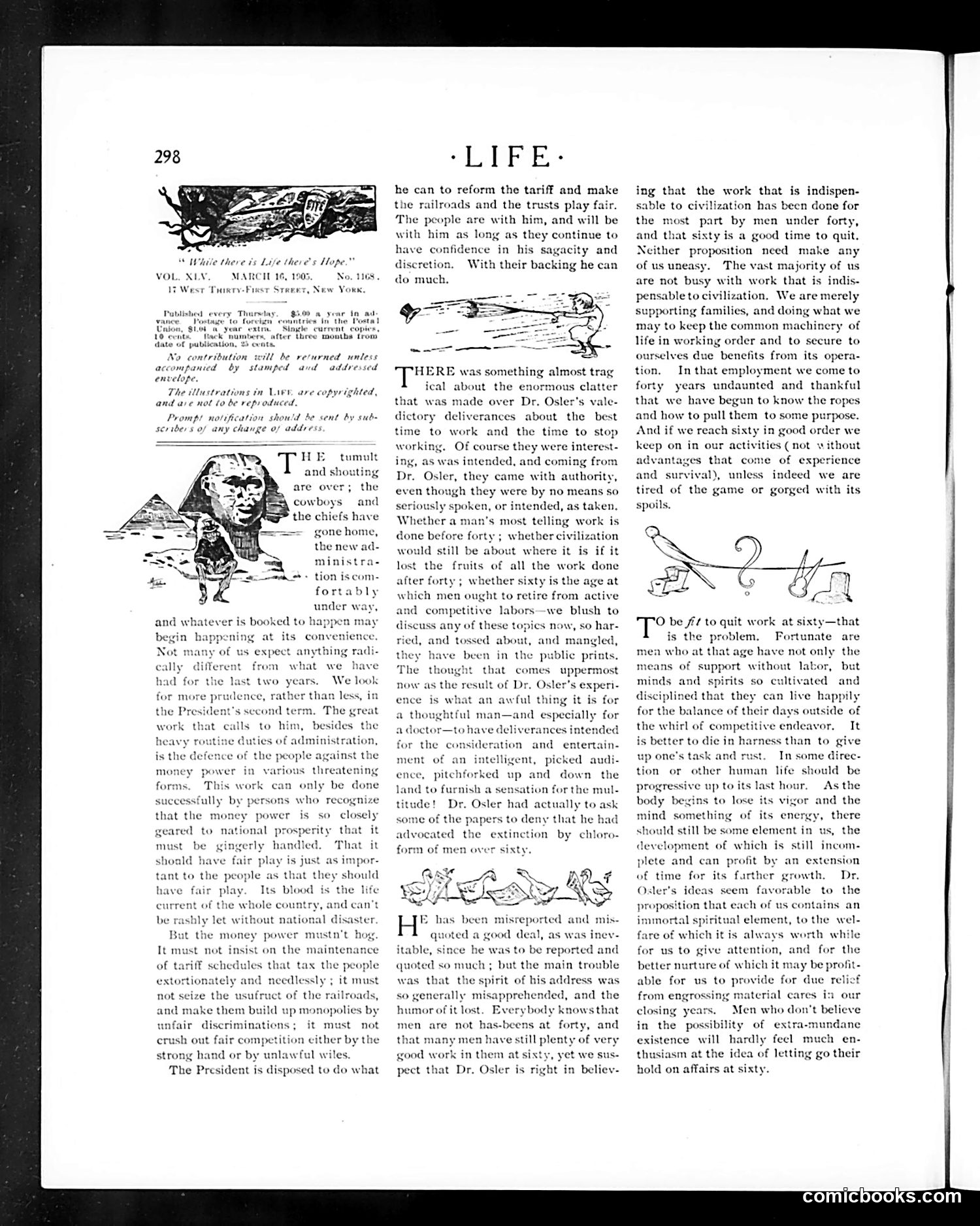
This page discusses **Dr. Osler's valedictory address** about retirement at age sixty. The cartoons satirize the controversy surrounding his remarks. The illustrated caricatures appear to depict **Dr. Osler as a central figure** (shown as an older gentleman), with surrounding imagery suggesting tumult and debate—depicting "cowboys and chiefs" in administrative turmoil. The article defends Osler's position that men should retire at sixty to pursue leisure and intellectual development, while acknowledging public misinterpretation of his remarks caused "an awful thing" for thoughtful people. The satire mocks both the sensationalized media coverage and society's resistance to accepting retirement as reasonable. The specific historical context involves a real physician's controversial speech about aging and work—a genuine public debate from this period.
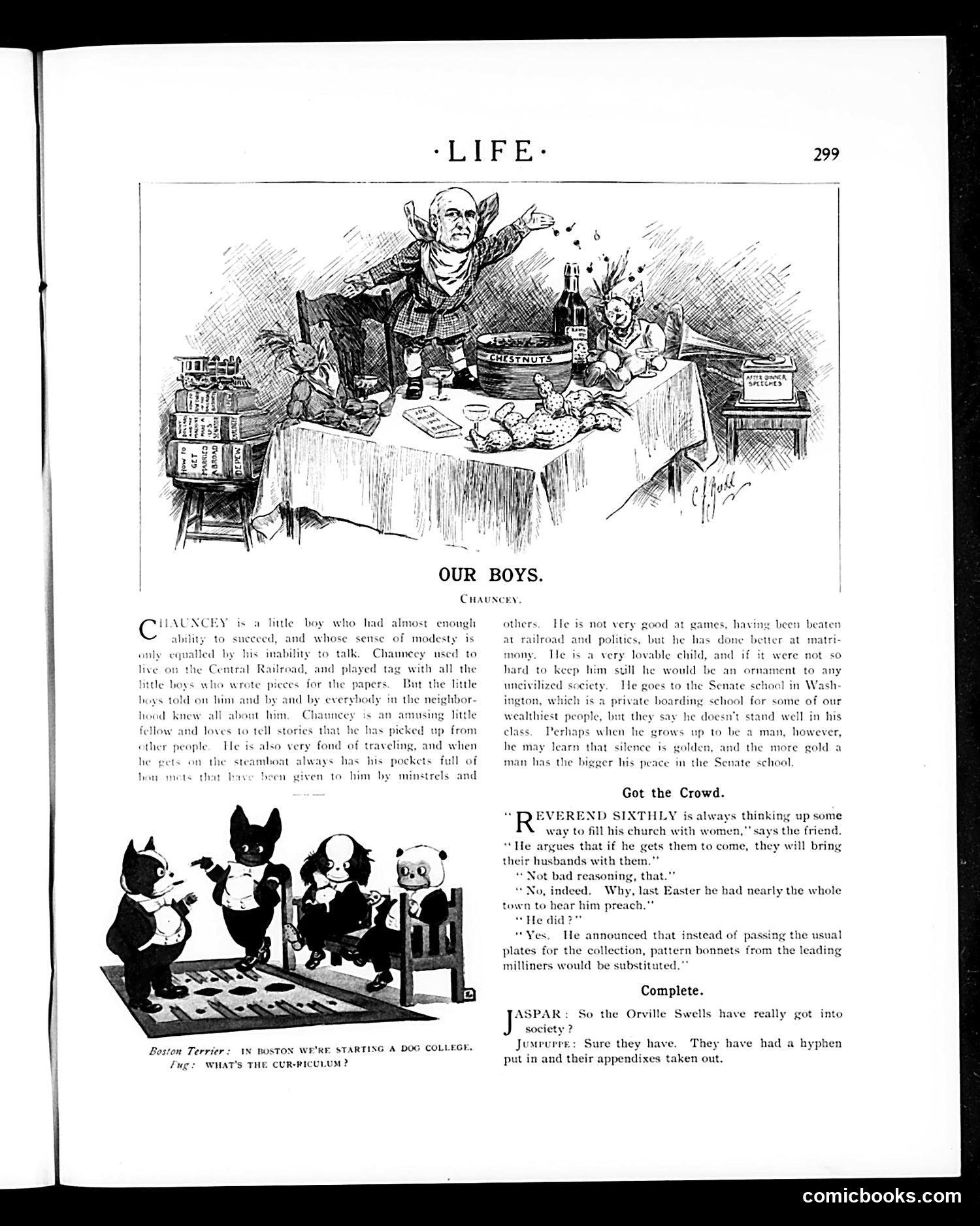
This page from *Life* magazine contains three satirical pieces mocking privileged children and clergy: **"Our Boys: Chauncey"** - A caricature of an entitled, well-to-do boy from wealthy Manhattan society who attends exclusive boarding schools. The satire ridicules his smugness, lack of genuine accomplishment, and the way his parents indulge his mediocrity despite his social ineptitude. **"Got the Crowd"** - A brief anecdote mocking Reverend Sixthly's manipulative preaching tactics—specifically his strategy to attract female parishioners to church by substituting fashionable bonnets for collection plates. **"Complete"** - A short joke about the Orville Swells, new society members whose "hyphen" and "appendices" have been surgically added—satirizing the artificial pretension of newly wealthy families attempting social climbing. The cartoons collectively critique American upper-class affectation and spiritual hypocrisy.
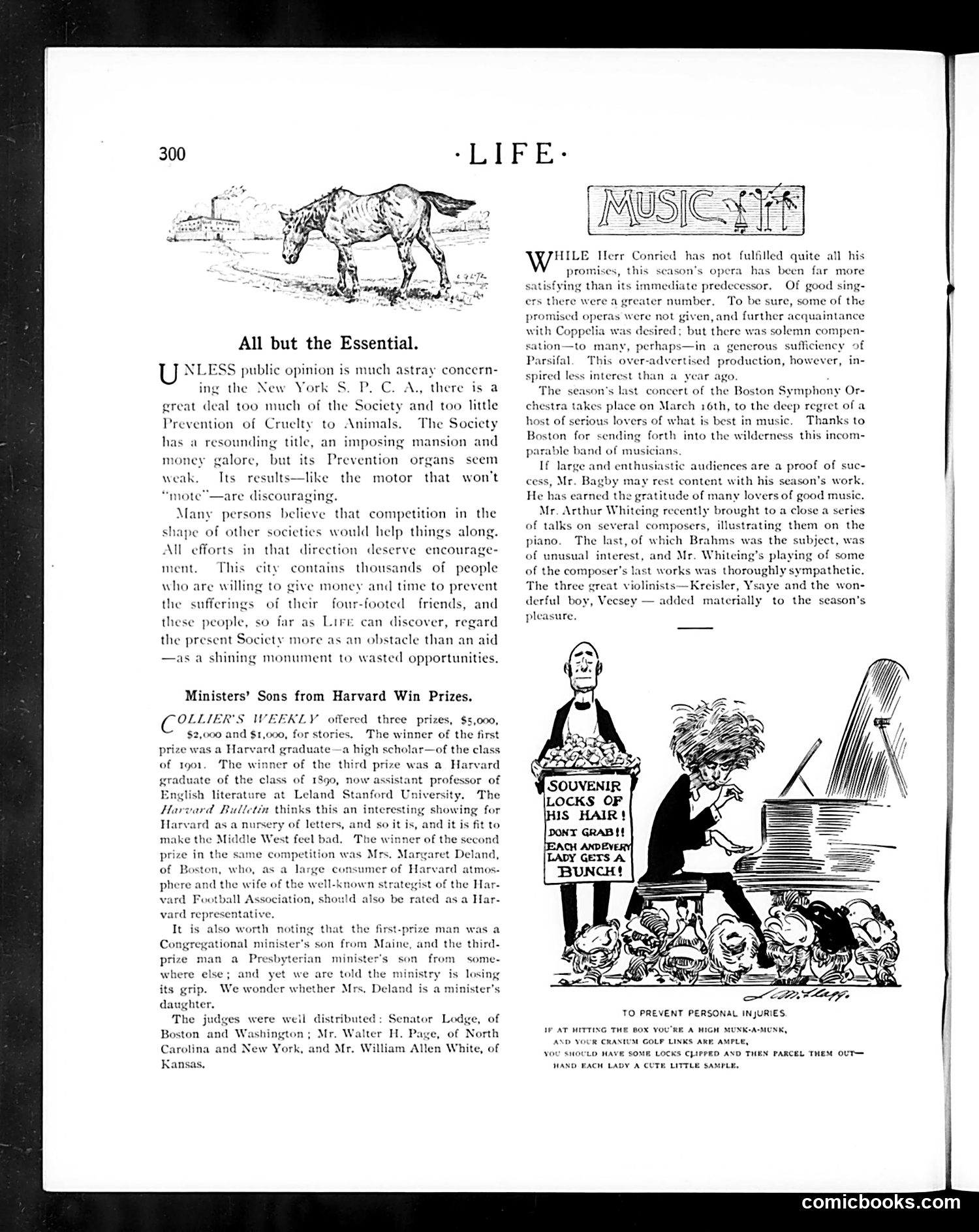
This page contains two distinct sections: **Left side:** An article titled "All but the Essential" critiques the SPCA (Society for Prevention of Cruelty to Animals) for having a "resounding title" but "weak" prevention organs and disappointing results. The piece argues the organization needs more focus and resources. **Right side:** A cartoon advertisement for "Souvenir Locks of His Hair" depicts a man at a desk handing out hair samples to women, with a caption warning ladies about hitting baseballs and golf, suggesting they should protect themselves with "cute little samples" (presumably hairpieces or bonnets). The satire mocks both excessive souvenir collecting and period attitudes about women's physical safety in sports. The page also contains a music section reviewing the Boston Symphony Orchestra season.
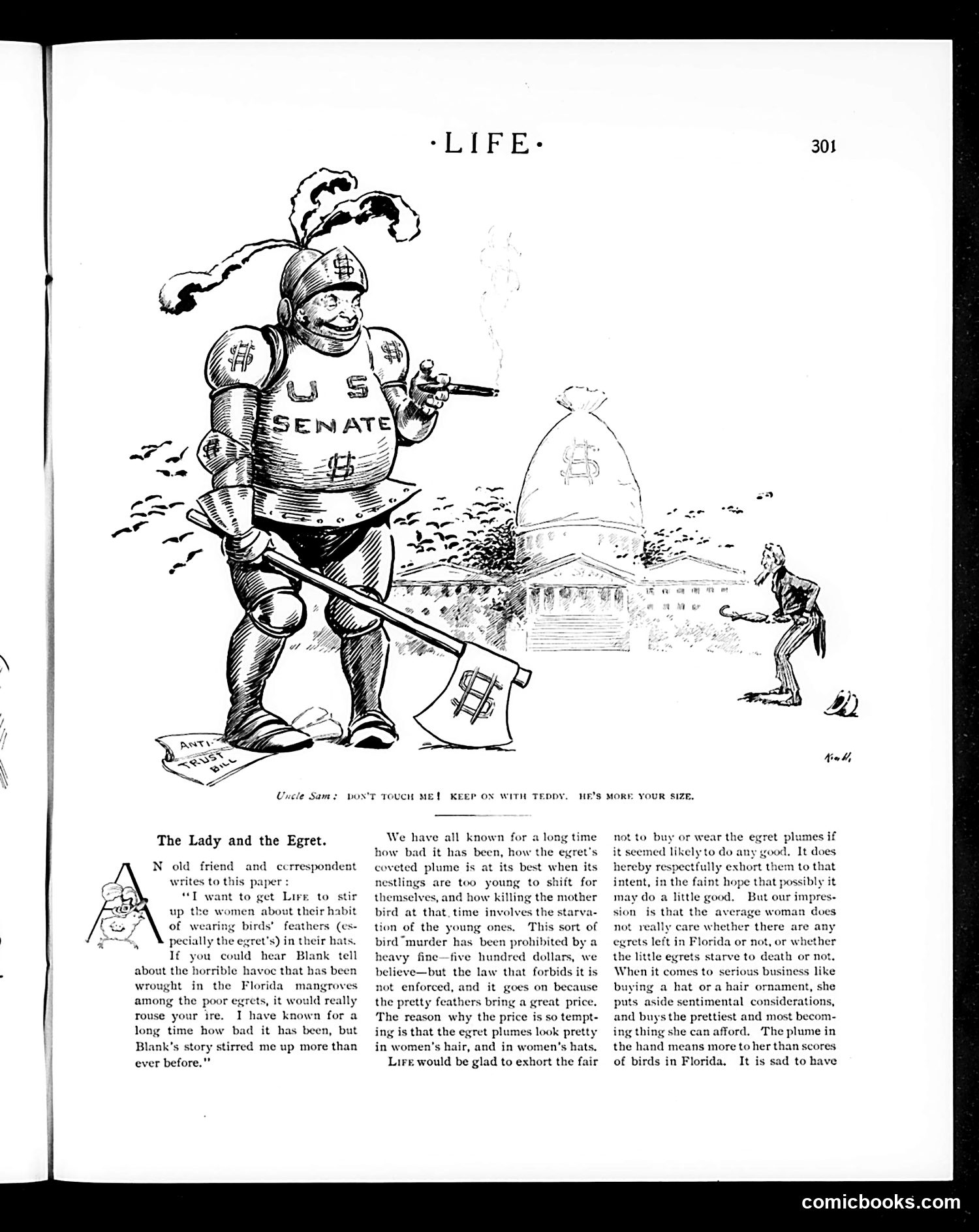
The main cartoon depicts a heavily armored "Uncle Sam" (representing the U.S. government) wielding a large axe labeled "Anti-Trust Bill," confronting a small, fleeing figure labeled "Teddy" (President Theodore Roosevelt). The satire critiques Roosevelt's trust-busting policies as overly aggressive government intervention in business. The accompanying article, "The Lady and the Egret," discusses the egret plume trade and feather fashion. It argues against wearing egret feathers in hats due to environmental concerns—young egrets starve when mothers are killed for their plumes. The piece advocates for conservation while acknowledging the plumes' commercial appeal and high price in the fashion industry.
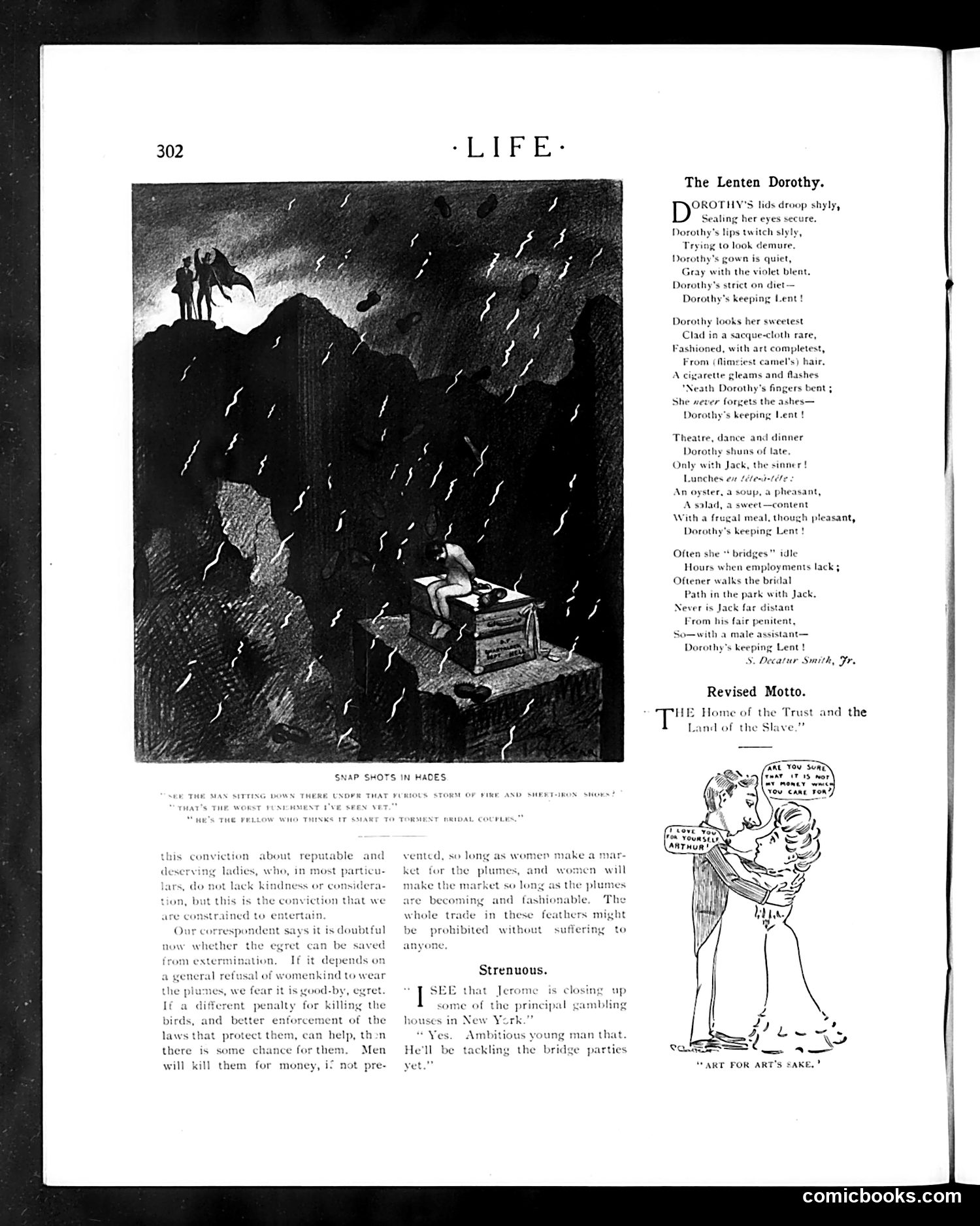
The page contains two distinct pieces: **"Snap Shots in Hades"** (left): A dramatic illustration showing figures in a storm of fire and brimstone, apparently depicting the damned in Hell. The caption quotes dialogue about a man "sitting down there under that furious storm of fire and shot-iron showers," suggesting this is satirical commentary on punishment and damnation—likely mocking or critiquing religious concepts of Hell or the fates of the wicked. **"The Lenten Dorothy"** (right): A poem celebrating a woman named Dorothy who observes Lenten sacrifice and piety during the Easter season. It contrasts her austere religious devotion with her social life and romance with "Jack." **"Art for Art's Sake"** (bottom right): A small cartoon showing two figures in an exaggerated, comedic pose, apparently satirizing aestheticism or artistic pretension. The overall theme appears to be religious and social satire typical of early 20th-century American humor magazines.
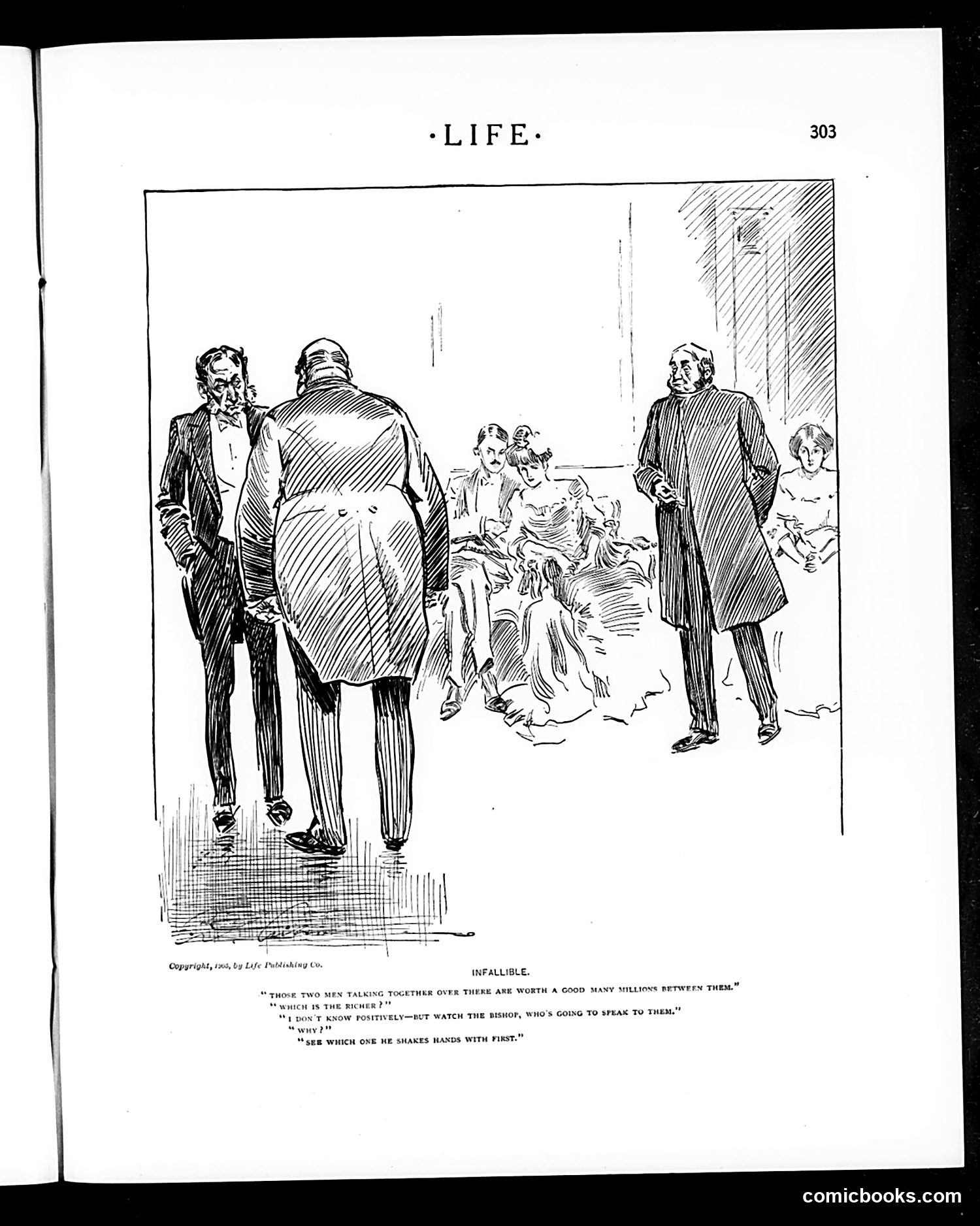
This cartoon satirizes wealthy financiers or businessmen through a scene of social observation. Two well-dressed men converse while others—including women and children—sit nearby. The dialogue reveals the satire's point: observers are trying to determine which man is wealthier by watching "which one he shakes hands with first," suggesting that social deference and handshake order reveal financial hierarchy. The joke critiques how people judge wealth and status through superficial social gestures rather than genuine merit. The title "Infallible" ironically suggests this method of assessment is foolproof, when it's actually a shallow and unreliable indicator of true worth. The illustration style and satirical tone are typical of early-20th-century Life magazine's social commentary on American class consciousness and materialism.
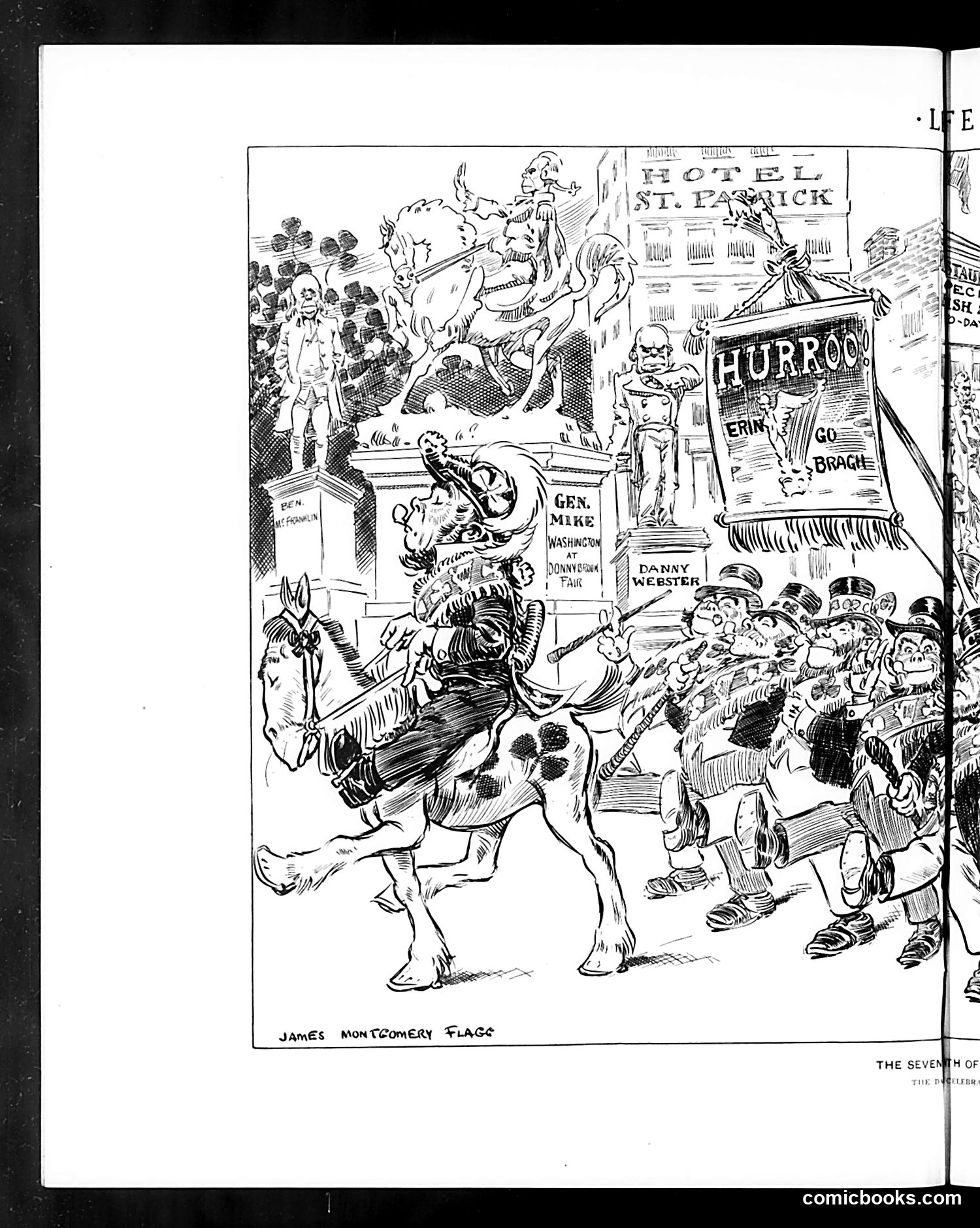
This is a satirical illustration by James Montgomery Flagg depicting a chaotic street scene outside the Hotel St. Patrick. A figure rides a rearing horse through a crowd of onlookers in period dress (top hats and formal wear). The scene references several named figures including "Gen. Mike" (appears to reference a military general), "Danny Webster," and others visible on storefronts and banners. The cartoon appears to satirize Irish-American political or social activity—suggested by the St. Patrick's Hotel signage and "Hurrah" banner. The energetic, comedic depiction of the mounted figure causing disruption likely mocks a specific political figure or event from the era when *Life* magazine was active in early 20th-century American satire. However, without clearer identification of the specific historical moment, the precise political target remains unclear from the image alone.
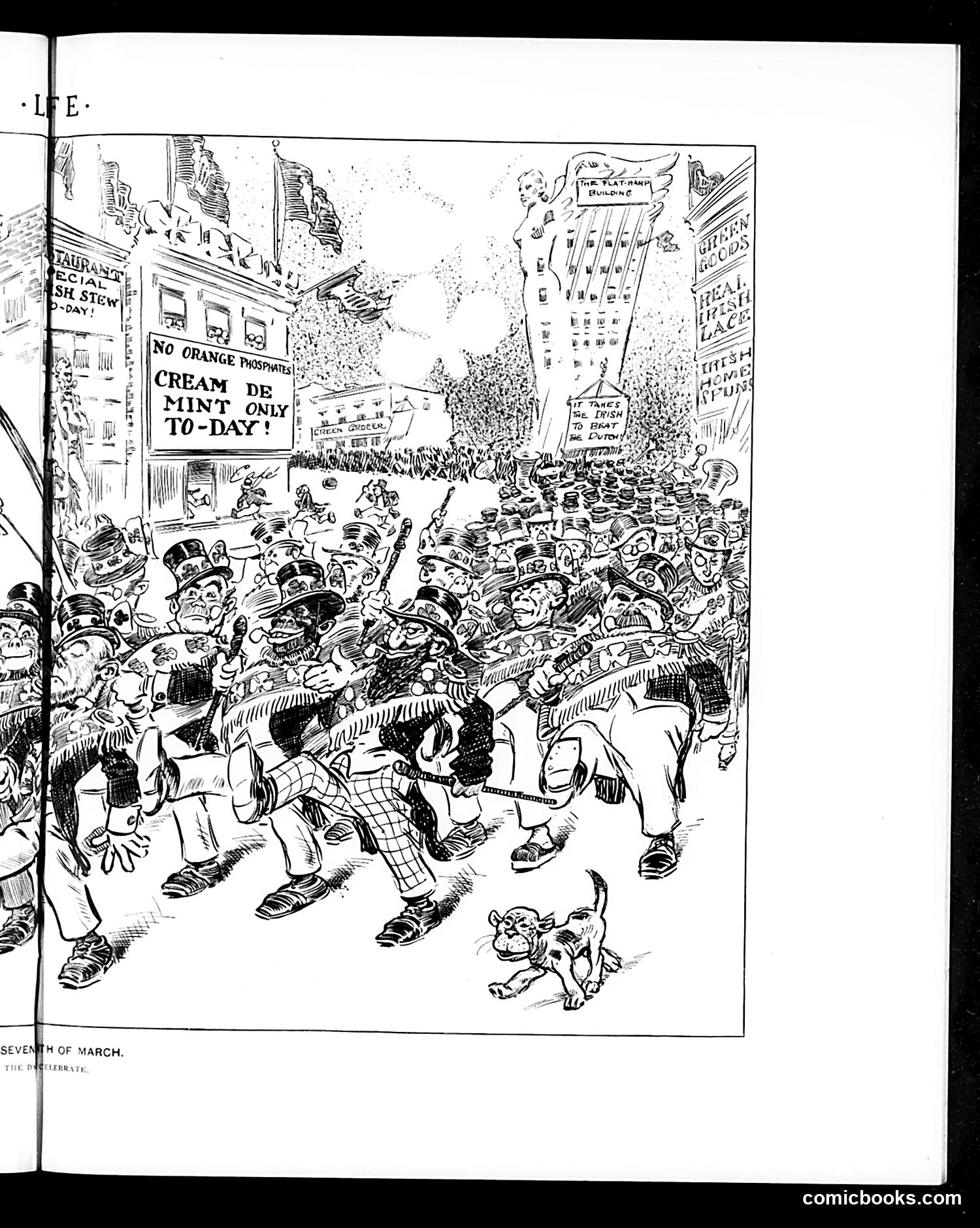
This satirical cartoon depicts a chaotic street scene centered on competing commercial advertisements. A large crowd of men in top hats (likely representing wealthy businessmen or politicians) jostle around storefront signs advertising "Cream de Mint To-Day!" and "No Orange Prompts" alongside other partially visible business promotions. The scene suggests commercial greed and competition overriding public interest—a common Life magazine theme mocking American consumerism and capitalist excess. The crowded, frenzied composition emphasizes how merchants and businessmen prioritize profit above all else. A small dog weaves through the chaos, perhaps symbolizing how ordinary citizens or nature become insignificant amid commercial frenzy. The "Seventh of March" caption indicates this references a specific historical date, though the exact event remains unclear from visible text. The overall critique appears aimed at American materialism and commercial culture during this period.
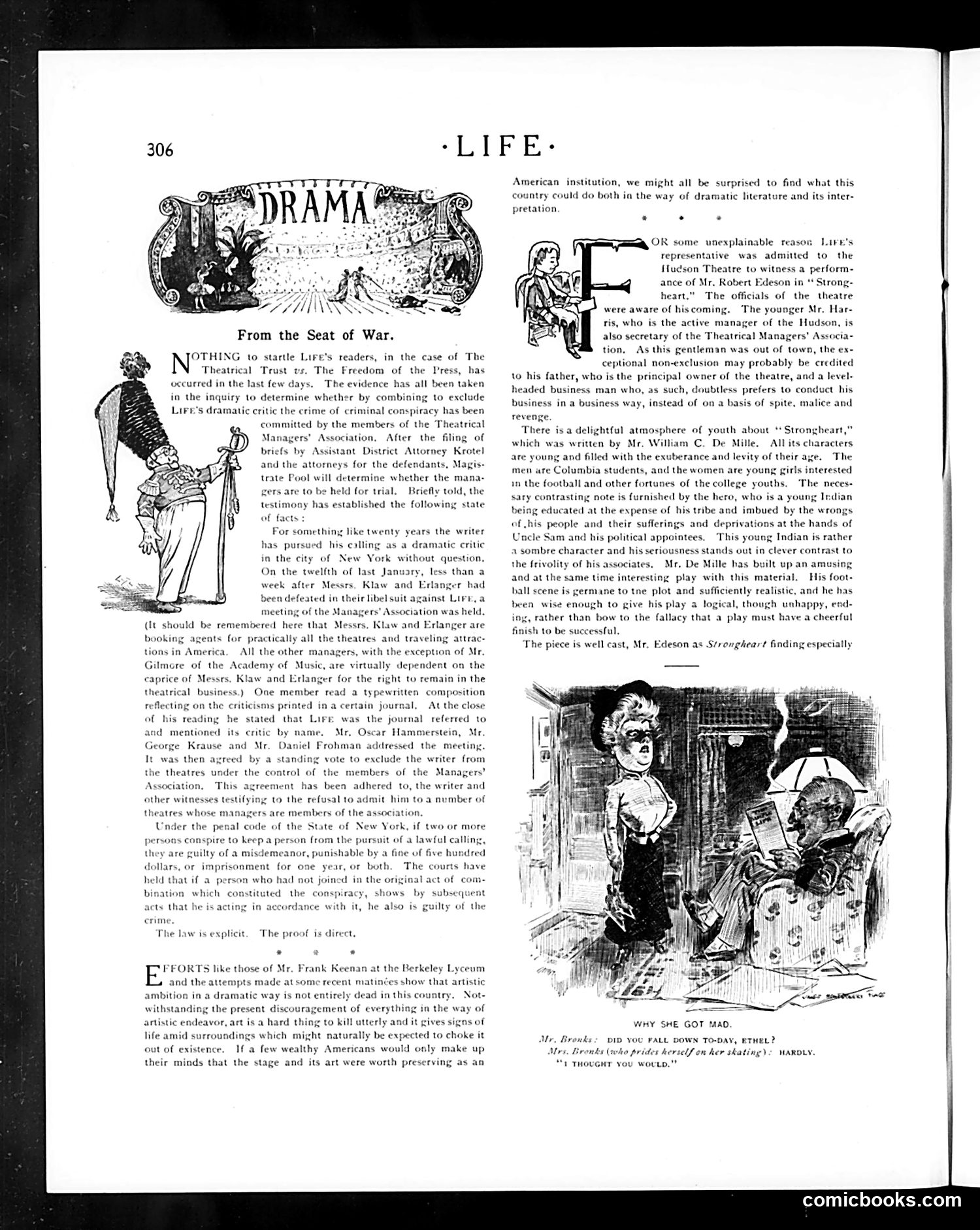
This page covers a major theatrical industry dispute from approximately the early 1900s involving the **Theatrical Trust** (controlled by Klaw and Erlanger) versus Life magazine's drama critic. **The Political Context:** Life's drama critic was blacklisted by theater managers who collectively agreed to exclude him from theaters they controlled—apparently retaliation for his criticism. The article argues this constitutes a criminal conspiracy under New York law to prevent someone from pursuing their lawful profession. Life is pursuing legal action through Assistant District Attorney Krotel. **The Significance:** This represents a clash between corporate monopoly power (the Trust's near-total control of theaters) and press freedom. Life champions artistic merit and independence, lamenting that theatrical ambition is being suppressed by financial interests rather than preserved as an American cultural institution. **The Illustration:** "Why She Got Mad" appears unrelated—likely an advertisement or separate humor feature. The page demonstrates how monopolistic practices threatened American theater in this era.
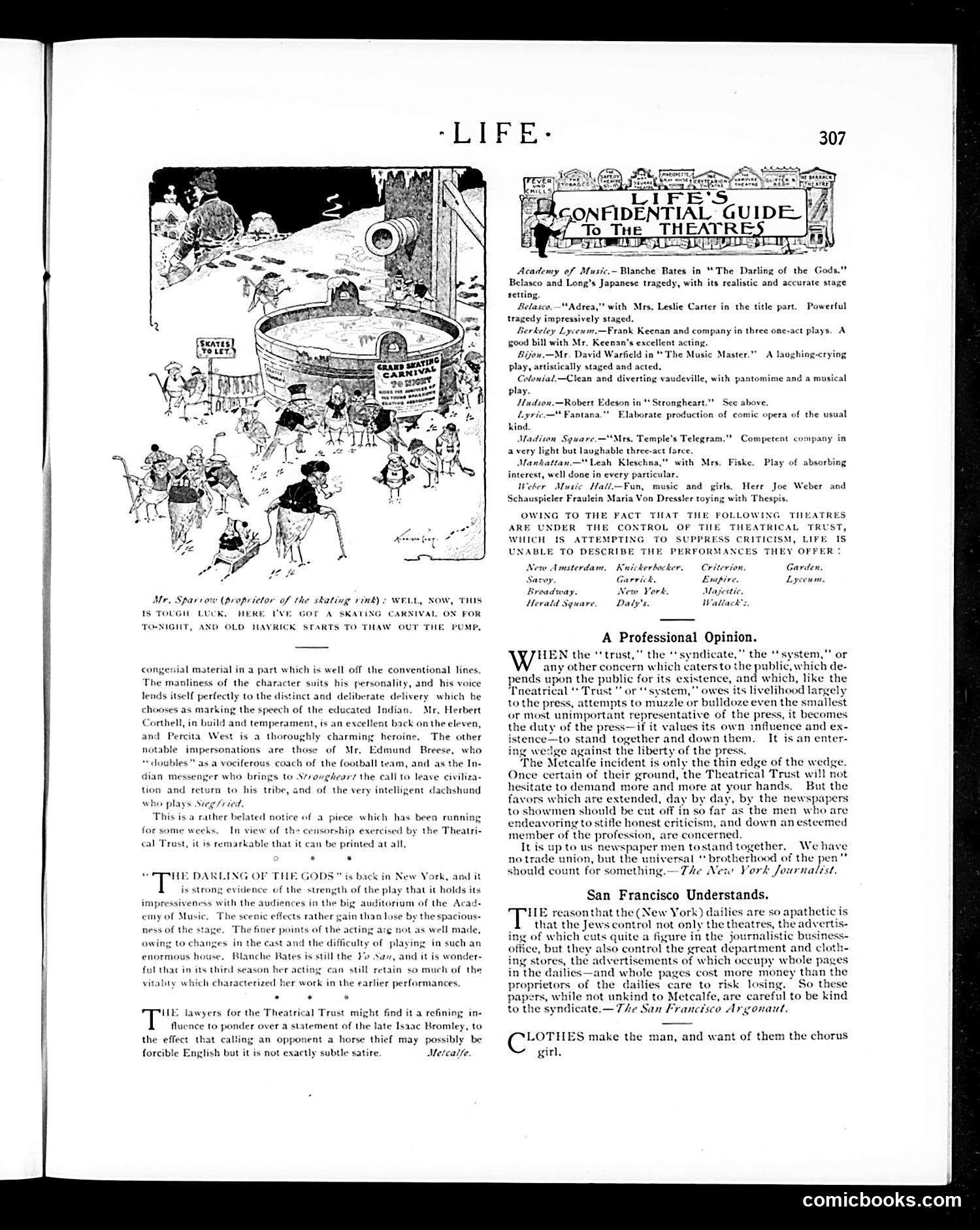
This page contains theater reviews and satirical commentary about early 1900s New York theatrical control. **The Cartoon:** Shows a skating rink proprietor ("Mr. Sparrow") frustrated because "Old Hayrick" is thawing out a pump, disrupting his skating carnival. This appears to be a simple visual joke about bad timing rather than political satire. **Main Content - The Theatrical Trust Controversy:** The page's real focus is criticizing the "Theatrical Trust" (a monopoly controlling major theaters). Life magazine identifies specific theaters "under the control of the Theatrical Trust, which is attempting to suppress criticism" and announces it cannot review performances there due to censorship pressure. **The Point:** Life is protesting corporate monopoly control over theater and artistic freedom. The magazine publishes theater reviews for independent venues while refusing to review Trust-controlled theaters, making a principled stand against what it saw as censorship and monopolistic practices stifling honest criticism. This reflects turn-of-century progressive concerns about corporate trusts limiting free speech and public discourse.
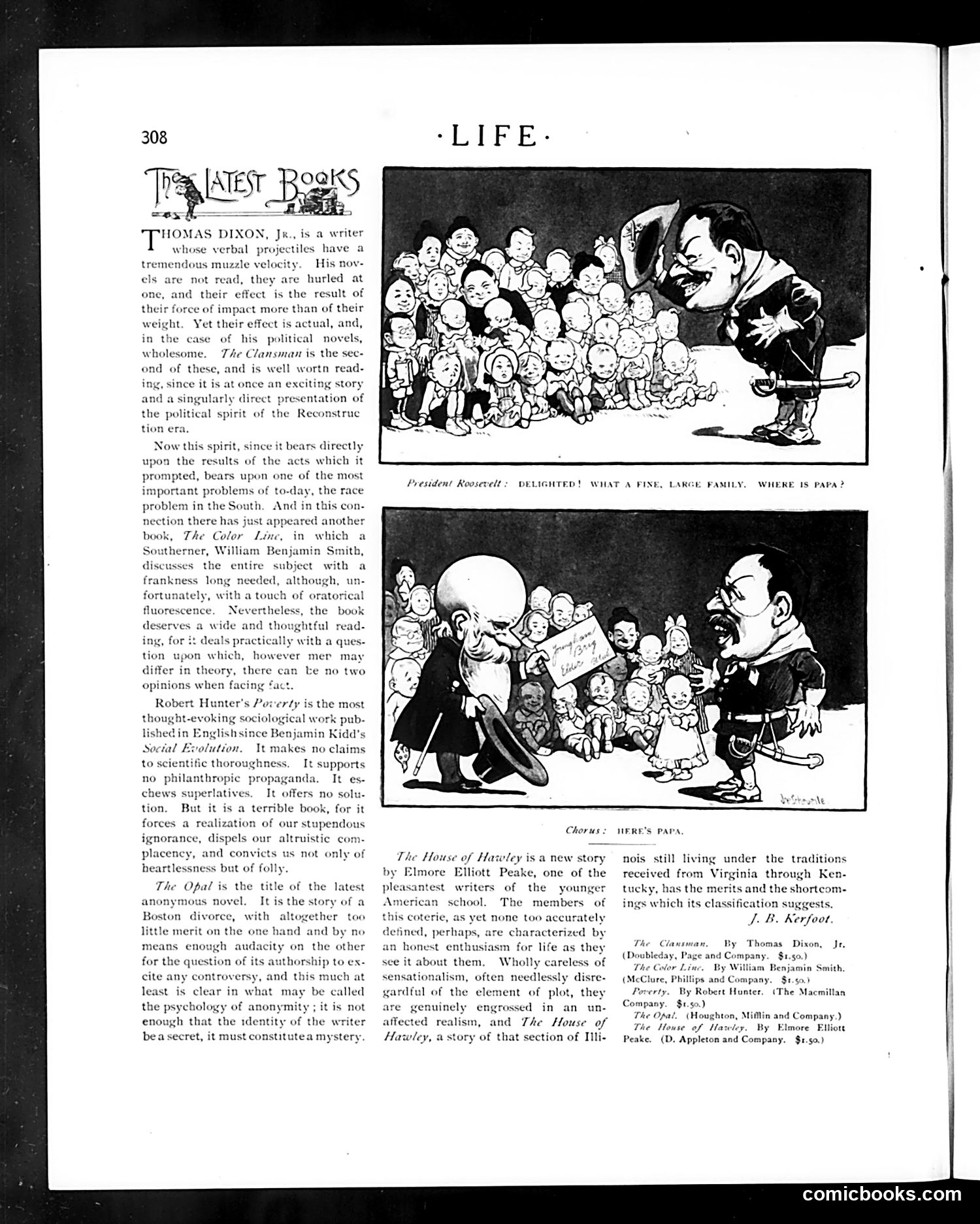
The two cartoons satirize President Theodore Roosevelt's large family by depicting him as delighted but absent. In the first cartoon, Roosevelt admires a massive crowd of children, exclaiming "What a fine, large family. Where is papa?" In the second, titled "Chorus: Where's Papa," multiple children ask the same question while Roosevelt appears elsewhere. The satire targets Roosevelt's political activism and public visibility—he's so consumed by his presidency and various endeavors that despite fathering many children, he's perpetually absent from family life. The joke plays on the contrast between his vociferous public presence (referenced in the accompanying text about Thomas Dixon's "tremendous muzzle velocity") and his private domestic unavailability. This reflects broader contemporary criticism of Roosevelt as an energetic but distracted public figure, more invested in national affairs than paternal duties.
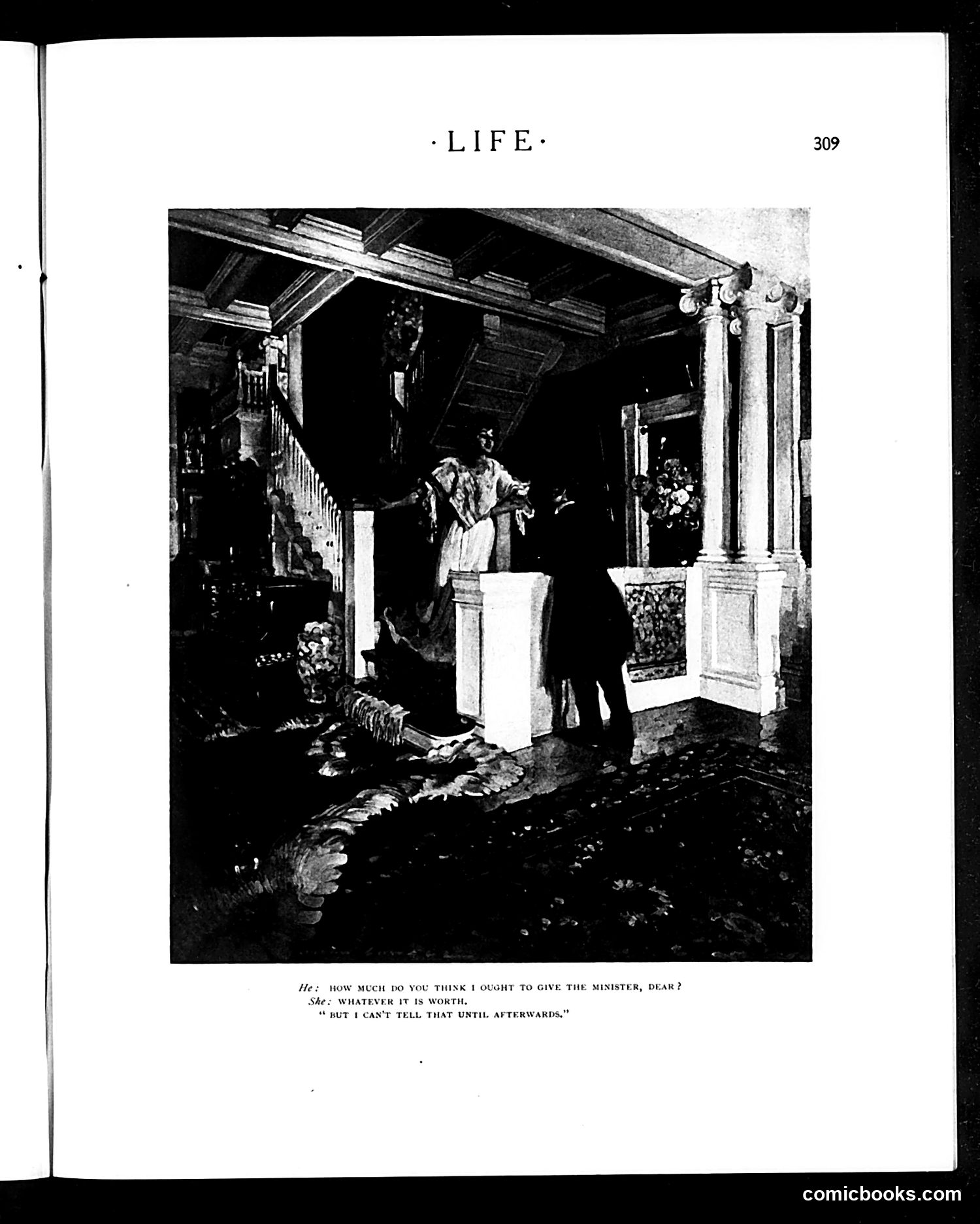
This is a satirical domestic scene depicting a couple discussing a monetary gift for their minister. The humor turns on the wife's witty deflection: when asked how much to give, she says she can't determine the proper amount "until afterwards." The joke satirizes the transactional nature of religious donations—implying the gift's value depends on the minister's future performance or sermon quality, which can only be judged after hearing it. It mocks both the awkwardness of monetary church contributions and the unspoken expectation that parishioners "pay" for spiritual services. The elaborate columned porch setting suggests a prosperous household, emphasizing that this is a middle-class concern about social propriety and appropriate charitable giving within their religious community.
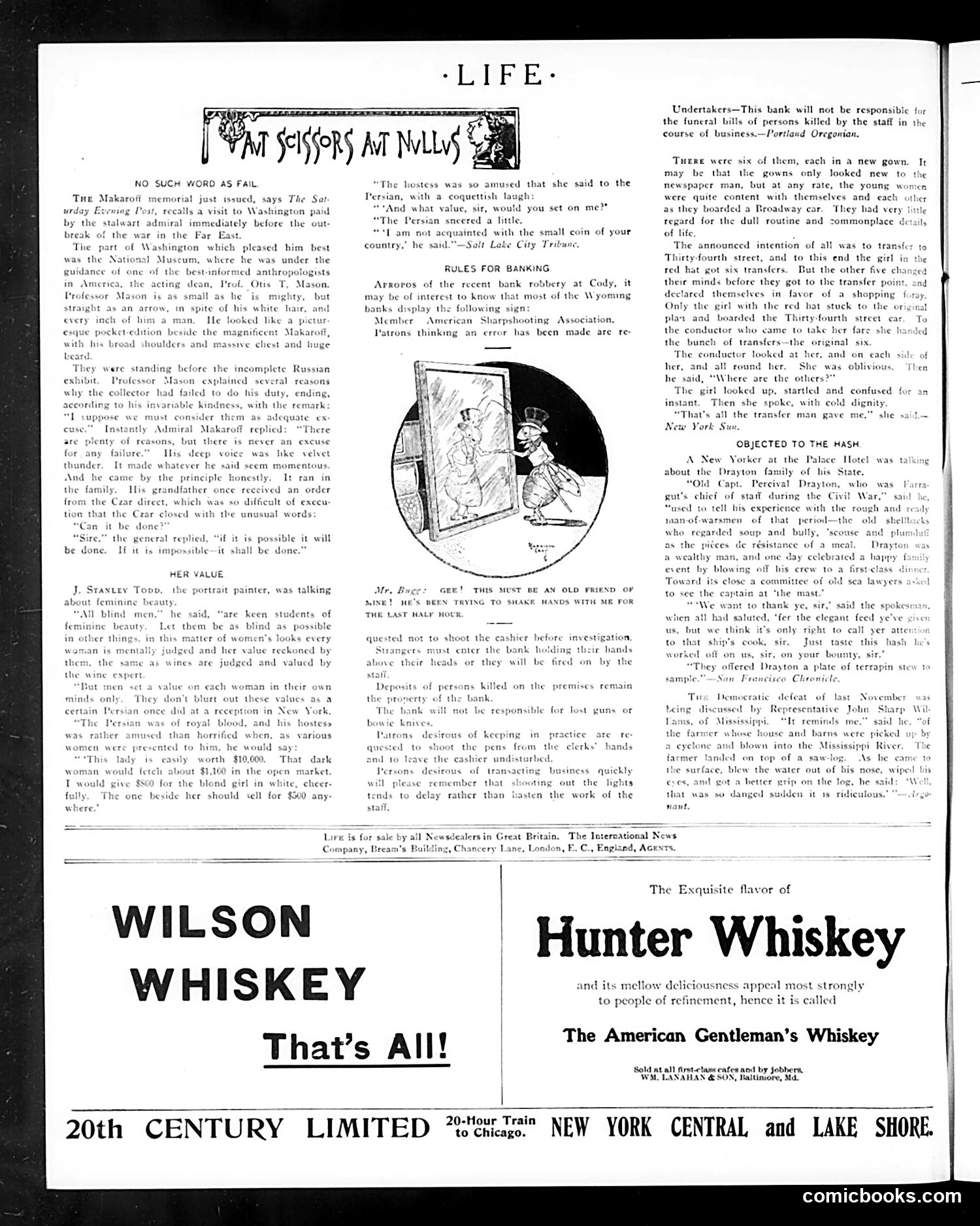
This page from *Life* contains several satirical pieces typical of the magazine's social commentary: **"No Such Word as Fail"** recounts Admiral Makarov's visit to Washington's National Museum. The satire contrasts the admiral's unwavering confidence ("if it is impossible—it shall be done") with American pragmatism, poking fun at Russian absolutism and American institutional mediocrity. **"Rules for Banking"** mocks bank security by showing a sign reading "Member American Sharpshooting Association"—dark humor following recent bank robberies, suggesting banks arm themselves against theft. **"Her Value"** and **"Objected to the Hash"** are brief anecdotes about social pretension and military strictness, likely satirizing class distinctions and naval hierarchy. The page also contains period whiskey advertisements (*Wilson* and *Hunter*), typical of early-20th-century magazine content. The overall tone reflects *Life*'s characteristic blend of social satire, institutional criticism, and genteel humor aimed at educated American readers.
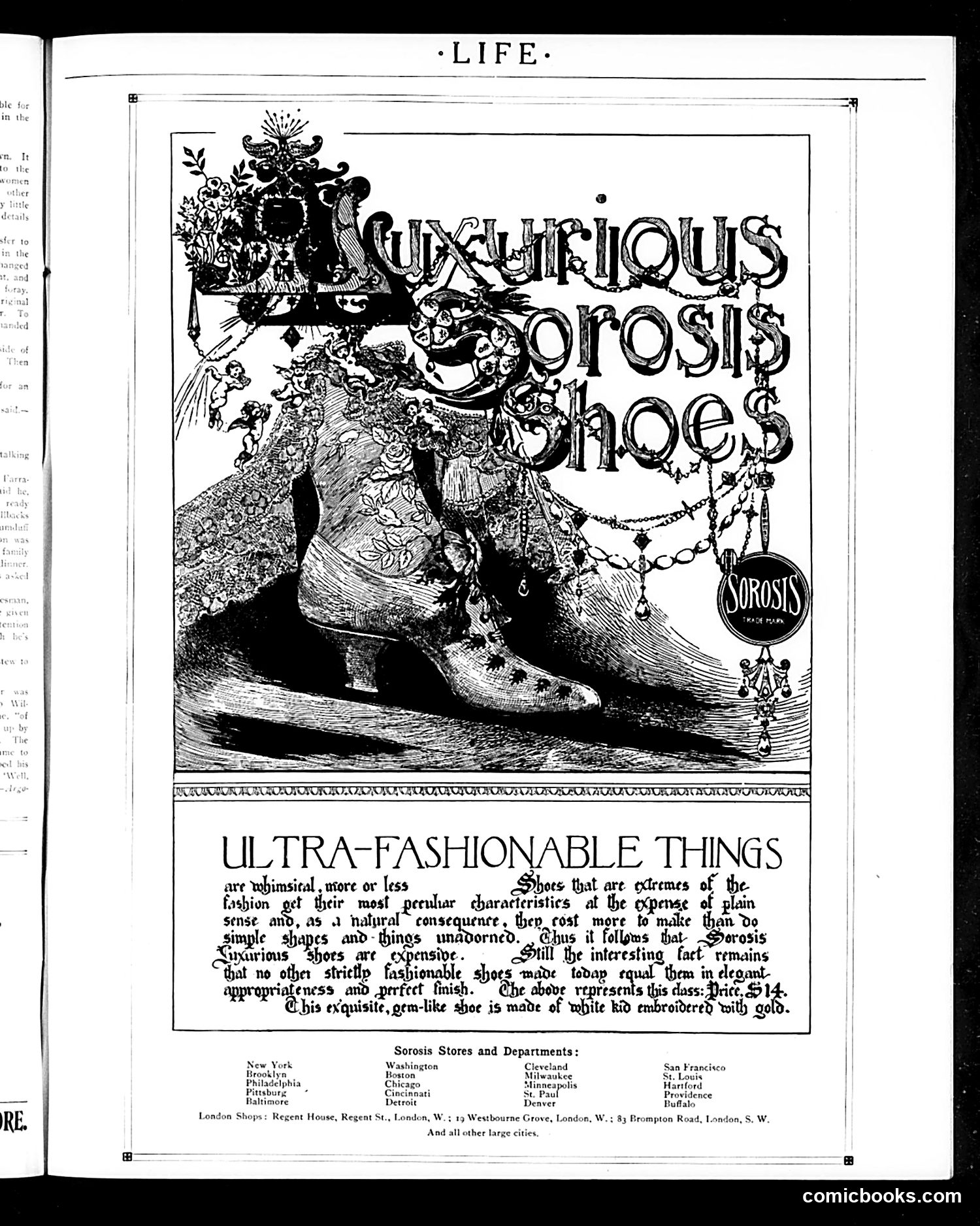
This is primarily a **Sorosis shoe advertisement** disguised as satirical commentary. The elaborate illustration depicts ornately decorated women's shoes—"luxurious" footwear designed for fashion-conscious wealthy women. The "satire" is gentle self-aware advertising: the text acknowledges that ultra-fashionable shoes are impractical, expensive, and sacrifice "plain sense" for aesthetic extremes. Yet it frames this as desirable, arguing that Sorosis shoes uniquely combine such extravagance with "elegant appropriateness and perfect finish." The specific shoe shown (priced at $14) is made of white kid leather embroidered with gold—clearly a luxury item for affluent women. The ornate Art Deco-style illustration reflects early 20th-century aesthetics. This represents a common Life magazine format: satirizing consumer excess while simultaneously promoting it to the magazine's affluent, fashionable readership. The joke operates on two levels—mocking fashion's absurdity while validating it as desirable.
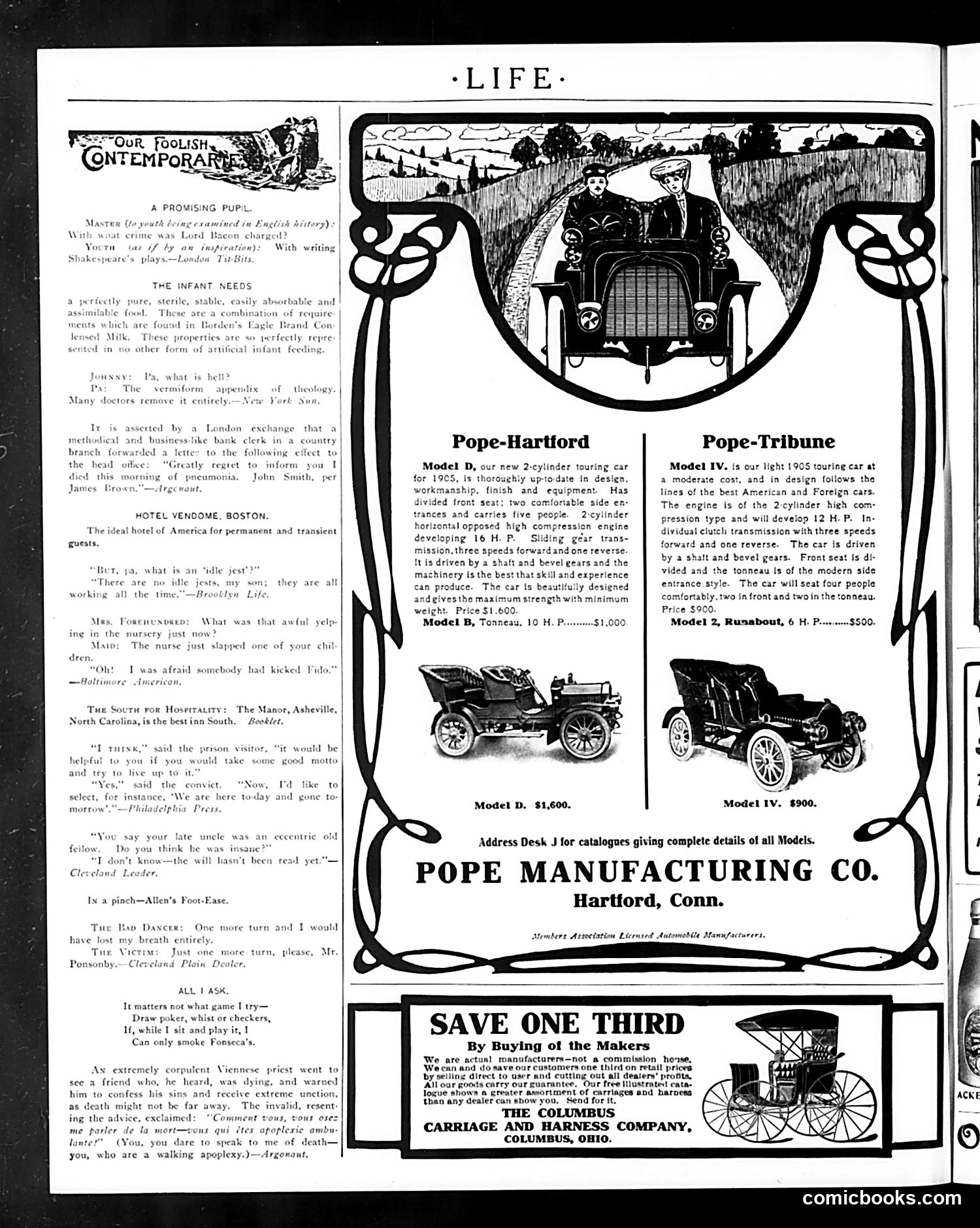
This page is primarily **automobile advertising** with satirical humor sections on the left side. ## The Satire/Humor Sections The left column contains brief comedic anecdotes mocking contemporary society: - **"A Promising Pupil"**: A student confident he'll excel at English history, despite not reading Shakespeare - **"The Infant Needs"**: Medical advice about infant formula - **"Hotel Vendome, Boston"**: Hotel advertisement - Various short jokes about servants, convicts, priests, and social situations These are typical *Life* magazine humor pieces—brief, observational comedy about middle-class life, servants' malapropisms, and moral/religious hypocrisy. ## Primary Content: Pope Automobile Advertisements The right half features two competing Pope car models (Model D Hartford and Model IV Tribune) with detailed specifications and prices ($900-$1,600). Below is a Columbus Carriage Company ad promoting direct-to-consumer sales. **Context for modern readers**: This reflects early 1900s automobile advertising and the era when multiple competing automobile manufacturers existed before industry consolidation.
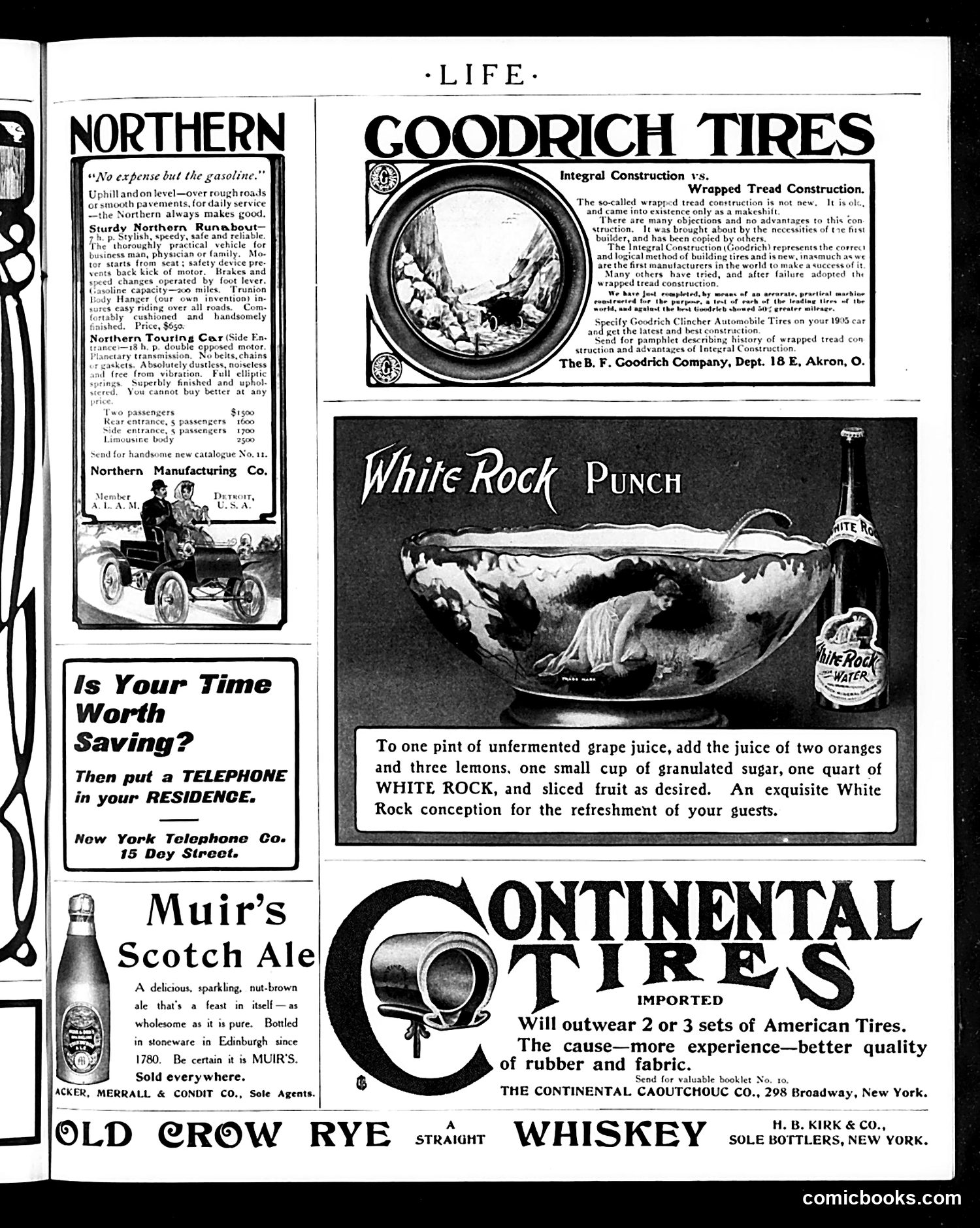
This is primarily an **advertising page** with no editorial cartoons. The content consists of early 1900s product advertisements: **Notable ads include:** - **Northern automobiles**: Promoting sturdy, affordable runabouts and touring cars with emphasis on durability over rough roads - **Goodrich Tires**: Comparing "Integral Construction" versus competitors' "Wrapped Tread Construction," claiming superiority - **White Rock Punch**: A recipe for a non-alcoholic beverage (notable given the Prohibition era context) - **Continental Tires**: Claiming superiority to American tires through better materials - **Alcoholic beverages**: Muir's Scotch Ale, Old Crow Rye Whiskey (all pre-Prohibition era products) - **New York Telephone Company**: Marketing residential telephones as time-saving The page reflects early 20th-century consumer culture and competitive product claims. The ads target middle-class professionals (doctors, businessmen) emphasizing reliability and modern convenience.
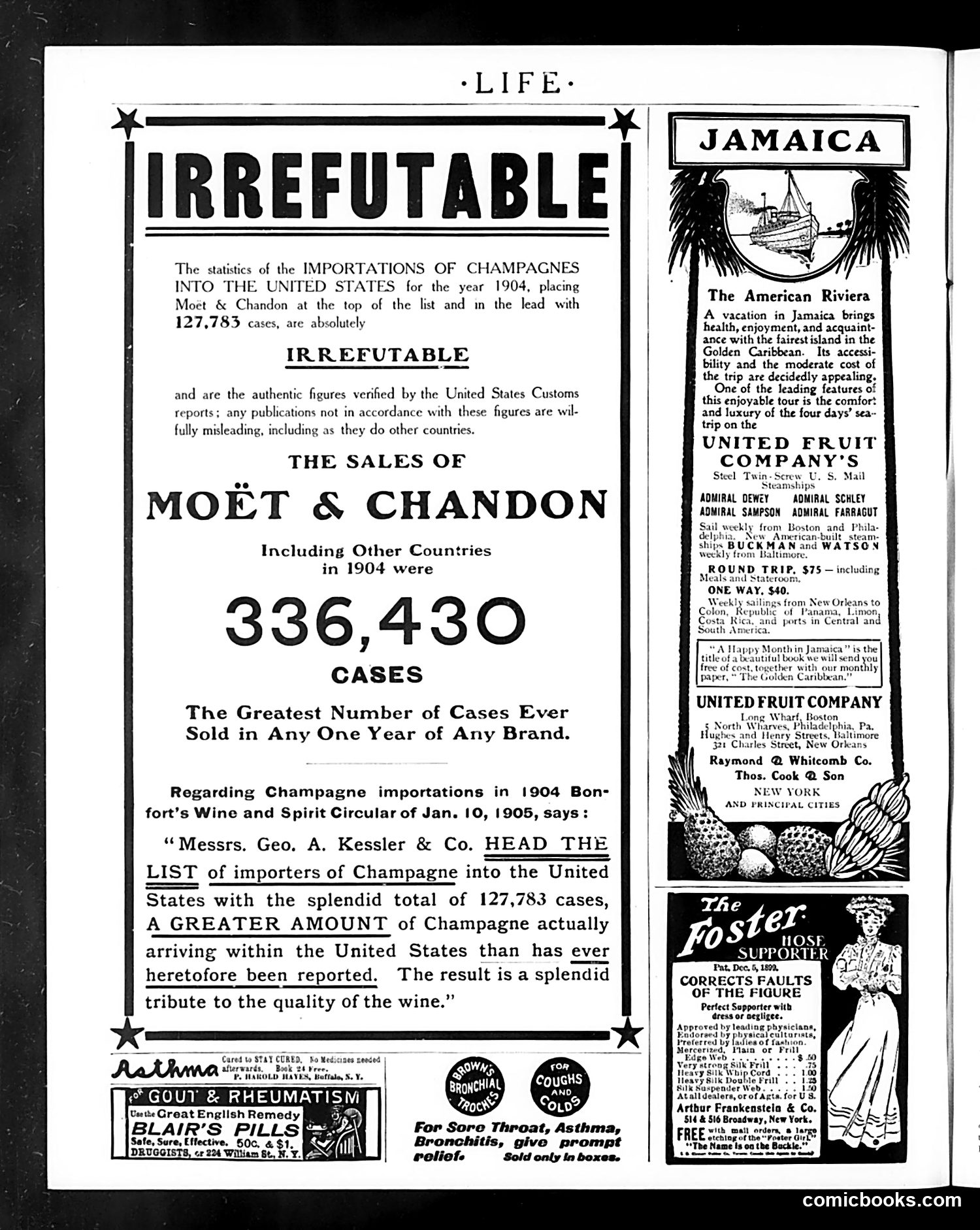
This is primarily a **champagne advertisement**, not political satire. The main content celebrates Moët & Chandon's dominance in U.S. champagne imports for 1904 (336,430 cases), with an emphatic declaration that these sales figures are "IRREFUTABLE" and verified by U.S. Customs. The page includes a quote from a wine industry publication vouching for importer Geo. A. Kessler & Co.'s record imports of 127,783 cases. This appears designed to establish credibility and market leadership during what was likely a competitive period in the luxury wine trade. The right column contains unrelated advertisements: Jamaica tourism, the United Fruit Company's steamship service, and period patent medicines (Blair's Pills, Foster corsets). **Historical context**: This reflects the Gilded Age's conspicuous consumption and marketing emphasis on authenticating luxury goods through official statistics and testimonials. There is no cartoon or satire on this page.
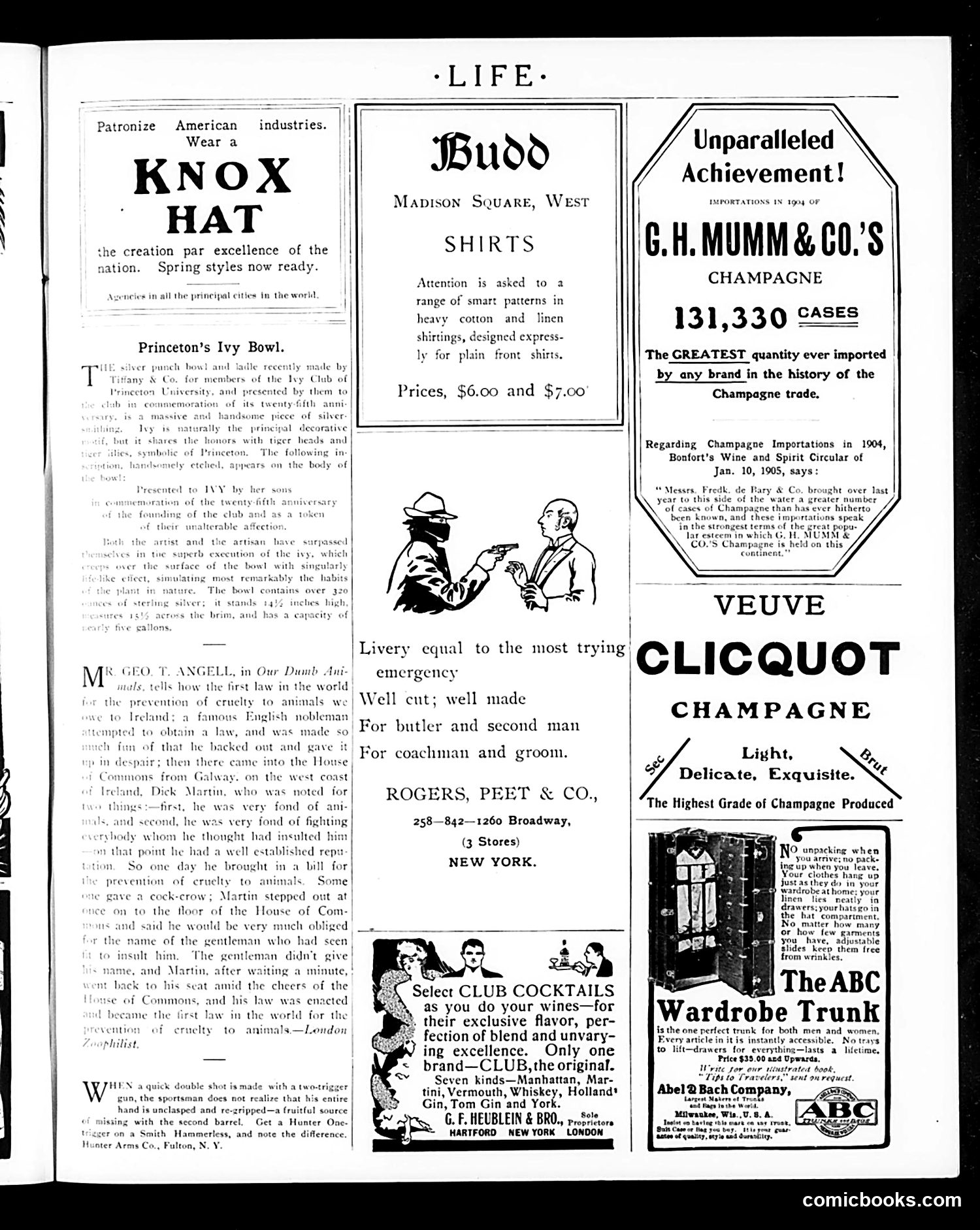
This page is primarily **advertising**, not political satire. It contains commercial advertisements for luxury goods and services typical of early 1900s America. The main visual element is a **cartoon illustration** (center-left) showing two men in period dress—one wearing a hat and suit, the other in formal attire—appearing to exchange or discuss something. The caption suggests this relates to "livery equal to the most trying emergency," advertising Rogers, Peet & Co.'s clothing services for domestic staff (butlers, coachmen, grooms). The page also includes text about **Princeton's Ivy Bowl** (a silver punch bowl), a historical anecdote by Mr. Geo. T. Angell about animal cruelty prevention in Ireland, and brief commentary on firearms. The remaining space is occupied by ads for **Knox Hats, Budd Shirts, Club Cocktails, Veuve Clicquot Champagne, and ABC Wardrobe Trunks**—reflecting consumer luxuries marketed to wealthy readers. **No political satire is evident.** This appears to be a standard Life magazine advertisement section with one illustrative cartoon serving commercial purposes.
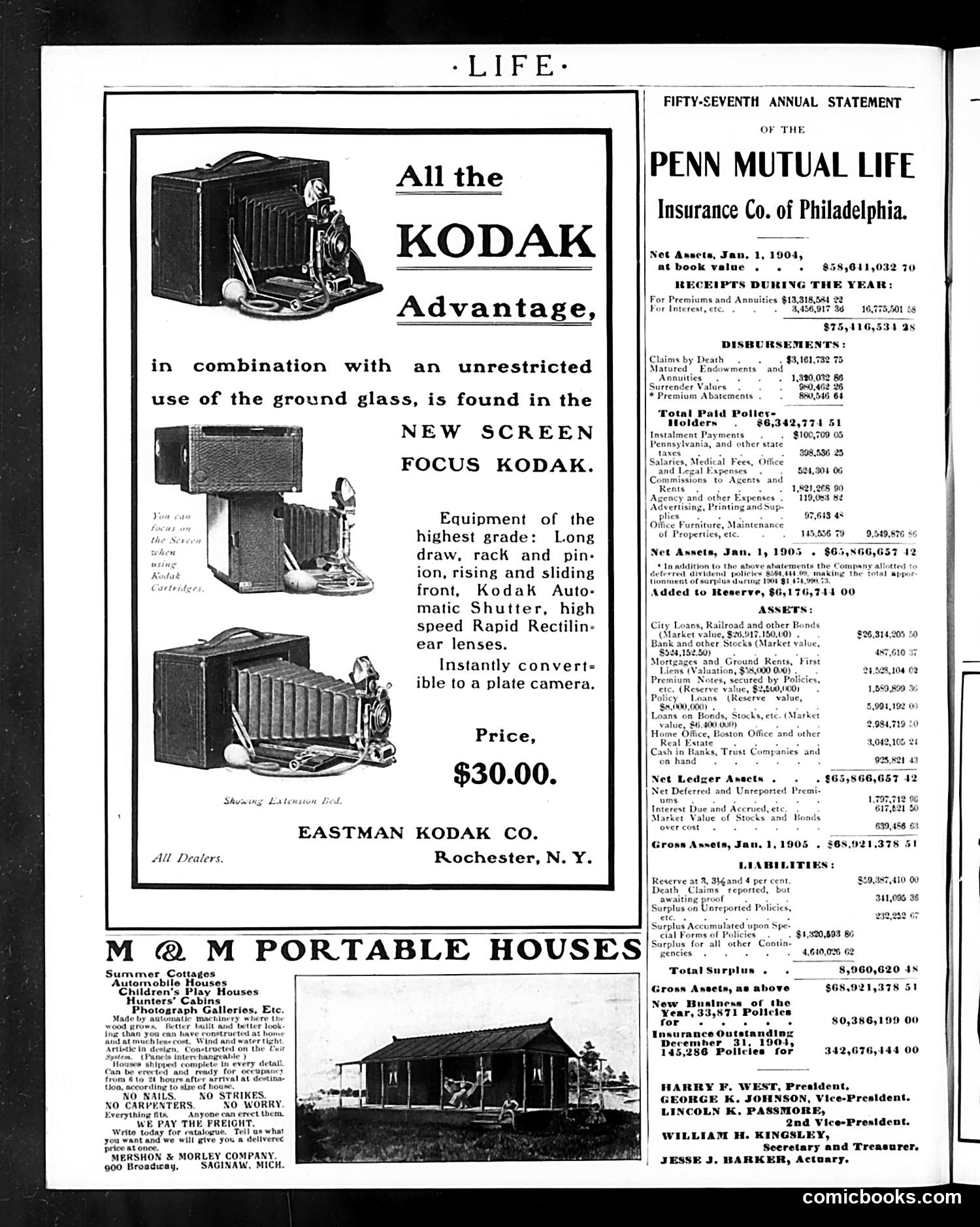
This is primarily **a financial/corporate document**, not satirical content. The page features the 57th annual statement of Penn Mutual Life Insurance Co. of Philadelphia, detailing assets, receipts, disbursements, and company officers as of January 1, 1905. The page also contains **period advertisements**: Eastman Kodak's "Screen Focus Kodak" camera ($30), and M&M Portable Houses (prefabricated cottages and structures). There is **no political cartoon or satirical content** visible. The page appears to be from *Life* magazine's back matter—likely the back cover or interior advertising/business section rather than editorial pages. The layout mixes corporate financial reporting with commercial advertisements, typical of early 1900s publication formats.
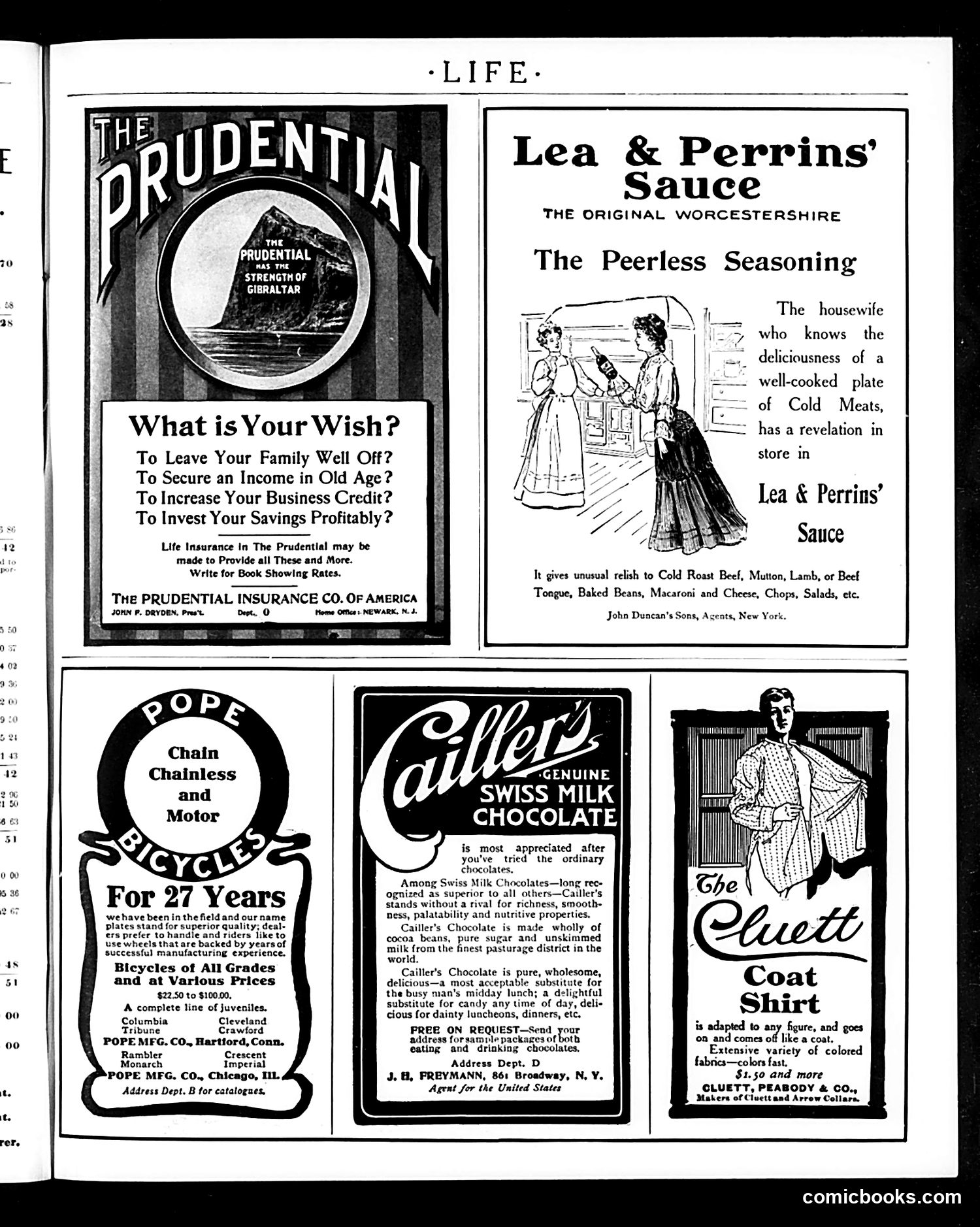
This page consists entirely of **product advertisements**, not political cartoons or satire. There are five ads for consumer goods typical of the early 1900s: 1. **The Prudential Insurance Co.** — appeals to middle-class anxieties about financial security, family welfare, and retirement 2. **Lea & Perrins' Worcestershire Sauce** — promotes a British condiment for cold meats and prepared dishes 3. **Pope Bicycles** — advertises chainless bicycles, emphasizing 27 years of manufacturing reputation and quality 4. **Cailler's Swiss Milk Chocolate** — positions Swiss chocolate as superior to ordinary varieties 5. **Cluett Coat Shirt** — a flexible garment "adapted to any figure" The page reflects advertising conventions of the period: appeals to respectability, emphasis on quality and tradition, and products aimed at comfortable middle-class households. There is **no satire or political content** visible—this is straightforward commercial advertising from Life's revenue-generating pages.
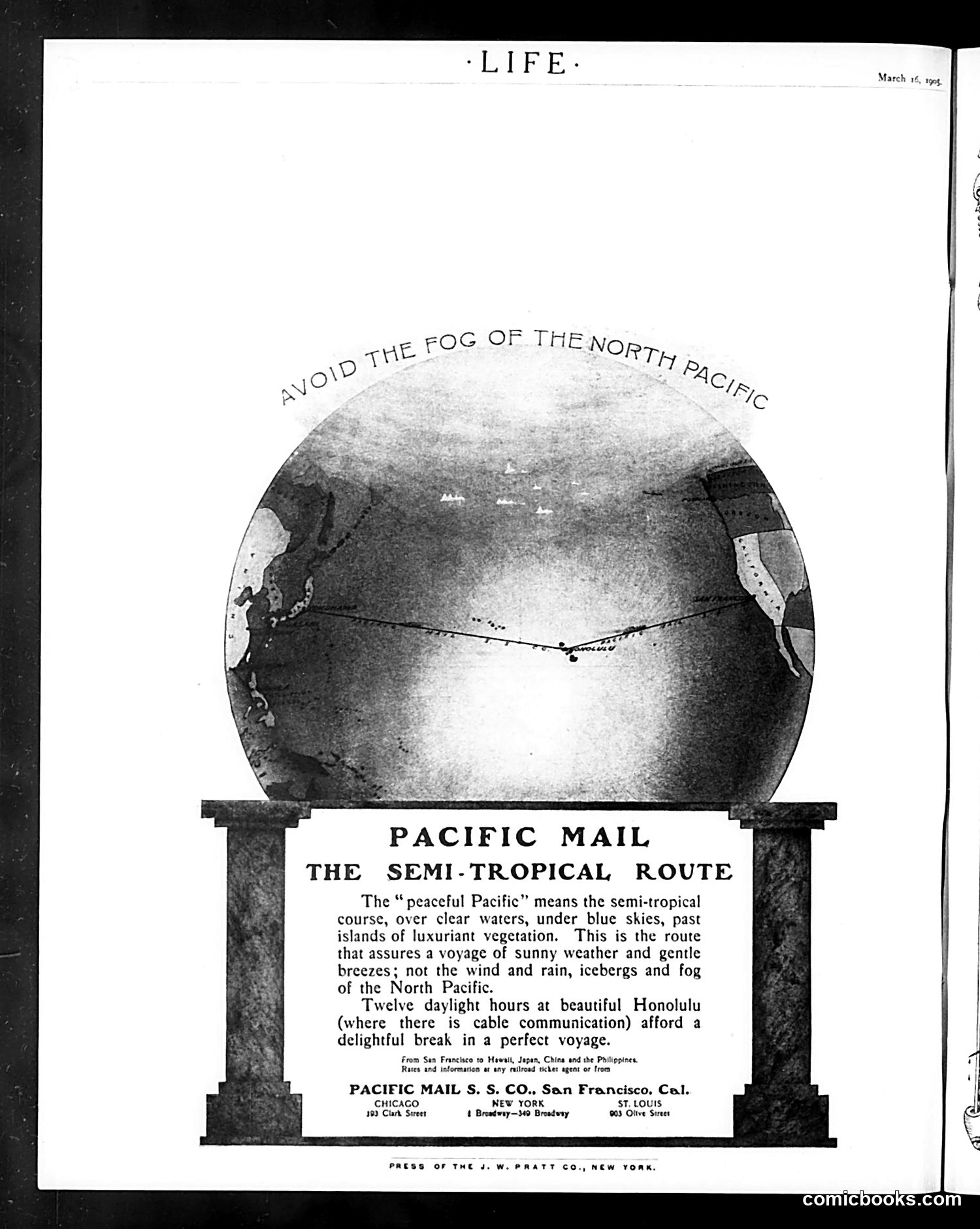
This is a full-page advertisement for Pacific Mail Steamship Company, not a political cartoon. The large spherical illustration depicts Earth, with the title "Avoid the Fog of the North Pacific" curving across it. A line drawn across the globe shows the route of the company's ships. The ad promotes the "semi-tropical route" from San Francisco to Hawaii, Japan, China, and the Philippines as preferable to northern Pacific routes. It emphasizes advantages: clear waters, blue skies, island vegetation, sunny weather, gentle breezes, and a pleasant stop in Honolulu—contrasted with the fog, wind, rain, icebergs, and harsh conditions of the northern route. This is straightforward commercial advertising designed to attract passenger and cargo business to Pacific Mail's shipping services during the early 1900s, when transpacific travel was becoming increasingly popular.