
Life, 1905-03-16 · page 17 of 28
Life — March 16, 1905 — page 17: what you’re looking at
What you’re looking at
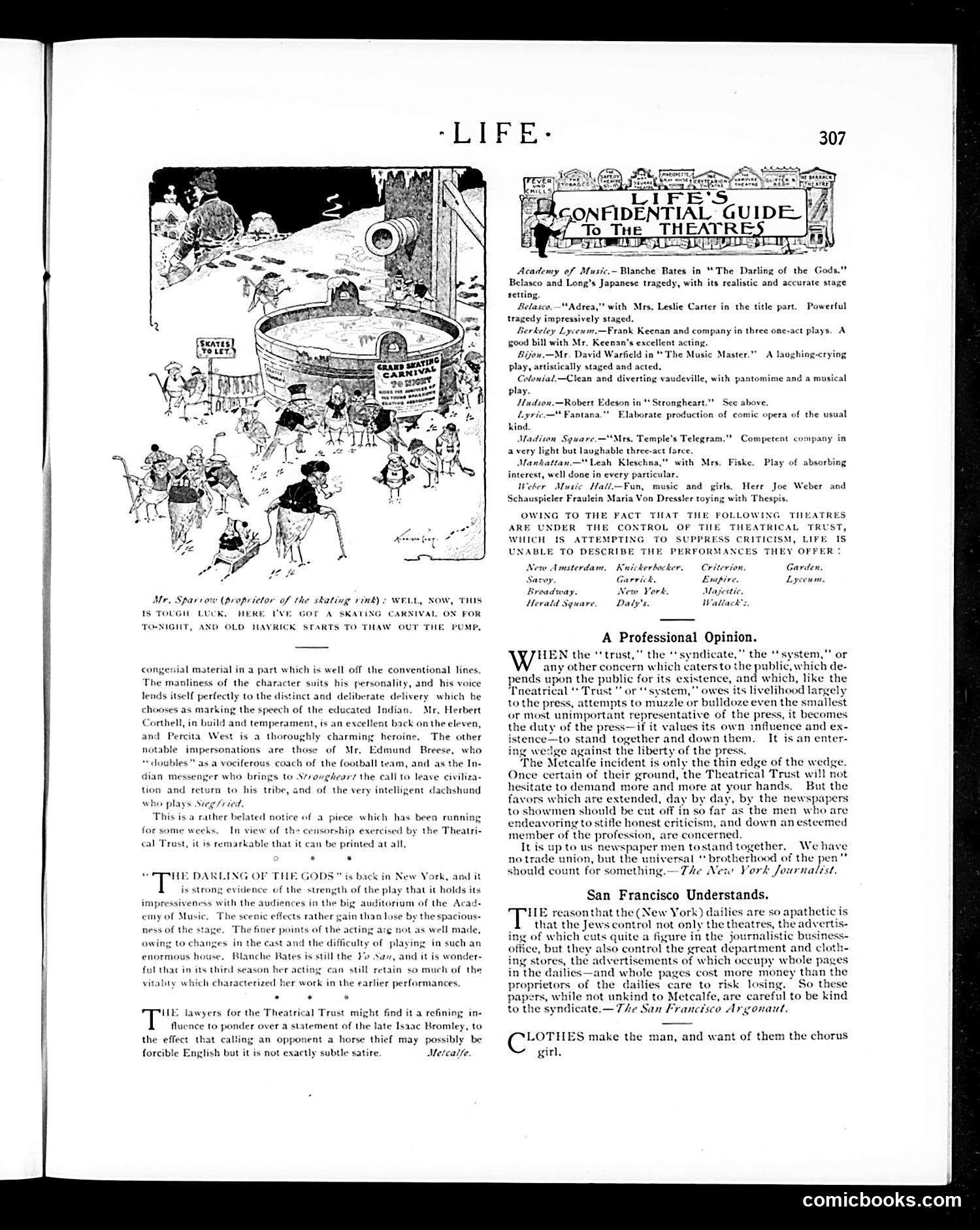
This page contains theater reviews and satirical commentary about early 1900s New York theatrical control. **The Cartoon:** Shows a skating rink proprietor ("Mr. Sparrow") frustrated because "Old Hayrick" is thawing out a pump, disrupting his skating carnival. This appears to be a simple visual joke about bad timing rather than political satire. **Main Content - The Theatrical Trust Controversy:** The page's real focus is criticizing the "Theatrical Trust" (a monopoly controlling major theaters). Life magazine identifies specific theaters "under the control of the Theatrical Trust, which is attempting to suppress criticism" and announces it cannot review performances there due to censorship pressure. **The Point:** Life is protesting corporate monopoly control over theater and artistic freedom. The magazine publishes theater reviews for independent venues while refusing to review Trust-controlled theaters, making a principled stand against what it saw as censorship and monopolistic practices stifling honest criticism. This reflects turn-of-century progressive concerns about corporate trusts limiting free speech and public discourse.
📄 Transcribed text from this page (OCR, searchable)
Machine-transcribed from the original scan — historical spelling and the odd misread are preserved.
Mr, Sparvovw (proprietor of the skating rink) > WELL, NOW, THIS IS TOUGH LUCK, HERE I'VE GOT A SKATING CARNIVAL ON FOR TO-NIGHT, AND OLD HAYRICK STARTS TO THAW OUT THE PUMP, The manliness of the character suits his personality, and his voice lends itself perfectly to the dis which be chooses as marking the spe Corthell, in bui and Percita West is a thoroughly charming heroine, The other nial material in a part which is well off the conventional lines. ate delive net and del of the educated Indian, Mr. Herbert jd and temperament, is an excellent back on the eleven, notable impersonations are those of Mr. Edmund Breese, who *doubl dian messenger who brings to S/rougheart the call to leave civiliza- as a vociferous coach of the football team, and as the In- tion and return to his tribe, and of the very intelligent dachshund who plays Sreg/ried. This isa rather belated notice of a piece which has been running for some weeks. In view of the censorship exercised by the Theatri- cal Trust, it is remarkable that it can be printed at all. HE DARLING OF THE GODS" is back in New York, and it is strong evidence of the strength of the play that it holds its impressiveness with th { Music. The scenic effects rather udiences in the big auditorium of the Acad- emy than lose by the spacious- gal The finer points of the cling arg not as well made, owing to changes in the cast and the difficulty of playing in such enormous house, Blanche Rates is still the V0 Sav, and it is wonder- ful that in its third season her acting can still retain so much of the vitality which characterized ker work in the earlier performances, ILE lawyers for the Theatrical Trust might find it a refining in- sto be fluence to ponder over a statement of the late Isaac Bromle; the effect that calling an opponent a horse thief may possibly forcible English but it is not exactly subtle satire. Metcalfe. LIFE'S GONFIDENTIAL, GUIDE To Toe THEATRE, it Academy of Music. Blanche Bates in “The D: Belasco and Long's Japanese tragedy, with its realis setting. Selasco.—“Adrea," with Mrs, Leslie Carter in the title part. Powerful tragedy impressively staged. Berkeley Lyceum.—Frank Keenan and company in three one-act plays. A good bill with Mr. Keenan's excellent acting. Biyou.—Mr. David Warfield in “The Music Master.” A laoghing-crying play, artistically staged and acted. Colontal.—Clean and diverting vaudeville, with pa play. Hudson.—Robert Edeson in Strongheart."” Sec above. ana."" Elaborate production of comic opera of the us} ling of the Gods.” and accurate stage omime and a musical Madison Sguare.—*Mes. Temple's Telegram.” C a very light but laughable three-act farce. Manhattan.—" Leah Kleschna,” with Mrs, Fiske. Play of interest, well done in every particular, Weber Music Halt.—Fun, music and gitl, Here Joe Weber and Schauspieler Fraulein Maria Von Dressler toying with Thesp mpetent company in absorbing is. OWING TO THE PACT THAT THE POLLOWING THEATRES ARE UNDER THE CONTROL OF THE THEATRICAL TRUST, WHICH IS ATTEMPTING TO SUPPRESS CRITICISM, LIPE IS UNABLE TO DESCRIBE THE PERFORMANCES THEY OFFER: New Amsterdam, Knickerbocker. — Criterion. Garden. Savoy rick. Empire. Lyceum Broadway. New York Majestic. Herald Square, Daly's. Wallack’: A Professional Opinion. HEN the ‘‘trust," the * syndicate,” the ‘'system,”’ or any other concern which caters to the public, which de- pends upon the public for its existence, and which, like the ‘Theatrical * Trust "' or ‘ system," owes its livelihood largely tothe press, attempts to muzzle or bulldoze even the smallest or most unimportant representative of the press, it becomes the duty of the press—if it values its own influence and istence—to stand together and down them. It is an enter- ing wedge against the liberty of the press. ‘The Metcalfe incident is only the thin edge of the wedge. Once certain of their ground, the Theatrical Trust will not hesitate to demand more and more at your hands. But the favors which are extended, day t by the newspapers to showmen should be cut off in so far as the men who are endeavoring to stifle honest criticism, and down an esteemed member of the profession, are concerned It is up to us newspaper men tostand together, We have no trade union, but the universal ‘ brotherhood of the pen"? should count for something.— The New York Journalist. San Francisco Understands. IIE reason that the (New York) dailies are so apatheti that the Jews control not only the theatres, the advertis- ing of which cuts quite a figure in the journalistic business office, but they also control the great department and clot! ing stores, the advertisements of which occupy whole pages. in the dailies—and whole pages cost more money than the proprietors of the dailies care to risk losing,” So these papers, while not unkind to Metcalfe, are careful to be kind to the syndicate.— The San Francisco Argonaut. LOTHES make the man, and want of them the chorus girl. comicbooks.com