
Life, 1905-03-16 · page 16 of 28
Life — March 16, 1905 — page 16: what you’re looking at
What you’re looking at
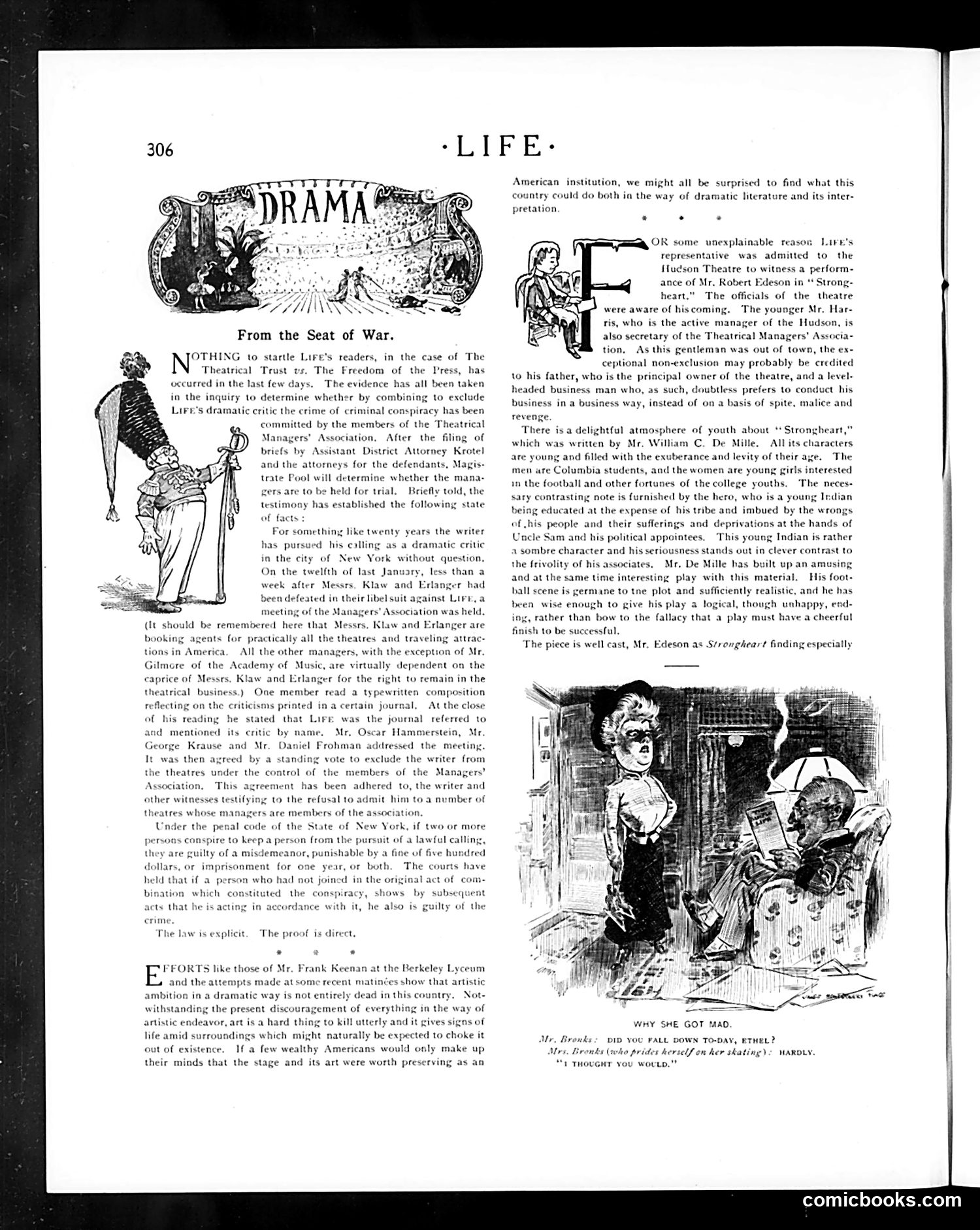
This page covers a major theatrical industry dispute from approximately the early 1900s involving the **Theatrical Trust** (controlled by Klaw and Erlanger) versus Life magazine's drama critic. **The Political Context:** Life's drama critic was blacklisted by theater managers who collectively agreed to exclude him from theaters they controlled—apparently retaliation for his criticism. The article argues this constitutes a criminal conspiracy under New York law to prevent someone from pursuing their lawful profession. Life is pursuing legal action through Assistant District Attorney Krotel. **The Significance:** This represents a clash between corporate monopoly power (the Trust's near-total control of theaters) and press freedom. Life champions artistic merit and independence, lamenting that theatrical ambition is being suppressed by financial interests rather than preserved as an American cultural institution. **The Illustration:** "Why She Got Mad" appears unrelated—likely an advertisement or separate humor feature. The page demonstrates how monopolistic practices threatened American theater in this era.
📄 Transcribed text from this page (OCR, searchable)
Machine-transcribed from the original scan — historical spelling and the odd misread are preserved.
ALLS SOS From the Seat of War. Noms to startle Lire’s readers, in the case of The Theatrical Trust vs, The Freedom of the Press, has occurred in the last few days, The evidence has all been taken in the inquiry to determine whether by combining to exclude Lirr’s dramatic critic committed by the members of the Th Managers’ Association, After the filing of briefs by Assistant District Attorney Krotel and the attor trate Pool will determine whether the mana- Briefly told, the has established the following state crime of criminal conspiracy has been ys for the defendants, Mag gers are to be held for trial. testimor For something like twenty years the writer has pursued his calling as a dea in the city of New York with On the twelfth of last January, less than a week after Messrs, Klaw and Erlanger had been defeated in their libel suit against Lire, a natic crit ut question, n eld. ting of the Managers’ Association was (It should be remember booking agents for practically all the theatres tions in America, All the other manag, Gilmore of the Academy of caprice of Messrs. Klaw and Erlang { here that Messrs. Klaw and Erlanger are nd traveling attrac: ers, with the exception of Mr. ic, are virtually dependent on the for the right to remain in the theatrical business.) One member read a typewritten composition At the close t LipE was the journal referred to reflecting on the criticisms printed in a certain journal, stated th and mentioned its eritic by nam Krause and Mr. Dani It was then agre of his n Mr, Oscar Hammerstein, Mr cl Frohman addressed the meeting. J by a standing vote to exclude the writer from theatres under the control of bers of the Managers’ Association, This agreement has been adhered to, the writer and nit him toa number of tres whose managers are members of the association Under the pe e of persons conspire to keep a person from the other witnesses te: th ifying to the refusal to ad al code of the Si ‘ew York, if two or more ursuit of a lawful calling, hundred they are guilty of a misdemeanor, punishable by a fine of f dollars, or imprisonment for one year, or both, The courts ha held that if a person who had not joined in the original act of con bination which constituted the conspiracy, shows by subsequent acts that he is acting in accordance with it, he also is guilty of the The law is explicit. The proof is direct. FFORTS like those of Mr. Frank Keenan at the Berkeley Ly and the attempts made at some re ambitic m nt matinées show that artistic nin a dramatic way is not er rely dead in this country. Not- withstanding the present discouragement of everything in the way of artistic endeavor, art is a hard thing to kill utterly and it gives signs of life amid surroundings which might naturally be expected to choke it wt of existence. If a few wealthy Americans would only make up their minds that the stage and its art were worth preserving as an *LIFE® American institution, we might all be surprised to find what this untry could do both in the way of dramatic literature and its inter- pretation representative was admitted the {lucson Theatre to witness a perform- ance of Mr, Robert Edeson in “ Strong- heart.” The officials of the theatre of hiscoming. The younger Mr. Har- ris, who is the active manager of the Hudson, is also secretary of the Theatrical Managers’ Associa- tion, As this gentleman was out of town, the ex- ceptional non-exclusion may probably be credited to his father, who is the principal owner of the theatre, and a level- headed business man who, as such, doubtless prefers to conduct his business ina business way, instead of on a basis of spite, malice and revenge. There isa delightful atmosphere of youth about * Strongheart,” which was written by Mr. William C. De Mille. are young and filled with the exuberance and levity of their aye. The men are Columbia students, and the women are young girls interested All its characters 1n the football and other fortunes of the college youths. The neces- sary contrasting note is furnished by the hero, who is a young Indian being educated at the expense of his tribe and imbued by the wrongs of his people and their sufferings and de Uncle Sam and his political appointees, This youog Indian is rather 1 sombre character and his seriousness stands out in clever contrast to the frivolity of his associates, Mr, De Mille has built up an amusing and at the same time interesting play with this material, His foot- plot and sufficiently realistic, and he has been wise enough to give his play a logical, though unhappy, end- ing, rather than bow to the fallacy that a play must have a cheerful fi rivations at the hands of hall scene is germane to tn sh to be successful. The piece is well cast, Mr, Edeson as Strongheart finding especially WHY SHE GOT a0. Mr, Brouks DI YOU PALL DOWN TODAY, ETHEL? Mrs, Bronks (sho prides herself on her skating) “1 THovGHT vou woctp."” MAROLY. comicbooks.com