
Life, 1905-03-16 · page 8 of 28
Life — March 16, 1905 — page 8: what you’re looking at
What you’re looking at
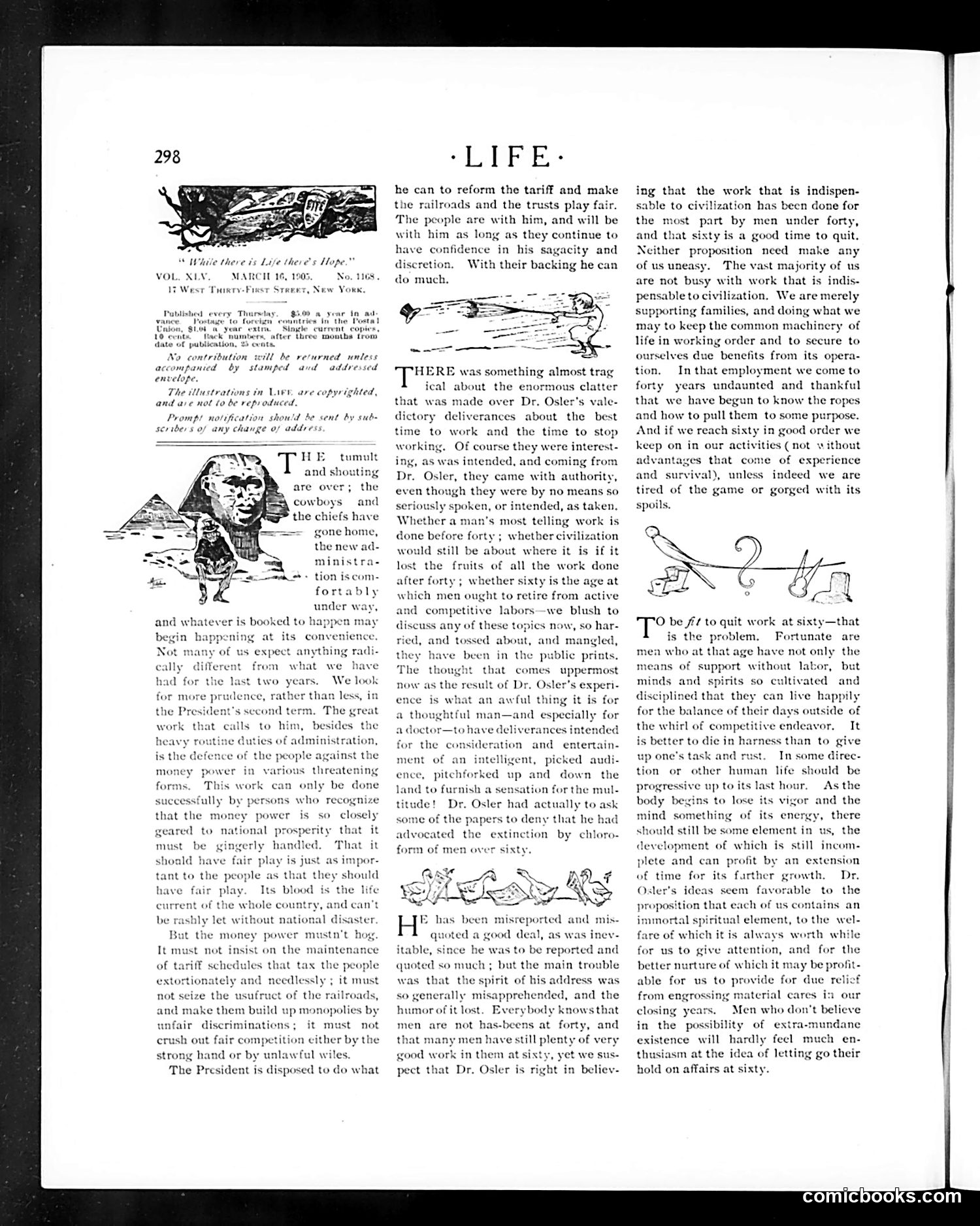
This page discusses **Dr. Osler's valedictory address** about retirement at age sixty. The cartoons satirize the controversy surrounding his remarks. The illustrated caricatures appear to depict **Dr. Osler as a central figure** (shown as an older gentleman), with surrounding imagery suggesting tumult and debate—depicting "cowboys and chiefs" in administrative turmoil. The article defends Osler's position that men should retire at sixty to pursue leisure and intellectual development, while acknowledging public misinterpretation of his remarks caused "an awful thing" for thoughtful people. The satire mocks both the sensationalized media coverage and society's resistance to accepting retirement as reasonable. The specific historical context involves a real physician's controversial speech about aging and work—a genuine public debate from this period.
📄 Transcribed text from this page (OCR, searchable)
Machine-transcribed from the original scan — historical spelling and the odd misread are preserved.
“ While there ts Life the VOL, XLV MARCIE 16, 1905, No, 1108. Hi West Tranry-Fie Street, New Vous. $5.0 a year tn ad. tries In the Postal Single current. co date of publ 9 contribution will be re‘urned unless accompanied by stamped and addressed envelo The illustrations in Lave, are copyrighte and are not to be reproduced, Prompt notification should be sent by sub- scribes s of any change of address H tumult and shouting are over; the cowboys iefs have gone home, the new ad- ministra- tion iscom- fortably under way, and whatever is booked to happen may its conv noe, $s expect anything radi- from what we have We look dence, rather than less, . The great besides the cally differ had for the last two years. for more pr the President’s second t work that calls to him, ; administration, is the defence of the people against the money power in various threatening "This work can only be successfully by persons who recognize that the money ed to national prosperity that it That it shoald have fair play is just as impor- tantt nould have power is so. closely must be handled. the people as t fair play. Its bl current of the whole country, and can’t be rashly let without national disaster. But the money power mustn't hog It must not insist on the maintenance of tariff schedules that tax the people it must not seize the usufruct of the railroads, and make them build up monopolies by fair it must not her by the strong hand or by unlawful wiles. The President is disposed to do what ately and needlessly ; discriminations ; crush out fair competitior “LAPRE* he can to reform the tariff and make the railroads and the trusts play fair. The people are with him, and will be with him as long as they continue to have confidence in his sagacity and discretion, With their backing he can do much, HERE was something almost trag ical about the e clatter at was made over Dr. Osler’s vale- dictory deliverances about the best time to work and the time to stop working. Of course they were interest- ing, as was intended, and coming from Dr. Osler, they came with authority, even though they were by no means so seriously spoken, or intended, as taken. Whether a man's most telling work is done before forty ; whether civilization would still be about where it is if it the fruits of all the work done after forty ; whether sixty is the age at which men ought to retire from active and competitive labors—we blush to pics now, So har- ried, and tossed about, and mangled, ey have been in the public prints. that comes uppermost of Dr, Osler’s experi- ence is what an awful thing it is for lost discuss any of these t he thought now as the resul a thoughtful man—and especially for —to have deliverances intended and. entertain- intelligent, picked audi- ence, pitehforked up and down the a docte for the consideration ment of an ation for the mul- Dr. Osler had actually to ask the papers to deny that he had advocated the extinction by chloro- m of me} land to furnish a s« titude! some ¢ over sixty. has been misreported and mis- uoted a good deal, as was inev- able, since he was to be reported and quoted so much ; but the main trouble was that the spirit of his address was so generally misapprehended, and the humor of it lost. Everybody knows that men not has-beens at forty, and that many men have still plenty of very good work in them at sixty, y pect that Dr. Osler is right in believ- are t we sus- ing that the work that is indispen- sable to civilization has been done for the most part by men under fort and that sixty is a good time to quit. Neither proposition need make any ‘The vast majority of us are not busy with work that is indis- pensable to civilization. We are merely supporting families, and doing w! may to keep the common machi life in working order and to secure to ourselves due benefits from its opera- tion. In that employment we come to. forty years undaunted and thankful that we have begun to know the ropes. and how to pull them to some purpose. nd if we reach sixty in good order we keep on in our activities (not v ithout advantages that come of experience and survival), unless indeed we are tired of the game or gorged with its spoils. of us uneasy. pe 4 be fit to quit work at sixty—that is the problem, Fortunate are who at that age have not only the cans of support without labor, but minds and spirits so cultivated and disciplined that they can live happily for the balance of their days outside of the whirl of competitive endeavor. It is better to die in harness than to give up one’s task and rust. In some direc- tion or life should be progressive up to its last hour. As the body begins to lose its vigor and the mind something of its energy, there vuld still be some element in us, the development of which is still incom. plete and can profit by an extension of time for its farther growth, Dr. Osler’s ideas seem favorable to the ains an other human proposition that each of us immortal spiritual element, to the wel- fare of which it is always worth while for us to give attention, and for the better nurture of which it may be profi able for us to provide for due reli from engrossing Men who don't believe in the possibilit nundane existence will hardly much en- thusiasm at the idea of letting go their hold on affairs at sixty. closing years.