
Life, 1905-03-16 · page 18 of 28
Life — March 16, 1905 — page 18: what you’re looking at
What you’re looking at
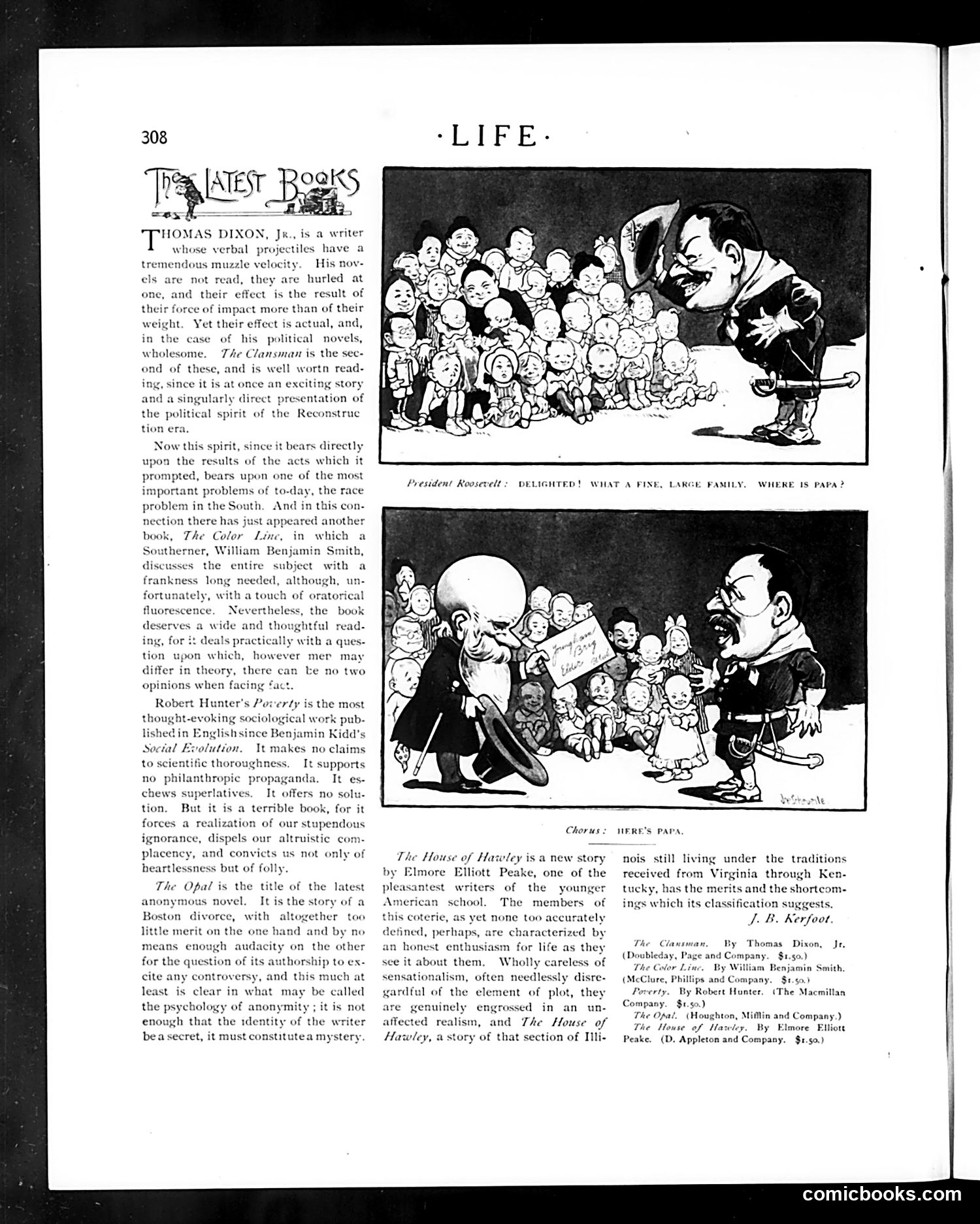
The two cartoons satirize President Theodore Roosevelt's large family by depicting him as delighted but absent. In the first cartoon, Roosevelt admires a massive crowd of children, exclaiming "What a fine, large family. Where is papa?" In the second, titled "Chorus: Where's Papa," multiple children ask the same question while Roosevelt appears elsewhere. The satire targets Roosevelt's political activism and public visibility—he's so consumed by his presidency and various endeavors that despite fathering many children, he's perpetually absent from family life. The joke plays on the contrast between his vociferous public presence (referenced in the accompanying text about Thomas Dixon's "tremendous muzzle velocity") and his private domestic unavailability. This reflects broader contemporary criticism of Roosevelt as an energetic but distracted public figure, more invested in national affairs than paternal duties.
📄 Transcribed text from this page (OCR, searchable)
Machine-transcribed from the original scan — historical spelling and the odd misread are preserved.
HOMAS DIXON, Jk., is a writer whose verbal projectiles have tremendous muzzle velocity. His nov- s are not read, they hurled at und their effect is the result of their force of impact more than of their weight. Yet their effect is actual, and, in the case of his political novels, wholesome. The Clansman is the sec- ond of these, and is well wortn read- ny, Since it is at once an exciting story and a singularly direct presentation of the political spirit of the Reconstruc tion era. Now this spirit, since it bears directly upon the results of the acts which it prompted, bears pos Gne of:the: mass President Roosevelt: DELAGHTED! WHAT A PINE, LARGE FAMILY, WHERE 1S PAPA? important problems of to-day, the race problem in the South. And in this con- nection there has just appeared another book, The Color Line, in which Southerner, William Benjamin $ discusses the entire sub: frankness long needed, al f ely, with a touch of orato fluorescence. Nevertheless, the book deserves a w nd thought read- ing, for it deals practical a ques. tion upon which, however mer may differ in theory, there can Le no two opinions when facing Robert Hunter's Poverty is the most thought-evoking sociological we lish Snglishsince Benjamin Kidd's Social Evolution. It makes no claims to sci c thoroughness. It supports no philanthropic propaganda. It es- chews superlatives. It offers no solu- tion. But it is a terrible book, for it forces a realization of our stupendous Chorus: WERE'S PAPA. ispels our altruistic com ncy, and convicts us not only of The Hause i of Hawley is a new story nois still living under the traditions heartlessness but of fc y Elmore Elliott Peake, one of the received from Virginia through Ken- The Opal is the title of the latest test writers of the younger has the merits and the shorteom- anonymous novel. It isthe story of a American school. The members of ings w Boston divorce, with altogether erie, as yet none too accurately ittle merit on the one hand and by no defined, perhaps, are characterized by means enough audacity on the other an honest enthusiasm for life as they The Clausman. B Thomas Dixon, Jr. for the question of its authorship to ex- see it about them, Wholly careless of ‘Peubleday, Pare snare cite any controversy, and this much at sensationalism, often needlessly disre- ny. $1.50) . least is clear in what may be called gardful of the element of plot, they iy» By Robere Hnter, (The Manian the psychology of anonymity ; it is not are genuinely engrossed in an un. Company. $t.s0 ante enough that the identity of the writer affected realism, and The House of — 7At Ona (Houghton, Simin and Company.) ‘ s The House of Hawhy, By Elmore E! bea secret, it must constitutea mystery Hawley, ory of that section of Illi- Peake. (D. Appleton and Company. $1.50.) comicbooks.com