
A complete issue · 24 pages · 1904
Life — December 8, 1904
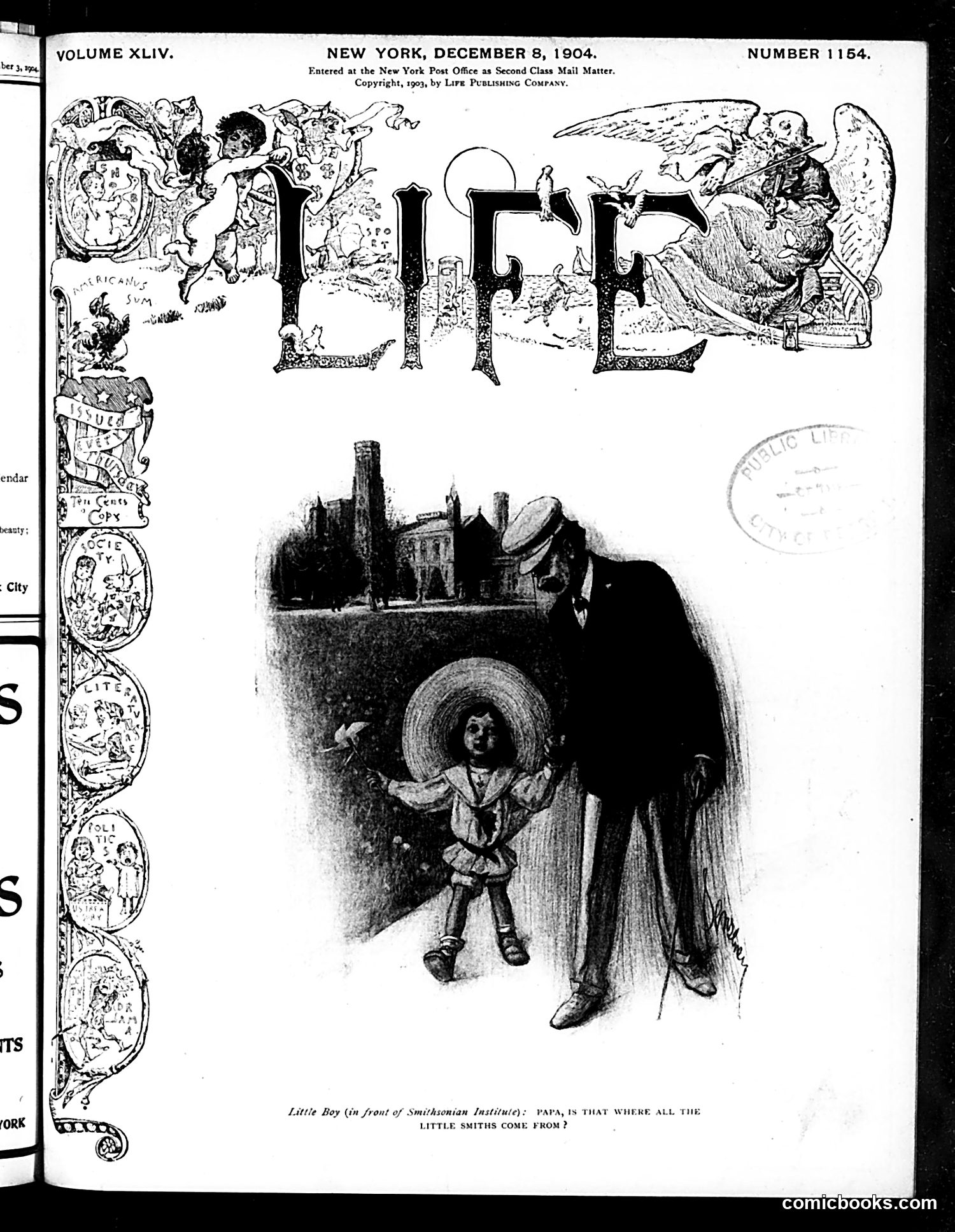
This satirical cartoon depicts a tall man in formal attire standing beside a small boy wearing an oversized sombrero. The caption reads: "Little Boy (in front of Smithsonian Institute): PAPA, IS THAT WHERE ALL THE LITTLE SMITHS COME FROM?" The joke appears to target the Smithsonian Institution through a children's logic pun. The child misunderstands "Smithsonian" as literally a place where "Smiths" (people with that surname) originate, rather than recognizing it as named after benefactor James Smithson. This plays on innocent childhood misinterpretation of institutional nomenclature—a common humor format in Life magazine's satirical approach. The cartoon likely mocks either the Institution itself or reflects contemporary attitudes about institutional naming conventions.
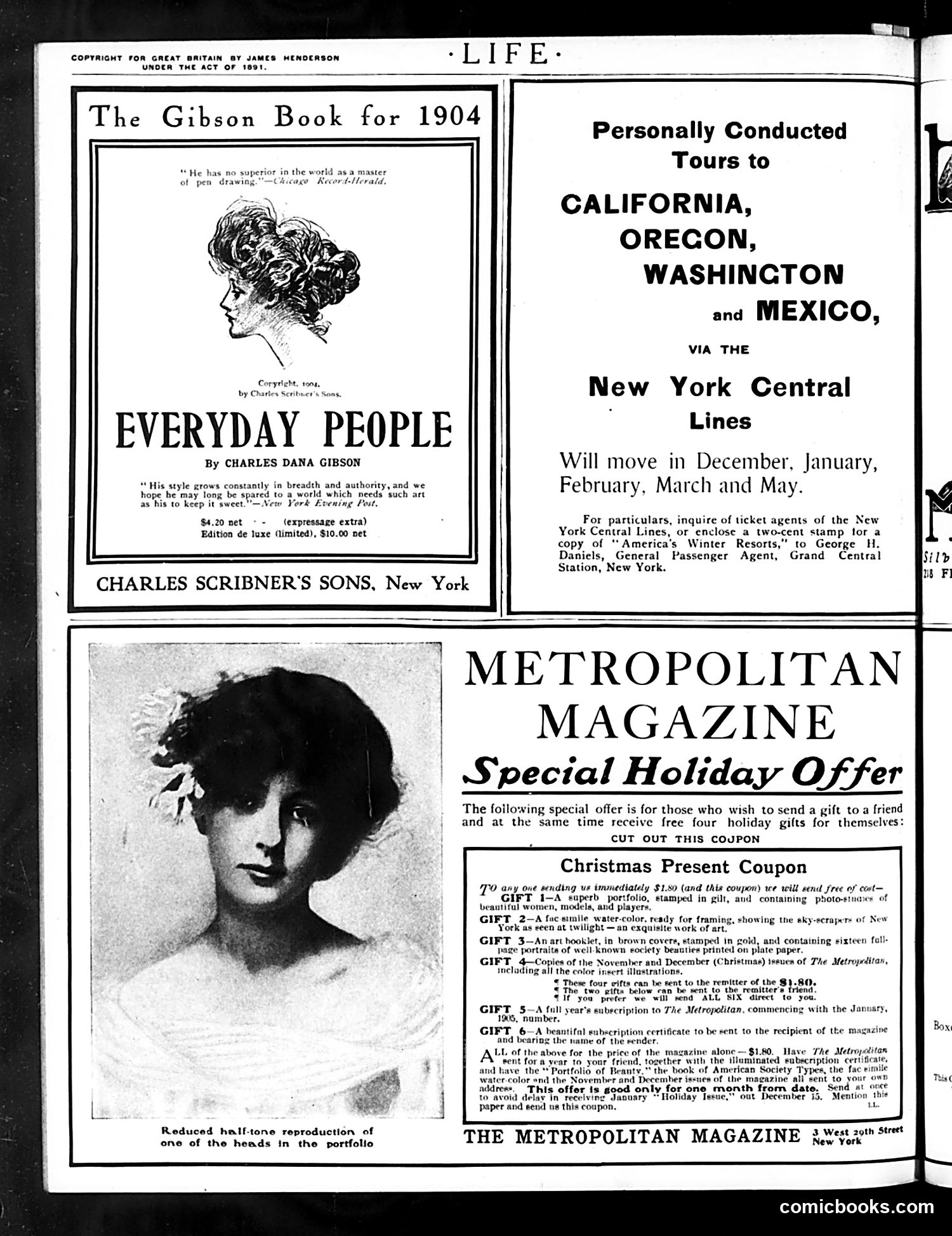
This page is primarily **advertising**, not satire or political commentary. The top left features an ad for Charles Dana Gibson's 1904 book *Everyday People*, promoting his illustrated collection with a sketch of a fashionable woman's profile. The top right advertises personally conducted railroad tours to California, Oregon, Washington, and Mexico via New York Central Lines, departing in winter and spring months. The bottom half contains a Metropolitan Magazine holiday gift promotion featuring a half-tone photograph of an attractive woman. The ad offers various gift packages combining magazine subscriptions, illustrated portfolios, and special Christmas issues. All three ads target affluent readers interested in culture, travel, and luxury goods—typical Life magazine advertising from this era.
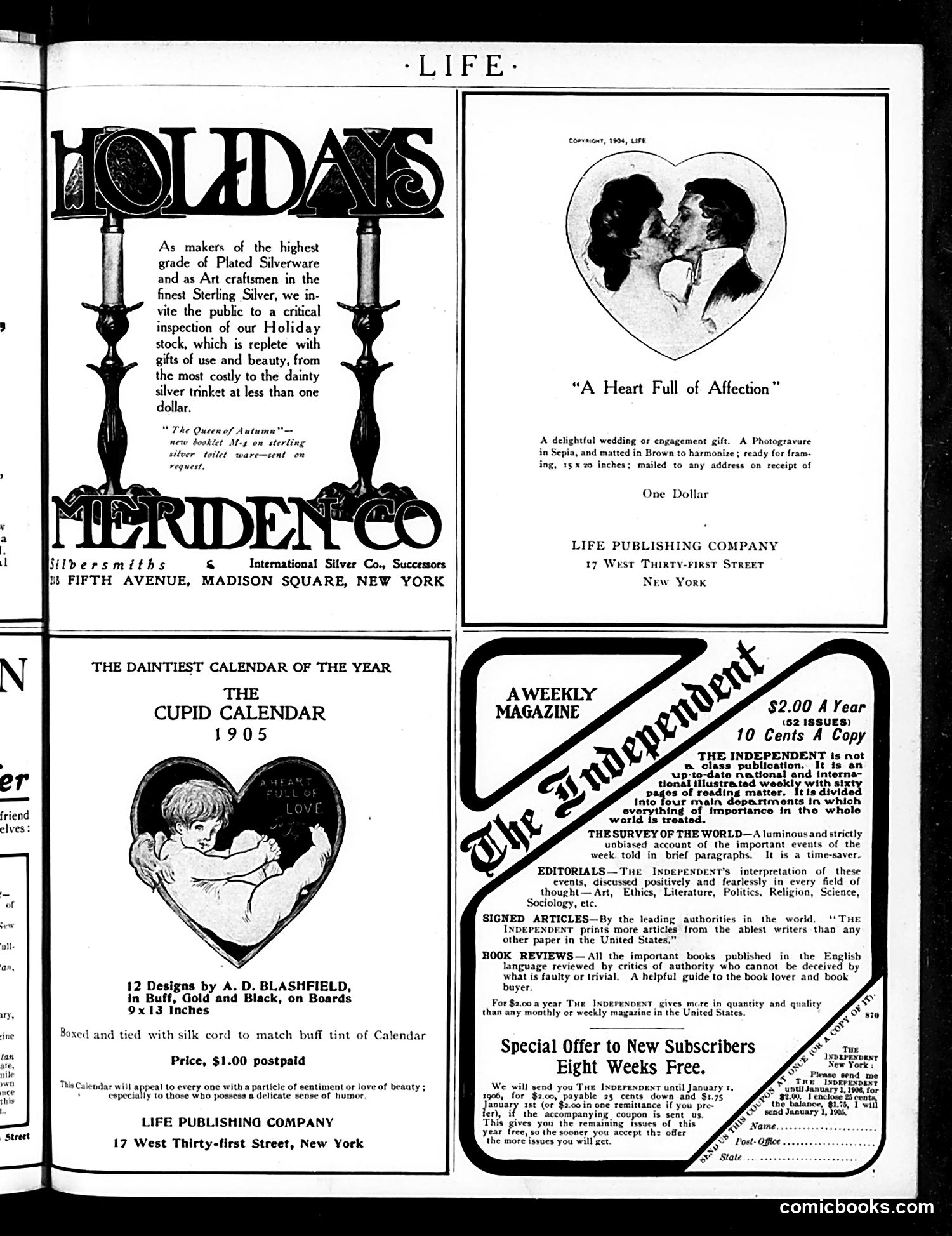
This page is primarily **advertising and product promotion** rather than political satire. It contains: 1. **Meriden Co. silverware ad** (top left): Promotes plated silver holiday gifts, positioning them as luxury items affordable to middle-class consumers. 2. **"A Heart Full of Affection"** (top right): A photogravure print advertisement for Life Publishing Company—a wedding/engagement gift priced at one dollar. 3. **"Cupid Calendar 1905"** (bottom left): A calendar featuring cupid designs by A.D. Blashfield, priced at $1.00—marketed as humorous romantic imagery. 4. **"The Independent" magazine** (bottom right): Promotion for a competing weekly publication emphasizing news coverage and editorial quality. The page reflects early 1900s consumer culture, marketing romance and luxury goods to middle-class readers.
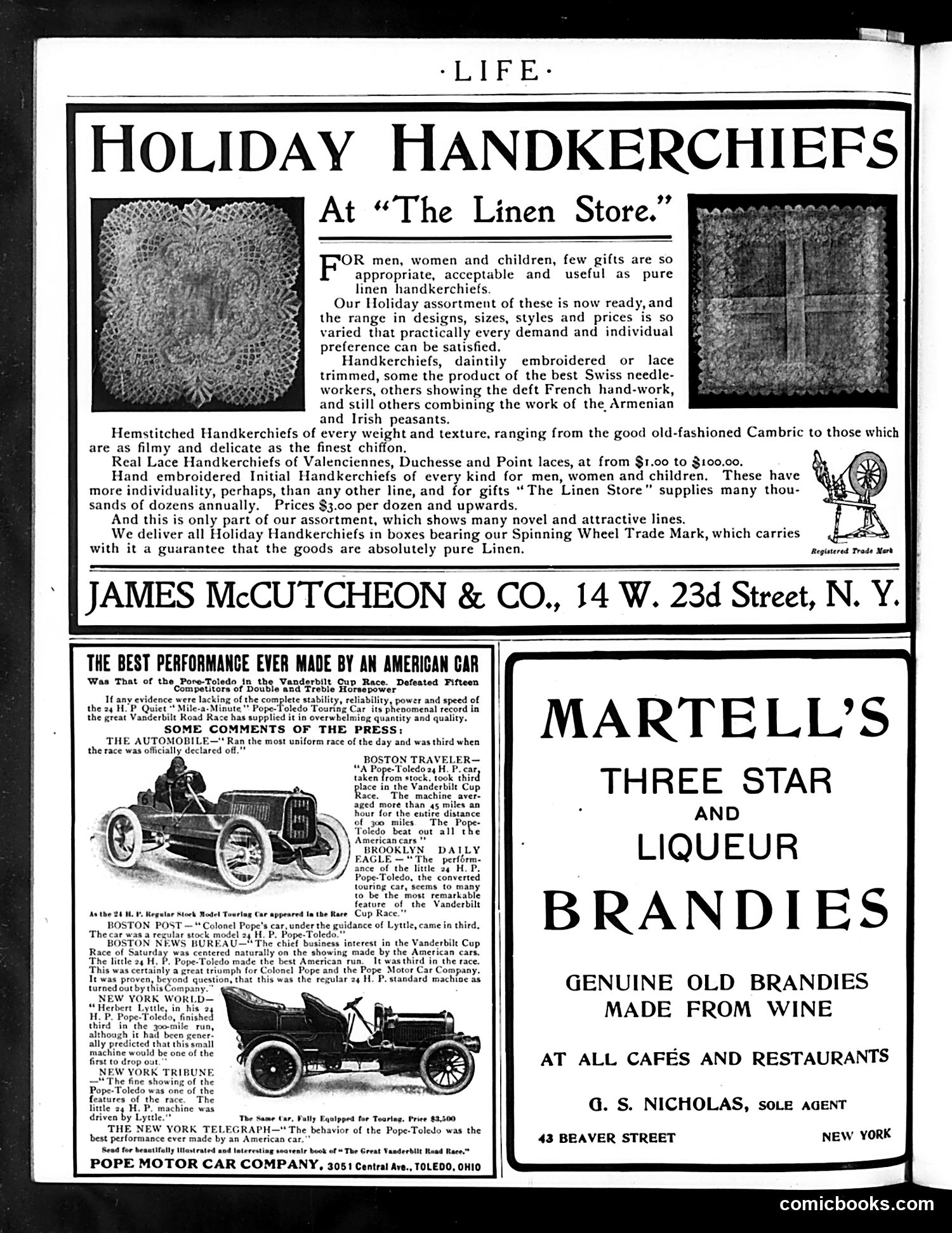
This page contains **no political cartoons or satirical content**. Instead, it features three advertisements: 1. **Holiday Handkerchiefs** from James McCutcheon & Co., promoting linen handkerchiefs as gifts, emphasizing Swiss needlework and French hand-work. 2. **Pope Motor Car Company** advertisement highlighting the Pope-Toledo's performance in the Vanderbilt Cup race, with press comments praising it as "the best performance ever made by an American car." 3. **Martell's Three Star and Liqueur Brandies** advertisement promoting "genuine old brandies made from wine," available at cafés and restaurants. The page is primarily commercial advertising typical of early 20th-century Life magazine, with no satirical elements or political messaging present.
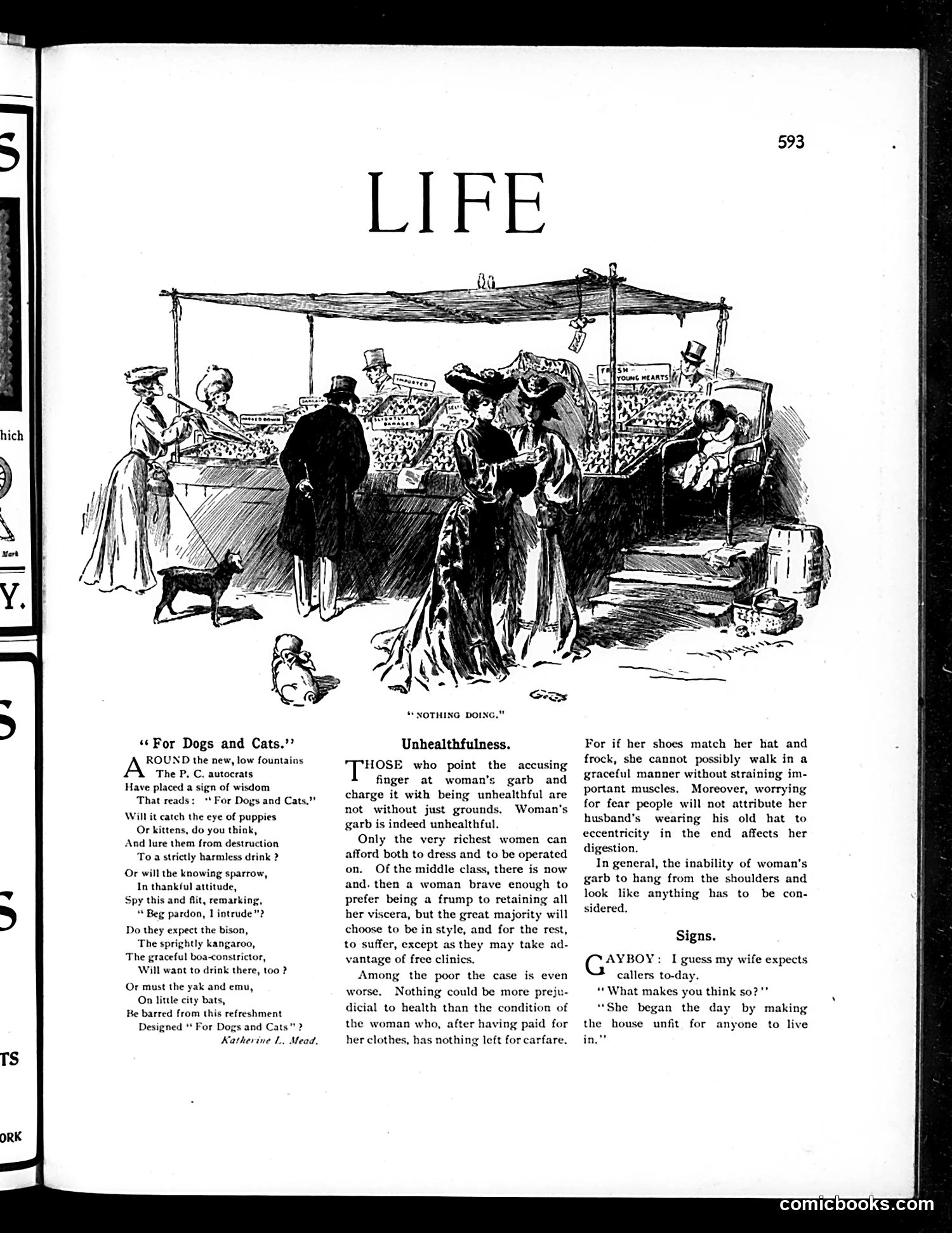
This page critiques women's fashion and health through satirical commentary and illustration. The main cartoon depicts a fashionable outdoor market or gathering scene, likely satirizing women's attendance at social events. The text attacks women's fashion choices as unhealthful, particularly corsets ("the graceful boa-constrictor") that restrict breathing and digestion. It argues that even wealthy women cannot afford both stylish dress and good health, while poor women suffer worst—having spent money on clothes, they lack funds for food. The "Signs" section includes a brief joke about a wife making the house "unfit for anyone to live in," suggesting marital discord humor typical of the era. The overall message criticizes how fashion priorities damage women's physical wellbeing across social classes.
**The Main Cartoon** (upper left) depicts a figure being crushed or overwhelmed, illustrating the article's critique of the import tax on artworks under the Dingley Law—protectionist tariffs that made foreign art expensive in America. **The Political Context**: The article discusses tariff policy disagreements, mentioning Parker (likely Alton B. Parker, Democratic candidate) and Roosevelt. It argues protective tariffs hurt American artists by pricing out foreign competition while claiming to help domestic industry. **The Subway References**: Multiple passages criticize the Subway and Elevated Railroad's billboard advertising as public nuisances that should be taxed like other offensive advertisements. The page blends economic policy critique with municipal reform complaints typical of Progressive Era satire.
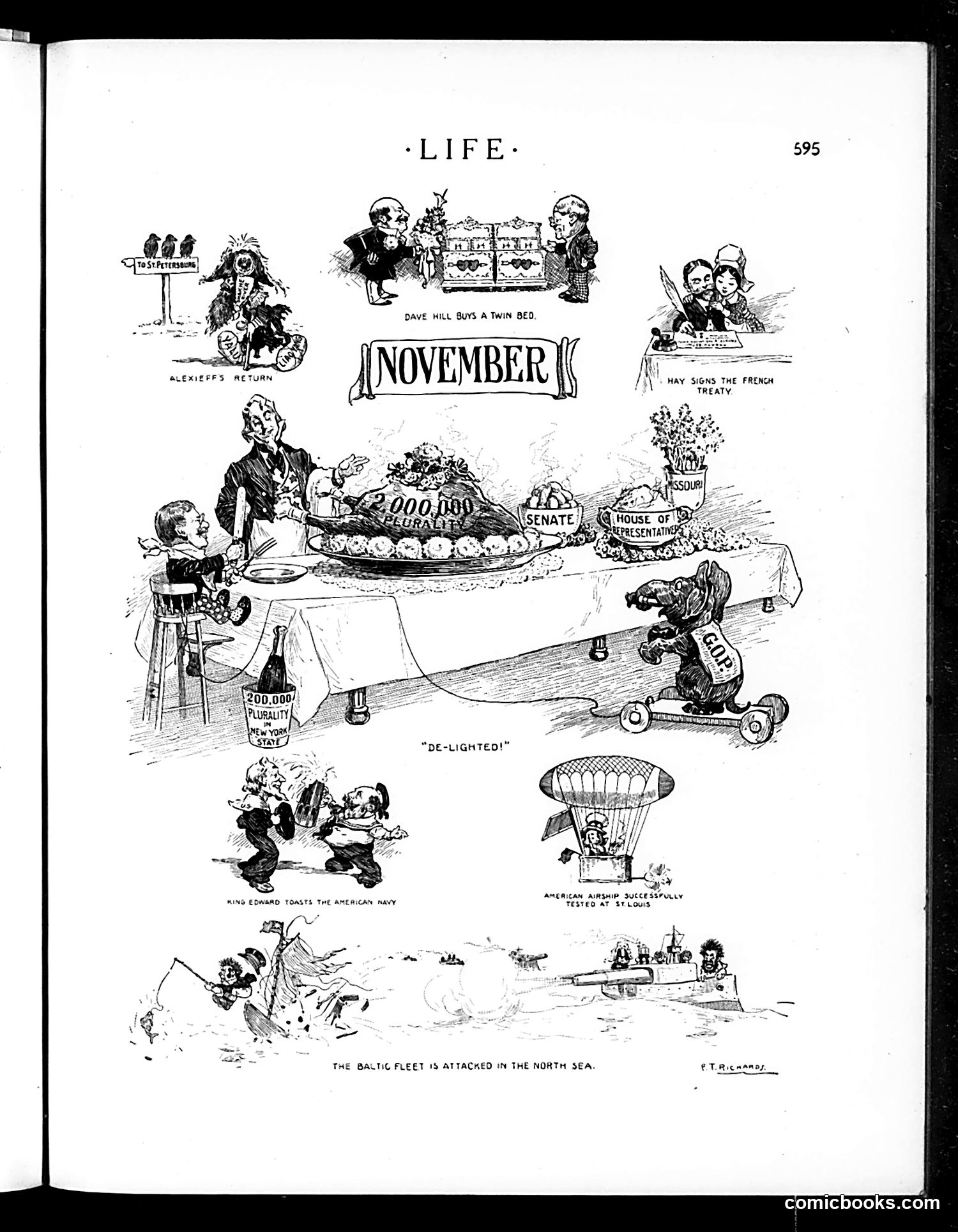
This is a satirical November calendar page from Life magazine featuring multiple political cartoons addressing 1907-1908 events (based on historical references visible). The central cartoon depicts a lavish banquet with "$2,000,000" displayed prominently, likely satirizing government spending or corruption. References include "Senate," "House of Representatives," and "Missouri," suggesting Congressional budget debates. Other cartoons reference: - "Alexieff's Return" (Russian political figure) - "Hay Signs the French Treaty" (diplomatic negotiations) - "King Edward Toasts the American Navy" (international relations) - "American Airship Successfully Tested at St. Louis" (new aviation technology) - "The Baltic Fleet is Attacked in the North Sea" (international military conflict) The overall tone mocks American political institutions and their spending priorities against international developments of the era.
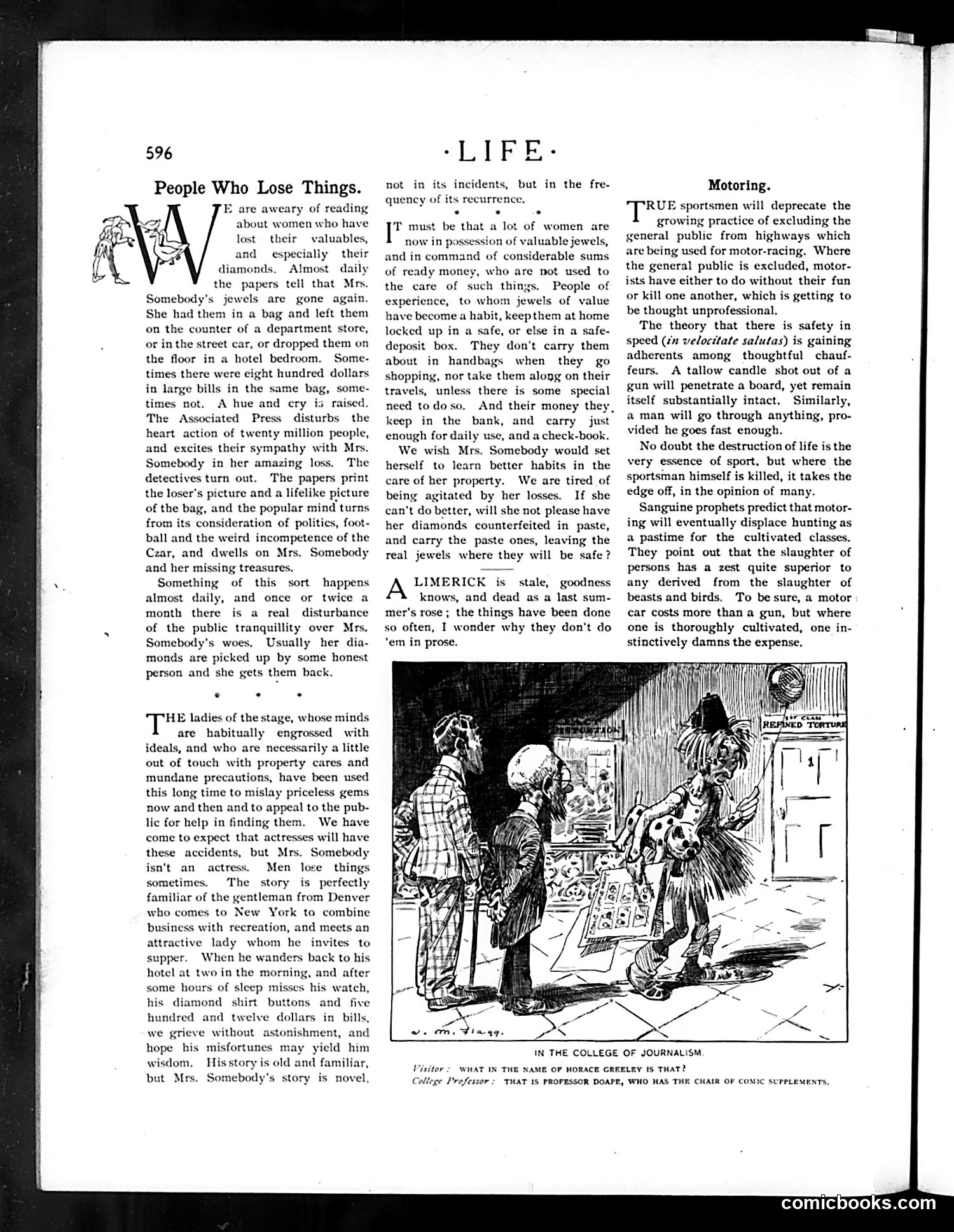
This cartoon satirizes journalistic ethics and sensationalism in early 20th-century American newspapers. The scene depicts what appears to be a journalism classroom or newsroom where students/reporters are examining illustrated newspapers or comic supplements spread on a table. The caption presents a dialogue: a student (Enter) asks "What is the name of Horace Greeley is that?" The College Professor responds that it's "Professor Doake, who has the chair of comic supplements." The satire targets the rise of illustrated, sensational "comic supplement" sections in newspapers—suggesting they've become so dominant that they merit academic chairs. The joke critiques how entertainment-focused visual journalism was displacing serious news coverage and traditional journalistic standards, treating comics/illustrations as equivalent to serious editorial work.
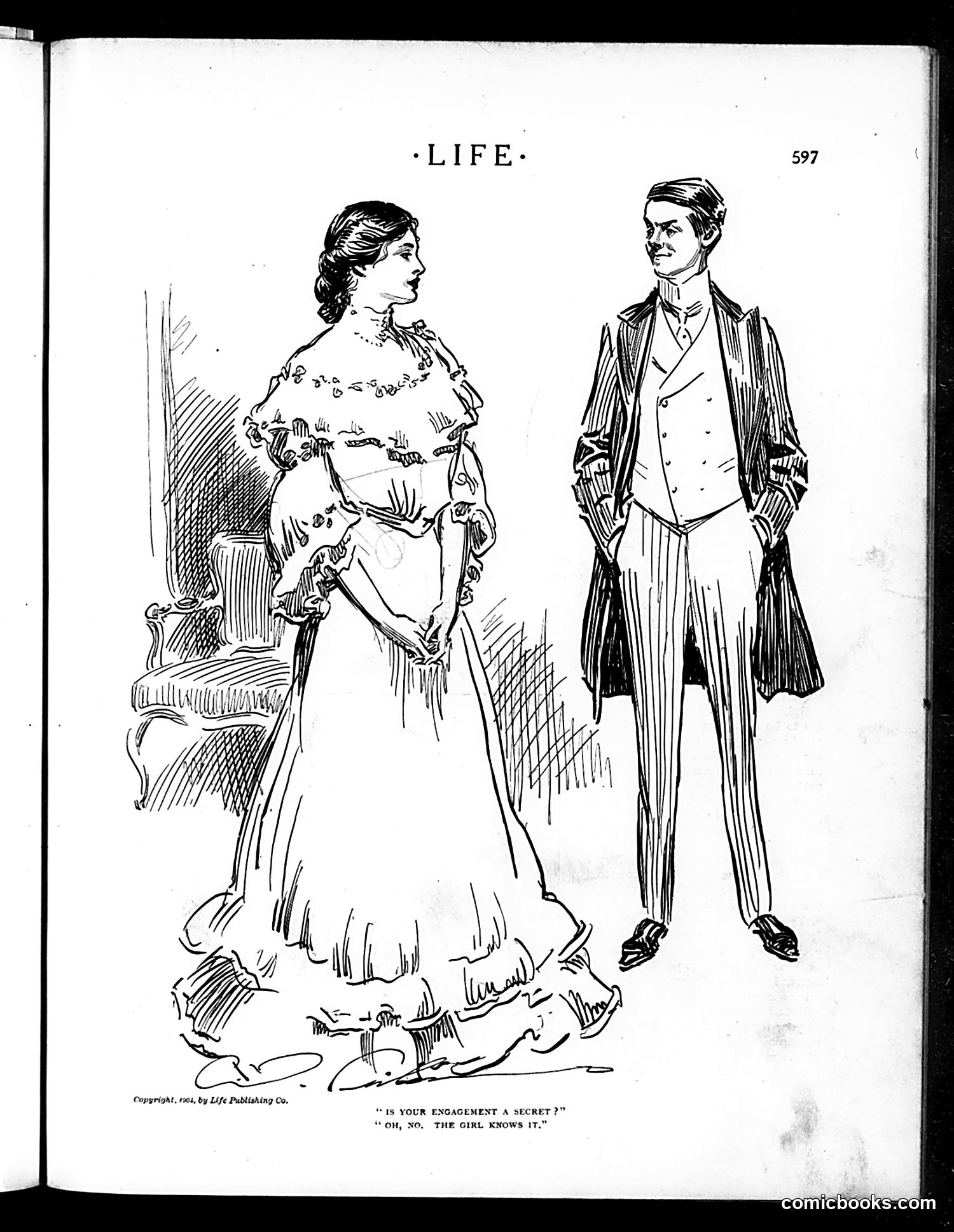
This is a single illustration from Life magazine (page 597) depicting two figures in formal early 20th-century dress. The woman sits while the man stands nearby. The caption reads: "IS YOUR ENGAGEMENT A SECRET?" / "OH, NO. THE GIRL KNOWS IT." **The joke:** The humor relies on a double meaning of "the girl knows it." The man implies the engagement isn't secret because the woman is aware of it—but the punchline suggests she knows about his engagement to *someone else*, implying infidelity or duplicity. It's a commentary on masculine deception in romantic relationships. This reflects period attitudes about courtship and social propriety, where engagements were significant public matters, making the suggestion of hidden engagements socially scandalous.
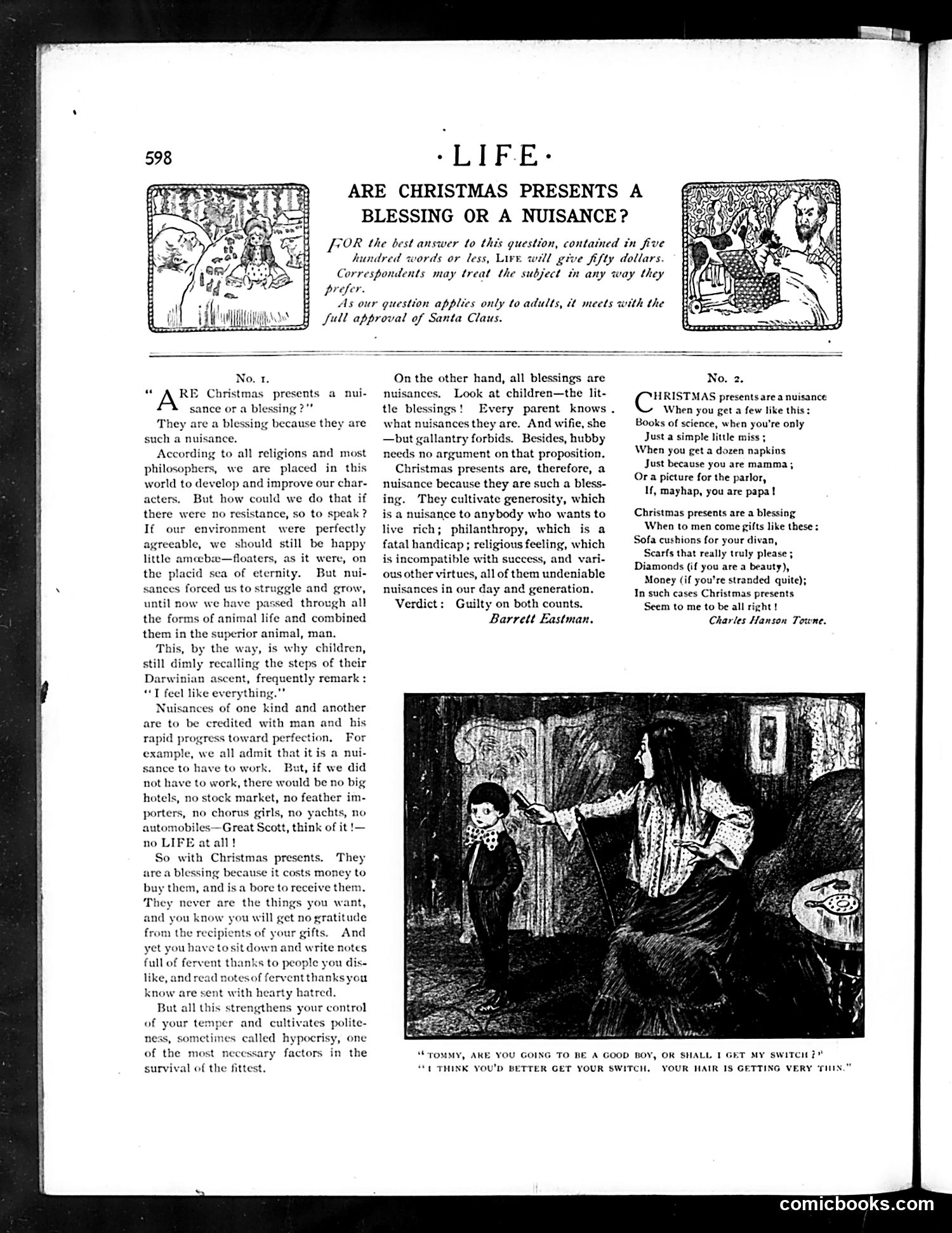
This page presents two opposing arguments about Christmas gift-giving. **No. 1** (attributed to Barrett Eastman) argues presents are blessings because they cost money, require gratitude, and cultivate politeness—"one of the most necessary factors in the survival of the fittest." **No. 2** (attributed to Charles Hanson Towne) counters that presents are nuisances: unwanted books, napkins, scarves, and diamonds that clutter one's life rather than improve it. The cartoon below shows a mother threatening her son with a "switch" (beating) if he misbehaves, sarcastically referencing Santa's behavioral incentive system. The debate reflects early 20th-century anxieties about commercialism, child discipline, and whether material gift-giving strengthened or weakened character.
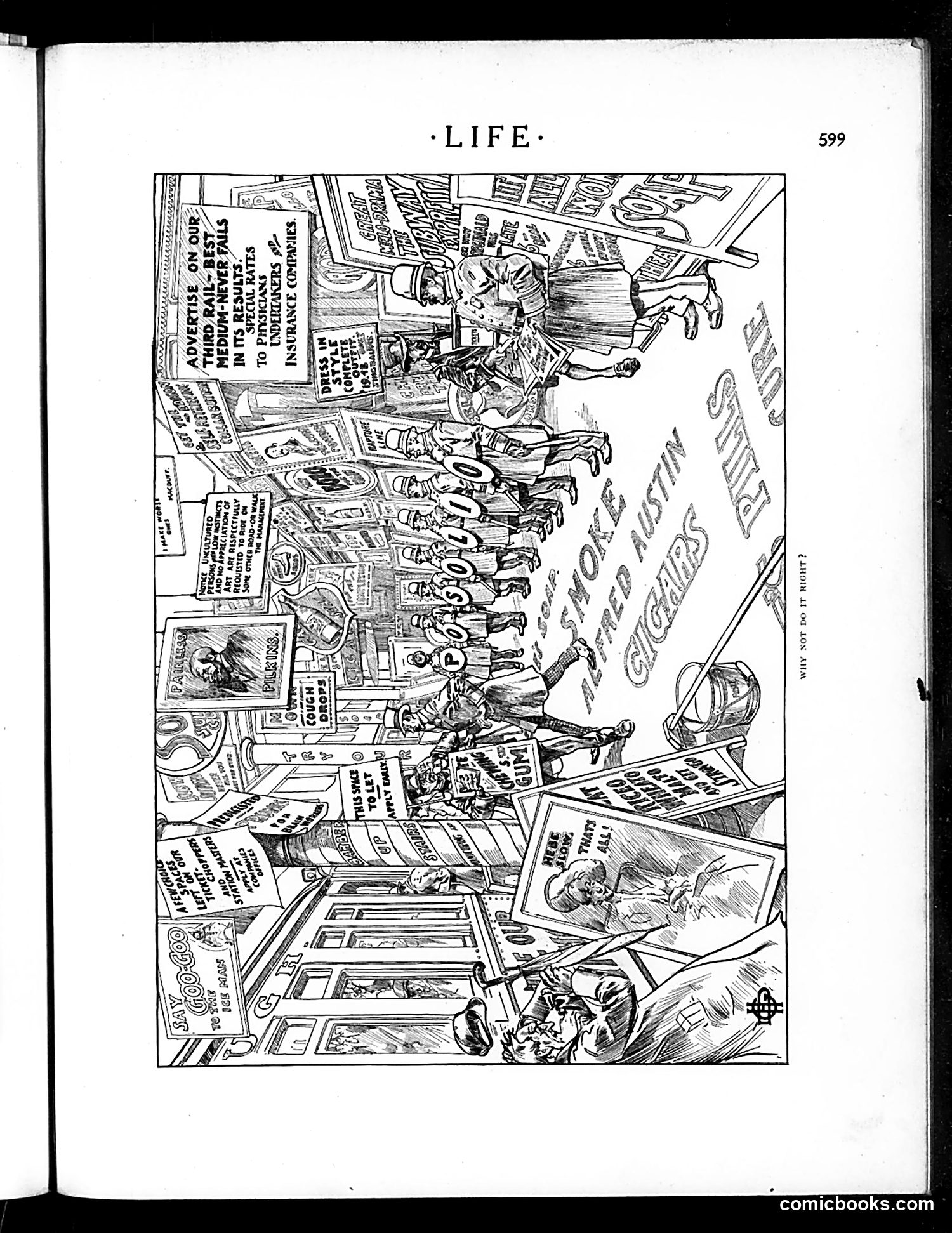
This page appears to be a satirical cartoon turned sideways (requiring rotation to read properly). The illustration depicts what seems to be a crowded commercial or retail scene with numerous figures and advertising signage visible throughout. The cartoon satirizes consumer culture and commercialism, showing an overwhelming array of products, advertisements, and people in what appears to be a shopping district or marketplace. Multiple product boxes, signs, and commercial messaging fill the composition, suggesting commentary on the invasiveness of advertising and consumerism in American life. However, without being able to clearly read all the specific text and signage in the image, I cannot definitively identify particular products, figures, or the precise satirical targets. The general theme clearly critiques commercial excess and advertising saturation, which were recurring subjects in Life magazine's social commentary.
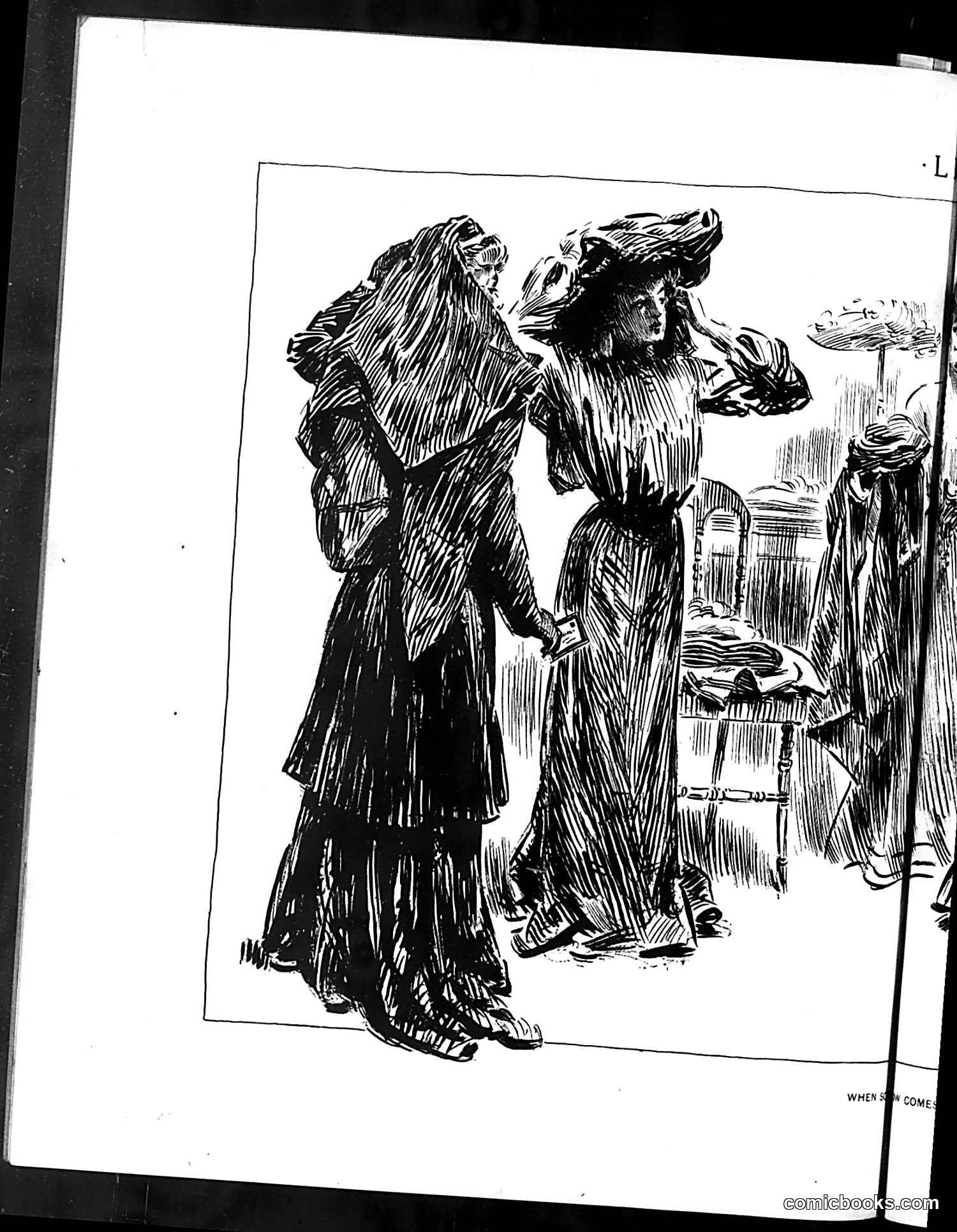
This is a pen-and-ink illustration showing two elegantly dressed women in early 20th-century fashion, engaged in conversation. The woman on the left wears an elaborate feathered hat and long coat; the woman on the right adjusts her own fashionable hat. The style and composition suggest this is satirical commentary on women's fashion and social behavior. The partial text at the bottom reads "WHEN S... COME—" (incomplete), preventing identification of the specific joke or social critique. Without the full caption, I cannot definitively explain what behavior or fashion trend Life magazine was mocking here. The illustration's elegant execution and prominent placement suggests it addressed a topic relevant to Life's readership, likely concerning women's fashion, social pretension, or courtship rituals of the period.
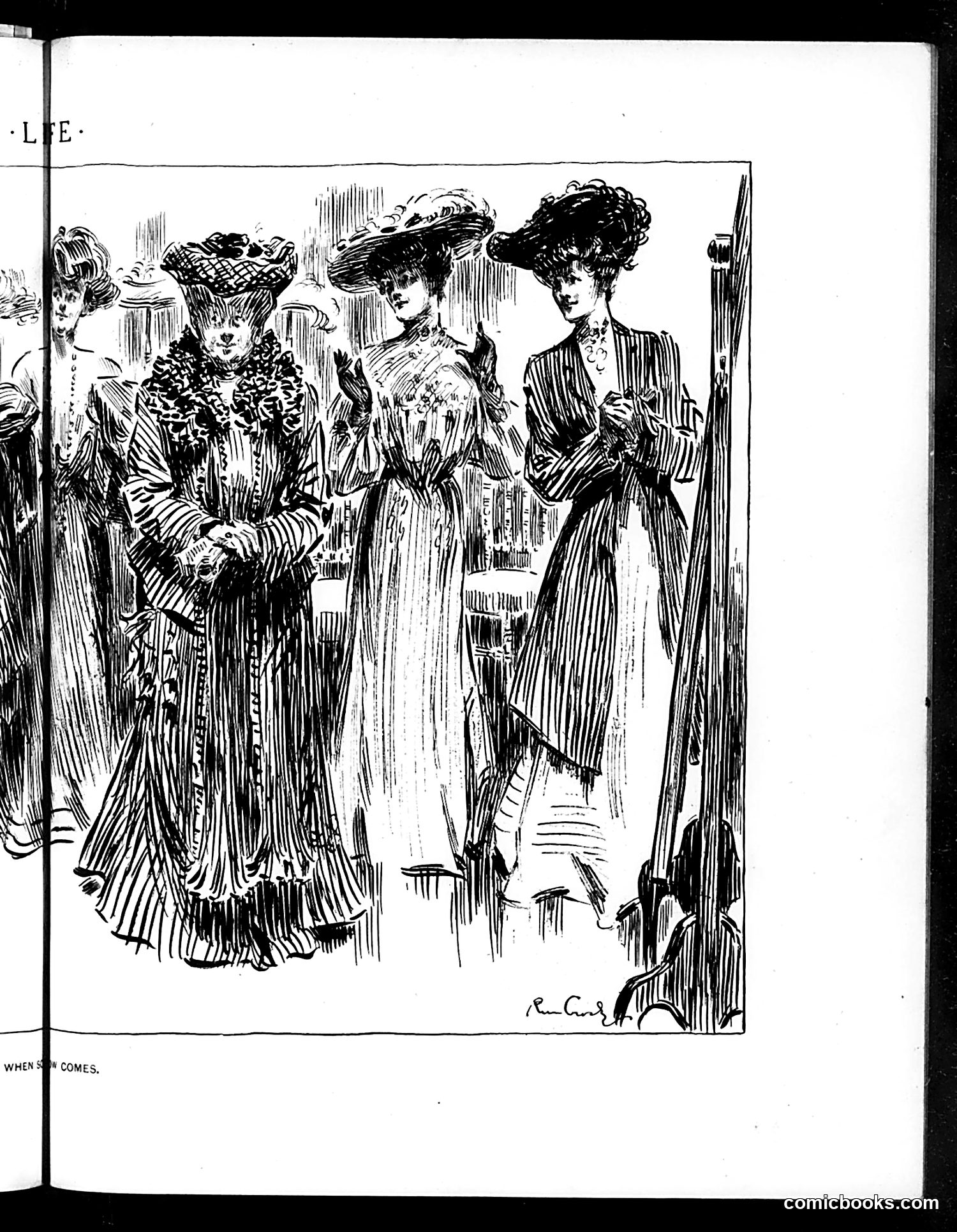
This is a sketch by an artist signed "R. Cay" (or similar) depicting fashionable women in elaborate Edwardian-era dress with large, ornate hats and corseted gowns featuring detailed pleating and embellishment. The women appear to be at a social gathering or promenade. The text fragment "WHEN SHE COMES" suggests this illustrates a humorous social commentary, likely satirizing the excessive fashion and conspicuous consumption of wealthy women of the early 1900s. The exaggerated rendering of their clothing—particularly the impractical, heavily decorated garments and towering hats—mocks the pretension and frivolity of high society fashion during this period. Without more text context, the specific joke remains unclear, but the satirical tone targets upper-class women's fashion excess.
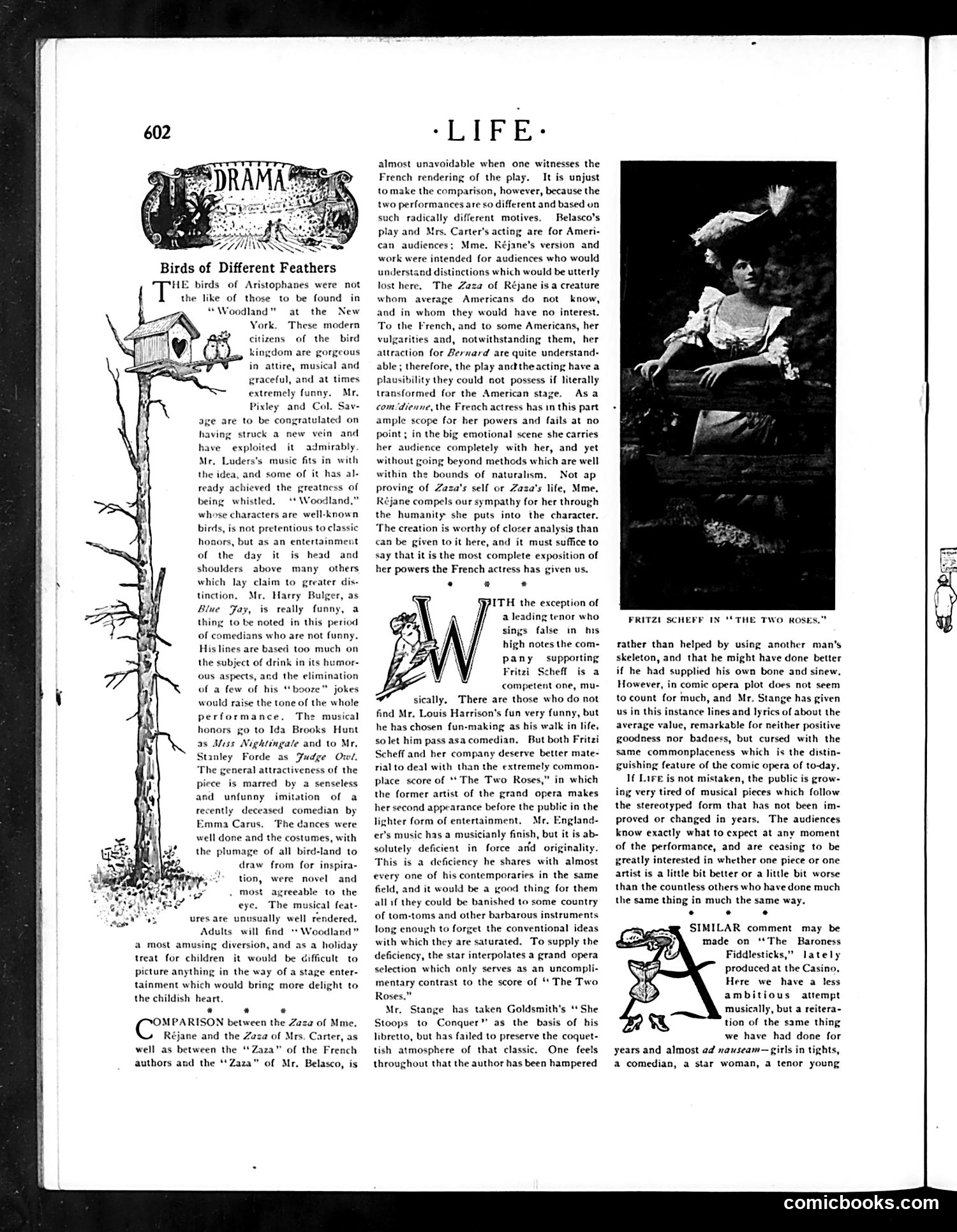
This page reviews theatrical productions, primarily the operetta "Woodland." The left column's illustration depicts a stylized bird perched on a bare tree branch—fitting the "birds" metaphor for the show's animal characters. The reviews praise "Woodland" as amusing entertainment with catchy music and attractive costumes. However, the critic notes comedian Harry Bulger relies too heavily on alcohol-related jokes, which lowers the production's tone. Emma Carus receives criticism for performing an imitation of a "recently deceased comedian"—apparently in poor taste. The page also compares two productions of "Zaza": the French actress Mme. Réjane's version versus Mrs. Carter's American adaptation. The critic argues Réjane's performance succeeds because she maintains the character's authentic French context, generating sympathy through naturalistic acting rather than sanitizing the morally questionable protagonist for American audiences.
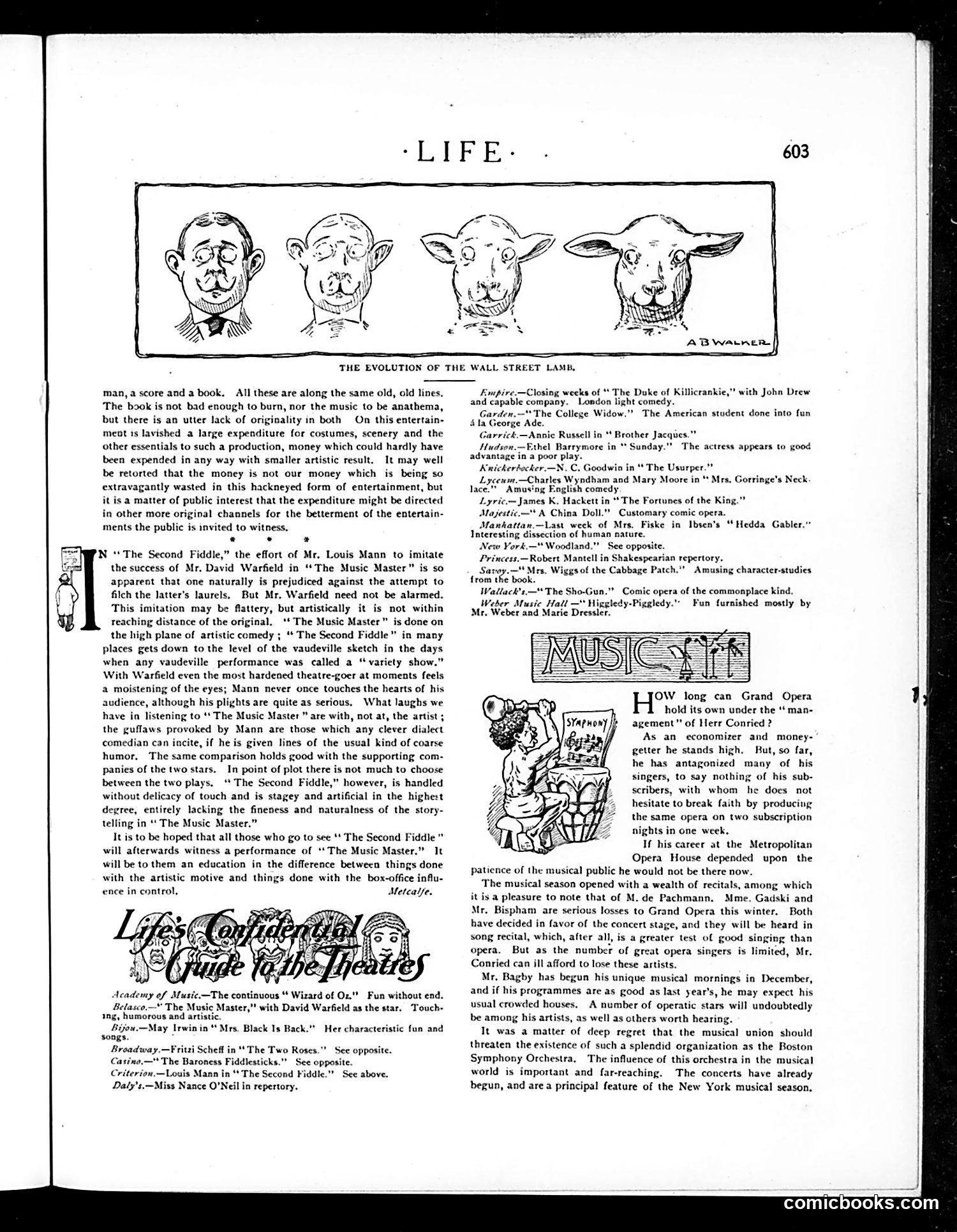
The cartoon at the top, credited to A.B. Walker, shows four progressive head transformations progressing left to right—from human to increasingly sheep-like features. This is a visual metaphor for how Wall Street investors become progressively more docile and foolish, losing their critical judgment as they're manipulated by financial schemes. The title "Evolution of the Wall Street Lamb" satirizes how savvy businessmen gradually transform into gullible "lambs"—victims ready for slaughter by market manipulators. The term "lamb" was period slang for a naive investor easily fleeced. Walker's cartoon warns that those involved in financial speculation gradually surrender their intelligence and independence, becoming passive victims of exploitation. This reflects broader Progressive Era skepticism toward Wall Street practices and unchecked capitalism.
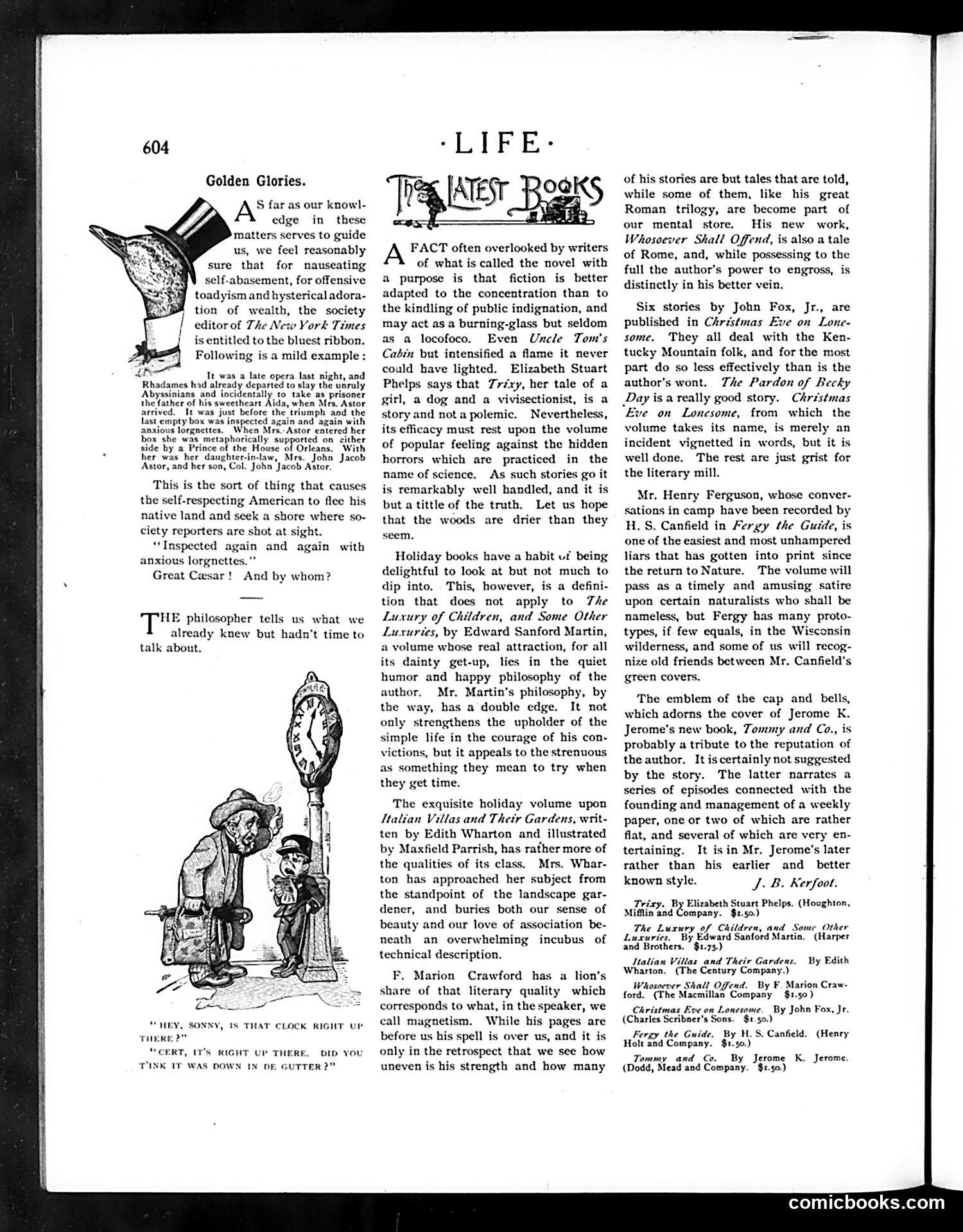
This page contains two distinct satirical pieces: **"Golden Glories" (top):** Life ridicules the *New York Times* society editor for obsequious coverage of wealthy socialites, particularly the Astor family attending the opera. The satire mocks the absurd deference shown to the rich—the editor describes Mrs. Astor as being "metaphorically supported" by French nobility. Life sarcastically suggests that such fawning journalism should make any self-respecting American flee the country. The piece attacks the era's class-conscious society reporting. **"The Latest Books" (right column):** A book review section covering contemporary literature, including works by Edward Sanford Martin and F. Marion Crawford. **The bottom cartoon** appears unrelated—a comic dialogue between two figures about a clock's location, likely a mild joke about class or dialect humor common to the era. The page's core message: Life condemns servile media treatment of the wealthy as contemptible and un-American.
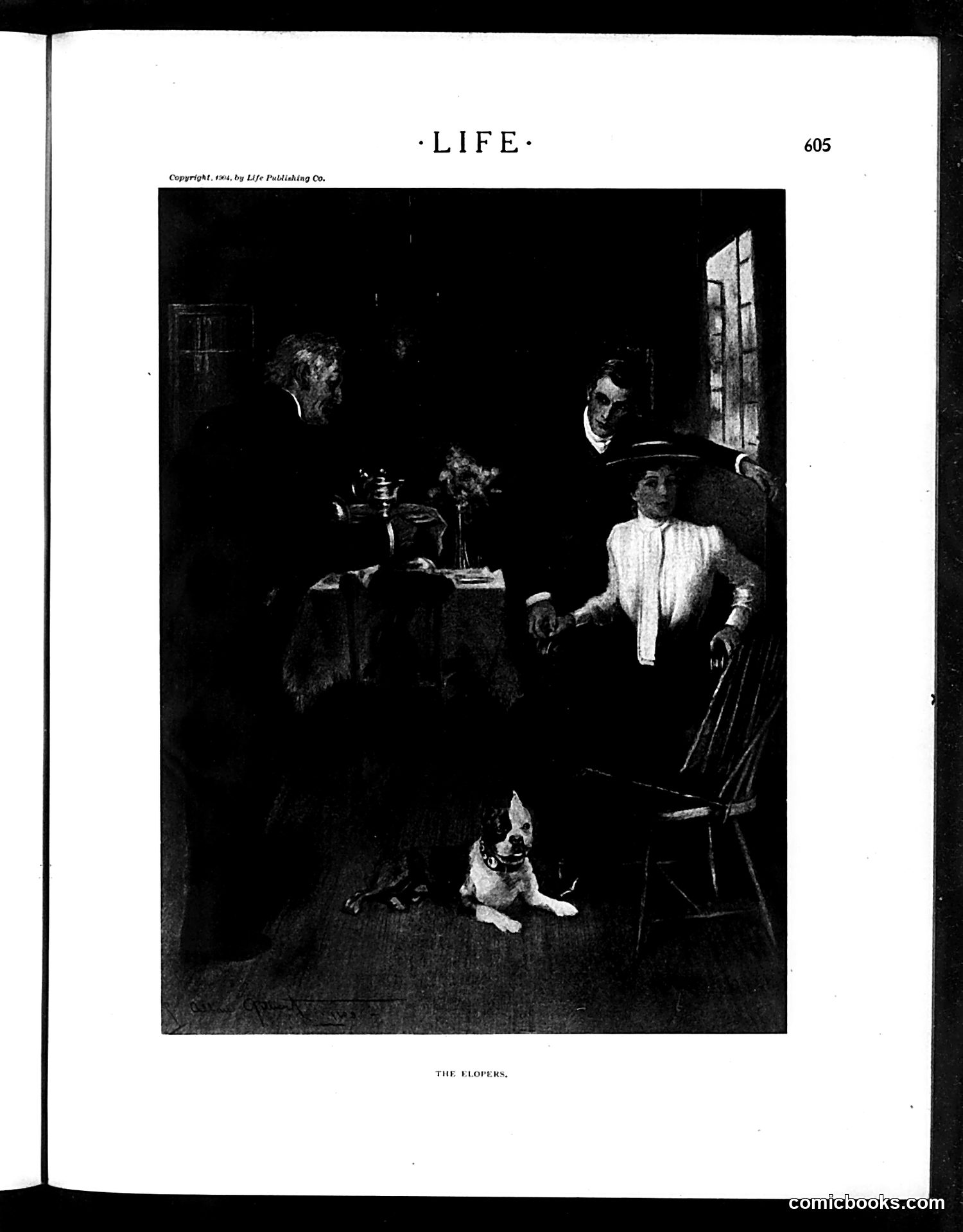
This illustration satirizes a common domestic comedy scenario of the early 1900s. The scene depicts what appears to be a young couple attempting a secret elopement, with concerned family members observing their departure. The figures' formal dress and the interior setting suggest middle or upper-class society. The satire likely mocks the dramatic tension between young lovers' desires and parental authority—a popular theme in period comedies and literature. The dog in the foreground may add to the humor, perhaps representing a family pet witnessing the scandalous family drama. The title "The Elopers" indicates this is mocking the melodrama and social complications surrounding young couples running away to marry without parental consent, a recurring source of social comedy in early 20th-century American humor magazines.
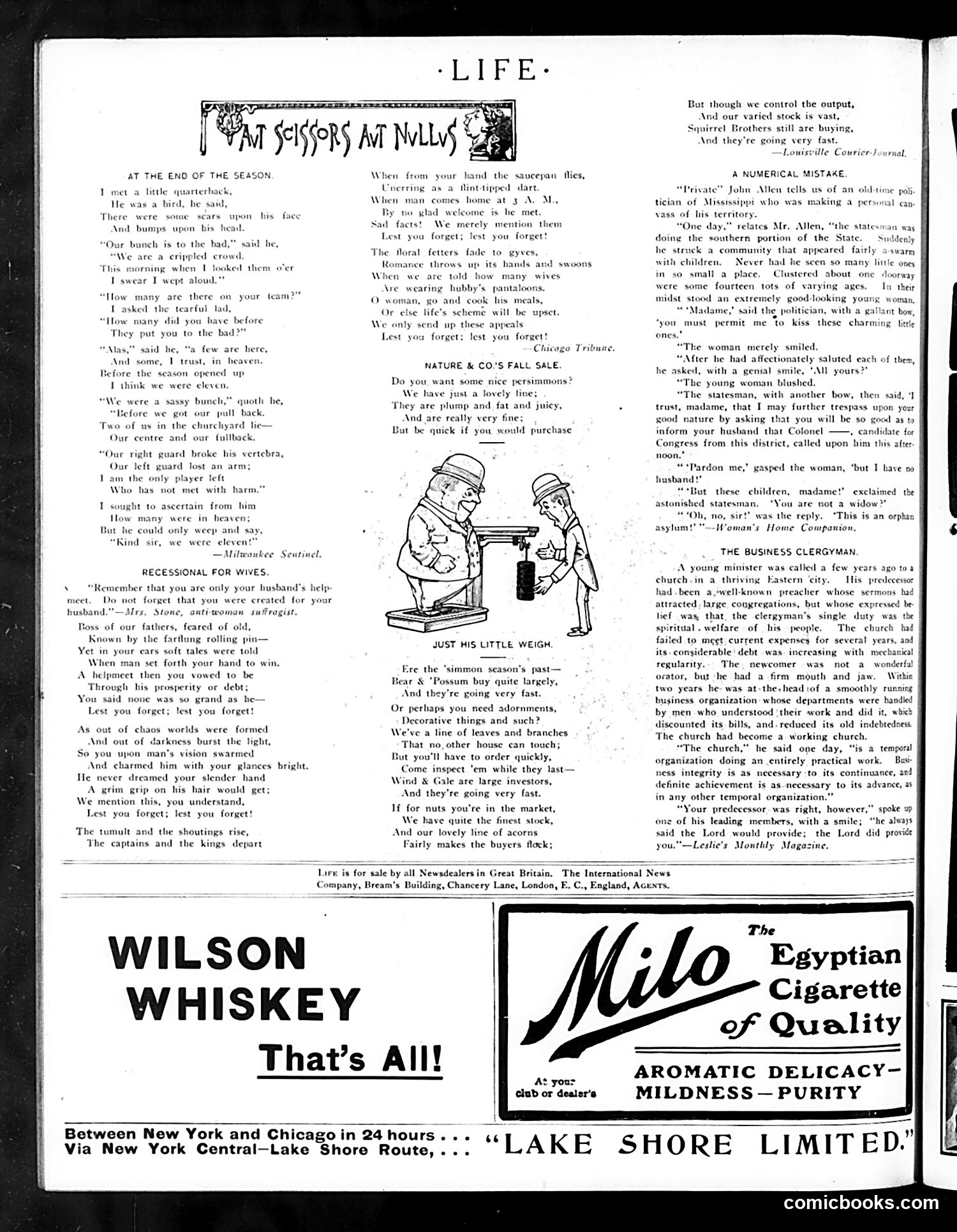
This page contains three distinct satirical pieces typical of Life's early 20th-century humor: **"At the End of the Season"**: A football poem mocking a decimated team. The quarterback explains their roster has been reduced from eleven players to just himself, with others dead, injured, or disabled—a dark joke about the brutal nature of early American football. **"Recessional for Wives"**: A suffrage-era satire mocking anti-women's-rights rhetoric. It mimics Kipling's "Recessional" to ridicule the argument that women exist solely as "helpmeets" to men, sarcastically emphasizing domestic servitude while implicitly defending women's right to independence. **"Nature & Co's Fall Sale"**: A humorous mock-advertisement where animals (bears, possums, squirrels, wind, gale) are depicted as customers bulk-buying seasonal goods, with the store unable to keep stock despite controlling output—likely satirizing real commercial shortages or monopoly practices of the era. The page reflects Life's satirical approach to contemporary social debates and absurdist humor.
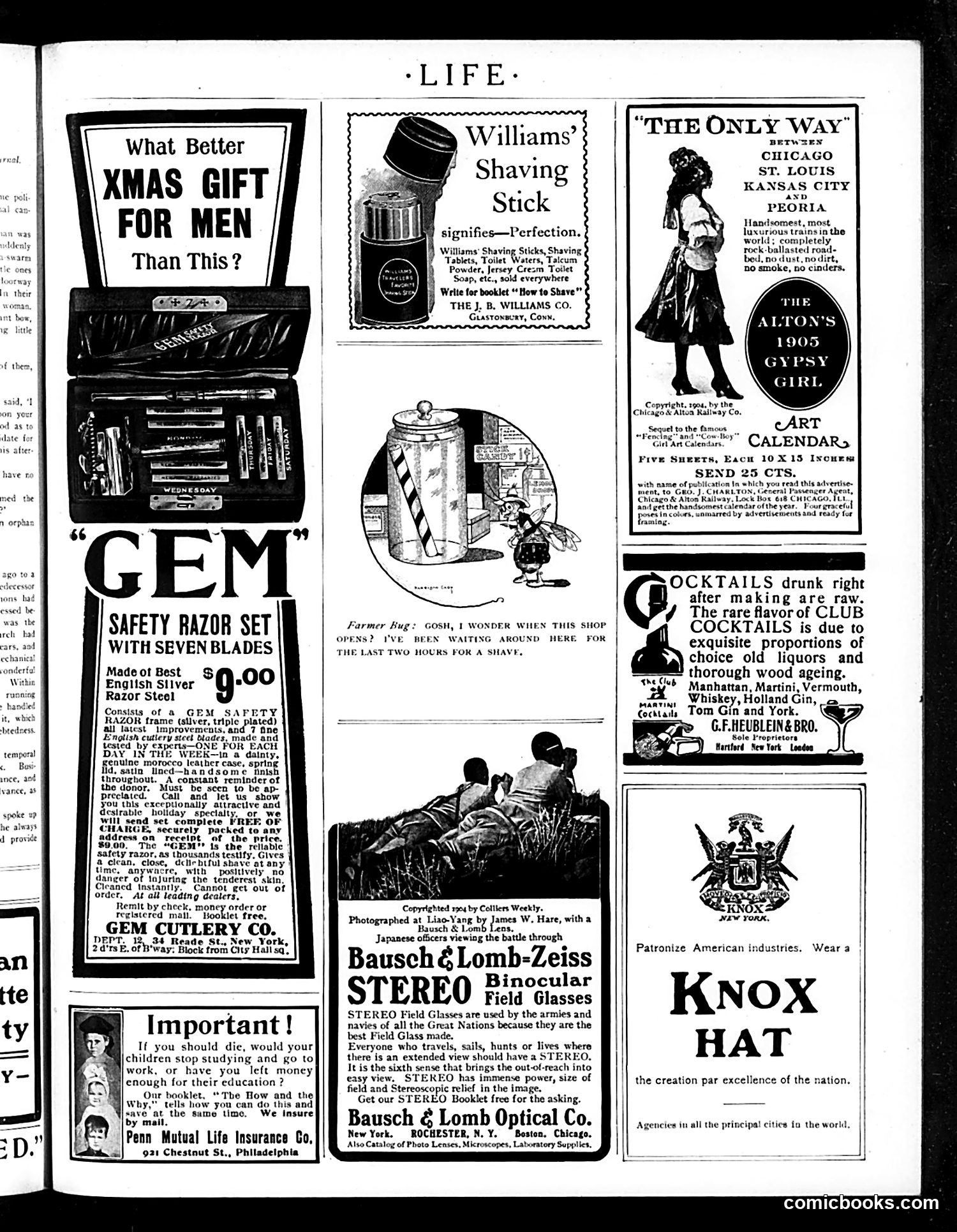
This is primarily an **advertising page** from Life magazine, circa 1904-1905, with one small cartoon. ## The Cartoon The single cartoon shows a farmer complaining to a barber: "Gosh, I wonder when this shop opens? I've been waiting around here for the last two hours for a shave." The joke is straightforward—the farmer is impatient or has arrived too early. ## The Advertisements The page features typical early-1900s luxury goods marketed to middle-class men: - **"Gem" Safety Razor Set** ($9.00)—a premium Christmas gift for men - **Williams' Shaving Stick**—toiletries marketed as "perfection" - **Bausch & Lomb Stereo Field Glasses**—illustrated with a reference to the Russo-Japanese War (1904-1905), showing Japanese officers using the binoculars - **Railway, insurance, cocktails, and hat advertisements** The Bausch & Lomb ad is historically significant: it directly references contemporary warfare, using combat photography to advertise consumer goods—typical of how manufacturers exploited current events for marketing.
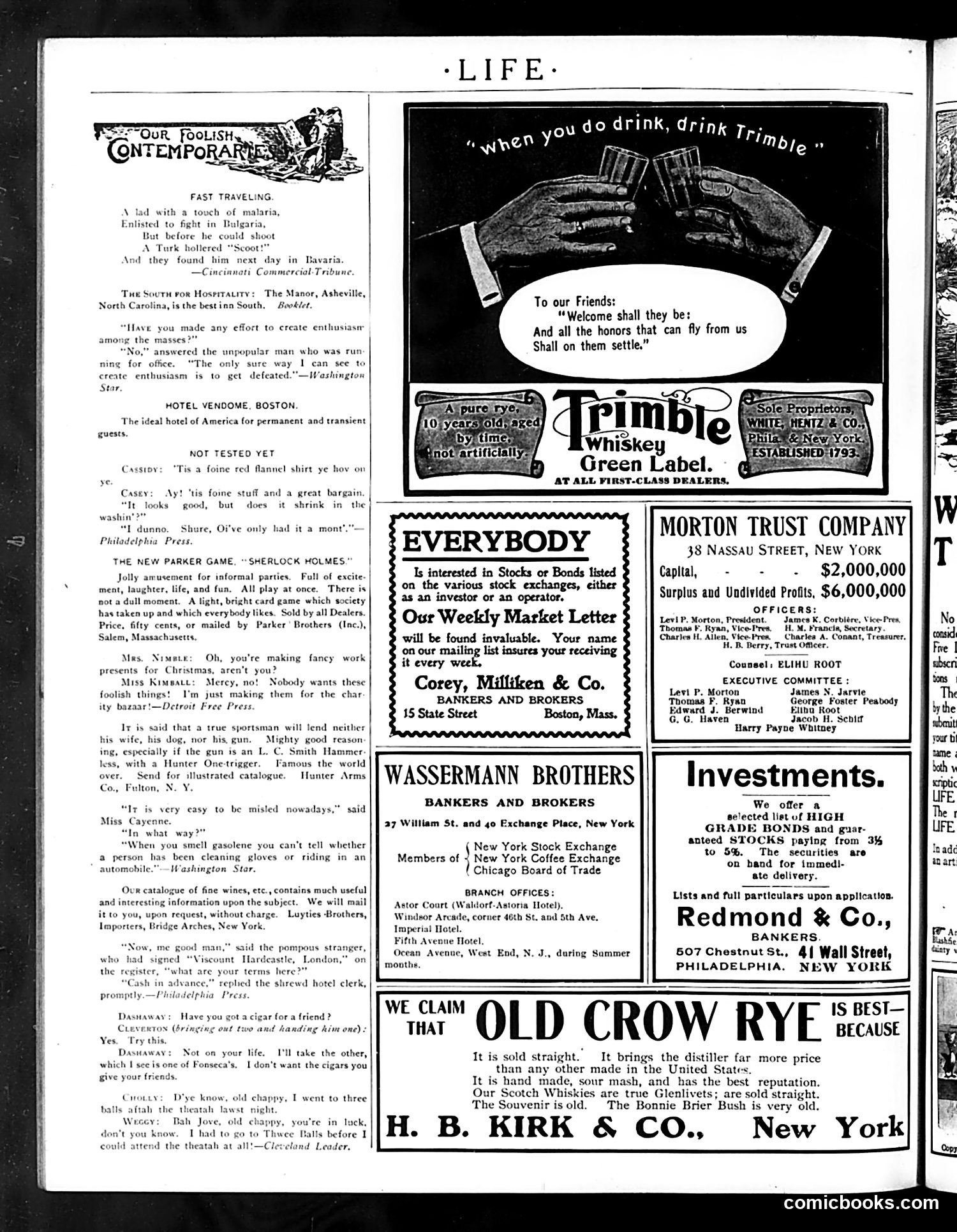
This is primarily an advertising and humor page from Life magazine, typical of the era's content mix. **Visible satirical content:** Brief humorous "shorts" mock domestic situations (wives concerned about shrinking shirts) and social pretension (someone making fancy work only for charity bazaars, not gifts). One joke suggests a true sportsman won't lend his wife, dog, or gun—playing on machismo stereotypes. **Main advertisements:** Banking and investment firms (Wassermann Brothers, Morton Trust Company, Redmond & Co.) dominate the page alongside liquor ads, particularly Trimble Whiskey and Old Crow Rye—marketed with testimonials about purity and quality. **Context:** This reflects early 20th-century Life as a satirical weekly mixing light social commentary with financial advertising, targeting an educated, prosperous readership. The humor is gentle observational comedy about middle-class life and manners.
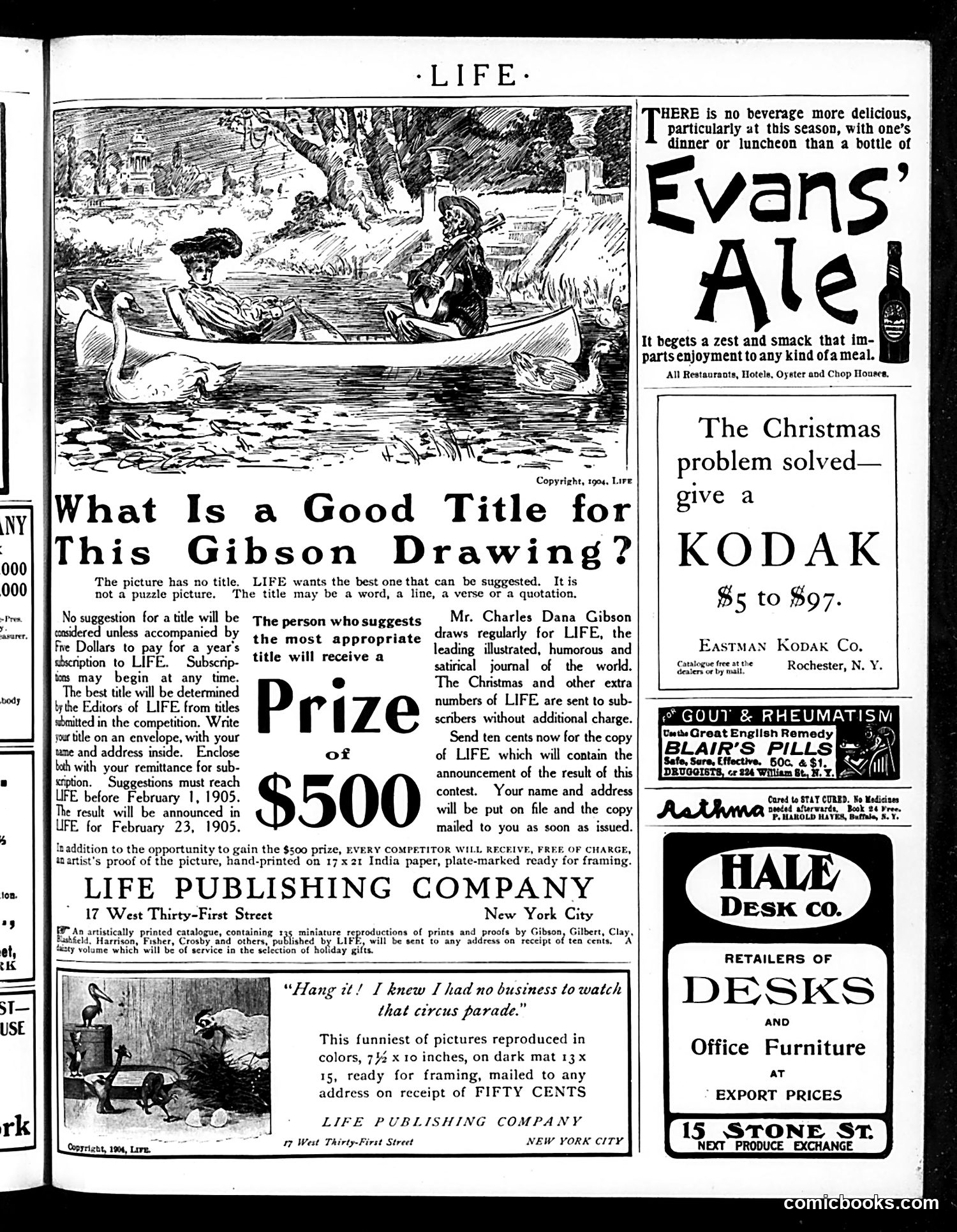
This is primarily an **advertising and promotional page** with a contest element. The main content is a **Charles Dana Gibson drawing** showing two elegantly-dressed figures in a rowboat on a lake, with leisure-class scenery visible. The point is unclear without a caption—viewers are invited to **suggest a title** for $5 subscription fee, with a $500 prize for the best submission. Gibson was Life's signature illustrator of high-society satire; his drawings typically mocked upper-class pretension and romantic complications. The cartoon's subject appears to involve leisure or courtship, typical Gibson themes. The page is dominated by **period advertisements** (Evans' Ale, Kodak cameras, desk furniture, patent medicine) interspersed with promotional copy. The lower cartoon—a man regretting he watched a circus parade—is separate, likely from ongoing Life features. This reflects Life's business model: prestigious illustrator content coupled with premium advertising.
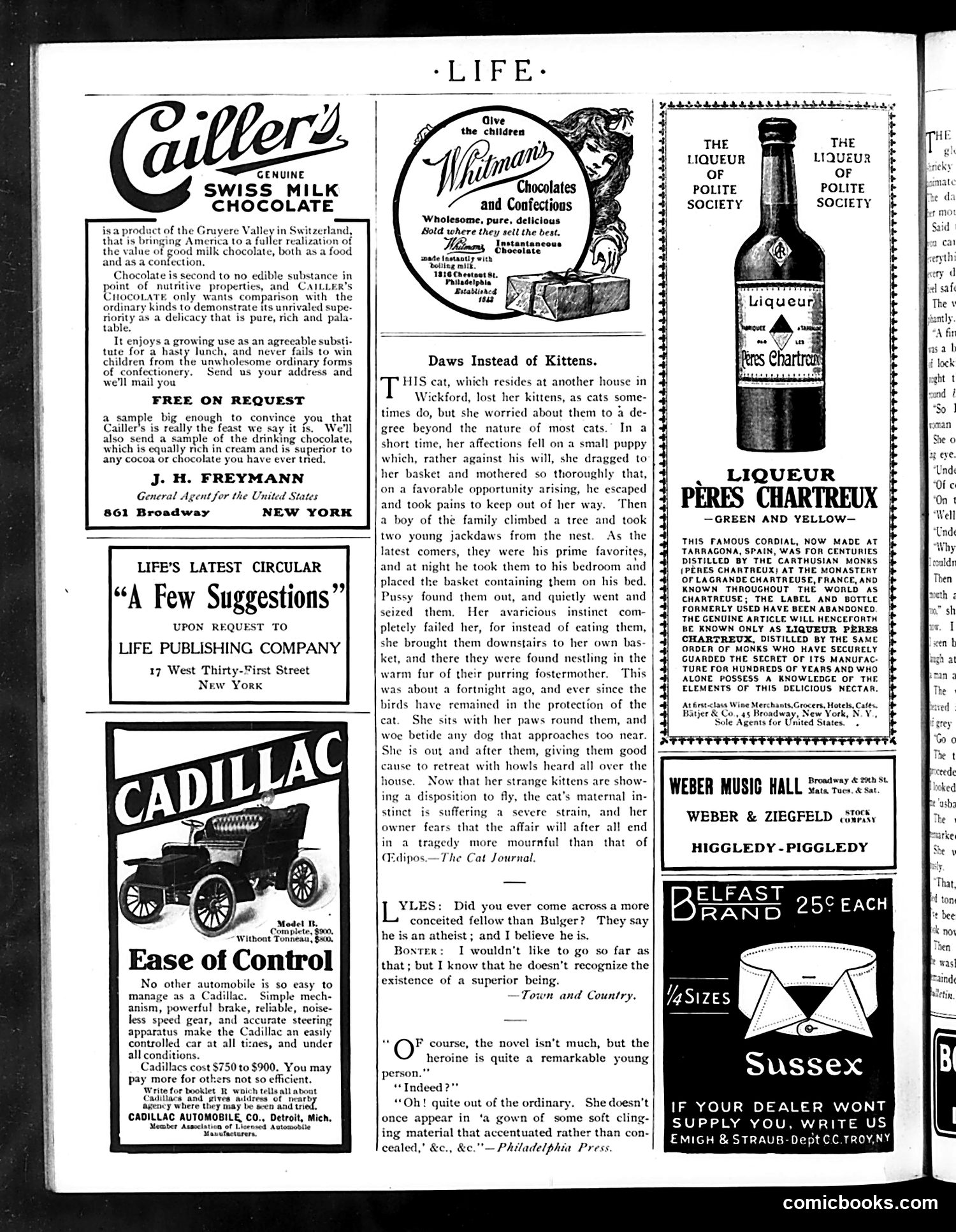
This page is primarily **advertising**, not political satire. It contains commercial notices for luxury goods popular in the early 1900s: Swiss chocolate (Cailler's), automobiles (Cadillac), liqueur (Pères Chartreux), and other products. The only narrative content is a brief anecdote titled "Daws Instead of Kittens"—a sentimental animal story about a cat who, after losing her kittens, adopts a puppy, then two young jackdaws (birds), mothering them despite her predatory nature. The piece demonstrates the cat's maternal instinct overriding her hunting instincts, presented as heartwarming rather than satirical. Below that are two short joke exchanges mocking pretension and atheism, typical of the era's light humor. **This is not a political cartoon page.** It's a magazine advertisement section with minimal editorial content.
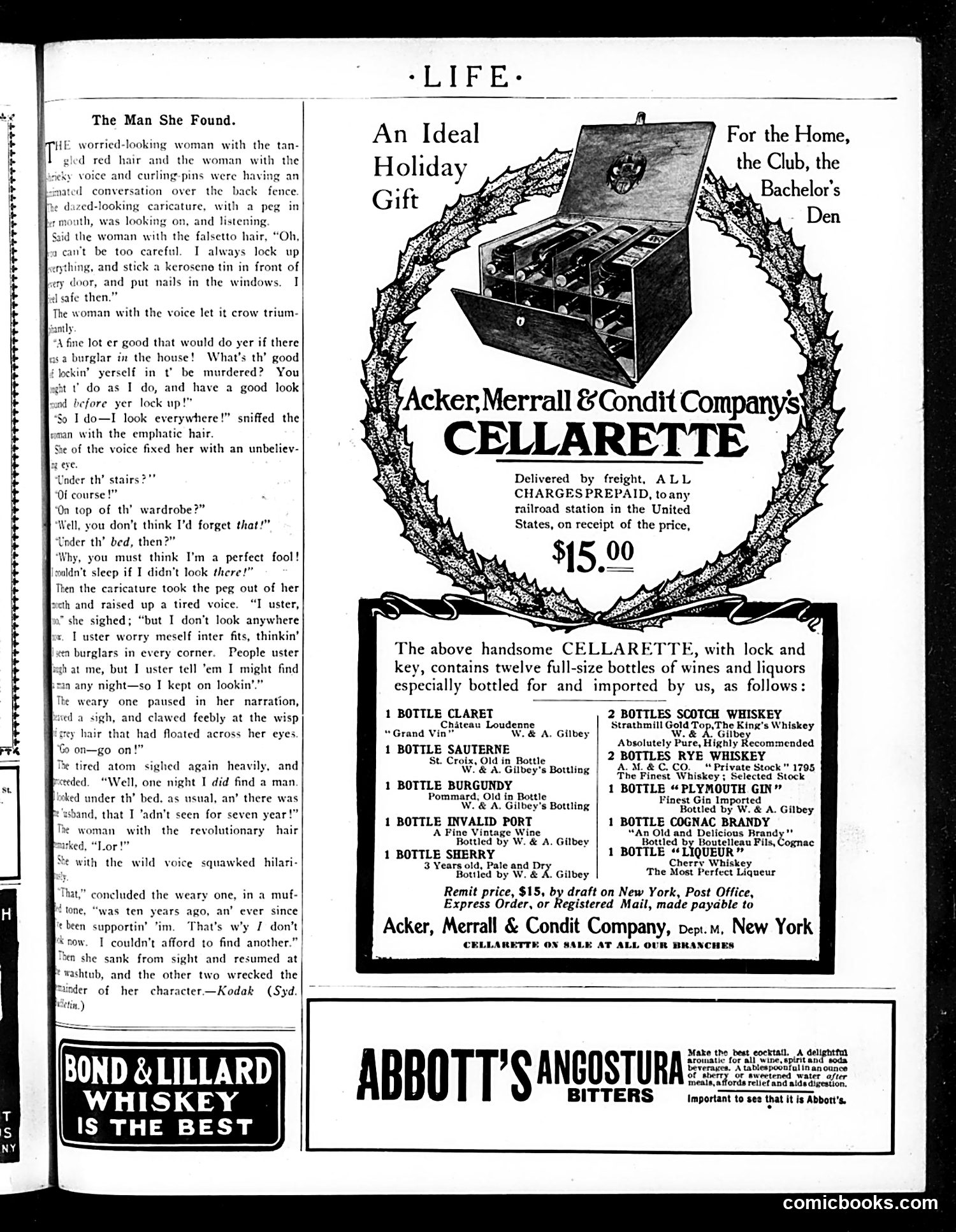
This is a humorous domestic narrative cartoon depicting three working-class women gossiping over a fence about home security. Two women obsessively describe elaborate precautions against burglars—locking doors, placing kerosene tins and nails at windows, searching under stairs and beds. The third woman, initially silent and "weary-looking," then reveals the punchline: she *did* find a man under her bed—an estranged husband she hadn't seen in seven years. Rather than being a burglar, he turned out to be a financial burden; she's been supporting him for a decade since. The satire targets obsessive, anxiety-ridden middle-class women and suggests that their real domestic threat isn't crime but dependent husbands. The joke relies on period anxieties about urban crime and marital obligation, presented through exaggerated female stereotypes—gossipy, fearful, and ultimately trapped. The page also contains period alcohol advertisements, typical of Life's commercial content.
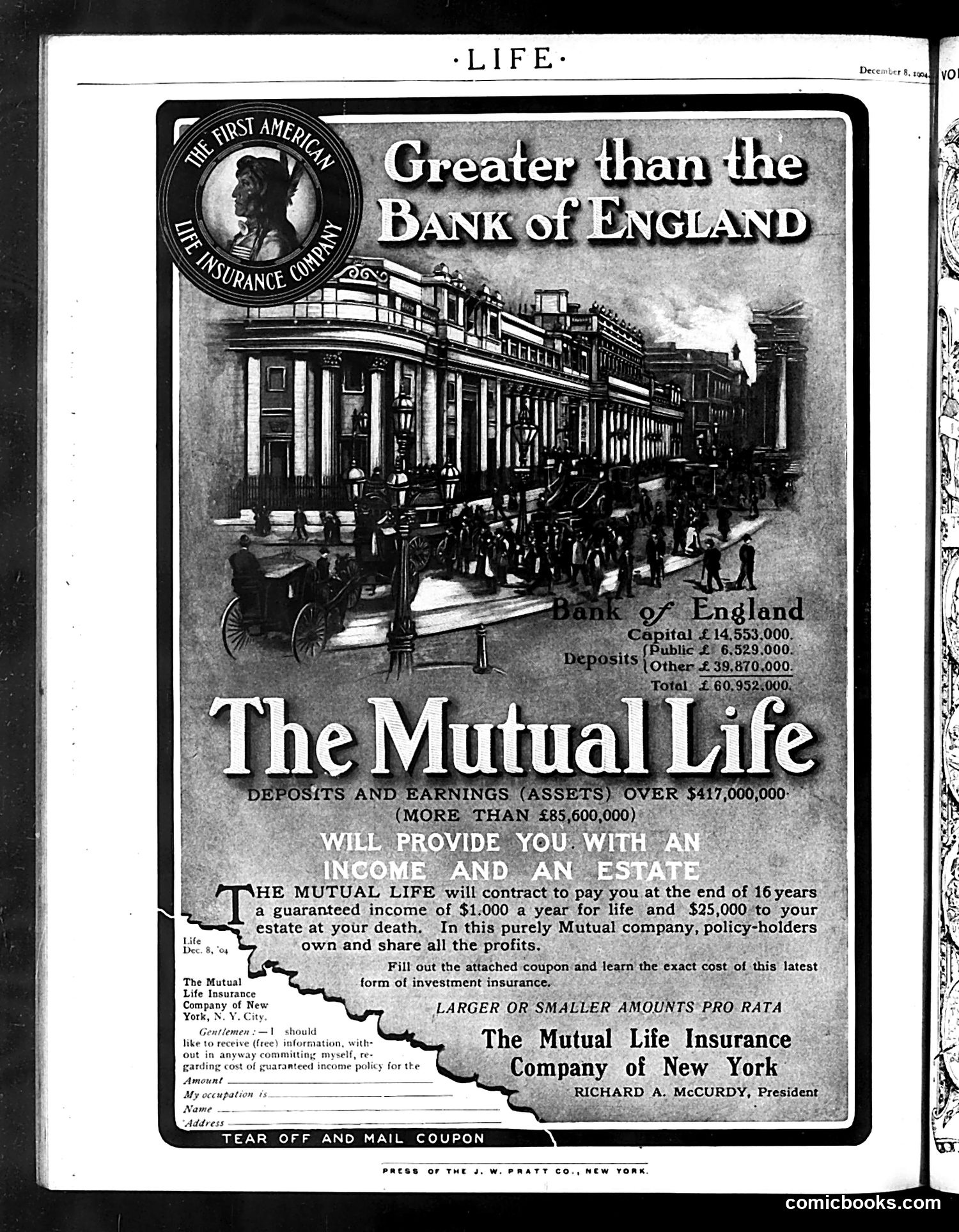
This is primarily a full-page advertisement for The Mutual Life Insurance Company of New York, not a political cartoon. The ad compares The Mutual Life's assets (over $417 million) favorably to the Bank of England's capital and deposits (£60.952 million), using an illustration of a grand neoclassical building with period street activity to establish prestige and solidity. The pitch emphasizes that policyholders "own and share all the profits" in this mutual company—a selling point highlighting democratic ownership versus stockholder-owned competitors. The ad promises guaranteed income ($1,000 yearly for 16 years plus $25,000 upon death) and includes a tear-off coupon for interested readers. This reflects early-20th-century insurance marketing's emphasis on institutional trustworthiness and the mutual company structure as an advantage to consumers.