
Life, 1904-12-08 · page 15 of 24
Life — December 8, 1904 — page 15: what you’re looking at
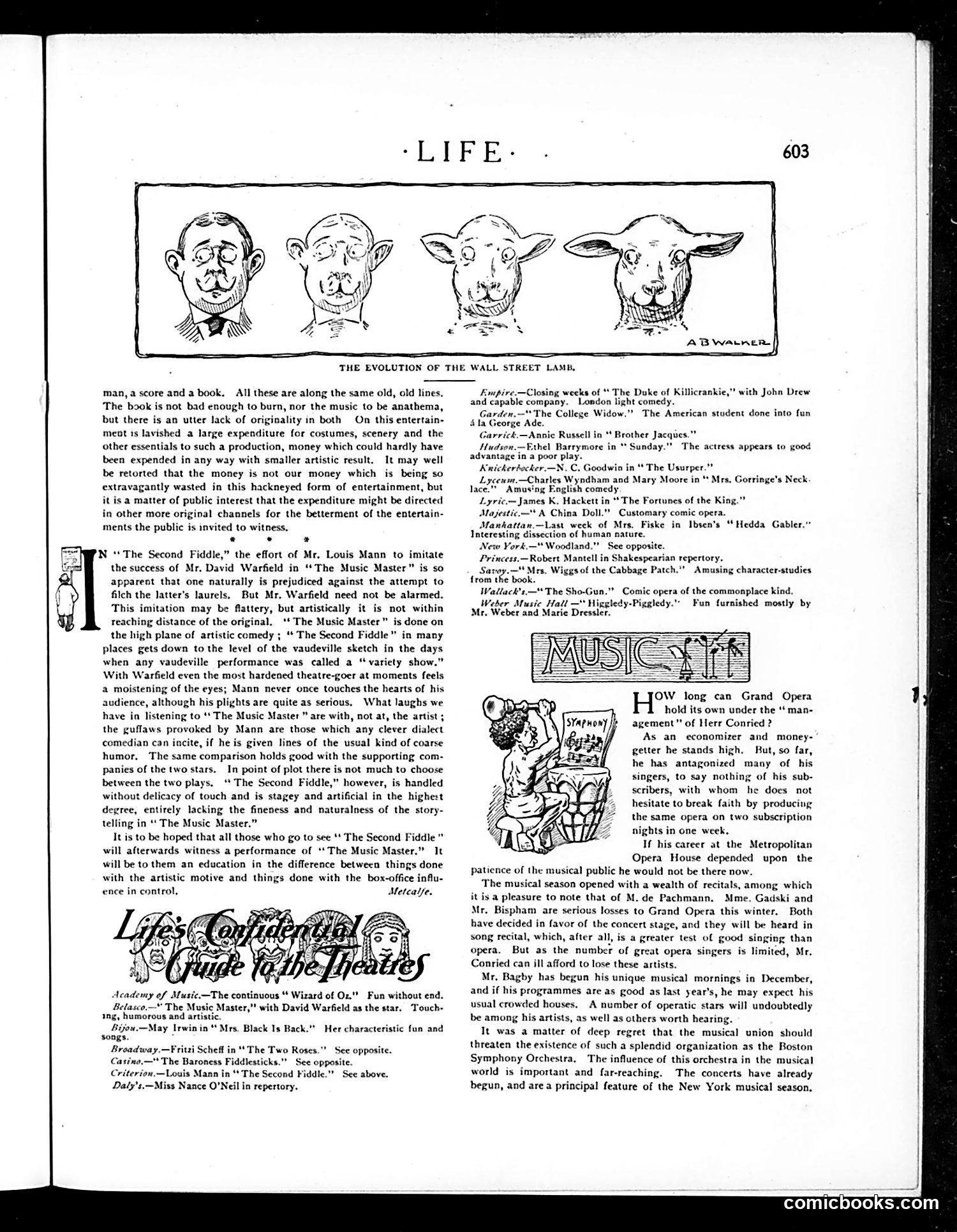
What you’re looking at
The cartoon at the top, credited to A.B. Walker, shows four progressive head transformations progressing left to right—from human to increasingly sheep-like features. This is a visual metaphor for how Wall Street investors become progressively more docile and foolish, losing their critical judgment as they're manipulated by financial schemes. The title "Evolution of the Wall Street Lamb" satirizes how savvy businessmen gradually transform into gullible "lambs"—victims ready for slaughter by market manipulators. The term "lamb" was period slang for a naive investor easily fleeced. Walker's cartoon warns that those involved in financial speculation gradually surrender their intelligence and independence, becoming passive victims of exploitation. This reflects broader Progressive Era skepticism toward Wall Street practices and unchecked capitalism.
📄 Transcribed text from this page (OCR, searchable)
Machine-transcribed from the original scan — historical spelling and the odd misread are preserved.
ABWacner |} J THE EVOLUTION OF THE WALL STREET LAMB, man, a score and a book. All these are along the same old, old lines, The book is not bad enough to burn, nor the music to be anathema, but there is an utter lack of originality in both On this entertain- meot is lavished a large expenditure for costumes, scenery and the other essentials to such a production, money which could hardly have been expended in any way with smaller artistic result. It may well be retorted that the money is not our money which is being so extravagantly wasted in this hackneyed form of entertainment, but it is a matter of public interest that the expenditure might be directed in other more original channels for the betterment of the entertain- ments the public is invited to witness. * . * 'N ‘The Second Fiddle,” the effort of Mr. Louis Mann to imitate the success of Mr. David Warfield in “The Music Master” is so apparent that one naturally is prejudiced against the attempt to filch the latter’s laurels, But Mr, Warfield need not be alarmed. This imitation may be flattery, but artistically it is not within reaching distance of the original, ‘ The Music Master” is done on the high plane of artistic comedy ; “ The Second Fiddle” in many places gets down to the level of the vaudeville sketch in the days when any vaudeville performance was called a “variety show.” With Warfield even the most hardened theatre-goer at moments feels a moistening of the eyes; Mann never once touches the hearts of his audience, although his plights are quite as serious. What laughs we have in listening to The Music Master ” are with, not at, the artist ; the guffaws provoked by Mann are those which any clever dialect comedian can incite, if he is given lines of the usual kind of coarse humor. ‘The same comparison holds good with the supporting com- panies of the two stars. In point of plot there is not much to choose between the two plays,“ The Second Fiddle,” however, is handled without delicacy of touch and is stagey and artificial in the highest degree, entirely lacking the fineness and naturalness of the story- telling in “ The Music Master.” It is to be hoped that all those who go to see “ The Second Fiddle " will afterwards witness a performance of ‘The Music Master.” It Will be to them an education in the difference between things done with the artistic motive and things done with the box-office influ- ence in control, Metcalfe. Academy ef Music—The continuous “ Wizard of Oz."" Fun without end. Selasco.—” The Music Master,” with David Warfield as the star. Touch- ang, humorous and artistic. Bijou.—May Irwin in “ Mrs. Black Is Back." Her characteristic fun and songs. Broadway.—Fritzi Scheff in “The Two Roses." See opposite. Casine.—* The Baroness Fiddlesticks.”” See opposite. Criterion.—Louis Mann in ** The Second Fiddle." See above. Daty's.—Miss Nance O'Neil in repertory. Empire.—Closing weeks of The Duke of Killicrankie,” with John Drew and capable company. London light comedy. Garden.—" The College Widow.”” The American student done into fun 4 la George Ade. Garrick. —Annic Russell in “ Brother Jacques.” Hudson.—Ethel Barrymore in ** Sunday."” ‘The actress appears to good advantage in a poor play. Knickerbocker. —N. C, Goodwi The Usurper Lyceum.—Charles Wyndham and Mary Moore in" Mrs, Gorringe's Neck lace." Amusing English comedy Lyrieo James K. Hackett in “The Fortunes of the King.”” Mayestic.—* A China Doll." Customary comic opera. Manhattan.—Last week of Mrs. Fiske in Ibsen’ Interesting dissection of human nature. New York.—"* Woodland.” See opposite. Princess,—Robert Mantell in Shakespearian repertory. Savey.—* Mrs. Wiggs of the Cabbage Patch." Amusing character-studies from the book. Watlack's.—" The Sho-Gun.”” Comic opera of the commonplace kind. Weber Music Hall —* Higgledy-Piggledy.” Fun furnished mostly by Mr, Weber and Marie Dressler. Hedda Gabler.” OW long can Grand Opera hold its own under the “ man- agement" of Herr Conried ? As an economizer and money- getter he stands high. But, so far, he has antagonized many of his singers, to say nothing of his sub- scribers, with whom he does not hesitate to break faith by producing the same opera on two subscription nights in one week, If his career at the Metropolitan Opera House depended upon the patience of the musical public he would not be there now. ‘The musical season opened with a wealth of recitals, among which it is a pleasure to note that of M.de Pachmann, Mme. Gadski and Mr. Bispham are serious losses to Grand Opera this winter. Both have decided in favor of the concert stage, and they will be heard in song recital, which, after all, is a greater test of good singing than opera, But as the number of great opera singers is limited, Mr. Conried can ill afford to lose these artists. Mr. Bagby has begun his unique musical mornings in December, and if his programmes are as good as last year’s, he may expect his usual crowded houses. A number of operatic stars will undoubtedly be among his artists, as well as others worth hearing. It was a matter of deep regret that the musical union should threaten the existence of such a splendid organization as the Boston Symphony Orchestra, The influence of this orchestra in the musical world is important and far-reaching. The concerts have already begun, and area principal feature of the New York musical season. comicbooks.com