
Life, 1904-12-08 · page 14 of 24
Life — December 8, 1904 — page 14: what you’re looking at
What you’re looking at
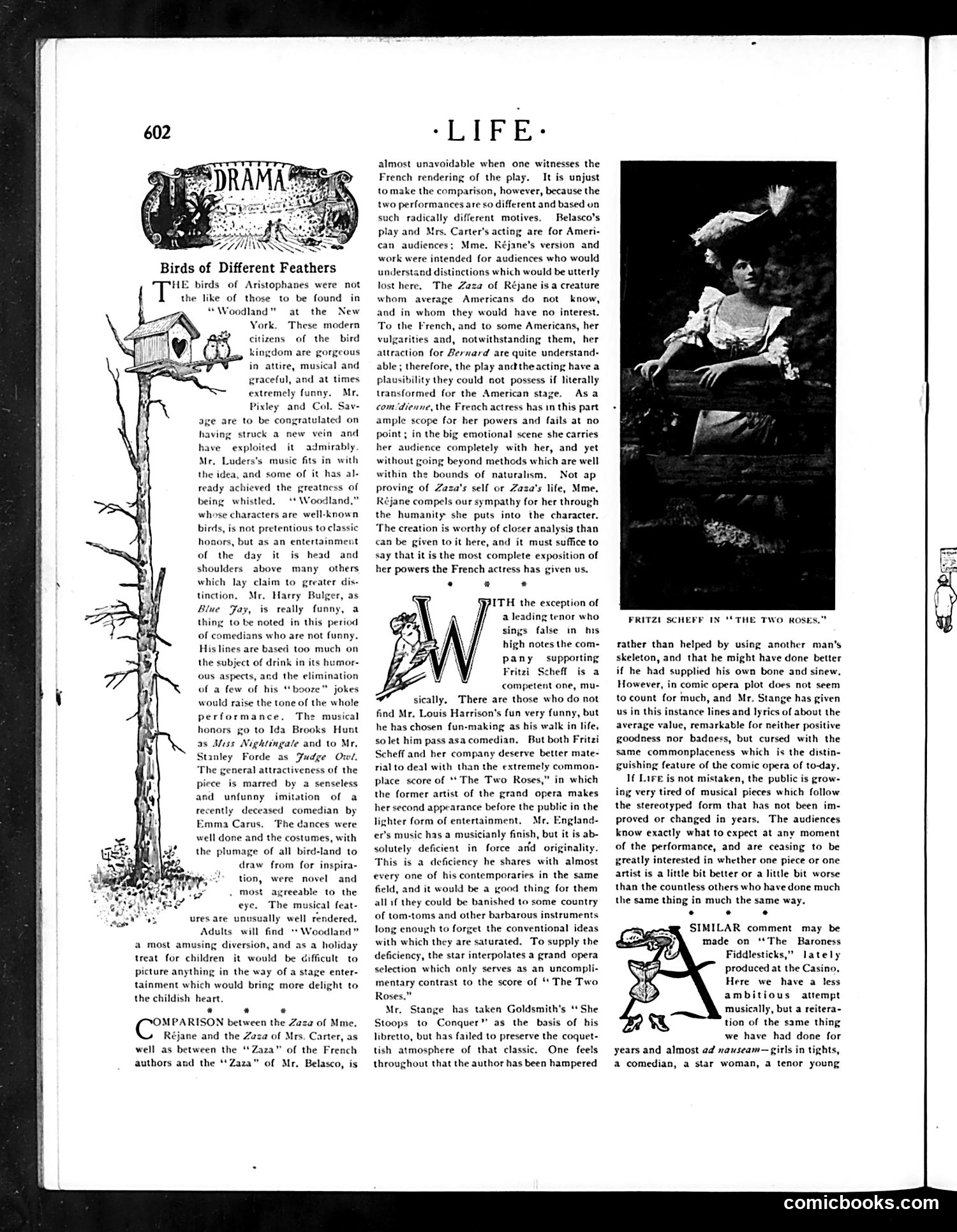
This page reviews theatrical productions, primarily the operetta "Woodland." The left column's illustration depicts a stylized bird perched on a bare tree branch—fitting the "birds" metaphor for the show's animal characters. The reviews praise "Woodland" as amusing entertainment with catchy music and attractive costumes. However, the critic notes comedian Harry Bulger relies too heavily on alcohol-related jokes, which lowers the production's tone. Emma Carus receives criticism for performing an imitation of a "recently deceased comedian"—apparently in poor taste. The page also compares two productions of "Zaza": the French actress Mme. Réjane's version versus Mrs. Carter's American adaptation. The critic argues Réjane's performance succeeds because she maintains the character's authentic French context, generating sympathy through naturalistic acting rather than sanitizing the morally questionable protagonist for American audiences.
📄 Transcribed text from this page (OCR, searchable)
Machine-transcribed from the original scan — historical spelling and the odd misread are preserved.
Birds of Different Feathers HE birds of Aristophanes were not the like of those to be found in Woodland" at the New York. These modern citizens of the bird kingdom are gorgeous in attire, musical and graceful, and at times extremely funny, Mr. Pixley and Col. are to be congratulated on having struck a new vein and have exploited it admirably Mr. Luders’s music fits in with and some of it has al- the id ready achieved the greatness of being whistled. ‘* Woodland,” whose characters are well-known birds, is not pretentious to classic honors, but as an entertainment of the day it is head shoulders above many others which lay claim to greater dis- tinction, Mr. Harry Bulger, as Blue Fay, is really funny, a thing to be noted in this period of comedians who are not funny, Hislines are based too much on the subject of drink in its humor- ous aspects, ard the elimination of a few of his “booze” jokes would raise the tone of the whole performance, The musical honors go to Ida Brooks Hunt as ahss Nightingale and to Mr, anley Forde as Judge Owl, ‘The general attractiveness of the piece is marred by a senseless and unfunny imitation of a recently deceased comedian by Emma Carus. ‘Phe dances were well done and the costumes, with the plumage of all bird-land to draw from for inspira- tion, were novel and agreeable to the The musical feat- ures are unusually well rendered, Adults will find ** Woodland” most amusing diversion, and as a holiday treat for children it would be difficult to picture anything in the way of a stage enter- tainment which would bring more delight to the childish heart * * * PARISON between the Zaza of Mme, Réjane and the Zaza of Mrs. Carter, as well as between the “Zaza” of the French authors and the ‘*Zaza” of Mr, Belasco, is and . most eye. -LIFE- almost unavoidable when one witnesses the French rendering of the play. It is unjust tomake the comparison, however, because the two performances are so different and based un such radically different motives. Belasco’s play and Mrs. Carter's acting are for Ameri- can audiences; Mme, Kéjane’s version and work were intended for audiences who would understand distinctions which would be utterly lost here, The Zaza of Réjane isa creature whom average Americans do not know, and in whom they would have no interest. To the French, and to some Americans, her vulgarities and, notwithstanding them, her attraction for Bernard are quite understand- able ; therefore, the play and theacting have a plausibility they could not possess if literally transformed for the American stage, Asa com dienne, the Freoch actress has in this part ample scope for her powers and fails at no point ; in the big emotional scene she carries her audience completely with her, and yet without going beyond methods which are well within the bounds of naturalism. Not ap proving of Zaza's self or Zaza's life, Mme, Réjane compels our sympathy for her through the humanity she puts into the character. ‘The creation is worthy of closer analysis than can be given to it here, and it must suffice to say that it is the most complete exposition of her powers the French actress has given us. « * ITH the exception of a leading tenor who sings false in his high notes the com- pany supporting Fritzi Scheff is a competent one, mu- sically. There are those who do not find Mr. Louis Harrison's fun very funny, but he has chosen fun-making as his walk in life, solet him pass asa comedian, But both Fritzi Scheff and her company deserve better mate- rial to deal with than the extremely common- place score of The Two Roses,” in which the former artist of the grand opera makes her second appearance before the public in the lighter form of entertainment, Mr. England- er’s music has a musicianly finish, but it is ab- solutely deficient in force arid originality. This is a deficiency he shares with almost every one of his contemporaries in the same field, and it would be a good thing for them all if they could be banished to some country of tom-toms and other barbarous instruments, long enough to forget the conventional ideas with which they are saturated. To supply the deficiency, the star interpolates a grand opera selection which only serves as an uncompli- mentary contrast to the score of The Two Roses.” Mr. Stange has taken Goldsmith's * She Stoops to Conquer” as the basis of his libretto, but has failed to preserve the coquet- tish atmosphere of that classic. One feels throughout that the author has been hampered FRITZI SCHEFF IN ‘THE TWO ROSES. rather than helped by using another man’s skeleton, and that he might have done better if he had supplied his own bone and sinew. However, in comic opera plot does not seem to count for much, and Mr. Stange has given us in this instance lines and lyrics of about the average value, remarkable for neither positive goodness nor badoess, but cursed with the same commonplaceness which is the distin- guishing feature of the comic opera of to-day, If Lire is not mistaken, the public is grow- ing very tired of musical pieces which follow the stereotyped form that has not been im- proved or changed in years, The audiences know exactly what to expect at any moment of the performance, and are ceasing to be greatly interested in whether one piece or one artis a little bit better or a little bit worse than the countless others who have done much the same thing in much the same way. . . . SIMILAR comment made on ‘*The Baroness Fiddlesticks,” lately produced at the Casino, Here we have a less ambitious attempt musically, but a reitera- tion of the same thing we have had done for years and almost ad nauseam—girls in tights, @ comedian, a star woman, a tenor young may be comicbooks.com