
Life, 1904-12-08 · page 8 of 24
Life — December 8, 1904 — page 8: what you’re looking at
What you’re looking at
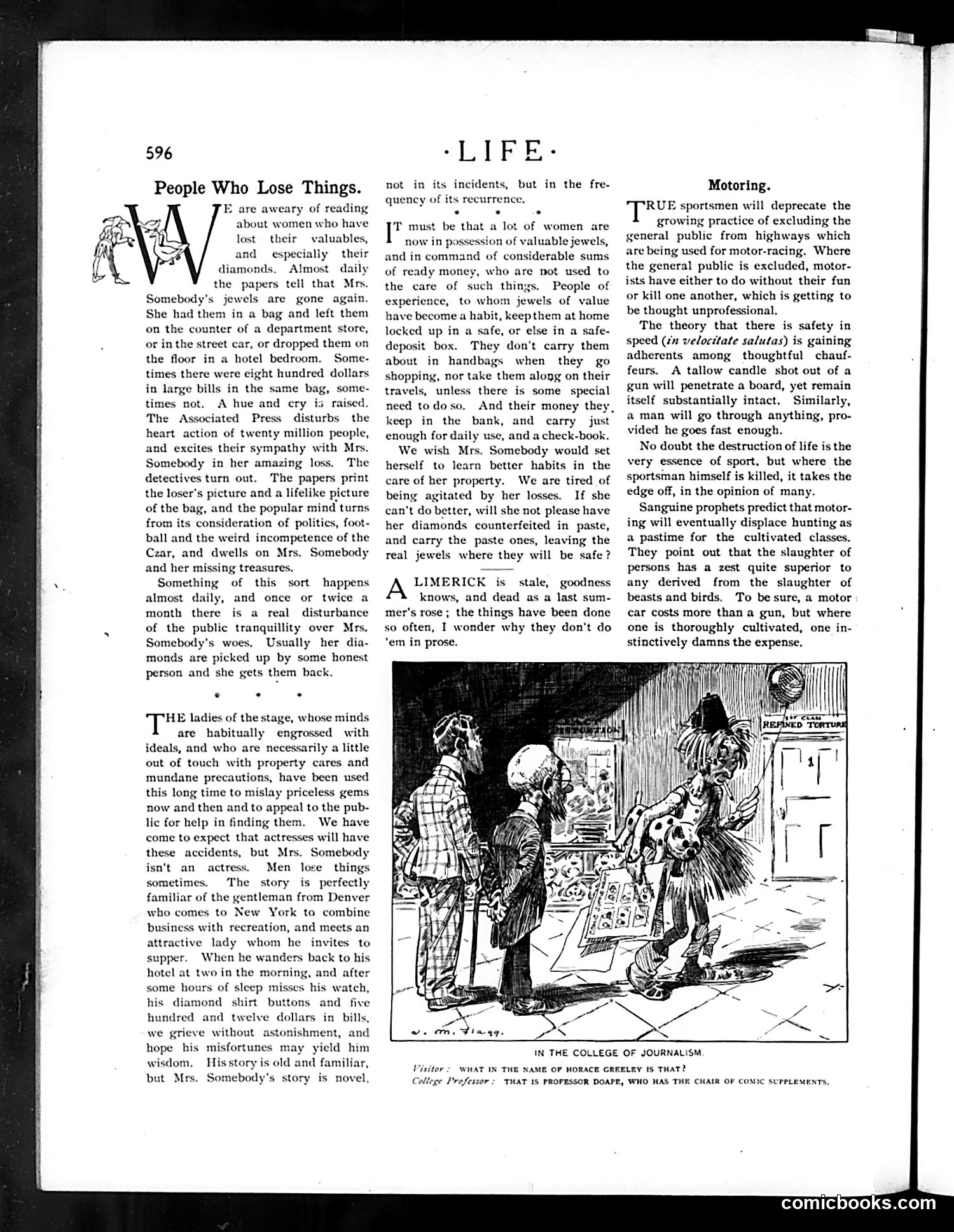
This cartoon satirizes journalistic ethics and sensationalism in early 20th-century American newspapers. The scene depicts what appears to be a journalism classroom or newsroom where students/reporters are examining illustrated newspapers or comic supplements spread on a table. The caption presents a dialogue: a student (Enter) asks "What is the name of Horace Greeley is that?" The College Professor responds that it's "Professor Doake, who has the chair of comic supplements." The satire targets the rise of illustrated, sensational "comic supplement" sections in newspapers—suggesting they've become so dominant that they merit academic chairs. The joke critiques how entertainment-focused visual journalism was displacing serious news coverage and traditional journalistic standards, treating comics/illustrations as equivalent to serious editorial work.
📄 Transcribed text from this page (OCR, searchable)
Machine-transcribed from the original scan — historical spelling and the odd misread are preserved.
596 People Who Lose Things. E are aweary of reading about women who have lost their valuables, and especially their diamonds. Almost daily the papers tell that M Somebody's jewels are gone again. She had them in a bag and left them on the counter of a department store, or in the street car, or dropped them on the floor in a hotel bedroom. Some- times there were eight hundred dollars in large bills in the same bag, some- times not. A hue and cry is raised. The Associated Press disturbs the heart action of twenty million people, and excites their sympathy with Mrs. Somebody in her amazing loss. The detectives turn out. The papers print the loser's picture and a lifelike picture of the bag, and the popular mind turns from its consideration of politics, foot- ball and the weird incompetence of the Czar, and dwells on Mrs. Somebody and her missing treasures. Something of this sort happens almost daily, and once or twice a month there is a real disturbance of the public tranquillity over Mrs. Somebody's woes. Usually her dia- monds are picked up by some honest person and she gets them back. . . . HE ladies of the stage, whose minds are habitually engrossed with ideals, and who are necessarily a little out of touch with property cares and mundane precautions, have been used this long time to mislay priceless gems now and then and to appeal to the pub- lic for help in finding them, We have come to expect that actresses will have these accidents, but Mrs. Somebody isn't an actress. Men lose things sometimes. The story is perfectly familiar of the gentleman from Denver who comes to New York to combine business with recreation, and meets an attractive lady whom he invites to supper. When he wanders back to his hotel at two in the morning, and after some hours of sleep misses his watch, his diamond shirt buttons and five hundred and twelve dollars in bills, we grieve without astonishment, and hope his misfortunes may yield him wisdom. Hisstory is old and familiar, but Mrs. Somebody's story is novel, “LIF Ee not in its incidents, but in the fre- quency of its recurrence, it a lot of women are [° must be th sion of valuable jewels, now in pos and in command of considerable sums of ready money, who are not used to the care of such thing People of experience, to whom jewels of value have become a habit, keepthem at home locked up in a safe, or else in a safe- deposit box. They don’t carry them about in handbags when they go shopping, nor take them alogg on their travels, unless there is some special need to do so, keep in the bank, and carry just enough for daily use, and a check-book. We wish Mrs. Somebody would set herself to learn better habits in the care of her property. We are tired of being agitated by her losses. If she can't do better, will she not please have her diamonds counterfeited in paste, and carry the paste ones, leaving the real jewels where they will be safe? LIMERICK is_ stale, goodness knows, and dead as a last sum- mer's rose; the things have been done so often, I wonder why they don’t do "em in prose. And their money they, Motoring. RUE sportsmen will deprecate the growing practice of excluding the general public from highways which are being used for motor-racing. Where the general public is excluded, motor- ists have either to do without their fun or kill one another, which is getting to be thought unprofessional. The theory that there is safety in speed (7 velocttate salutas) is gaining adherents among thoughtful chauf- feurs. A tallow candle shot out of a gun will penetrate a board, yet remain itself substantially intact. Similarly, a man will go through anything, pro- vided he goes fast enough. No doubt the destruction of life is the very essence of sport, but where the sportsman himself is killed, it takes the edge off, in the opinion of many. Sanguine prophets predict that motor- ing will eventually displace hunting as a pastime for the cultivated classes. They point out that the slaughter of persons has a zest quite superior to any derived from the slaughter of beasts and birds. To be sure, a motor car costs more than a gun, but where one is thoroughly cultivated, one in- stinctively damns the expense, IN THE COLLEGE OF JOURNALISM Visiter Coltege Profesior : WHAT IN THE NAME OP HORACE GREELEY IS THAT? THAT 1S PROFESSOR DOAPE, WHO HAS THE CHAIR OF COMIC SUPPLEMENTS, comicbooks.com