
Life, 1904-12-08 · page 6 of 24
Life — December 8, 1904 — page 6: what you’re looking at
What you’re looking at
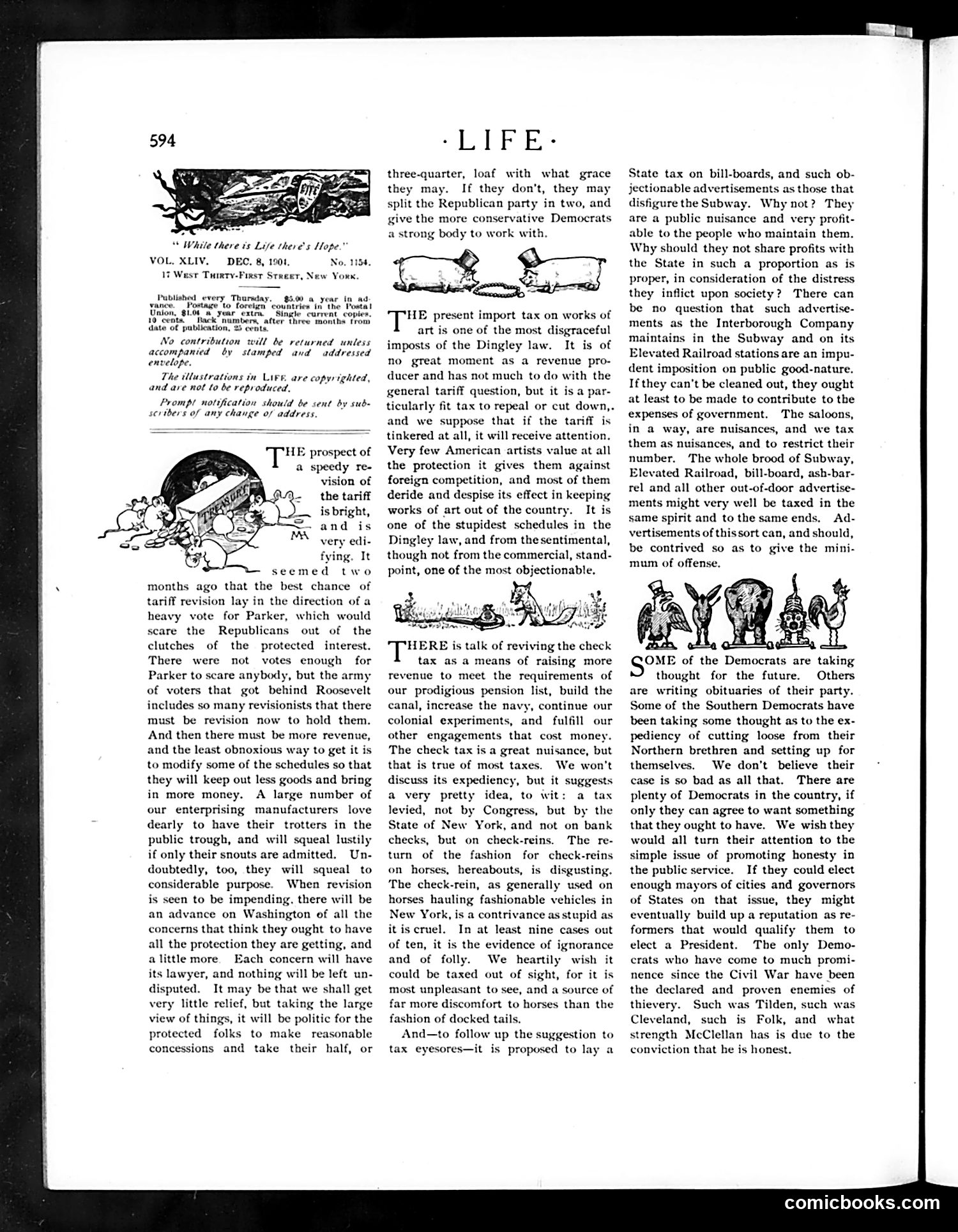
**The Main Cartoon** (upper left) depicts a figure being crushed or overwhelmed, illustrating the article's critique of the import tax on artworks under the Dingley Law—protectionist tariffs that made foreign art expensive in America. **The Political Context**: The article discusses tariff policy disagreements, mentioning Parker (likely Alton B. Parker, Democratic candidate) and Roosevelt. It argues protective tariffs hurt American artists by pricing out foreign competition while claiming to help domestic industry. **The Subway References**: Multiple passages criticize the Subway and Elevated Railroad's billboard advertising as public nuisances that should be taxed like other offensive advertisements. The page blends economic policy critique with municipal reform complaints typical of Progressive Era satire.
📄 Transcribed text from this page (OCR, searchable)
Machine-transcribed from the original scan — historical spelling and the odd misread are preserved.
“While there is Life there's Hope.” VOL. XLIV. DEC. 8 1904, No. 1154. 17 West Tutety-First Street, New Yorx. Published every Thuratay, vance. Postage to foreign Union, sL.04 a year extra Single current’ copie Rack numbers, after three months from tate of publications 2 rte $5.09 a year in ad countries in the Postat No contribution will be returned unless accompanied by stamped and addressed envelope. The illustrations in Live, are copyrighted, and are not to be reproduced. Prompt notification should be sent by sub- ser thers of any change of address, pups prospect of a speedy re- vision of the tariff is bright, and is very edi- fying. It seemed two months ago that the best chance of tariff revision lay in the direction of a heavy vote for Parker, which would scare the Republic: out of the clutches of the protected interest. There were not votes enough for Parker to scare anybody, but the army of voters that got behind Roosevelt includes so many revisionists that there must be revision now to hold them. And then there must be more revenue, and the least obnoxious way to get it is to modify some of the schedules so that they will keep out less goods and bring in more money. A large number of our enterprising manufacturers love dearly to have their trotters in the public trough, and will squeal lustily if only their snouts are admitted. Un- doubtedly, too, they will squeal to considerable purpose. When revision is seen to be impending, there will be an advance on Washington of all the concerns that think they ought to have all the protection they are getting, and alittle more. Each concern will have its lawyer, and nothing will be left un- disputed. It may be that we shall get very little relief, but taking the large view of things, it will be politic for the protected folks to make reasonable concessions and take their half, or LIFE- three-quarter, loaf with what grace they may. If they don't, they may split the Republican party in two, and give the more conservative Democrats a strong body to work with. HE present import tax on works of art is one of the most disgraceful imposts of the Dingley law. It is of no great moment as a revenue pro- ducer and has not much to do with the general tariff question, but it is a par- ticularly fit tax to repeal or cut down,. and we suppose that if the tariff is tinkered at all, it will receive attention. Very few American artists value at all the protection it gives them against foreign competition, and most of them deride and despise its effect in keeping works of art out of the country. It is one of the stupidest schedules in the Dingley law, and from the sentimental, though not from the commercial, stand- point, one of the most objectionable. HERE is talk of reviving the check tax as a means of raising more revenue to meet the requirements of our prodigious pension list, build the canal, increase the navy, continue our colonial experiments, and fulfill our other engagements that cost money. The check tax is a great nuisance, but that is true of most taxes. We won't discuss its expediency, but it suggests a very pretty idea, to wit: a tax levied, not by Congress, but by the State of New York, and not on bank checks, but on check-reins. The re- turn of the fashion for check-reins on horses, hereabouts, is disgusting. The check-rein, as generally used on horses hauling fashionable vehicles in New York, is a contrivance as stupid as itis cruel. In at least nine cases out of ten, it is the evidence of ignorance and of folly. We heartily wish it could be taxed out of sight, for it is nt to see, and far more discomfort to ho: fashion of docked tails. And—to follow up the suggestion to tax eyesores—it is proposed to lay a a source of s than the State tax on bill-boards, and such ob- jectionable advertisements as those that disfigure the Subway. Why not? They are a public nuisance and very profit- able to the people who maintain them. Why should they not share profits with the State in such a proportion as is proper, in consideration of the distress they inflict upon society? There can be no question that such advertise- ments as the Interborough Company maintains in the Subway and on its Elevated Railroad stations are an impu- dent imposition on public good-nature. If they can’t be cleaned out, they ought at least to be made to contribute to the expenses of government. The saloons, in a way, are nuisances, and we tax them as nuisances, and to restrict their number. The whole brood of Subway, Elevated Railroad, bill-board, ash-bar- rel and all other out-of-door advertise- ments might very well be taxed in the same spirit and to the same ends, Ad- vertisements of thissort can, and should, be contrived so as to give the mini- mum of offense. OME of the Dene are taking thought for the future. Others are writing obituaries of their party. Some of the Southern Democrats have been taking some thought as to the ex- pediency of cutting loose from their Northern brethren and setting up for themselves. We don’t believe their case is so bad as all that. There are plenty of Democrats in the country, if only they can agree to want something that they ought to have. We wish they would all turn their attention to the simple issue of promoting honesty in the public service. If they could elect enough mayors of cities and governors of States on that issue, they might eventually build up a reputation as re- formers that would qualify them to elect a President. The only Demo- crats who have come to much promi- nence since the Civil War have been the declared and proven enemies of thievery. Such was Tilden, such was Cleveland, such is Folk, and what strength McClellan has is due to the conviction that he is honest. comicbooks.com