
Life, 1904-12-08 · page 16 of 24
Life — December 8, 1904 — page 16: what you’re looking at
What you’re looking at
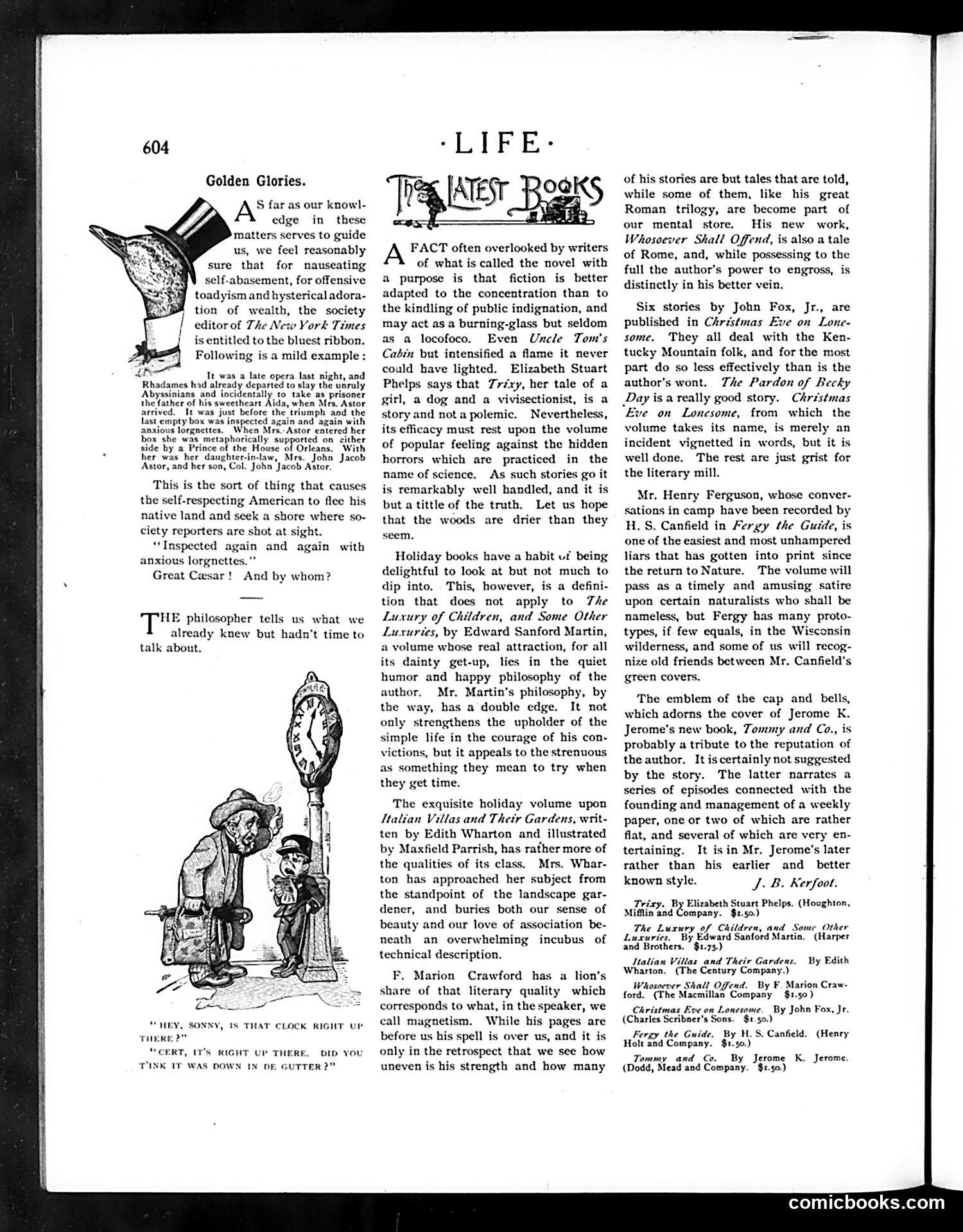
This page contains two distinct satirical pieces: **"Golden Glories" (top):** Life ridicules the *New York Times* society editor for obsequious coverage of wealthy socialites, particularly the Astor family attending the opera. The satire mocks the absurd deference shown to the rich—the editor describes Mrs. Astor as being "metaphorically supported" by French nobility. Life sarcastically suggests that such fawning journalism should make any self-respecting American flee the country. The piece attacks the era's class-conscious society reporting. **"The Latest Books" (right column):** A book review section covering contemporary literature, including works by Edward Sanford Martin and F. Marion Crawford. **The bottom cartoon** appears unrelated—a comic dialogue between two figures about a clock's location, likely a mild joke about class or dialect humor common to the era. The page's core message: Life condemns servile media treatment of the wealthy as contemptible and un-American.
📄 Transcribed text from this page (OCR, searchable)
Machine-transcribed from the original scan — historical spelling and the odd misread are preserved.
Golden Glories. S far as our knowl- edge in these matters serves to guide us, we feel reasonably sure that for nauseating self-abasement, for offensive toadyism and hysterical adora- tion of wealth, the society editor of The New York Times is entitled to the bluest ribbon. Following is a mild example: It was a late opera last night, and Rhadames had already departed to slay the unruly Abyssinians and incidentally to take as prisoner the father of his sweetheart Aida, when Mies. Astor arrived. It was just before the'triumph and the last empty box was inspected again and again with anxious lorgnettes. When Mrs.-Astor entered her box she was metaphorically supported on either side by a Prince of the House of Orleans. With her was her daughter-in-law, Mrs, Joha Jacob Astor, and her son, Col. John Jacob Astor. This is the sort of thing that causes the self-respecting American to flee his native land and seek a shore where so- ciety reporters are shot at sight. “Inspected again and again with anxious lorgnette: Great Casar! And by whom? HE philosopher tells us what we already knew but hadn't time to talk about. “HEY, THERE 2” “CERT, IT'S RIGHT UP THERE. DID you TINK IT WAS DOWN IN DE GUTTER?” SONNY, IS THAT CLOCK RIGHT UP FACT often overlooked by writers of what is called the novel with a purpose is that fiction is better adapted to the concentration than to the kindling of public indignation, and may act as a burning-glass but seldom as a locofoco. Even Uncle Tom's Caéin but intensified a flame it never could have lighted. Elizabeth Stuart Phelps says that 7réxy, her tale of a girl, a dog and a vivisectionist, is a story and nota polemic. Nevertheless, its efficacy must rest upon the volume of popular feeling against the hidden horrors which are practiced in the name of science. As such stories go it is remarkably well handled, and it is but a tittle of the truth. Let us hope that the woods are drier than they seem. Holiday books have a habit uf being delightful to look at but not much to dip into. This, however, is a defini- tion that does not apply to The Luxury of Children, and Some Other Luxuries, by Edward Sanford Martin, a volume whose real attraction, for all its dainty get-up, lies in the quiet humor and happy philosophy of the author, Mr, Martin's philosophy, by the way, has a double edge. It not only strengthens the upholder of the simple life in the courage of his con- victions, but it appeals to the strenuous as something they mean to try when they get time. The exquisite holiday volume upon Italian Villas and Thetr Gardens, writ- ten by Edith Wharton and illustrated by Maxfield Parrish, has rather more of the qualities of its clas Mrs. Whar- ton has approached her subject from the standpoint of the landscape gar- dener, and buries both our sense of beauty and our love of association be- neath an overwhelming incubus of technical description. F, Marion Crawford has a lion's share of that literary quality which corresponds to what, in the speaker, we call magnetism. While his pages are before us his spell is over us, and it is only in the retrospect that we see how uneven is his strength and how many of his stories are but tales that are told, while some of them, like his great Roman trilogy, are become part of our mental store. His new work, Whosoever Shall Offend, is also a tale of Rome, and, while possessing to the full the author’s power to engross, is distinctly in his better vein. Six stories by John Fox, Jr., are published in Christmas Eve on Lone- some, They all deal with the Ken- tucky Mountain folk, and for the most part do so less effectively than is the author's wont. The Pardon of Becky Day is a really good story. Christmas Eve on Lonesome, from which the volume takes its name, is merely an incident vignetted in words, but it is well done. The rest are just grist for the literary mill. Mr. Henry Ferguson, whose conver- sations in camp have been recorded by H. S. Canfield in Fergy the Guide, is one of the easiest and most unhampered liars that has gotten into print since the return to Nature. The volume will pass as a timely and amusing satire upon certain naturalists who shall be nameless, but Fergy has many proto- types, if few equals, in the Wisconsin wilderness, and some of us will recog- nize old friends between Mr. Canfield’s green covers. The emblem of the cap and _ bells, which adorns the cover of Jerome K. Jerome's new book, Tommy and Co., is probably a tribute to the reputation of the author. It is certainly not suggested by the story. The latter narrates a series of episodes connected with the founding and management of a weekly paper, one or two of which are rather flat, and several of which are very en- tertaining. It isin Mr. Jerome's later rather than his earlier and better known style. J. B. Kerfoot. Trizy. By Elizabeth Stuart Phelps. (Houghton, Mifflin and Company. $1.50) The Luxury of Children, and Some Other Luxuries, By Edward Sanford Martin. (Harper and Brothers. $1.75.) Malian Villas and Their Gardens. Wharton, (The Century Company.) Whosoever Shall Offend. By F Marion Craw. ford. (The Macmillan Company $1.50) Christmas Eve on Lonesome. By John Fox, Jr (Charles Scribner's Sons. $1.50.) By u S. Canfield. $1.50.) Tommy and Co. By Jerome K. Jerome. (Dodd, Mead and Company. - $1.50.) By Edith Fergy the Guide. (Henry Holt and Company. comicbooks.com