
A complete issue · 20 pages · 1904
Life — June 23, 1904
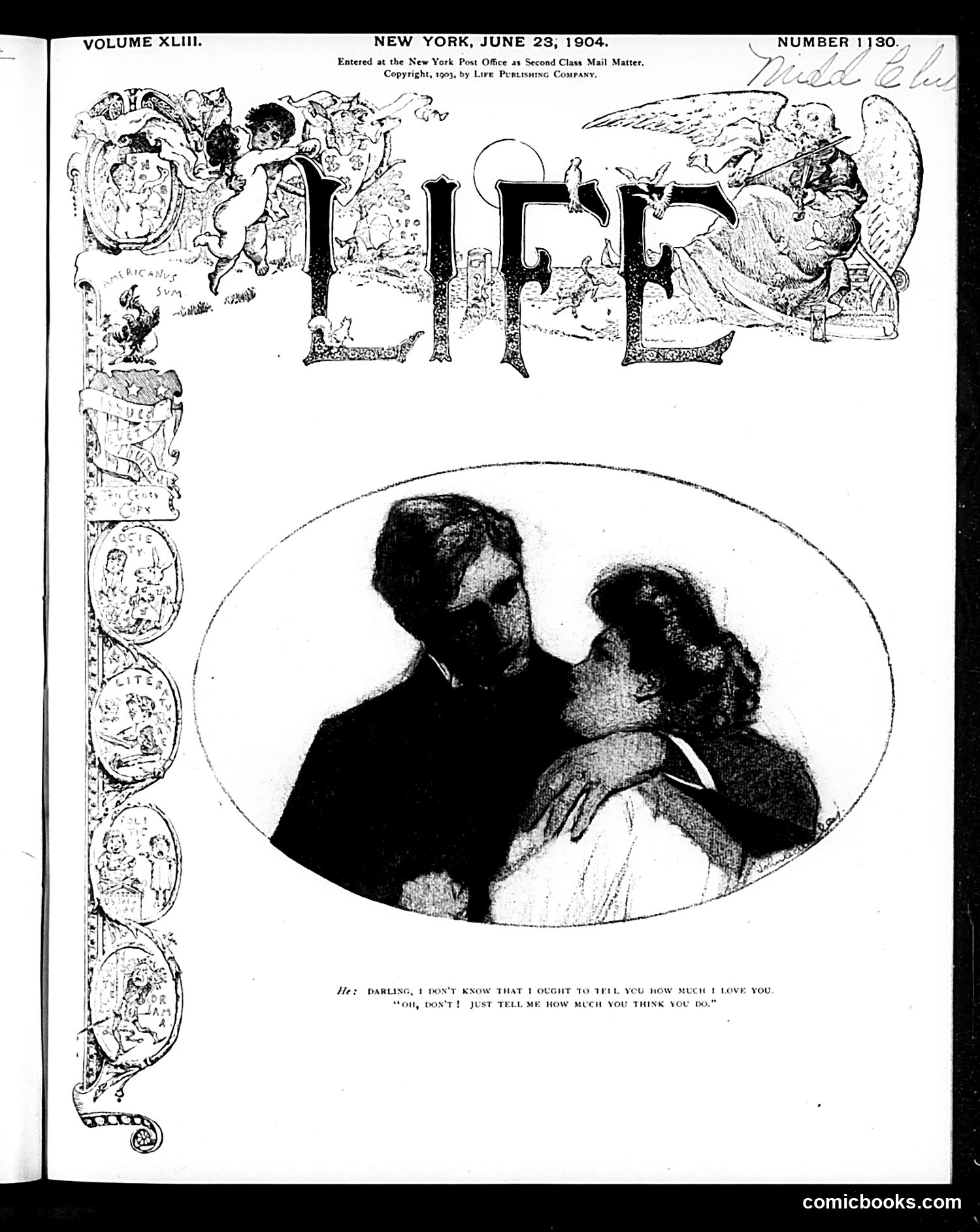
This page features a romantic illustration with accompanying dialogue. A man and woman are depicted in an intimate moment, with the man saying: "Darling, I don't know that I ought to tell you how much I love you. 'Oh, don't I just tell me how much you think you do.'" The ornate left border contains classical zodiac or constellation medallions, typical of Life's decorative design style from this era. The elaborate title treatment reading "LIFE" dominates the upper portion, surrounded by whimsical illustrative vignettes featuring cherubs and pastoral scenes. This appears to be a sentimental romantic feature rather than political satire—representative of Life's mix of humor, romance, and social commentary that appealed to early 20th-century American readers.
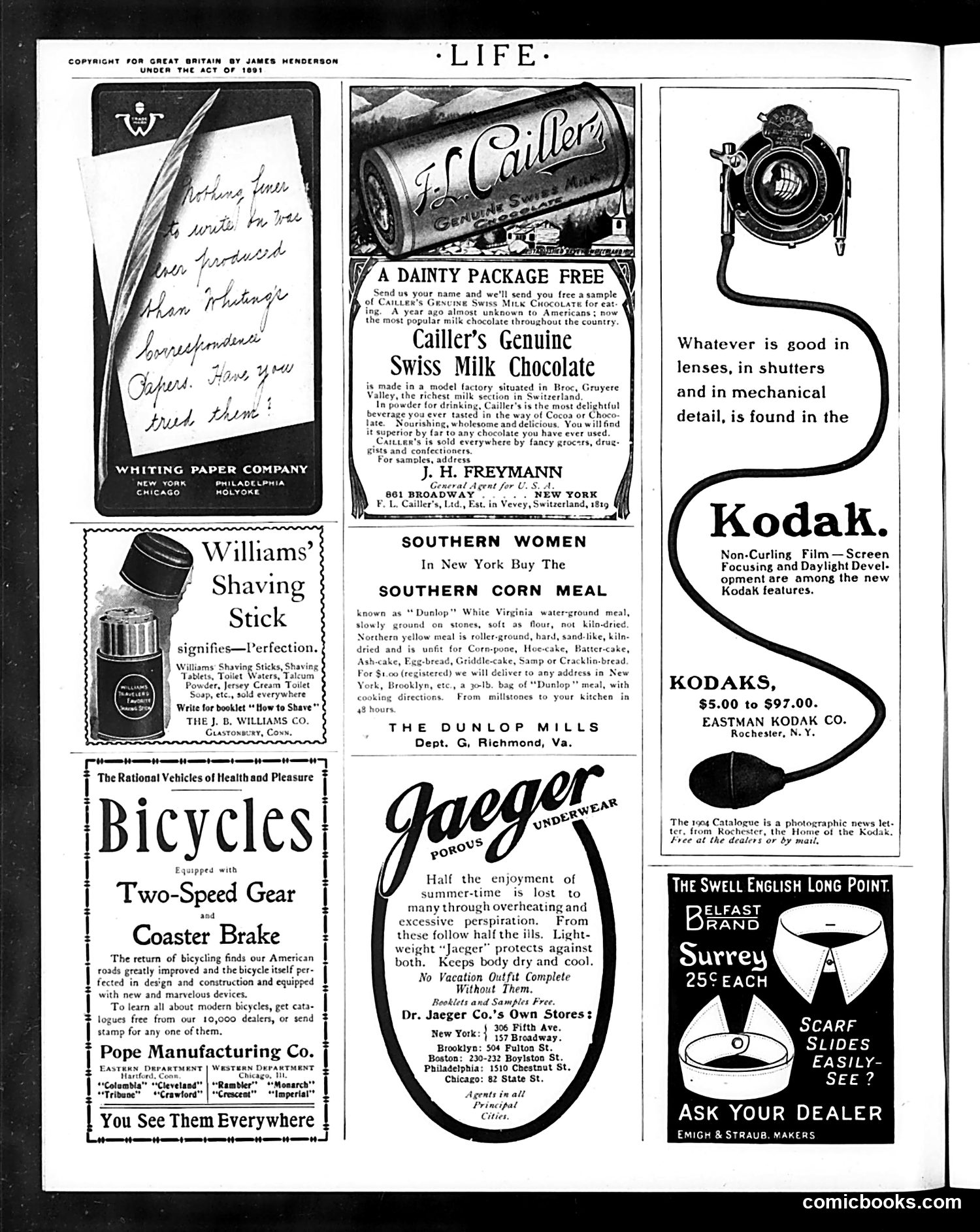
This page is **primarily advertisements**, not satirical content. It contains product ads for: - **Whiting Paper Company** (stationery) - **Williams' Shaving Stick** - **Cailler's Swiss Milk Chocolate** - **Kodak cameras** ($5–$97) - **Pope Manufacturing bicycles** with two-speed gear - **Jaeger porous underwear** - **Belfast Brand scarf slides** - **Southern Corn Meal** (regional product) The only text-based humor appears in the **Jaeger underwear ad**, which jokes about staying cool in summer heat—typical light advertising humor of the era. There are **no political cartoons or caricatures** on this page. It represents typical early-1900s Life magazine advertising, reflecting consumer products and marketing approaches of that period.
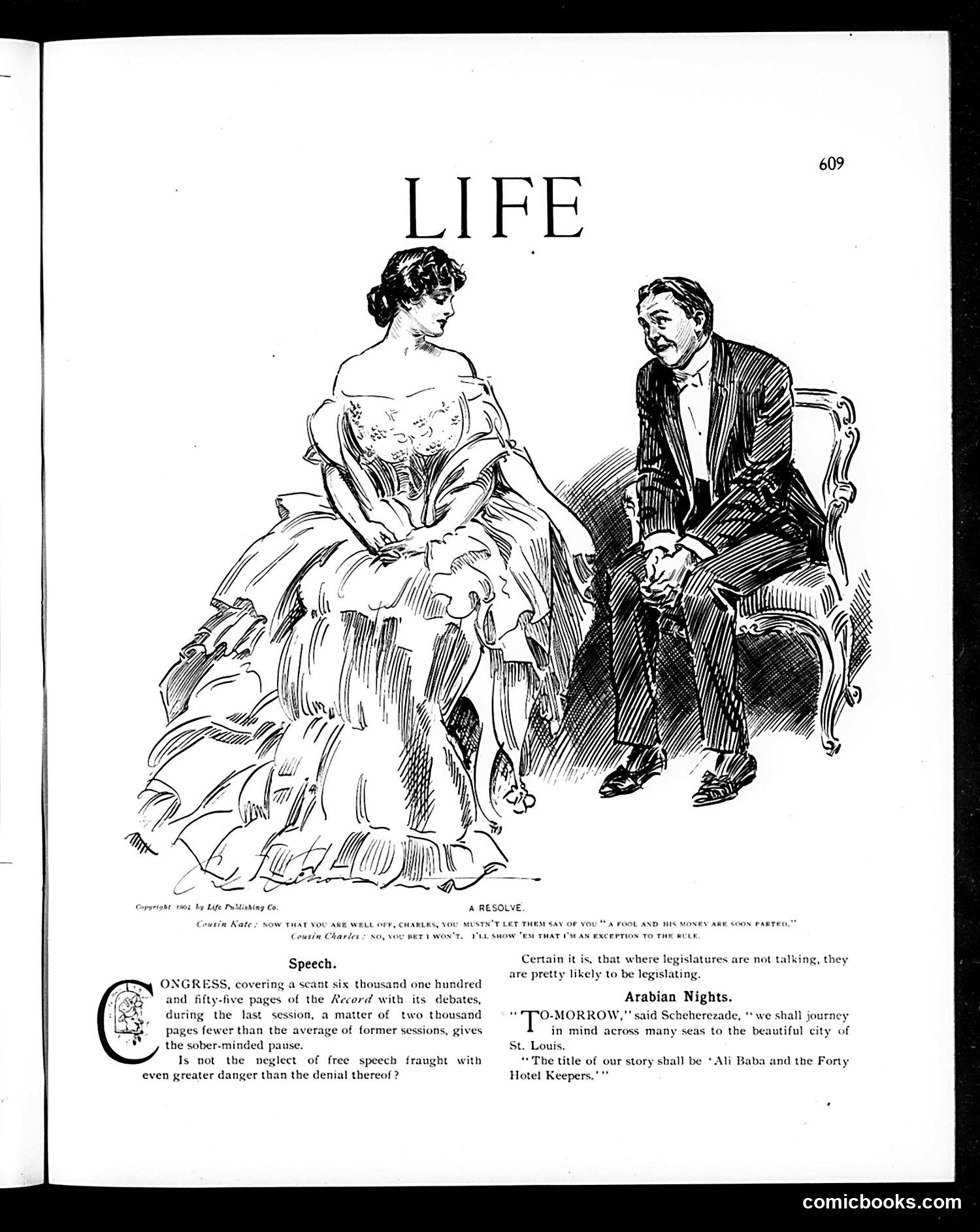
The main illustration titled "A Resolve" depicts a couple in conversation. The caption quotes a woman saying she won't let a man call her "a fool and his money are soon parted," suggesting she'll prove an exception to this rule. Below, the "Speech" section comments on Congressional debates, noting that legislatures covering "scant six thousand one hundred and fifty-five pages of the Record" generate lengthy discussions—implying Congress produces verbose oratory with minimal legislative substance. The "Arabian Nights" section begins a serialized story titled "Ali Baba and the Forty Hotel Keepers," apparently a satirical take on the classic tale, likely referencing contemporary hotel industry practices or scandals, though the specific context remains unclear from this excerpt alone.
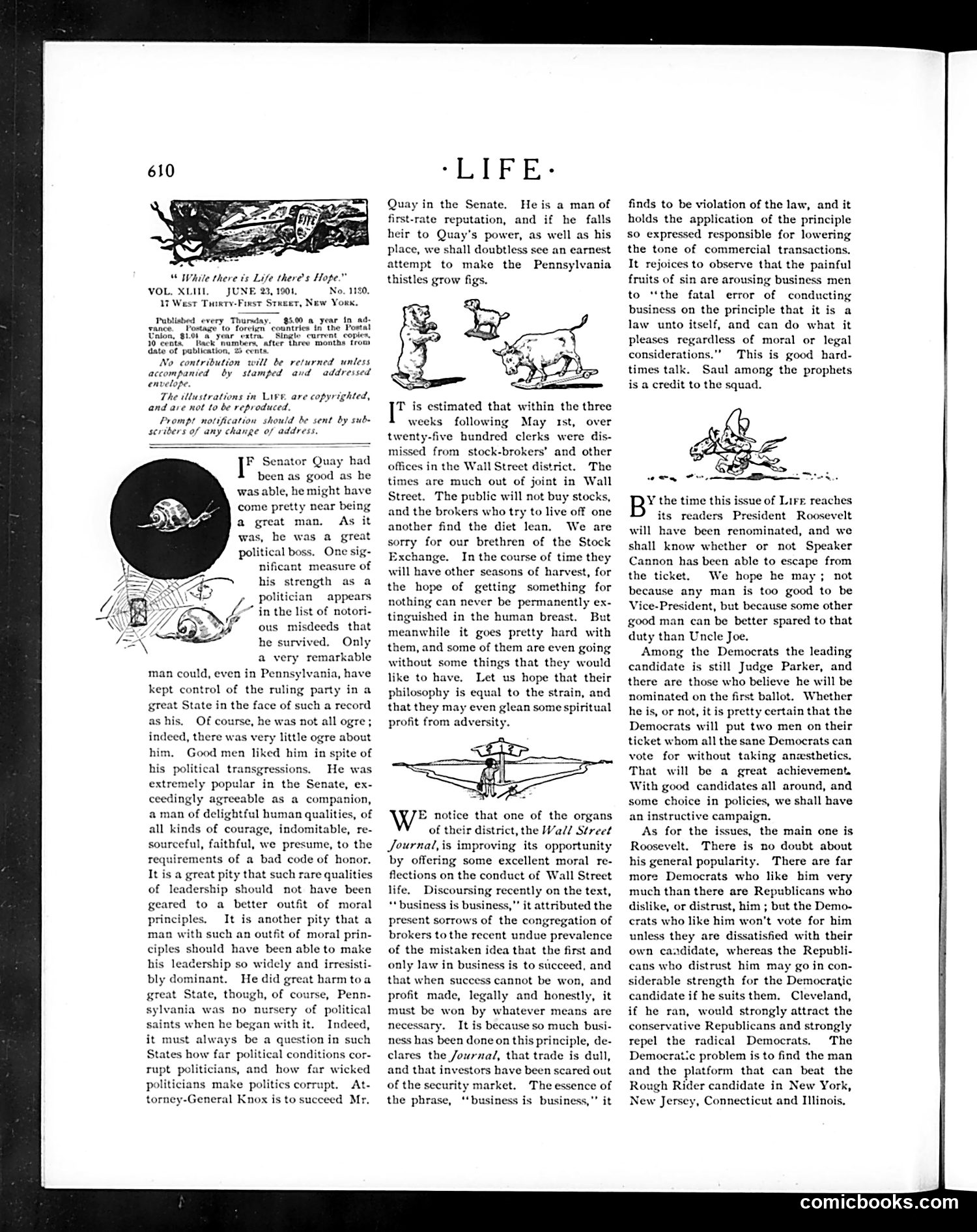
This page satirizes Senator **Quay** (likely Matthew Quay of Pennsylvania, a prominent Republican politician of the era). The text praises Quay as a political survivor despite various scandals, noting he was "a great political loss" to Pennsylvania but acknowledging his political skill and resilience. The accompanying illustrations appear to be generic decorative cartoons (cherubs, animals) rather than direct caricatures of Quay himself. The page also discusses the **1904 Democratic presidential nomination**, mentioning potential candidates and strategic positioning. It references **President Roosevelt** and notes debates over candidate selection, suggesting internal Democratic Party division during this transitional political period. The satire seems directed at political opportunism and moral flexibility in business and politics.
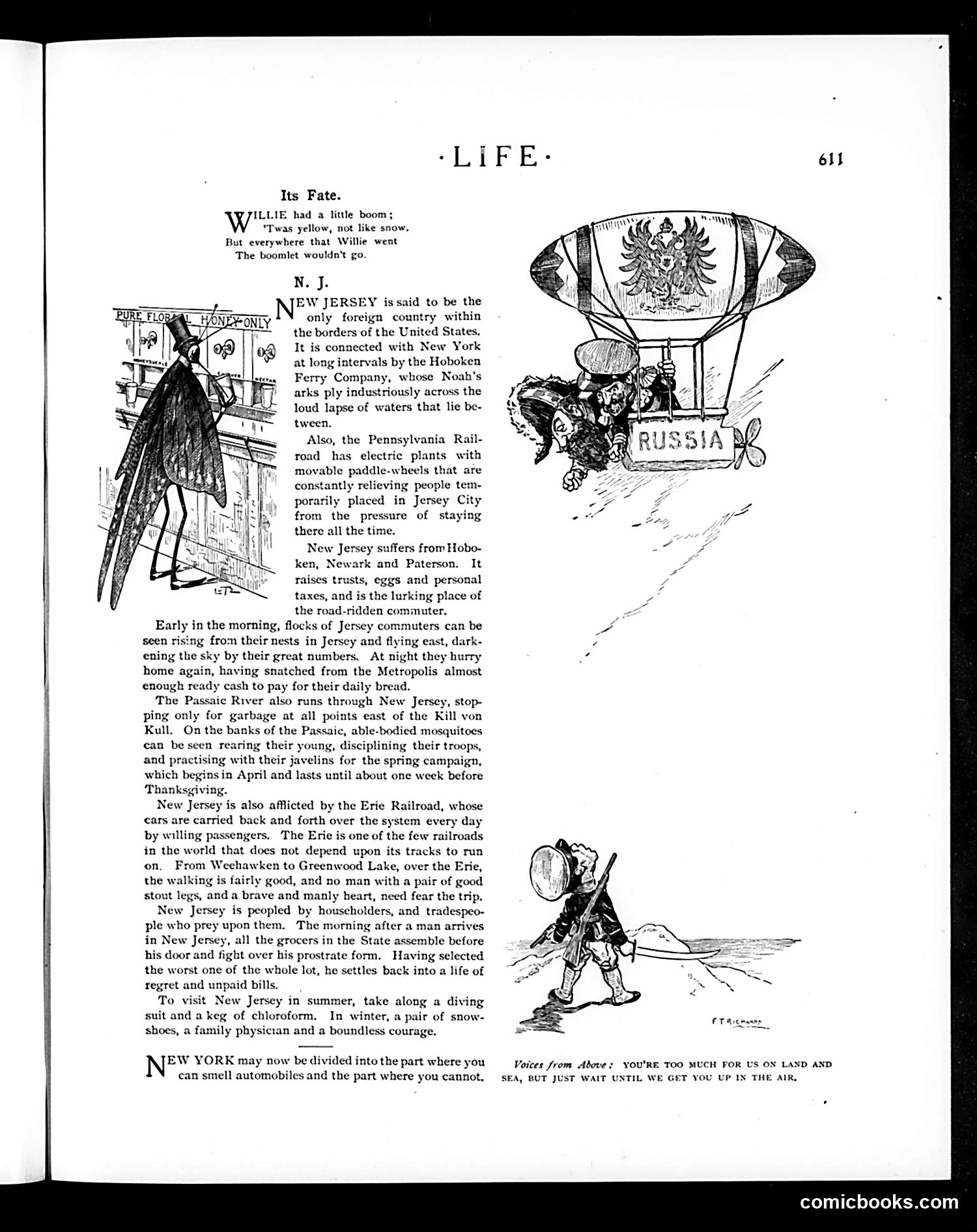
This page satirizes New Jersey's reputation and geography circa early 1900s. The left cartoon shows a mosquito—referencing the Passaic River's swampy banks, which the text describes as breeding grounds for "able-bodied mosquitoes" that train "young" for campaigns lasting until near Thanksgiving. The right cartoon depicts a hot-air balloon labeled "RUSSIA" carrying figures away from New Jersey, with the caption "YOU'RE TOO MUCH FOR US ON LAND AND SEA, BUT JUST WAIT UNTIL WE GET YOU UP IN THE AIR." This mocks New Jersey's industrial chaos and poor conditions—suggesting even Russia finds New Jersey too difficult to handle, though humorously implying aerial dominance might help. The text criticizes New Jersey as a transit zone plagued by commuters, trusts, taxes, and environmental problems (mosquitoes, the polluted Passaic River). The satire positions New Jersey as uniquely miserable and chaotic.
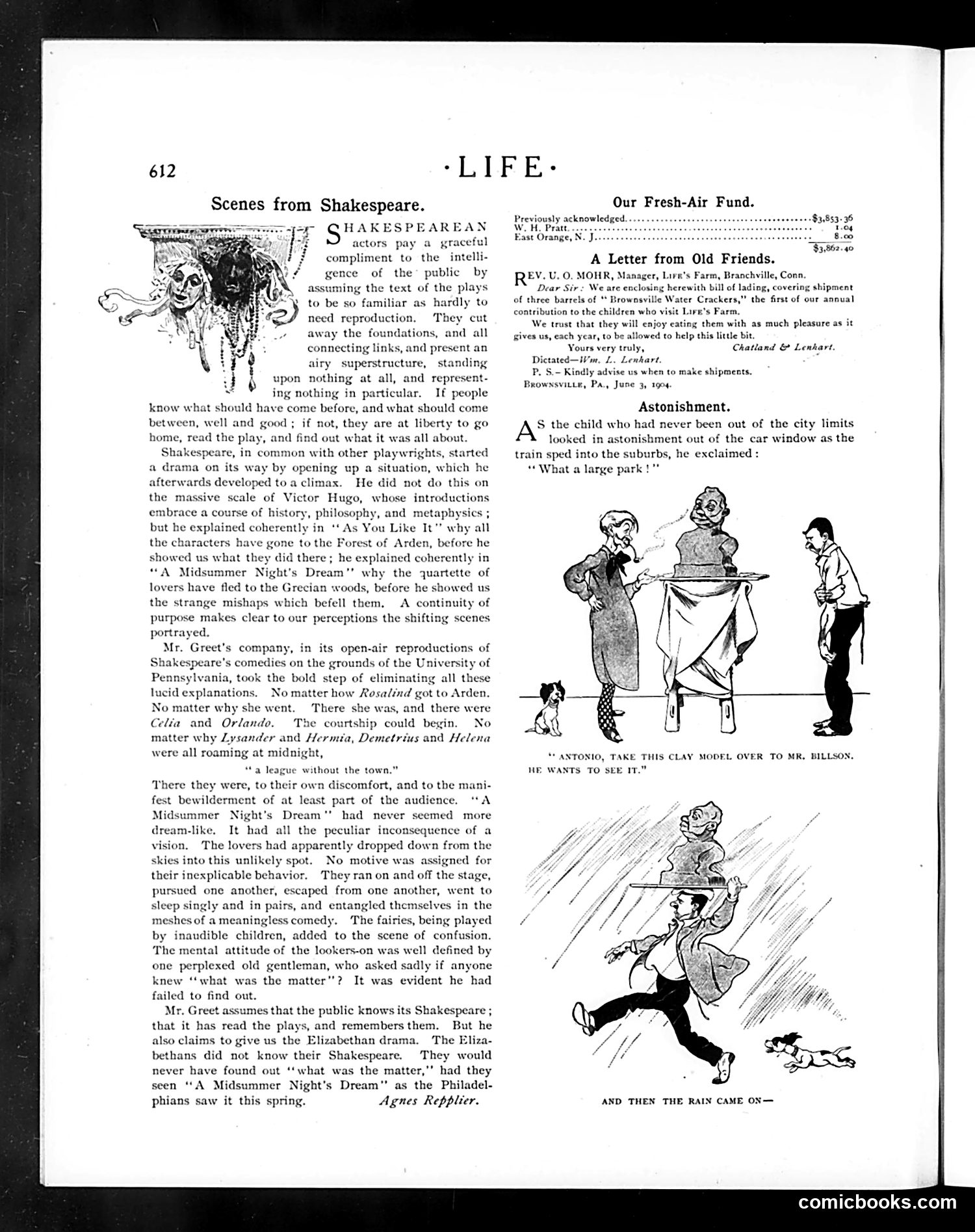
This page contains two distinct sections: a critical essay on Shakespeare productions and an unrelated cartoon about a child's first encounter with nature. The main text, "Scenes from Shakespeare," critiques theatrical adaptations of Shakespeare's plays, particularly Mr. Greet's open-air productions at the University of Pennsylvania. The author argues that modern directors strip away Shakespeare's careful structure, eliminate essential exposition, and create confusion—exemplified by their staging of "A Midsummer Night's Dream" where characters roam inexplicably without motivation. The essay suggests audiences left bewildered, with one elderly gentleman asking what "was the matter?" The cartoon "Astonishment" is separate humor: a city child's first park visit, exclaiming "What a large park!" The second panel shows rain, with the caption "and then the rain came on—" a gentle joke about weather interrupting the outing.
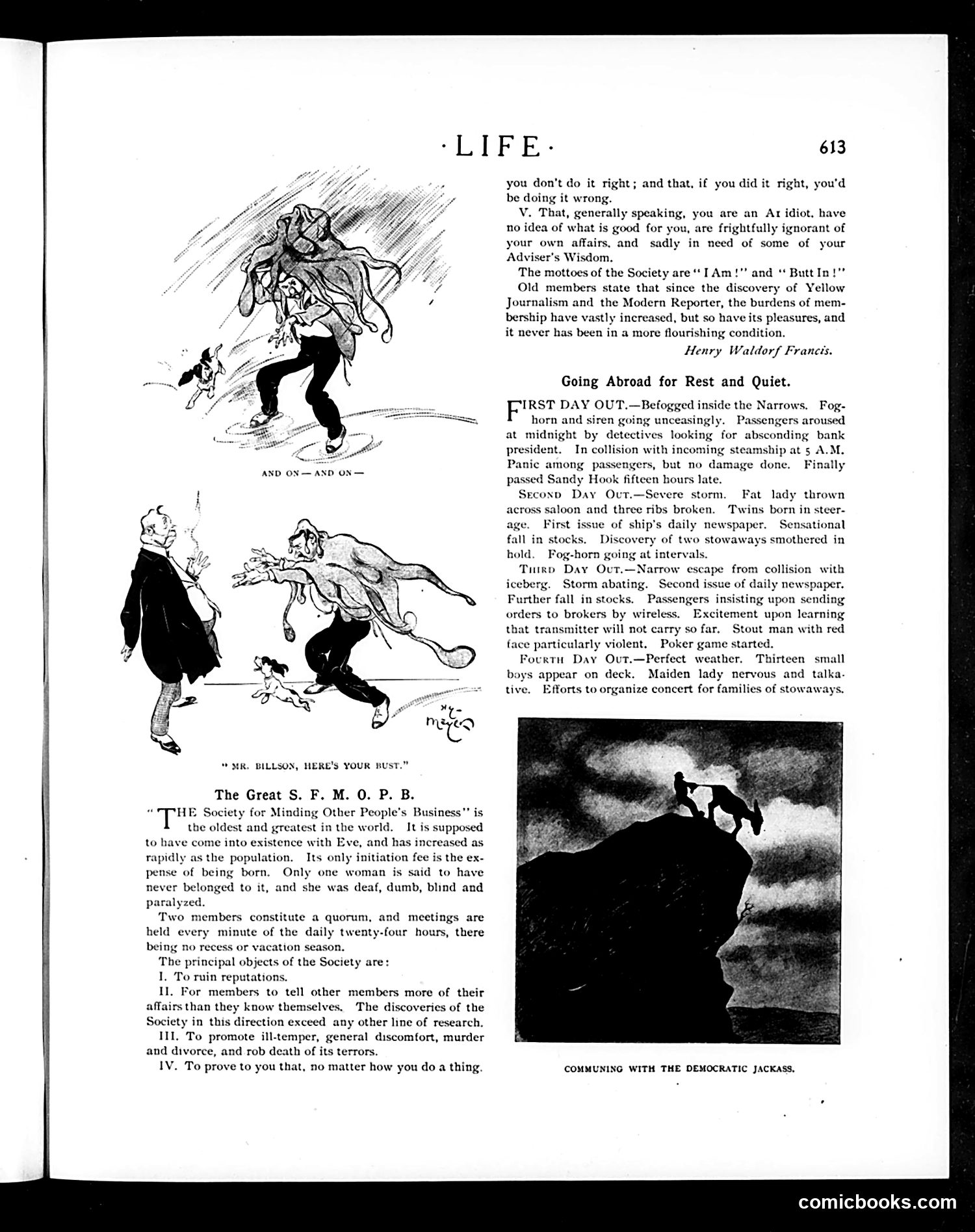
This page contains satirical commentary on two topics: 1. **"Going Abroad for Rest and Quiet"** - A humorous account of a ship voyage where chaos reigns instead of peace. The text catalogs disasters: collisions, births, broken ribs, stowaway discoveries, and general mayhem across four days at sea. 2. **"The Great S.F.M.O.P.B."** - A satirical "Society for Minding Other People's Business," described as the world's oldest organization (existing since Eve). The text mock-seriously lists the society's objectives: ruining reputations, spreading gossip, promoting discord and murder, and proving "no matter how you do a thing, you don't do it right." The cartoons (drawn in early 20th-century style) illustrate people in chaotic situations, reinforcing the satirical message about human interference and bustling incompetence.
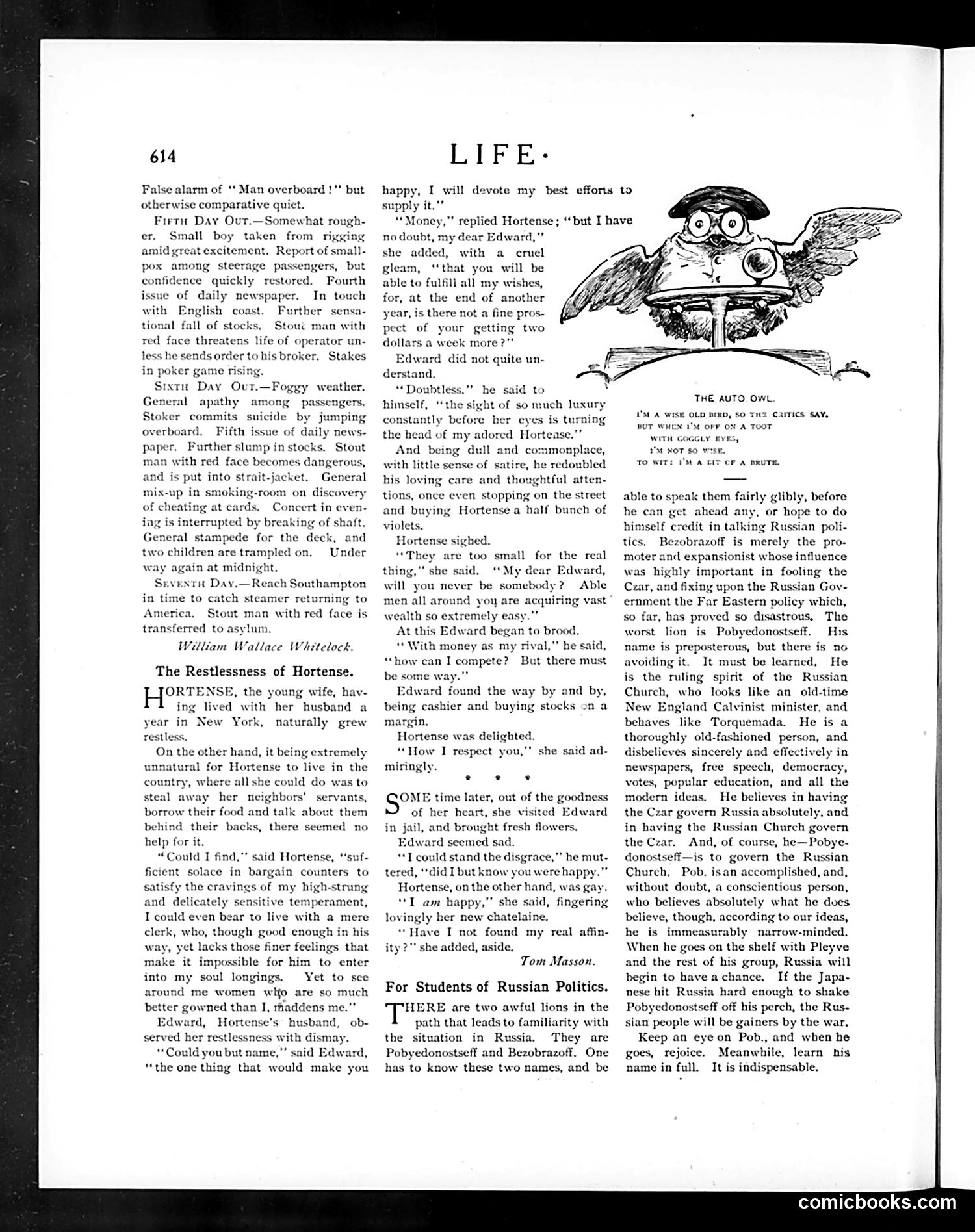
This small cartoon depicts an owl perched on a book, wearing spectacles. The owl's caption reads: "I'm a wise bird, say its critics say, / But when I'm off on a foot / with crooked eyes, / I'm not so wise. / To wit: I'm a bit of a brute." The cartoon satirizes intellectual pretension—specifically, someone (likely a public figure or type of person) who presents themselves as wise and learned but behaves foolishly or brutally in practice. The owl, traditionally a symbol of wisdom, undercuts this by admitting hypocrisy: appearing scholarly while acting poorly. This appears to mock a contemporary public figure or the gap between intellectual reputation and actual behavior, though the specific target isn't identified in the visible text.
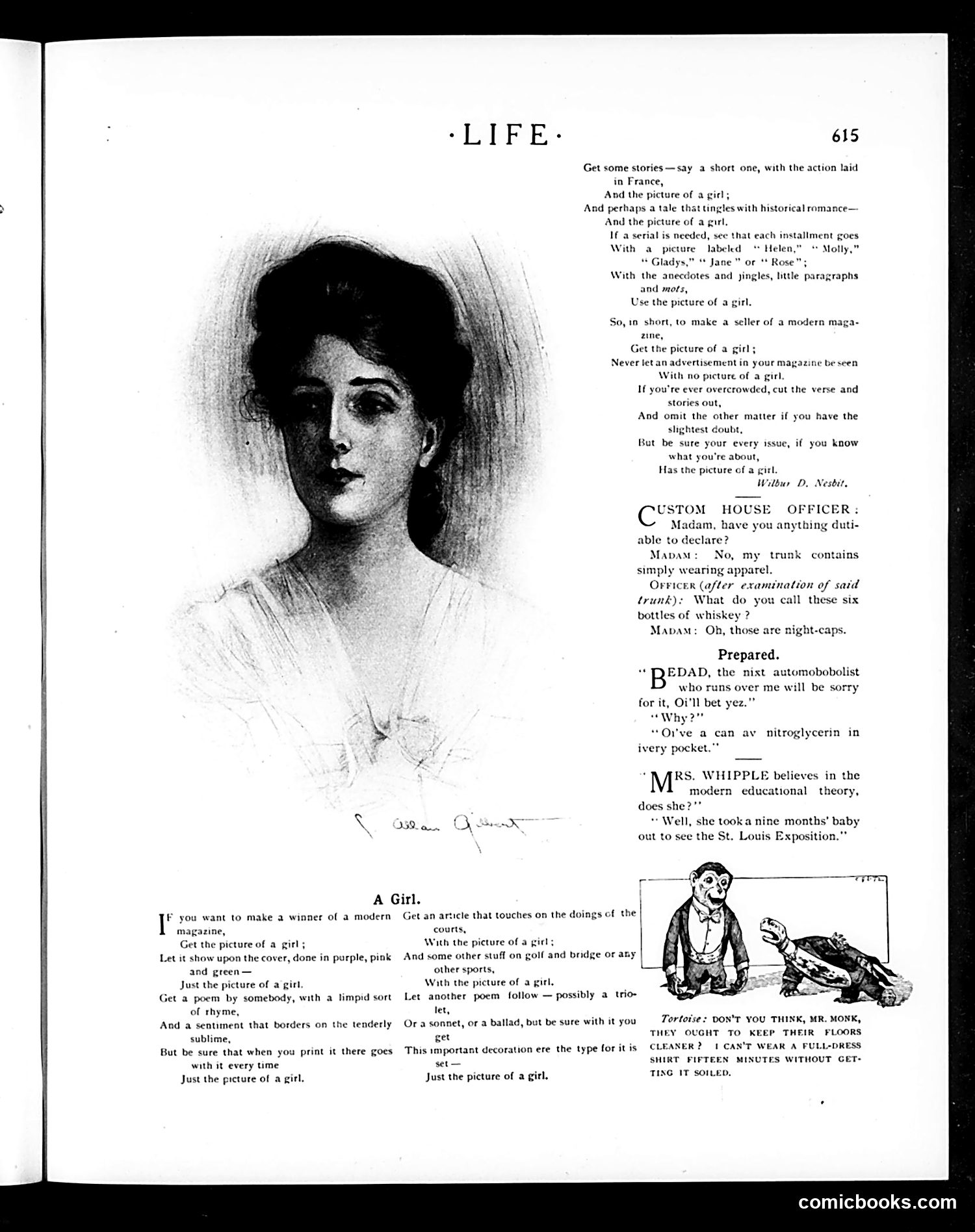
This page satirizes **magazine editorial advice** to contributors. The left side features a sketch of an attractive young woman, illustrating the essay's central point: to succeed in modern magazines, always include "the picture of a girl." The text mockingly prescribes a formula for magazine success: stories set in France, poems with "historical romance," articles on sports—but crucially, **every piece must feature an attractive woman's portrait**. This is satirizing the visual culture of early 20th-century American magazines, which relied heavily on female imagery to sell copies. The accompanying anecdotes (about custom house officers and Mrs. Whipple) are humorous examples showing how absurdly this rule applies even when irrelevant. The satire targets both magazine publishers' cynical commercial practices and readers' predictable preferences.
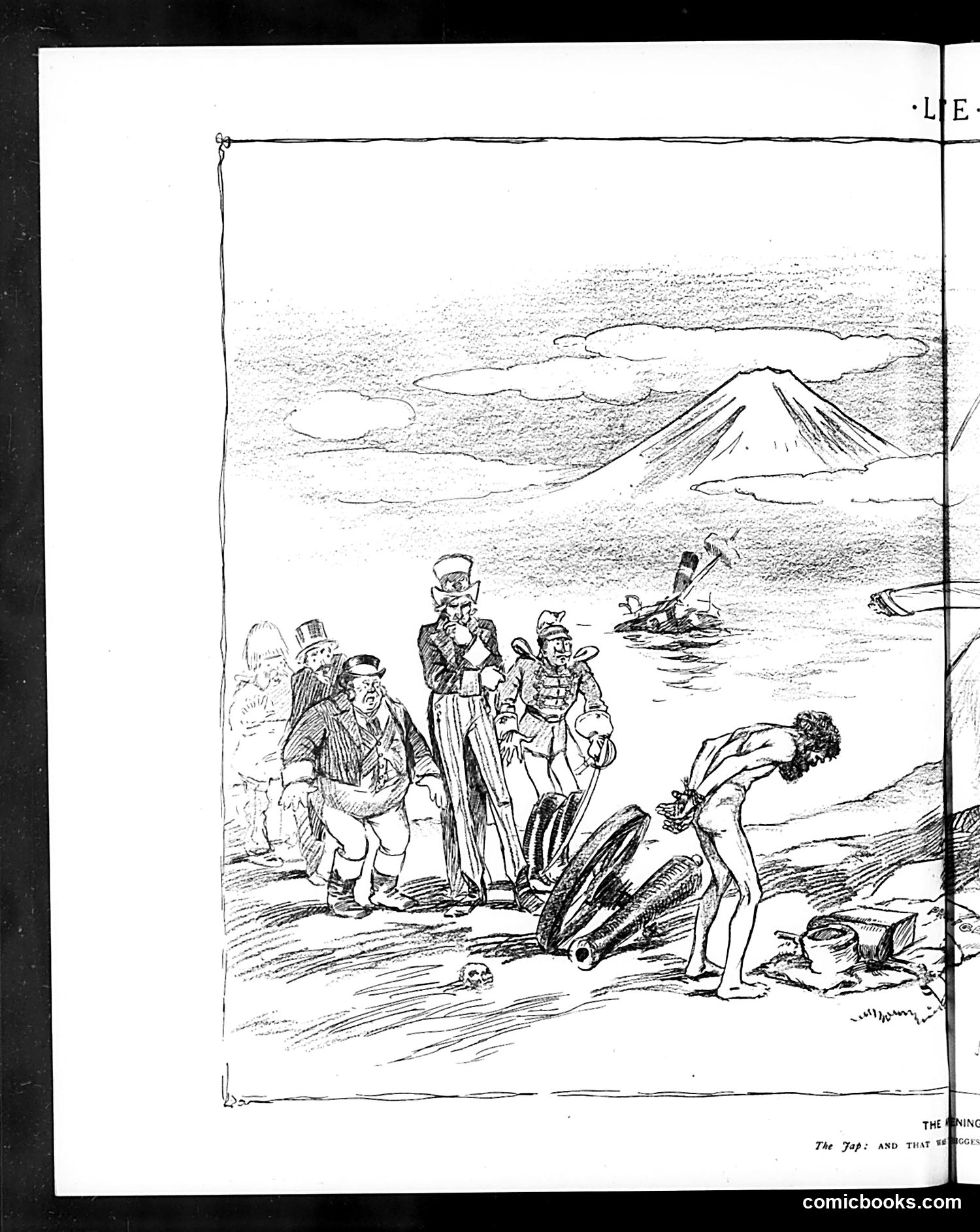
This is a satirical cartoon from Life magazine depicting what appears to be European dignitaries or military officials (identifiable by their formal dress, top hats, and military uniforms) encountering a nearly-naked indigenous person on a tropical beach. A volcano is visible in the background. The satire critiques European imperialism and colonialism: the formally-dressed officials represent the "civilized" Western powers, while the contrast with the indigenous person suggests Life's ironic commentary on European superiority claims. The cartoon likely mocks the pretensions of colonial expansion—the notion that European nations were "civilizing" distant lands when their actual behavior was exploitative. The caption fragment ("The Top: AND THAT WI...") is incomplete, preventing full interpretation of the specific historical reference or joke's intended target.
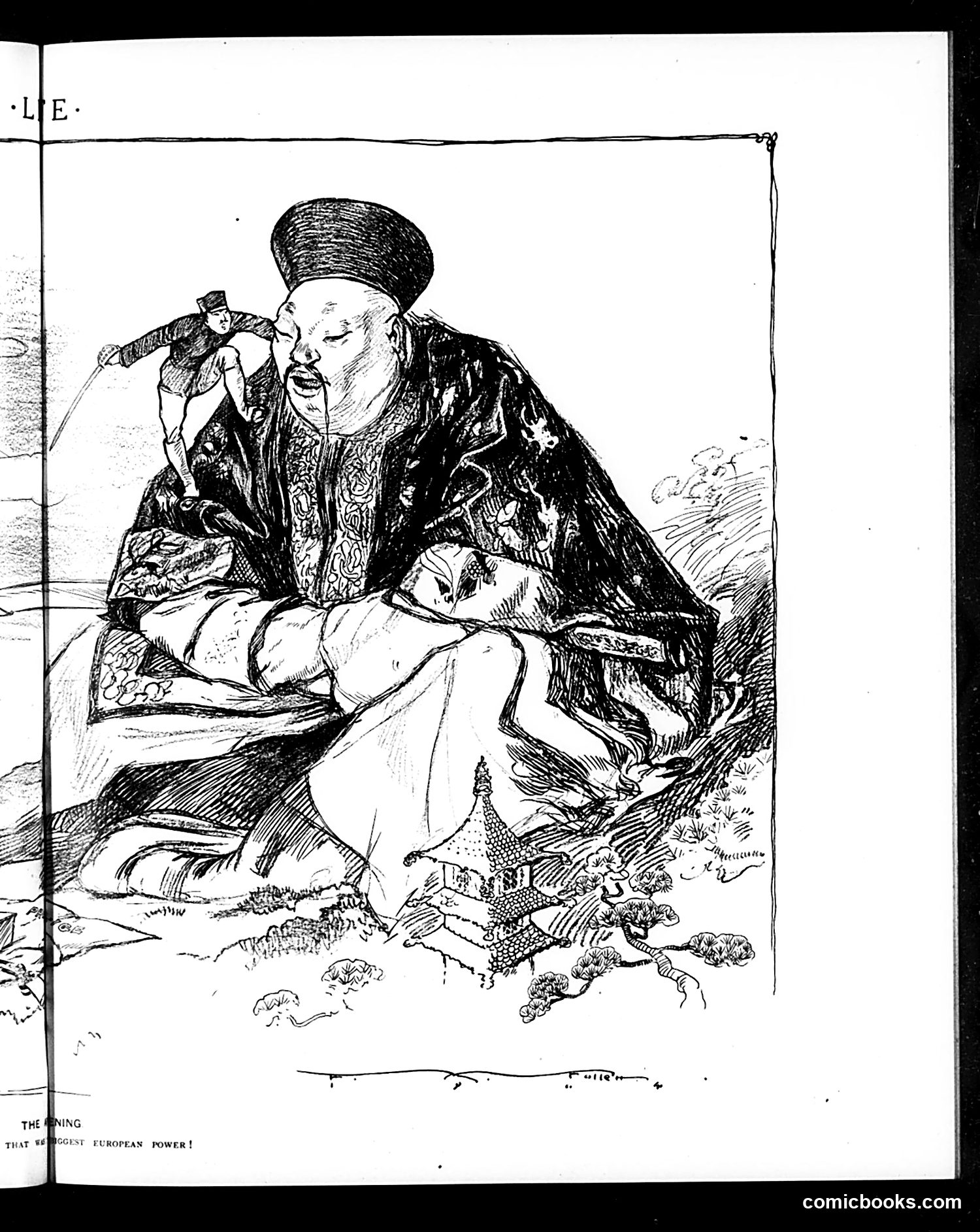
This appears to be a satirical cartoon from *Life* magazine depicting a caricatured Asian figure (likely representing China or an Asian power) sitting cross-legged, wearing traditional robes and a tall hat. A small Western figure stands on the character's shoulder, appearing to whisper or counsel. The caption fragment reads "THE RISING...THAT BIGGEST EUROPEAN POWER!" which is partially cut off. The satire likely comments on Western imperial influence over Asian nations during the colonial era—specifically how European powers wielded control over nominally independent Asian states through manipulation and domination, despite public pretenses of the "rising" power's autonomy. The exaggerated facial features reflect the racist caricature conventions typical of early 20th-century American editorial cartooning.
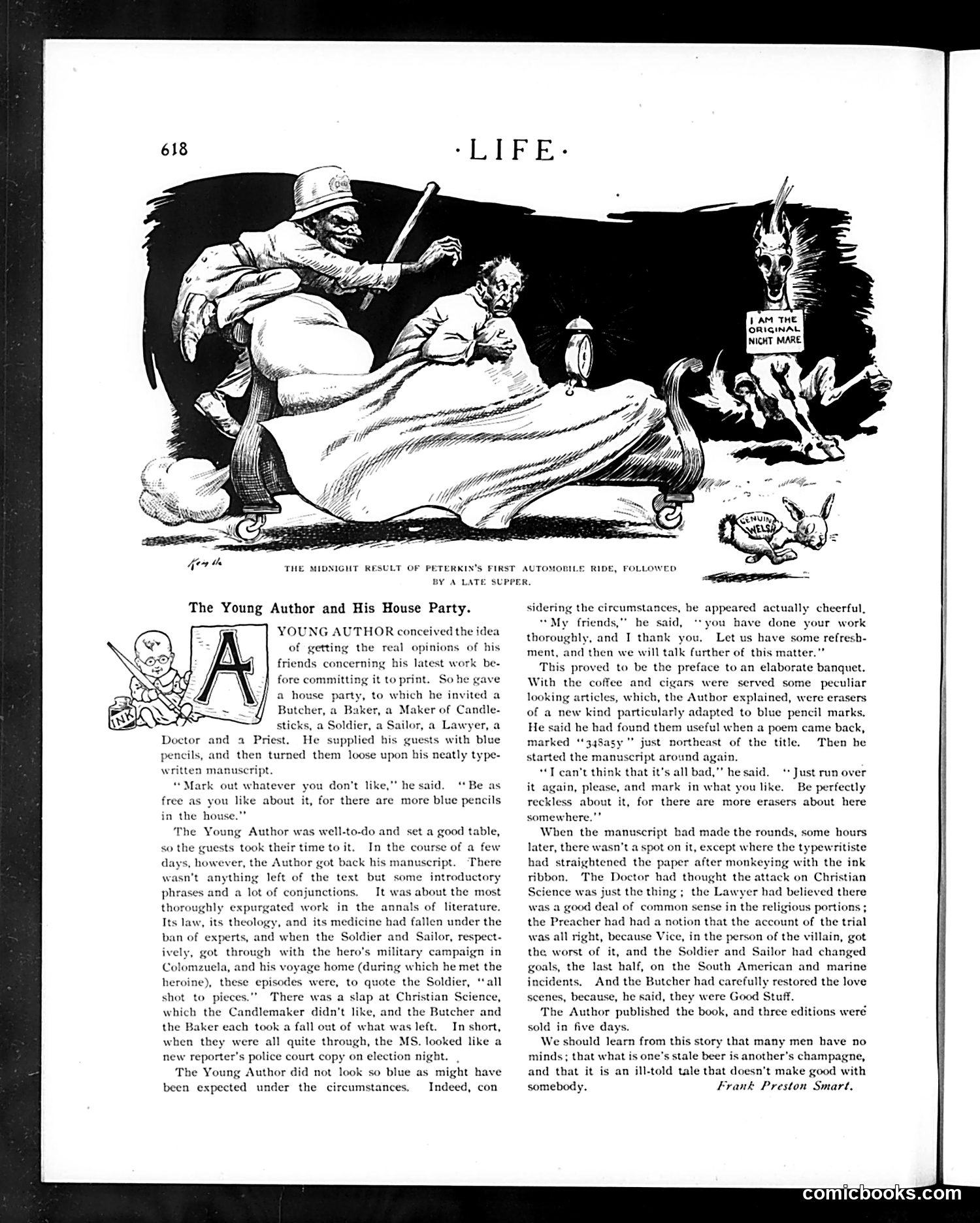
The top cartoon depicts a nightmare scene following an automobile accident. A grotesque demon-like figure declares "I AM THE ORIGINAL NIGHTMARE," suggesting early anxieties about automobiles as dangerous, nightmarish technology. The accident victim appears injured in bed while demons surround him—reflecting turn-of-the-century fears that cars were inherently perilous. The main article, "The Young Author and His House Party," satirizes literary criticism. A young writer invites various professionals (a doctor, lawyer, soldier, baker, etc.) to critique his manuscript, armed with blue pencils for editing. The satire mocks how amateur critics from unrelated fields presume to judge literature, resulting in a manuscript so heavily revised it becomes unrecognizable. The author publishes it anyway and finds unexpected success—poking fun at both pretentious criticism and literary merit's unpredictability.
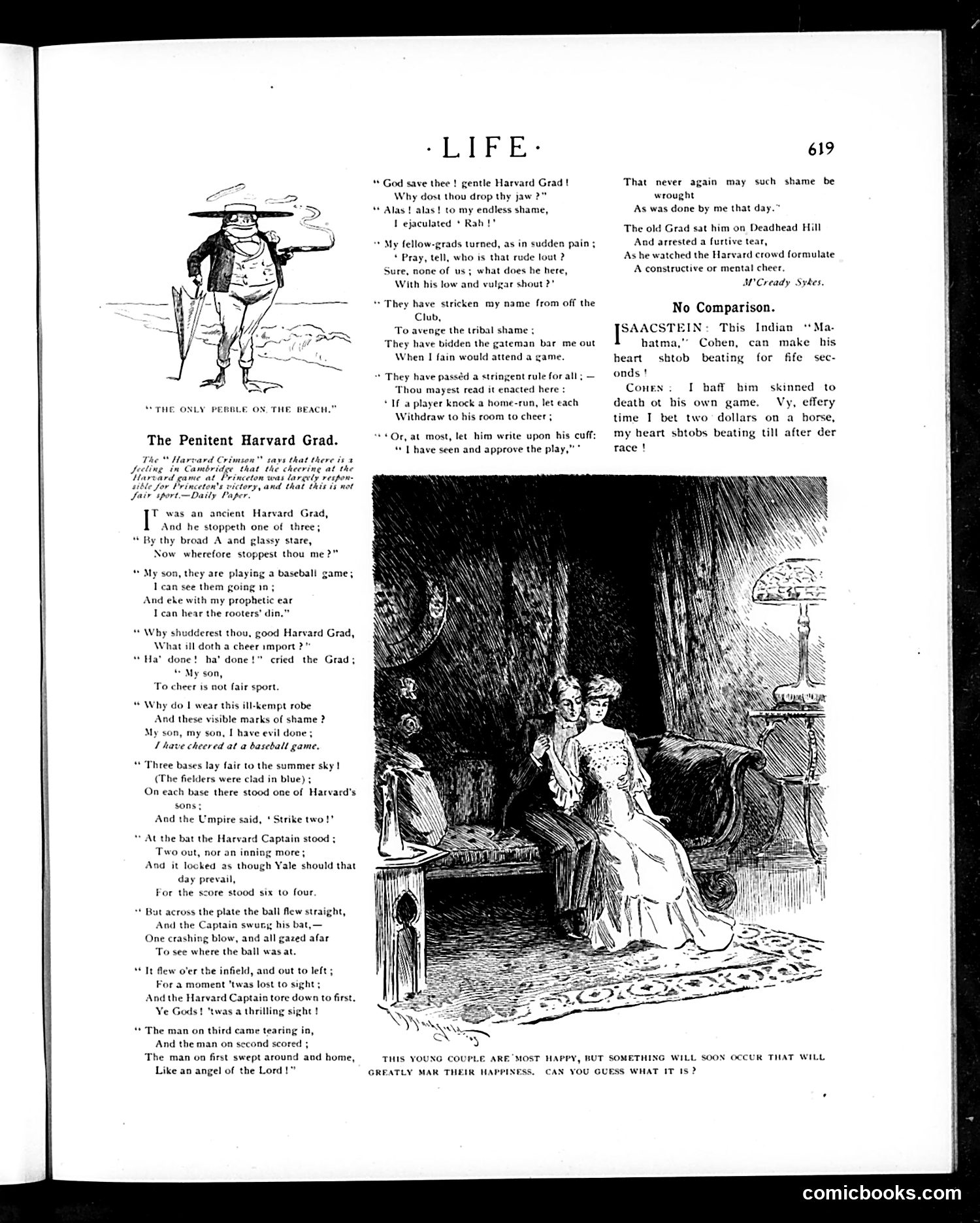
This satirical poem mocks Harvard's excessive propriety around school spirit. The setup references a real controversy: Harvard claimed Princeton's enthusiastic cheering at a baseball game was "unfair sport," suggesting emotional support was somehow dishonorable. The poem narrates a Harvard graduate's shame: he spontaneously cheered ("Rab!") during an exciting baseball moment when Harvard scored. For this outburst of genuine enthusiasm, he was expelled from his club, barred from games, and shamed by classmates. Harvard's response was to institute a rule requiring students to suppress cheers—they could only *write* approval on their cuffs, never shout it. The satire's point: Harvard's concern with "fair sport" and decorum has become absurdly repressive, punishing natural human emotion and school loyalty. The magazine ridicules the university's stuffiness and the grad's pathetic acceptance of such ridiculous rules. The bottom section, "No Comparison," is an unrelated joke about nervous betting habits.
This is a book review section titled "The Latest Looks," containing no political cartoons—just literary criticism. The page reviews contemporary novels (early 1900s), praising works that blend romance with realism and authentic regional observation. Key reviews include: - **Mary Austin's *The Land of Little Rain***: Praised for capturing the American Southwest's spirit through poetic observation rather than mere description - **Gertrude Atherton's *Rulers of Kings***: A romance featuring an American billionaire competing with German royalty for dominance—reflecting contemporary anxieties about American industrial power and European geopolitical rivalry - **David Graham Phillips's *The Cost***: Commended for honest realism over sensationalism, addressing industrial-era money worship The critic notes a literary trend: the popular "return to nature" ideal is being tempered by "workaday reality." This reflects Progressive Era concerns about industrialization, authenticity, and American identity. The emphasis on regional particularity and honest social observation reflects early 20th-century literary modernism's rejection of Victorian sentimentality.
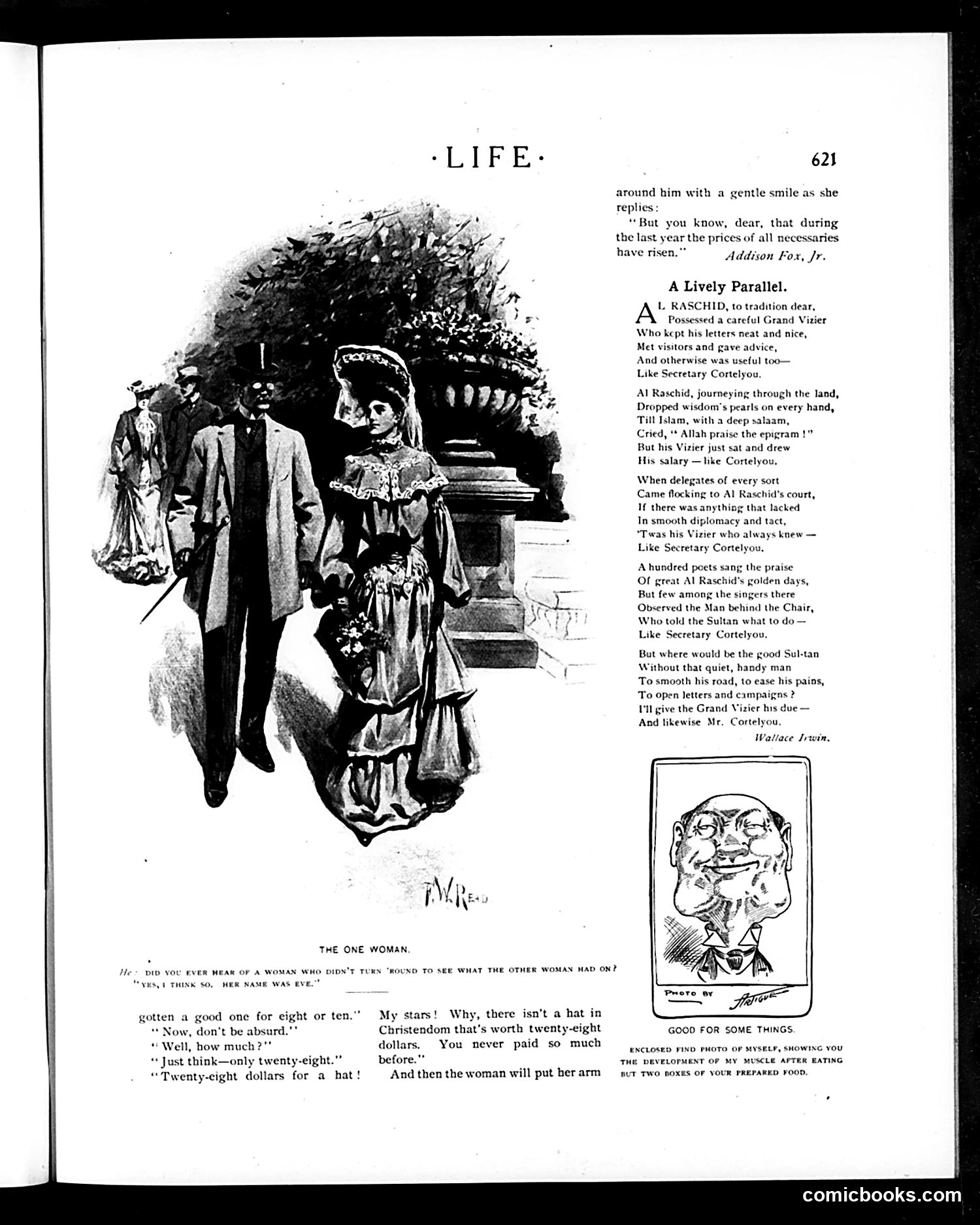
**Main Cartoon (left):** A husband and wife discuss a woman's hat costing twenty-eight dollars. She justifies the expense by citing inflation—prices of necessities have risen. The satire targets both marital dynamics (wives' spending habits) and economic anxiety about rising costs, likely from the early 1900s when this inflation was a genuine concern. **"A Lively Parallel" (right):** This poem compares the historical Caliph Al Raschid's Grand Vizier to contemporary U.S. Secretary of State **George B. Cortelyou** (serving under Theodore Roosevelt). The satire suggests Cortelyou—like the vizier—deserves credit as the quiet, competent administrator behind the famous leader, handling the unglamorous diplomatic work while the Sultan/President receives public praise. The small cartoon at bottom right ("Good for Some Things") is a humorous food advertisement claiming muscle development results.
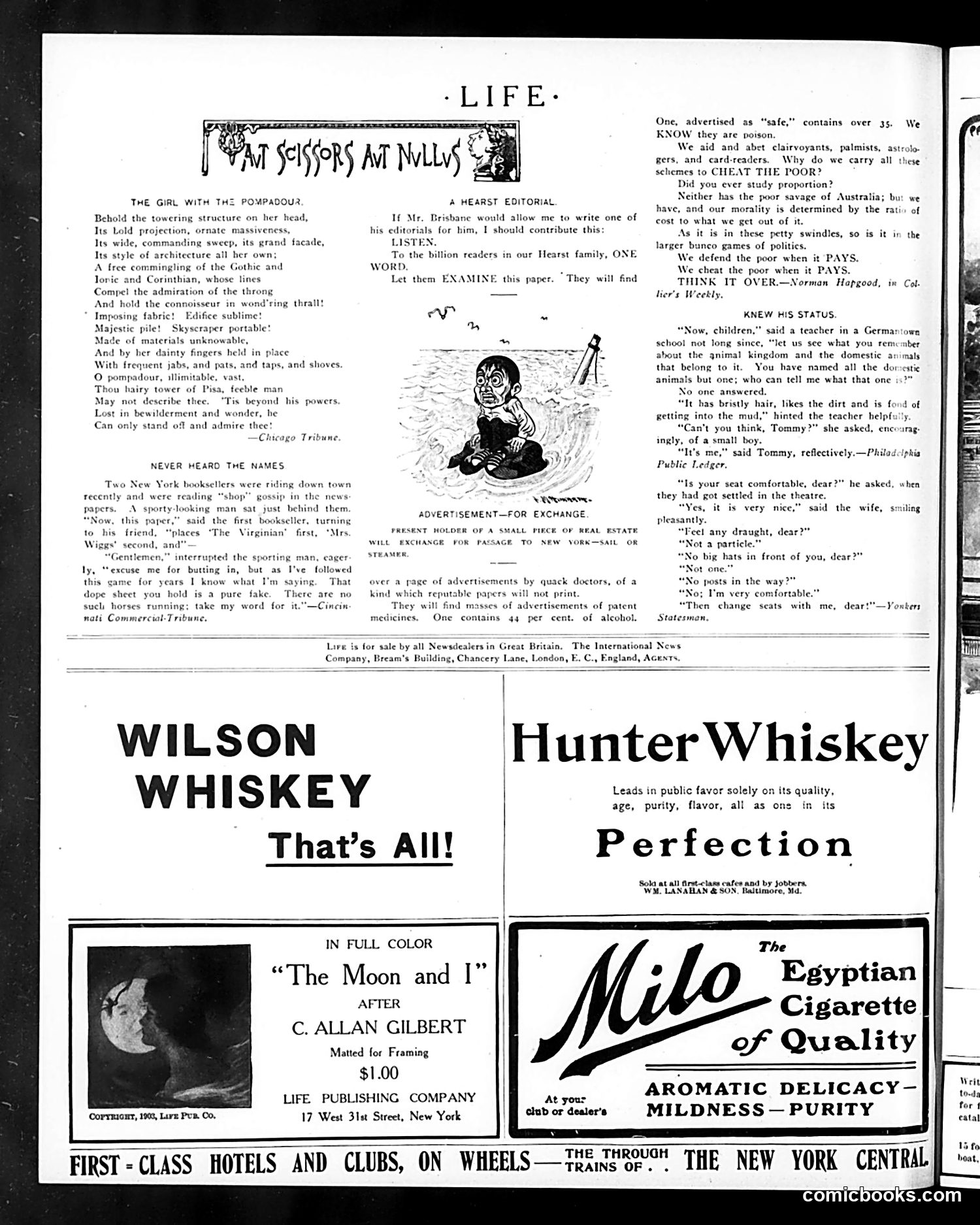
This page from *Life* magazine contains several distinct pieces of satire and commentary: **"The Girl with the Pompadour"** ridicules the elaborate Gibson Girl-era hairstyle—an exaggerated upswept coiffure popular among upper-class women. The poem mockingly compares the towering structure to architectural styles, suggesting vanity and impracticality. **"A Hearst Editorial"** attacks William Randolph Hearst's newspapers for hypocrisy: while claiming to defend the poor, they advertise fraudulent schemes (quack medicines, fortune tellers, fake estate deals) that exploit vulnerable people. The satire argues Hearst's moral stance is determined by profit rather than principle. **"Knew His Status"** is a brief joke about a German schoolteacher asking children to name domestic animals; a boy answers "me"—implying working-class self-awareness of their degraded social position. **"Never Heard the Names"** mocks unsophisticated newspaper readers who mistake "The Virginian" (Owen Wister's novel) for a newspaper. The page is rounded out by period advertisements for whiskey, cigarettes, and art prints—ironically placed alongside critiques of deceptive advertising.
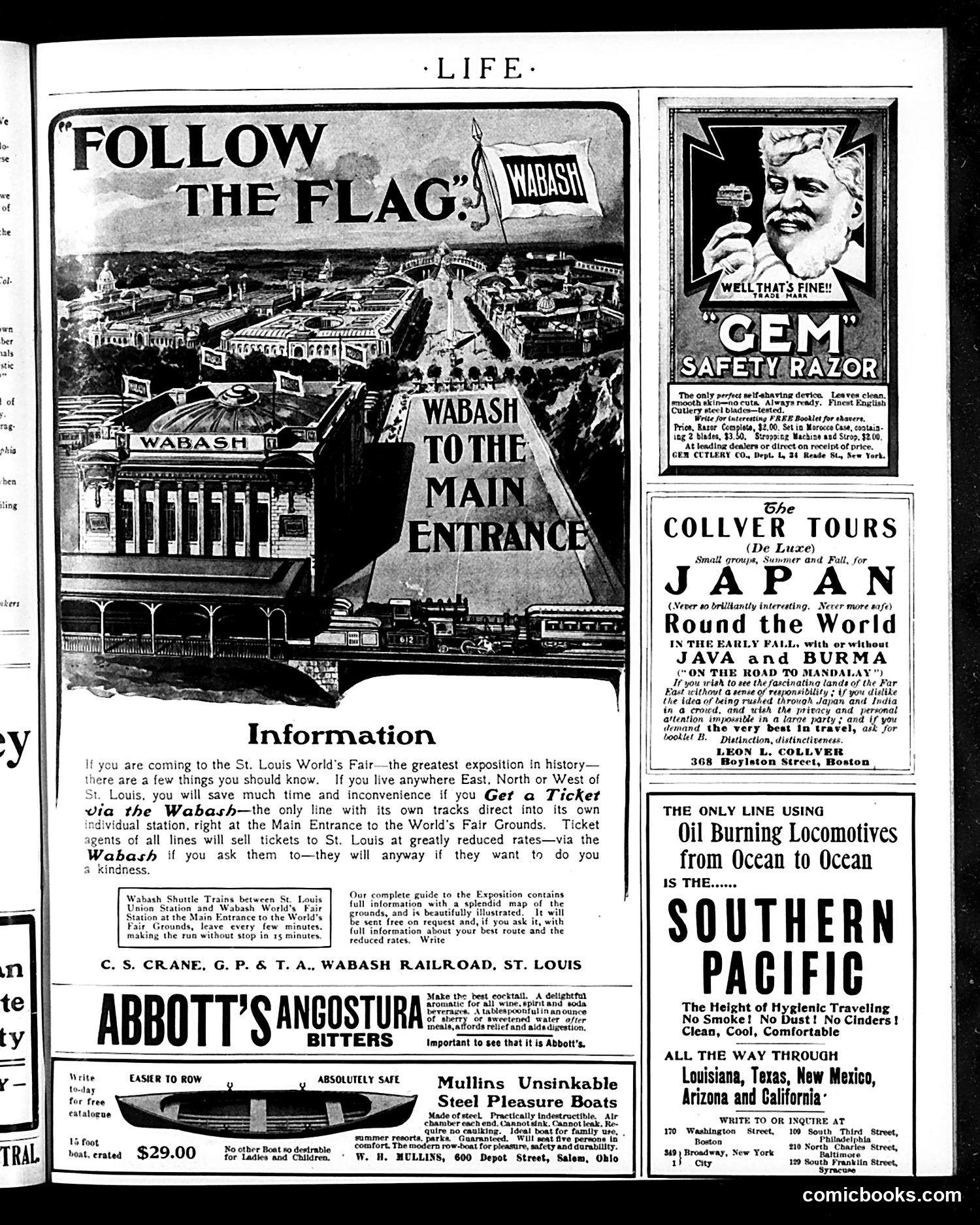
This page from Life magazine is primarily **advertising**, not political satire. The dominant feature is a large Wabash Railroad advertisement promoting train service to the St. Louis World's Fair (appears to be early 1900s based on the fair reference and design style). The left side shows an illustrated aerial view of the fairgrounds with the Wabash flag, encouraging visitors to "Follow the Flag" to the main entrance. The text emphasizes the railroad's direct access and convenience. The right side contains various product advertisements: a "Gem" safety razor featuring a mustachioed man endorsing the product, travel tour advertisements, pleasure boats, and Southern Pacific Railroad promoting oil-burning locomotives. There is **no political cartoon or satire visible**—this is a commercial magazine page designed to generate advertising revenue. The content reflects turn-of-the-century consumer products and transportation services marketed to middle-class readers.
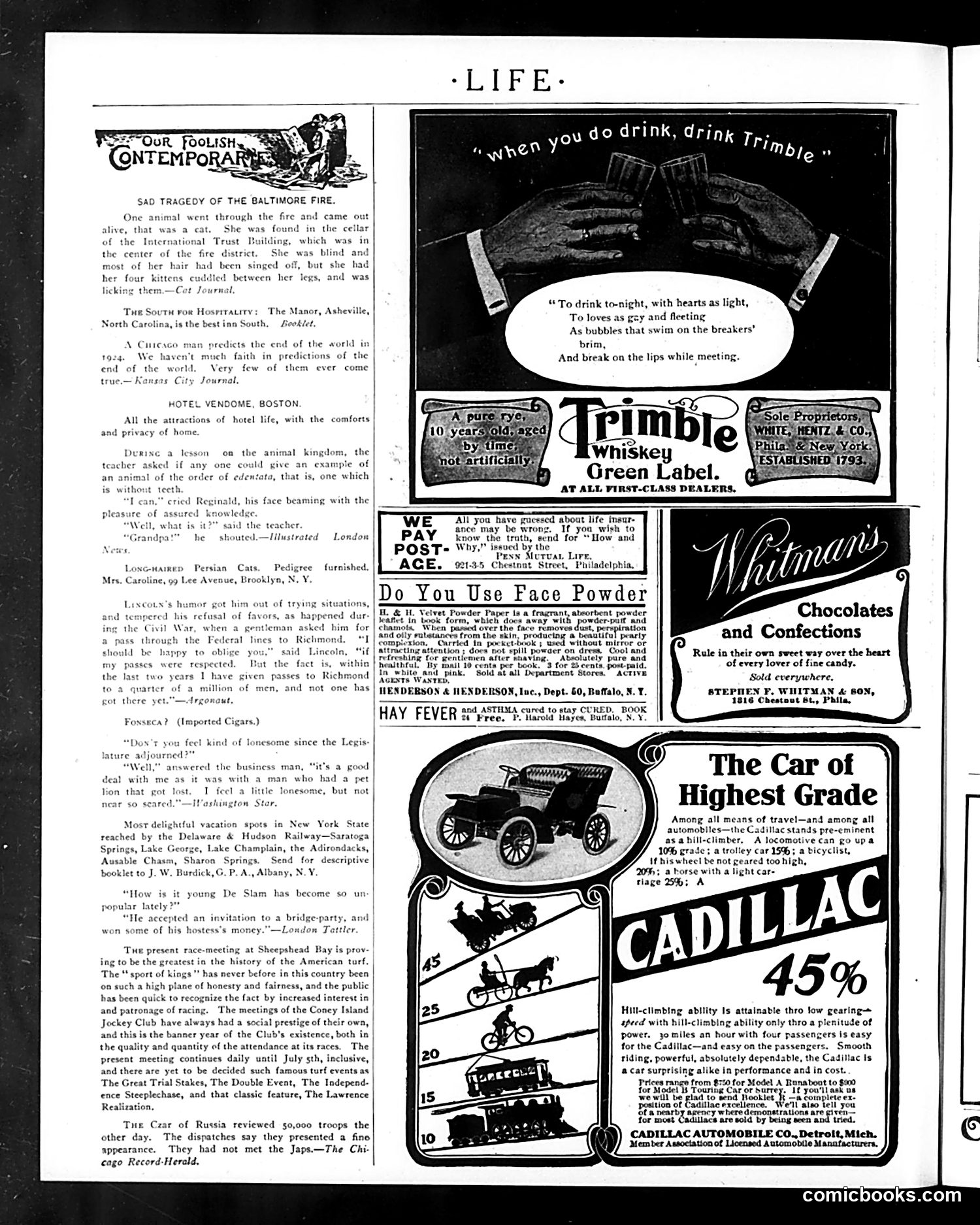
This page contains satirical commentary and advertisements typical of early 20th-century Life magazine. The left column includes humorous anecdotes: a cat surviving the Baltimore fire with her kittens, a Chicago man predicting the world's end in 1924 (satirizing apocalyptic predictions), and Lincoln refusing a favor by noting he'd already given passes to Richmond to "a quarter of a million of men" without success—mocking wartime corruption. The right side is dominated by advertisements, including Trimble Whiskey (with romantic poetry), Whitman's Chocolates, and notably a Cadillac automobile ad emphasizing "highest grade" performance and hill-climbing ability using percentages. The "Do You Use Face Powder" advertisement reflects contemporary beauty standards and marketing to women. The overall tone is satirical commentary on American life mixed with period consumer advertising, demonstrating Life's role as both humor publication and advertising vehicle.
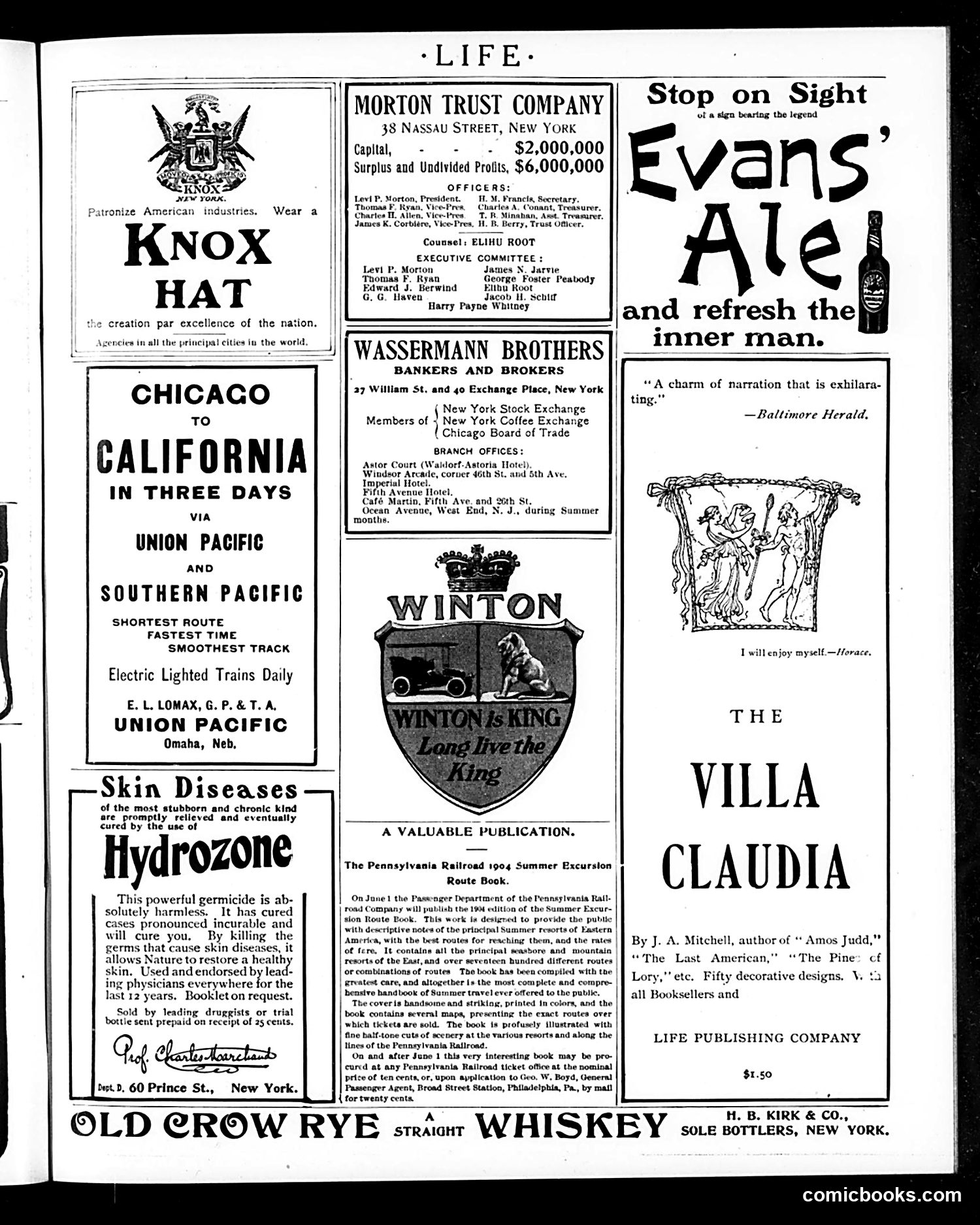
This is primarily an **advertising page** with no political cartoons or satirical content. It consists entirely of commercial advertisements typical of early 1900s American publications. Notable ads include: - **Knox Hat**: Appeals to nationalism ("Patronize American industries") - **Union Pacific Railroad**: Promotes fast Chicago-to-California travel - **Hydrozone**: A patent medicine claiming to cure skin diseases - **Financial institutions**: Morton Trust Company and Wassermann Brothers banking - **Pennsylvania Railroad**: Summer excursion guidebook - **Evans' Ale**: Beverage advertisement with classical imagery - **The Villa Claudia**: A novel by J.A. Mitchell - **Old Crow Rye Whiskey**: Spirits advertisement The page reflects early 20th-century consumer culture and advertising conventions. The "Evans' Ale" ad features classical figures, while patent medicine ads (like Hydrozone) represent now-discredited medical claims common to the era. No satire or political commentary is apparent.
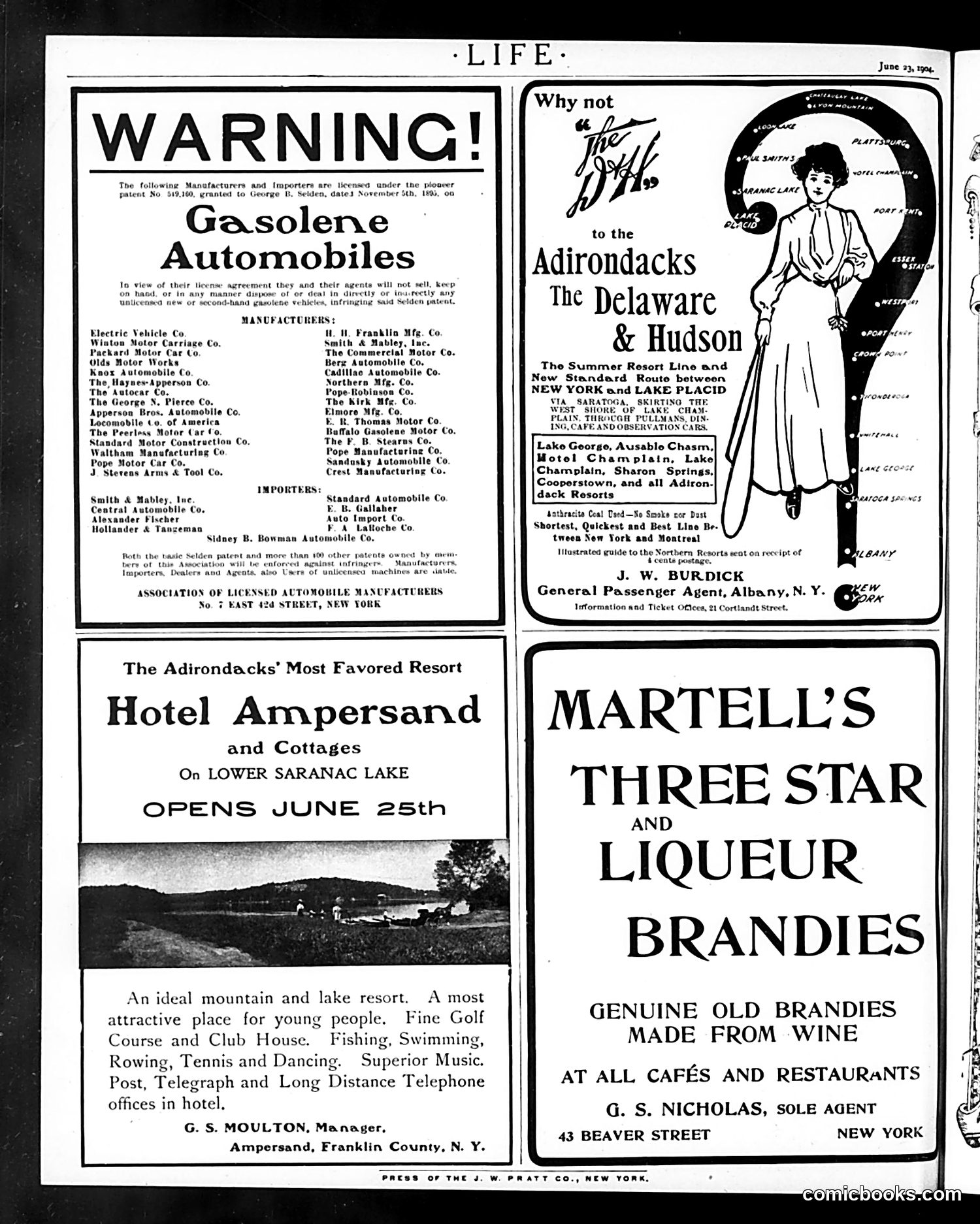
This is primarily **advertising material** rather than a political cartoon. The page features: **Main Warning (Top Left):** The Association of Licensed Automobile Manufacturers issued a legal threat against unlicensed car makers and users. This references the **Selden Patent dispute**—a monopoly battle over George Selden's 1895 gasoline-automobile patent. Licensed manufacturers (listed) sought to enforce patent fees against competitors, particularly Henry Ford's company (notably absent from the "licensed" list). **Commercial Context:** The remainder of the page contains vacation resort advertisements (Hotel Ampersand in the Adirondacks), railroad promotions (Delaware & Hudson route), and spirit/brandy ads—typical of the era. **Modern Relevance:** The warning illustrates early patent litigation in the auto industry, a precursor to modern tech monopoly battles. Ford ultimately fought and broke the Selden Patent monopoly by 1911.