
Life, 1904-06-23 · page 4 of 20
Life — June 23, 1904 — page 4: what you’re looking at
What you’re looking at
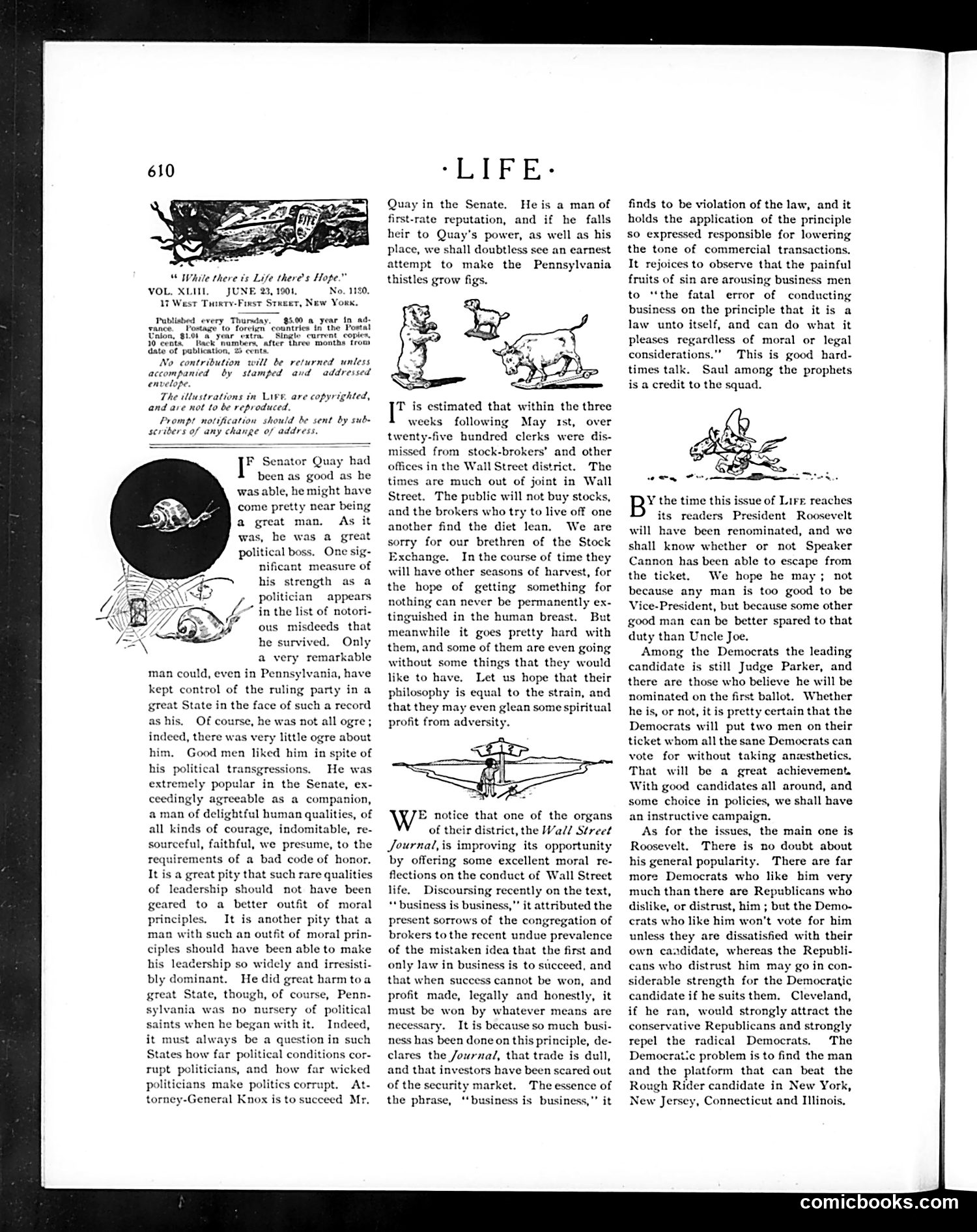
This page satirizes Senator **Quay** (likely Matthew Quay of Pennsylvania, a prominent Republican politician of the era). The text praises Quay as a political survivor despite various scandals, noting he was "a great political loss" to Pennsylvania but acknowledging his political skill and resilience. The accompanying illustrations appear to be generic decorative cartoons (cherubs, animals) rather than direct caricatures of Quay himself. The page also discusses the **1904 Democratic presidential nomination**, mentioning potential candidates and strategic positioning. It references **President Roosevelt** and notes debates over candidate selection, suggesting internal Democratic Party division during this transitional political period. The satire seems directed at political opportunism and moral flexibility in business and politics.
📄 Transcribed text from this page (OCR, searchable)
Machine-transcribed from the original scan — historical spelling and the odd misread are preserved.
“ While there ts Life there's Hope.” LIL, JUNE 23, 1901, No. 1180. est Taarty- treeT, New York. $5.00 a year in ad- ance. Postage to forcign countries tn the Postal Union, $1.01 a extra. Single current copies, 10 cents, Rack hers after three months from date of pablicat ‘cents No contribution will be returned unless accompanied by stamped and addressed envelope. The illustrations in Live. are copyrighted, and ave not to be reproduced, Prompt notification should be sent by sub- scribers of any change of address. Publisbed every Thuraday. Senator Qua been as good a was able, he might ha come pretty near being a@ great man. As it was, he was a great political boss, One sig- nificant measure of his strength as a te y , politician appears é “ in the list of notori- 7) ous misdeeds that he survived. Only a very remarkable man could, even in Pennsylvania, have kept control of the ruling party in a great State in the face of such a record as his, Of course, he was not all ogre ; indeed, there was very little ogre about him. Good men liked him in spite of his political transgressions. He was extremely popular in the Senate, ex- ceedingly agreeable as a companion, a man of delightful human qualities, of all kinds of courage, indomitable, re- sourceful, faithful, we presume, to the requirements of a bad code of honor. It is a great pity that such rare qualities of leadership should not have been geared to a better outfit of moral principles. It is another pity that a man with such an outfit of moral prin- ciples should have been able to make his leadership so widely and irresi: bly dominant. He did great harm toa though, of course, Penn- ery of political saints when he began with it. Indeed, it must always be a question in such States how far political conditions cor- rupt politicians, and how far wicked politicians make politics corrupt. At- ieneral Knox is to succeed Mr, great State, ‘LIFE: Quay in the Senate, He is a man of first-rate reputation, and if he falls heir to Quay’s power, as well as his place, we shall doubtless see an earnest attempt to make the Pennsylvania thistles grow figs. a timated that within the three ‘s following May 1st, over ve hundred clerks were dis- missed from stock-brokers’ and other offices in the Wall Street district. The times are much out of joint in Wall Street. The public will not buy stocks, and the brokers who try to live off one another find the diet lean. We are sorry for our brethren of the Stock hange. In the course of time they will have other seasons of harvest, for the hope of getting something for nothing can never be permanently ex- tinguished in the human breast. But meanwhile it goes pretty hard with them, and some of them are even going without some things that they would like to have. Let us hope that their philosophy is equal to the strain, and that they may even glean some spiritual profit from adversity. E notice that one of the organs of their district, the Wall Street Journal, is improving its opportunity by offering some excellent moral re- flections on the conduct of Wall Street life, Discoursing recently on the text, ** business is business,”’ it attributed the present sorrows of the congregation of brokers to the recent undue prevalence of the mistaken idea that the first and only law in business is to sticceed, and that when success cannot be won, and profit made, legally and honestly, it must be won by whatever means are necessary, It is because so much busi- ness has been done on this principle, de- clares the Journal, that trade is dull, and that investors have been scared out of the security market. The essence of the phrase, “business is business, finds to be violation of the law, and it holds the application of the principle so expressed responsible for lowering the tone of commercial transactions. It rejoices to observe that the painful fruits of sin are arousing business men to ‘‘the fatal error of conducting business on the principle that it is a law unto itself, and can do what it pleases regardless of moral or legal This is good hard- times talk. Saul among the prophets is a credit to the squad. B Y the time th s its readers President Roosevelt will have been renominated, and we shall know whether or not Speaker Cannon has been able to escape from the ticket. We hope he may; not because any man is too good to be Vice-President, but because some other good man can be better spared to that duty than Uncle Joe. Among the Democrats the leading candidate is still Judge Parker, and there are those who believe he will be nominated on the first ballot. Whether he is, or not, it is pretty certain that the Democrats will put two men on their ticket whom all the sane Democrats can vote for without taking anzsthetics. That will be a great achievement. With good candidates all around, and some choice in policies, we shall have an instructive campaign. As for the issues, the main one is Roosevelt. There no doubt about his general popularity. There are far more Democrats who like him very much than there are Republicans who dislike, or distrust, him ; but the Demo- crats who like him won't vote for him unless they are dissatisfied with their own candidate, whereas the Republi- cans who distrust him may go in con- siderable strength for the Democratic candidate if he suits them. Cleveland, if he ran, would strongly attract the conservative Republicans and strongly repel the radical Democrats. The Democratic problem is to find the man and the platform that can beat the Rough Rider candidate in New York, New Jersey, Connecticut and Illinois. comicbooks.com