
Life, 1904-06-23 · page 6 of 20
Life — June 23, 1904 — page 6: what you’re looking at
What you’re looking at
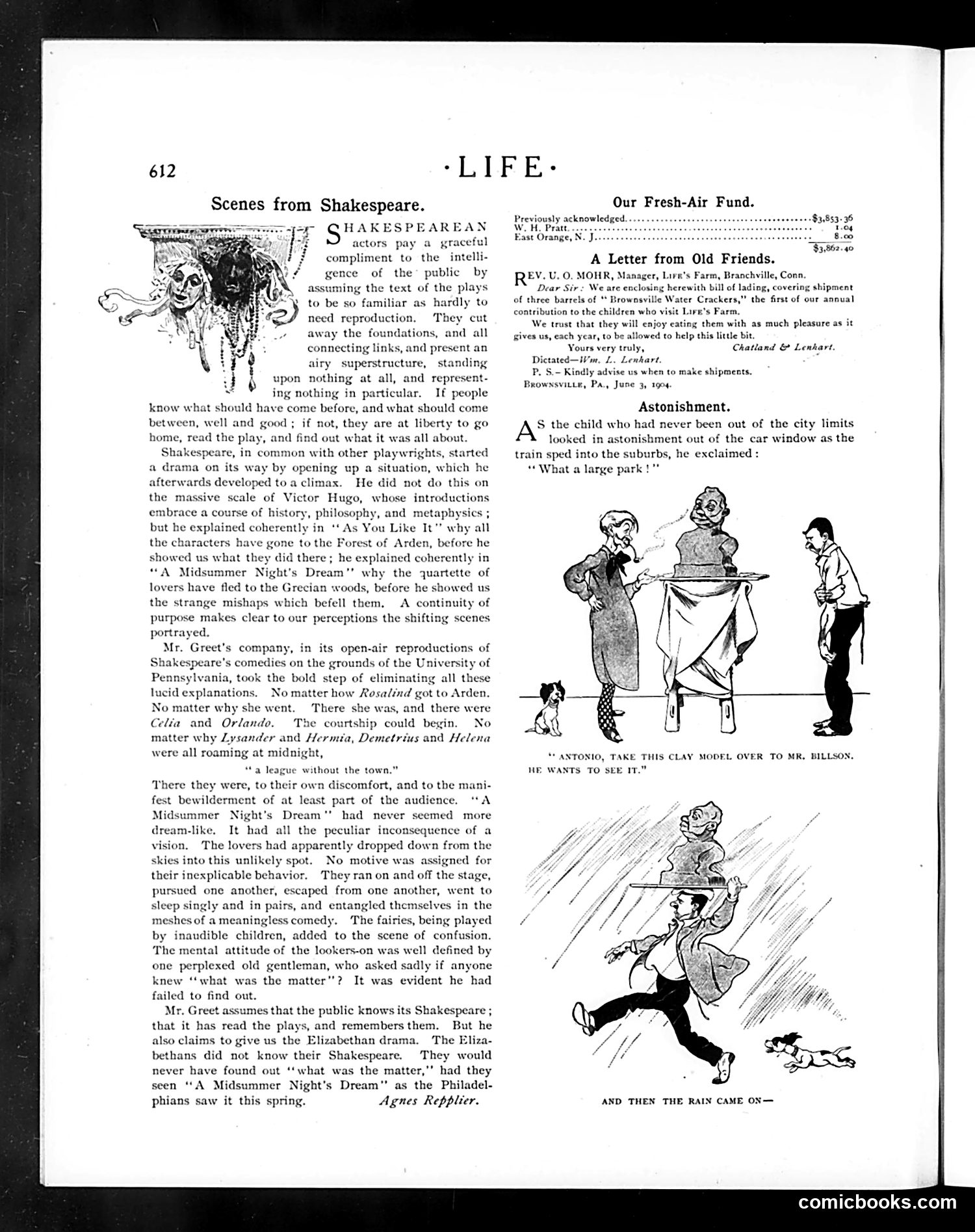
This page contains two distinct sections: a critical essay on Shakespeare productions and an unrelated cartoon about a child's first encounter with nature. The main text, "Scenes from Shakespeare," critiques theatrical adaptations of Shakespeare's plays, particularly Mr. Greet's open-air productions at the University of Pennsylvania. The author argues that modern directors strip away Shakespeare's careful structure, eliminate essential exposition, and create confusion—exemplified by their staging of "A Midsummer Night's Dream" where characters roam inexplicably without motivation. The essay suggests audiences left bewildered, with one elderly gentleman asking what "was the matter?" The cartoon "Astonishment" is separate humor: a city child's first park visit, exclaiming "What a large park!" The second panel shows rain, with the caption "and then the rain came on—" a gentle joke about weather interrupting the outing.
📄 Transcribed text from this page (OCR, searchable)
Machine-transcribed from the original scan — historical spelling and the odd misread are preserved.
-LIFE- Scenes from Shakespeare. Our Fresh-Air Fund. Previously acknowledged. . . HAKESPEAREAN WH Prater: East Orange, N. J bec : : tors pay a graceful compliment to the intelli- A Letter from Old Friends. gence of the public by REV. U. 0. MOHR, Manager, Lirs's Farm, Branchville, Cona. ssuming the text of the plays Dear Sir: We are enclosing herewith bill of lading, cove to be so familiar as hardly to of three barrels of * Water Crackers,” the first of our anpual contribution to the children who visit Lire’s Farm. We trust that they will enjoy eating them with as much pleasure as it gives us, each year, to be allowed to help this little bit. connecting links, and present an Yours very truly, Chatland & Lenhart. airy superstructure, standing Dictated— Wm. 1. Lenhart, Looe ;: - P, S.- Kindly advise us when to make shipments. upon nothing at all, and represent- Browssviiis, Pa, JoA¢ 4,. 1004 ing nothing in particular. If people know what should have come before, and what should come Astonishment. , well and good ; if not, th liberty to go S the child who had never been out of the cit home, read the pla id find out what it was all about. looked in astonishment out of the car window as the Sh peare, in common with other playwrights, started train sped into the suburbs, he exclaimed : a drama on its way by opening up a situation, which he “What a large park !"* afterwards developed to a climax. He did not do this on the massive scale of Victor Hugo, whose introductions embrace a course of history, philosophy, and metaphysics ; but he explained coherently in ‘* As You Like It" why all the characters have gone to the Forest of Arden, before he showed us what they did there ; he explained coherently in “A Midsummer Night's Dream" why the quartette of lovers have fled to the Grecian woods, before he showed us the strange mishaps which befell them. A continuity of purpose makes clear to our perceptions the shifting scenes portrayed, Mr. Greet’s company, in its open-air reproductions of akespeare's comedies on the grounds of the versity of Pennsylvania, took the bold step of eliminating all th lucid explanations. No matter how Rosalind got to Arden. No matter why she went. There she was, and there were Celia and Orlando. The courtship could begin. No matter why Lysander and Hermia, Demetrius and Helena were all roaming at midnight, need reproduction, ‘They cut away the foundations, and all ANTONIO, TAKE THIS CLAY MODEL OVER TO MR, BILLSOD “a league without the tow: STO SEE IT.” There they were, to their own discomfort, and to the mani- fest bewilderment of at least part of the audience. ‘A Midsummer Night's Dream"' had never seemed more dream-like. It had all the peculiar inconsequence of a vision. The lovers had apparently dropped down from the skies into this unlik: spot. No motive was assigned for their inexplicable behavior. They ran on and off the stage, pursued one another, escaped from one another, went to sleep singly and in pairs, and entangled themselves in the meshes of a meaningless comedy. ‘The fairies, being played by inaudible children, added to the scene of confusion. The mental attitude of the lookers-on was well defined by one perplexed old gentleman, who asked sadly if anyone knew ‘what was the matter"? It was evident he had failed to find out. Mr. Greet assumes that the public knows its Shakespeare ; that it has read the plays, and remembers them. But he also claims to give us the Elizabethan drama. The Eli bethans did not know their Shakespeare. They would never have found out ‘‘what was the matter,’’ had they seen ‘A Midsummer Night's Dream" as the Philadel- phians saw it this spring. Agnes Repplier. AND THEN THE RAIN CAME ON— comicbooks.com