
Life, 1904-06-23 · page 14 of 20
Life — June 23, 1904 — page 14: what you’re looking at
What you’re looking at
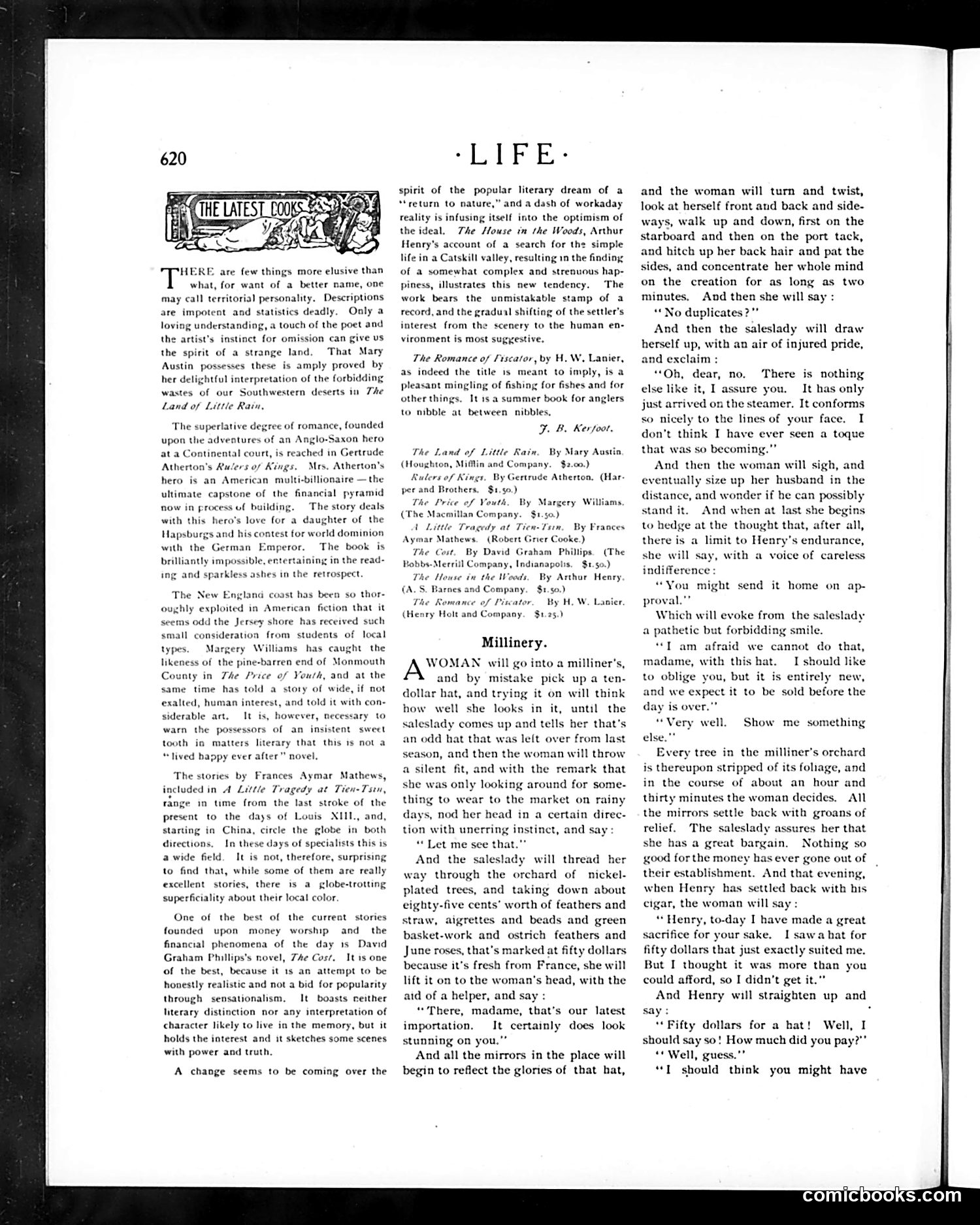
This is a book review section titled "The Latest Looks," containing no political cartoons—just literary criticism. The page reviews contemporary novels (early 1900s), praising works that blend romance with realism and authentic regional observation. Key reviews include: - **Mary Austin's *The Land of Little Rain***: Praised for capturing the American Southwest's spirit through poetic observation rather than mere description - **Gertrude Atherton's *Rulers of Kings***: A romance featuring an American billionaire competing with German royalty for dominance—reflecting contemporary anxieties about American industrial power and European geopolitical rivalry - **David Graham Phillips's *The Cost***: Commended for honest realism over sensationalism, addressing industrial-era money worship The critic notes a literary trend: the popular "return to nature" ideal is being tempered by "workaday reality." This reflects Progressive Era concerns about industrialization, authenticity, and American identity. The emphasis on regional particularity and honest social observation reflects early 20th-century literary modernism's rejection of Victorian sentimentality.
📄 Transcribed text from this page (OCR, searchable)
Machine-transcribed from the original scan — historical spelling and the odd misread are preserved.
HERE. are few things more elusive than what, for want of a better name, one may call territorial personality, Descriptions are impotent and statistics deadly, Only a loving understanding, a touch of the poet and the artist’s instinct for omission can give us the spirit of a strange land, That Mary Austin possesses these is amply proved by her delightful interpretation of the forbidding wastes of our Southwestern deserts in The Land of Little Rain, The superlative degree of romance, founded upon the adventures of an Anglo-Saxon hero at a Continental court, is reached in Gertrude Atherton’s Rulers of Kings, Mrs. Atherton’s hero is an American multi-billionaire —the ultimate capstone of the financial pyramid now in process of building. ‘The story deals with this hero's love for a daughter of the Hapsburgs and his contest for world dominion with the German Emperor. The book is taining in the read- the retrospect. brilliantly impossible, € ing and sparkless ashes The New England coast has been so thor- a American fiction that it seems odd the Jerse small consideration from students of local types, Williams likeness of the pine-barren end of Monmouth County in The Price of Youth, and at the same time has told a stoty of wide, if not oughly exploited shore has received such Margery has caught the exalted, human interest, and told it with con- siderable art, warn the possessors of an insistent sweet tooth in matters literary that this 1s nota “lived bappy ever after” novel, It is, however, necessary to The stories by Frances included in A Little Tragedy at Tien-Tsin, range in time from the last stroke of the present to the days of Louis NII, and, starting in China, circle the globe in both Aymar Mathews, directions, In these days of specialists this is awide field. It is not, therefore, surprising to find that, while some of them are really excellent stories, is a globe-trotting superficiality about their local color there One of founded the best of the current. stories upon worship and the financial phenomena of the day 1s David Graham Phillips's novel, The Cost, tis one of the best, because it 1s an attempt to be honestly realistic and not a bid for popularity through sensationalism, It boasts neither Iterary distinction nor any interpretation of character likely to live in the memory, but it holds the interest and it sketches some scenes with power and truth. money A change seems to be coming over the ~LLPE- spirit of the popular literary dream of a “return to nature,” and a dash of workaday reality is infusing itself into the optimism of the ideal, The House in the Woods, Arthur Henry's account of a search for the simple life in a Catskill valley, resulting in the finding of a somewhat complex and strenuous hap- piness, illustrates this new tendency. The work bears the unmistakable stamp of a record, and the gradual shifting of the settlers interest from the scenery to the human en- vironment is most suggestive. The Romance of Fiscator, by H.W. Lanier, as indeed the title 1s meant to imply, is a pleasant mingling of fishing for fishes and for other things. It 1s a summer book for anglers to nibble at between nibbles, J. B. Kerfoot, The Land of Little Rain. (Houghton, Kulers of Kings, By Gertrude Atherton, (Har- per and Brothers. $1.50.) The Price of Youth. By (The Macmillan Company. 1 Little Tragedy at Ti Aymar Mathews. (Robert Grier Cooke.) The Cost. By David Graham Phillips. (The Bobbs-Merriil Company, Indianapolis, $1.50.) The House in the Woods. By Arthur Henry (A. S. Barnes and Company. $1.50.) By H.W $1.25) By Mary Austin $2.00.) Jifflin and Company. Margery Williams. $1.50.) ~Trin, By Frances The Romance of Piscator Lanier. (Henry Holt and Company Millinery. WOMAN will go into a milliner's, and by mistake pick up a ten- dollar hat, and trying it on will think well she looks in it, until the saleslady comes up and tells her that's an odd hat that was le{t over from last season, and then the woman will throw a silent fit, and with the remark that she was only looking around for some- thing to wear to the market on rainy days, nod her head in a certain direc- tion with unerring instinct, and say: “Let me see that." And the saleslady will thread her way through the orchard of _nickel- plated trees, and taking down about eighty-five cents’ worth of feathers and straw, aigrettes and beads and green basket-work and ostrich feathers and June roses, that’s marked at fifty dollars because it’s fresh from France, she will lift it on to the woman's head, with the aid of a helper, and say : “There, madame, that’s our latest importation. It certainly does look stunning on you.” And all the mirrors in the place will begin to reflect the glories of that hat, how and the woman will turn and twist, look at herself front and back and side- ways, walk up and down, first on the starboard and then on the port tack, and hitch up her back hair and pat the sides, and concentrate her whole mind on the creation for as long as two minutes. And then she will say : “*No duplicates?" And then the saleslady will draw herself up, with an air of injured pride, and exclaim : “Oh, dear, no, There is nothing else like it, I assure you. It has only just arrived on the steamer. It conforms so nicely to the lines of your face. I don’t think I have ever seen a toque that was so becoming.”” And then the woman will sigh, and eventually size up her husband in the distance, and wonder if he can possibly stand it. And when at last she begins to hedge at the thought that, after all, there is a limit to Henry's endurance, she will say, with a voie indifference : “You might send it home on ap- proval.’” Which will evoke from the saleslady a pathetic but forbidding smile. of careless “Tam afraid we cannot do that, madame, with this hat. I should like to oblige you, but it is entirely new, and we expect it to be sold before the day is over.” “Very well. Show me something else. Every tree in the milliner’s orchard is thereupon stripped of its fohage, and in the course of about an hour and thirty minutes the woman decides. All the mirrors settle back with groans of relief. The saleslady assures her that she has a great bargain. Nothing so ood for the money has ever gone out of their establishment. And that evening, when Henry has settled back with his cigar, the woman will say “ Henry, to-day I have made a great sacrifice for your sake. I sawa hat for fifty dollars that just exactly suited me. But I thought it was more than you could afford, so I didn’t get it."" And Henry will straighten up and ‘Fifty dollars for a hat! Well, I should say so! How much did you pay?” “Well, guess."’ “T should think you might have comicbooks.com