
Life, 1904-06-23 · page 12 of 20
Life — June 23, 1904 — page 12: what you’re looking at
What you’re looking at
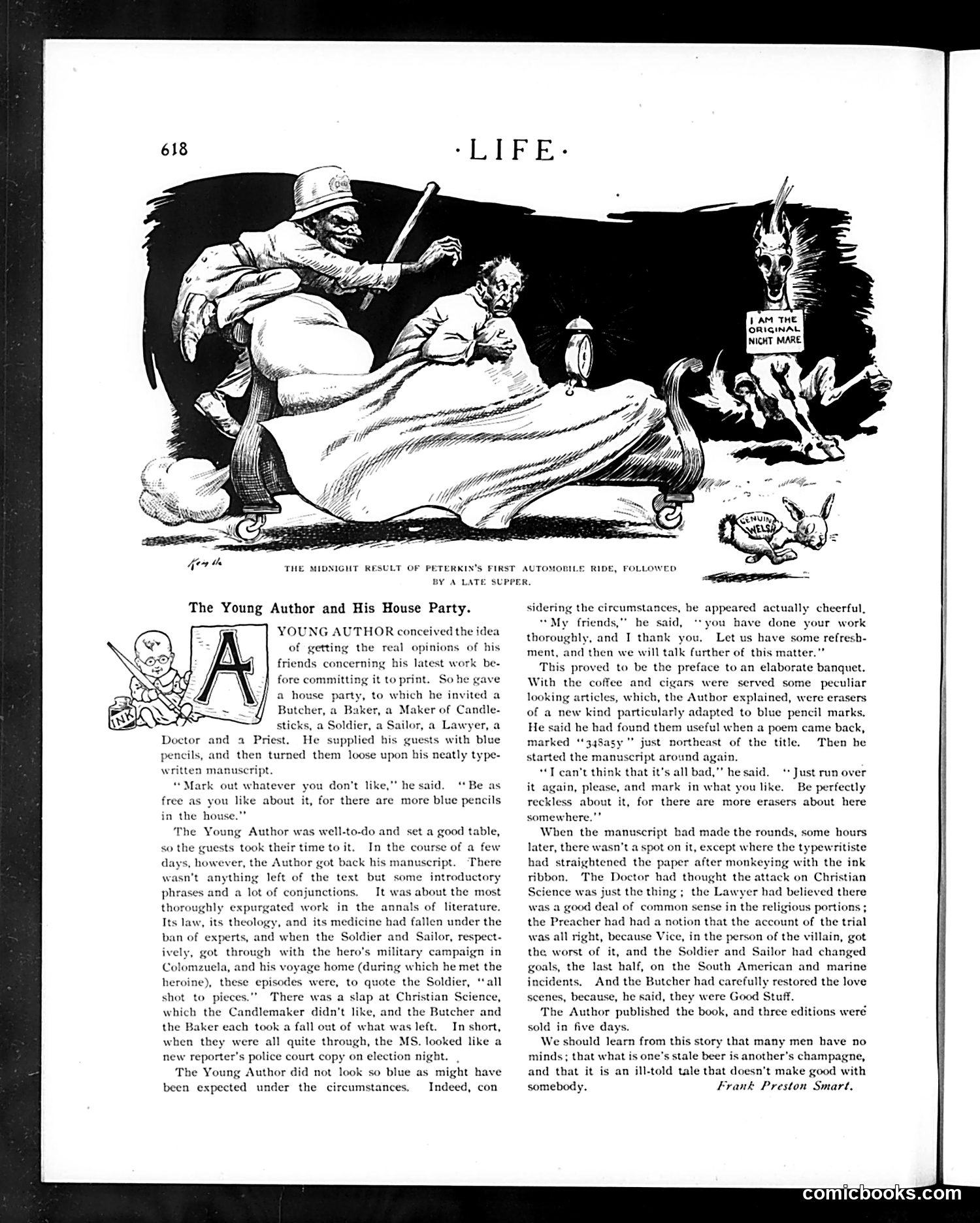
The top cartoon depicts a nightmare scene following an automobile accident. A grotesque demon-like figure declares "I AM THE ORIGINAL NIGHTMARE," suggesting early anxieties about automobiles as dangerous, nightmarish technology. The accident victim appears injured in bed while demons surround him—reflecting turn-of-the-century fears that cars were inherently perilous. The main article, "The Young Author and His House Party," satirizes literary criticism. A young writer invites various professionals (a doctor, lawyer, soldier, baker, etc.) to critique his manuscript, armed with blue pencils for editing. The satire mocks how amateur critics from unrelated fields presume to judge literature, resulting in a manuscript so heavily revised it becomes unrecognizable. The author publishes it anyway and finds unexpected success—poking fun at both pretentious criticism and literary merit's unpredictability.
📄 Transcribed text from this page (OCR, searchable)
Machine-transcribed from the original scan — historical spelling and the odd misread are preserved.
fen te THE MIDNIGHT RESULT OF PETERKIN’S FIRST AUTOMOBILE RIDE, FOLLOWED. BY A LATE SUPPER. The Young Author and His House Party. YOUNG AUTHOR conceived the idea of getting the real opinions of his. friends concerning his latest work be- fore committing it to print. So he gave a house party, to which he invited a Butcher, a Baker, a Maker of Candle- sticks, a Soldier, a Sailor, Lawyer, a Doctor and a Priest. He supplied bis guests with blue and then turned them loose upon his neatly type- nuscript. Mark out whatever 1 don't like," he said. ‘Be as free as you like about it, for there are more blue pencils in the house." The Young Author w: so the guests took their time to it. days, however, the Author got back his 1 well-to-do and set a good table, In the course of a few script. There wasn't anything left of the text but some introductory phrases and a lot of conjunctions. It was about the most thoroughly expurgated work in the annals of literature. Its law, its theology, and its medicine had fallen under the id when the Soldier and Sailor, respect- ively, got through with the hero’s military ban of experts, ampaign in Colomzuela, and his voyage home (during which he met the heroine), these episodes were, to quote the Soldier, “all shot to pieces.” ‘There was a slap at Christian Science, which the Candlemaker didn’t like, and the Butcher and the Baker each took a fall out of what was left. In short, when they were all quite through, the MS. looked like a new reporter's police court copy on election night. The Young Author did not look so blue as might have been expected under the circumstances, Indeed, con sidering the circumstances, he appeared actually cheerful, “My friends,” he said, your work thoroughly, and I thank you, Let us have some refresh- ment, and then we will talk further of this matter." This proved to be the preface to an elaborate banquet. With the coffee and cigars were served some peculiar looking articles, which, the Author explained, were erasers of a new kind particularly adapted to blue pencil marks. He said he bad found them useful when a poem came back, marked ‘*34Sasy " just northeast of the title. Then he started the manuscript around again. “Tcan't think that it’s all bad," he said. ** Just run over it again, please, and mark in what you like. Be perfectly reckless about it, for there are more erasers about here “you have done somewhere, When the manuscript bad made the rounds, some hours later, there wasn’t a spot on it, except where the typewritiste had straightened the paper after monkeying with the ink ribbon, The Doctor had thought the attack on Christian Science was just the thing ; the Lawyer had believed there a good deal of common sense in the religious portions ; the Preacher had had a notion that the account of the trial was all right, because Vice, in the person of the villain, got the worst of it, and the Soldier and Sailor had changed goals, the last half, on the South American and marine incidents. And the Butcher had carefully restored the love scenes, because, he said, they were Good Stuff. [he Author published the book, and three editions weré sold in five days. We should learn from this story that many men have no minds; that what is one’s stale beer is another's champagne, and that it is an ill-told tale that doesn't make good with somebody. Frank Preston Smart.