
A complete issue · 26 pages · 1904
Life — February 18, 1904
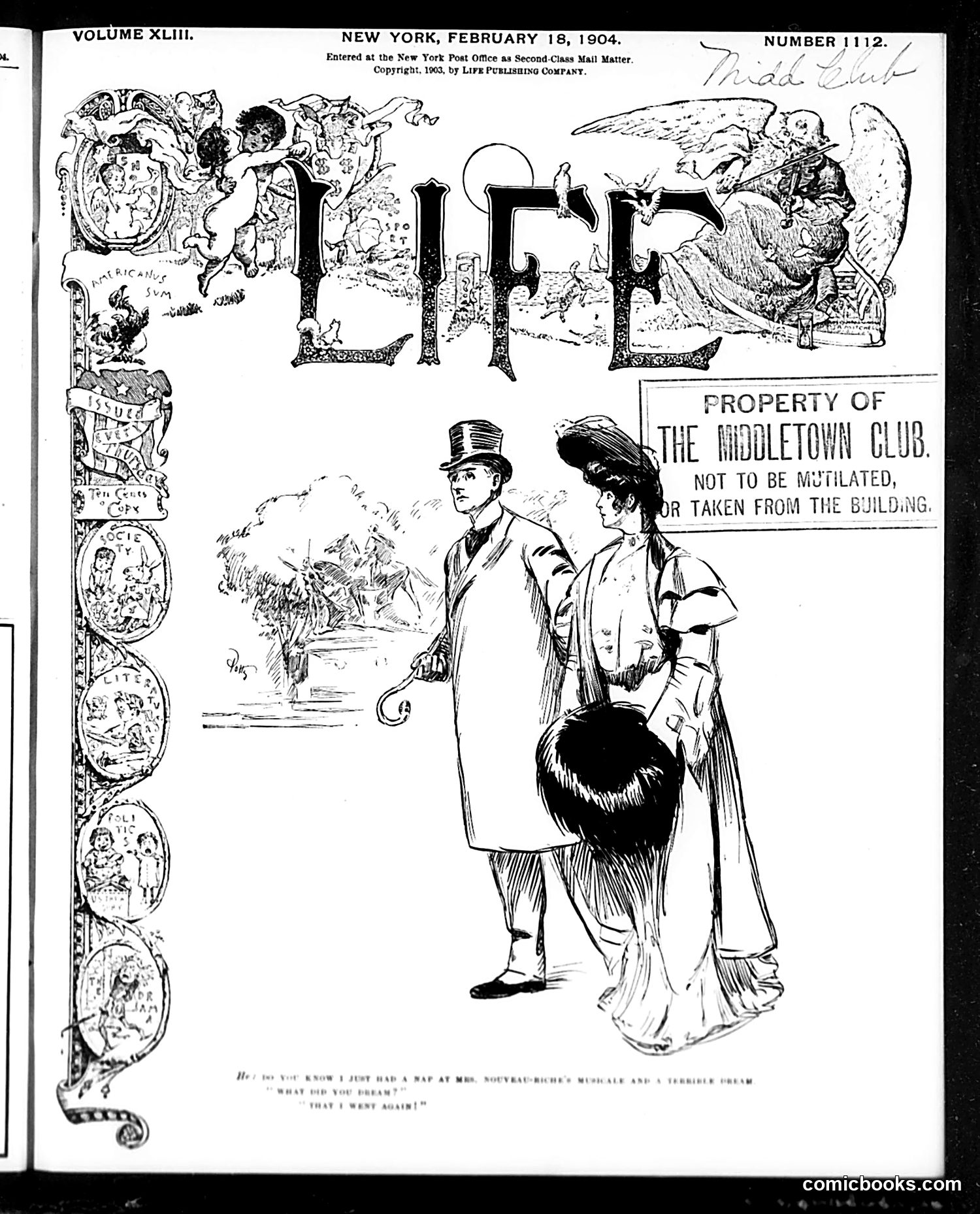
This page features an illustration titled "Life" with a satirical scene. Two well-dressed figures—a man in a top hat and overcoat, and a woman in Edwardian dress—appear to be conversing outdoors near water. The caption references "Mrs. Nouveauriche's musical and a terrible dream," suggesting the cartoon mocks nouveau riche (newly wealthy) pretension. The ornate decorative border on the left contains small medallion illustrations, typical of Life's design aesthetic. A property notice for "The Middletown Club" indicates this was used as club material. The specific social satire targets wealthy newcomers to high society and their aspirations toward cultural sophistication, though the exact individuals or events referenced are unclear without additional context from that era's events.
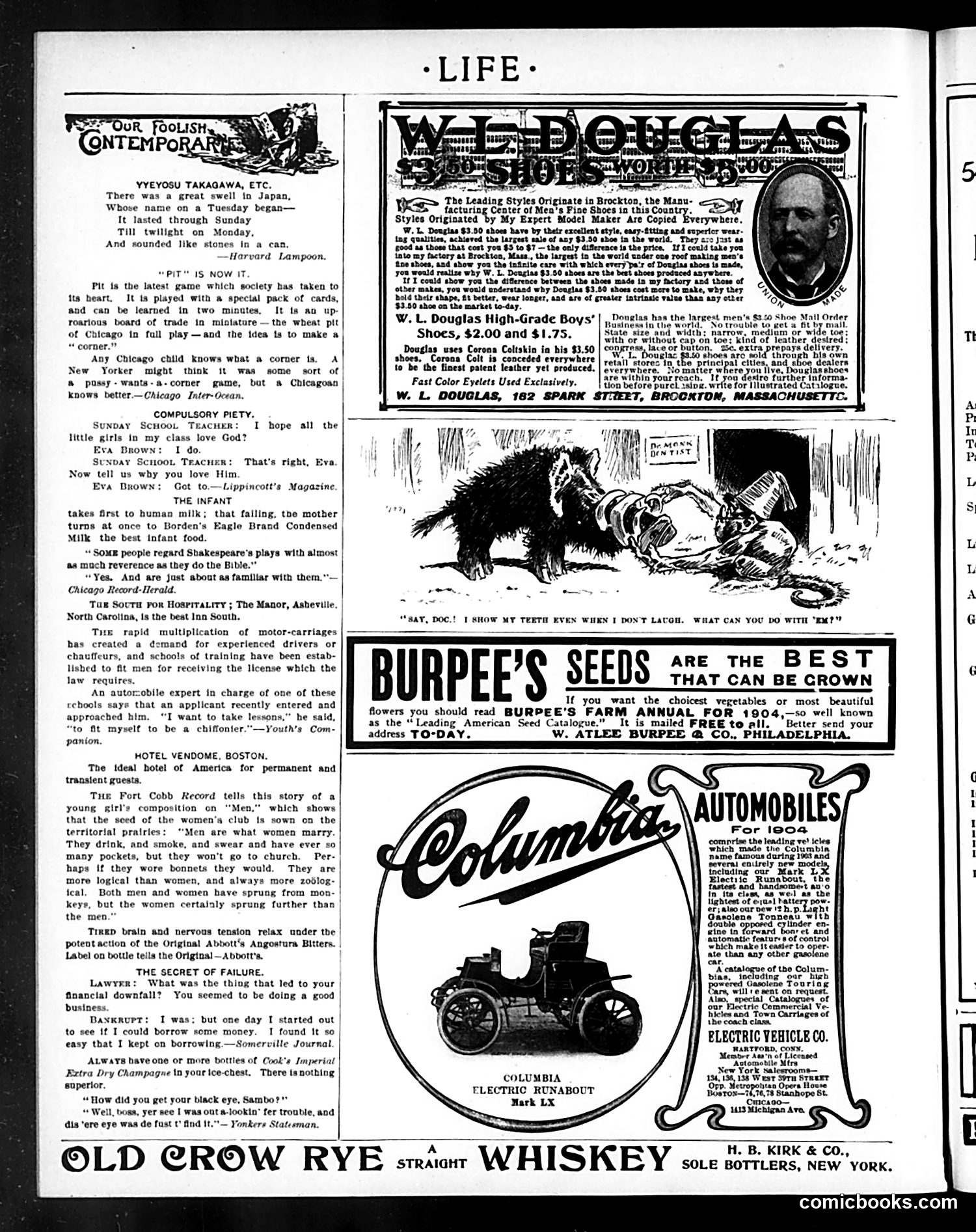
This page is primarily **advertising**, with minimal editorial content. The dominant elements are: 1. **W.L. Douglas Shoes advertisement** (top) - promoting men's footwear at $3.00 and $1.75, emphasizing quality leather. 2. **Cartoon illustration** (center) - depicts a disheveled dog with scattered items, captioned "Say, Doc! I show my teeth even when I don't laugh. What can you do with 'em?" This appears to be a humorous commentary on dentistry or dental care, though the specific satirical target is unclear. 3. **Additional ads** for Burpee Seeds, Columbia Automobiles, and Old Crow Whiskey occupy the remaining space. The page lacks evident political satire or caricature. It represents typical early 20th-century magazine content: entertainment mixed with commercial messaging.
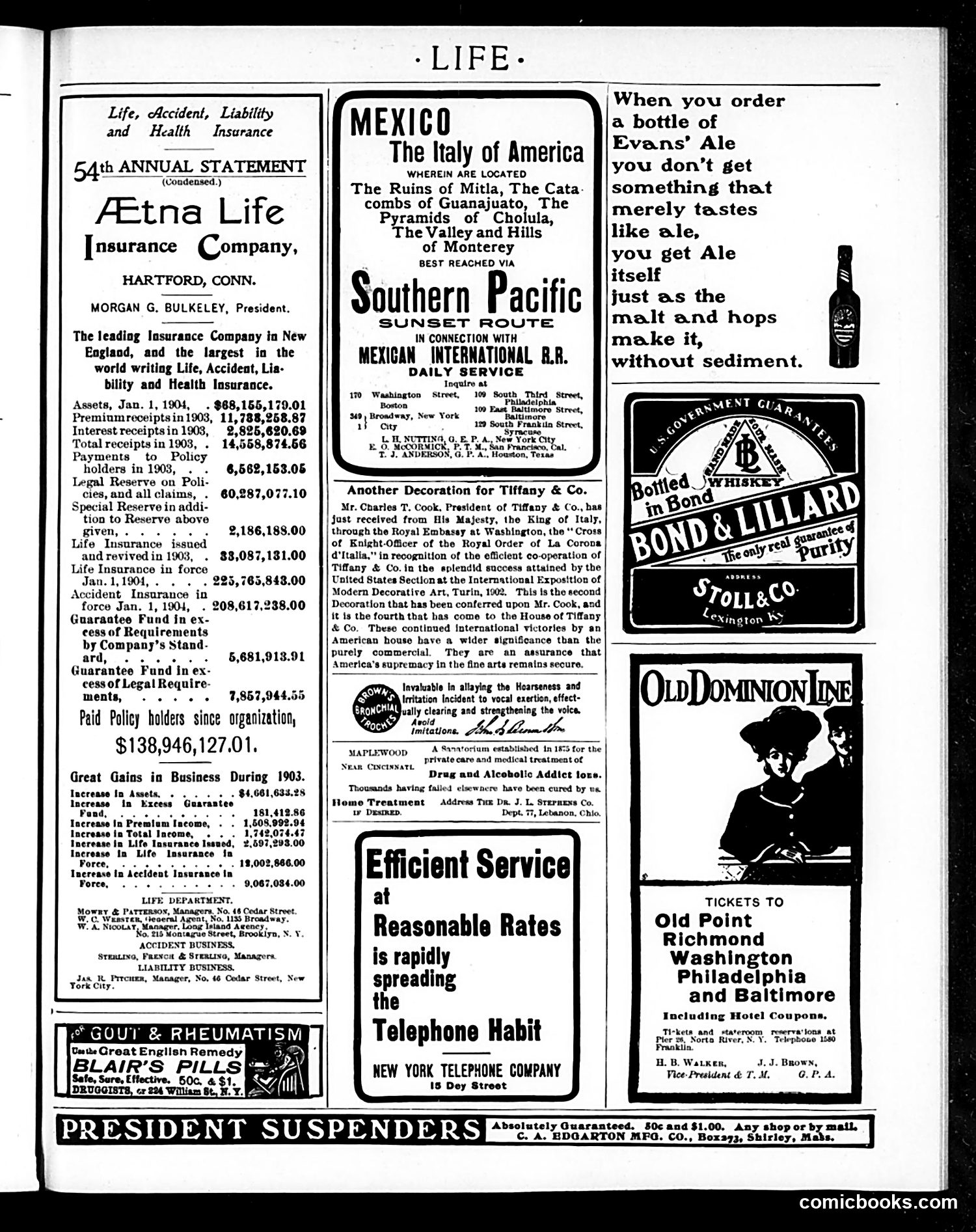
This page is primarily **advertising and corporate announcements** rather than satirical cartoons. The main content includes: - **Aetna Life Insurance Company's 54th annual statement** (Hartford, Connecticut), detailing assets and business gains - **Travel advertisement** promoting Mexico as "The Italy of America," accessible via Southern Pacific Railroad - **Product advertisements** for Evans' Ale, Bond & Lilliard whiskey, Old Dominion Line tickets, and Blair's Pills - **New York Telephone Company** promoting the "Telephone Habit" - Various other commercial notices and financial reports The page contains **no apparent political satire or editorial cartoons**. It represents typical early 1900s magazine content blending corporate reporting with consumer advertising, reflecting the publication's mixed business and entertainment focus during that era.
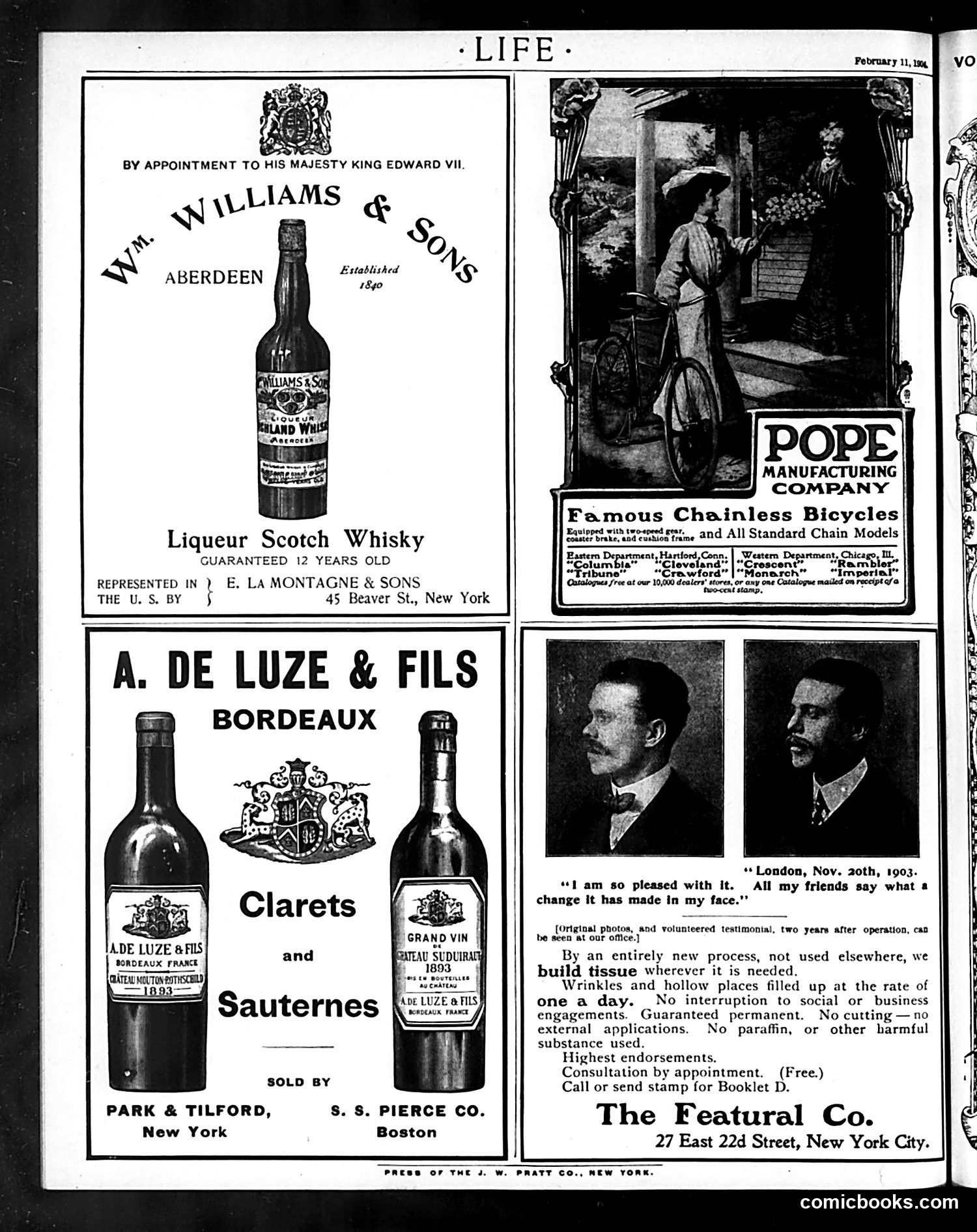
This page contains **advertisements, not political cartoons or satire**. The content includes: 1. **Whisky ad** (top left): W.M. Williams & Sons, Aberdeen scotch, represented in the U.S. by J.E. La Montagne & Sons, New York 2. **Bicycle ad** (top right): Pope Manufacturing Company advertising "Famous Chainless Bicycles" 3. **Wine ad** (bottom left): A. De Luze & Fils of Bordeaux selling clarets and sauternes through New York and Boston distributors 4. **Medical ad** (bottom right): The Featural Co. advertising a tissue-building treatment for wrinkles, with testimonial photos and claims of results without external applications or harmful substances This is a straightforward commercial page from a 1904 Life magazine. There are no political messages or satire present—only period product advertisements.
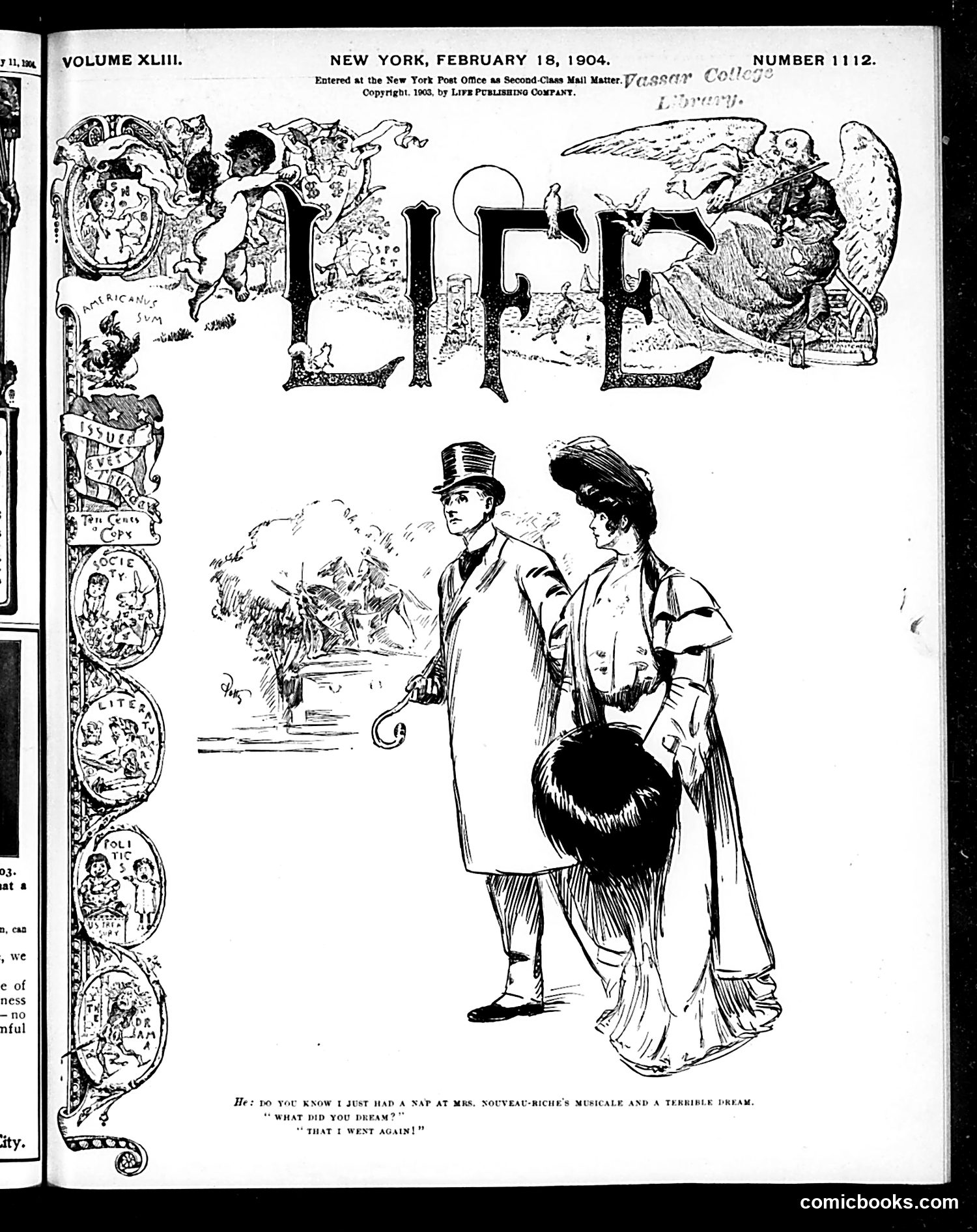
This page features a satirical cartoon about a social embarrassment at Mrs. Nouveau-Riche's musical event. Two well-dressed gentlemen encounter a woman leaving, and one remarks that he "just had a nap at Mrs. Nouveau-Riche's musicale and a terrible dream." The humor targets the nouveau riche—newly wealthy people lacking refined taste. The implication is that Mrs. Nouveau-Riche's musical performance was so tedious it induced sleep and nightmares in guests. The satirical point mocks both the hostess's pretentious social aspirations and the inferior quality of her entertainment despite her wealth. The decorative border on the left contains classical theatrical and mythological imagery, ironically contrasting with the mundane social discomfort depicted in the main scene.
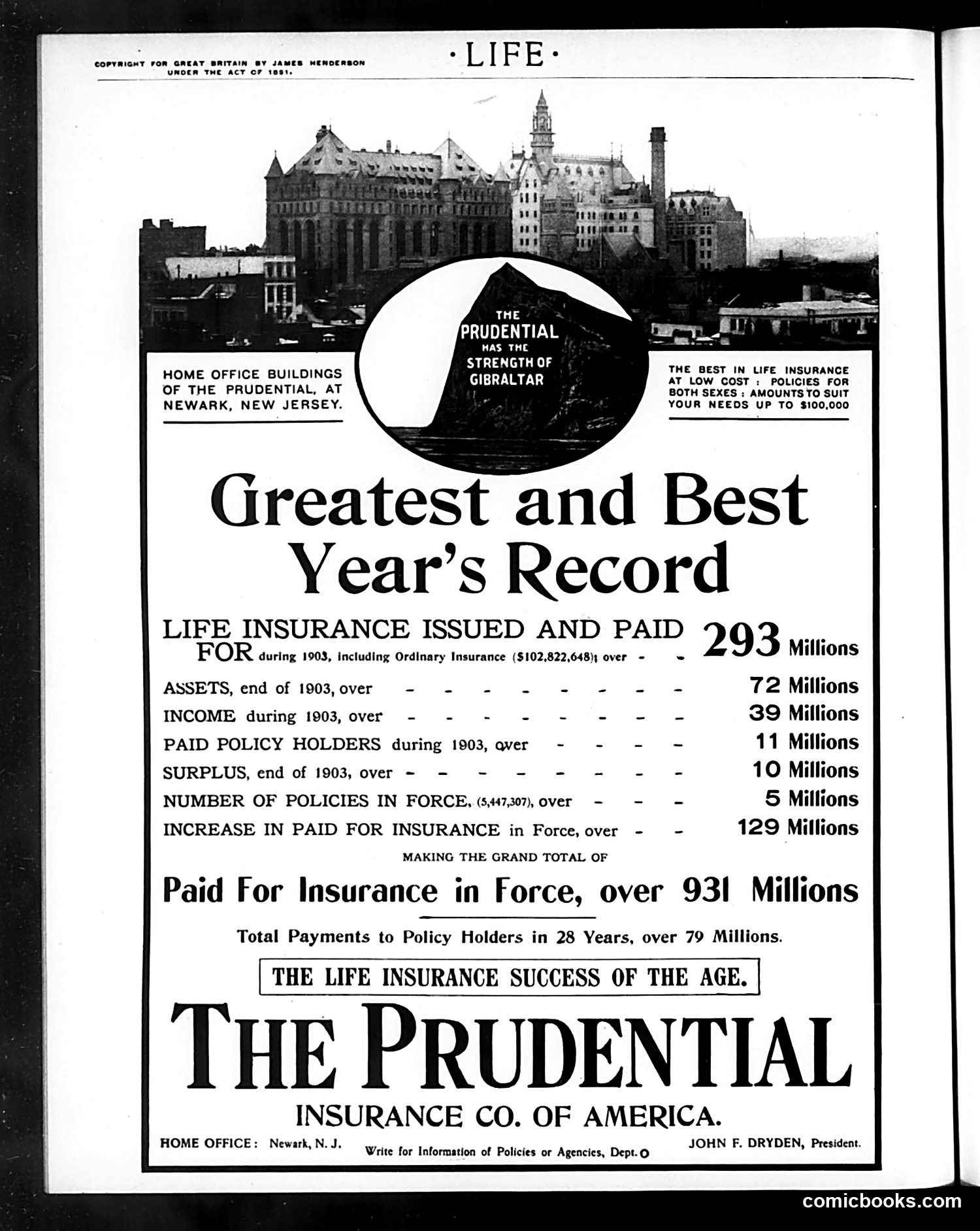
This page is primarily **advertising**, not satire or political commentary. It's a 1903 advertisement for The Prudential Insurance Company of America, promoting their business achievements. The page features their Newark, New Jersey headquarters building prominently at top. The central image shows Gibraltar—symbolizing strength and stability—supporting the company's claim to have "the strength of Gibraltar." The ad lists impressive financial statistics for 1903: $293 million in insurance issued, $72 million in assets, $931 million total paid for insurance in force. It emphasizes "Greatest and Best Year's Record" and touts "The Life Insurance Success of the Age." This represents early corporate advertising strategy: using architectural imagery, financial data, and symbolic metaphors (Gibraltar's permanence) to build consumer confidence in the insurance industry.
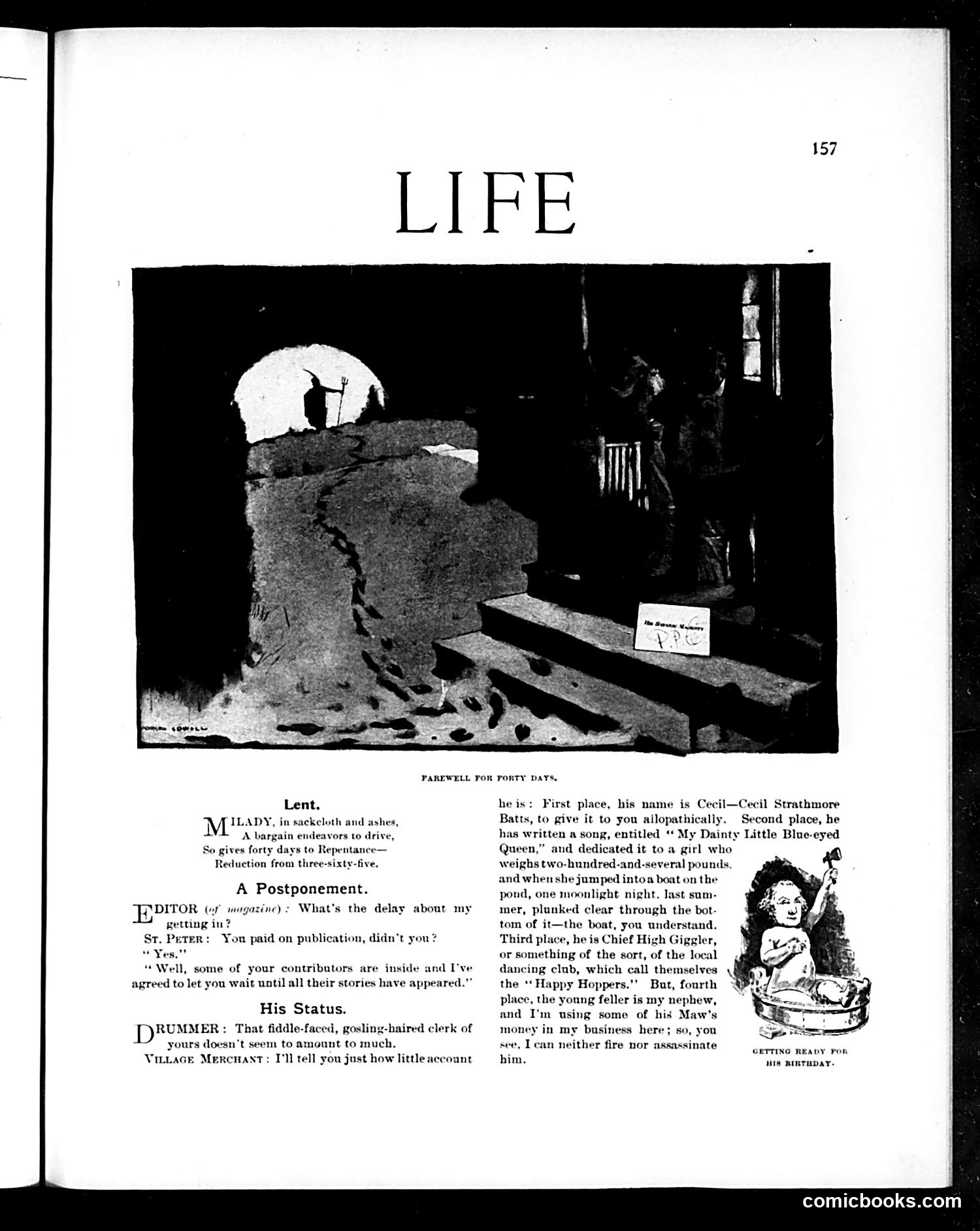
This page contains three separate satirical pieces typical of early Life magazine humor: 1. **"Farewell for Forty Days" (Lent)**: A poem mocking religious Lenten observance, suggesting hypocritical piety during the forty-day period. 2. **"A Postponement"**: A brief joke about an editor delaying magazine publication until all contributors' stories arrive—satirizing editorial delays and contributor reliability. 3. **"His Status"**: A humorous exchange between a drummer and village merchant about debt collection, poking fun at traveling salesmen and their financial irresponsibility. The illustration shows what appears to be a theatrical or mining scene with figures and moonlight, likely accompanying the Lent poem. The small illustration of a baby ("Getting Ready for His Birthday") appears decorative. The humor targets contemporary social types: hypocritical religious observance, publishing inefficiency, and transient salesmen.
This page is primarily **text-based obituary or memorial content**, not a political cartoon. It appears to be mourning **Mr. Whitney**, describing him as an exceptionally talented and generous man who served in public service for twelve years. The article praises his character—his mental power, judgment, kindness, and willingness to help others. It notes he accumulated significant wealth but chose not to pursue politics despite being well-suited for it. The accompanying **decorative illustrations** (ornamental vignettes with natural motifs) are standard period design elements, not satirical commentary. This reads as a sincere tribute rather than satire, likely memorializing a prominent businessman or public figure whose specific identity remains unclear from the visible text alone.
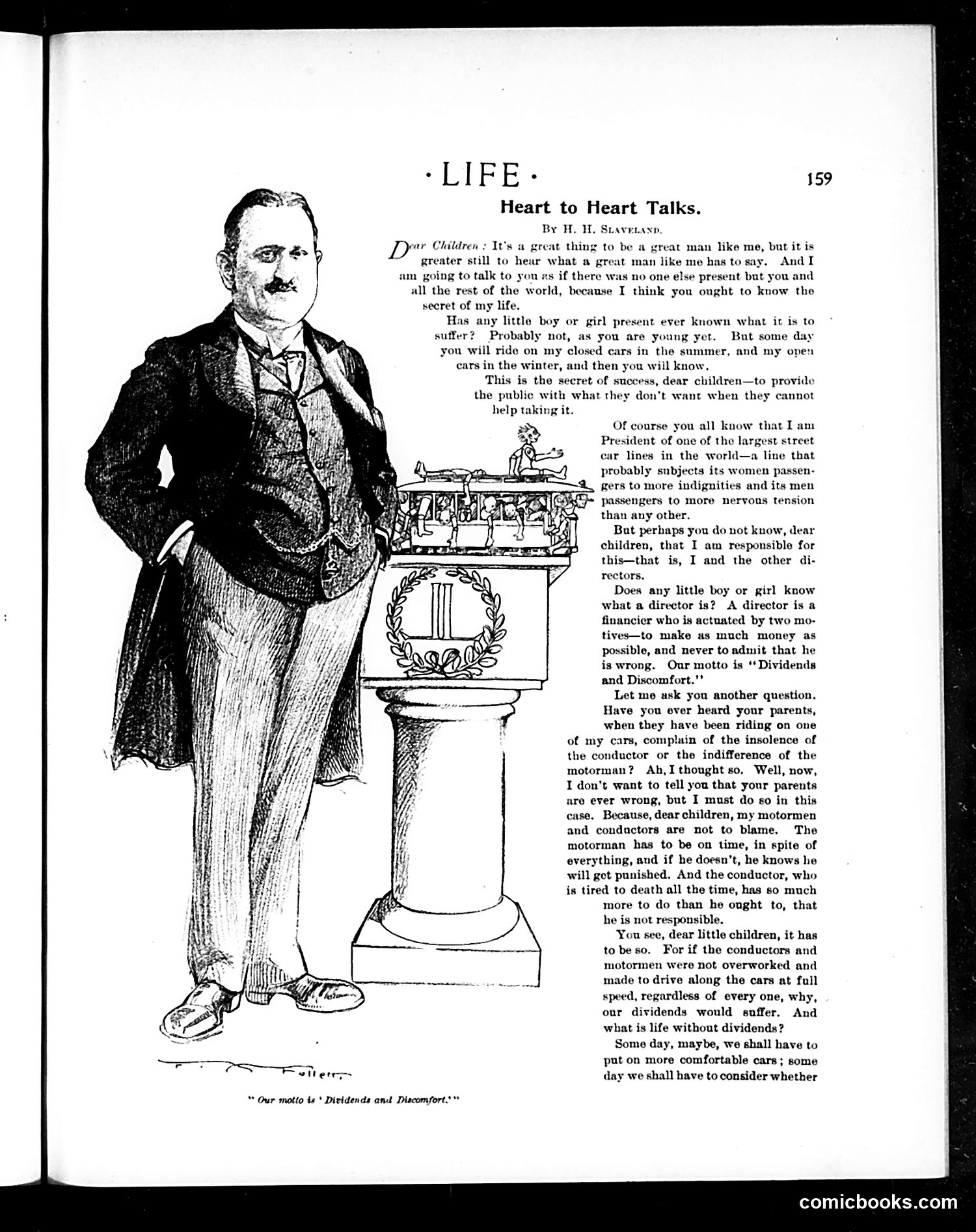
This is a satirical piece by H. H. Slayland featuring a well-dressed man (identified by his motto "Dividends and Discomfort") addressing children about life lessons. The speaker appears to be a railroad executive or transit company president, based on the streetcar illustration he displays. The satire targets corporate exploitation: the speaker cynically justifies overworking motormen and conductors to maximize profits ("dividends"), dismissing complaints about their harsh conditions. He frames this abuse as necessary and inevitable, asking children rhetorically whether life without dividends is worth living. The cartoon mocks how industrial capitalists rationalize worker mistreatment to shareholders and the public, presenting greed as justified economic principle rather than exploitation.
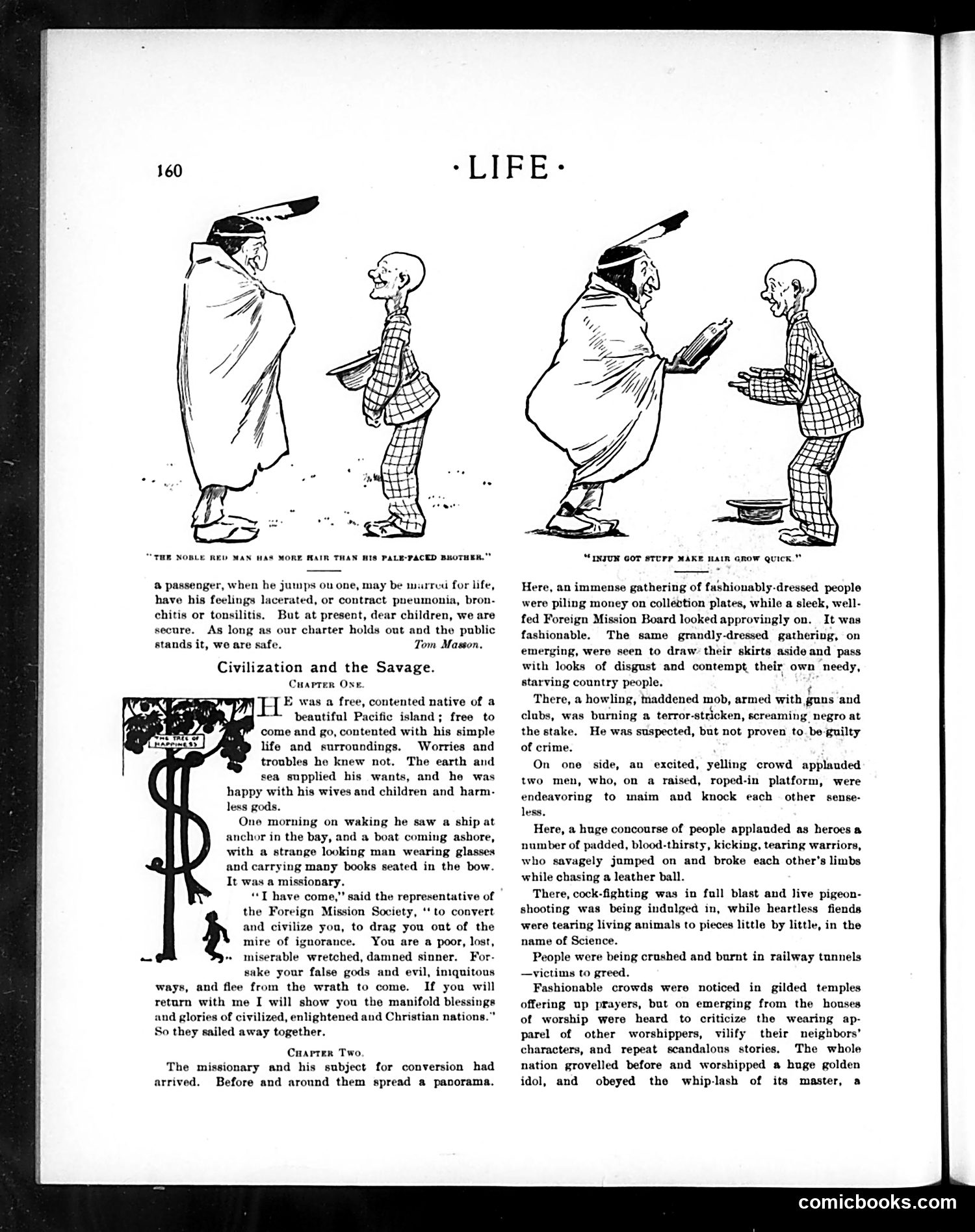
This page from *Life* magazine satirizes Western missionary work and colonialism in the Pacific. The top cartoons mock hypocrisy: a missionary with a feathered headdress tells a native Islander that "civilization" will cure his ailments, while the text notes the missionary ironically has more hair than his "pale-faced brother." The longer satirical narrative criticizes missionary activity as exploitative and culturally destructive. It describes a "free, contented native" corrupted by missionary contact, then depicts scenes of colonial "civilization"—violence, cock-fighting, animal cruelty, wealth disparity, and false piety. The satire suggests that Western missionaries and colonizers bring not enlightenment but moral degradation, greed, and suffering to indigenous populations. The piece is fundamentally anti-imperialist, attacking both the missionary enterprise and broader colonial attitudes masquerading as benevolent "civilization."
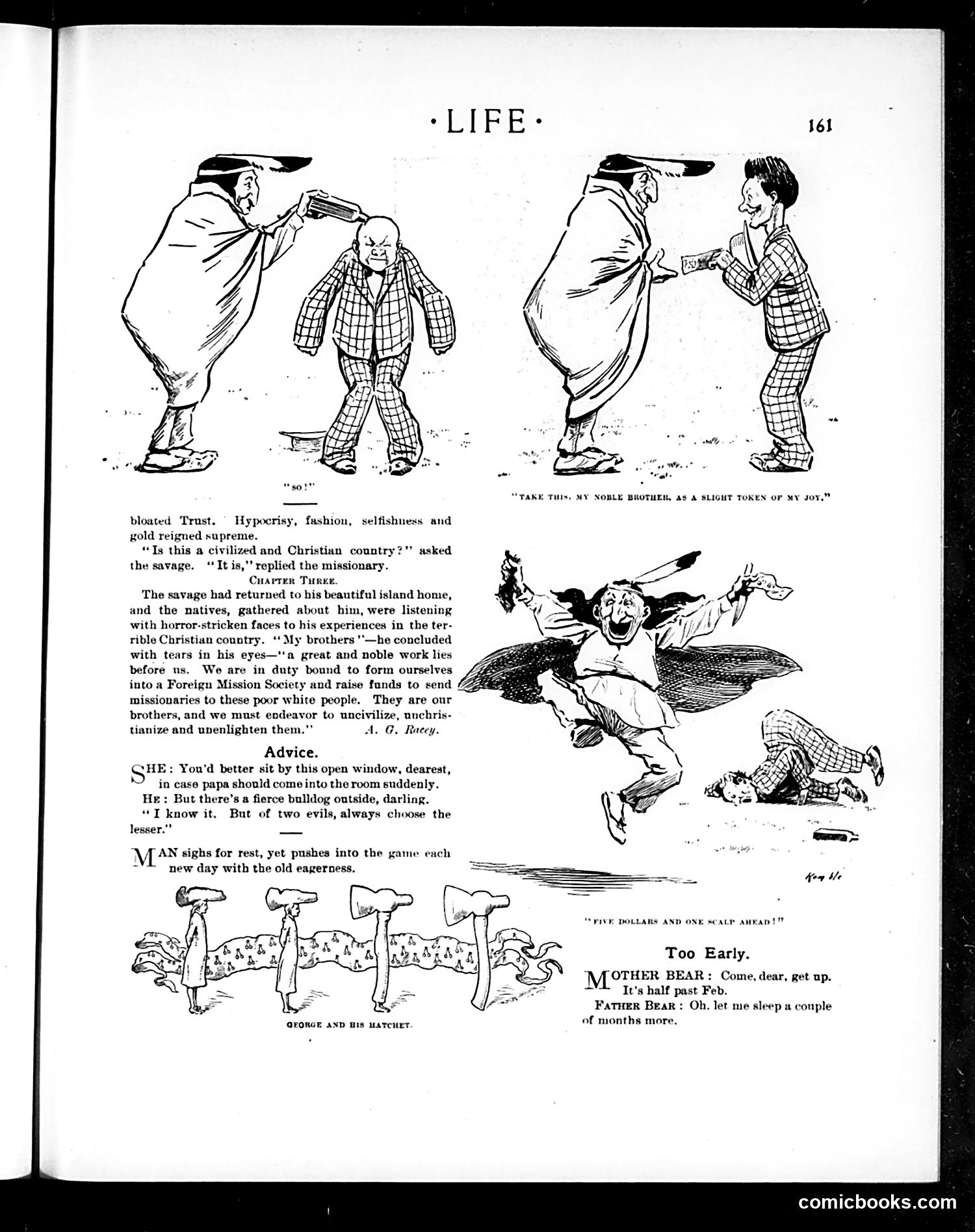
This page contains several satirical cartoons and humorous sketches typical of early-20th-century American humor: **Top panels**: A tall figure in a cape (appearing to represent arrogance or pretension) interacts with a shorter man in checkered clothing, demonstrating contrasting social positions or attitudes. **Middle cartoon**: A winged figure labeled "FIVE DOLLARS AND ONE HALF AHEAD!" suggests gambling or competitive excess. **Bottom section**: A sketch labeled "GEORGE AND HIS HATCHET" depicts multiple figures in similar poses, likely referencing the George Washington cherry tree legend—a satirical commentary on repetitive American mythology. The page mixes social satire about class distinctions, greed, and American cultural touchstones with domestic humor ("Too Early," showing bears arguing about hibernation schedules). The overall tone is lighthearted mockery of contemporary attitudes and behaviors.
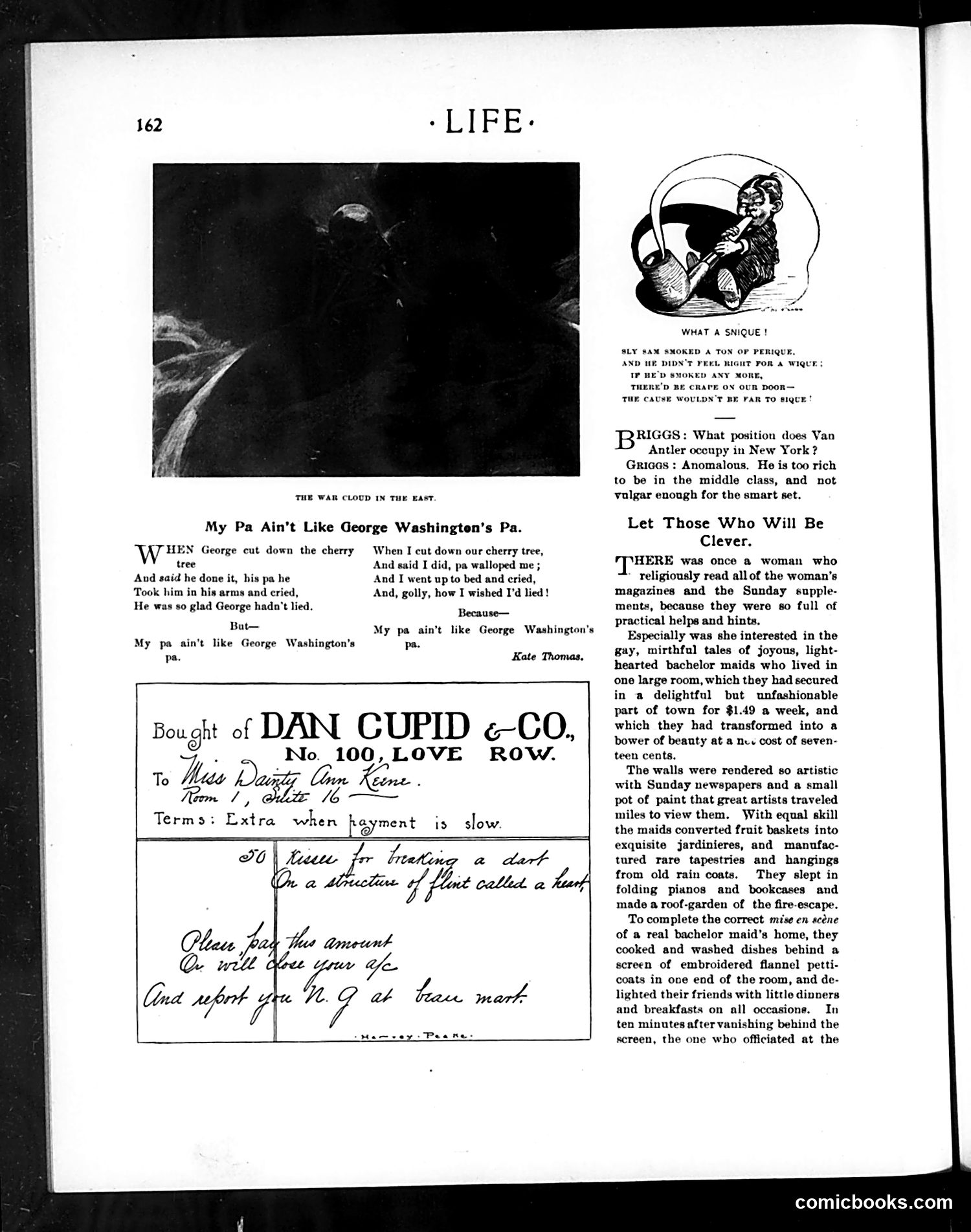
This page contains a sentimental poem titled "My Pa Ain't Like George Washington's Pa" by Kate Thomas, which humorously contrasts the speaker's father unfavorably with George Washington's father (who, according to legend, punished young George for cutting down a cherry tree). The poem's joke relies on the famous Washington anecdote about honesty and parental discipline. The page also includes a humorous advertisement for "Dan Cupid & Co." at "Love Row," written in cursive script with tongue-in-cheek romantic language. Additionally, there's a brief Q&A about Van Antler's social position in New York, and an unrelated story titled "Let Those Who Will Be Clever" about women creating an artistic bachelor-pad home. The illustrations are typical early-20th-century magazine decoration.
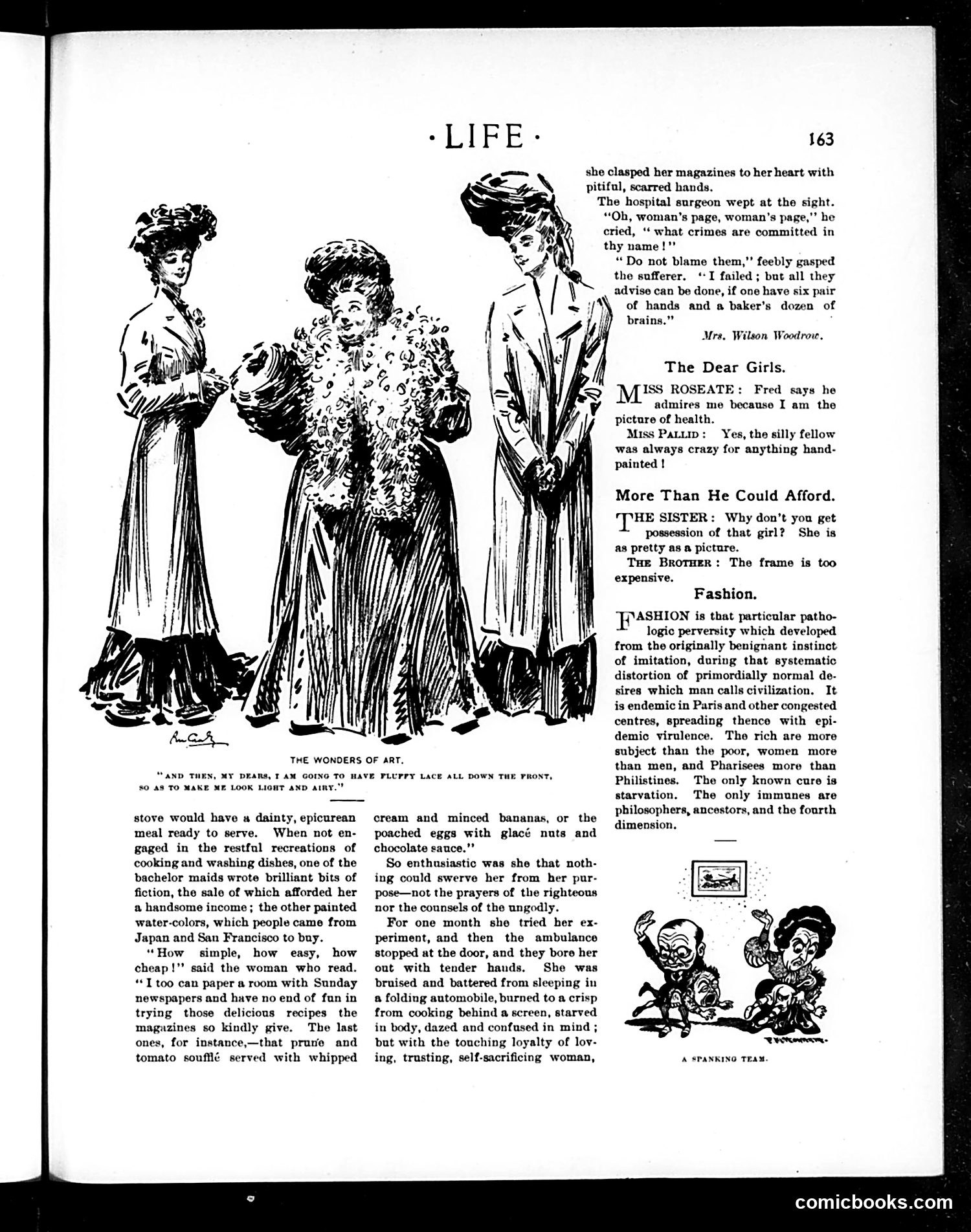
This page contains multiple satirical pieces mocking women's magazines and fashion culture of the early 1900s. **"The Wonders of Art"** (main illustration): Three fashionably dressed women display absurdly elaborate clothing. The caption satirizes women's magazine advice—one woman attempted to follow magazine recipes and household tips literally for a month, resulting in her hospitalization, bruised and starved. The satire targets the impracticality of magazine advice and women's blind devotion to such publications. **"The Dear Girls" and "More Than He Could Afford"**: Brief comic exchanges mocking courtship and materialism—a man admires a woman's health (actually hand-painted makeup), and a brother cannot afford an expensive picture frame for a pretty girl. **"Fashion"** (essay): A pseudo-academic definition treating fashion as a psychological disease endemic to Paris, affecting women more than men, with "starvation" as the only cure. This mock-serious tone satirizes both fashion obsession and intellectualized social commentary. The overall point: ridicule of women's susceptibility to magazine trends and fashion's wasteful, impractical demands.
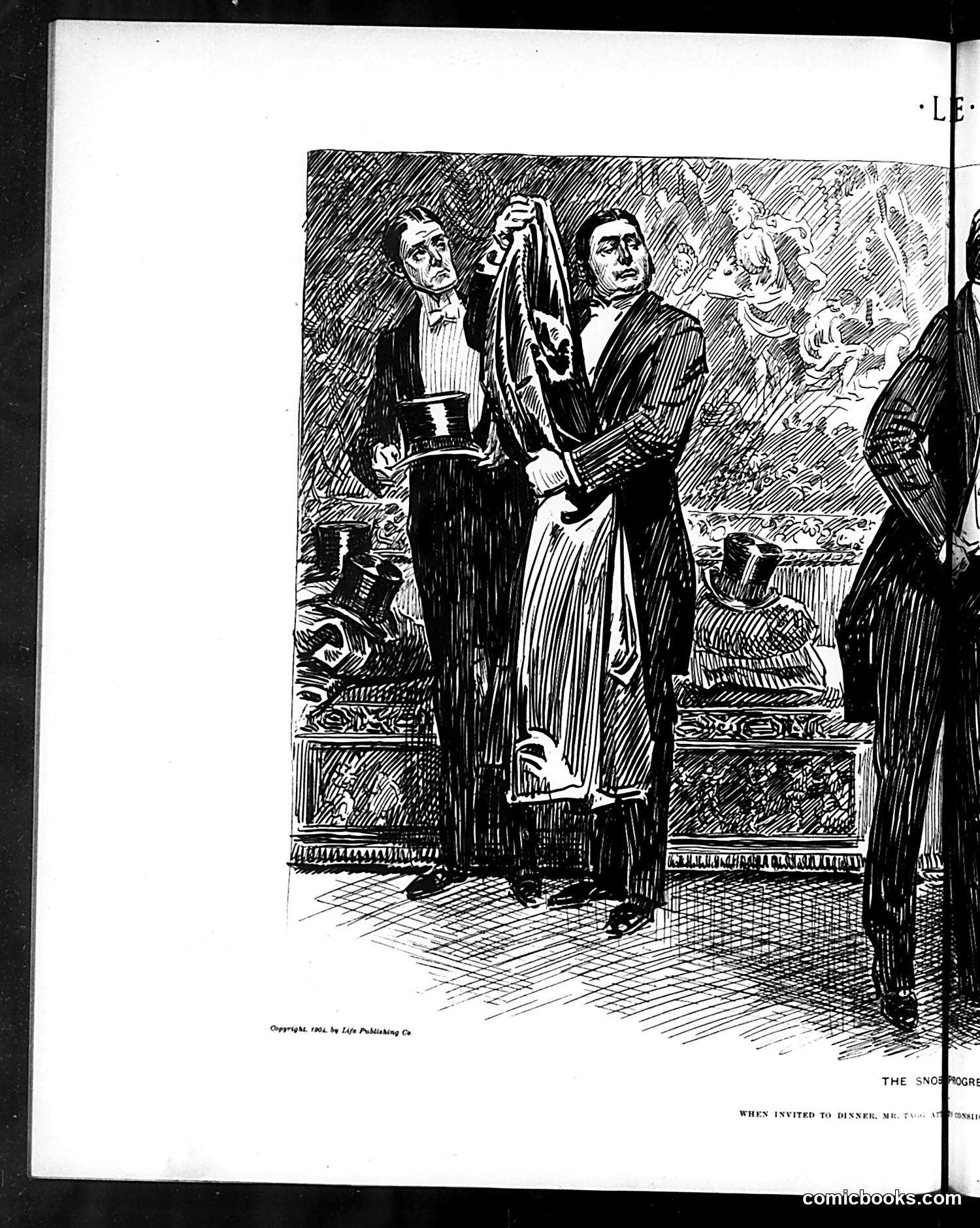
This 1904 Life magazine illustration appears to satirize social climbing and pretension among the wealthy. The cartoon shows well-dressed men in formal attire (tuxedos and evening wear) in an ornate interior setting, with one figure prominently displaying what appears to be fine dining accessories or tableware. The caption "The Snob's Progress" and partial text mentioning "When invited to dinner" suggests the satire targets ostentatious display of wealth and refined tastes at formal dinners. The exaggerated formal dress and elaborate furnishings mock the pretentiousness of high society gatherings. This reflects early 1900s American satire of nouveau riche behavior and the affectations of upwardly mobile social climbers attempting to display culture and refinement.
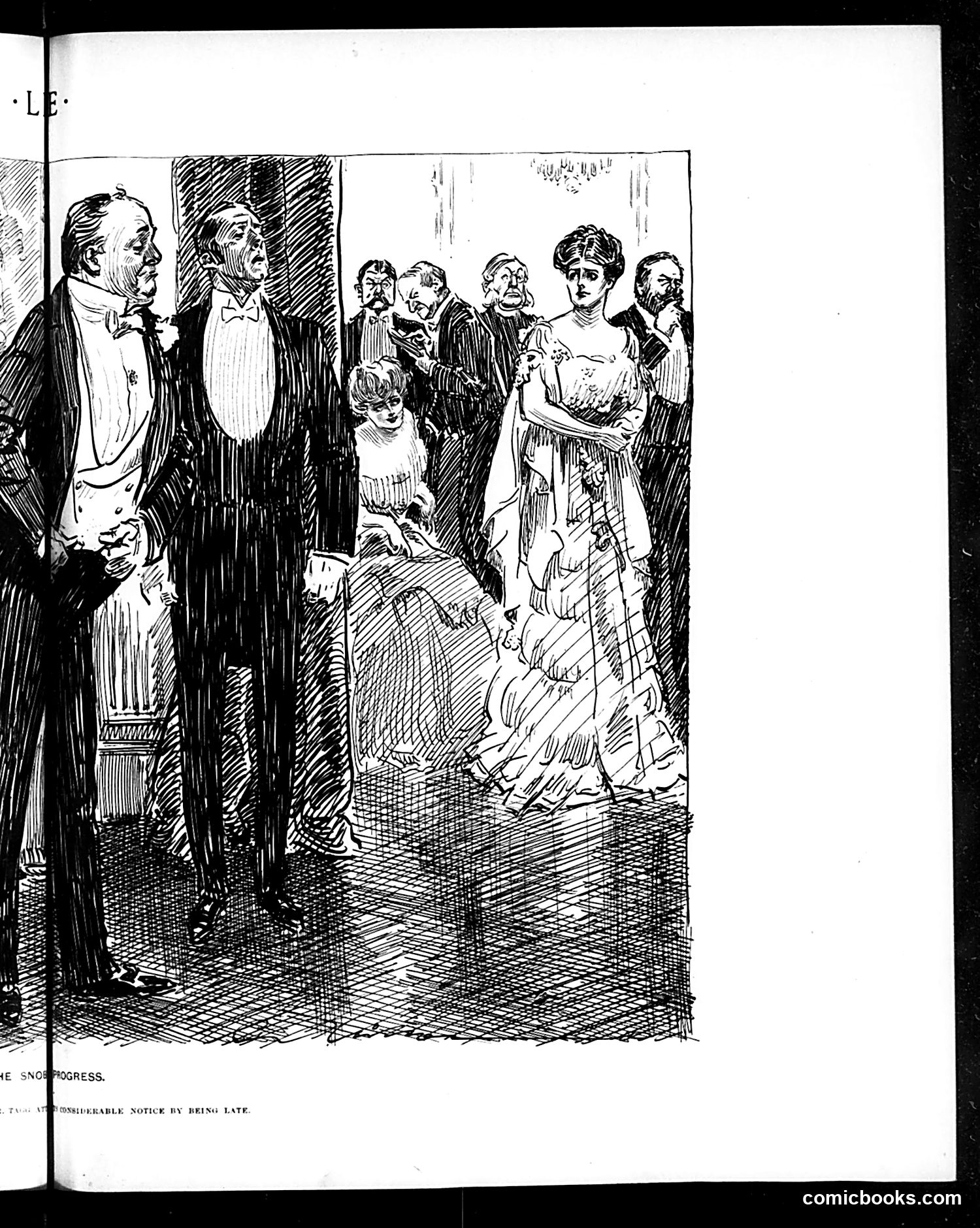
The OCR text is too corrupted to read clearly. However, the cartoon itself depicts a formal social gathering—likely a ball or reception—with well-dressed men in tuxedos and women in evening gowns. The visible caption fragment "THE SNOB PROGRESS" and partial text about "NOTICE BY BEING LATE" suggest this is satirizing social pretension and status anxiety among the wealthy. The scene appears to mock upper-class conventions: attendees observing strict formality, the emphasis on fashionable dress and punctuality as markers of respectability. The cartoon likely critiques how social climbers use artificial rules and careful timing to signal their elite status. Without clearer text, I cannot identify specific figures or pinpoint the exact social critique intended.
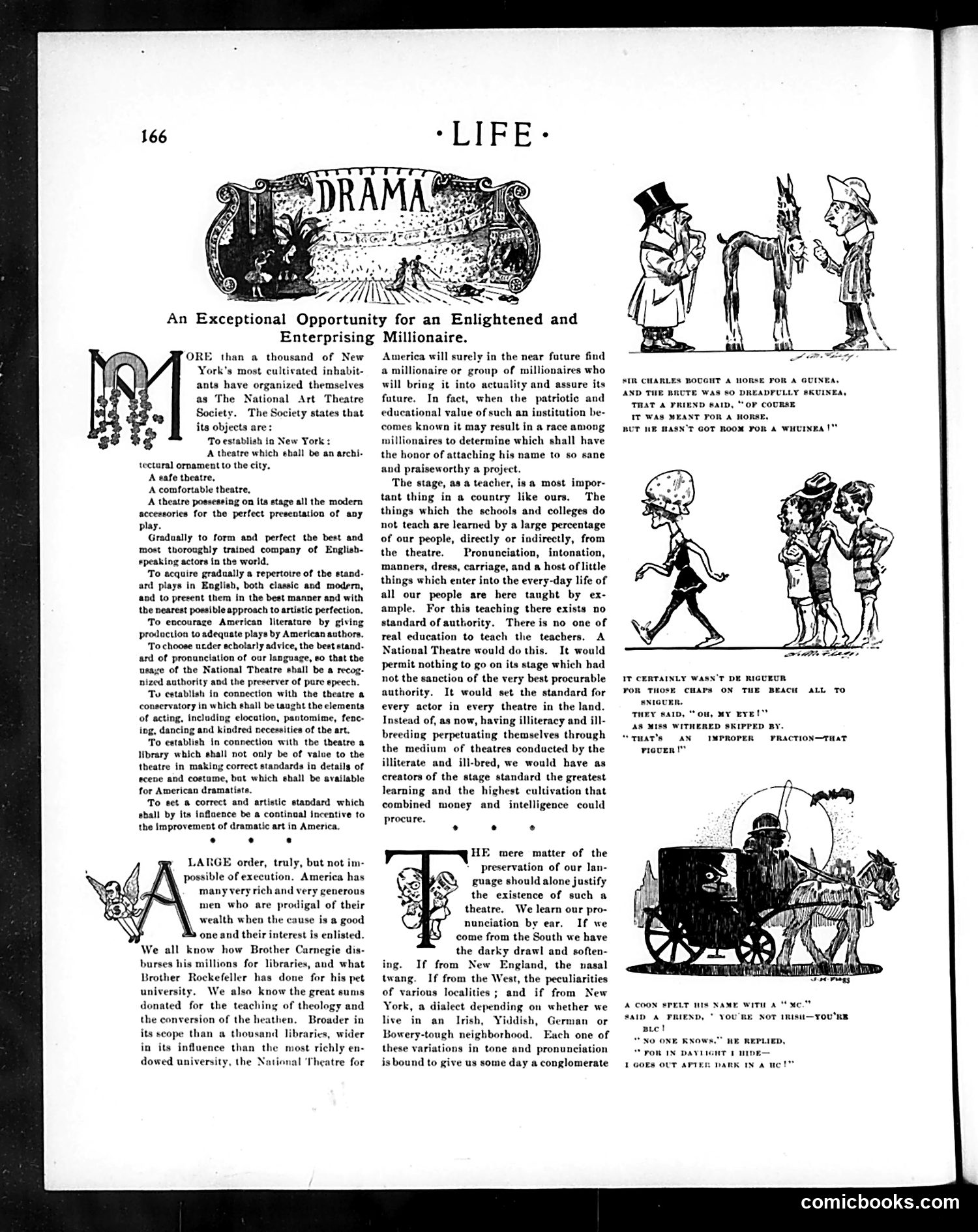
This page promotes the establishment of a **National Art Theatre Society** in New York—a cultural institution proposed by wealthy philanthropists to create an elite theatrical venue with attached conservatory and library. The accompanying cartoons satirize the **pretentiousness and expense** of such an ambitious undertaking. The sketches depict various comedic scenarios: a man in a top hat negotiating with what appears to be theatrical figures, and a scene with a carriage and formally-dressed characters. The dialogue snippets mock the project's grandiosity—one caption references someone unable to afford a guinea (a costly coin) for theater tickets. **The satire's point**: While the article earnestly argues for theater as a civilizing moral force and educational tool, the cartoons suggest the endeavor is impractical, expensive, and inaccessible to ordinary people. The juxtaposition critiques the philanthropic pretense of the wealthy—they claim cultural uplift while creating institutions beyond most citizens' reach. This reflects early 1900s debates about whether "high culture" genuinely served democracy or merely displayed elite status.
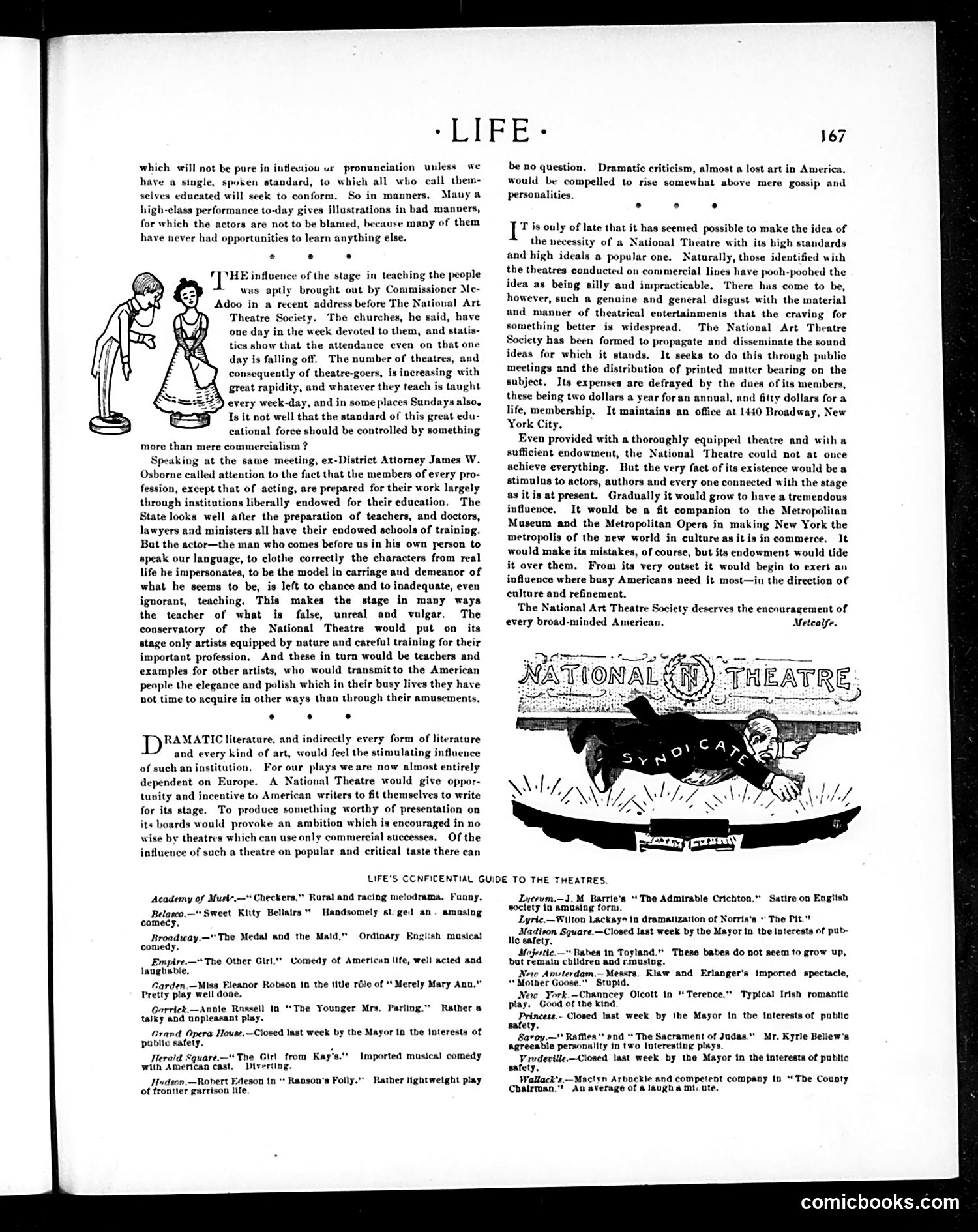
This page discusses the **National Art Theatre Society**, an organization advocating for a state-funded, high-quality national theatre in America modeled on European institutions. The small illustration shows two figures in classical theatrical dress, likely representing idealized theatrical performance or the arts. **The argument presented:** Speakers (Commissioner McAdoo and ex-District Attorney James W. Osborne) contend that theatre—which reaches more Americans than churches—should be regulated for quality, not just profit. Unlike other professions (law, medicine, teaching), acting lacks formal educational institutions. This leaves actors unprepared and the stage teaching "false, unreal and vulgar" lessons to the public. **The satire's point:** The page criticizes American theatre's commercialism and argues a government-supported National Theatre would elevate dramatic standards, encourage American playwrights, and restore "dramatic criticism" as a serious art form rather than mere gossip. The *National Theatre* logo at bottom suggests this was promotional material for the Society's actual educational mission.
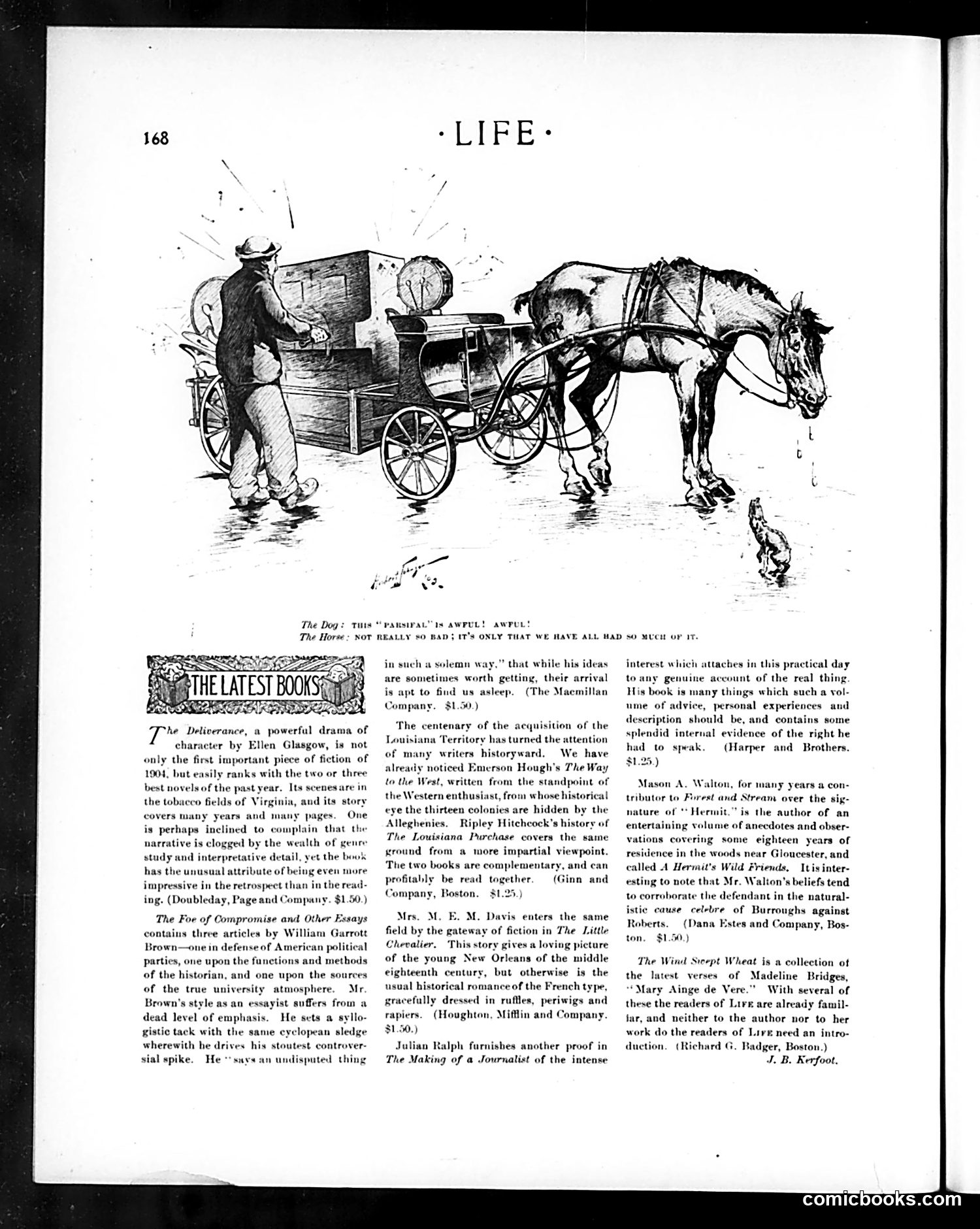
This page combines a satirical cartoon with book reviews. The cartoon depicts a man and horse-drawn cart in conversation. The dog complains the opera "Parsifal" is "awful," while the horse responds dismissively that it's "only that we have all had so much of it"—suggesting oversaturation and jadedness about high culture rather than genuine poor quality. The satire targets urban sophistication: even working animals supposedly appreciate Wagner, yet complain of boredom rather than incomprehension. It mocks the pretension of calling something culturally refined while admitting you're simply tired of it. Below, "The Latest Books" reviews contemporary 1904 publications, including Ellen Glasgow's *The Deliverance* and works on the Louisiana Territory centenary, positioning literary discussion as part of cultured Life magazine readership—the very audience the cartoon gently ridicules for affected worldliness.
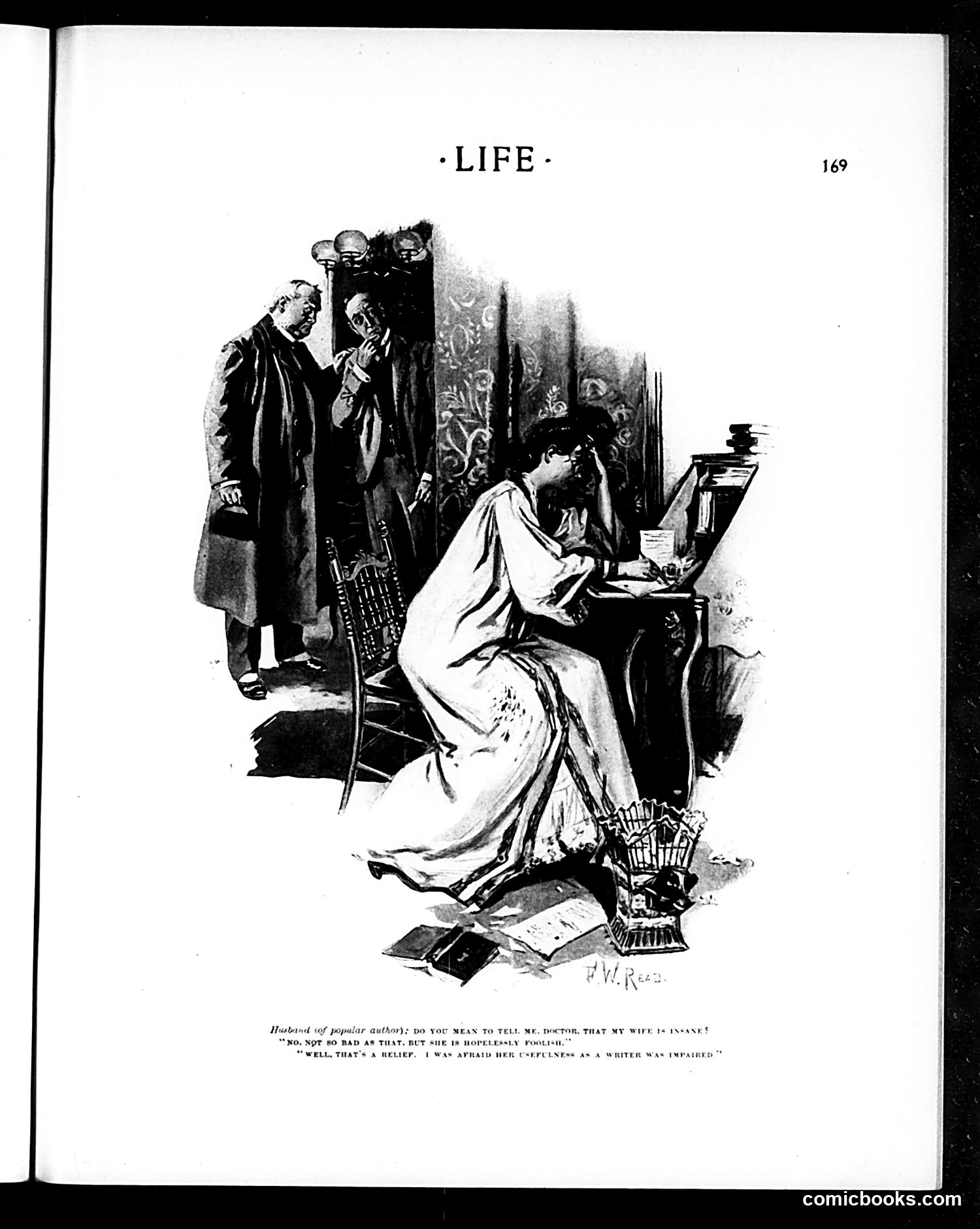
This satirical cartoon depicts a husband consulting a doctor about his wife's writing. The husband is a "popular author" seeking medical reassurance that his wife's literary aspirations aren't a sign of insanity. The joke critiques gender attitudes of the era: the husband treats his wife's writing ambitions as a potential mental health concern rather than a legitimate pursuit. His relief that she's merely "foolish" rather than genuinely impaired reveals the satirical target—the absurdity of men dismissing women's intellectual and creative ambitions as irrational or pathological. The cartoon mocks both the husband's patronizing attitude and the period's broader resistance to women's professional and creative independence. The satire suggests that considering a woman a writer was itself considered grounds for medical concern.
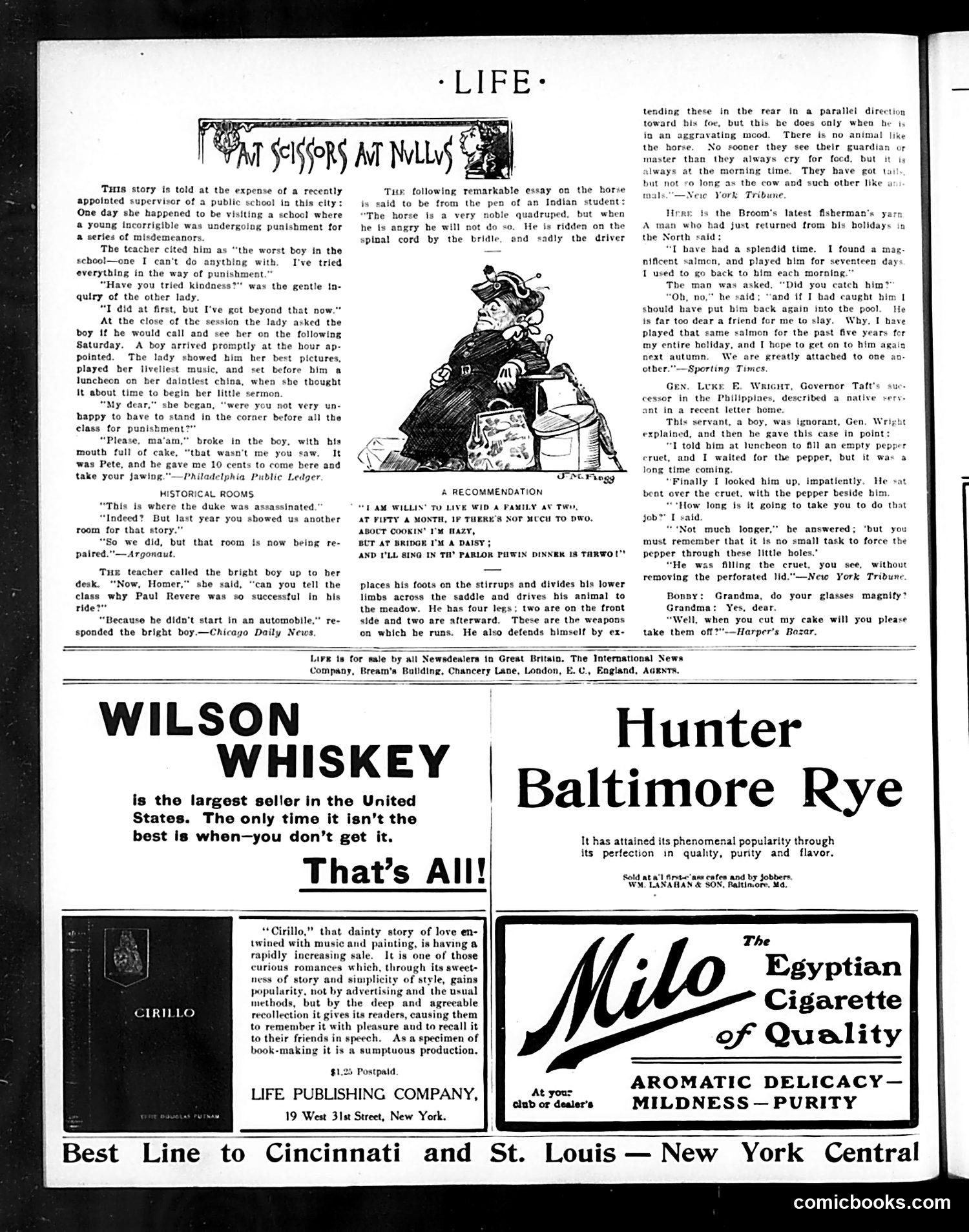
This page contains multiple brief humorous anecdotes rather than a single political cartoon. The main illustrated piece, "Scissors at Nulls," satirizes progressive educational reform through a story about a newly appointed school supervisor. The joke: The supervisor, embodying fashionable "kindness" pedagogy, invites a supposedly incorrigible boy to her home, treating him to music, pictures, and cake before delivering a moral lecture. The boy reveals he was paid ten cents by another student (Pete) to attend—he's not the punished student at all. **The satire targets**: Early 1900s progressive educators who believed punishment should be replaced with gentleness and kindness. The cartoon suggests such methods are naive and easily exploited, particularly by clever working-class youth. The anecdote mocks the supervisor's good intentions as ineffective against street-smart children. This reflects contemporary debates about educational philosophy, where traditional discipline faced challenges from progressive reformers—a tension the magazine's conservative audience apparently found amusing.
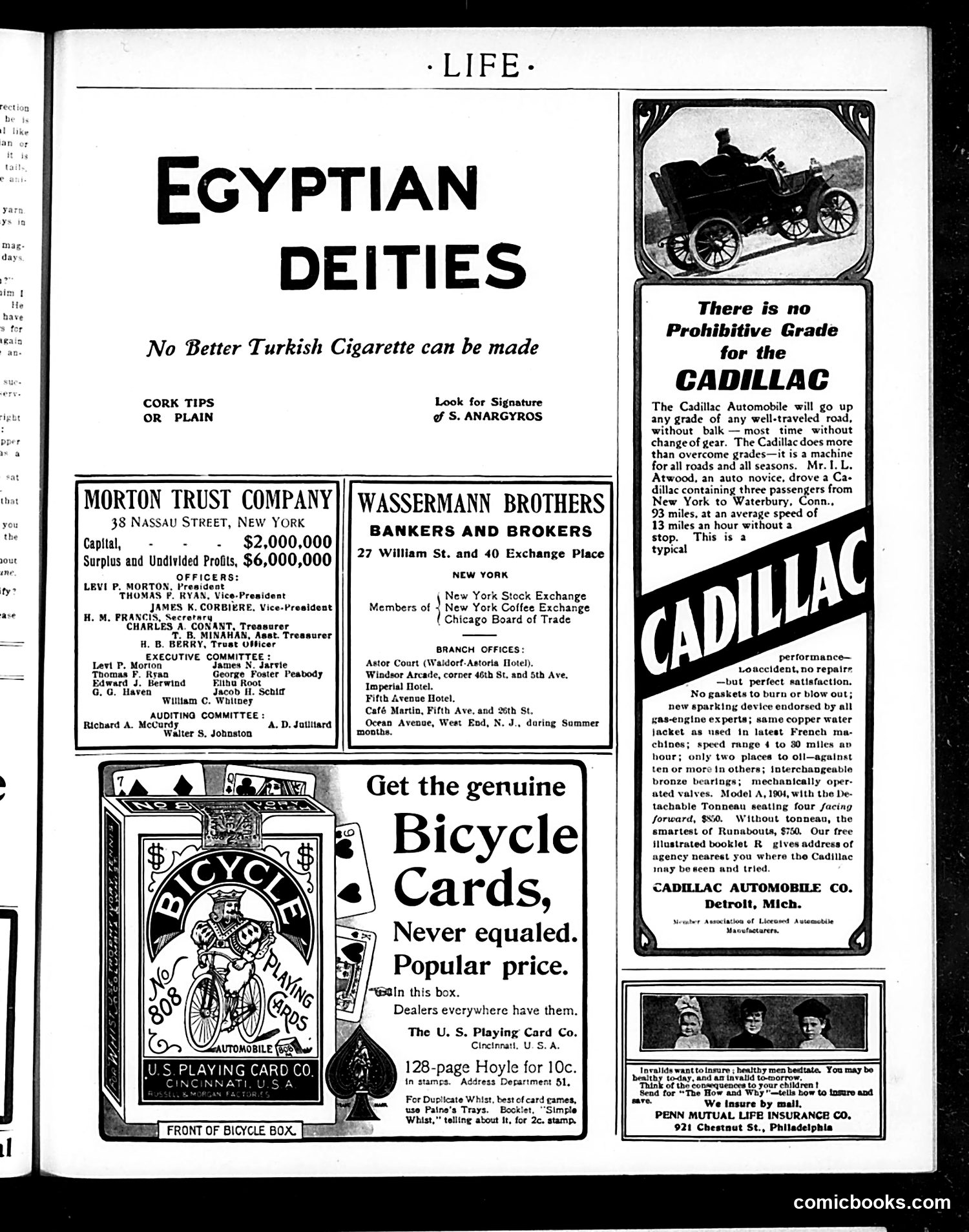
This page is **primarily advertising**, not satirical content. The headline "Egyptian Deities" refers only to Egyptian Deities cigarettes—a brand advertisement claiming superiority in Turkish tobacco. The page contains financial institution ads (Morton Trust Company, Wassermann Brothers bankers), product advertisements (Cadillac automobiles, Bicycle playing cards, Penn Mutual Life Insurance), and cigarette branding. The only potential satirical element is subtle: the cigarette brand name "Egyptian Deities" ironically positions a commercial product as something quasi-religious or elevated—a common advertising trope of the era that mocked consumer culture's tendency to treat consumer goods as objects of worship. The Cadillac ad emphasizes reliability and performance for the "auto novice," reflecting early-1900s automobile marketing targeting hesitant buyers unfamiliar with vehicles. This appears to be a standard **commercial page from Life magazine**, which balanced satirical editorial content with substantial advertising revenue.
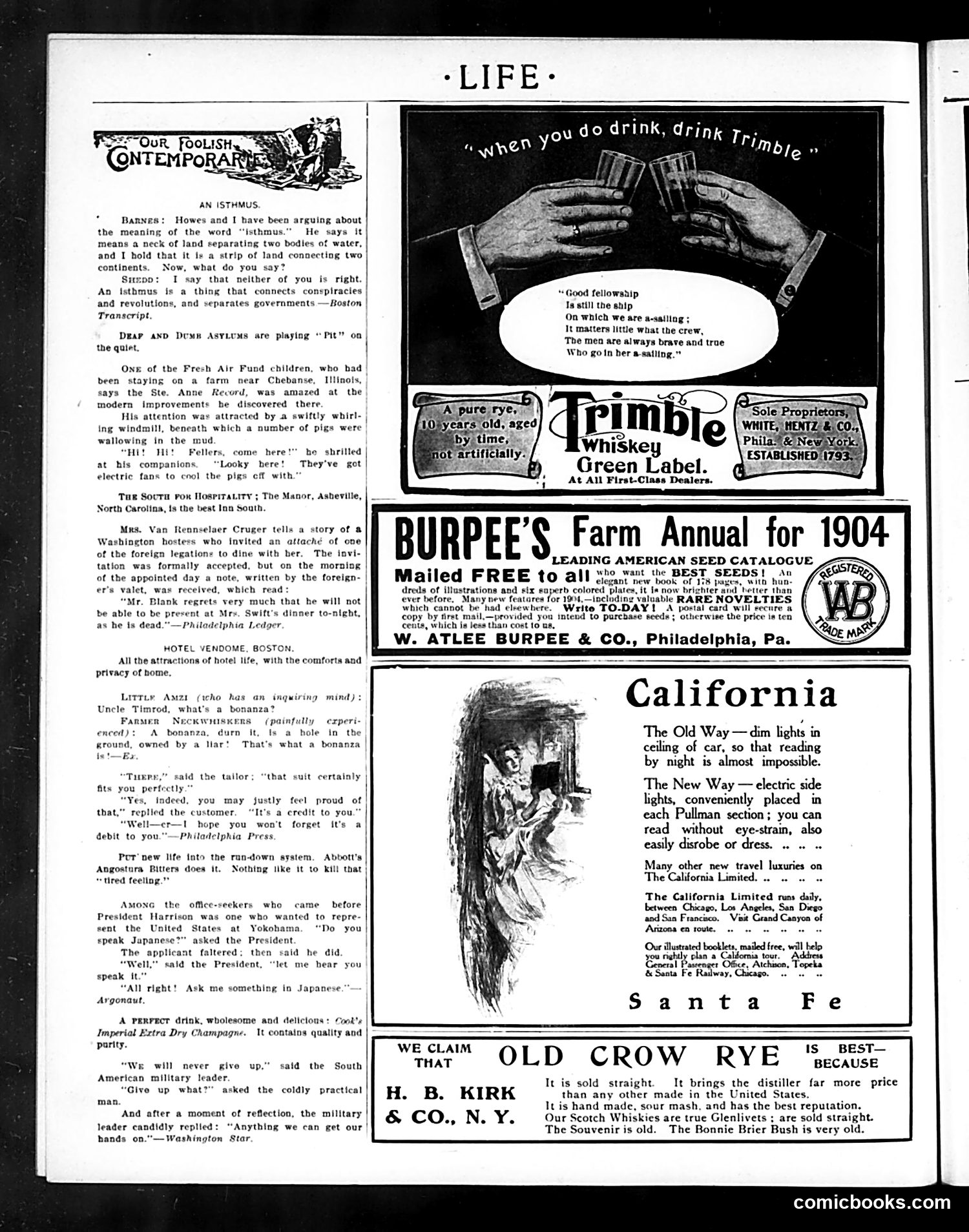
This page combines several satirical pieces typical of early 1900s Life magazine humor: **The "Isthmus" joke** opens with a debate about the word's definition, then a Boston Transcript editorial redefines it as "a thing that connects conspiracies and revolutions, and separates governments"—likely a jab at political corruption and governmental instability of the era. **Other anecdotes mock** various subjects: a farm child amazed by modern conveniences (rural ignorance), diplomatic incompetence (an unqualified ambassador to Japan who doesn't speak Japanese), and class-based humor (servants, tailors, military leaders). The page is primarily **advertisements** for Trimble Whiskey, Burpee's Seeds, Santa Fe Railway, and Old Crow Rye—showing how Life blended editorial content with commercial messaging. The humor relies on **class satire, ethnic stereotyping, and observations of American social pretension**—typical of the magazine's satirical approach during the Progressive Era.
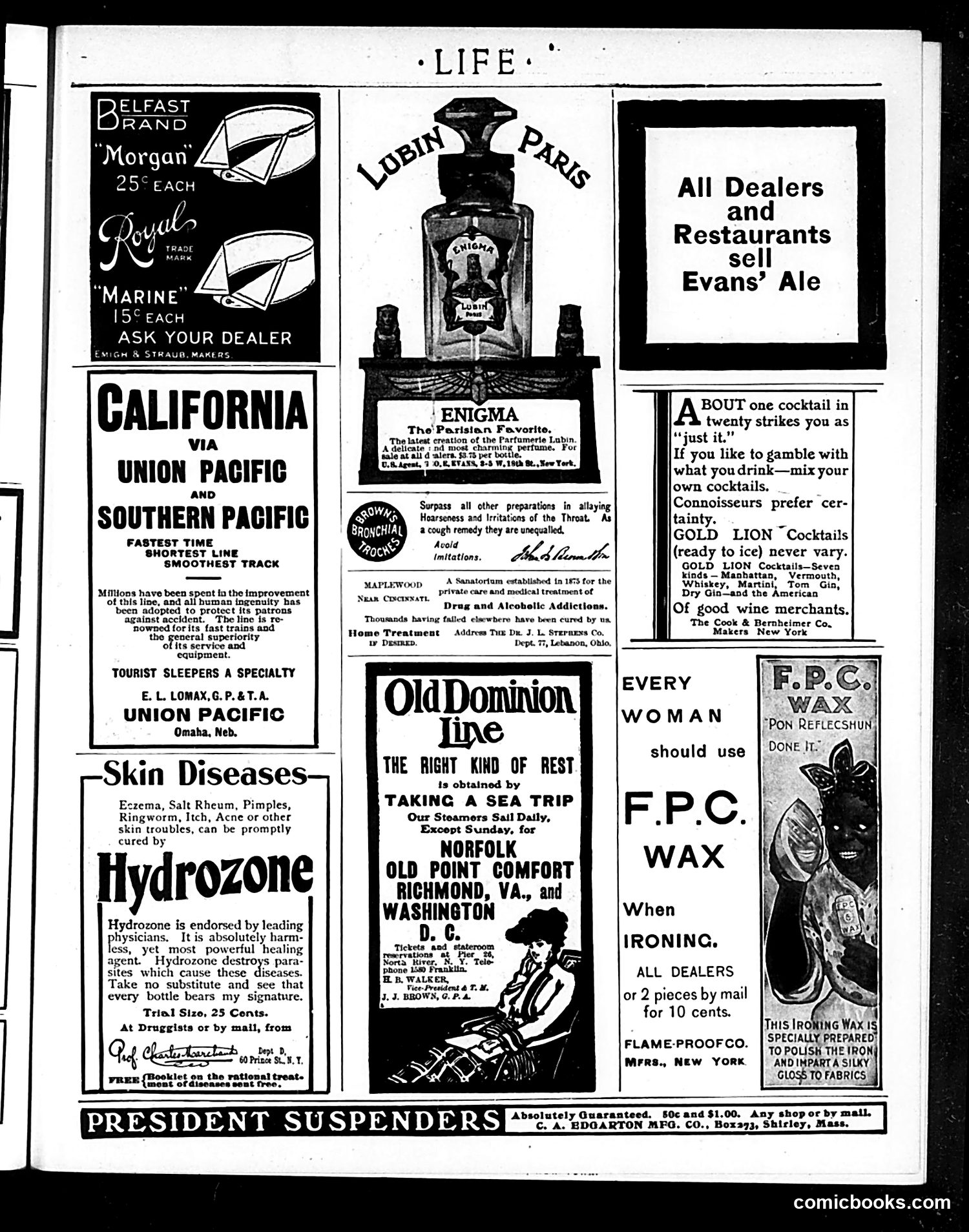
This is primarily an **advertising page** from Life magazine, not a satirical cartoon page. It contains vintage product advertisements typical of the early 1900s. Notable ads include: - **Transportation**: Union Pacific and Southern Pacific railroads competing for passengers - **Patent medicines**: Hydrozone (for skin diseases), treatments for drug/alcohol addiction—reflecting an era before FDA regulation when unproven remedies were widely advertised - **Luxury goods**: Lobin Paris perfume, Gold Lion cocktails (pre-made drinks), Evans' Ale - **Travel**: Old Dominion steamship line The ads reveal period attitudes: casual promotion of addiction treatments, endorsements by unnamed "physicians," and marketing strategies emphasizing safety (railroads) or convenience (ready-made cocktails). **What's striking to modern readers**: The frank advertising of remedies for serious medical conditions without scientific evidence, and the prominent placement of alcohol advertising alongside addiction treatment ads—an irony likely unintended by the publication.
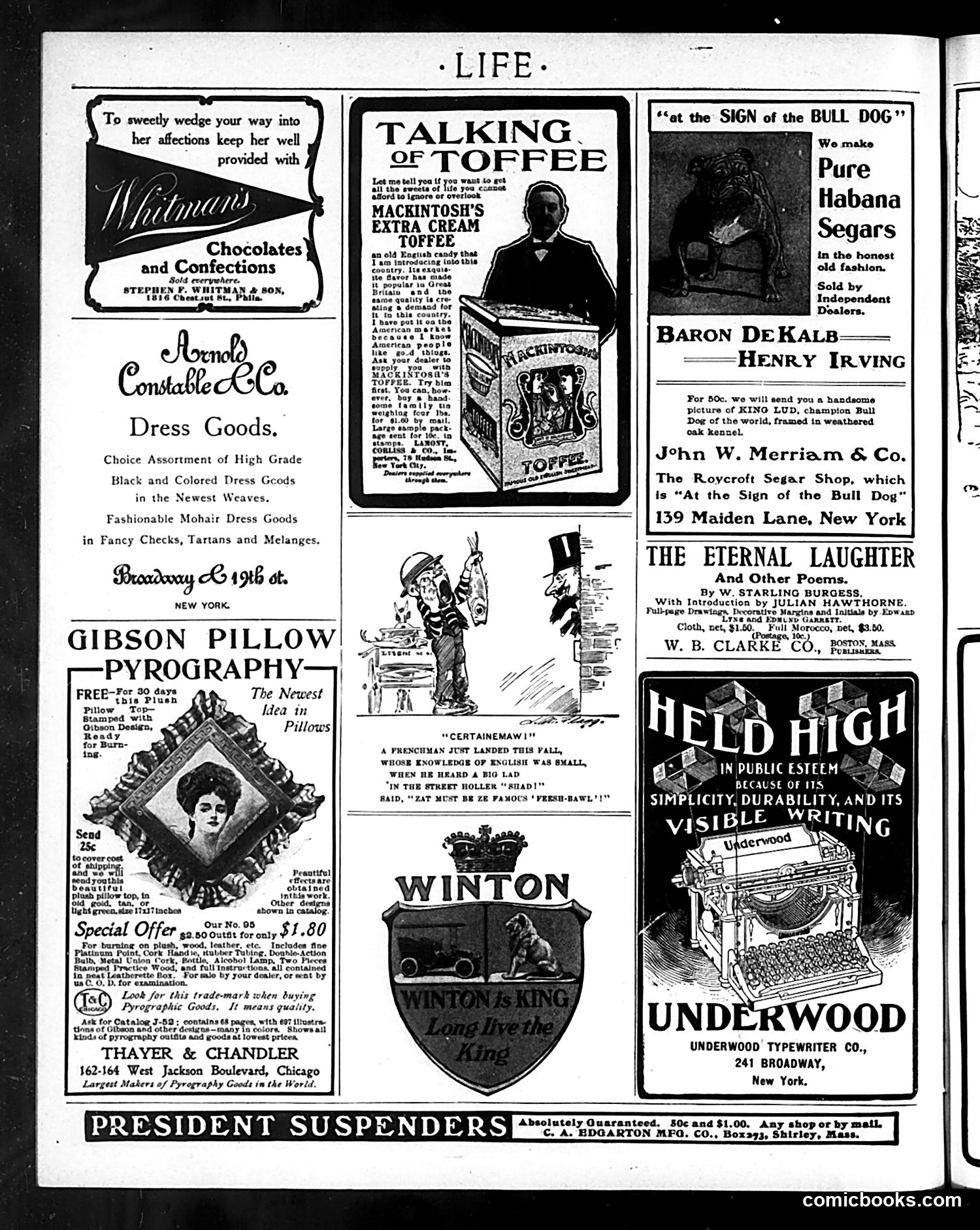
This is primarily an **advertising page** from Life magazine, circa early 1900s. Most content consists of commercial ads for consumer goods (chocolates, dress fabric, pyrography kits, toffee, cigars, books, and typewriters). The only substantive cartoon appears midway down: a **satirical joke about a French immigrant**. A newly arrived Frenchman, unfamiliar with English, hears a street child shout "Shut up!" and mistakes this common American slang for the famous "Prussian Ball"—apparently a known reference point in period culture. The humor relies on the immigrant's confusion between vulgar street language and what he assumes is refined American society. The cartoon gently mocks both the Frenchman's linguistic ignorance and, implicitly, American street manners. It reflects early 20th-century attitudes toward immigration and cultural assimilation that modern readers would find dated. The remaining content is straightforward product marketing with period-typical imagery and sales language.
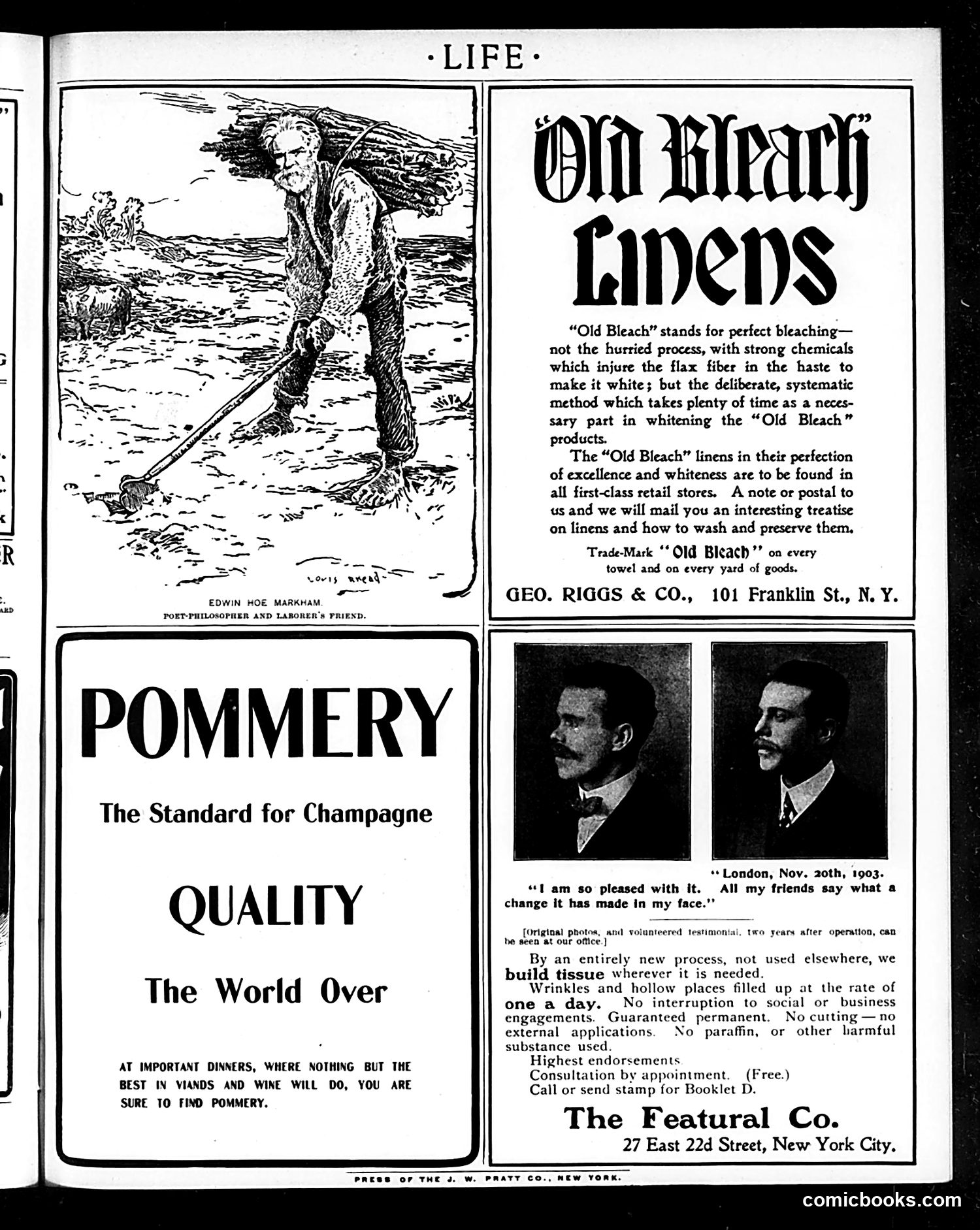
This page is primarily **advertising**, not satire or editorial content. The only non-commercial element is a sketch by Edwin Hoe Markham titled "Poet-Philosopher and Laborer's Friend"—a simple illustration of an elderly man carrying firewood, likely celebrating Markham as a working-class advocate. The three advertisements promote: 1. **Old Bleach Linens**—emphasizing slow, gentle whitening versus harsh chemical processes 2. **Pommery Champagne**—positioned as the luxury choice for upscale dining 3. **The Featural Co.**—a cosmetic procedure business claiming to permanently fill facial wrinkles and hollows "at the rate of one a day" with no cutting or harmful substances The Featural ad includes before-and-after photographs and testimonial from London (dated 1903), suggesting this was an early cosmetic/dermatological treatment. To modern readers, the claims appear exaggerated and the procedure's safety questionable by contemporary standards.
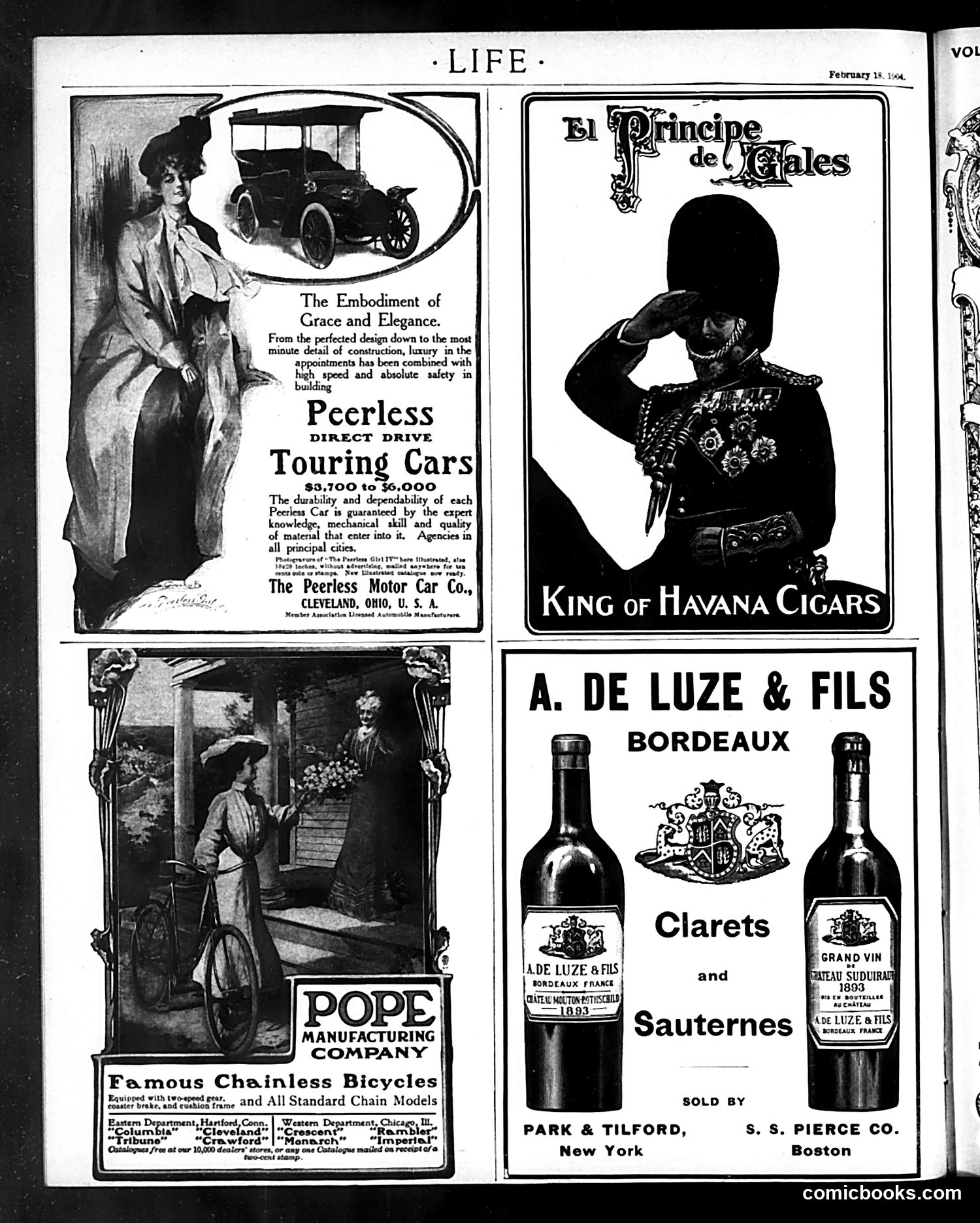
This is primarily an **advertising page**, not a satirical cartoon. It contains four luxury product advertisements typical of early-1900s American magazines: 1. **Peerless Touring Cars** ($3,700-$6,000): An automobile ad featuring an elegantly dressed woman, appealing to affluent buyers seeking "grace and elegance" and safety. 2. **El Príncipe de Gales Cigars**: A silhouetted figure in formal dress (likely referencing the Prince of Wales), marketing premium Cuban cigars. 3. **Pope Manufacturing Chainless Bicycles**: Featuring a woman on a bicycle, highlighting modern "chainless" technology and safety features. 4. **A. De Luze & Fils Bordeaux Wines**: French wine merchant advertising clarets and sauternes through New York and Boston distributors. The page reflects the **Gilded Age consumer culture**, targeting wealthy readers with imported luxuries and emerging automobile technology. The repeated imagery of fashionable women suggests marketing to or through middle/upper-class female consumers—notable for the era.