
Life, 1904-02-18 · page 16 of 26
Life — February 18, 1904 — page 16: what you’re looking at
What you’re looking at
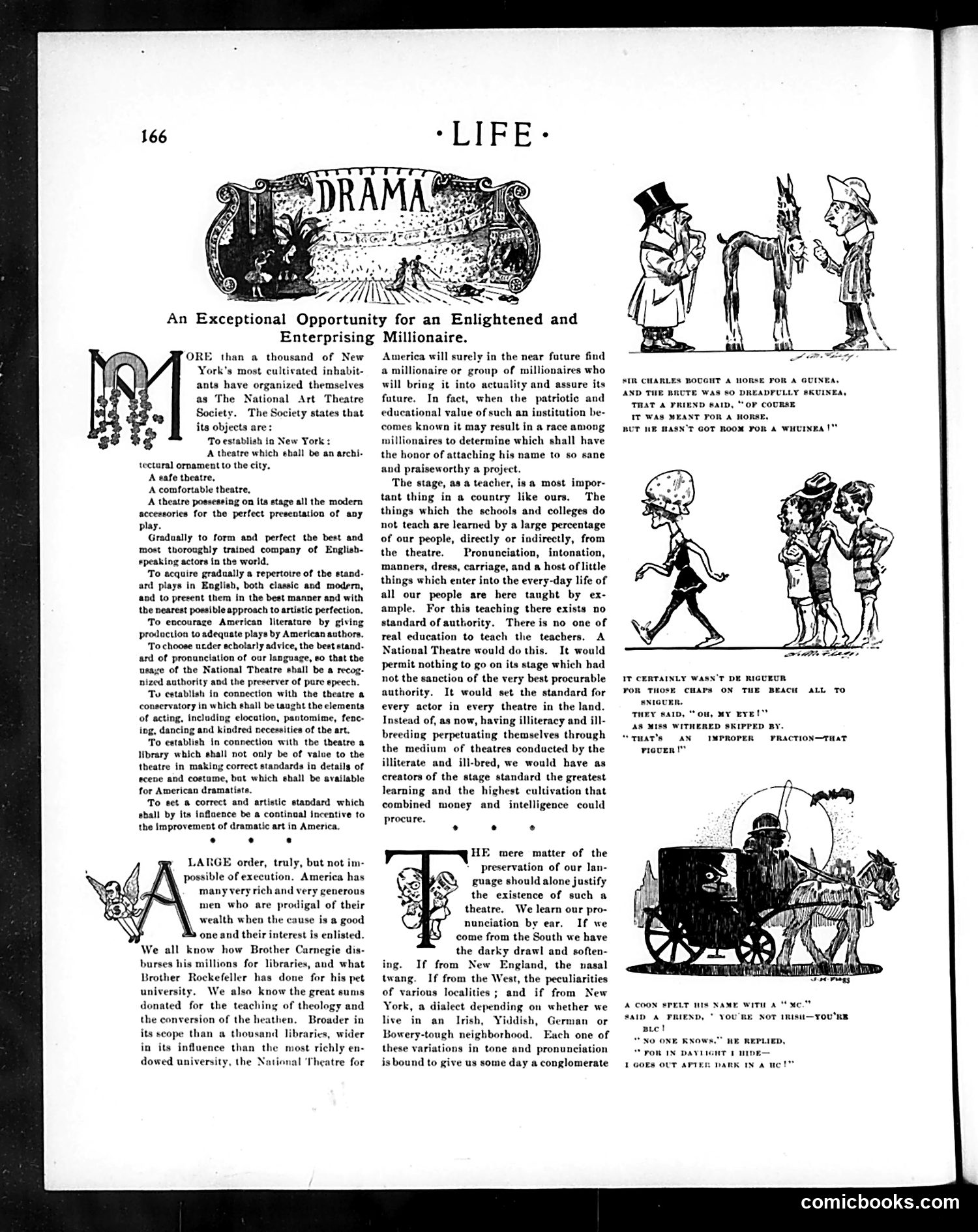
This page promotes the establishment of a **National Art Theatre Society** in New York—a cultural institution proposed by wealthy philanthropists to create an elite theatrical venue with attached conservatory and library. The accompanying cartoons satirize the **pretentiousness and expense** of such an ambitious undertaking. The sketches depict various comedic scenarios: a man in a top hat negotiating with what appears to be theatrical figures, and a scene with a carriage and formally-dressed characters. The dialogue snippets mock the project's grandiosity—one caption references someone unable to afford a guinea (a costly coin) for theater tickets. **The satire's point**: While the article earnestly argues for theater as a civilizing moral force and educational tool, the cartoons suggest the endeavor is impractical, expensive, and inaccessible to ordinary people. The juxtaposition critiques the philanthropic pretense of the wealthy—they claim cultural uplift while creating institutions beyond most citizens' reach. This reflects early 1900s debates about whether "high culture" genuinely served democracy or merely displayed elite status.
📄 Transcribed text from this page (OCR, searchable)
Machine-transcribed from the original scan — historical spelling and the odd misread are preserved.
Enterprising Millionaire. ORE than a thousand of New York's most cultivated inhabit- ants have organized themselves as The National Art Theatre Society. The Society states that its objects are: Toestablish in New York : A theatre which ehall be an archi- tectural ornament to the city. A eafo theatre, A comfortable theatre, A theatre possessing on its stage all the modern accessories for the perfect presentation of any play. Gradually to form and perfect the best and most thoroughly trained company of English- *peaking actors in the world. To acquire gradually a repertoire of the stand- ard plays in English, both classic and modern, ‘and to present them in the best manner and with the nearest possible approach to artistic perfection. ‘To encourage American literatare by giving production to adequate plays by American authors. ‘To choose utder echolarly advice, the best stand ard of pronunciation of our language, eo that the usage of the National Theatre shall be a recog- nized authority and the preserver of pure speech. To cetablish in connection with the theatre a conservatory in which shall be taught the elements of acting, including elocation, pantomime, fenc- ing, dancing and kindred necessities of the art. To establish in connection with the theatre a Wbrary which shall not only be of value to the theatre in making correct standards in details of ecene and costume, but which shall be available for American dramatists. To eet @ correct and artistic standard which eball by its influence be @ continual incentive to the improvement of dramatic art in America. . . . LARGE order, truly, but not im- possible of execution. America has many very rich and very generous men who are prodigal of their wealth when the cause is a good one and their interest is enlisted. We all know how Brother Carnegie dis- burses his millions for libraries, and what Brother Rockefeller has done for his pet university. We also know the great sums donated for the teaching of theology and the conversion of the heathen. Broader in its scope than a thousand libraries, wider in its influence than the most richly en- dowed university, the National Theatre for America will surely in the near fature find a millionaire or group of millionaires who will bring it into actuality and assure its future. In fact, when the patriotic and educational value of such an institution be- comes known it may result in a race among millionaires to determine which shall have the honor of attaching his name to so sane and praiseworthy a projec The stage, asa teacher, isa most impor- tant thing in a country like ours. The things which the schools and colleges do not teach are learned by a large percentage of our people, directly or indirectly, from the theatre. Pronunciation, intonation, manners, dress, carriage, and a host of little things which enter into the every-day life of all our people are here taught by ex- ample. For this teaching there exists no standard of authority. There is no one of real education to teach the teachers. A National Theatre would do this. It would permit nothing to go on its stage which had not the sanction of the very best procurable authority. It would set the standard for every actor in every theatre in the land. Instead of, as now, having illiteracy and ill- breeding perpetuating themselves through the medium of theatres conducted by the illiterate and ill-bred, we would have as creators of the stage standard the greatest learning and the highest cultivation that combined money and intelligence could Procure. . . ° HE mere matter of the preservation of our lan- guage should alone justify the existence of such a theatre. We learn our pro- nunciation by ear. If we come from the South we have the darky drawl and soften- ing. If from New England, the nasal twang. If from the West, the peculiarities of various localities ; and if from New York, a dialect depending on whether we live in an Irish, Yiddish, rman or Bowery-tough neighborhood. Each one of these variations in tone and pronunciation is bound to give us some day a conglomerate IR CHARLES BOUGHT A HORSE FOR A GUINEA, AND THE BRUTE WAS 80 DREADFULLY 8KUINEA, THAT A FRIEND SAID, “OP COURSE IT WAS MEANT POR A HORSE, AUT NE HASN'T GOT Room FoR A wHtUrINnA !"" TT CERTAINLY WASN'T DE RIG YOR THOSE CHAPS ON TUE BEACH sxtou} THEY saiD, “ou, MY EYE!" AS MISS WITHERED SKIPPED BY. “TUAT'S AN IMPROPER — PRACTION—THAT vioven!" ALL To A COON SPELT IIe NAME WITH A "xc." SAID A FRIEND, * YOU'RE NoT Int Bic! “NO ONE KNOWS.” * Pon IN Dayt 1 GOES OUT APT HE REPLIED, Tm park IN auc!” comicbooks.com