
Life, 1904-02-18 · page 8 of 26
Life — February 18, 1904 — page 8: what you’re looking at
What you’re looking at
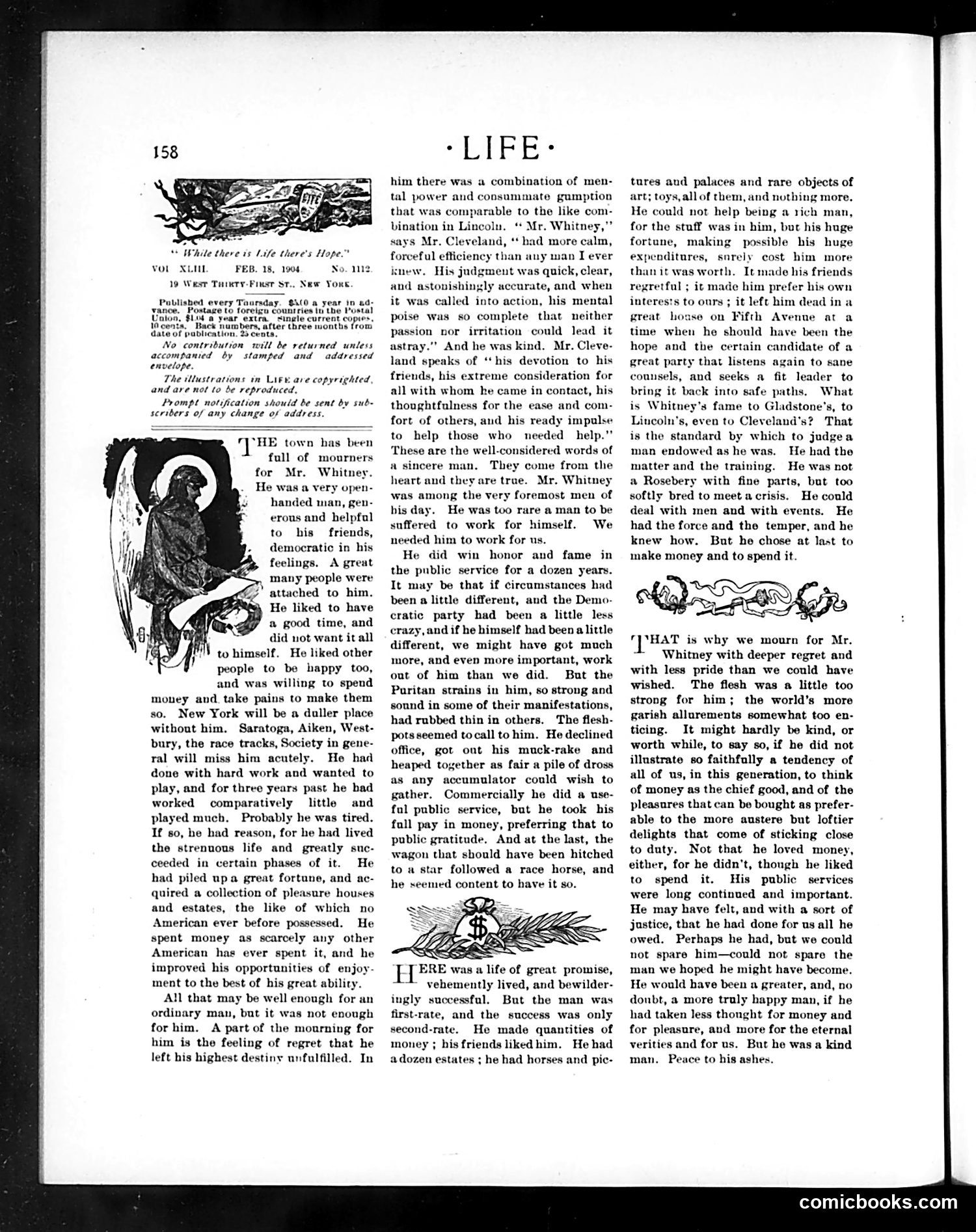
This page is primarily **text-based obituary or memorial content**, not a political cartoon. It appears to be mourning **Mr. Whitney**, describing him as an exceptionally talented and generous man who served in public service for twelve years. The article praises his character—his mental power, judgment, kindness, and willingness to help others. It notes he accumulated significant wealth but chose not to pursue politics despite being well-suited for it. The accompanying **decorative illustrations** (ornamental vignettes with natural motifs) are standard period design elements, not satirical commentary. This reads as a sincere tribute rather than satire, likely memorializing a prominent businessman or public figure whose specific identity remains unclear from the visible text alone.
📄 Transcribed text from this page (OCR, searchable)
Machine-transcribed from the original scan — historical spelling and the odd misread are preserved.
“+ While there ts Life there's Hope.” vol XLUL FEB. 18, 1906 No. nz, 19 West Tarety-Prest St.. New Yous. Published every Taursday. $\(0 a year in ad- . Fostaxe to foreign count ies tu the Postal No contribution will be returned unless accompanied by stamped and addressed envelope. The illustrations in Lite ave copyrighted, and are not to be reproduced. Prompt notification should be sent by sub- scribers of any change of address. ‘] (HE town has been full of mourners for Mr. Whitney. He was a very open- handed man, gen- erous and helpfal to his friends, democratic in his feelings. A great many people were ‘attached to him. He liked to have a good time, and did not want it all to himself. He liked other people to be happy too, and was willing to spend mouey and. take pains to make them so. New York will be a duller place without him. Saratoga, Aiken, West- bury, the race tracks, Society in gene- ral will miss him acutely. He had done with hard work and wanted to play, and for three years past he bad worked comparatively little and played much. Probably he was tired. If 80, he had reason, for he had lived the strenuous life and greatly suc- ceeded in certain phases of it. He had piled upa great fortune, and ac- quired a collection of pleasure houses and estates, the like of which no American ever before possessed. He spent money as scarcely any other American has ever spent it, and he improved his opportunities of enjoy- ment to the best of his great ability All that may be well enough for an ordinary man, but it was not enough forhim. A part of the mourning for him is the feeling of regret that he left his highest destiny unfulfilled. In “LIFE * him there was a combination of men- tal power and consummate gumption that was comparable to the like com- bination in Lincolu. “ Mr. Whitney,” says Mr. Cleveland, “had more calm, forceful efficiency than any wan I ever imew. His judgment was quick, clear, and astonishingly accurate, and when it was called into action, his mental poise was so complete that neither passion nor irritation could lead it astray.” And he was kind. Mr. Cleve- land speaks of ‘‘his devotion to his friends, his extreme consideration for all with whom ke came in contact, his thoughtfulness for the ease and com- fort of others, and his ready impulse to help those who needed help.” These are the well-considered words of a sincere man, They come from the heart and they are trae. Mr. Whitney was among the very foremost men of bis day. He was too rare a man to be suffered to work for himself. We needed him to work for us. He did win honor and fame in the public service for a dozen years. It may be that if circumstances had been a little different, and the Demo- cratic party had been a little less crazy, and if he himself had been a little different, we might have got much more, and even more important, work out of him than we did. Bat the Puritan strains in him, so strong and sound in some of their manifestations, had rubbed thin in others. The flesh- potsseemed tocall tohim. He declined office, got ont his muck-rake and heaped together as fair a pile of dross as any accumulator could wish to gather. Commercially he did a use- fal public service, but he took his fall pay in money, preferring that to public gratitude. And at the last, the wagon that should have been hitched to a star followed a race horse, and he seemed content to have it so. EL ERE was a life of great promise, ~ vehemently lived, and bewilder- ingly successful. first-rate, and the success was only But the man was second-rate. He made quantities of money ; his friends liked him. He had adozen estates ; he had horses and pic- tures and palaces and rare objects of art; toys, all of them, and nothing more. He could not help being a rich man, for the stuff was in him, but his huge fortune, making possible his huge expenditures, sorely cost him more than it was worth. It made his friends regretful ; it made him prefer his own interests to ours ; it left him dead ina great house on Fifth Avenne at a time when he should have been the hope and the certain candidate of a great party that listens again to sane counsels, and seeks a fit leader to bring it back into safe paths. What is Whitney's fame to Gladstone's, to Lincoln's, even to Cleveland's? That is the standard by which to judgea man endowed as he was. He had the matter and the training. He was not a Rosebery with fine parts, but too softly bred to meet a crisis. He could deal with men and with events. He had the force and the temper, and he knew how. But he chose at last to make money and to spend it. KS Ge raat is why we mourn for Mr. Whitney with deeper regret and with less pride than we could have wished. The flesh was a little too strong for him; the world’s more garish allurements somewhat too en- ticing. It might hardly be kind, or worth while, to say so, if he did not illustrate so faithfully a tendency of all of us, in this generation, to think of money as the chief good, and of the pleasures that can be bought as prefer- able to the more austere but loftier delights that come of sticking close to duty. Not that he loved money, either, for he didn't, though he liked to spend it. His public services were long continued and important. He may have felt, and with a sort of justice, that he had done for us all he owed. Perhaps he had, but we could not spare him—could not spare the man we hoped he might have become. He would have been a greater, and, no donbt, a more truly happy man, if he had taken less thonght for money and for pleasure, and more for the eternal verities and for us. But he was a kind man. Peace to his ashes. comicbooks.com