
Life, 1904-02-18 · page 17 of 26
Life — February 18, 1904 — page 17: what you’re looking at
What you’re looking at
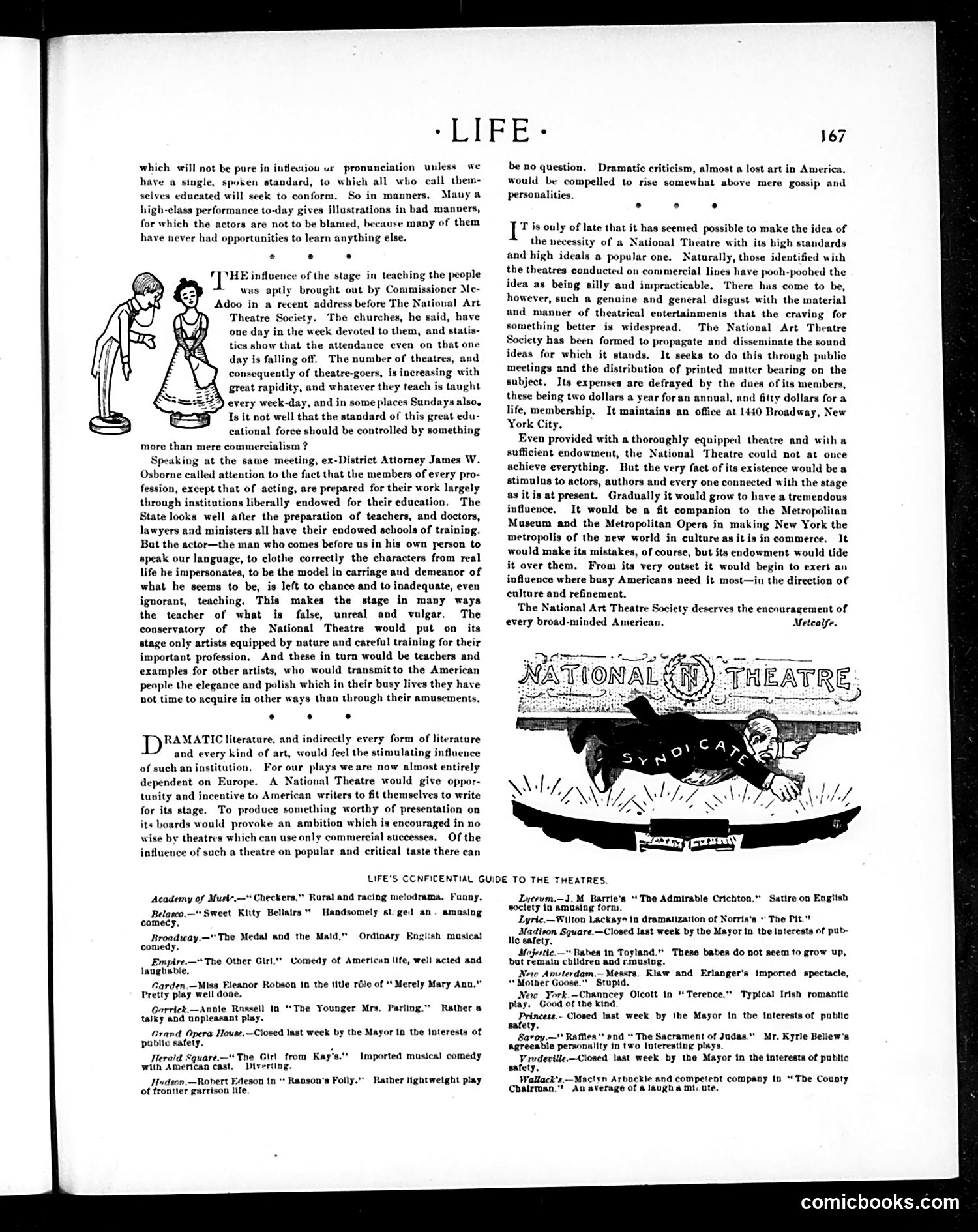
This page discusses the **National Art Theatre Society**, an organization advocating for a state-funded, high-quality national theatre in America modeled on European institutions. The small illustration shows two figures in classical theatrical dress, likely representing idealized theatrical performance or the arts. **The argument presented:** Speakers (Commissioner McAdoo and ex-District Attorney James W. Osborne) contend that theatre—which reaches more Americans than churches—should be regulated for quality, not just profit. Unlike other professions (law, medicine, teaching), acting lacks formal educational institutions. This leaves actors unprepared and the stage teaching "false, unreal and vulgar" lessons to the public. **The satire's point:** The page criticizes American theatre's commercialism and argues a government-supported National Theatre would elevate dramatic standards, encourage American playwrights, and restore "dramatic criticism" as a serious art form rather than mere gossip. The *National Theatre* logo at bottom suggests this was promotional material for the Society's actual educational mission.
📄 Transcribed text from this page (OCR, searchable)
Machine-transcribed from the original scan — historical spelling and the odd misread are preserved.
DIRE which will not be pure in intlectiou ur pronunciation unless we have a single, spoken standard, to which all who call them- selves educated will seek to conform. So in manners. Many a high-class performance to-day gives illustrations in bad manners, for which the actors are not to be blamed, because many of them have never had opportunities to learn anything else. ° e . TPHE influence of the stage in teaching the people wus aptly brought out by Commissioner Me- Adoo in a recent address before The National Art Theatre Society. The churches, he said, have one day in the week devoted to them, and statis- tics show that the attendance even on that one day is falling off. The number of theatres, and consequently of theatre-goers, is increasing with great rapidity, and whatever they teach is taught every week-day, and in some places Sundays also. Is it not well that the standard of this great edu- cational force should be controlled by something more than mere commercialism ? Speaking at the same meeting, ex-District Attorney James W. Osborne called attention to the fact that the members of every pro- fession, except that of acting, are prepared for their work largely through institutions liberally endowed for their education. The State looks well after the preparation of teachers, and doctors, lawyers and ministers all have their endowed schools of training. But the actor—the man who comes before us in his own person to speak our language, to clothe correctly the characters from real life he impersonates, to be the model in carriage and demeanor of what he seems to be, is left to chance and to inadequate, even ignorant, teaching. This makes the stage in many ways the teacher of what is false, unreal and vulgar. The conservatory of the National Theatre would put on its stage only artists equipped by nature and careful training for their important profession. And these in turn would be teachers and examples for other artists, who would transmitto the American people the elegance and polish which in their busy lives they have not time to acquire in other ways than through their amusements. ° . . RAMATIC literature, and indirectly every form of literature and every kind of art, would feel the stimulating influence of such an institution. For our plays weare now almost entirely dependent on Europe. A National Theatre would give oppor- tunity and incentive to American writers to fit themselves to write for its stage. To produce something worthy of presentation on its boards would provoke an ambition which is encouraged in no wise by theatres which can use only commercial successes, Of the influence of such a theatre on popular and critical taste there can 167 be no question. Dramatic criticism, almost a lost art in America, would be compelled to rise somewhat above mere gossip and personalities, o 2 I is only of late that it has seemed possible to make the idea of the necessity of a National Theatre with its high standards and high ideals a popular one, Naturally, those identified with the theatres conducted on commercial lines have pooh-poohed the idea as being silly and impracticable. There hus come to be, however, such a genuine and general disgust with the material and manner of theatrical entertainments that the craving for something better is widespread. The National Art Theatre Society has been formed to propagate and disseminate the sound ideas for which it stands. It seeks to do this through public meetings and the distribution of printed matter bearing on the subject. Its expenses are defrayed by the dues of its members, these being two dollars a year foran annual, and filty dollars for a life, membership. It maintains an office at 1440 Broadway, New York City. Even provided with a thoroughly equipped theatre and with a sufficient endowment, the National Theatre could not at once achieve everything. But the very fact of its existence would be a stimulus to actors, authors and every one connected with the atage as it is at present. Gradually it would grow to have a tremendous influence. It would be a fit companion to the Metropolitan Maseum and the Metropolitan Opera in making New York the metropolis of the new world in culture as it is in commerce. It would make its mistakes, of course, but its endowment would tide it over them. From its very outset it would begin to exert an influence where busy Americans need it most—in the direction of culture and refinement, The National Art Theatre Society deserves the encouragement of every broad-minded American, Metcalfe. LIFE'S CCNFICENTIAL GUIDE TO THE THEATRES. Academy of Must,—" Checkers.” Rural and racing melodrama, Fanny. weet Kitty Bellairs * Handsomely st-ged an. amasing “The Medal and the Maid.” Ordinary English musical Broadway. comedy. Empire.—"The Other Girl." Comedy of Americun life, well acted and laughable. Carden.—Miss Eleanor Robson in the title réle of Merely Mary Ann." Pretty play well done. Garrick.—Annle Rnssell in “The Younger Mrs, Parling.” talky and unpleasant play. Crand Opera House,—Ciosed last week by the Mayor tn the Interests of public safety. . Herald Square.—“ The Girl from Kay with American cast. Diverting. Hudson.—Robert Edeson in * Ranson’s Folly."* of frontier garrison life. Rather 8 Imported musical comedy Rather lightweight play Lycevm.—J3.M_ Barrie's “The Admirable Crichton. Satire on Engitsb society 1n amusing form. Lyric,—Wilton Lackays 1n dramatization of Norris's + The Pit. Madivon Square.—Cloved last week by the Mayor in the interests of pub- Ue safety. Mojeste.— Babes in Toyland.” ‘These babes do not seem to grow up, bat remain children and rmusiog. New Amsterdam.— Messrs. Kiaw and Erlanger‘a imported spectacle, + Mother Goose." Stupid. New York.—Channcey Olcott tn “Terence.” Typical Irish romantic play. Good of the kind sarincess.- Cloved Inst week by the Mayor in the interests of pabite ety. Saroy.—'* Raffles end“ The Sacrament of Judas." Mr. Kyrie Bellew's agreeable personality in two interesting plays. Frvdecille—Ciosed Isat week by the Mayor in the interests of public safety. Wallack's—Maciyn Arbuckle and competent company tn “The County Chairman.” Au average of a laugh mi. ute. comicbooks.com