
Life, 1904-02-18 · page 18 of 26
Life — February 18, 1904 — page 18: what you’re looking at
What you’re looking at
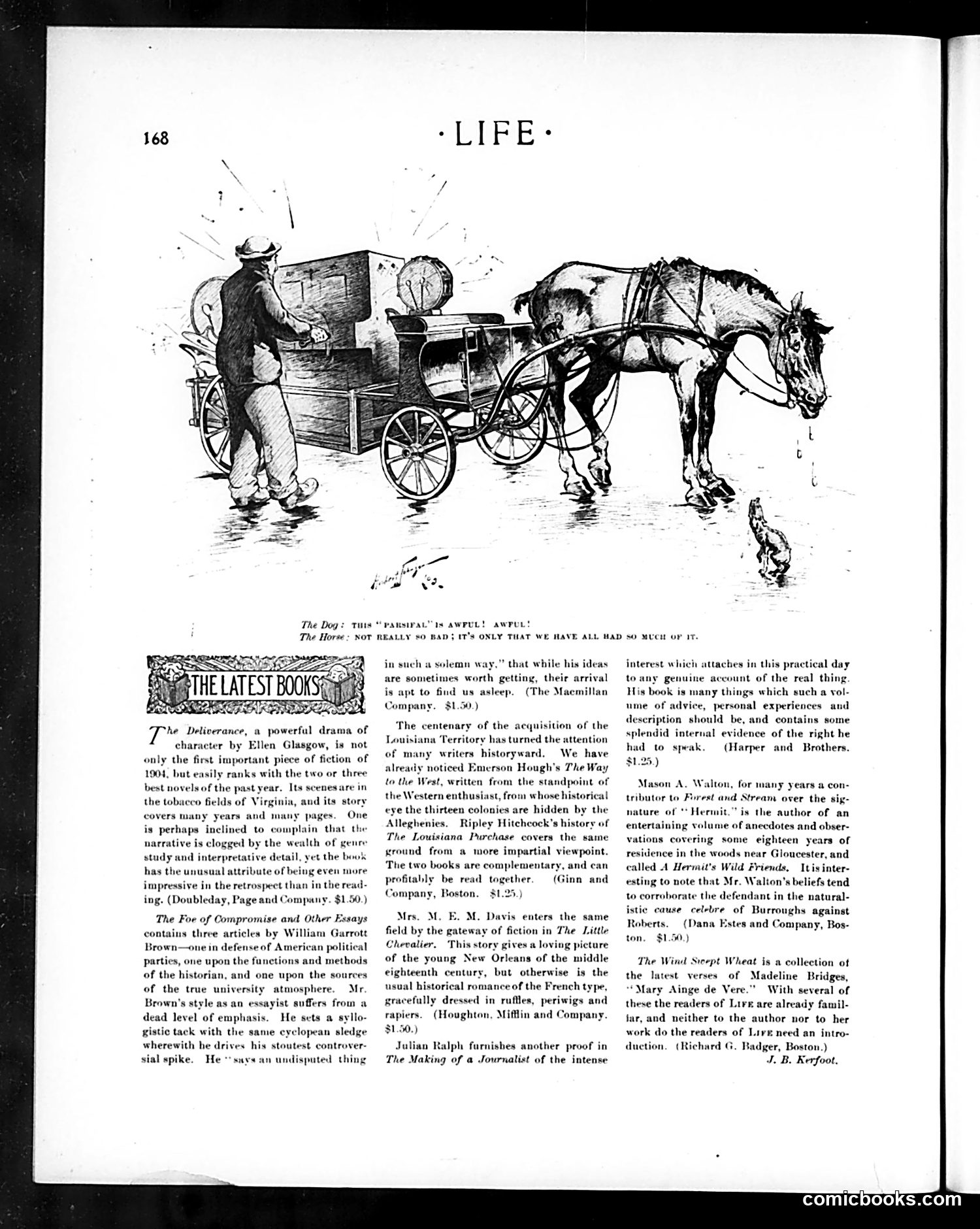
This page combines a satirical cartoon with book reviews. The cartoon depicts a man and horse-drawn cart in conversation. The dog complains the opera "Parsifal" is "awful," while the horse responds dismissively that it's "only that we have all had so much of it"—suggesting oversaturation and jadedness about high culture rather than genuine poor quality. The satire targets urban sophistication: even working animals supposedly appreciate Wagner, yet complain of boredom rather than incomprehension. It mocks the pretension of calling something culturally refined while admitting you're simply tired of it. Below, "The Latest Books" reviews contemporary 1904 publications, including Ellen Glasgow's *The Deliverance* and works on the Louisiana Territory centenary, positioning literary discussion as part of cultured Life magazine readership—the very audience the cartoon gently ridicules for affected worldliness.
📄 Transcribed text from this page (OCR, searchable)
Machine-transcribed from the original scan — historical spelling and the odd misread are preserved.
The Dog: The Horse 5 ny ot he Deliverance, a powerful drama of character by Ellen Glasgow, is not only the first important piece of fiction of 1904, but easily ranks with the two or three best novels of the past year. Its scenesare in the tobacco fields of Virginia, and its story covers many years and many pages. One is perhaps inclined to complain that t narrative is clogged by the wealth of ge study and interpretative detail, yet the book has the unusual attribute of being even more impressive in the retrospect than i ing. (Doubleday, Page and Compan he read- $1.50.) The Foe of Compromise and Other Essays contains three articles by William Gurrott Brown—oue in defense of American political parties, one upon the functions and methods of the historian, and one upon the sources of the true university atmosphere. Mr Brown's style as an essayist suffers from a dead level of emphasis. He sets a syllo- gistic tack with the same eyclopean sled; wherewith he drives his stoutest controver- sial spike. He “says an undisputed thing Tus NOT REALLY 80 BAD} (T'S ONLY THAT WE HAVE ALL MAD so MUCH oF IT. PANSIPAL” Is AWPUL! AWPUL! in such a solemn ” that while his ideas are sometimes worth getting, their arrival is apt to fin (The Maemillan $1.50.) us asleep. npany. The centenary of the acquisition of the Louisiana Territory has turned the attention of many writers historyward. We have y noticed Emerson Hough's The Way to the West, written from the standpoint of the Western enthusiast, from whose historical eye the thirteen colonies are hidden by the Alleghenies. Ripley Hitchcock's history of The Louisiana Purchase covers the ground from a wore impartial viewpoint. The two books are complementary, and can profitably be read together. inn and Company, Boston. $1.25.) alre: same Mrs. M. E. M. Davis enters the same field by the gateway of fiction in The Little Chevalier. This story gives a loving picture of the young New Orleans of the middle eighteenth century, but otherwise is the usual historical romance of the French type, gracefully dressed in rufiles, periwigs and rapiers. (Houghton, Mifflin and Company. $1.50.) Julian Ralph furnishes another proof in The Making of a Journalist of the intense interest which attaches in this practical day toany genuine account of the real thing. His book is many things which such a vol- ume of advice, personal experiences and description should be, and contains some splendid internal evidence of the right he had to (Harper and Brothers. 25.) Mason A. Walton, for many years a con- tributor to Fi wer the sig- ‘is the author of an entertaining volume of anecdotes and obser- vations covering some eighteen years of residence in the woods near Gloucester, and called A Hermit’s Wild Friends. Itisinter- esting to note that Mr. Walton's beliefs tend to corroborate the defendant in the natural- istic cause celebre of Burroughs against Roberts. (Dana Estes and Company, Bos- ton. $1.50.) nature of * Hermit The Wind Siept Wheat is a collection ot the of Madeline Bridges, ‘Mary Ainge de Vere.” With several of these the readers of Lire are already famil- jar, and neither to the author nor to her work do the readers of Lire need an intro- duction. (Richard Badger, Boston.) J.B. Kerfoot. latest verses comicbooks.com