
A complete issue · 20 pages · 1904
Life — January 14, 1904
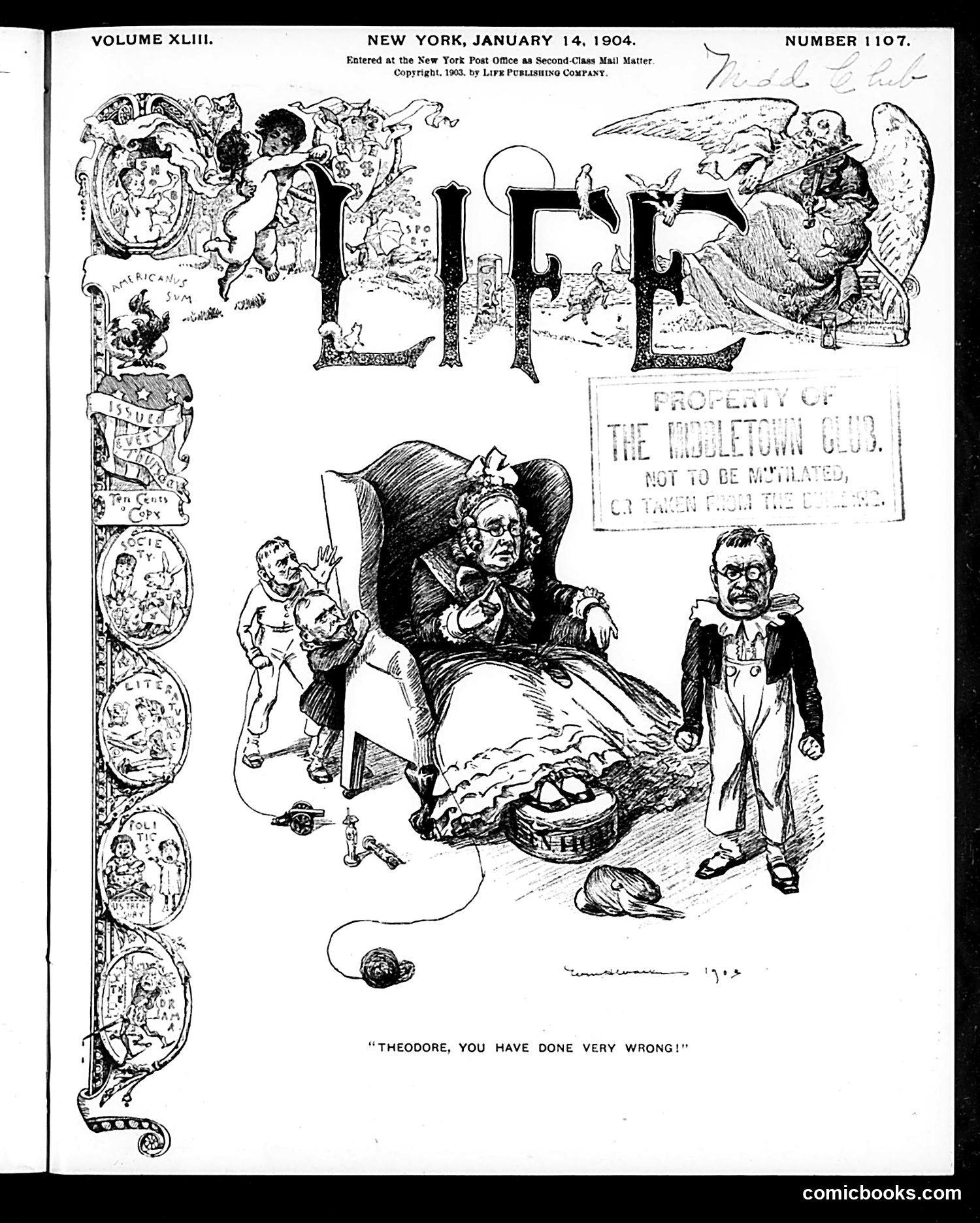
This political cartoon satirizes **Theodore Roosevelt** (identifiable by the distinctive caricature and the caption "Theodore, you have done very wrong!"). The central scene depicts Roosevelt in bed being scolded by what appears to be an **older authority figure** (likely representing either a parent, political mentor, or the American establishment). Two **small children** stand nearby, suggesting innocence or naivety. The cartoon criticizes Roosevelt for some specific action, though the exact historical reference is unclear from the visible text alone. The phrase "you have done very wrong" indicates public disapproval of a presidential decision or policy. The decorative border and elaborate "LIFE" masthead are characteristic of the publication's design. The satire mocks Roosevelt through domestic/parental imagery, a common technique for criticizing powerful figures.
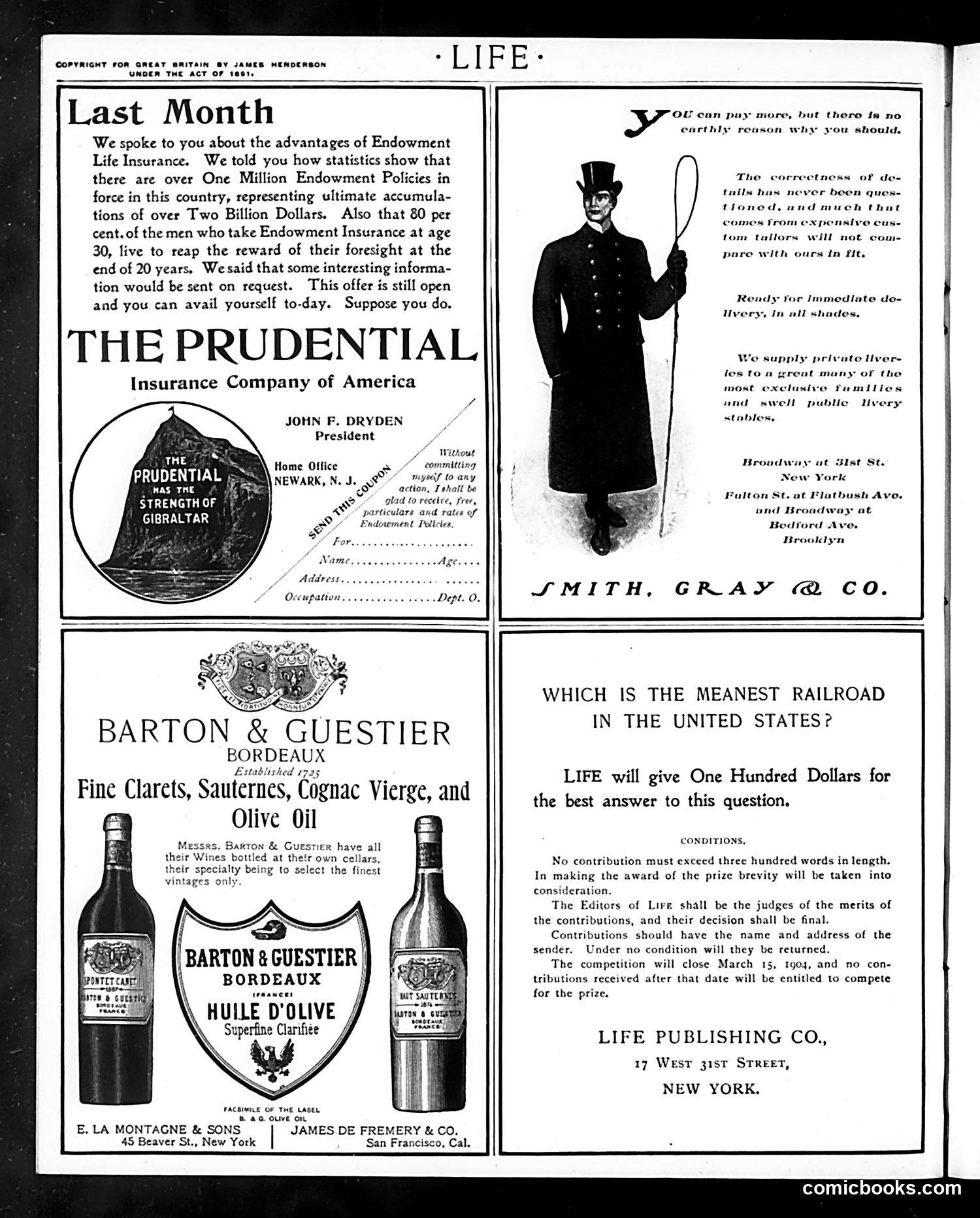
This page is primarily **advertising**, not political satire. It contains four distinct ads: 1. **The Prudential Insurance Company** promotes endowment life insurance, claiming over one million policies exist and targeting 30-year-old men. 2. **Smith, Gray & Co.** advertises custom tailoring services in New York and Brooklyn, emphasizing quality and ready delivery. 3. **Barton & Guestier** promotes French wines and olive oil from Bordeaux, established 1725. 4. **Life Publishing Co.** runs a contest offering $100 for the best answer to "Which is the meanest railroad in the United States?"—likely a play on words about railroad companies' reputations for poor service or treatment of customers. The page reflects early-20th-century consumer marketing with no obvious political satire.
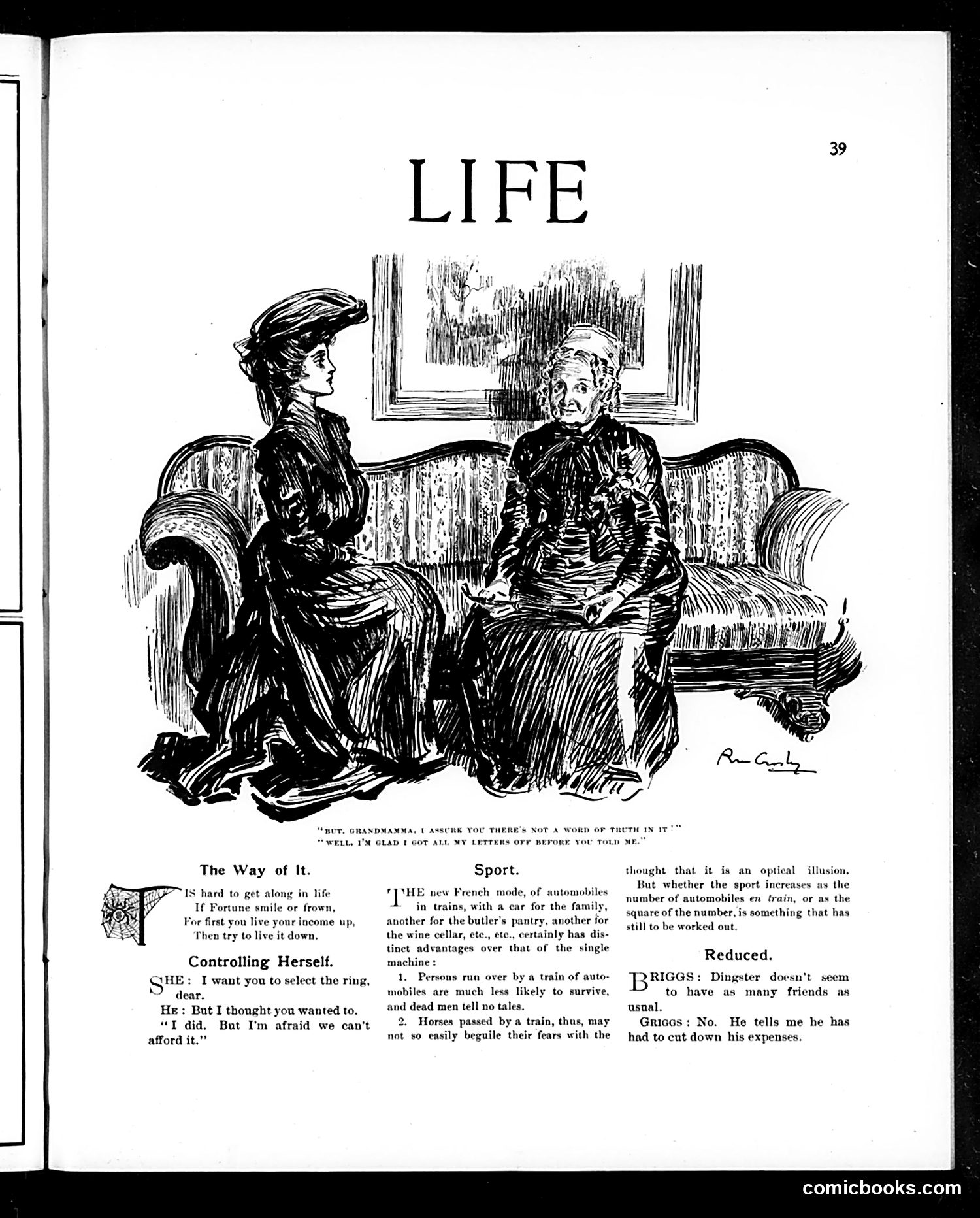
**Main Illustration:** Shows two women on a sofa in an interior setting. The caption reads: "BIT, GRANDAMMA; I ASSURE YOU THERE'S NOT A WORD OF TRUTH IN IT!" / "WELL, I'M GLAD I GOT ALL MY LETTERS OFF BEFORE YOU TOLD ME." This depicts a younger woman reassuring an elderly grandmother about rumors or gossip—apparently too late, as the grandmother has already spread the story via correspondence. The humor relies on the timeless scenario of well-intentioned but ineffective damage control regarding rumors. **Below are three short satirical pieces** addressing contemporary social topics: "The Way of It" (advice on living frugally), "Controlling Herself" (marital negotiation), "Sport" (automobiles' advantages over horses), and "Reduced" (cutting social obligations for financial reasons). These vignettes mock middle-class social conventions and economic pressures of the era.
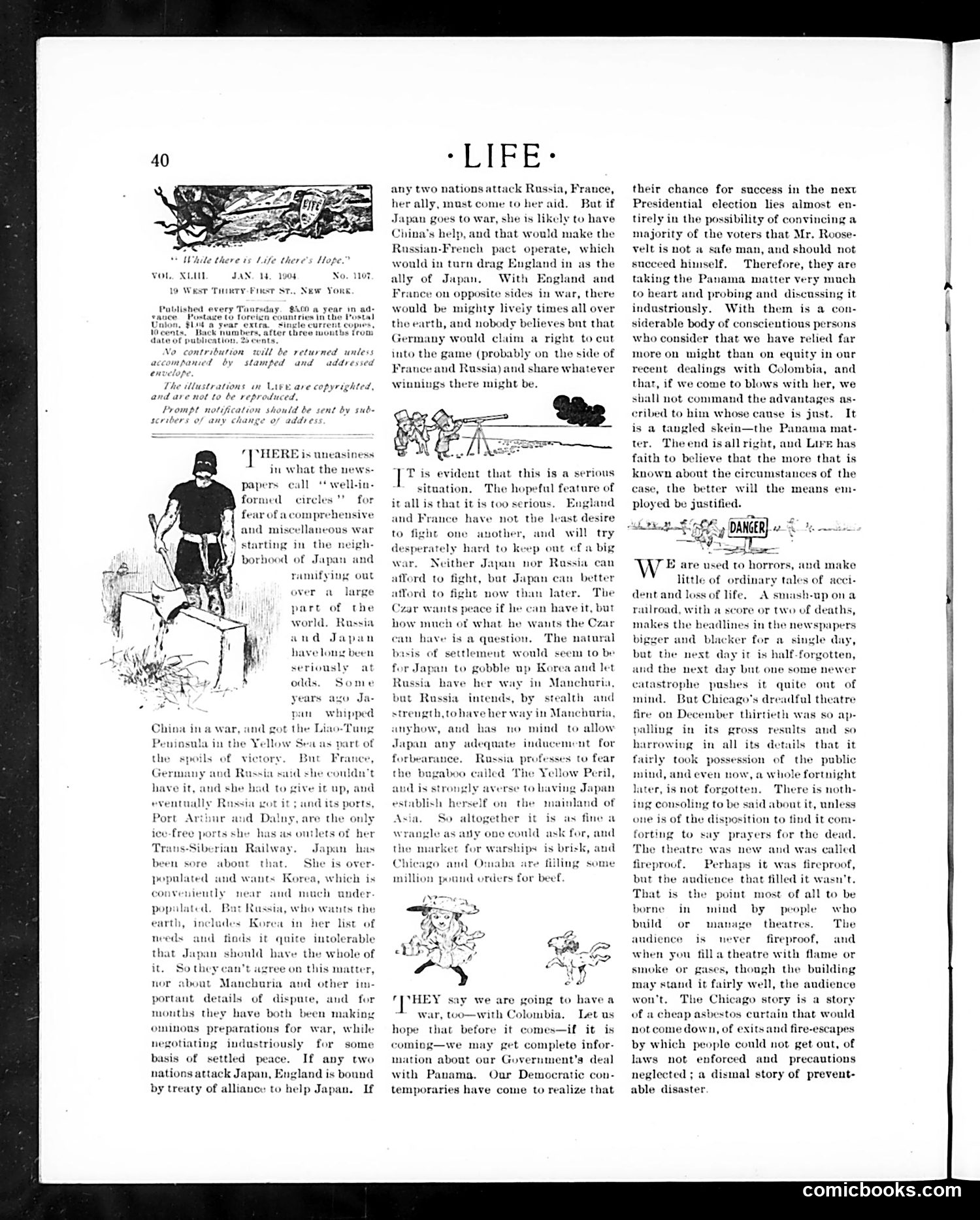
This page discusses potential war scenarios involving Japan, Russia, France, and England. The text argues that if Japan attacks Russia, France would likely aid Russia, which could draw England into conflict as Japan's ally. The left cartoon depicts a figure (appears to be a political leader or diplomat) standing precariously on a tightrope or narrow beam, suggesting the precarious balance of international relations and the difficulty of maintaining peace amid competing alliances. The right section criticizes Chicago's recent theater fire disaster, arguing that while newspapers sensationalize such tragedies temporarily, public memory fades quickly—and that theatre safety regulations remain inadequately enforced. The satire targets both media exploitation of disasters and institutional negligence in preventing preventable catastrophes.
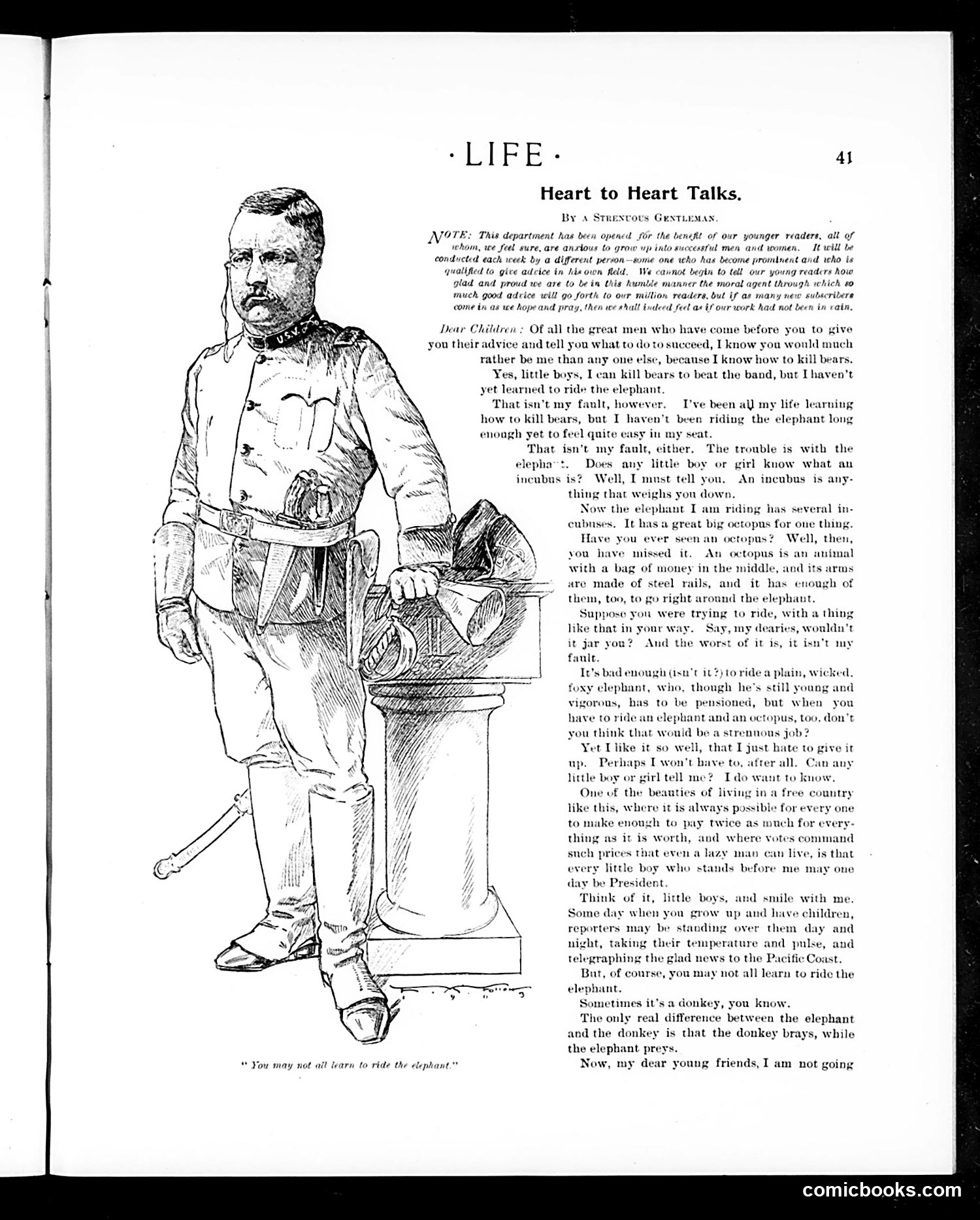
This "Heart to Heart Talks" column features a sketch of a military officer in formal uniform addressing young readers. The text is a humorous advice piece where the speaker discusses riding elephants and donkeys, using animal metaphors to discuss life challenges and opportunities. The officer appears to be a prominent figure giving fatherly guidance to "Dear Children," a common format in Life magazine. The piece uses lighthearted animal anecdotes—discussing elephant riding difficulties, octopus encounters, and the difference between donkeys and elephants—as vehicles for discussing perseverance, ambition, and the American opportunity to succeed. The satire likely targets the grandiose tone of advice-giving by established authorities, deflating their wisdom through absurdist animal scenarios. Without identifying the specific officer depicted, the cartoon mocks the pretentious nature of such "sage counsel" columns.
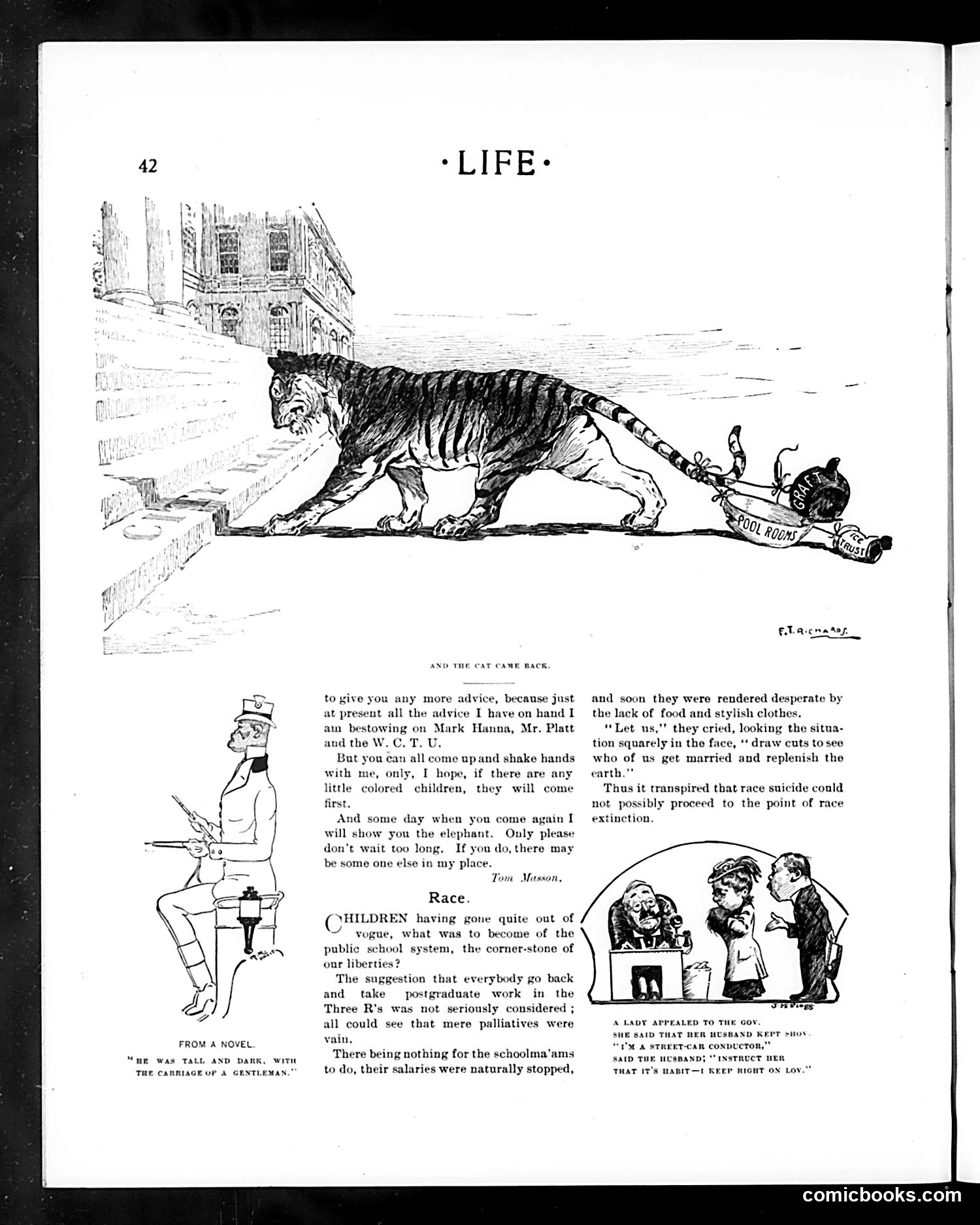
**Top Cartoon ("And the Cat Came Back"):** This depicts a large tiger being dragged by what appears to be a small figure labeled "FOOD RIOTS" and "UNREST." The satire suggests that despite efforts to suppress civil unrest and food riots, these problems persistently return—like the folk song "The Cat Came Back." The tiger represents either a nation or existing social problems that cannot be permanently eliminated. **"Race" Section:** The text discusses children's education and school systems during a period when "postgraduate work" and "Three R's" education were debated. The accompanying cartoon shows a woman appealing to a governor about a street conductor, emphasizing class and labor issues of the era. The page overall critiques social instability and educational inequality through satirical commentary typical of early 20th-century American journalism.
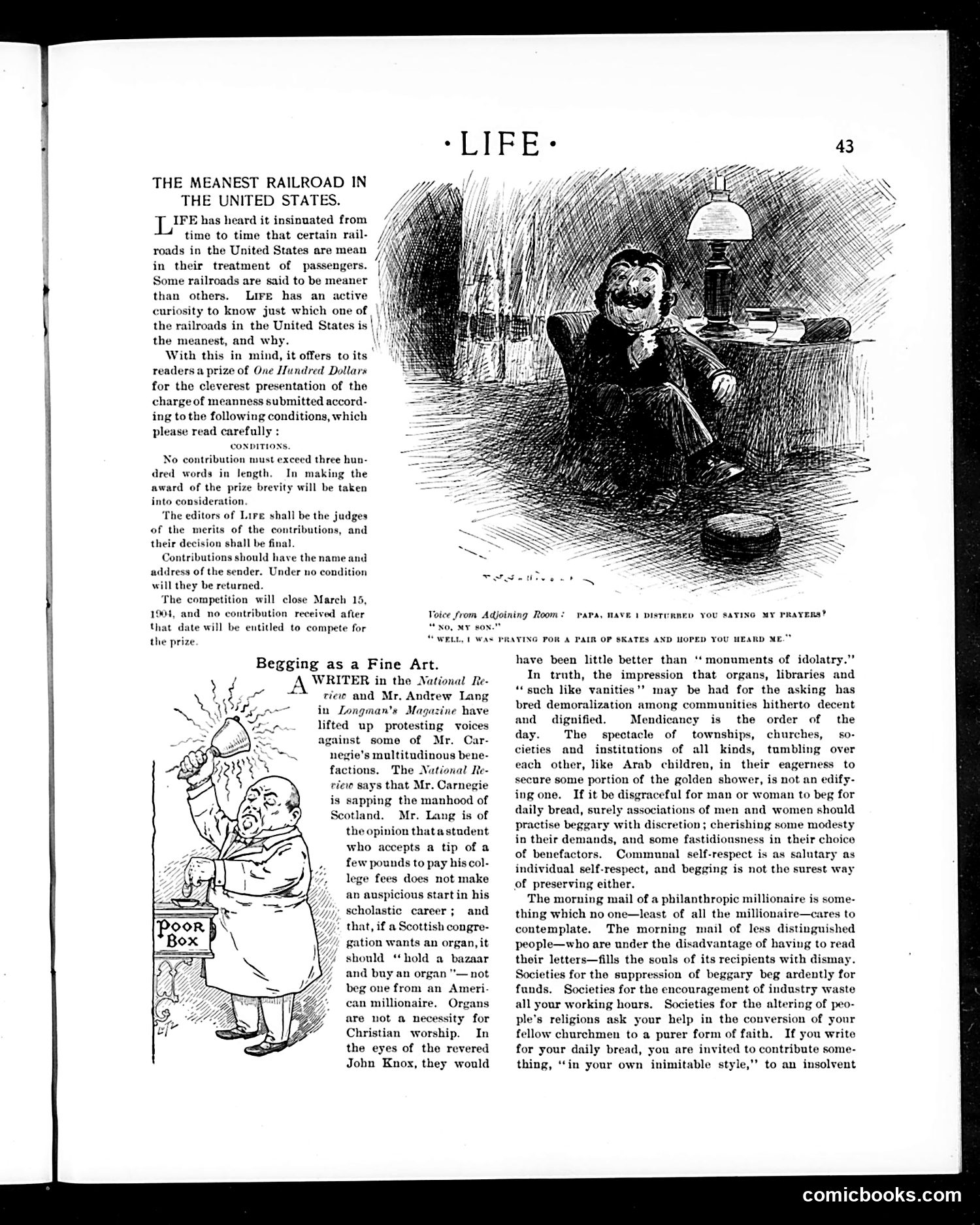
This page contains two distinct satirical pieces: **"The Meanest Railroad in the United States"** (top right): A contest announcement offering $100 for readers to submit the worst example of railroad mistreatment of passengers. The accompanying sketch shows a disheveled man in a sparse train compartment, suggesting the poor conditions some railroads provided. **"Begging as a Fine Art"** (left): Satirizes philanthropist Andrew Carnegie's opposition to begging. The cartoon depicts a poor person in a "Poor Box" being confronted by Carnegie's influence. The article criticizes Carnegie and writer Andrew Lang for suggesting that begging should be discouraged rather than addressed through charity. The satire argues that opposing begging while ignoring poverty is hypocritical—that proper charity requires addressing root causes, not simply eliminating visible poverty.
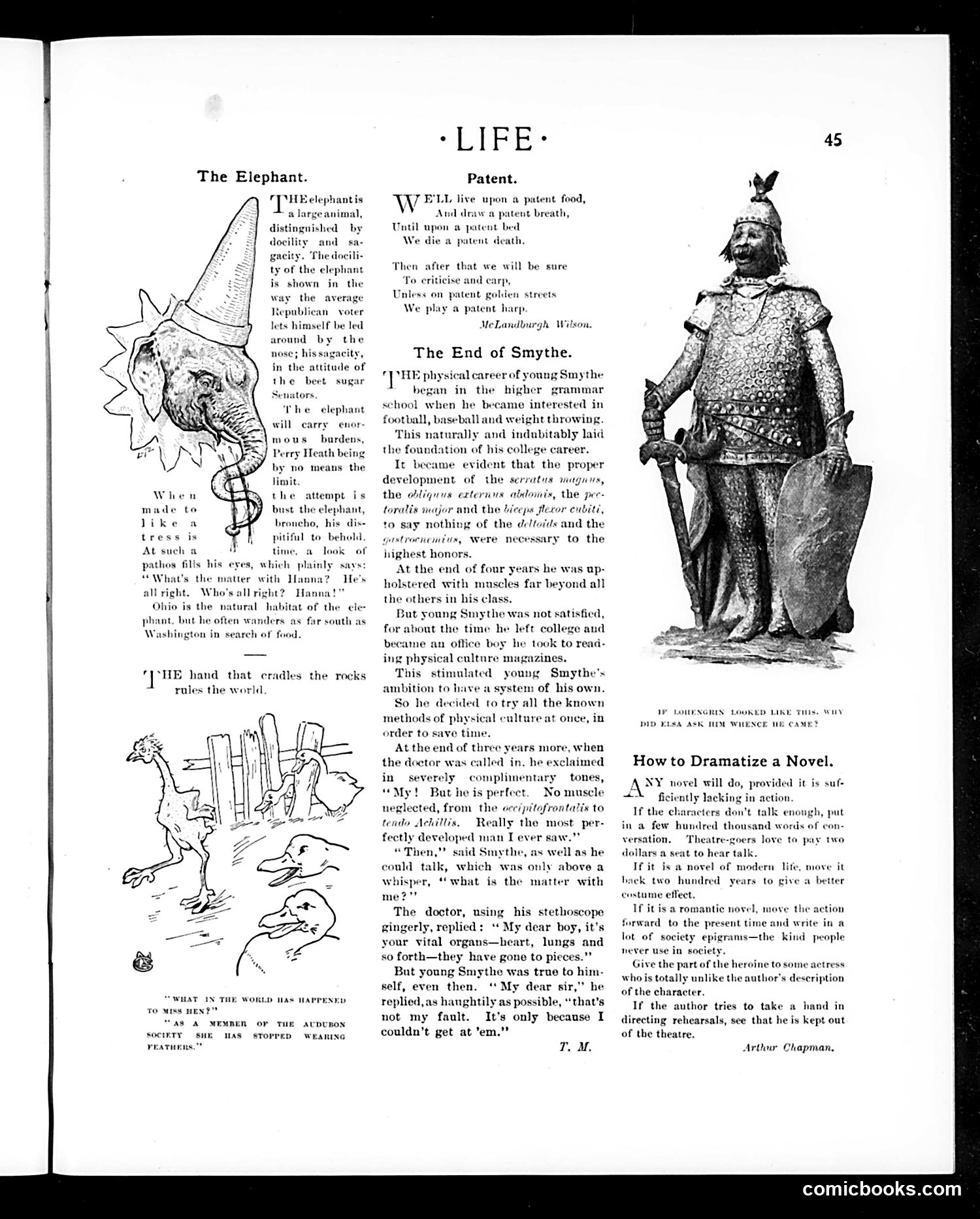
This page contains three separate pieces: **"The Elephant"** (left): A satirical cartoon depicting an elephant wearing a Republican voter's hat, with text explaining the elephant represents Republican politicians. The caricature emphasizes the elephant's docility and large burden-carrying capacity—satirizing Republicans as beasts of burden following leadership blindly. The accompanying sketches mock politicians' pretensions. **"Patent"** (top right): A brief satirical poem mocking those living off patent monopolies, suggesting they live parasitically on patented goods until death. **"The End of Smythe"** (center/right): A humorous narrative about a young man's obsessive pursuit of physical development through various exercise methods, ultimately destroying his health—satirizing the era's fad diets and fitness pseudoscience. **"How to Dramatize a Novel"** (bottom right): Practical theatrical adaptation advice by Arthur Chapman.
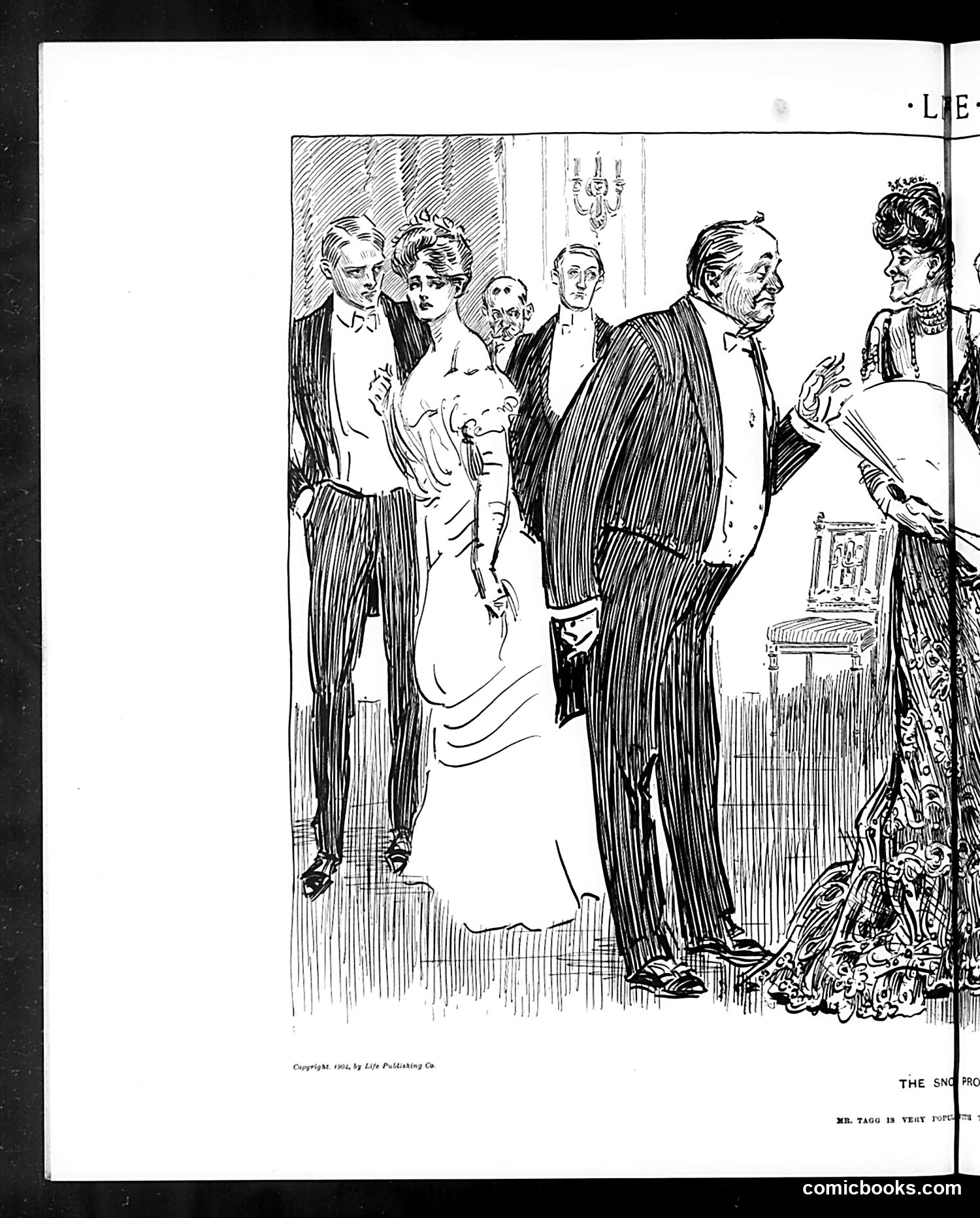
This is a satirical illustration from *Life* magazine (copyright 1912 by Life Publishing Co.). The cartoon depicts an elegant formal social gathering, likely a high-society event. The caption reads "THE SNO[B PRO...]" and "MR. TAGG IS VERY POPUL[AR...]" (text cut off). The satire appears to target social pretension and class consciousness among wealthy elites. The detailed rendering of formal dress—tuxedos, evening gowns, ornate furniture—emphasizes the artificiality of upper-class gatherings. The partial captions suggest the joke concerns "Mr. Tagg's" popularity, likely mocking how superficial social standing depends on wealth rather than character. The illustration's fine linework highlights the magazine's sophisticated humor aimed at educated readers aware of contemporary social hypocrisy. The specific identity of "Mr. Tagg" remains unclear without additional context.
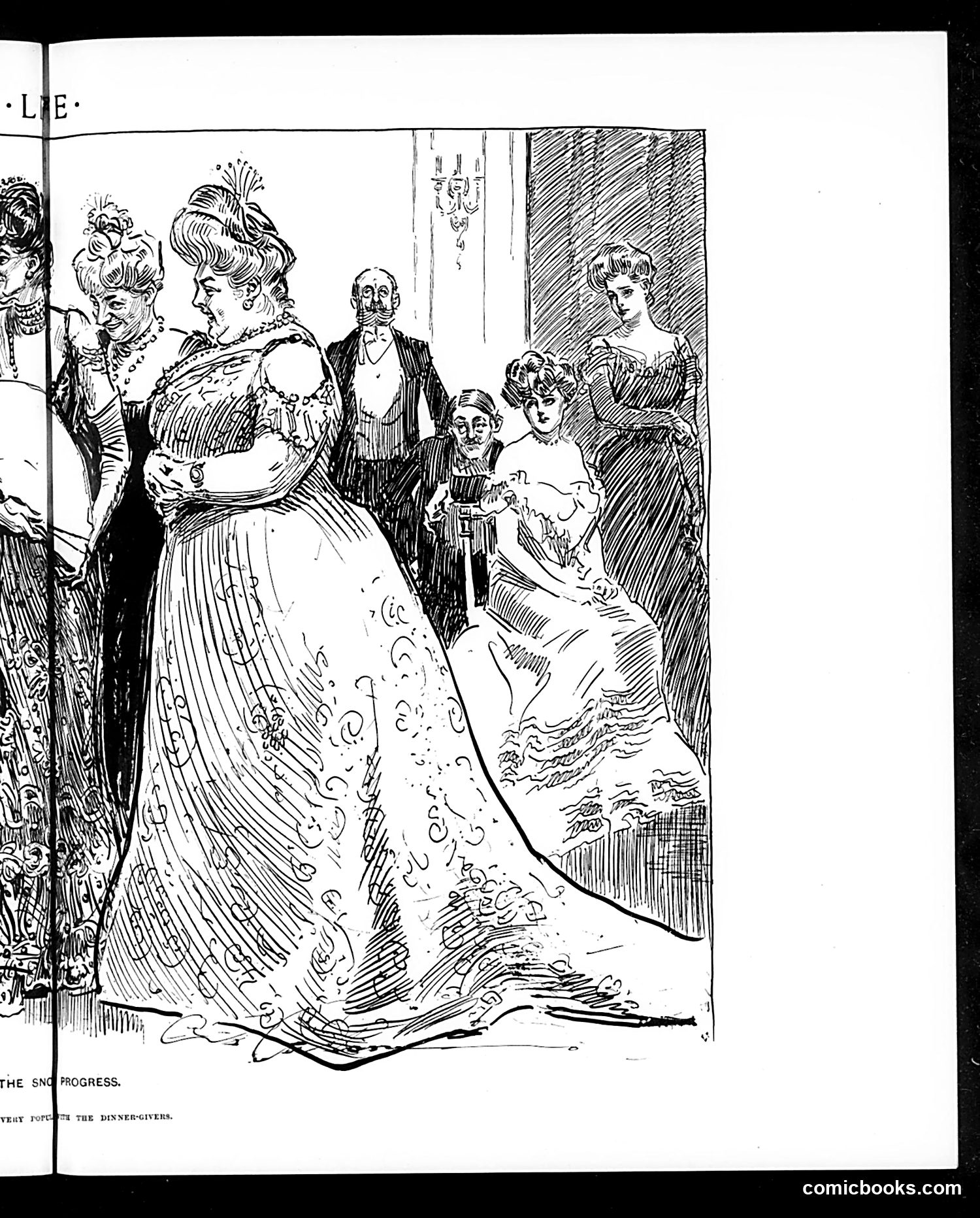
This appears to be a satirical illustration about wealth and class disparity in late 19th or early 20th century America. The central figure is an elaborate, well-dressed woman with an expansive train, surrounded by elegantly-dressed attendants and what appears to be children. The ornate gown and jewelry suggest extreme wealth and ostentation. The title "The Sno Progress" (likely "The Snow Progress" with OCR error) likely satirizes the notion of "progress" in society. The composition suggests social commentary on how the wealthy live extravagantly while others attend to them, contrasting material excess with actual human advancement. The detailed rendering emphasizes the absurdity of such conspicuous consumption as a measure of civilization's progress.
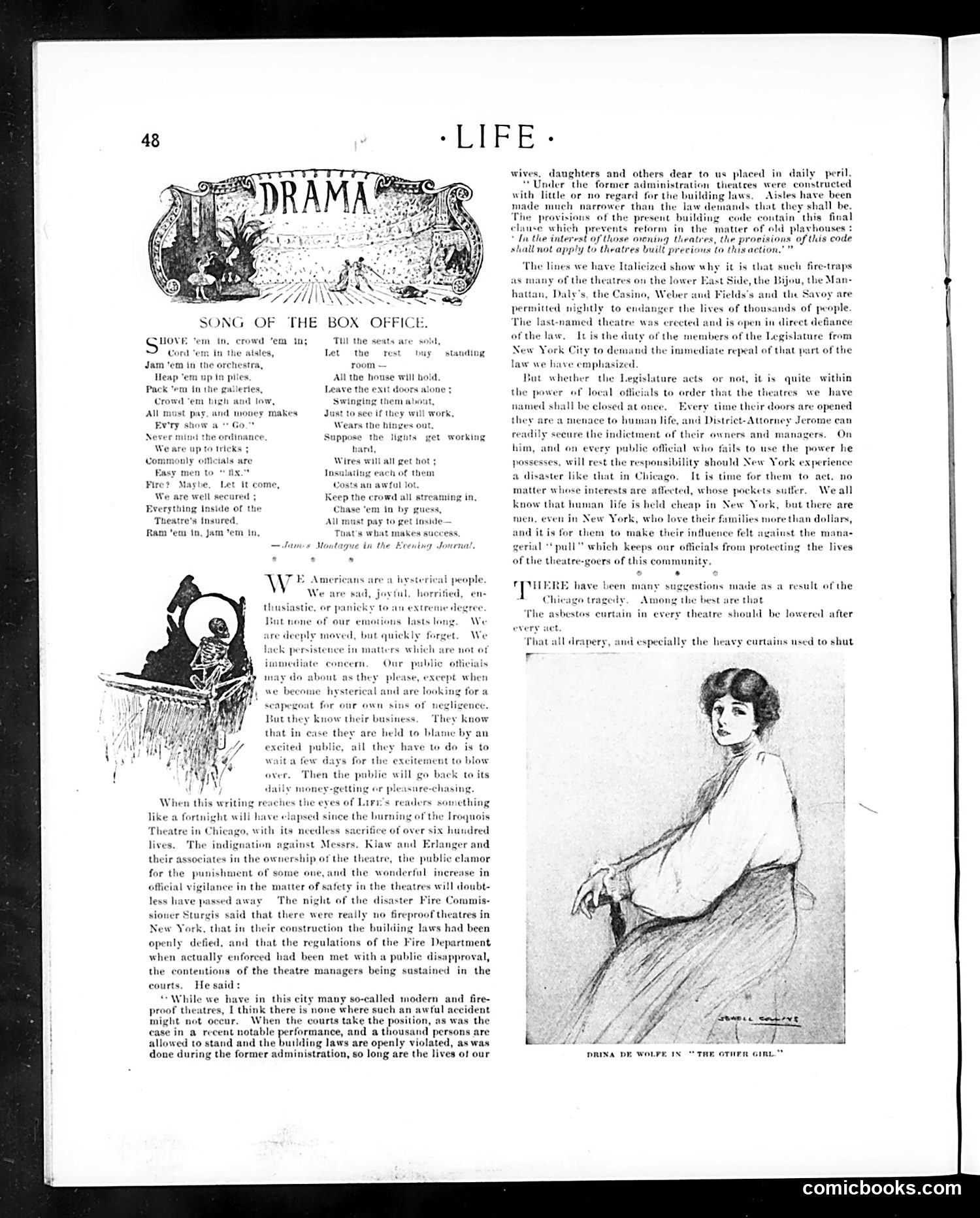
This page satirizes American theatrical management and public apathy following a major theater disaster (likely the Iroquois Theatre fire in Chicago, which killed over 600 people). The cartoon depicts a skeleton conducting an orchestra labeled "box office," mocking how theater owners prioritize profits over safety. The accompanying poem ridiculing crowd behavior—"Shove 'em in, crowd 'em in"—criticizes both negligent managers and audiences who passively accept dangerous conditions. The prose essay argues that New York officials must enforce theater safety regulations against owners' resistance. It references specific theaters and officials' failure to prevent "menaces to human life," calling for government intervention to protect public welfare over commercial interests. The satire targets systemic corruption enabling preventable tragedies.
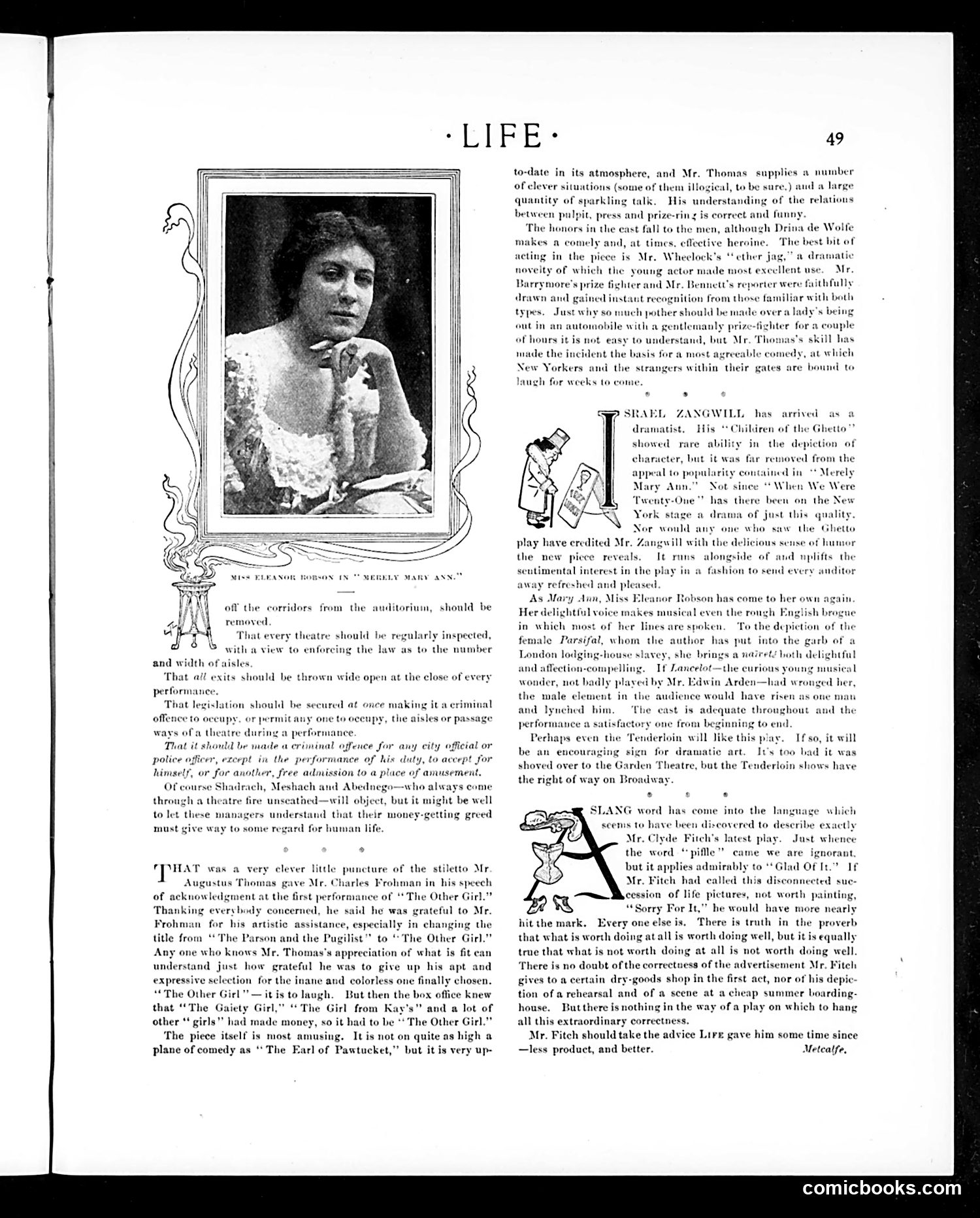
This is a theater criticism page from Life magazine featuring reviews of Broadway productions. The visible photograph shows **Miss Eleanor Robson in "Merely Mary Ann."** The text discusses several theatrical matters: 1. **Safety regulations** — The opening section advocates for theater fire safety laws, sarcastically invoking "Shadrach, Meshach and Abednego" (biblical figures who survived fire) to mock theater managers who prioritize profits over audience safety. 2. **"The Other Girl"** — A comedy by Augustus Thomas, criticized for having its title changed from the more apt "The Parson and the Pugilist" to something generic, simply because similar "girl" titles had made money. 3. **Reviews of current plays** including works by Israel Zangwill and discussions of performances by various actors. The satire targets theater management greed and commercial exploitation of dramatic art, while also providing contemporary performance criticism. This reflects Progressive Era concerns about public safety and artistic integrity versus commercialism.
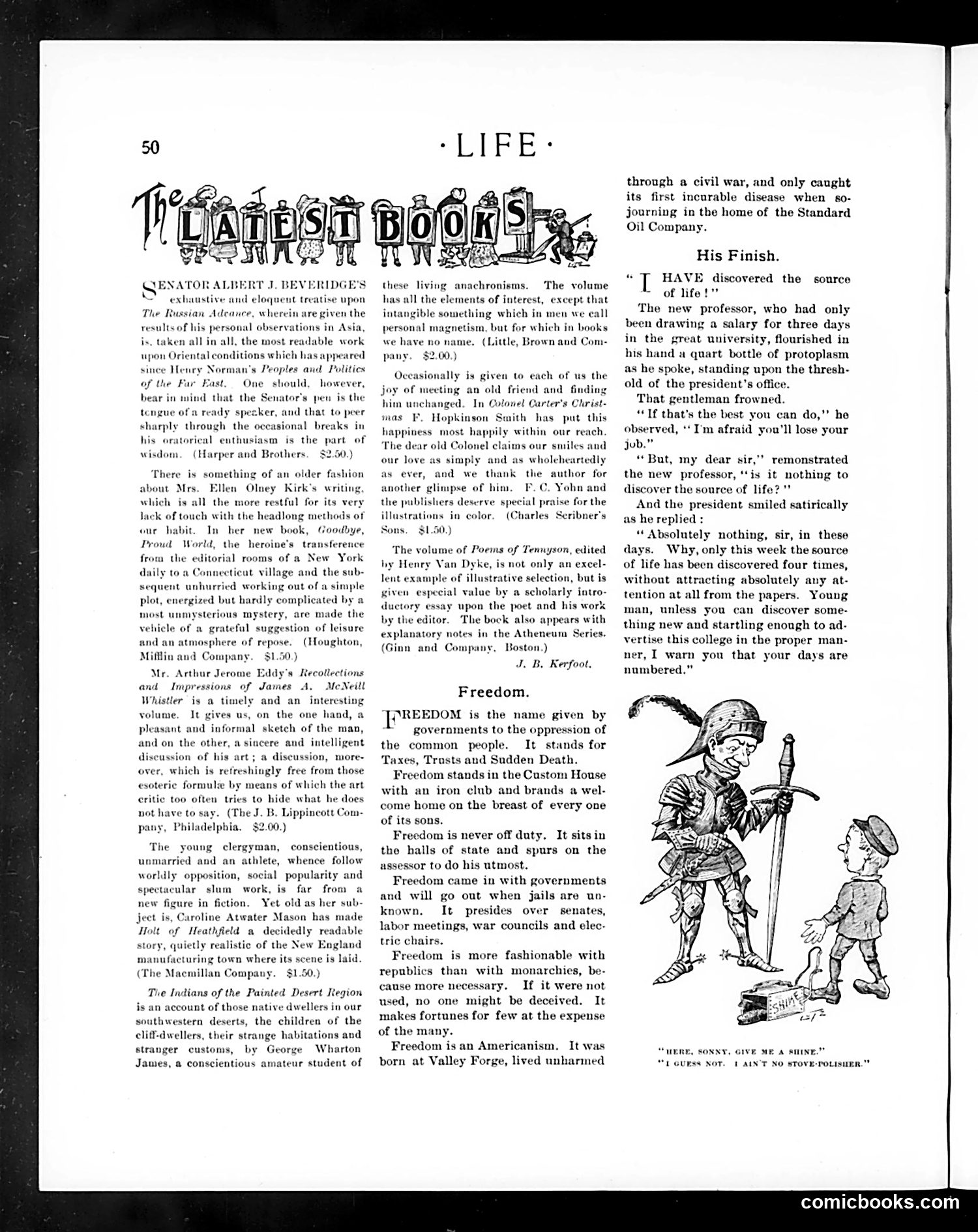
This page contains a sharp satirical definition of "Freedom" alongside an accompanying cartoon. The text mockingly redefines the patriotic concept as merely "the oppression of the common people" consisting of "Taxes, Trusts and Sudden Death." The illustration depicts a militaristic, brutish figure labeled "Freedom"—depicted as a soldier or enforcer—literally branding or striking ordinary citizens. The caption below reads: "HERE, SONNY, GIVE ME A SHINE. / 'I GUESS NOT. I AIN'T NO STOVE-POLISHER.'" The satire targets Gilded Age inequality: the government claims to represent "Freedom," but actually uses force to extract taxes and enforce corporate interests (trusts) against working people. The cartoon's soldier-figure embodies this contradiction—claiming to protect citizens while actually serving state and corporate power. The shoe-shining exchange illustrates the indignity imposed on the poor under this false "freedom."
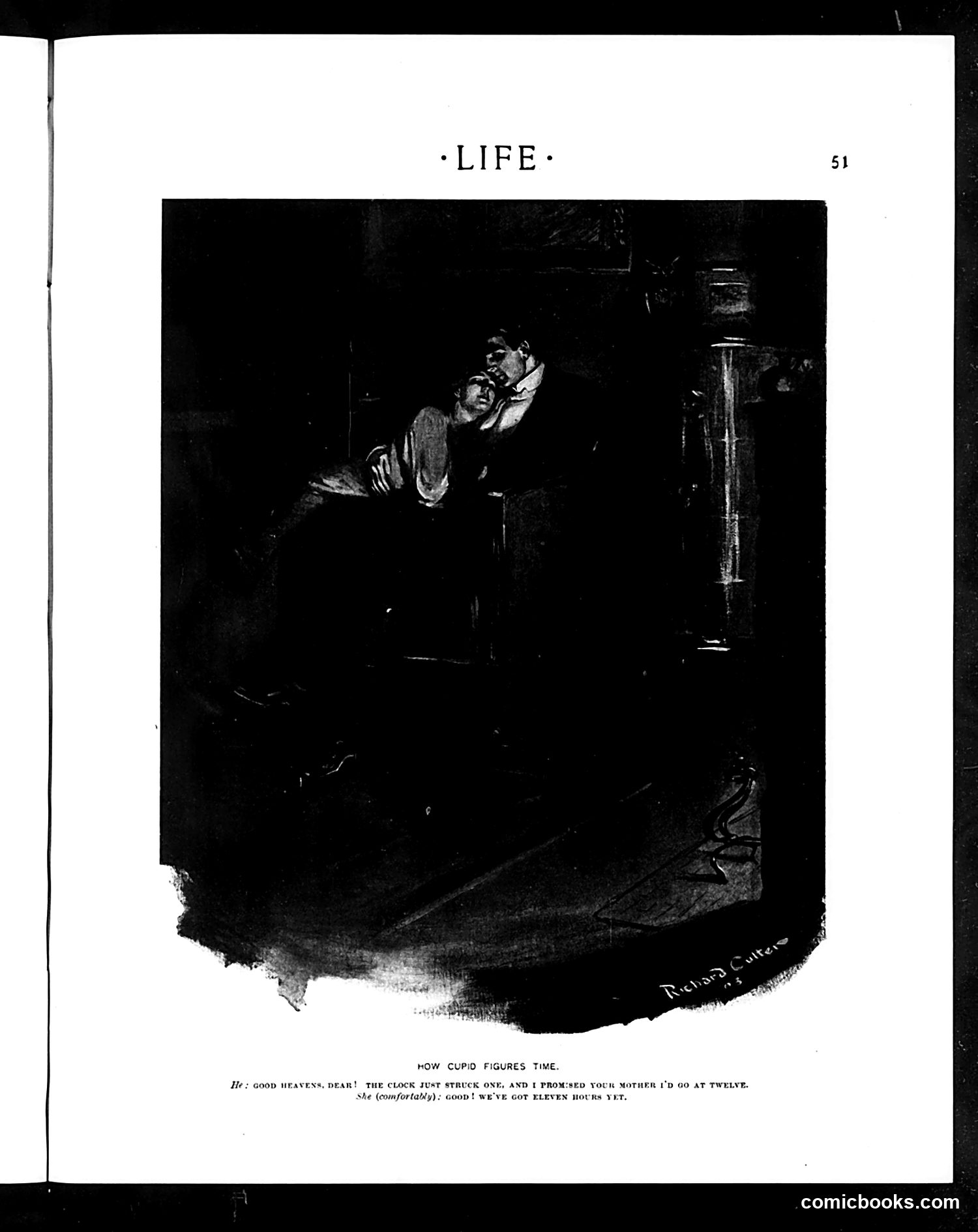
This is a romantic comedy illustration satirizing young lovers' perception of time. A couple are embracing in darkness; the man has just realized the clock struck 1 AM, meaning he promised the woman's mother he'd leave at midnight—he's already late by one hour. The humor lies in the woman's carefree response: she points out they still have "eleven hours" until noon, treating the violation of a parental curfew as trivial. The satire mocks both romantic couples' obliviousness to time when together and young women's dismissive attitudes toward parental authority. The title "How Cupid Figures Time" suggests that love makes people poor judges of hours passing. This reflects early 20th-century anxieties about youth courtship and parental control over dating.
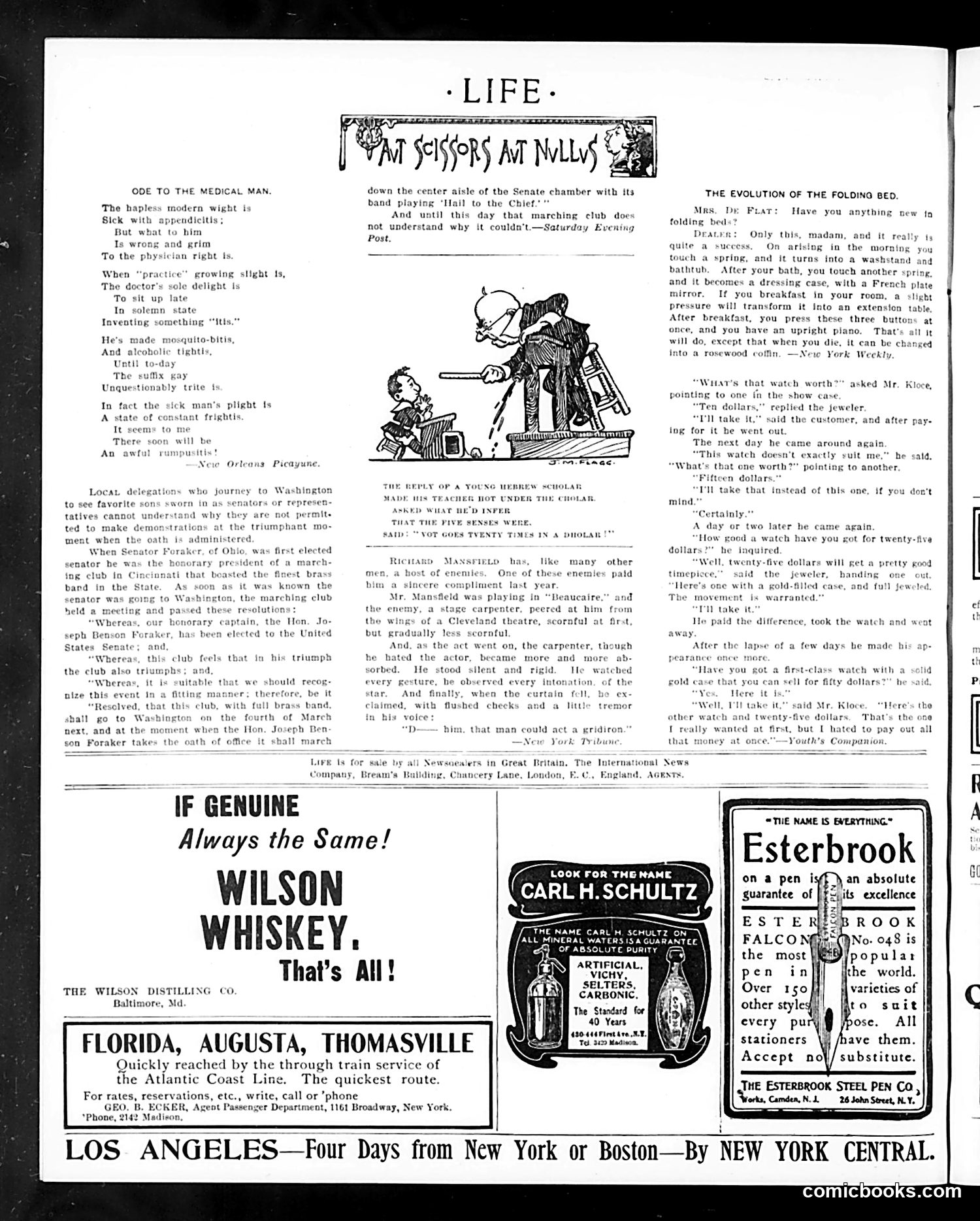
This page contains three satirical pieces typical of early 1900s American humor: **"Ode to the Medical Man"** mocks modern physicians, suggesting they invent dubious diseases (like "mosquito-bitis" and "pholic tights") to maintain profitable practices when genuinely sick patients become scarce. **"The Evolution of the Folding Bed"** satirizes Victorian-era multi-functional furniture crazes, humorously depicting an absurdly over-engineered bed that transforms into washstand, dressing case, piano, and finally—darkly—a coffin. **The watch-trading anecdote** features a customer repeatedly returning to a jeweler, trading up watches for increasingly higher prices, suggesting either the customer's indecision or the jeweler's manipulative sales tactics. The humor lies in the cycle of dissatisfaction. The remaining text discusses Senate delegations and theatrical anecdotes typical of Life's political-social commentary. These pieces collectively exemplify the magazine's satirical approach to American manners, professions, and consumer culture.
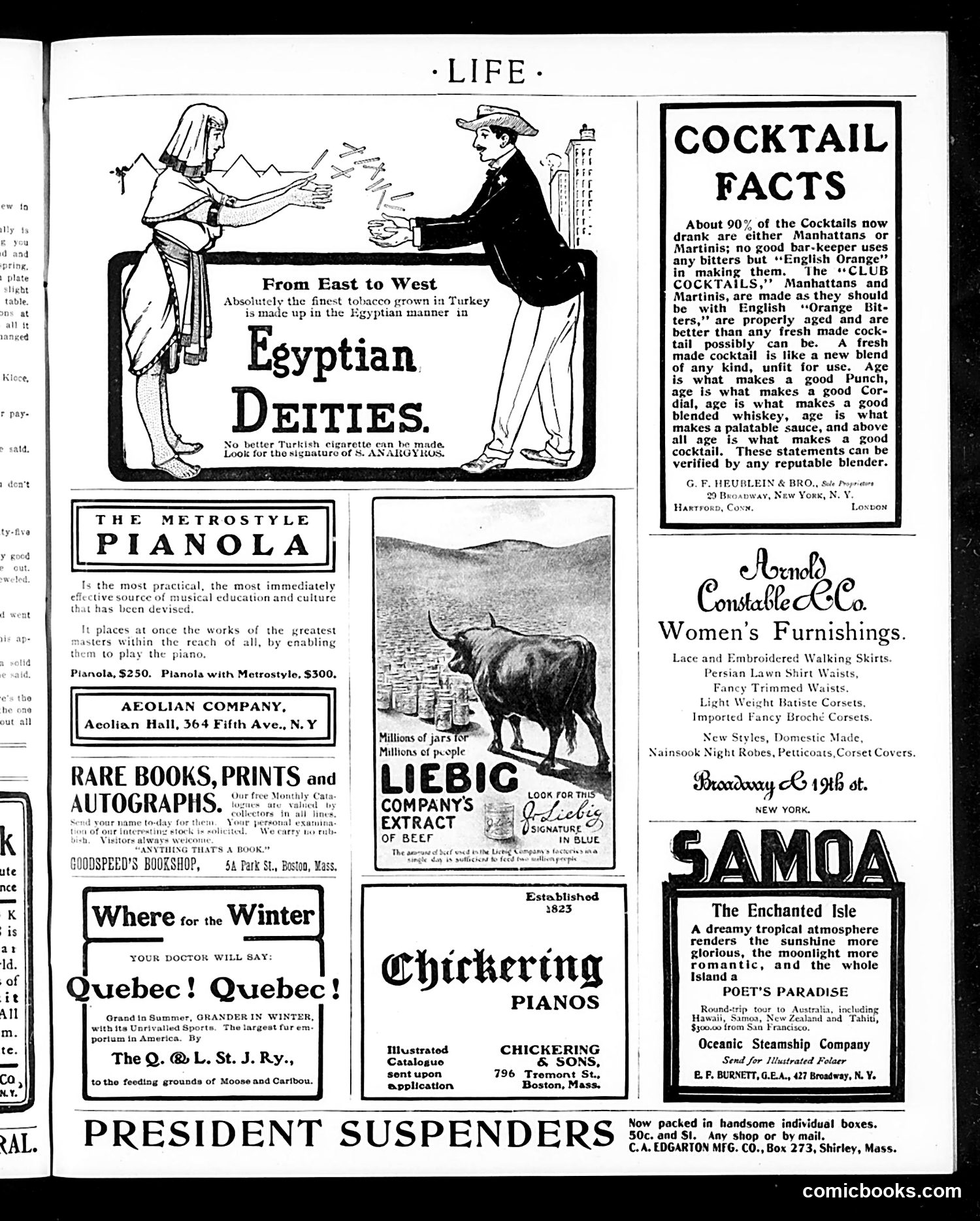
This page is primarily **advertisements** rather than political satire. The main cartoon—"From East to West"—depicts two men exchanging cigarettes, illustrating Egyptian Deities brand Turkish cigarettes made in the Egyptian manner. It's a straightforward product advertisement with no apparent satirical content. The page showcases early 1900s consumer goods: pianos, rare books, Quebec tourism, Liebig beef extract, Chickering pianos, cocktail mixers, women's clothing, and steamship travel to the South Pacific. The "Cocktail Facts" advertisement is notable for claiming that 90% of cocktails are Manhattans or Martinis, and promoting Club Cocktails made with English Orange Bitters—essentially branded spirits marketing disguised as bartending expertise. Overall, this represents Life magazine functioning as a high-end advertising vehicle for luxury goods and travel, typical of the publication's business model during this era.
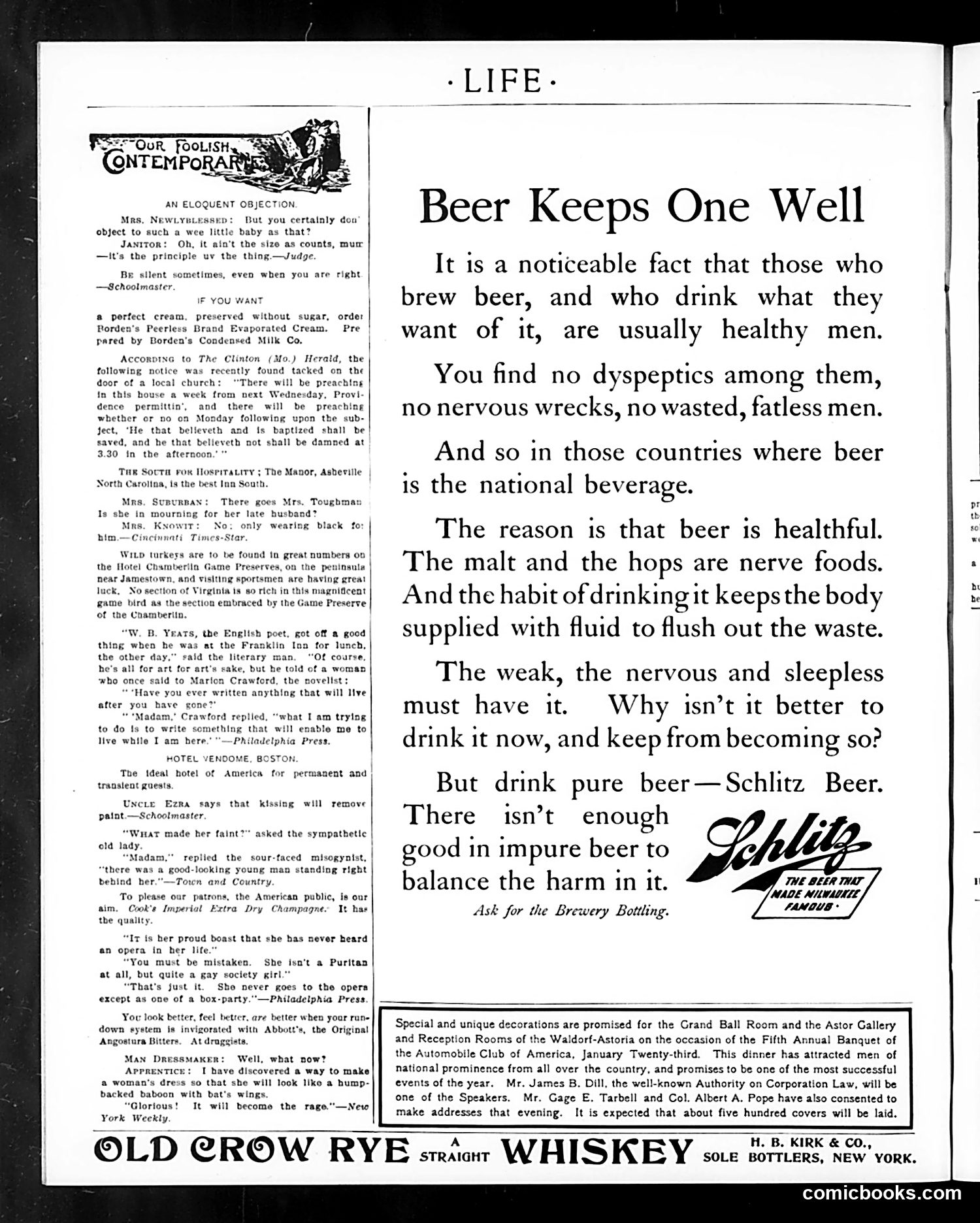
This page combines satirical humor with period advertising. The left column features short jokes typical of Life magazine's humor section, including quips about objections to babies, church announcements, and romantic mishaps—all reflecting early 20th-century sensibilities. The dominant right-side content is a **Schlitz Beer advertisement** disguised as editorial advocacy. It argues that beer promotes health, claiming brewers and drinkers are notably healthy because "malt and hops are nerve foods" and beer "flushes out waste." The ad targets the weak, nervous, and sleepless, positioning beer as preventative medicine. This reflects the **pre-Prohibition era** (before 1920) when alcohol was marketed with exaggerated health claims. The ad's pseudoscientific language—describing beer as therapeutic rather than recreational—was typical marketing strategy before federal regulations restricted such claims. Modern readers should recognize this as both period advertising and a historical artifact of how differently alcohol promotion was conducted and regulated over a century ago.
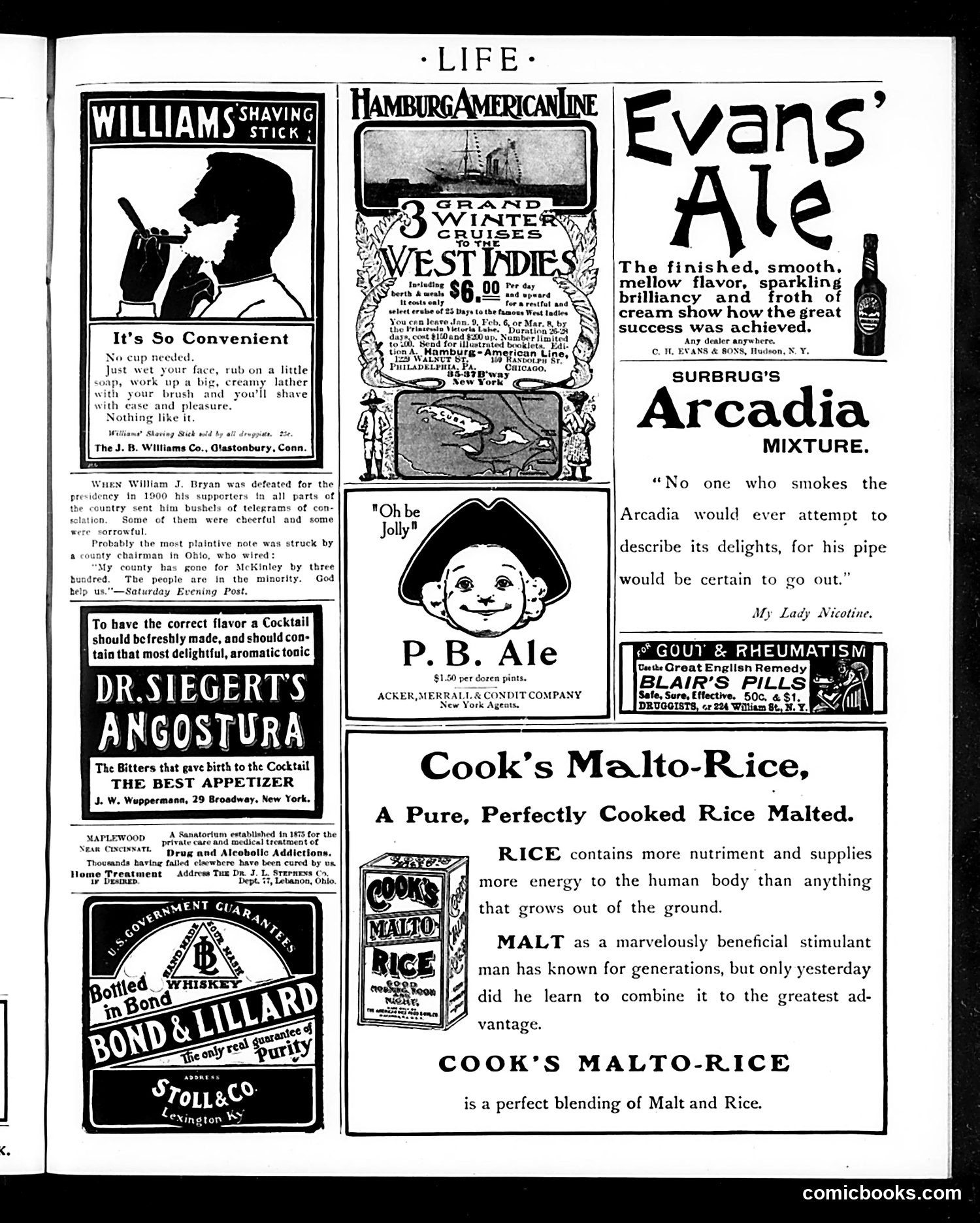
This is primarily an **advertising page**, not a satirical cartoon page. However, it contains one brief humorous anecdote: The **Bryan defeat story** references William Jennings Bryan's 1900 presidential loss to William McKinley. The joke comes from a consolation telegram sent by an Ohio county chairman, who reported his county went for McKinley "by three hundred" and lamented "The people are in the minority. God help us." The humor relies on the absurdity of the phrasing—the chairman accidentally expresses that the *majority* supported McKinley while claiming the people are in the minority, inverting logic to comic effect. It satirizes overwrought political despair following Bryan's defeat. The rest of the page consists of period advertisements for patent medicines, alcohol (whiskey, ale, bitters), tobacco, and food products—typical for early 1900s Life magazine. Many promote dubious health claims now recognized as false (the sanatorium for "Drug and Alcoholic Addictions," various tonics as cure-alls).
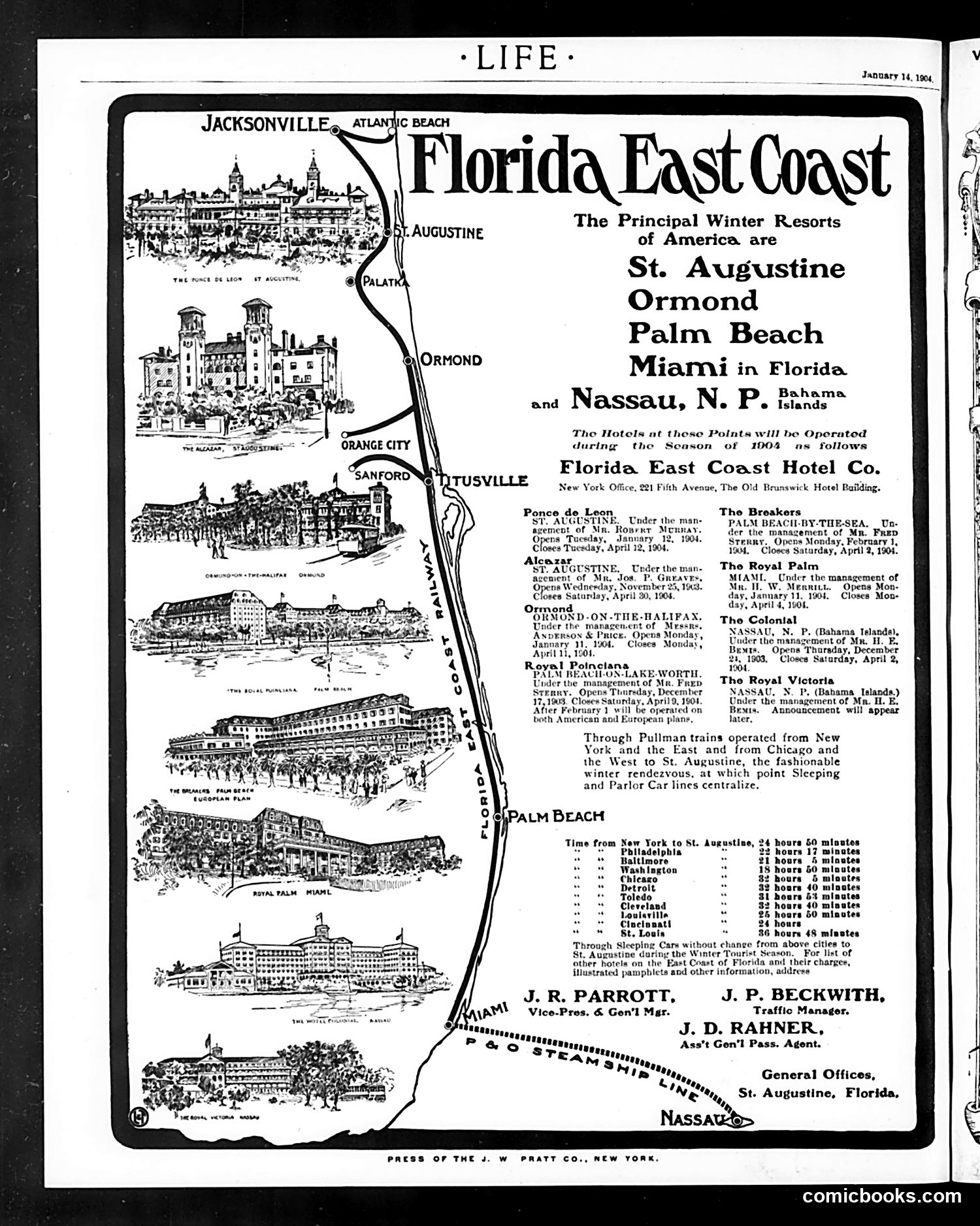
This is not a cartoon or satire—it's a **full-page advertisement** from *Life* magazine (January 14, 1904) promoting Florida's winter resort destinations operated by the Florida East Coast Hotel Company. The page features architectural drawings of luxury hotels (Ponce de Leon, Alcazar, Ormond-on-the-Halifax, Royal Poinciana, Royal Palm, and others) positioned along a map of Florida's east coast from Jacksonville to Nassau in the Bahamas. The text emphasizes rail connections via Pullman trains from major northern cities (New York, Philadelphia, Chicago), advertising travel times and the "fashionable winter rendezvous" at St. Augustine. Hotel opening/closing dates and management details are listed. This reflects the Gilded Age travel industry: wealthy Americans escaping cold winters via luxury rail and resort infrastructure—a booming tourism market in early 1900s Florida.