
Life, 1904-01-14 · page 13 of 20
Life — January 14, 1904 — page 13: what you’re looking at
What you’re looking at
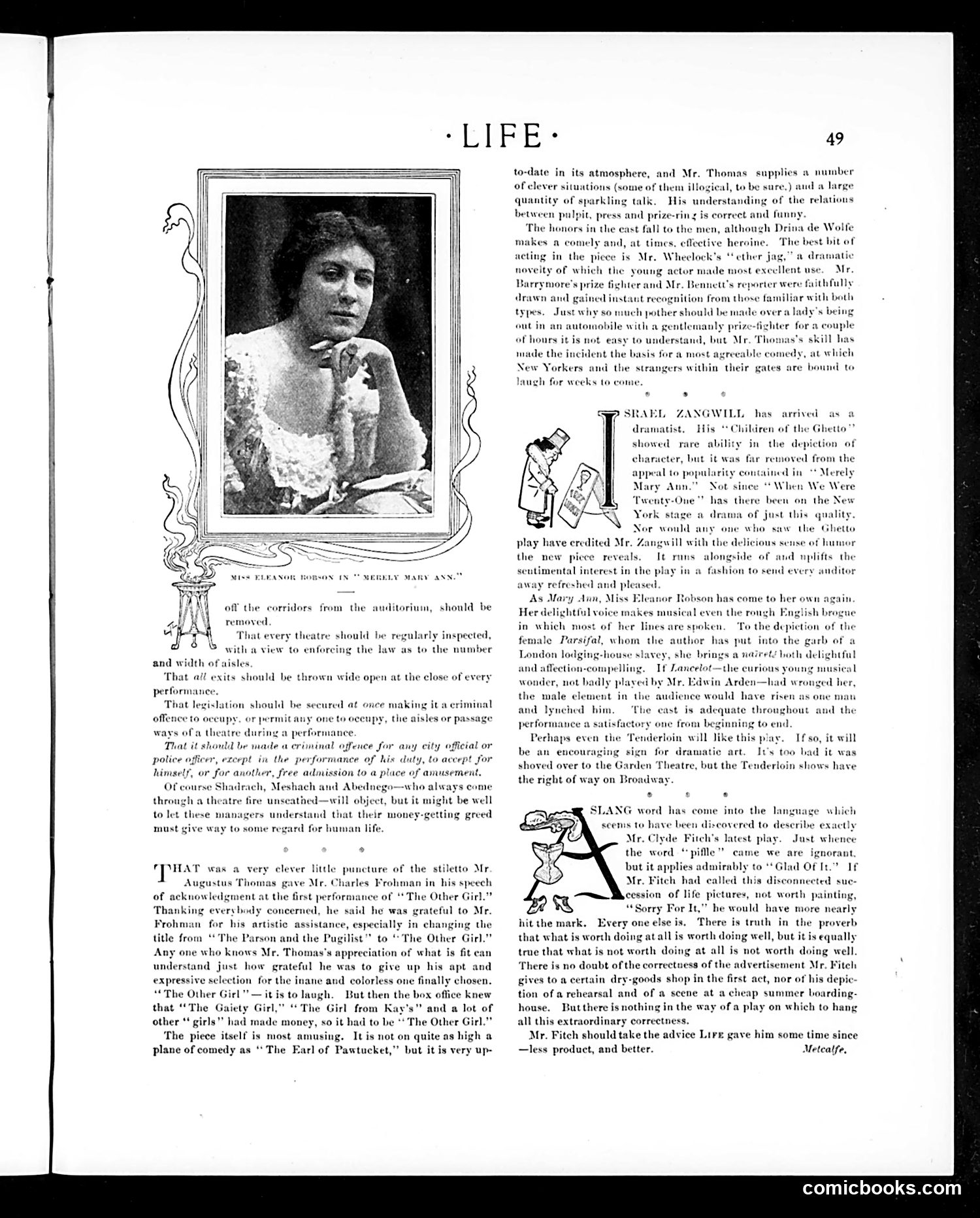
This is a theater criticism page from Life magazine featuring reviews of Broadway productions. The visible photograph shows **Miss Eleanor Robson in "Merely Mary Ann."** The text discusses several theatrical matters: 1. **Safety regulations** — The opening section advocates for theater fire safety laws, sarcastically invoking "Shadrach, Meshach and Abednego" (biblical figures who survived fire) to mock theater managers who prioritize profits over audience safety. 2. **"The Other Girl"** — A comedy by Augustus Thomas, criticized for having its title changed from the more apt "The Parson and the Pugilist" to something generic, simply because similar "girl" titles had made money. 3. **Reviews of current plays** including works by Israel Zangwill and discussions of performances by various actors. The satire targets theater management greed and commercial exploitation of dramatic art, while also providing contemporary performance criticism. This reflects Progressive Era concerns about public safety and artistic integrity versus commercialism.
📄 Transcribed text from this page (OCR, searchable)
Machine-transcribed from the original scan — historical spelling and the odd misread are preserved.
‘CIPE« 49 aay Many of the corridors from the auditorium, should be removed That every theatre should be regnls with a view t and width of aisles enforcing the law as to the number t all exits should be thrown wide open at the close of every mance, That legislation should be secured at once making ita criminal offence to occupy, or permit any one to occupy, the aisles or passage 1 performance ould be made a criminal offence for any city official or police officer, except in the performance of his duty, to accept for himself, or for another, free admission to a place of amusement, Shadrach, Meshach and Abednego—who always come gla theatre fire unseathed—will object, but it might be well to let these managers understand that their money-getting greed must give way to some regard for human life ery clever little puncture of the stiletto Mr homas gave Mr. yee was Augustus 1 of acknowledgment at the first performance of The Other Girl.” harles Frohman in his speech Thanking everybody concerned, | he was grateful to Mr. Frohman for his artistic assis especially in changing the title from “The Parson and the Pugilist” to “The Other Girl.” Any one who knows Mr. Thomas's appreciation of what is fit can understand just how grateful he was to give up his apt and expressive selection for the inane and colorless one finally chosen. “The Other Girl” — itis to laugh. But then the box office knew that “The Gaiety Girl,” “The Girl from Kay's” and a lot of other * girls” had made money, so it had to be “* The Other Girl.” The piece itself is most amusing. Itis not on quite as high a plane of comedy as “The Earl of Pawtucket,” but it is very up- to-date in its atmosphere, and Mr. Thomas supplii number ofe situations (some of them illogical, to be sure.) quantity of sparkling talk, His understanding of the relations between pulpit, press and prize-rin g is correct ‘The honors in the east fall to the men, althous de Wolfe makes a comely and, times, pest bit of acting in the piece is Mr. Wheelock's ‘ether Ya dramatic novelty of whi Barrymore's yy nd a large the young actor made most excellent use. Mr. ghter and Mr. Bennett's reporter were faithfully drawn and gained instant recognition from th niliar with both types. Just why so much pother should ben out in ttomobile with a gentlemanly p and, but Mr. T' cident the basis for a most rkers h for weeks to cow of hours it is not easy to under: nd the strangers within their gates SRAEL dramatist. NGWILL has His “Children of the Ghett arrived as showed rare ability in depiction of r, but it was far removed from the appeal to popularity contained in“ Merely “When We Were Jue" has there been on the New charie of just this quality ny one who saw the Ghet sill with the delicious sense of humor Lifts the interest in the play in a fashion to send every auditor the new It runs alongside of seutiment: sed. »bson has come to her own Her delightful in which me ec makes musical even the r of her lines female Parsifat, whom the author has put London lo y, she brit and affection-compelling, If Lancete wonder, not badly played by Mr, Edwin Arden—had wronged her, the male element in the audience would have rise and lynched him. ‘The performance a satisfact Pech be an encou English brogn e spoken. To the depiction of the the garb of a sand te hoth de heful the curious young musical ing-house sl as one man dequate thronghout and the ing sign for dra to the Garden Theatre, but the Tenderloin s the right of way on Broadway. shoved ov word has come into the langus to have been discovered to deseril Mr. Clyde Fitch's the word “piflle” norant but it applies admirably to “Glad OF I." If Mr. Fitch had called this disconnected sue- cession of life pictures, not worth painting, “Sorry For It,” he would have more nearly hit the mark. Every one else is, There is truth in the proverb that what is worth doing at all is worth doing well, but it is equally true that what is not worth doing at all is not worth doing well. ‘There is no doubt of the correctuess of the advertisement Mr. Fiteh gives toa certain dry-goods shop in the first act, nor of his depic- tion of a rehearsal and of a scene at acheap summer boarding- house. Dut there is nothing in the way of a play on which to hang all this extraordinary correctness. Mr. Fitch should take the advice Lire gave him some time since —less product, and better. Metcalfe. comicbooks.com