
Life, 1904-01-14 · page 7 of 20
Life — January 14, 1904 — page 7: what you’re looking at
What you’re looking at
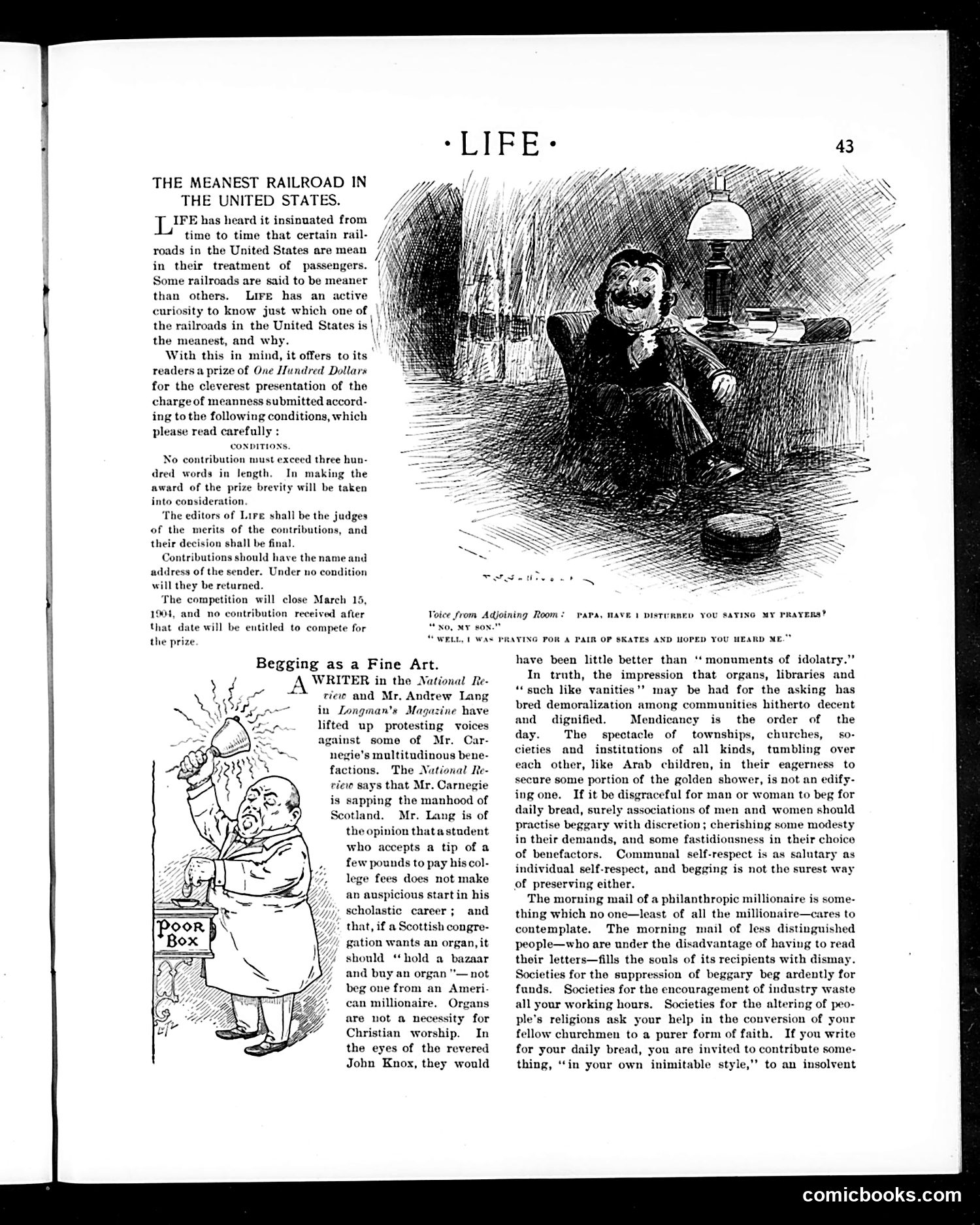
This page contains two distinct satirical pieces: **"The Meanest Railroad in the United States"** (top right): A contest announcement offering $100 for readers to submit the worst example of railroad mistreatment of passengers. The accompanying sketch shows a disheveled man in a sparse train compartment, suggesting the poor conditions some railroads provided. **"Begging as a Fine Art"** (left): Satirizes philanthropist Andrew Carnegie's opposition to begging. The cartoon depicts a poor person in a "Poor Box" being confronted by Carnegie's influence. The article criticizes Carnegie and writer Andrew Lang for suggesting that begging should be discouraged rather than addressed through charity. The satire argues that opposing begging while ignoring poverty is hypocritical—that proper charity requires addressing root causes, not simply eliminating visible poverty.
📄 Transcribed text from this page (OCR, searchable)
Machine-transcribed from the original scan — historical spelling and the odd misread are preserved.
THE MEANEST RAILROAD IN THE UNITED STATES. LIFE has heard it insinuated from time to time that certain rail- roads in the United States are mean in their treatment of passengers. Some railroads are said to be meaner than others. Lire has an active curiosity to know just which one of the railroads in the United States is | the meanest, and why. \ With this in mind, it offers to its readers a prize of One Hundred Dollars for the cleverest presentation of the charge of meanness submitted accord- ing to the following conditions, which please read carefully : CONDITIONS No contribution must exceed three hun- dred words in length. In making the award of the prize brevity will be taken into consideration The editors of Lire shall be the judges of the merits of the contributions, and their decision shall be final. Contributions should have the name and address of the sender. Under no condition will they be returned. The competition will close March 15, 1904, and no contribution received after that date will be entitled to compete for the prize MY SON Begging as a Fine Art. y { A WRITER in the National Re- ) riew and Mr. Andrew Lang in Longman's Magazine have lifted up protesting voices against some of Mr. Car- negie’s multitudinous bene- factions. The National Re- view says that Mr. Carnegie is sapping the manhood of Scotland. Mr. Lang is of the opinion thata student who accepts a tip of a few pounds to pay his col- lege fees does not make an auspicious start in his scholastic career; and that, if a Scottish congre- gation wants an organ, it should “hold a bazaar and buy an organ "— not beg one from an Ameri- can millionaire. Organs are not a necessity for Christian worship. In the eyes of the revered John Knox, they would Voice from Adjoining Room : PAPA, NAVE 1 DISTERRED YOU SAYING MY PRayEns? FLL, 1 WAS PRAYING POR A PAIR OF SKATES AND MOPED YoU MEARD ME.” have been little better than ‘‘ monuments of idolatry.” In truth, the impression that organs, libraries and “‘such like vanities’? may be had for the asking has bred demoralization among communities hitherto decent and dignified. | Mendicancy is the order of the day. The spectacle of townships, churches, so- cieties and institutions of all kinds, tumbling over each other, like Arab children, in their eagerness to secure some portion of the golden shower, is not an edify- ing one. If it be disgraceful for man or woman to beg for daily bread, surely associations of men and women should practise beggary with discretion; cherishing some modesty in their demands, and some fastidionsness in their choice of benefactors. Communal self-respect is as salutary as individual self-respect, and begging is not the surest way of preserving either. The morning mail of a philanthropic millionaire is some- thing which no one—least of all the millionaire—cares to contemplate. The morning mail of less distinguished people—who are under the disadvantage of having to read their letters—fills the souls of its recipients with dismay. Societies for the suppression of beggary beg ardently for funds. Societies for the encouragement of industry waste all your working hours. Societies for the altering of peo- ple’s religions ask your help in the conversion of your fellow churchmen to a purer form of faith. If you write for your daily bread, you are invited to contribute some- thing, “in your own inimitable style,’’ to an insolvent comicbooks.com