
Life, 1904-01-14 · page 14 of 20
Life — January 14, 1904 — page 14: what you’re looking at
What you’re looking at
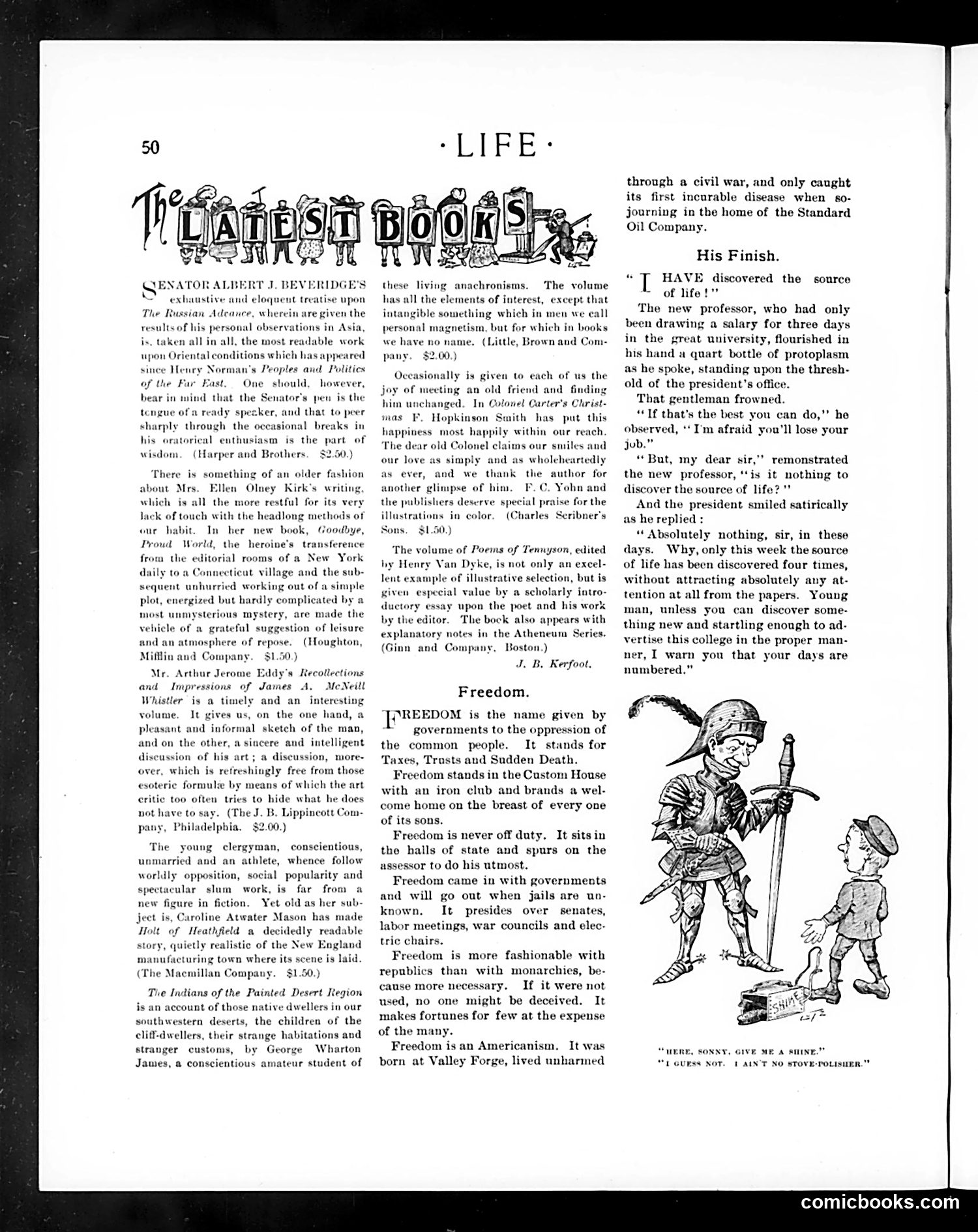
This page contains a sharp satirical definition of "Freedom" alongside an accompanying cartoon. The text mockingly redefines the patriotic concept as merely "the oppression of the common people" consisting of "Taxes, Trusts and Sudden Death." The illustration depicts a militaristic, brutish figure labeled "Freedom"—depicted as a soldier or enforcer—literally branding or striking ordinary citizens. The caption below reads: "HERE, SONNY, GIVE ME A SHINE. / 'I GUESS NOT. I AIN'T NO STOVE-POLISHER.'" The satire targets Gilded Age inequality: the government claims to represent "Freedom," but actually uses force to extract taxes and enforce corporate interests (trusts) against working people. The cartoon's soldier-figure embodies this contradiction—claiming to protect citizens while actually serving state and corporate power. The shoe-shining exchange illustrates the indignity imposed on the poor under this false "freedom."
📄 Transcribed text from this page (OCR, searchable)
Machine-transcribed from the original scan — historical spelling and the odd misread are preserved.
IT J. BEVERIDG exhaust nd eloquent trea The Russian Adcauce, wherein are given the results of his personal observations in A is, taken all in all, the most r vle work upon Oriental conditions which has appeared "s Peoples and Politics hould, or’s pen is the nd that to peer al breaks in of the Far East, ind that the Se tengue of a ready specker, sharply through the oc his oratorical enthusiasm is the part of, One however, bear ir wisdom. (Harper and Brothers, $2.50.) There is something of an older fashion about Mrs. Ellen Olney Kirk's writi which is all the more restful for its very lack of touch with the headlong methods of our habit. In her new book, Goodbye, Proud World, the heroine's transference from the editorial rooms of a New York daily to a Connecticut village and the sub- sequent unhurried working out of a simple ergized but complicated by a most unmysterious myste a grateful suggestion of leisure and an atmosphere of repose. (Houghton, Mifflin and Company. $1.50.) plot, er ardly re made the vehicle o Mr. Arthur Jerome Eddy's Recollections and Impre: f James A, MeNeill Whistler is a timely and an interesting volume. It gives us, on the one hand, a pleasant al sketch of the man, and on the other, a sincere and intelligent of his art; a discussion, more- ch is refreshingly free from those means of which the art nd infor discussic over, wh esoteric formule by critic too often tries to hide wh: not have to say. (The J. B. Lippincott Com- pany, Philadelphia. $2.00.) The young clergyman, conscientious, unmarried and an athlete, whence follow worldly opposition, social popularity and spectacular slum work, is far from a ew figure in fiction. Yet old as her sub- ject is, Caroline Atwater Mason has made Holt of Heathfield a decidedly readable story, quietly realistic of the New England manufacturing town where its scene is laid (The Macmillan Company. $1.50.) Tie Indians of the Painted Desert Region is an account of those native dwellers in our southwestern deserts, the children of the cliff-dwellers, their strange habitations and stranger customs, Wharton James, a conscientious amateur student of by George these living anachronisms. The volume has all the elements of interest, except that intangible sowething which in men we 1 personal magnetism, but for which in books we have no name, (Little, Brown and C pany. $2.00.) Occasionally is given to each of us the joy of meeting an old friend and findi hanged. In Colonel Carte ri Hopkinson Smith has put this happiness most happily within our reach The dear old Colonel claims our smiles a our love as simply and as wholeheartedly as ever, thank the author for another glimpse of him. F.C. Yohn and the publishers deserve special praise for the illustrations in color. ( rles $ Sons. $1.50.) him un mas F. and we cribner's The volume of Poems of Tennyson, edited hy Henry Van Dyke, is not only an excel- lent example of illustrative selection, but is given especial value by a scholarly intro- ductory essay upon the poet and his work by the editor. The bock also appears with notes in the Atheneum Serie Boste J. B. Kerfoot, explanatory (Ginn and Company, Freedom. [PREEDOM is the name given by governments to the oppression of the common people. It stands for Taxes, Trusts and Sudden Death. Freedom stands in the Custom House with an iron club and brands a wel- come home on the breast of every one of its sons. Freedom is never off duty. It sitsin the halls of state and spurs on the assessor to do his utmost. Freedom came in with governments and will go out when jails are un- known, It presides o senates, labor meetings, war councils and elec- tric chairs. Freedom is more fashionable with republics than with monarchies, be- cause more necessary. If it were not used, no one might be deceived. It makes fortunes for few at the expense of the many. Freedom is an Americanism. It was born at Valley Forge, lived unharmed through a civil war, and only caught its first incurable disease when so- journing in the home of the Standard Oil Company. His Finish. HAVE discovered the source of life!" The new professor, who had only been drawing a salary for three days in the great university, flourished in his hand a quart bottle of protoplasm as he spoke, standing upon the thresh- old of the president's office. That gentleman frowned. “Tf that’s the best you can do,’’ he observed, “I'm afraid you'll lose your job.” “But, my dear sir,’ remonstrated the new professor, ‘is it nothing to discover the source of life? '’ And the president smiled satirically as he replied : Absolutely nothing, sir, in these Why, only this week the source of life has been discovered four times, without attracting absolutely any at- tention at all from the papers. Young man, unless you can discover some- thing new and startling enough to ad- vertise this college in the proper man- ner, I warn you that your days are numbered,” SONS Nor. GIVE ME A SILIN! 1 AIN'T No sTOvE-POLIsuER.”” comicbooks.com