
A complete issue · 21 pages · 1903
Life — December 31, 1903
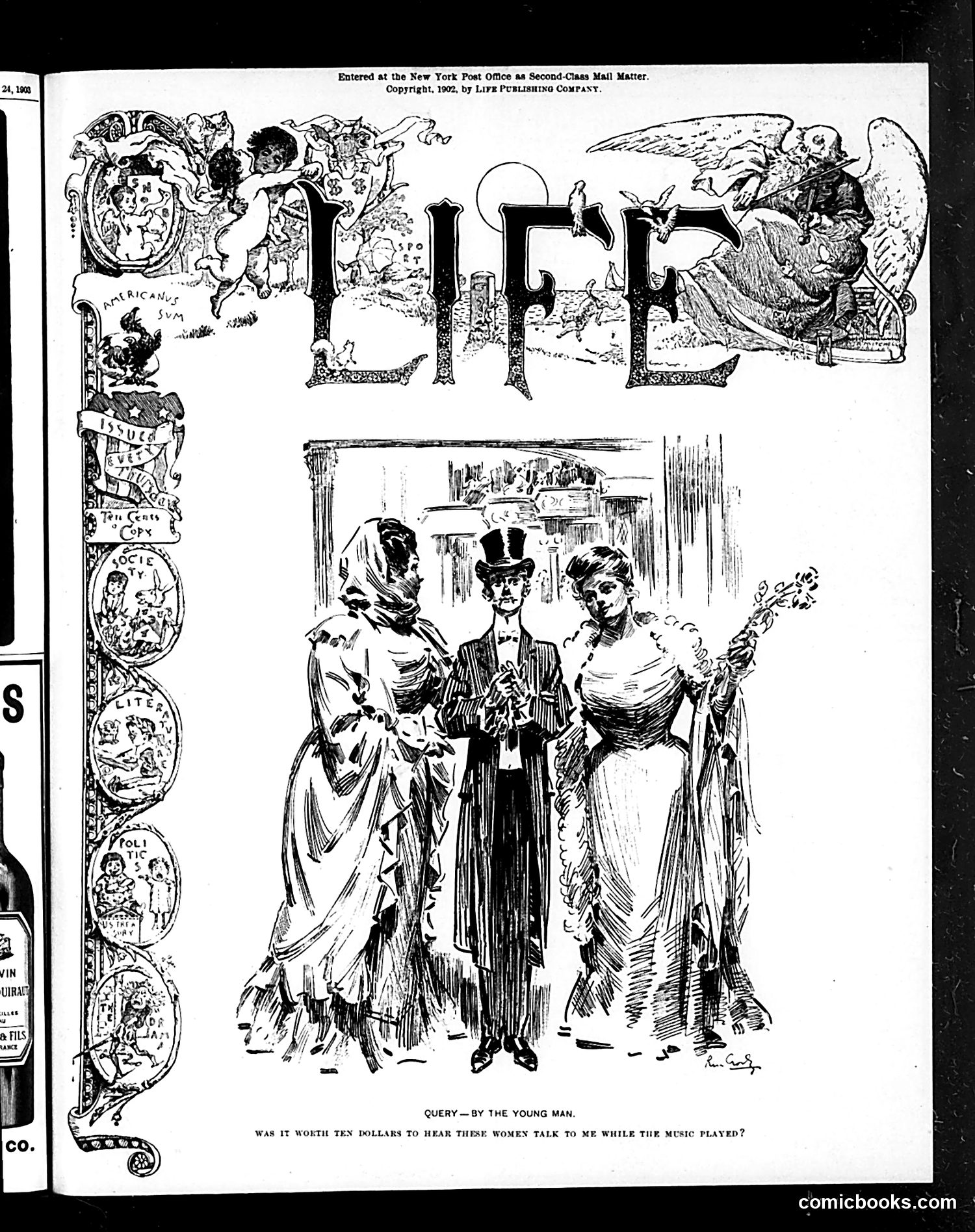
This page features an illustrated article titled "LIFE" with decorative border elements. The main cartoon depicts three figures—two women in fashionable dress flanking a man in formal attire with a top hat. The caption reads: "QUERY—BY THE YOUNG MAN. WAS IT WORTH TEN DOLLARS TO HEAR THESE WOMEN TALK TO ME WHILE THE MUSIC PLAYED?" The satire mocks the expense of entertainment and social interaction in early 1900s urban life. The joke suggests the young man paid ten dollars (a significant sum then) for the privilege of conversing with women at what appears to be a social venue or dance hall. The humor targets both the frivolous spending habits of wealthy young men and the commodification of social companionship during the era.
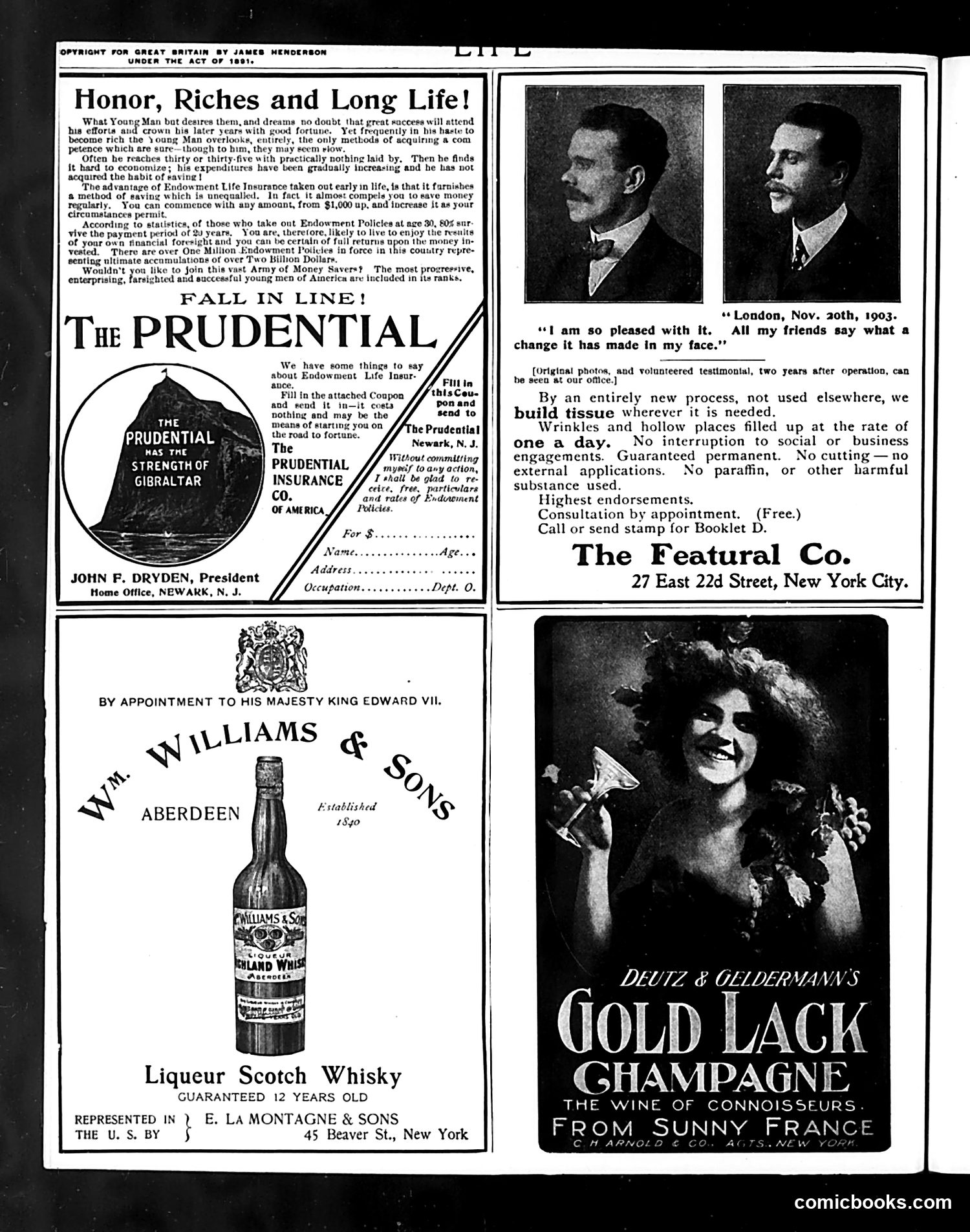
This page is primarily **advertising**, not satirical content. It contains four distinct advertisements: 1. **The Prudential Insurance Company** - promoting endowment life insurance with a call to young men to secure financial futures 2. **The Featural Co.** - advertising a cosmetic procedure (appears to be a facial treatment for wrinkles, dated Nov. 20, 1903, with a testimonial photo) 3. **W.M. Williams & Sons** - Scotch whisky from Aberdeen, established 1890 4. **Deutz & Geldermann's Gold Lack Champagne** - French wine, featuring a woman with a champagne glass The page represents typical early 1900s Life magazine content: a mix of financial services, beauty treatments, and luxury goods marketed to affluent readers. No political satire or cartoon commentary is present.
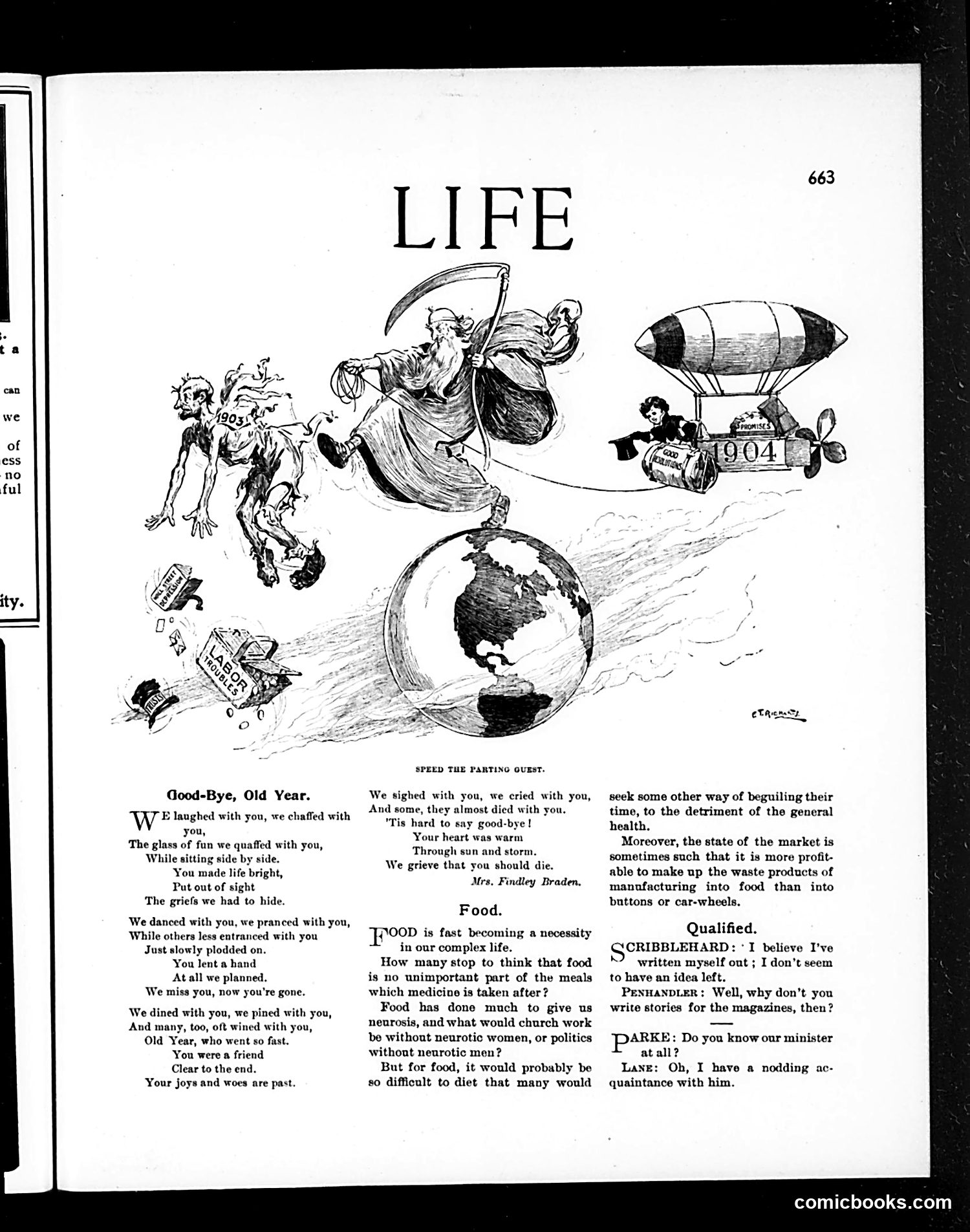
This page combines New Year's sentiment with early 20th-century satire. The main cartoon "Speed the Parting Guest" depicts Death (the robed skeleton figure with scythe) chasing away 1903, while an airship labeled "1904" arrives—suggesting optimism about the new year displacing the old. The poem "Good-Bye, Old Year" sentimentalizes the departing year with nostalgic references to past pleasures and pains now ended. Below, the "Food" section appears to be satirical commentary on dietary trends and their connection to social anxieties—mentioning neurotic women, politics, and manufacturing concerns about waste products becoming food. The dialogue snippet mocks magazine writers and ministers, suggesting contemporary intellectual pretensions. The overall message: bidding farewell to 1903 while poking fun at modern social concerns.
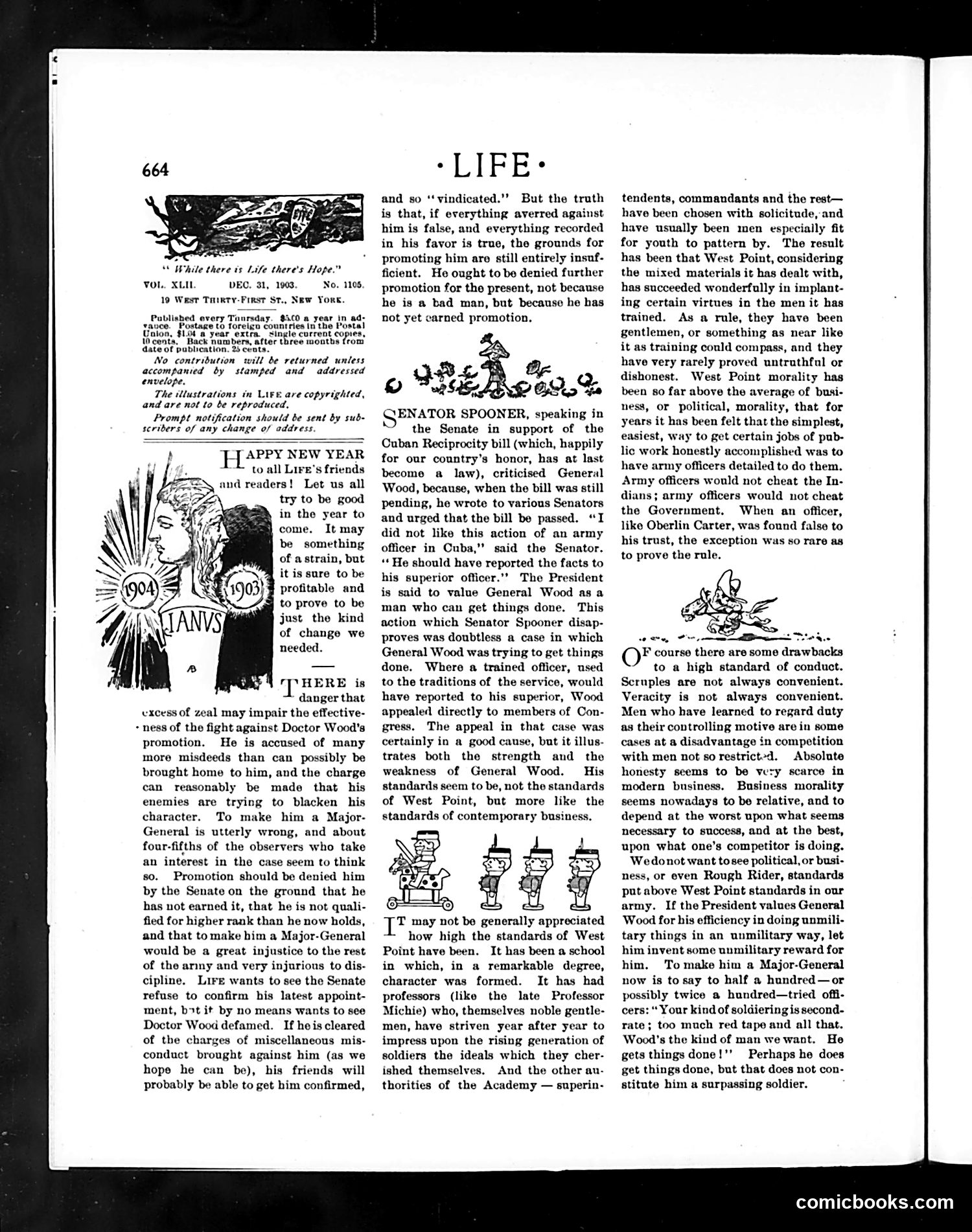
This page addresses General Leonard Wood's promotion controversy. Senator Spooner criticized Wood's handling of the Cuban Reciprocity bill, claiming Wood (as an army officer) should have reported facts to superiors rather than directly lobbying Congress—a breach of military protocol. The editorial defends Wood as exceptionally competent, arguing his promotion shouldn't be denied because he exceeded his rank. However, it acknowledges legitimate concerns: absolute honesty should govern military conduct, and business ethics shouldn't replace military standards. The satirical drawings (small figures at bottom) appear to mock the debate's absurdity—showing how standards differ between military discipline and civilian business pragmatism.
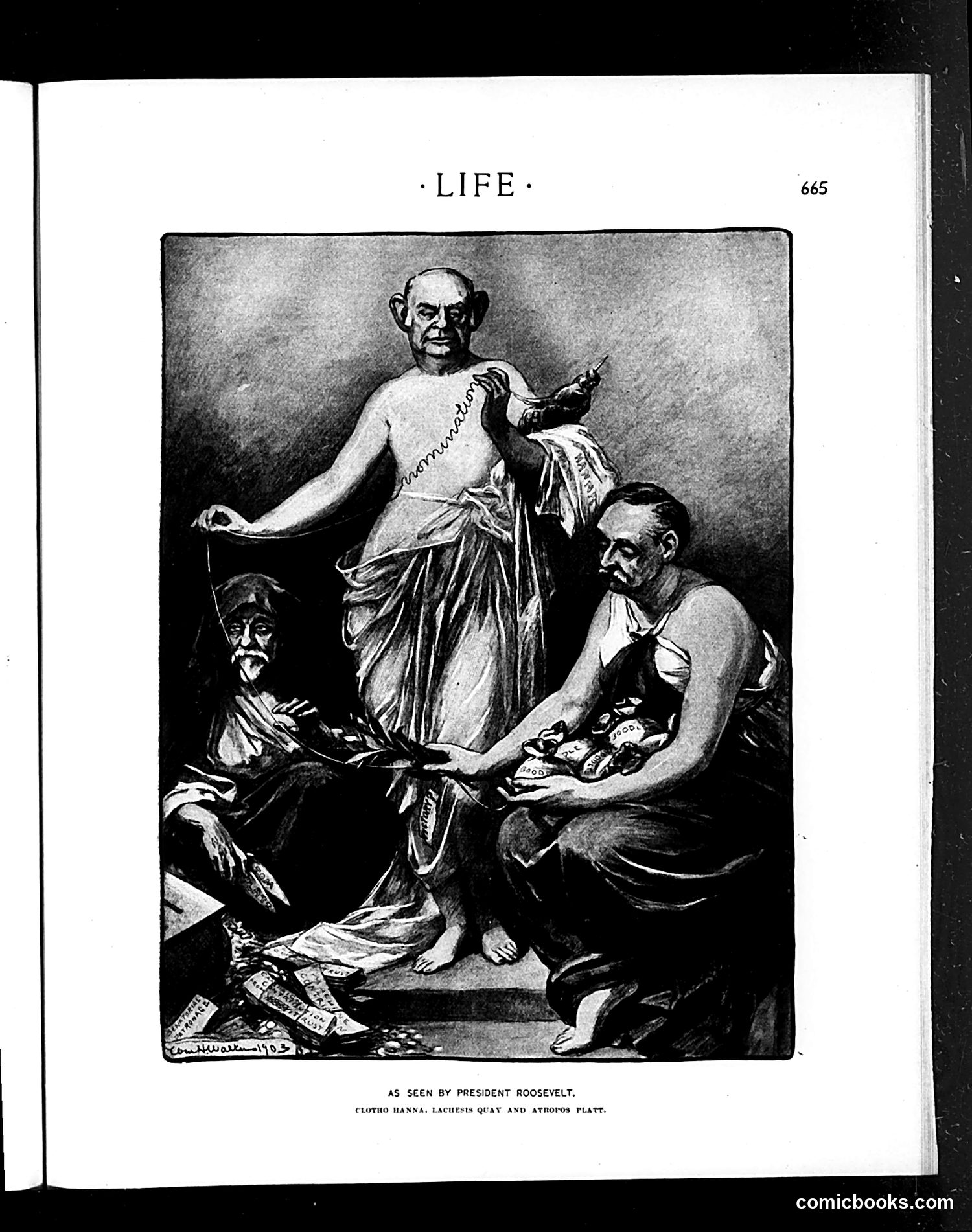
This *Life* magazine cartoon, titled "As Seen by President Roosevelt," depicts an allegorical scene with three figures. A central robed figure (labeled "Clotho Hanna, Lachiesis Quay and Atropos Platt") stands elevated, gesturing downward toward two seated men below. The caption references the Greek Fates (the three figures named), suggesting Roosevelt's view of political manipulation by Republican party figures. The names reference Mark Hanna, Joseph Quay, and Thomas Platt—powerful GOP operatives of the early 1900s. The satire appears to critique Roosevelt's perception that these party bosses controlled political outcomes through hidden machinations, reducing elected officials to puppets of fate. The imagery equates their power with mythological forces beyond human control.
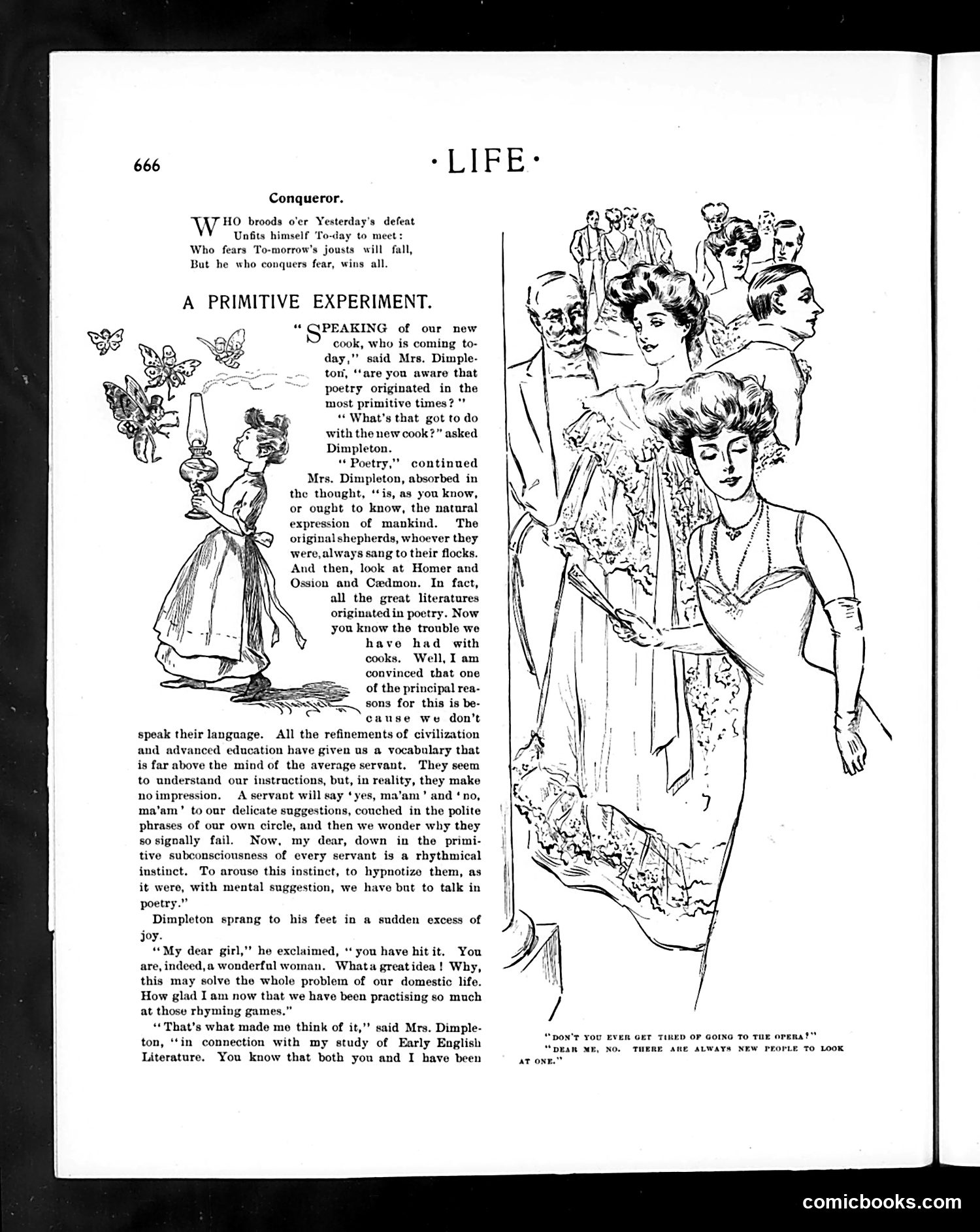
This satirical piece mocks pretentious intellectual arguments about domestic servants. Mr. Dimpleton argues that servants lack refinement because they don't understand "poetry"—claiming poetry originated in primitive times with shepherds, so speaking poetry to servants will somehow awaken their "rhythmical instinct." Mrs. Dimpleton finds this reasoning absurd, countering that both she and her husband have studied Early English Literature, implying his theory is pseudointellectual nonsense. The cartoon ridicules upper-class attempts to "improve" working-class people through condescending cultural lessons. The right illustration shows fashionable society figures, emphasizing the gap between the Dimpletons' pretensions and actual social reality. The satire targets both their pomposity and the era's class-based assumptions about refinement.
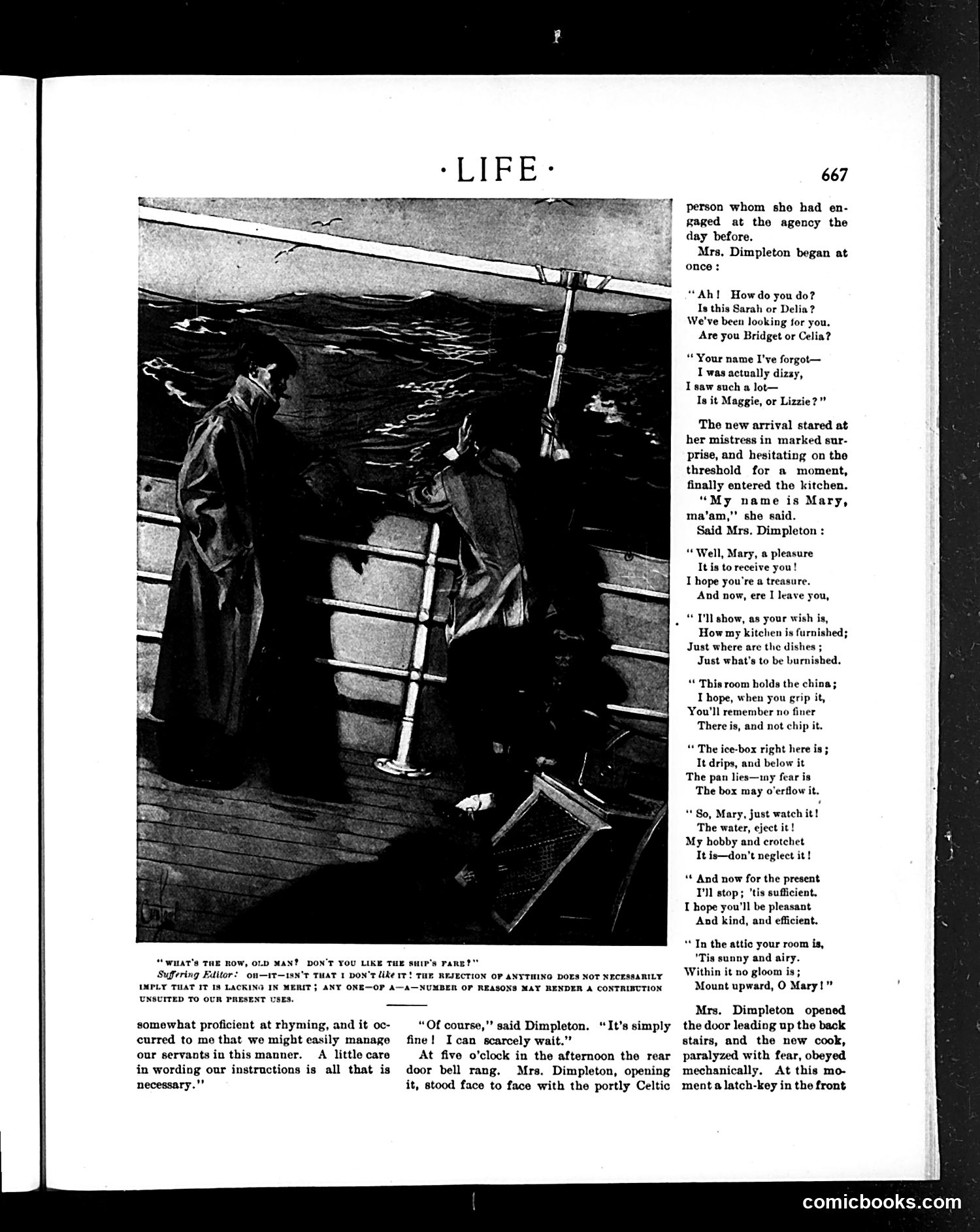
This page appears to be from a serialized story or novel rather than a political cartoon. The large illustration shows two figures on what appears to be a ship or boat deck, with dialogue and narrative text beside it. The content depicts a domestic servant scenario: Mrs. Dimpleton is meeting a new kitchen maid named Mary. The text shows Mrs. Dimpleton giving detailed household instructions about managing the kitchen, ice-box, and dishes—with particular emphasis on careful handling of fine china and preventing water damage. The satirical humor targets upper-class pretentiousness: an employer's fussy, elaborate instructions for basic domestic tasks, and her anxiety about servants damaging valuable possessions. The caption at bottom mocks this verbose instructional style. This reflects early 20th-century class tensions and servant-employer relations.
This page contains a serialized story rather than a political cartoon. The illustration shows what appears to be a dramatic nighttime scene in a locomotive or train cabin, with a figure visible in dim lighting. The narrative depicts Mrs. Dimpleton discussing dinner preparations with her husband. The story is primarily dialogue-driven domestic fiction, not satire. The embedded poem about meal preparation ("Aye, marry, 'tis the hour...") celebrates traditional cooking—roasted meats, vegetable sides, pasta, salads—suggesting this reflects late 19th or early 20th century household values around domestic management and traditional cuisine. This is literary entertainment rather than political commentary or social satire.
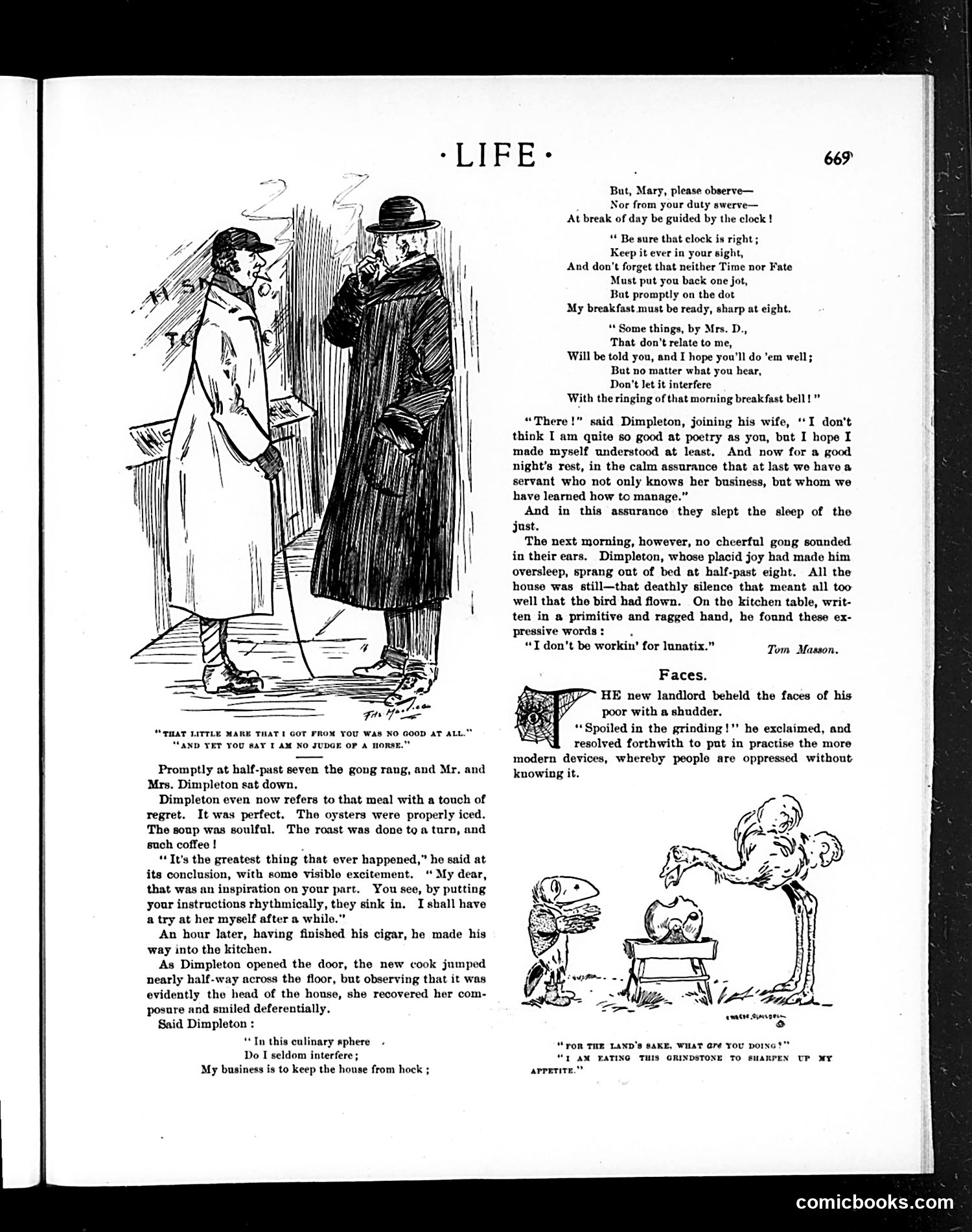
This page contains a domestic humor story about Mr. and Mrs. Dimpleton, a couple negotiating household management. The main cartoon shows them in conversation, with Mary instructing her husband about breakfast timing and the servant's duties. The satire centers on **Victorian-era servant management**: Mrs. Dimpleton insists the cook ring the breakfast bell precisely on time, warning that neither "Time nor Fate" must delay it. Mr. Dimpleton responds by praising their new cook's competence, but the ironic punchline reveals she's written "I don't be workin' for fanatix" (fanaticsic) — mocking the wife's obsessive household demands. The lower cartoon about "Faces" satirizes landlords who exploit poor tenants using modern "devices" to oppress them without obvious cruelty.
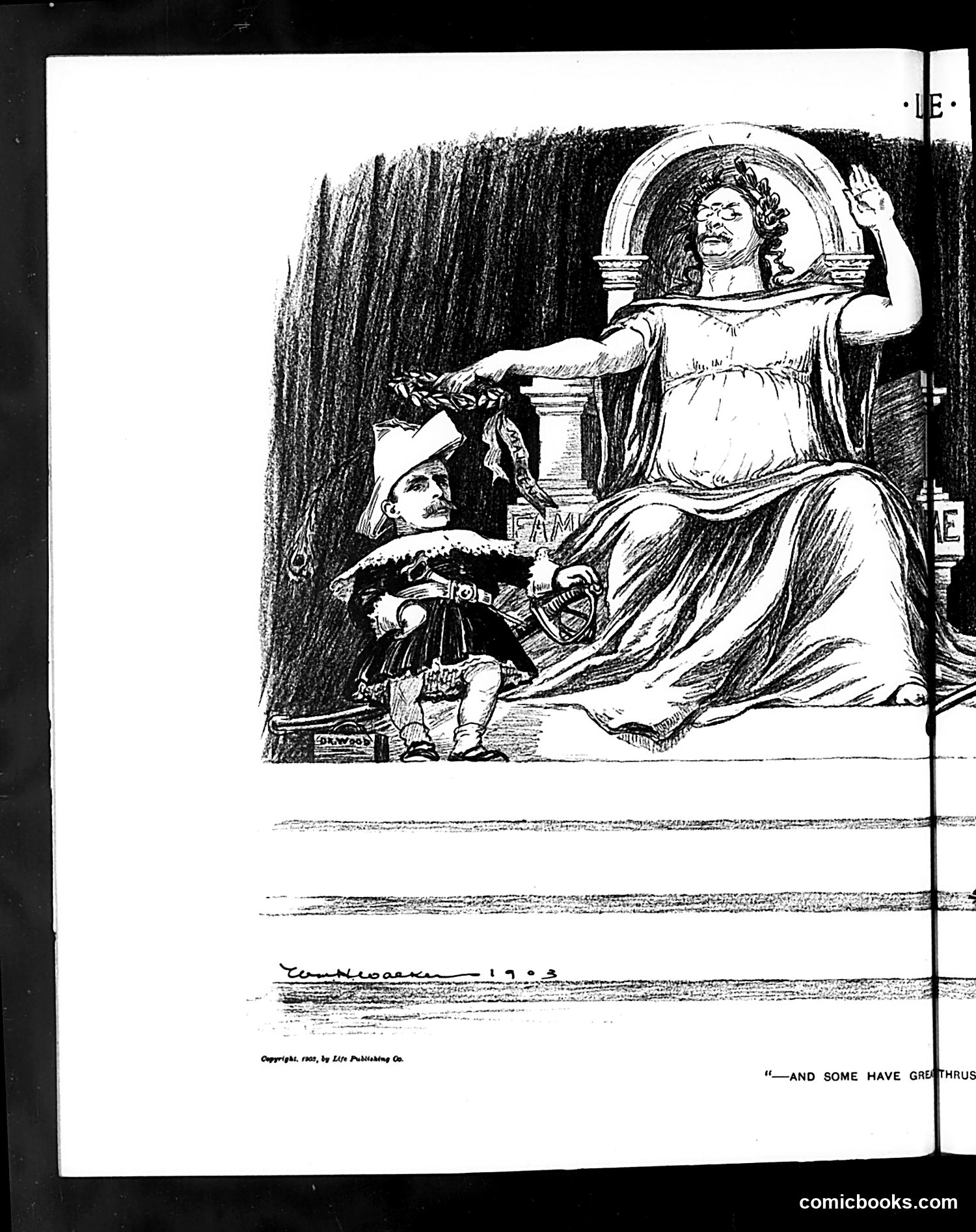
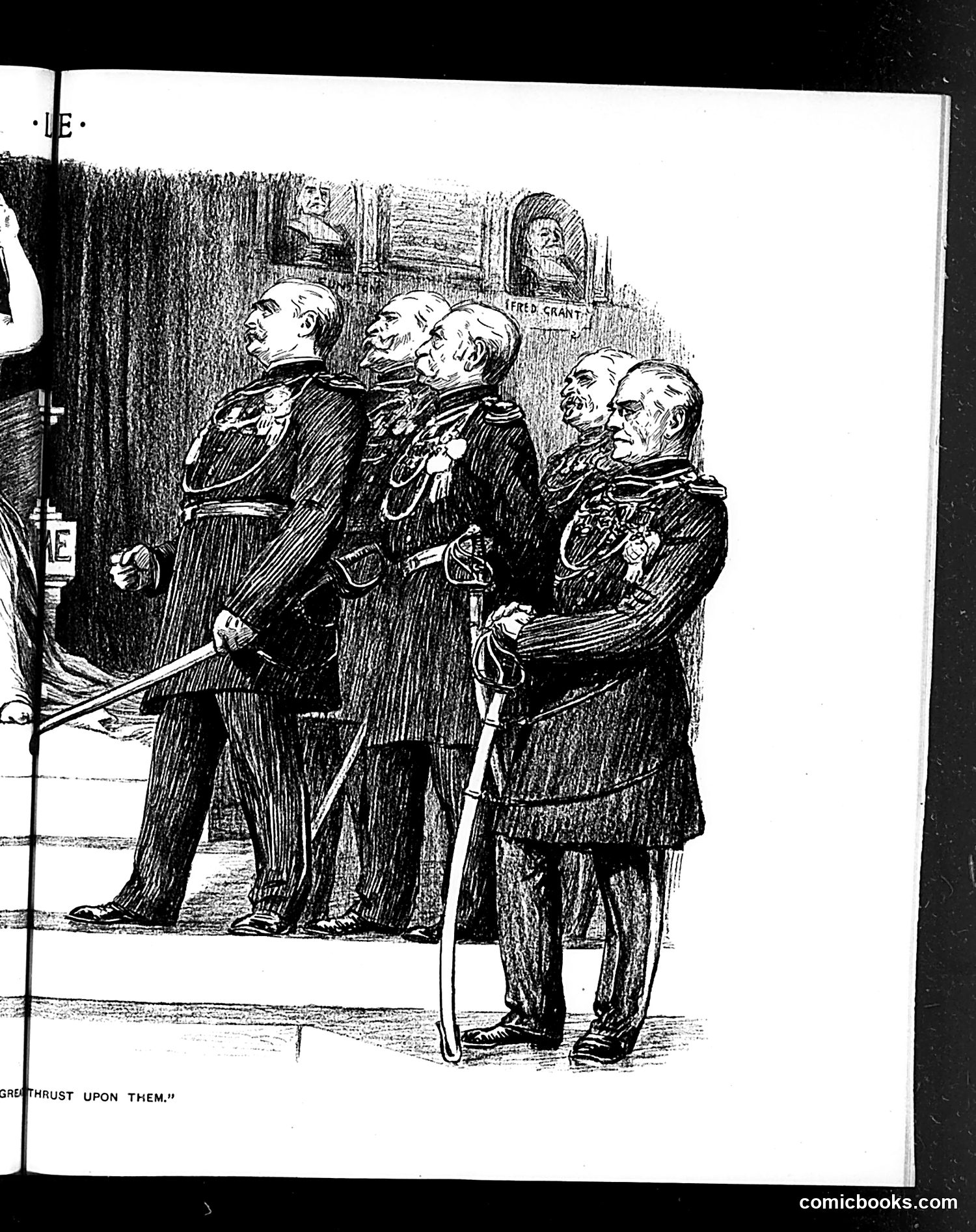
This appears to be a satirical cartoon from Life magazine depicting military or government officials in formal uniforms with decorative insignia and swords. The visible caption fragment reads "GREAT THRUST UPON THEM," suggesting the cartoon satirizes leaders who have had power or responsibility unexpectedly imposed upon them. The five uniformed figures are drawn in exaggerated caricature style typical of early 20th-century political satire. Without clearer identification or complete caption text, I cannot definitively name the specific historical figures or pinpoint the exact political event being lampooned. The style and subject matter suggest commentary on wartime leadership or diplomatic negotiations, but the specific context remains unclear from this partial page.
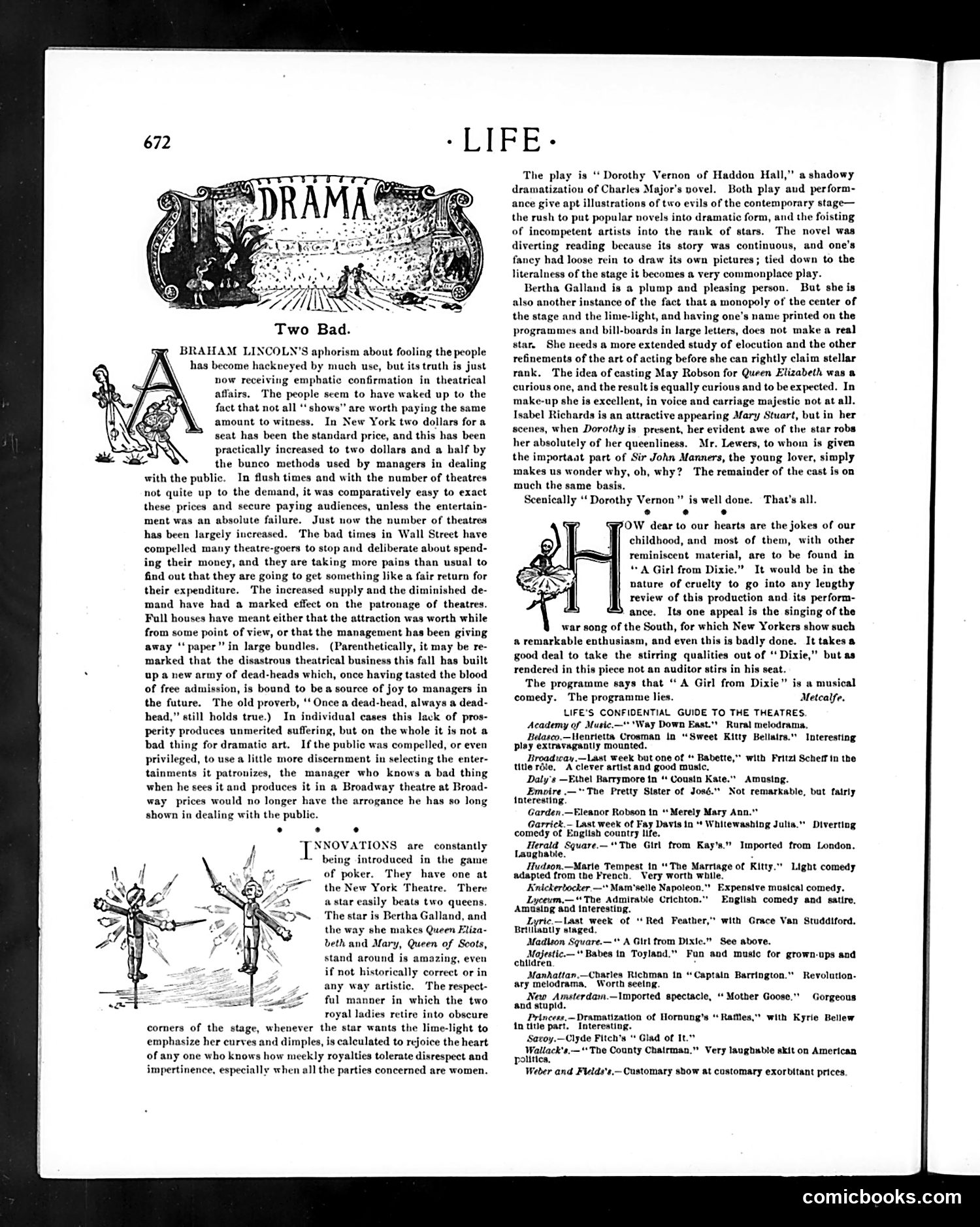
This page critiques theatrical productions and casting decisions of the era. The main text discusses "Dorothy Vernon of Haddon Hall," a dramatization of a Charles Major novel, criticizing how incompetent artists are being cast as stars through popular demand rather than merit. The cartoon labeled "Two Bad" (top left) appears to show two figures in theatrical poses, likely satirizing poorly-trained actors or bad performances. The page includes discussion of Bertha Galland and other actresses, noting casting problems—particularly criticizing May Robson's casting as "Queen Elizabeth" and Isabel Richards' acting abilities. The text argues that theatrical standards have declined due to economic pressures and increased ticket prices, forcing theatres to cast inadequately-trained performers to fill seats and satisfy audiences' demands for celebrity names over talent.
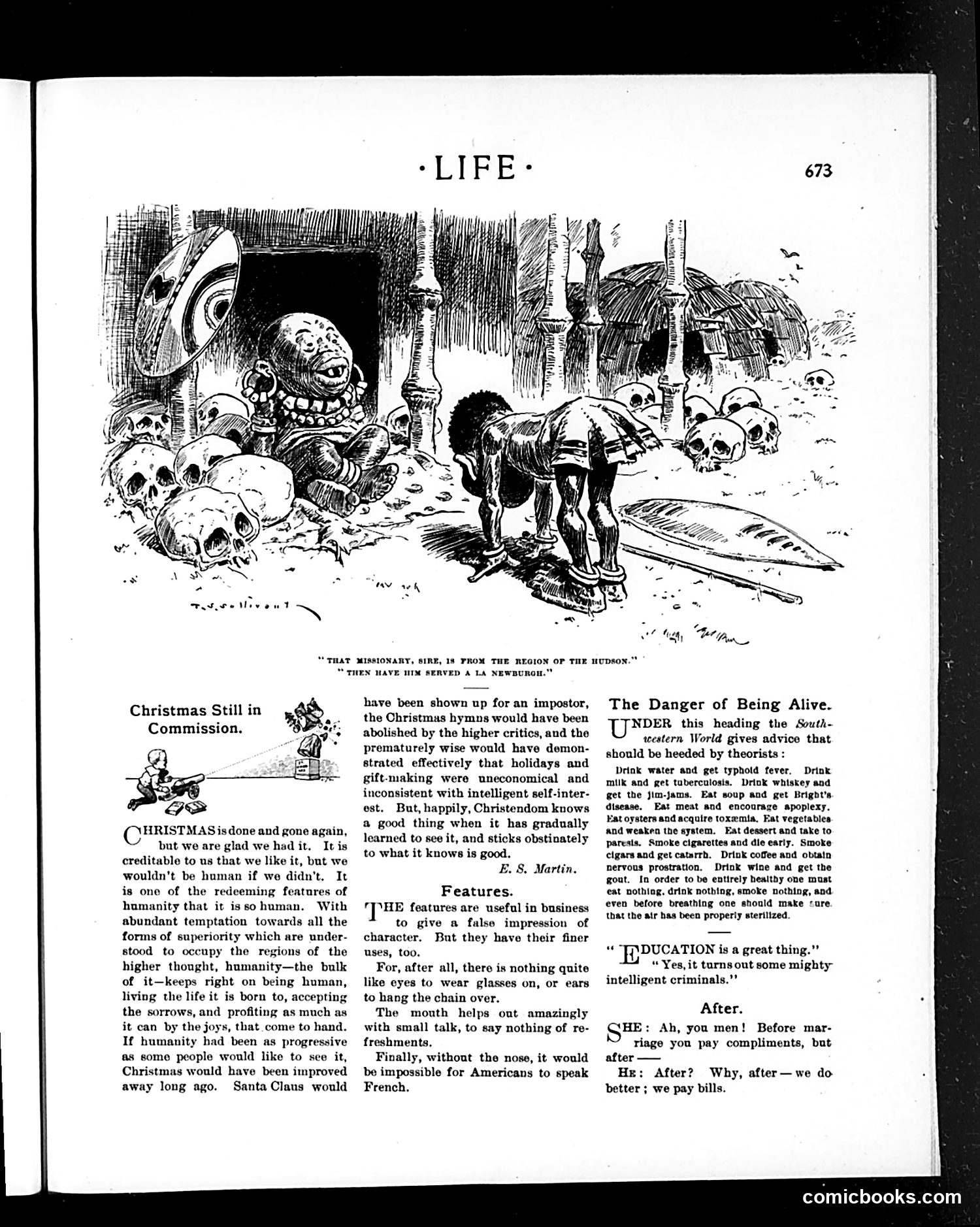
**The main cartoon** depicts a colonial-era scene where a missionary from the Hudson region is served "à la Newburg" (a luxurious seafood dish)—a dark joke suggesting cannibalism of missionaries by indigenous peoples. This reflects period attitudes toward colonial encounters and "savages." **The text pieces** are satirical vignettes on contemporary American life: - **"Christmas Still in Commission"** defends maintaining Christmas traditions against progressive critics who viewed holidays as economically wasteful. - **"Features"** makes light observations about facial features and their social uses—eyes for glasses, mouths for eating and talking, noses for pronouncing French. - **"The Danger of Being Alive"** is sardonic advice listing how virtually every food and drink causes illness, mocking health-conscious theorists of the era. - **"Education" and "After"** are brief jokes: one about education producing criminals; the other about how men's courtship compliments become bill-paying after marriage. The page reflects early-20th-century American satirical humor targeting social conventions, health fads, and marital dynamics.
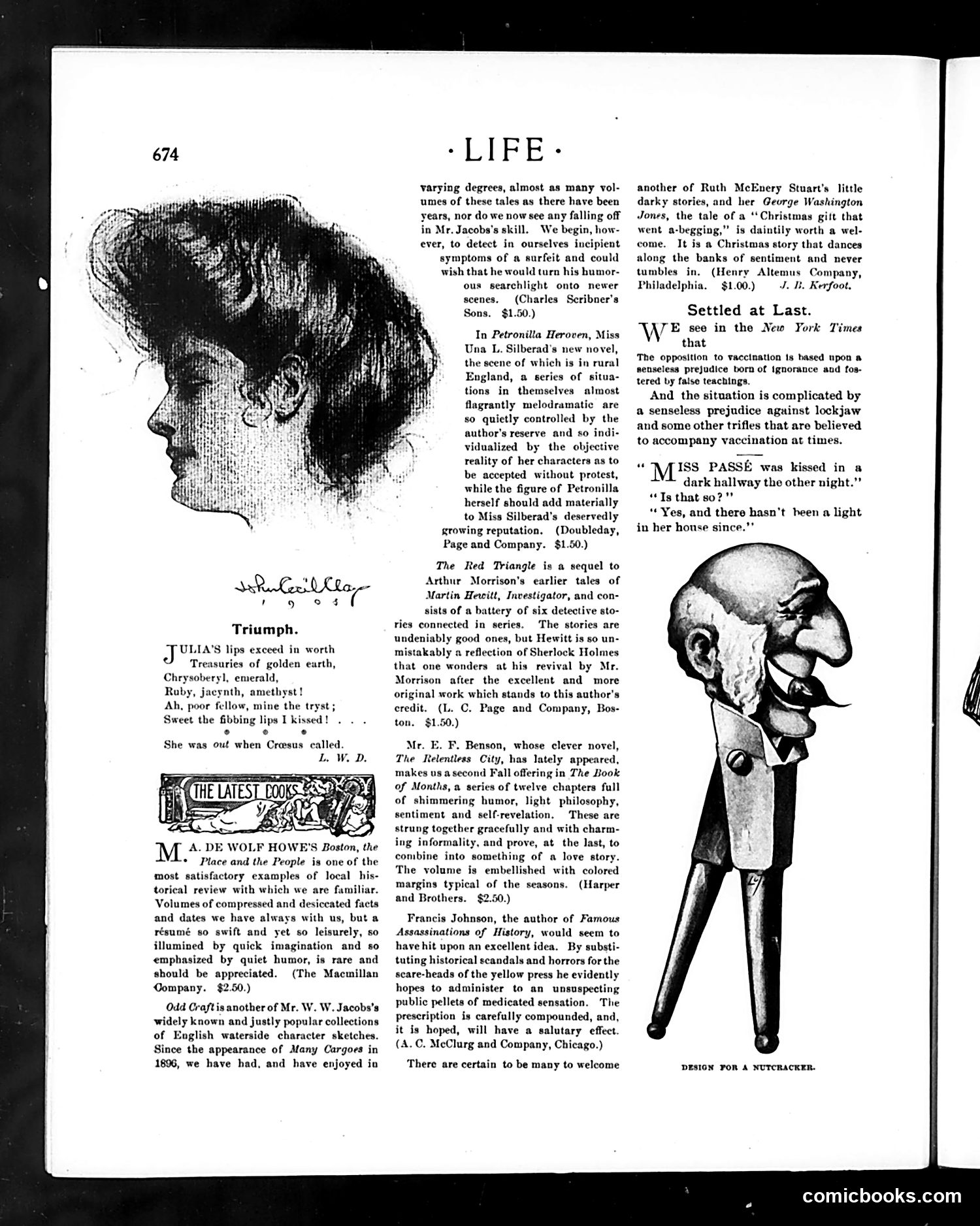
This page contains book reviews and a short humorous poem titled "Triumph," not political cartoons. The illustrated portraits on the page are decorative elements accompanying the reviews—a profile sketch at top left and a skeletal figure labeled "DESIGN FOR A NUTCRACKER" at right. The poem "Triumph" uses classical allusions (references to Cressus, the wealthy king) to joke about romantic competition: a man brags about kissing a woman with lips "exceed in worth / Treasuries of golden earth," but the punchline reveals she was actually visiting someone else (Cressus) when he called—his romantic "victory" is hollow. The main content reviews contemporary books on local history, detective fiction, and short stories. A brief note at page's bottom addresses vaccination opposition, calling it based on "senseless prejudice born of ignorance"—reflecting turn-of-century public health debates.
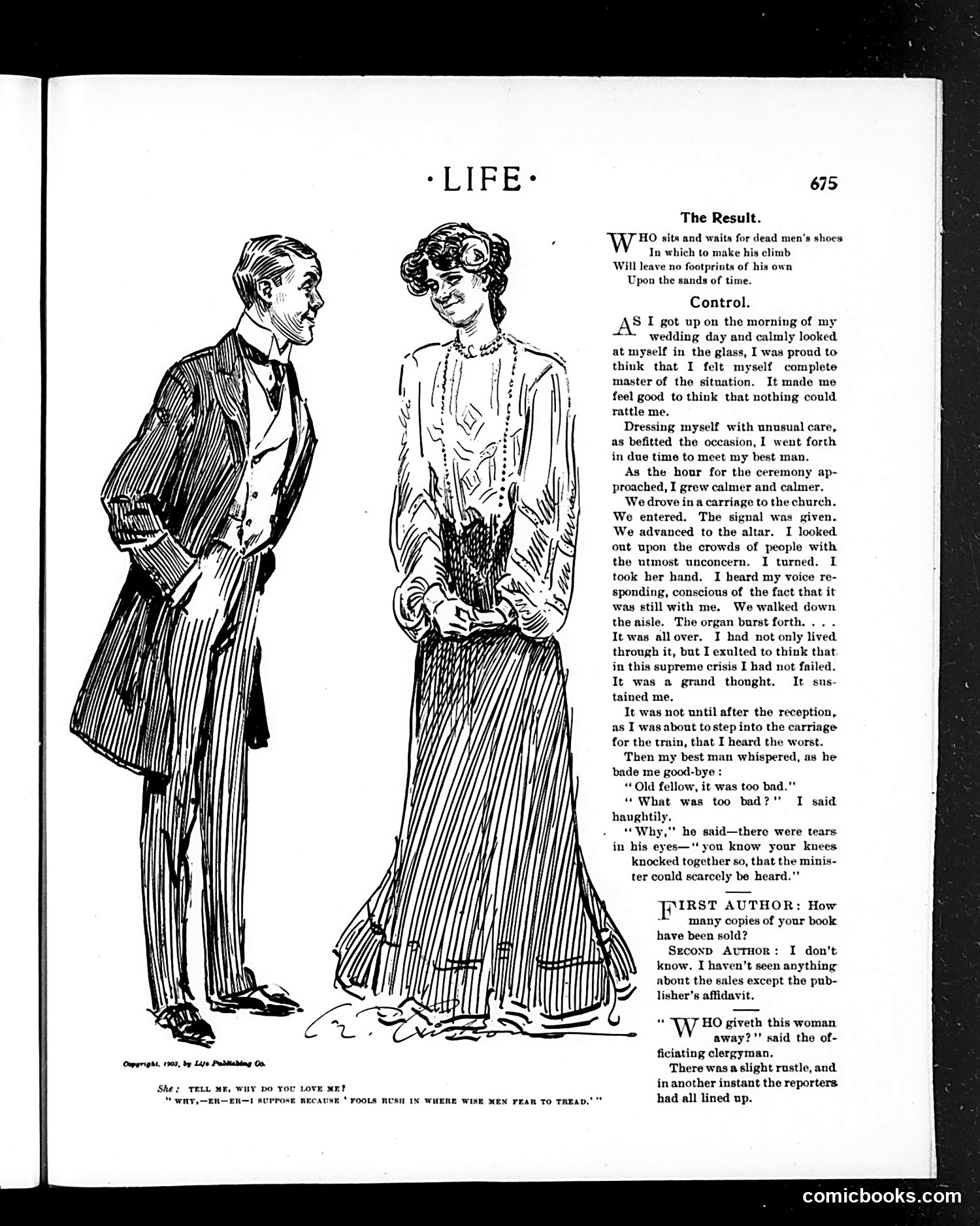
This page from Life (1903) contains three satirical pieces mocking male anxieties and pretense: **Main Illustration & Caption**: A couple at their wedding, with a verse about leaving no legacy. The accompanying story "Control" is ironic satire—a groom boasts about maintaining composure throughout his wedding, only to learn from his best man that his knees were visibly shaking so badly the minister could barely hear the vows. The joke: his imagined mastery was entirely illusory. **Lower Section**: A brief comic exchange between two authors about book sales, where the second admits he knows nothing except what the publisher's legal affidavit states—satirizing either authorial ignorance or publishers' opaque accounting. **Bottom Cartoon**: A clergyman asking "who giveth this woman away?" prompts reporters to rush in—mocking sensationalist journalism's invasion of private moments and the era's obsession with celebrity weddings. The overall theme: exposing the gap between male self-perception and reality, and media intrusion into personal life.
This page satirizes the phenomenon of wealthy American heiresses marrying British aristocrats. The main poem mocks a London *Truth* magazine proposal to impose tariffs on American matrimonial "imports." **The satire's point:** British newspapers fretted that American heiresses—bringing substantial dowries—were "invading" England and marrying impoverished English noblemen. The joke presents this as an absurd trade problem: should these women be taxed as "goods" or on their monetary value? The poem argues the situation is ridiculous—love transcends class and national boundaries, yet Britain treats wealthy American women as economic commodities. The closing point: no tariff will stop this "invasion" because both parties benefit. **Context for modern readers:** This reflects real Gilded Age patterns where cash-rich American families married daughters into titled but financially-struggling European families, gaining prestige while shoring up aristocratic finances. The secondary items on the page (newspaper anecdotes, book reviews) are unrelated filler typical of *Life's* miscellaneous content.
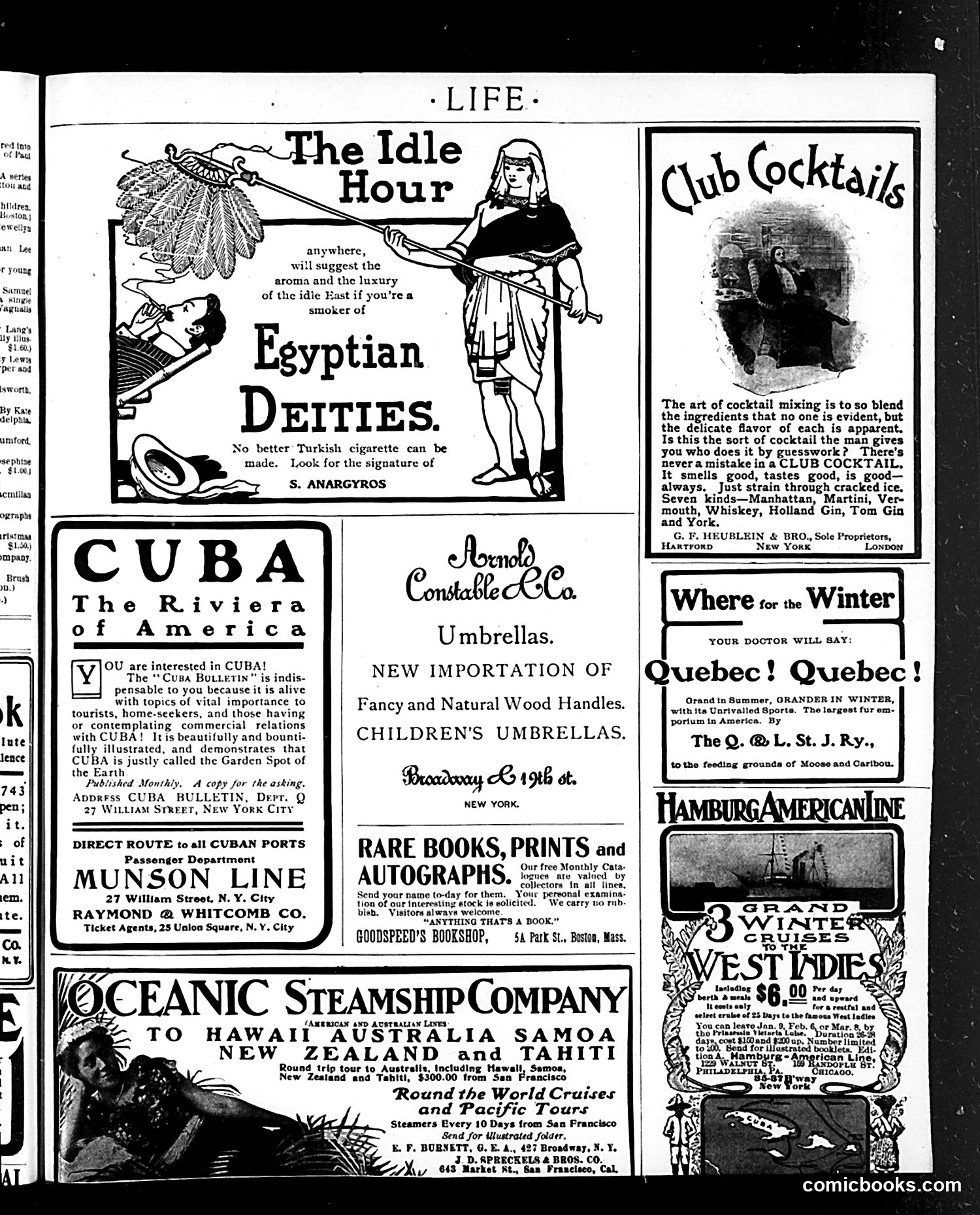
This is primarily an **advertising page** from Life magazine, likely from the early 1900s. The page contains multiple travel and consumer product advertisements rather than editorial cartoons requiring political interpretation. The notable visual element is **"The Idle Hour"** advertisement at top-left, depicting an Egyptian-style figure with a fan and a reclining man. It advertises Egyptian Deities cigarettes, playing on early-20th-century Orientalism—the fashionable Western fascination with exotic "Eastern" imagery. The ad promises customers the "aroma and luxury of the idle East," appealing to aspirational leisure culture. Other ads promote travel (Cuba, Hawaii, Australia, Quebec), luxury goods (umbrellas, cocktails), and services (bookshop, steamship lines). The "Club Cocktails" advertisement emphasizes precision and reliability—suggesting cocktail culture was becoming standardized and commercialized. The page reflects the commercial interests and consumer aspirations of wealthy Americans during this era rather than political satire.
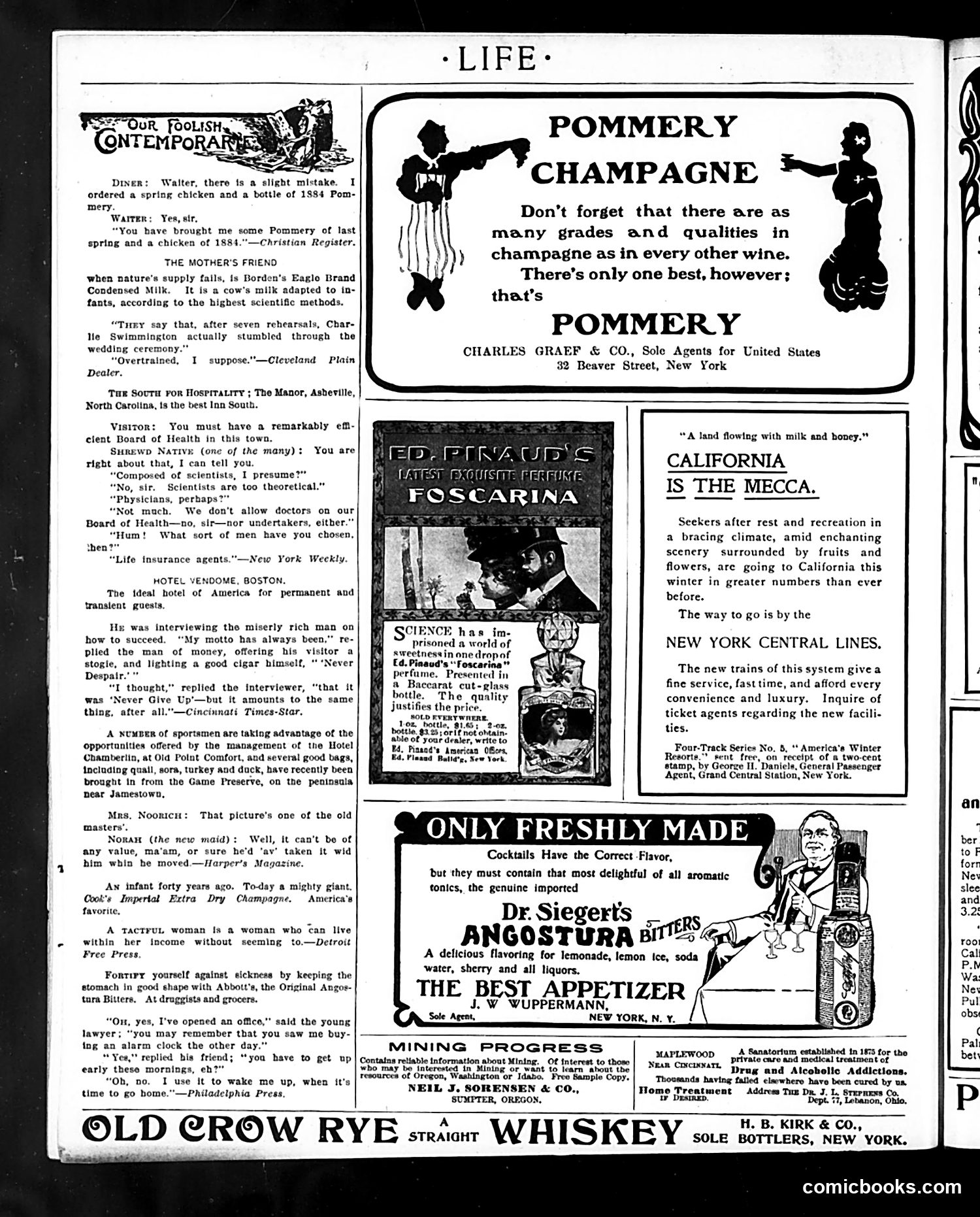
This page from *Life* magazine is primarily **advertising**, featuring multiple product endorsements interspersed with brief humorous anecdotes. The "Our Foolish Contemporary" section contains short jokes mocking social pretension and absurdity. One notable item satirizes a Southern town's "Board of Health" — revealed to consist entirely of life insurance agents rather than scientists or doctors, suggesting corrupt or misguided civic management. The major advertisements promote **champagne, whiskey, bitters, and other alcoholic beverages** — products heavily marketed in this era. A Pommery Champagne ad emphasizes brand prestige. Dr. Siegert's Angostura Bitters advertisement claims superiority for cocktails. Other ads promote travel (New York Central Lines to California), hotels (Boston's Hotel Vendome), and condensed milk (Borden's Eagle Brand). The page reflects **turn-of-the-century American consumer culture**, where *Life* monetized its readership through luxury product marketing alongside satirical commentary on contemporary manners and society. The overall tone is lighthearted social observation rather than hard-hitting political satire.
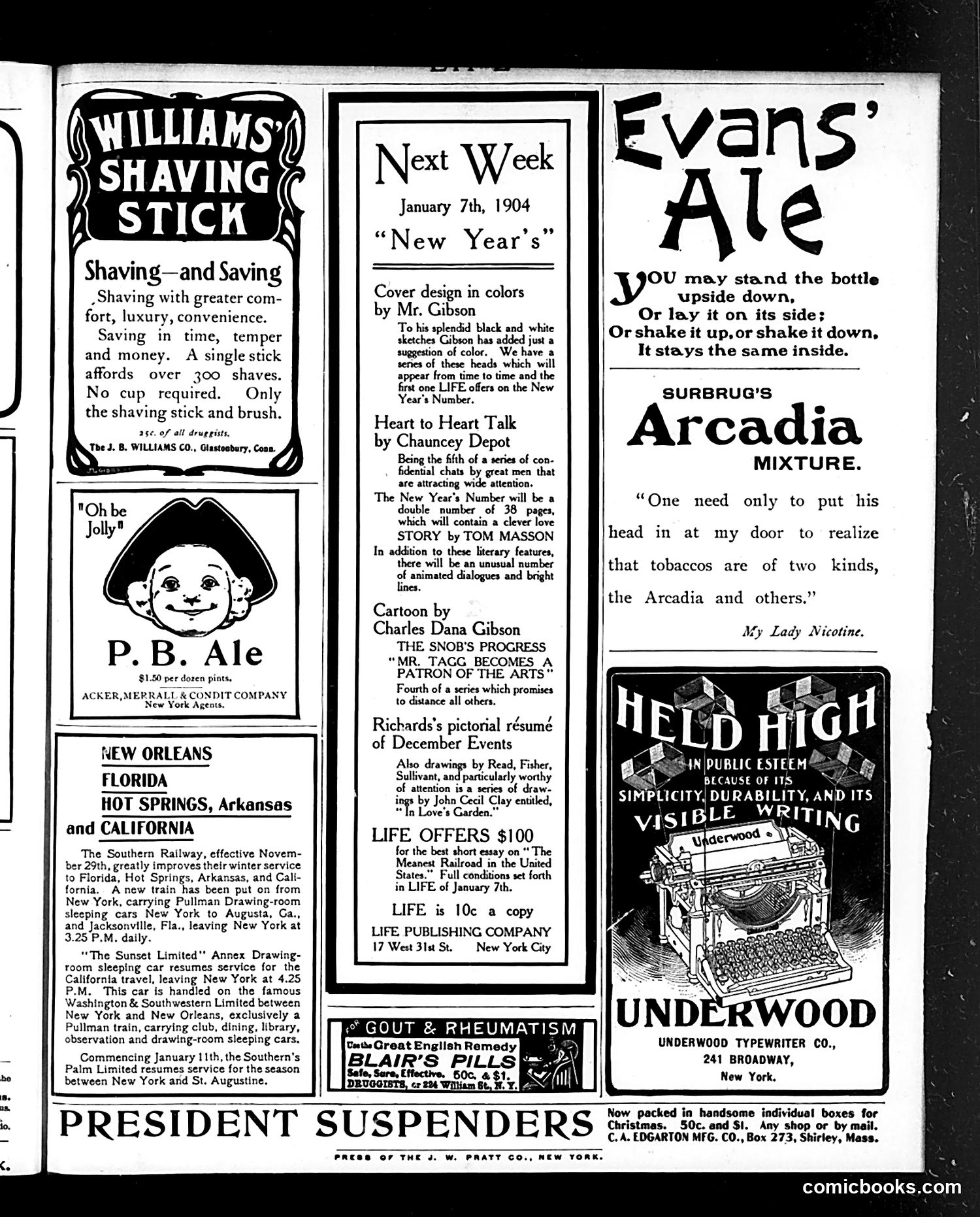
This page is primarily **advertising**, with some editorial content promoting the upcoming January 7th issue. The main editorial feature mentions Charles Dana Gibson's cartoon series "The Snob's Progress: Mr. Tagg Becomes a Patron of the Arts"—likely satirizing wealthy nouveaux riches who adopt cultural pretensions without genuine appreciation. The advertisements reflect early 1900s consumer goods: Williams Shaving Stick, P.B. Ale, Evans' Ale, Surbrug's Arcadia tobacco mixture, Underwood typewriters, and President Suspenders. A Southern Railway ad promotes winter travel to warm destinations (Florida, California), indicating this was a seasonal luxury market. One ad humorously claims Evans' Ale "stays the same inside" regardless of bottle position—a tongue-in-cheek quality guarantee. The typewriter ad emphasizes "visible writing," a major selling point for early machines. The page reflects turn-of-the-century American consumer culture and leisure travel for the affluent.
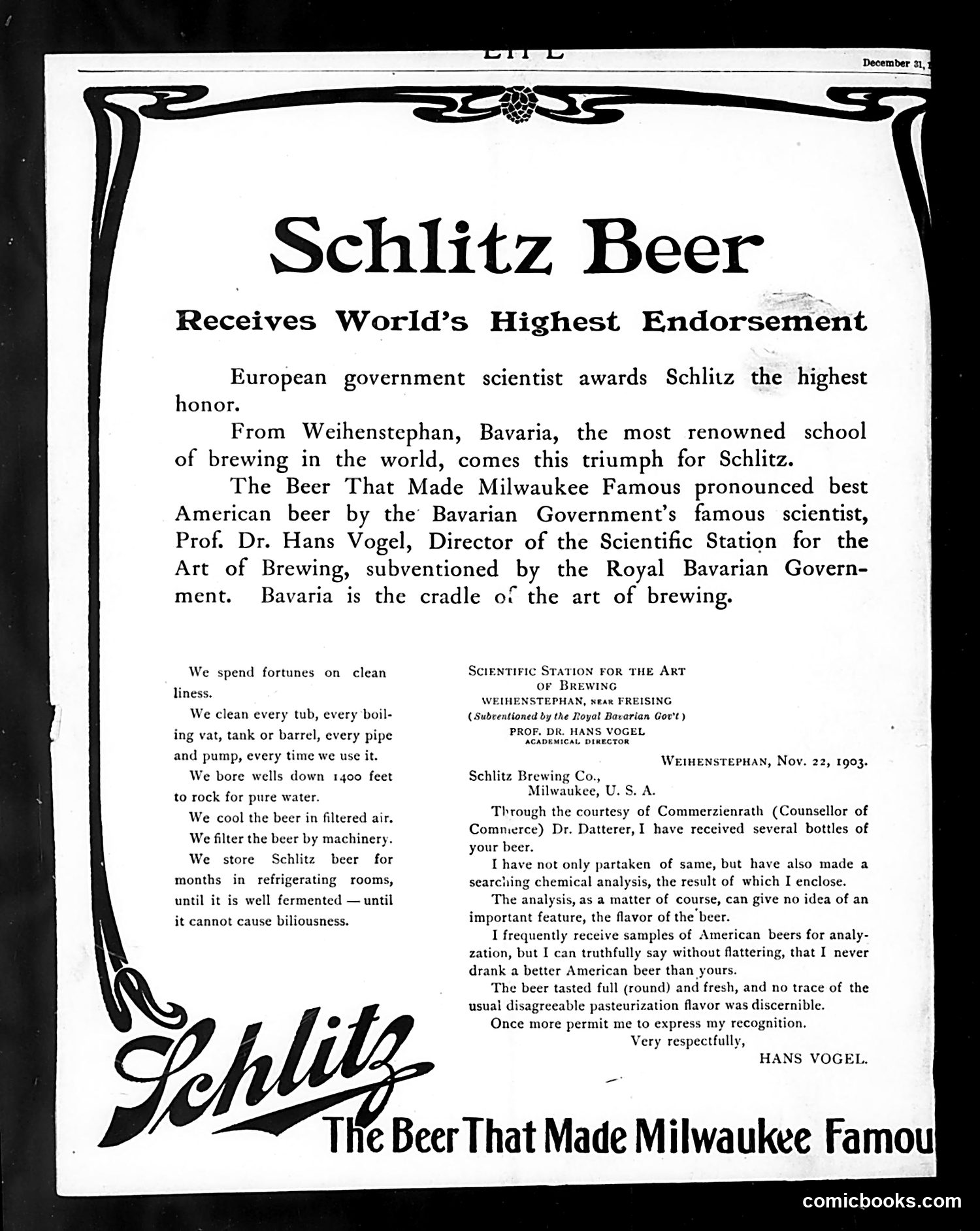
This is a **beer advertisement**, not a cartoon or satire. It presents a testimonial letter from Prof. Dr. Hans Vogel, a Bavarian brewing scientist, endorsing Schlitz as the finest American beer he's ever tasted. The appeal is to **Old World authority and purity standards**. By 1903, German/Bavarian beer was considered the gold standard globally. Schlitz leverages this by securing praise from an official German government scientist at a prestigious brewing academy, claiming legitimacy through European expertise rather than American marketing alone. The ad emphasizes **scientific cleanliness and rigorous production methods**—deep wells for pure water, filtered air cooling, extended fermentation—addressing contemporary concerns about contamination and pasteurization flavor (considered inferior to European lager methods). The tagline "The Beer That Made Milwaukee Famous" reflects Milwaukee's real identity as an American beer hub, here validated by European authority.
I can see this is a very dark image, mostly black with minimal visible content. There appear to be some small white marks or text fragments visible—including what looks like a date reference "ember 31" at the top left and the watermark "comicbooks.com" at the bottom right—but the main content is not legible enough for me to identify specific cartoons, figures, or satirical references with confidence. Without being able to read the text or see the illustrations clearly, I cannot accurately explain what political or social commentary this page contains. To provide a reliable analysis of the satire and historical context, I would need a clearer image where the cartoon artwork and OCR text are both readable.